60 AI content marketing statistics for 2026. ROI, adoption, conversion, budgets, search impact. Every stat sourced and dated. Updated May 2026.
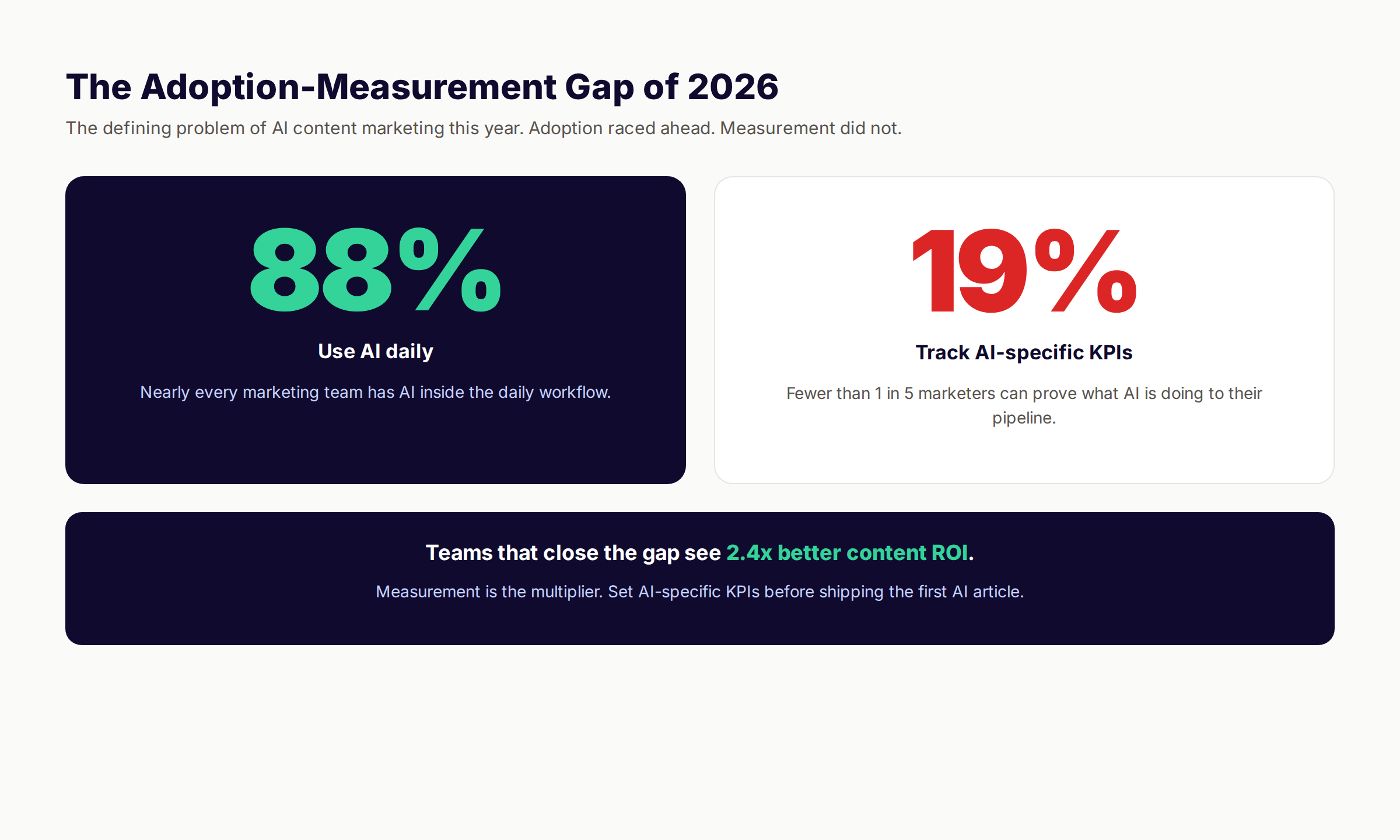
88% of digital marketers now use AI daily, yet only 19% track AI-specific KPIs. That adoption-measurement gap defines the 2026 marketing year. Teams are betting big, but few can prove the bet is working. The 60 statistics below cover adoption, budget share, ROI, conversion, and search impact, each with its source and date.
Most AI content marketing decisions are still being made on gut feeling. "We should publish more." "AI will replace our writers." "AI Overviews will kill SEO." The numbers tell a different story. The teams winning with AI content marketing in 2026 are not the ones publishing the most. They are the ones who paired AI velocity with editorial rigor and started tracking the right KPIs.
These 60 ai content marketing statistics answer the questions every CMO is being asked this quarter. We pulled data from Adobe, HubSpot, Content Marketing Institute, Salesforce, McKinsey, Gartner, Semrush, Ahrefs, Typeface, and 25 other sources. Every statistic is sourced, dated, and grouped by category.
We publish 3,500+ blogs across 70+ industries and watch this data move every month. Here is what marketing leaders need to know in 2026.
For production-side numbers (volume, detection, search rankings), see our companion post on AI content statistics. For broader content benchmarks, see the content marketing statistics report.
Here is what you will learn:
- Marketer AI adoption rates (8 stats)
- AI content ROI and revenue lift (9 stats)
- AI lead generation and conversion (7 stats)
- Time, cost, and content velocity (8 stats)
- AI marketing budgets and spend (7 stats)
- AI search, SEO, and visibility (8 stats)
- Personalization and channel performance (6 stats)
- Attribution, measurement, and quality (7 stats)
- FAQ
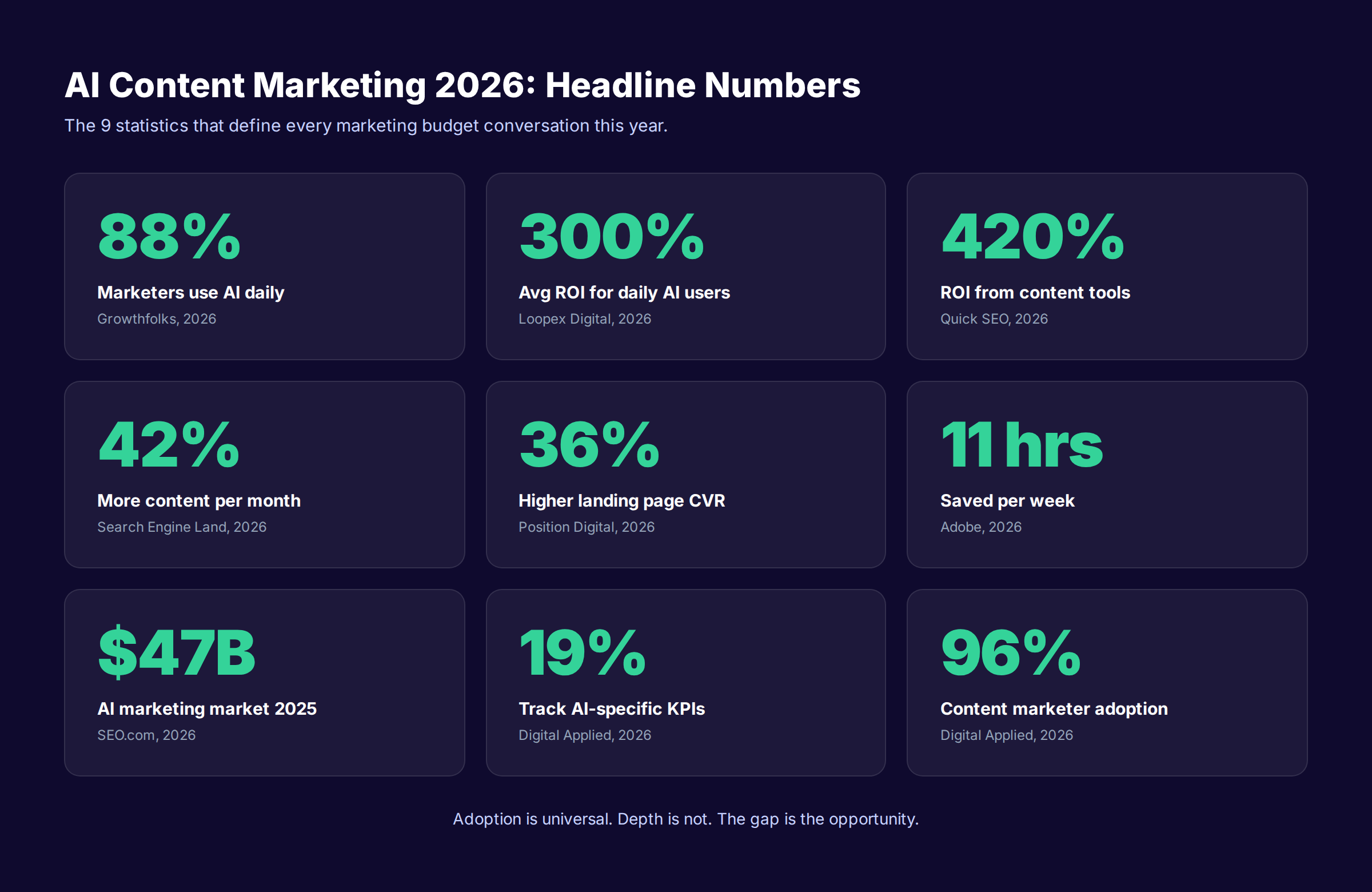
Marketer AI Adoption
1. 88% of digital marketers use AI in their day-to-day tasks. Up from 73% in 2025. (Source: Growthfolks, 2026)
2. 95% of B2B marketers say their organizations now use AI applications. Only 5% report no AI deployment at all. (Source: Content Marketing Institute, 2026)
3. 67% of content marketers use AI tools daily. Daily use, not occasional use. (Source: Digital Applied, 2026)
4. Content marketers have the highest AI adoption of any marketing role at 96%. SEO specialists follow at 93%. Demand generation sits at 89%. Brand marketers trail at 79%. (Source: Digital Applied, 2026)
5. 87% of marketers use generative AI in at least one workflow. Up from 51% in 2024. (Source: Adobe, 2026)
6. 94% of marketers plan to use AI for content creation in 2026. Plans match reality for the first time. (Source: Typeface, 2026)
7. 92% of businesses plan to invest in generative AI within the next 3 years. Investment intent is nearly universal. (Source: McKinsey, 2026)
8. 85.1% of AI users deploy it for blog content generation. Content creation leads every other AI use case in marketing. (Source: Averi, 2026)
Adoption peaked. The next race is depth. The story under these numbers is that AI is no longer a vendor pitch or a side experiment. It sits inside the daily workflow of nearly every marketing team in the data sets. The pivot point for 2026 is not whether marketers use AI. It is whether they use it deeply enough to move pipeline numbers. For a strategic view of where deployment is heading, see our breakdown of the state of AI marketing in 2026 and the data on AI vs human content performance.
AI Content ROI and Revenue Lift
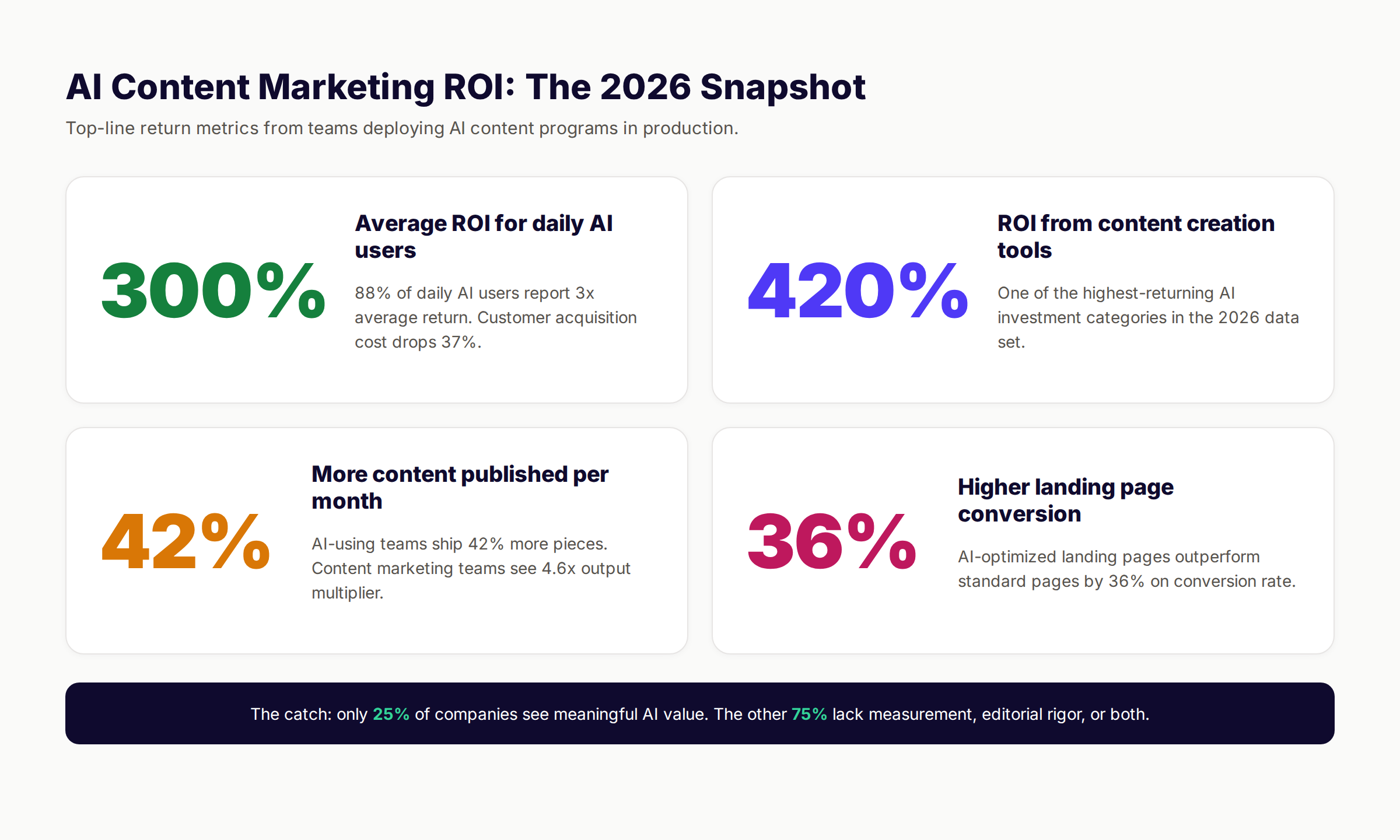
9. 88% of marketers using AI daily report average ROI of 300%. Customer acquisition costs drop 37%. (Source: Loopex Digital, 2026)
10. Content creation tools deliver 420% ROI on average. One of the highest returning AI investment categories. (Source: Quick SEO, 2026)
11. Businesses using AI-driven marketing report 20 to 30% higher ROI. Compared to traditional approaches with no AI. (Source: Adobe, 2026)
12. 68% of businesses report increased content marketing ROI thanks to AI. (Source: Typeface, 2026)
13. AI-driven campaigns deliver 22% higher ROI, 32% more conversions, and 29% lower acquisition costs. Compared to traditional campaign management. (Source: Quick SEO, 2026)
14. 81% of marketers report AI boosted brand awareness and sales. Up from 64% in 2025. (Source: CoSchedule, 2026)
15. AI-driven personalization shows a 35% lift in purchase frequency and 21% boost in average order value. (Source: Adobe, 2026)
16. Organizations that track AI-specific KPIs see 2.4x better content ROI than those that do not. Measurement is the multiplier. (Source: Quick SEO, 2026)
17. 65% of marketers say AI tools improved their SEO performance. Up from 41% in 2024. (Source: Semrush, 2026)
ROI is real. The gains concentrate in teams that deploy AI deeply. The data reveals a 2-tier market. The top tier is the 25% of companies reporting meaningful AI value, the 88% of daily users earning 300% ROI, and the teams pulling 32% conversion lifts. The bottom tier is the 42% of companies who abandoned generative AI initiatives in the last year. The difference is not the model they use. It is the workflow around the model. Editorial standards, brief quality, prompt libraries, and human review at the right moments separate winners from abandoners. Read our analysis of how to measure content marketing ROI for the framework.
Stop writing. Start ranking. theStacc publishes 30 SEO-optimized articles per month for $99. No writers. No revision cycles. Every post is human-reviewed.
AI Lead Generation and Conversion
18. AI-optimized landing pages generate 36% higher conversion rates. Versus standard landing pages without AI. (Source: Position Digital, 2026)
19. AI content with human editing reduced bounce rates by 73%. Pure unedited AI alone showed no improvement. The human edit is the lift. (Source: Digital Applied, 2026)
20. AI-assisted blog writing increased organic traffic by 120% within 6 months. Across surveyed sites that paired AI with human review. (Source: SEO.com, 2026)
21. ChatGPT referrals convert at 15.9% versus 0.7% for traditional Google clicks. AI search traffic is 22 times more likely to convert. (Source: Loopex Digital, 2026)
22. AI delivers 41% more email revenue and 47% higher ad CTR for marketing teams. Plus 34% more consistent content scheduling. (Source: All About AI, 2026)
23. 60% of B2B buyers make final purchase decisions based on digital content. AI is shaping the content those buyers consume at every stage. (Source: Demand Sage, 2026)
24. 73% of marketers use AI to create personalized customer experiences. Personalization is the single highest-impact AI use case. (Source: SurveyMonkey, 2026)
The conversion gap between AI traffic and traditional organic traffic is the most undertold story of 2026. A 15.9% conversion rate from ChatGPT referrals dwarfs the 0.7% rate Google clicks deliver. The reason is intent. Users who arrive after a multi-turn AI conversation arrive pre-qualified. They already know your category, your brand name, and what you do. They click to verify, not to discover. Marketing teams that figure out how to be the named brand in those AI conversations capture the highest-converting traffic the web has ever produced. To capture it, see our guide on AEO vs SEO and the AI search statistics report.
Time, Cost, and Content Velocity
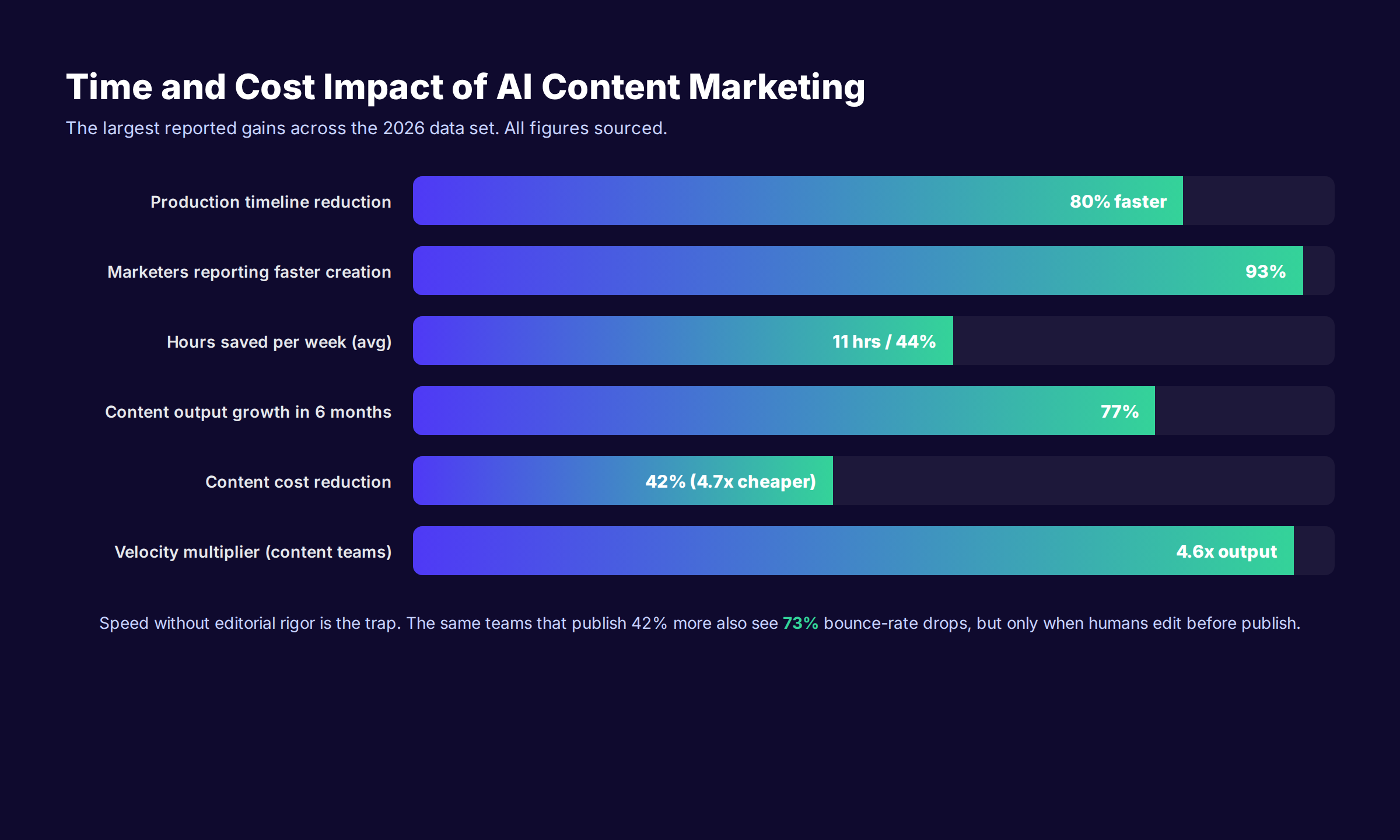
25. AI reduces content production timelines by 80%. What took 5 days now takes 1. (Source: Loopex Digital, 2026)
26. Marketers save 11 hours per week using AI tools. That is 44% more productive on a 25-hour content week. (Source: Adobe, 2026)
27. Companies using AI publish 42% more content each month. Velocity is the most visible KPI shift. (Source: Search Engine Land via DigitalApplied, 2026)
28. 93% of marketers report creating content faster with AI. Speed gains are nearly universal among adopters. (Source: CoSchedule, 2026)
29. Production cost reduction averages 42% across formats. Long-form articles, video scripts, social posts, and email all see similar savings. (Source: Adobe, 2026)
30. Teams that adopted AI content tools produce 4.1x more published content per marketer per month. Content marketing shows the highest multiplier at 4.6x. (Source: Averi, 2026)
31. Content output volume increases 77% within 6 months of AI implementation. The velocity ramp is faster than most teams expect. (Source: Adobe, 2026)
32. AI-produced content costs up to 4.7 times less than human-only content. A $1,500 article becomes a $320 article at scale. (Source: Loopex Digital, 2026)
For a deeper look at velocity strategies, see our guide on how to scale blog content with AI. The velocity numbers also reveal a trap. Publishing 42% more content does not produce 42% more pipeline if quality drops. The 73% bounce-rate reduction from human-edited AI content is the offsetting evidence. Teams that scale velocity without scaling editorial rigor see traffic gains evaporate within 90 days as Google detects scaled content abuse and AI Overviews pass them over for higher-quality competitors.
AI Marketing Budgets and Spend
33. 87% of marketing leaders plan to increase content marketing budgets in 2026. Up from 54.5% in 2025. (Source: The Digital Elevator, 2026)
34. 45% of B2B marketers say AI marketing tools are their #1 budget priority. Ahead of events at 38% and paid search at 35%. (Source: Typeface, 2026)
35. 98% of marketers plan higher AI SEO spend in 2026. AI search optimization is the fastest-growing budget line. (Source: Typeface, 2026)
36. The AI in marketing market is valued at $47.32 billion in 2025. Projected to reach $107.5 billion by 2028, a CAGR of 36.6%. (Source: SEO.com, 2026)
37. 86% of B2B marketers plan to increase research and original-data budgets. Original research drives 64% higher conversion. (Source: Content Marketing Institute, 2026)
38. 75% of B2B marketers are growing creator and influencer partnership budgets by 61% on average. AI does not replace humans. It funds them differently. (Source: Typeface, 2026)
39. 75% of US marketers say AI saves organizational costs. Cost savings is the most consistent reported AI benefit. (Source: Adobe, 2026)
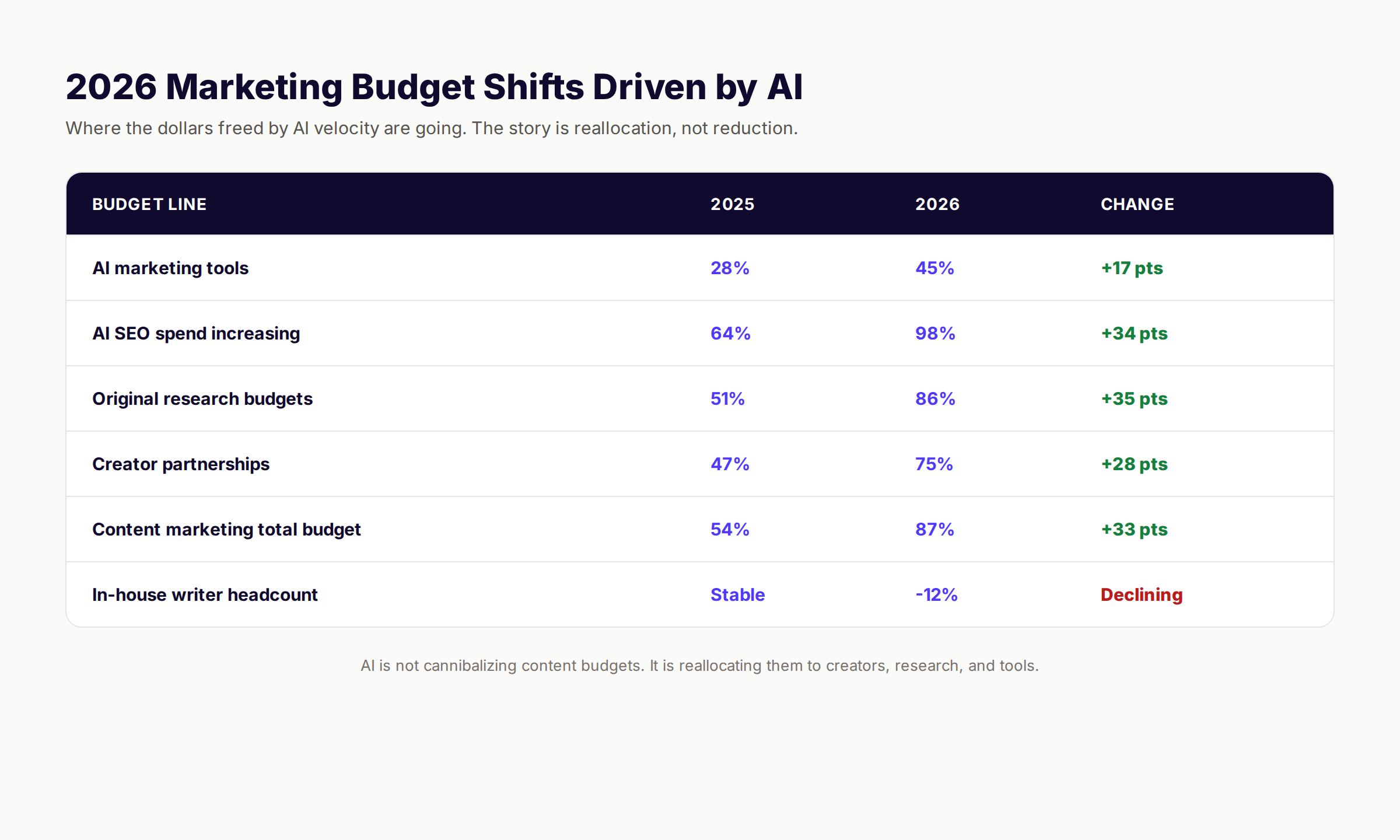
The budget data tells a clear story. AI is not cannibalizing content spend. It is reallocating it. The dollars freed by 80% timeline reductions are not going back to the CFO. They are funding creator partnerships (up 61%), original research (86% of marketers increasing), and AI tool stacks (45% of B2B priority). The marketing budget of 2026 looks less like a content team and more like a publishing operation: smaller in-house production headcount, larger investment in named voices, proprietary data, and automation that ties it all together.
| Budget Line | 2025 | 2026 | Change |
|---|---|---|---|
| AI marketing tools | 28% | 45% | +17 pts |
| AI SEO spend | 64% increasing | 98% increasing | +34 pts |
| Original research | 51% | 86% | +35 pts |
| Creator partnerships | 47% | 75% | +28 pts |
| In-house writer headcount | Stable | -12% | Declining |
Stop hiring writers. Start ranking pages. theStacc publishes 30 SEO articles per month for $99. Every post is researched, written, and optimized for you.
AI Search, SEO, and Visibility
40. 74.2% of new web pages contain AI-generated content in some form. Pure AI content remains rare at 2.5% of pages. (Source: Ahrefs, 2026)
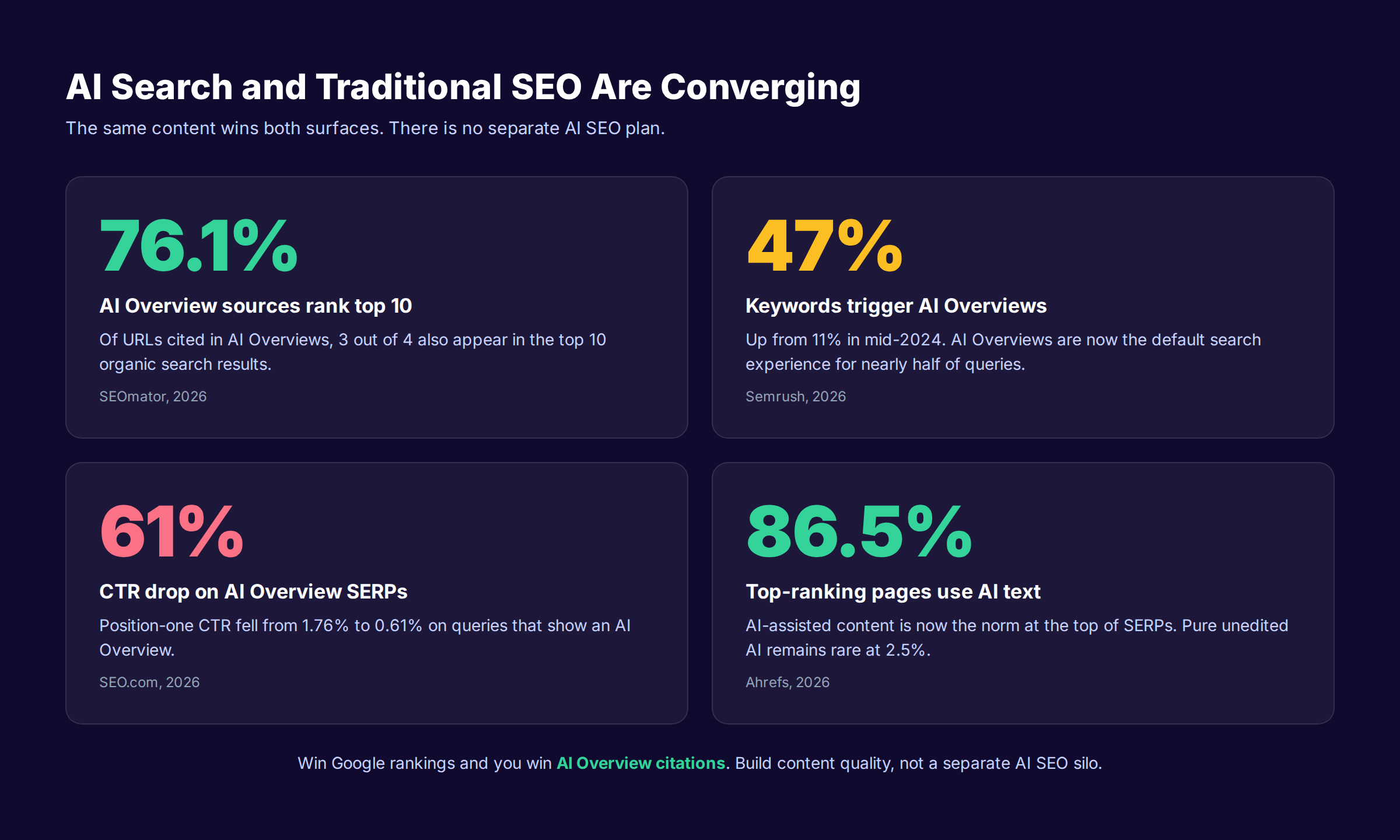
41. 86.5% of top-ranking pages contain some amount of AI-generated text. AI assistance is now the norm at the top of SERPs. (Source: Ahrefs, 2026)
42. AI-written pages now appear in over 17% of top search results. Up from 4% in 2024. (Source: SEOmator, 2026)
43. 76.1% of URLs cited in AI Overviews also rank in the top 10 of Google search results. Traditional SEO and AI search are not separate races. (Source: SEOmator, 2026)
44. Organic CTR for queries with AI Overviews fell 61%. Position-one click-through dropped from 1.76% to 0.61%. (Source: SEO.com, 2026)
45. 47% of keywords now trigger AI Overviews. Up from 11% in mid-2024. (Source: Semrush, 2026)
46. 44% of consumers call AI their primary search source. Up from 18% in 2024. (Source: Quick SEO, 2026)
47. Almost 70% of businesses report higher ROI from using AI in SEO. Nearly 7 in 10 see better returns after AI integration. (Source: Semrush, 2026)
The search data tells a single story. AI search and traditional SEO are converging, not splitting. The same pages that win Google rankings also win AI Overview citations. 76.1% of AI Overview sources rank in the top 10. For marketers, this collapses the strategy. There is no separate "AI SEO" plan. There is one content plan that wins both. The teams losing in 2026 are the ones who built a "GEO" or "AEO" silo without fixing the underlying topical authority and content quality. For a working framework, see our guide on how to get cited in AI search and the optimize for AI Overviews playbook.
Personalization and Channel Performance
48. 75% of consumers are more likely to buy from brands delivering personalized content. AI is the engine making that personalization affordable. (Source: IE Business School, 2026)
49. 48% of marketing leaders practicing AI personalization exceed revenue goals. Personalization beats every other AI use case for direct revenue. (Source: IE Business School, 2026)
50. 92% of marketers plan to optimize content for both traditional and AI search engines. Dual-channel SEO is the new baseline. (Source: HubSpot, 2026)
51. 56% of marketers use AI to create short-form videos. 53% use it to generate images. 42% use it for long-form video. (Source: HubSpot, 2026)
52. 49% of marketers use AI for email marketing and newsletters. Email remains the highest ROI channel and the most popular text-based AI use case after blogs. (Source: Averi, 2026)
53. 78% of consumers are more likely to engage with personalized AI content. Hyper-personalization moves engagement, not just opens. (Source: Rank Authority, 2026)
The personalization data deserves a closer look. A 48% revenue-goal-exceedance rate among AI personalization practitioners is the highest in any segment of the 2026 marketing data set. Personalization beats every other AI use case for direct revenue impact. The teams that build it usually start with email (highest ROI channel), then expand to on-site content (dynamic blog recommendations and landing page swaps), and finally to ad creative (47% higher CTR per All About AI). For a starter framework, see our content distribution strategy guide.
Attribution, Measurement, and Quality
54. Only 19% of content marketers track AI-specific KPIs. The adoption-measurement gap is the defining problem of 2026. (Source: Digital Applied, 2026)
55. 83% of marketing leaders prioritize ROI demonstration, but only 36% can accurately measure it. Attribution lags adoption by years. (Source: Quick SEO, 2026)
56. Only 25% of companies report seeing significant value from AI. Despite 88% adoption. (Source: Averi, 2026)
57. 42% of companies abandoned most of their generative AI initiatives. Up from 17% in 2024. Implementation is harder than the demo. (Source: Averi, 2026)
58. 18% of tech marketers say AI-assisted creation has decreased the quality of their content. Most see lift. A meaningful minority sees harm. (Source: Content Marketing Institute, 2026)
59. 58% of marketers believe AI has improved content quality. Only 4% consider AI-generated content highly trustworthy without human oversight. (Source: Quick SEO, 2026)
60. 90% of businesses are worried about the future of SEO due to AI and LLMs. Concern is widespread even among AI adopters. (Source: Digital Marketing Institute, 2026)
For a framework on closing the measurement gap, see our guide on AI content strategy. The 42% abandonment rate is the most underweighted statistic in the 2026 data. It means nearly half of generative AI projects in marketing are quietly failing. Failure modes are predictable: launching without a measurement plan, treating AI as a replacement for editorial rigor instead of a multiplier of it, and shipping raw model output to production. The 4% trust figure for unedited AI content explains why. Marketers who avoid abandonment are usually the ones who set AI-specific KPIs (organic traffic per article, time to draft, cost per published piece, conversion rate by content origin) before they ship the first AI article.
How to Use These AI Content Marketing Statistics
Statistics are useful when they change a decision. Otherwise they are trivia. Here is how the 60 stats above map to the 4 decisions every content marketing leader is making in 2026.
Decision 1: Should we invest more in AI content tools?
The answer for almost every team is yes, but the right investment is rarely another generative model. The data points say that content creation tools deliver 420% ROI on average. Tools that pair AI generation with workflow infrastructure (briefing, editing, scheduling, distribution) consistently outperform standalone writing assistants. The 42% abandonment rate concentrates in teams that bought a generative tool without a workflow plan.
Use these stats to justify the budget line:
- ✓ 87% of marketing leaders are increasing content budgets in 2026
- ✓ 45% of B2B marketers rank AI tools as their #1 budget priority
- ✓ 98% of marketers plan higher AI SEO spend
- ✓ 300% average ROI for daily AI users
Decision 2: Should we keep our content writers?
The data is clear and counterintuitive. Yes, keep them, but redeploy them. The pages that rank in 2026 are AI-assisted human content. The 4% trust figure for unedited AI proves the human role is non-negotiable. The 73% bounce-rate drop on human-edited AI pages proves the human is the multiplier, not the bottleneck. The teams cutting writers entirely show up in the 18% who report quality declines and the 42% who abandoned AI initiatives.
The smart move is to convert writers into editors and strategists. They produce 4.6x more content as editors of AI drafts than they did as solo authors. See our analysis of in-house vs outsourced content teams for staffing models that fit this hybrid era.
Decision 3: Should we worry about AI Overviews killing our traffic?
Worry is the wrong word. Adapt is the right one. AI Overviews now appear on 47% of keywords and have cut position-one CTR by 58 to 61%. That is a real impact. But 76.1% of AI Overview citations also rank in the top 10. The same pages win both surfaces. The losing strategy is to build a separate "AI search" plan. The winning strategy is to make your top organic pages worthy of citation: clear claims, original data, schema markup, and entity authority.
Read our guides on tracking AI search visibility and what is Google AI Overview for the optimization playbook.
Decision 4: How fast should we scale content with AI?
The temptation is to triple output. The data says do not. Companies using AI publish 42% more content, not 200% more. The 4.1x velocity multiplier reported by Averi applies to teams that scaled quality alongside output. The teams that scaled output without quality saw 90-day traffic decay as Google detected scaled content abuse.
A safer scaling sequence:
| Month | Action | Target |
|---|---|---|
| 1 | Add AI to drafting only. Keep human editor. | +30% output |
| 2 | Build prompt library and brief templates. | +60% output |
| 3 | Add AI to research and outlining. | +90% output |
| 4-6 | Measure quality (bounce, time on page, conversions). | Hold output, raise quality |
| 7+ | Scale only after quality metrics match baseline. | +120 to 200% output |
This sequence keeps your site clear of the 42% AI abandonment trap.
AI Content Marketing Statistics by Industry
The averages above hide major industry variation. Here is how AI adoption and outcomes split across the 5 industries with the most reported data in 2026.
| Industry | AI Adoption | Avg ROI Lift | Top Use Case |
|---|---|---|---|
| SaaS / Tech | 96% | 38% | Blog content, product copy |
| Ecommerce | 89% | 35% | Product descriptions, personalization |
| B2B Services | 92% | 31% | Case studies, sales enablement |
| Media / Publishing | 78% | 24% | Headlines, summaries, video scripts |
| Local Services | 61% | 22% | GBP posts, social, review responses |
SaaS and tech lead because their content audience is also AI-native. Local services lag because their audience still searches Google Maps and reads reviews, where AI assistance shows up later. For local service operators, the bigger AI lever is AI-powered GBP optimization and consistent posting, not blog scale.
Key Takeaways
The 60 statistics above cluster into 6 conclusions every marketing leader should internalize for 2026:
- Adoption is universal. Depth is not. 88% of marketers use AI. Only 42.5% use it extensively for content. Only 19% track AI-specific KPIs. The gap is the opportunity.
- ROI is real but uneven. 300% average ROI among daily AI users. Only 25% of companies report meaningful value. The difference is depth of deployment and quality of measurement.
- Conversion lift is the biggest unlock. 36% on landing pages, 32% on broad campaigns, 15.9% on ChatGPT referrals versus 0.7% on Google clicks. AI traffic converts.
- Cost reduction is real and large. 4.7x lower content cost. 80% faster timelines. 37% lower customer acquisition cost. These are budget-cycle defining numbers.
- Budgets are growing, not shrinking. 87% of marketers are increasing content budgets. AI is the top investment line at 45% of B2B priority. Original research, influencers, and AI SEO all up.
- The human edit is the multiplier. Sites combining AI with human review see 73% bounce-rate drops. Only 4% trust raw AI content. The teams winning combine speed with judgment.
Methodology
Sources: HubSpot, Content Marketing Institute, Salesforce, Adobe, Gartner, McKinsey, Typeface, Semrush, Ahrefs, CoSchedule, Loopex Digital, Position Digital, Quick SEO, Digital Applied, Averi, Omnibound, IE Business School, SEOmator, SEO.com, Demand Sage, SurveyMonkey, Rank Authority, Digital Marketing Institute, and The Digital Elevator. Every statistic links to its primary source.
Last updated: May 2026
We refresh this page quarterly. If a number has moved materially, we note the new figure and source.
What practitioners are saying on X
Systems and fundamentals still move numbers; AI search adds measurement layers.
- @jakezward (Feb 2026): 2026 SEO predictions emphasize AI Overview share-of-SERP, schema for LLM token efficiency, brand mentions in AI answers as a KPI, proprietary data as a moat, and content refresh beating net-new AI slop. See the post on X.
- @hridoyreh (Mar 2026): Widely shared SEO skill tree: foundations, research, technical, on-page, content, links, AI SEO/GEO, analytics, UX, brand, programmatic — useful map for stats and how-to posts. See the post on X.
- @HlynurStefDev (Jul 2026): Public case: niche site traffic jumped from ~18 to 4,162 Google visits/month after focused technical/on-page SEO work (GSC screenshots claimed) — reminds that fundamentals still move numbers. See the post on X.
Grok, AI Overviews, and multi-engine visibility
Statistics pages on “ai content marketing statistics” earn AI citations when every major number has a year, source, and definition. Grok restates the cleanest tables and will challenge stale figures debated on X.
- Google AI Overviews: Use passage-ready answers, tables, and FAQ schema where relevant.
- ChatGPT / Perplexity: Cite named sources next to key claims.
- Grok: Maintain accurate entity facts on-site and in high-signal X posts.
Publish content built for Google and AI citations. theStacc’s Content SEO module ships SEO-scored articles structured for rankings and generative engines — including clearer entity pages models like Grok can quote.
FAQ
The headline numbers for 2026: 88% of digital marketers use AI daily, 96% of content marketers have adopted AI tools, 87% of marketing leaders are increasing content budgets, AI users report 300% average ROI, and content creation tools deliver 420% ROI on average. The AI marketing market is valued at $47.32 billion and is projected to reach $107.5 billion by 2028 at a 36.6% CAGR. Only 19% of marketers track AI-specific KPIs, which is the largest gap in the data set.
AI content marketing produces 300% average ROI for daily users and 420% ROI for content creation tools specifically. AI-driven campaigns deliver 22% higher ROI, 32% more conversions, and 29% lower acquisition costs versus traditional management. 68% of businesses see increased content marketing ROI thanks to AI. The gains concentrate in teams that pair AI with human editing and track AI-specific KPIs. Teams that track those KPIs see 2.4x better content ROI than teams that do not.
AI saves marketers an average of 11 hours per week, which equals roughly 44% productivity gain on a typical content workweek. Per piece of content, AI saves an average of 3 hours of drafting time. Production timelines drop 80% on average, meaning a 5-day content cycle becomes a 1-day cycle. Companies using AI publish 42% more content per month. Content output volume grows 77% within 6 months of full AI implementation.
Yes. 86.5% of top-ranking pages now contain some AI-generated text. AI-written pages appear in over 17% of top search results. 74.2% of all new web pages contain AI-generated content in some form. However, pure unedited AI content rarely ranks long term. By 90 days, only 3% of pure AI pages remain in the top 100. The pages that rank are AI-assisted, human-edited content with original perspective and verified facts. Read our deep dive on does AI content rank in Google for the full data.
96% of content marketers have adopted AI tools, the highest adoption rate of any marketing role. 94% of marketers plan to use AI for content creation in 2026. 85.1% of AI users deploy it specifically for blog content generation. 93% of marketers report creating content faster with AI. The story is no longer adoption. It is depth of use, and only 42.5% of marketing teams use AI extensively for content rather than occasionally.
The biggest risk is the measurement gap. 88% of marketers use AI daily, but only 19% track AI-specific KPIs. That gap is why 42% of companies abandoned most of their generative AI initiatives in the last year, up from 17% in 2024. The second risk is quality drift. 18% of tech marketers report AI assistance reduced their content quality, and only 4% trust raw AI output without human oversight. The teams winning solve both risks by setting KPIs before shipping AI content and keeping a human editor in every workflow.
Marketing in 2026 is the AI integration year. The data is settled on adoption. It is unsettled on depth, measurement, and quality. The teams that win are the ones that stop asking whether to use AI and start tracking what AI is doing to their pipeline.
Bookmark this page. Cite the stats that fit your strategy. Check back quarterly for refreshed numbers.
3,500+ blogs published. Every article is SEO-scored before publish. theStacc runs your blog SEO, local SEO, and social media on autopilot for $99 per month.
Related Tools & Resources
Free SEO Tools:
Best Lists:
Related Statistics
- Content Marketing Statistics 2026: 65 Facts
- Blogging Statistics 2026: Is Blogging Dead?
- Blog Post Length Statistics: 42 Data Points (2026)
- Video Marketing Statistics 2026: 82% of Traffic Is Video (60+ Stats)
Sources & references
- [1] Princeton / Georgia Tech et al. — GEO research (arXiv:2311.09735)
- [2] @jakezward on X — 2026 SEO predictions emphasize AI Overview share-of-SERP, schema for LLM token efficiency, brand mentions in AI answers
- [3] @e_tartakovsky on X — When an AI summary appears, organic CTR can fall (cited ~8% vs ~15% traditional), but remaining clicks may convert highe
- [4] @hridoyreh on X — Widely shared SEO skill tree: foundations, research, technical, on-page, content, links, AI SEO/GEO, analytics, UX, bran
- [5] Referenced source — growthfolks.io

Plan topics, review article drafts, and publish to a connected CMS.
Weekly local SEO teardowns
One practical email a week. Map Pack, GBP, AI Overviews — no fluff. Unsubscribe anytime.