
AI Content Strategy (2026): Strategies, Tactics & Examples
ai content strategy guide for 2026: strategies, tactics, real examples, and implementation steps to get results faster.
97% of content marketers plan to use AI in their workflow by the end of 2026. Yet only 3% of purely AI-generated pages held a top-100 ranking after 3 months in a 16-month study by SE Ranking. The gap between those numbers tells you everything. AI adoption is not the problem. AI content strategy is.
Most teams adopt AI tools and immediately start producing more content. More blog posts. More social updates. More landing pages. Output goes up. Rankings do not. The missing piece is a system that connects AI production to business outcomes like organic traffic, leads, and revenue.
An AI content strategy is that system. It defines what to create, how AI assists at each stage, where humans add value, and how you measure results. Without it, AI becomes an expensive content factory producing material nobody reads.
We have published 3,500+ blog posts across 70+ industries using AI-assisted workflows. The pattern is clear: teams with a documented AI content strategy outperform those without one by 3 to 5 times in organic traffic within 6 months.
Here is what you will learn in this guide:
- What an AI content strategy is and why it matters more than AI tools
- How Google evaluates AI-generated content in 2026
- A 7-step framework for building your AI content strategy from scratch
- How to choose the right AI tools for each stage of content production
- The human-AI workflow that prevents quality collapse
- 9 AI content strategy mistakes that tank rankings
- How to measure AI content ROI with real numbers
- A 90-day rollout plan you can start this week
What Is an AI Content Strategy
An AI content strategy is a documented plan that defines how artificial intelligence fits into your content marketing workflow. It covers tool selection, content types, quality standards, publishing cadence, and measurement.
It is not the same as “using AI to write blog posts.” That is a tactic. A strategy answers bigger questions:
- Which content types benefit most from AI assistance?
- Where do humans add irreplaceable value?
- What quality standards must every piece meet before publishing?
- How do you scale production without diluting brand voice?
- What metrics prove the strategy works?
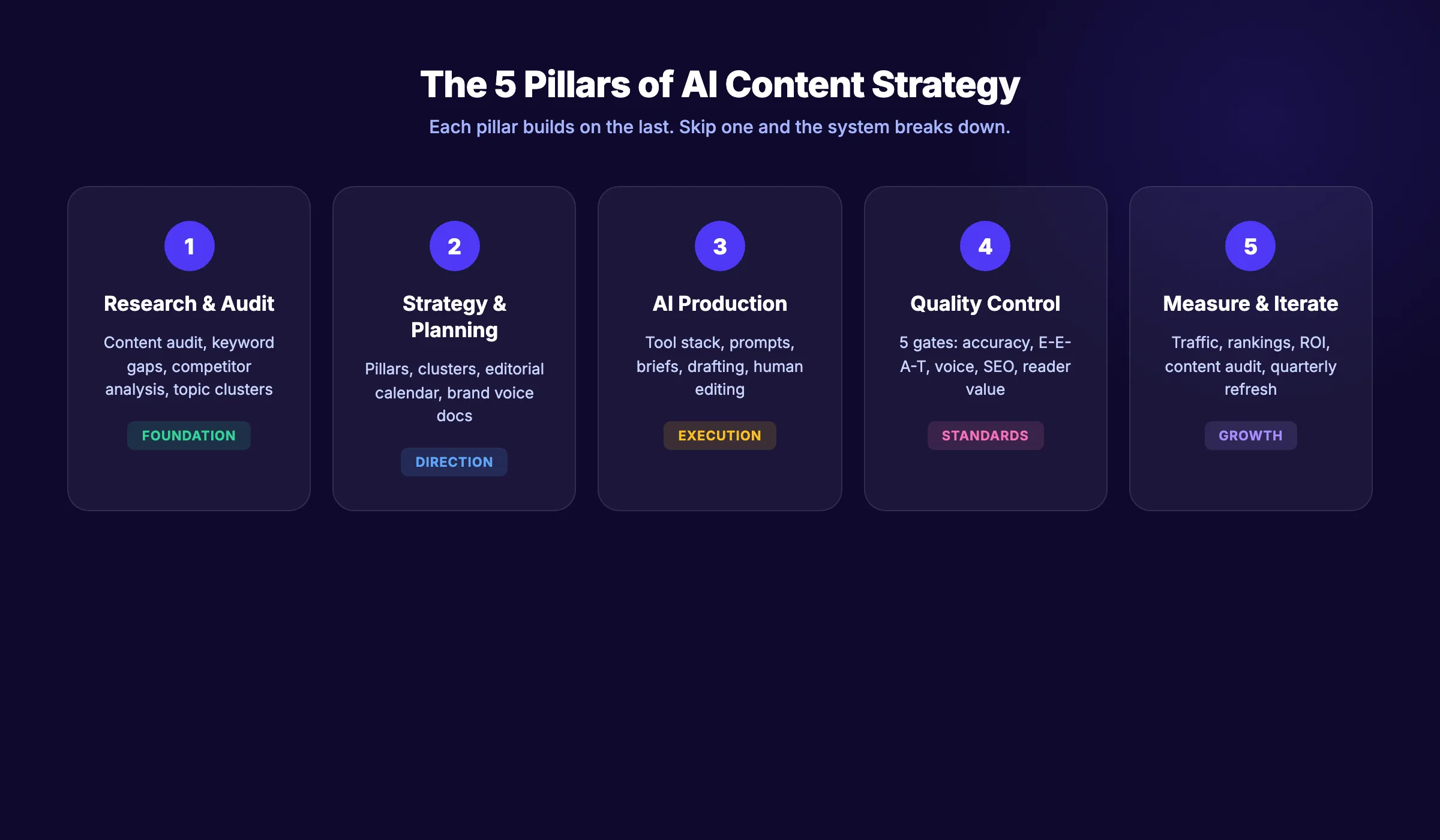
Think of AI as a production multiplier, not a replacement for strategic thinking. The teams seeing 22% better ROI and 32% more conversions from AI-assisted campaigns (per HubSpot’s 2026 marketing data) are not publishing AI drafts unchanged. They are running AI output through a strategic filter.
Why You Need One Now
Three forces make an AI content strategy urgent in 2026:
1. Content volume is exploding. More articles are now created by AI than by humans, according to Graphite’s analysis. Standing out requires strategy, not speed alone.
2. Google is getting better at detecting low-effort content. The SE Ranking study tracked AI-generated pages for 16 months. Pages without E-E-A-T signals, original insights, or editorial polish dropped out of rankings within 90 days (Search Engine Land).
3. AI search is changing distribution. AI Overviews reached 2 billion monthly users by Q2 2025. Content that gets cited by AI systems follows different rules than content that ranks in traditional search. Your strategy needs to account for both channels. Learn more in our generative engine optimization guide.
How Google Evaluates AI Content in 2026
Google has been explicit on this point. Their official guidance states: “Appropriate use of AI or automation is not against our guidelines.” The focus is on content quality, not production method (Google Search Central).
That does not mean all AI content ranks equally. Google evaluates content through the E-E-A-T framework: Experience, Expertise, Authoritativeness, and Trustworthiness. AI-generated content often fails on the first element. A language model has no first-hand experience running a dental practice, managing a plumbing crew, or negotiating a commercial lease.
| E-E-A-T Signal | What Google Looks For | How AI Content Fails |
|---|---|---|
| Experience | First-hand knowledge, personal examples | Cannot generate real experiences |
| Expertise | Depth, accuracy, technical precision | Hallucinates stats, misses nuance |
| Authoritativeness | Known author, cited sources, backlinks | Generic content earns zero links |
| Trustworthiness | Accuracy, transparency, editorial standards | Unchecked AI makes factual errors |
The 16-month SE Ranking experiment confirmed this pattern. Purely AI-generated pages on new domains without editorial enhancement lost rankings fast. Pages that combined AI production with human editing, original data, and proper E-E-A-T signals maintained or improved their positions.
The practical takeaway: Google does not penalize AI content. Google penalizes thin, unhelpful content. AI just makes it easier to produce thin content at scale if you lack a strategy.
Understanding what E-E-A-T means for your content is the foundation of any AI content strategy that lasts.
Stop writing. Start ranking. Stacc publishes 30 SEO-optimized articles per month for $99. Every post passes our quality framework before it goes live. Start for $1 →
The 7-Step AI Content Strategy Framework
This framework works for solo operators publishing 4 posts per month and for teams producing 80. The steps scale. The principles stay the same.
Step 1: Audit Your Current Content
Before adding AI to your workflow, know what you already have. Run a content audit that catalogs every published page, its traffic, rankings, and conversion data.
Categorize each piece:
- Keep: Ranking well, driving traffic or conversions
- Update: Has potential but needs refreshing or optimization
- Consolidate: Multiple thin pages covering the same topic
- Remove: Zero traffic, outdated, or off-brand
This audit reveals your content gaps. Those gaps become your AI-assisted production queue. Do not start AI content production without knowing what already exists. Otherwise you create duplicate content that competes with your own pages.
Step 2: Define Your Content Pillars and Topics
Map your target keywords into topical clusters. Each cluster has one pillar page and 5 to 15 supporting articles that link back to it.
AI is excellent at expanding topic clusters. Give it your pillar topic and ask it to generate 30 related subtopics. Then validate each one against search volume, competition, and business relevance using keyword research for blog posts.
Example cluster for a plumbing company:
| Pillar | Supporting Topics (AI-Generated, Human-Validated) |
|---|---|
| Plumbing Maintenance Guide | How to prevent frozen pipes, Water heater maintenance schedule, Signs you need a plumber, DIY vs professional plumbing repairs, Drain cleaning frequency |
The key word is “human-validated.” AI generates the list. You decide which topics align with your business goals and audience needs.
Step 3: Choose Your AI Tool Stack
Not every AI tool serves the same purpose. Match tools to specific tasks in your workflow.
| Workflow Stage | Best AI Use | Tool Examples |
|---|---|---|
| Research and ideation | Topic generation, keyword clustering, competitor gap analysis | ChatGPT, Claude, Semrush |
| Outlining | Structure drafts, H2/H3 suggestions, content briefs | Claude, Frase, Clearscope |
| Drafting | First-pass writing from detailed briefs | Claude, Jasper, Writesonic |
| Editing and optimization | SEO scoring, readability checks, grammar | Surfer SEO, Grammarly, Hemingway |
| Repurposing | Social posts from blogs, email summaries, video scripts | ChatGPT, Castmagic, Repurpose.io |
74% of marketers use AI for ideation. 61% use it for outlining. Only 44% use it for drafting, according to Typeface’s 2026 report. The most effective teams use AI across all five stages. But they use different tools and different levels of human oversight at each stage.
See our full breakdown of the best AI content writing tools for SEO and the best AI blog writing tools for detailed recommendations.
Step 4: Build Your Brand Voice Guidelines for AI
This is the step most teams skip. It is also the step that separates branded content from generic AI output.
Document your brand voice in a format AI tools can use:
- Tone descriptors: 3 to 5 words (e.g., “direct, practical, confident”)
- Vocabulary rules: Words to always use and words to never use
- Sentence structure: Max length, paragraph rules, formatting preferences
- Example passages: 3 to 5 paragraphs that represent your ideal voice
- Anti-examples: Content that violates your voice (common AI patterns to avoid)
Feed this document to your AI tool as a system prompt or custom instruction. Every piece of content starts from these guardrails. Without them, every brand using the same AI model produces the same generic output. Reddit users have noticed this pattern. One commenter noted that “AI-generated text tends to be very general and hedge more than real human responses” (Cornell study).
Your brand voice document is your antidote to AI sameness.
Step 5: Create Your Content Production Workflow
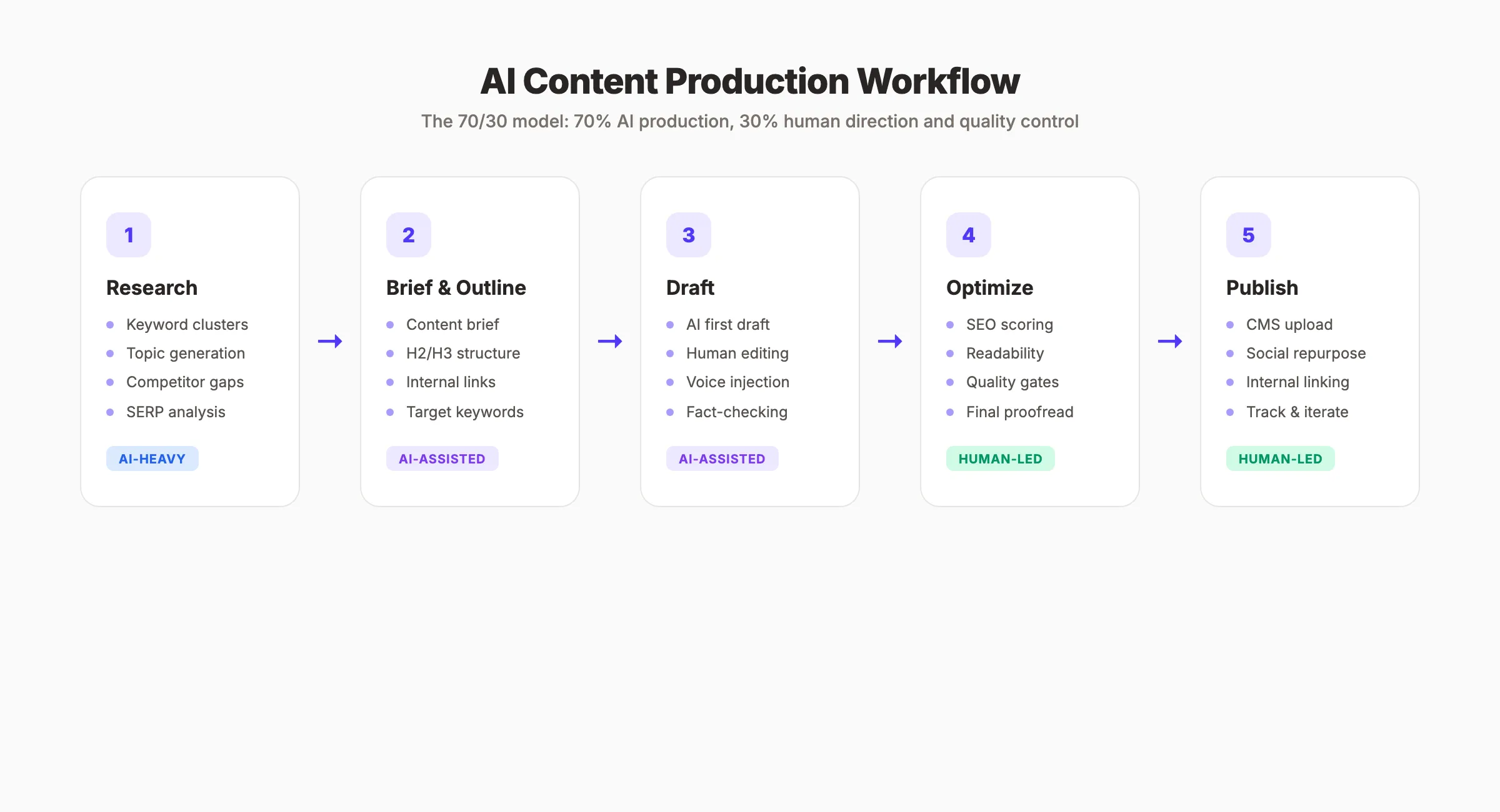
A production workflow maps every step from topic selection to publishing. Here is the workflow we use for 3,500+ published posts:
Stage 1. Research (AI-heavy, human-directed)
- AI generates keyword clusters and topic ideas
- Human selects topics based on business priorities
- AI pulls competitor content structures
- Human identifies gaps and unique angles
Stage 2. Brief and Outline (AI-assisted, human-approved)
- AI drafts a content brief with target keyword, search intent, H2 structure
- Human reviews and adjusts the structure
- AI suggests internal links from existing content
- Human approves link targets and anchor text
Stage 3. Draft (AI-generated, human-edited)
- AI writes the first draft from the approved outline
- Human adds original insights, examples, and data
- Human removes AI patterns and injects brand voice
- Human fact-checks every statistic and claim
Stage 4. Optimize (AI-scored, human-finalized)
- AI tools score for SEO, readability, and keyword coverage
- Human adjusts based on scores without over-optimizing
- Final proofread for accuracy and brand alignment
- Meta descriptions and title tags finalized
Stage 5. Publish and Distribute
- Publish to CMS
- Repurpose for social media
- Add to internal linking structure
- Schedule content refresh review in 90 days
The 70/30 model works well at scale: 70% AI production, 30% human direction and quality control. That ratio comes from teams producing 20 or more posts per month (Enrich Labs).
Step 6: Establish Quality Gates
Quality gates prevent bad content from reaching your audience. Every piece must pass these checks before publishing:
Gate 1. Factual Accuracy
- Every statistic has a verifiable source
- No hallucinated claims, names, or studies
- Dates and numbers are current
Gate 2. E-E-A-T Signals
- Original insight or experience present (goes beyond restated information)
- Author expertise connected to the topic
- Sources cited for all factual claims
- Read our E-E-A-T guide for blogs for the full framework
Gate 3. Brand Voice
- Matches documented tone and vocabulary
- No generic AI filler phrases
- Humanized content that reads naturally
Gate 4. SEO Optimization
- Target keyword in title, first 100 words, at least 1 H2, and meta description
- Blog post structure follows proven format
- Internal links point to real, relevant pages
- Images have descriptive alt text
Gate 5. Reader Value
- Answers the search intent completely
- Provides something competitors do not
- Includes actionable next steps
Skip these gates and you join the 97% of pages getting zero organic traffic. 86% of marketers say AI saves more than 1 hour daily on creative tasks (Typeface). Invest some of that saved time into quality control.
Your SEO team. $99 per month. 30 optimized articles, published automatically. Every post passes 5 quality gates before it goes live. Start for $1 →
Step 7: Set Up Measurement and Iteration
An AI content strategy without measurement is just content production. Define your KPIs before publishing your first AI-assisted piece.
| Metric | What It Tells You | Target Benchmark |
|---|---|---|
| Organic traffic per post | Content is ranking and attracting clicks | 100+ sessions/month within 90 days |
| Average time on page | Content holds attention | 3+ minutes |
| Bounce rate | Content matches search intent | Under 65% |
| Keyword rankings | SEO effectiveness | Top 20 within 60 days, top 10 within 120 |
| Conversion rate | Content drives business outcomes | 1-3% for blog-to-lead |
| Content velocity | Production efficiency | 2-4x previous output at same quality |
| Cost per article | Budget efficiency | 50-70% lower than manual production |
Track these monthly. Compare AI-assisted content against your historical benchmarks. If traffic goes up but conversions go down, your AI content is attracting the wrong audience or failing to engage the right one.
Learn how to set up a full tracking system in our content marketing ROI guide.
How to Choose the Right AI Tools
The AI tool market is crowded. ChatGPT is used by 80% of marketers. Claude is used by 55%. But adoption does not equal effectiveness, according to Siege Media’s AI writing statistics.
Match Tools to Tasks, Not Hype
The best AI content strategy uses multiple tools, each for what it does best.
For research and ideation: Use tools that can search the web, analyze SERPs, and identify content gaps. ChatGPT with browsing, Claude, and Perplexity excel here. Pair them with keyword research tools for search volume data.
For outlining and briefs: Use tools that understand content structure. Claude and ChatGPT produce strong outlines when given a detailed prompt. Content brief templates improve output quality.
For drafting: This is where tool differences matter most. Test 2 to 3 tools on the same brief and compare output quality, voice match, and factual accuracy. The best tool for your brand depends on your industry, voice, and content type.
For optimization: Dedicated SEO tools (Surfer, Clearscope, Frase) score content against ranking competitors. Use them to optimize content for SEO after the draft is complete.
For repurposing: AI cuts the time to turn a blog post into social media posts, email newsletters, and video scripts. One 3,000-word article can become 10 to 15 pieces of distribution content.
What to Spend
| Team Size | Recommended Monthly AI Budget | What It Covers |
|---|---|---|
| Solo / small business | $20 to $100 | 1 AI writing tool + 1 SEO tool |
| Small team (2-5 people) | $100 to $400 | Multiple AI tools + SEO suite + editing tools |
| Agency or larger team | $400 to $1,500 | Enterprise AI plans + full SEO platform + automation |
Compare this against $2,400 to $7,500 per month for 30 freelance-written articles. AI tools cost 90 to 95% less for the drafting stage. The human editing and quality control stage still costs time. But the total cost per published article drops by 60 to 80%.
9 AI Content Strategy Mistakes That Tank Rankings
These mistakes come from analyzing hundreds of AI content programs that failed to generate organic traffic. Every one is preventable.
Mistake 1: Publishing AI Drafts Without Editing
The most common mistake. AI drafts contain hallucinated statistics, invented sources, and generic filler. Publishing them unchanged is the fastest path to E-E-A-T failure. Every draft needs human review for accuracy, voice, and value.
Mistake 2: Treating AI as Strategy Instead of a Tool
AI handles production tasks. It does not set strategy. Asking ChatGPT to “create my content strategy” produces a generic plan that applies to nobody. Strategy requires business context, competitive analysis, and audience understanding that AI does not have.
Mistake 3: Using Vague Prompts
“Write a blog post about SEO” produces generic output. “Write a 2,000-word guide on technical SEO audits for ecommerce sites using Shopify, targeting intermediate marketers” produces something useful. The quality of AI output is directly proportional to the specificity of your input. See our guide on writing AI prompts for SEO articles.
Mistake 4: Ignoring E-E-A-T Signals
AI cannot generate first-hand experience. If your content does not include real examples, original data, named authors with relevant credentials, and cited sources, Google has no reason to rank it above competitors who provide those signals.
Mistake 5: Skipping Brand Voice Guidelines
Without documented voice guidelines fed to your AI tools, every piece sounds identical to every other brand using the same model. Readers notice. Google notices through engagement signals. Differentiation starts with voice.
Mistake 6: No Content Governance
Teams adopt AI tools without establishing who approves content, what the fact-checking process is, or who owns the editorial calendar. The result: inconsistent quality, duplicate topics, and missed deadlines. Build a content calendar with clear ownership.
Mistake 7: Prioritizing Volume Over Strategy
Publishing 50 AI-generated articles per month means nothing if they target the wrong keywords, cannibalize each other, or fail to match search intent. Ten well-targeted, well-edited articles outperform 50 thin ones every time.
Mistake 8: Never Auditing AI Content Performance
“Set it and forget it” does not work. AI content needs the same performance monitoring as any other content. Track rankings, traffic, and conversions. Update or remove underperforming pieces. Run a content audit quarterly.
Mistake 9: Expecting AI to Replace Your Content Team
AI replaces tasks, not roles. The teams reporting 68% increased content marketing ROI from AI (Averi AI benchmarks) are not firing their writers. They are redirecting writers from drafting to editing, strategy, and original research. The human role evolves. It does not disappear.
3,500+ blogs published. 92% average SEO score. See what Stacc can do for your site. Start for $1 →
How to Measure AI Content ROI
68% of marketers report increased content marketing ROI from AI adoption. But “increased ROI” means nothing without a measurement framework. Here is how to calculate yours.
The AI Content ROI Formula
AI Content ROI = (Revenue from AI content - Total AI content costs) / Total AI content costs × 100Total AI content costs include:
- AI tool subscriptions
- Human editing and review time (hours × hourly rate)
- SEO tool costs
- Image creation and design costs
- Publishing and distribution costs
Revenue from AI content includes:
- Organic traffic value (traffic × CPC equivalent)
- Direct conversions attributed to AI-published pages
- Lead value from content-driven form fills
- Brand search lift correlated with content publishing
Benchmark: Before and After AI
| Metric | Before AI Strategy | After AI Strategy (90 Days) |
|---|---|---|
| Articles published per month | 4 | 20 to 30 |
| Cost per article | $200 to $500 | $40 to $100 |
| Time from idea to publish | 2 to 3 weeks | 3 to 5 days |
| Organic traffic (monthly) | Baseline | 2 to 4x increase |
| Content quality score (SEO tools) | 60 to 70 | 80 to 90+ |
These numbers reflect teams using a documented AI content strategy, not teams dumping AI drafts directly into their CMS. The strategy is what creates the ROI improvement.
McKinsey’s data shows that personalization delivers 5 to 8x ROI on marketing spend. AI enables personalization at scale. Content tailored to specific audience segments, industries, and search intents outperforms one-size-fits-all content by a wide margin.
Track your numbers. Read our full content marketing ROI measurement guide for the complete attribution framework.
The 90-Day AI Content Strategy Rollout Plan
Do not try to implement everything at once. This phased plan builds capabilities week by week.
Days 1 to 14: Foundation
- Complete content audit of existing published content
- Document brand voice guidelines in a format AI tools can use
- Select 1 AI writing tool for testing (start with one, expand later)
- Identify 3 topical clusters with 5 supporting topics each
- Set up tracking for organic traffic, rankings, and conversions
Days 15 to 30: First Production Cycle
- Create content briefs for 4 to 8 articles
- Draft articles using AI with human editing
- Run each piece through all 5 quality gates
- Publish first batch and monitor indexing
- Document what worked and what needs adjustment in your workflow
Days 31 to 60: Scale and Refine
- Increase production to target cadence (10 to 30 articles per month)
- Add a second AI tool for a different workflow stage
- Build internal linking between new and existing content
- Run first performance review (rankings, traffic, engagement)
- Refine prompts and voice guidelines based on output quality
Days 61 to 90: Optimize and Expand
- Audit all AI-published content for performance
- Update or remove underperforming pieces
- Expand to additional content types (social, email, video scripts)
- Calculate first ROI benchmark
- Plan quarter 2 with updated keyword targets and content gaps
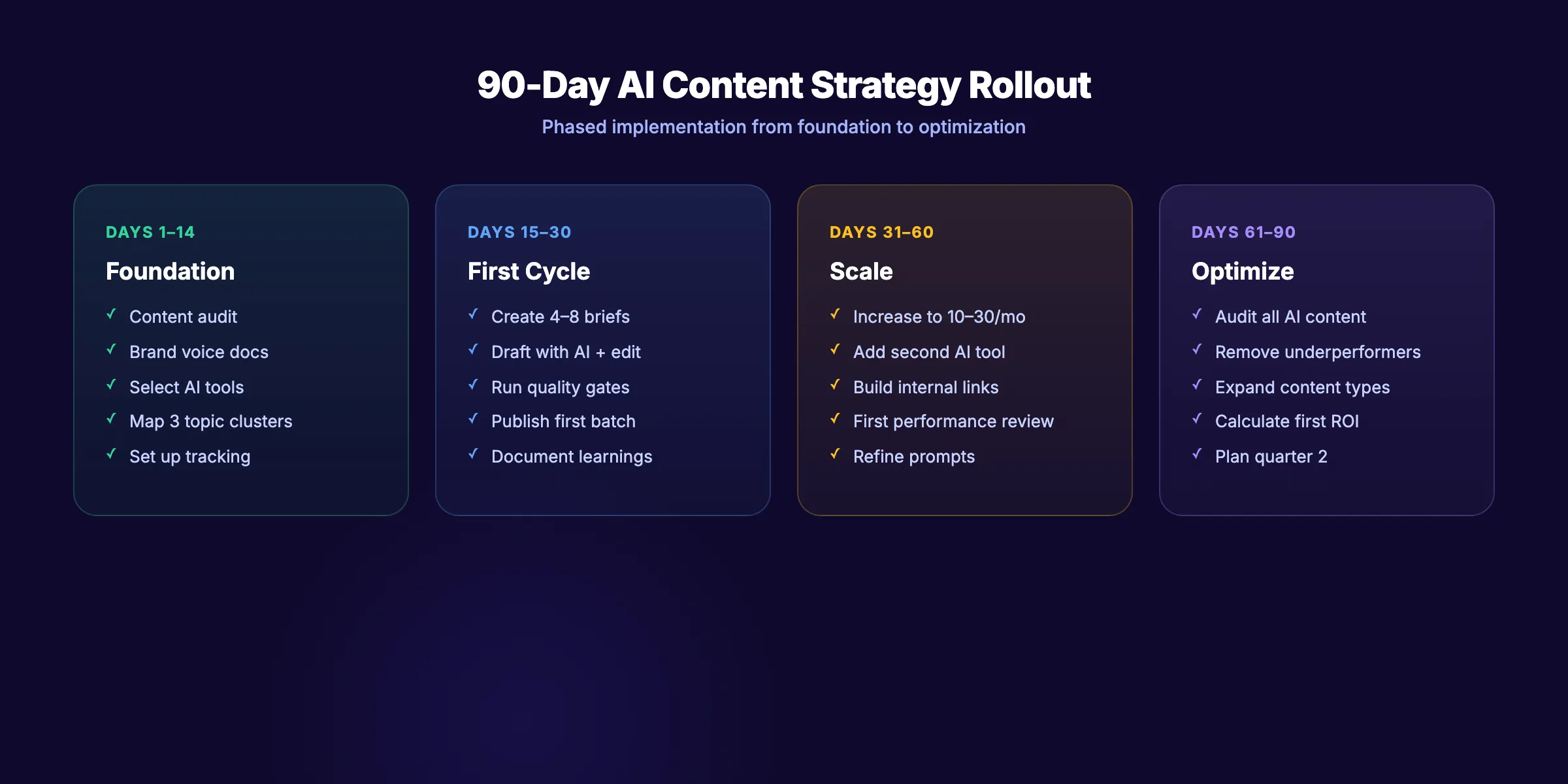
By day 90, you have a repeatable system. AI handles production. Humans handle strategy, quality, and measurement. Content compounds. Rankings build. Organic traffic grows.
Most teams see their first ranking improvements between days 60 and 90. The full effect of an AI content strategy plays out over 6 to 12 months as topical authority builds and search engines trust your domain for your target topics.
Rank everywhere. Do nothing. Blog SEO, Local SEO, and Social on autopilot. Stacc starts at $99/mo with a $1 trial. Start for $1 →
FAQ
What is an AI content strategy?
An AI content strategy is a documented plan that defines how AI tools fit into your content marketing workflow. It covers tool selection, content types, quality standards, brand voice guidelines, publishing cadence, and measurement. It is not the same as “using AI to write.” A strategy ensures AI output serves business goals.
Does Google penalize AI-generated content?
No. Google’s official position is that AI-generated content is not against their guidelines. Google evaluates content based on quality, helpfulness, and E-E-A-T signals, not production method. However, low-quality AI content that lacks expertise, experience, and editorial oversight will not rank, just like low-quality human content.
How much does an AI content strategy cost to implement?
AI tool costs range from $20 to $400 per month depending on team size. The bigger investment is human time for editing, quality control, and strategy. Total cost per AI-assisted article runs $40 to $100, compared to $200 to $500 for fully manual production. Most teams see a 60 to 80% reduction in per-article costs.
Can AI replace content writers?
AI replaces drafting tasks, not content roles. The most effective teams redirect writers from first-draft production to editing, strategy, original research, and quality assurance. 73% of top-performing content teams combine AI and human writing rather than replacing one with the other.
What are the best AI tools for content strategy?
No single tool covers every workflow stage. Use research tools (ChatGPT, Claude, Perplexity) for ideation, writing tools (Claude, Jasper) for drafting, and SEO tools (Surfer, Clearscope) for optimization. Start with one tool per stage and expand based on results. See our best AI content writing tools for SEO for detailed reviews.
How long before an AI content strategy shows results?
First ranking movements typically appear within 60 to 90 days. Meaningful traffic growth takes 3 to 6 months. The full compounding effect of consistent, high-quality AI-assisted publishing plays out over 6 to 12 months. Teams publishing 20 or more articles per month see faster results than those publishing 4 to 8.
An AI content strategy is not about whether to use AI. That decision is already made for 97% of marketers. The question is whether your AI usage follows a documented strategy or runs on autopilot without one. The teams winning in organic search are not the ones producing the most AI content. They are the ones producing the most strategic AI content.
Start with an audit. Build your framework. Publish with quality gates. Measure everything. The compounding effect of consistent, strategic content production is the most reliable path to organic growth in 2026.
Related Tools & Resources
Free SEO Tools:
Best Lists:

Written by
Siddharth GangalSiddharth is the founder of theStacc and Arka360, and a graduate of IIT Mandi. He spent years watching great businesses lose organic traffic to competitors who simply published more. So he built a system to fix that. He writes about SEO, content at scale, and the tactics that actually move rankings.
30 SEO blog articles published every month
Keyword-optimized, scheduled, and live on your site. Automatically.
30-day trial · Cancel anytime
theStacc
Stop writing SEO content manually
30 blog articles, 30 GBP posts, and social media content. Published every month. Automatically.
Start Your $1 Trial$1 for 3 days · Cancel anytime