
E-E-A-T for Blogs: How to Build Trust With Google
Learn how to demonstrate E-E-A-T in your blog content. Covers author setup, experience signals, trust mechanics, and a per-post audit checklist. Updated 2026.
Siddharth Gangal • 2026-03-28 • Content Strategy
In This Article
Google mentions E-E-A-T over 120 times in its Search Quality Rater Guidelines. Sites that demonstrate strong E-E-A-T signals saw a 23% traffic gain after the December 2025 Core Update. Sites that ignored it lost 40-50% of their organic traffic.
Most E-E-A-T guides are written for enterprise websites with teams of developers and PR departments. That advice does not help a solo blogger running a WordPress site from their kitchen table.
E-E-A-T for blogs is different. Your personal brand carries the weight. Your experience is your strongest signal. Your blog architecture determines whether Google sees you as an authority or just another content farm.
This guide covers how to demonstrate E-E-A-T specifically for blog content. Not generic website advice. Practical steps for bloggers, content creators, and small business owners who publish regularly.
We have published 3,500+ blog posts across 70+ industries. Here is what moves the needle.
What you will learn:
- The 4 pillars of E-E-A-T and what each one means for blog content specifically
- How to set up author pages, bios, and schema markup correctly
- Per-post experience signals that prove you know what you are writing about
- How E-E-A-T differs across blog niches (YMYL vs lifestyle vs tech)
- A checklist to audit your existing blog posts for E-E-A-T gaps
- How E-E-A-T affects whether AI systems cite your blog
The 4 Pillars of E-E-A-T (For Bloggers)
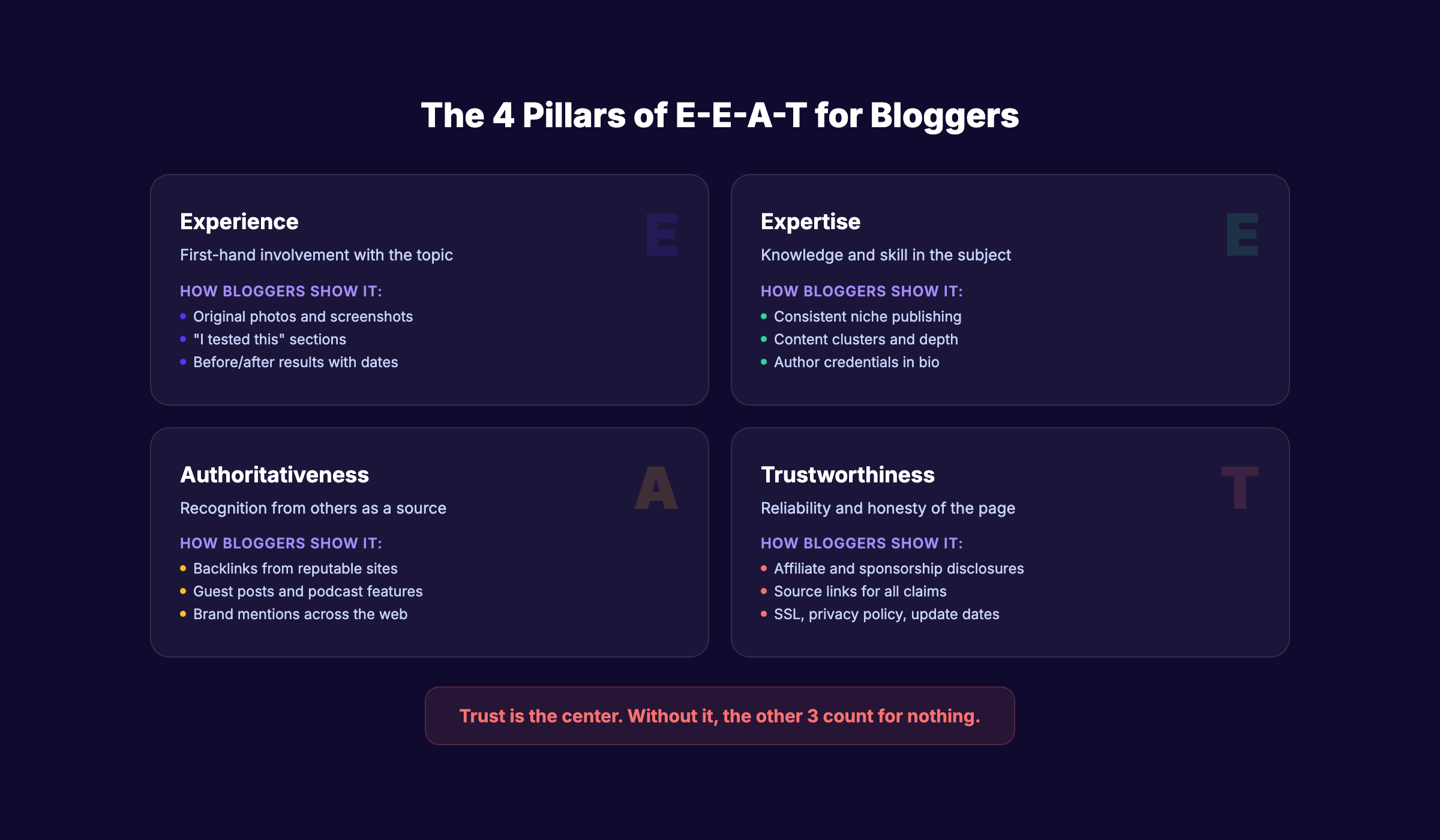
E-E-A-T stands for Experience, Expertise, Authoritativeness, and Trustworthiness. Google added the extra “E” for Experience in December 2022. For bloggers, that addition changed everything.
Before 2022, expertise meant formal credentials. A doctor writing about health. A CPA writing about taxes. Bloggers without degrees or certifications felt locked out.
The Experience E leveled the field. Google now values first-hand, lived experience alongside formal expertise. A plumber who blogs about fixing garbage disposals has more “experience” than a content writer who researched the topic for 30 minutes. A traveler who visited 40 countries has more experience than a travel agency that has never left the office.
Here is how each pillar applies specifically to blogs:
| Pillar | What Google Looks For | How Bloggers Demonstrate It |
|---|---|---|
| Experience | Evidence that the author has first-hand involvement with the topic | Original photos, “I tested this” sections, personal stories, process screenshots, before/after results |
| Expertise | Knowledge and skill in the subject area | Author bio with credentials, consistent publishing in a niche, depth of coverage, accurate information |
| Authoritativeness | Recognition from others as a go-to source | Backlinks from reputable sites, guest posts, podcast features, social following, brand mentions |
| Trustworthiness | The page and site are reliable and honest | Affiliate disclosures, update dates, editorial policy, SSL, privacy policy, accurate sourcing |
Trust sits at the center. Google’s guidelines state that Trust is the most important member of the E-E-A-T family. A blog can have experience and expertise but still fail on trust if it hides affiliate relationships, uses misleading headlines, or lacks basic security.
For a deeper overview of the E-E-A-T framework itself, read our E-E-A-T guide.
How to Set Up Your Blog’s Author Identity
The first thing Google’s quality raters check is: who wrote this? For blogs, the author IS the E-E-A-T signal. If Google cannot identify and verify who is behind the content, your E-E-A-T score starts at zero.
The Author Bio Box
Every blog post should display an author bio. This is the small box at the top or bottom of each post with the author’s name, photo, and credentials.
What to include:
- Full name (not a pen name or brand name alone)
- Professional headshot or real photo
- 2-3 sentences about your relevant experience
- Link to your full author page
- Links to your LinkedIn, Twitter/X, or relevant professional profiles
What to avoid:
- Generic bios like “John is a writer who loves SEO” (says nothing about expertise)
- Stock photos or avatars (Google’s quality raters specifically flag these)
- No bio at all (the most common mistake on small blogs)
The Dedicated Author Page
An author bio box is not enough. Create a dedicated /about or /author/[name] page with:
- Your full professional background
- Relevant certifications, awards, or publications
- Topics you cover and why you are qualified to cover them
- Links to your best or most-cited work
- Contact information or a way to verify your identity
- Photos of you in professional contexts
This page serves as the canonical reference for your identity. Google’s systems use it to connect your expertise across all your blog posts.
Person Schema Markup
Add Person schema (JSON-LD) to your author page. This tells search engines explicitly who you are, what you do, and where else you appear online.
Key properties to include:
name— Your full namejobTitle— Your professional titledescription— A brief summary of your expertisesameAs— Array of URLs linking to your social profiles and other web presencesurl— Your author page URL
For implementation details, see our guide on schema markup for SEO.
Stop writing. Start ranking. Stacc publishes 30 SEO articles per month for your business, starting at $99. Start for $1 →
Per-Post Experience Signals
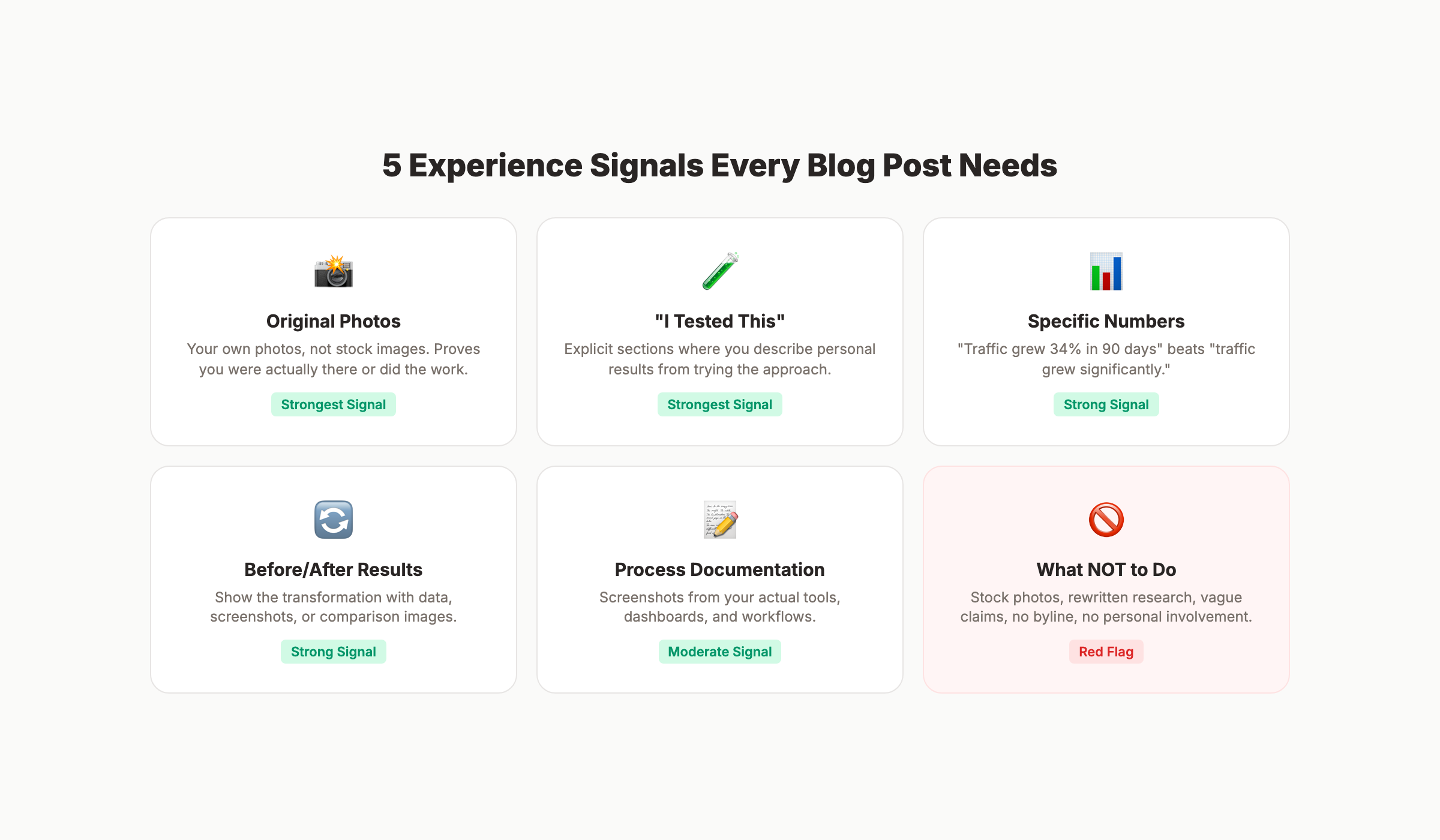
Setting up author pages is a one-time task. But E-E-A-T is evaluated per page, not just per site. Every blog post needs its own experience signals.
The “Experience” E is a blogger’s unfair advantage. It is the one signal that AI cannot fake and that big corporate sites cannot manufacture at scale. Here is how to weave experience into every post.
Original Photography
Include photos you took yourself. Product reviews with your own photos. Travel posts with images from your trip. Tutorial posts with screenshots from your actual screen. Stock photos signal “I did not actually do this.” Original photos signal “I was there.”
First-Person Process Documentation
Show your work. If you are writing about keyword research, include a screenshot of your actual keyword spreadsheet. If you are reviewing a tool, show your dashboard with real data. If you are teaching a technique, document each step with evidence from your own execution.
”I Tested This” Sections
Add explicit sections where you describe your personal experience:
- “I used this tool for 3 months. Here is what happened.”
- “We ran this strategy across 12 client sites. The average result was…”
- “I made this mistake on my own blog. Here is what I learned.”
These sections carry more weight than any number of statistics cited from third-party sources. They are uniquely yours.
Specific Numbers and Dates
Vague claims signal inexperience. Specific claims signal real involvement.
Weak: “This strategy increased traffic significantly.”
Strong: “This strategy increased organic traffic by 34% over 90 days, from 2,100 to 2,814 monthly sessions.”
Specific numbers imply you measured the results. Dates imply you were there when it happened. Both are experience signals.
Before-and-After Results
Show the transformation. A blog post about on-page SEO should include before and after ranking data. A post about content strategy should show traffic graphs. A cooking blog should show the plating progression from attempt 1 to attempt 5.
Building Expertise and Authority for Your Blog
Experience is what you have done. Expertise is what you know. Authority is what others say about you.
Demonstrate Expertise Through Depth
Google measures expertise partly through topical depth. A blog with 3 posts about SEO looks like a hobby. A blog with 50 posts covering keyword research, on-page optimization, content clusters, internal linking, and technical SEO looks like an authority.
Build topical authority by:
- Publishing consistently in your niche (not scattered across random topics)
- Creating pillar content that covers broad topics in depth
- Building content clusters with supporting articles linked to each pillar
- Updating existing posts with fresh data and new sections
A study of 250,000+ search results confirmed that topical authority is now the strongest on-page ranking signal. It outperforms domain traffic, backlink counts, and keyword density.
Build Authority Through External Validation
Authority is earned, not claimed. Google evaluates authority based on what the rest of the web says about you.
Actionable authority-building for bloggers:
- Write guest posts on reputable blogs in your niche
- Get quoted as an expert source in other articles
- Appear on podcasts or webinars (these get transcribed and indexed)
- Build backlinks through original research, data, and unique insights
- Maintain active social profiles where you share your expertise
- Participate in relevant communities (Reddit, forums, industry Slack groups)
Every external mention, link, and citation tells Google: other people trust this source. That is authority.
3,500+ blogs published. 92% average SEO score. See what Stacc can do for your site. Start for $1 →
Trust Signals Every Blog Needs
Trust is the center of E-E-A-T. Without it, experience, expertise, and authority count for nothing. For blogs specifically, trust comes from transparency and technical fundamentals.
Content Trust Signals
- Update dates on every post. Show “Last updated: [date]” on posts with time-sensitive information. Stale content erodes trust.
- Source your claims. Link to the original study, report, or data source for every statistic and major claim. “According to [source]” with a link is a trust signal. An unsourced claim is a trust red flag.
- Affiliate and sponsorship disclosures. If you earn money from links in a post, disclose it. Google’s quality raters look for this specifically. FTC regulations require it.
- Corrections and transparency. If you published incorrect information, correct it and note the correction. This signals intellectual honesty.
Technical Trust Signals
- SSL certificate installed (HTTPS, not HTTP)
- Privacy policy page published
- Terms of service page published
- Contact page with real contact information
- No intrusive interstitials or popups that block content
- Mobile-responsive design (mobile parity correlates with 28% higher authority scores)
- Fast page load speed (under 3 seconds)
Monetization Transparency
Blog monetization is not a problem. Hidden monetization is. Blogs that clearly label sponsored content, display affiliate disclosures, and maintain an editorial policy separate from advertising perform better in quality evaluations.
A simple editorial policy page stating “We only recommend products we have personally tested” is a powerful trust signal. It costs nothing to create and demonstrates integrity.
E-E-A-T Across Different Blog Niches
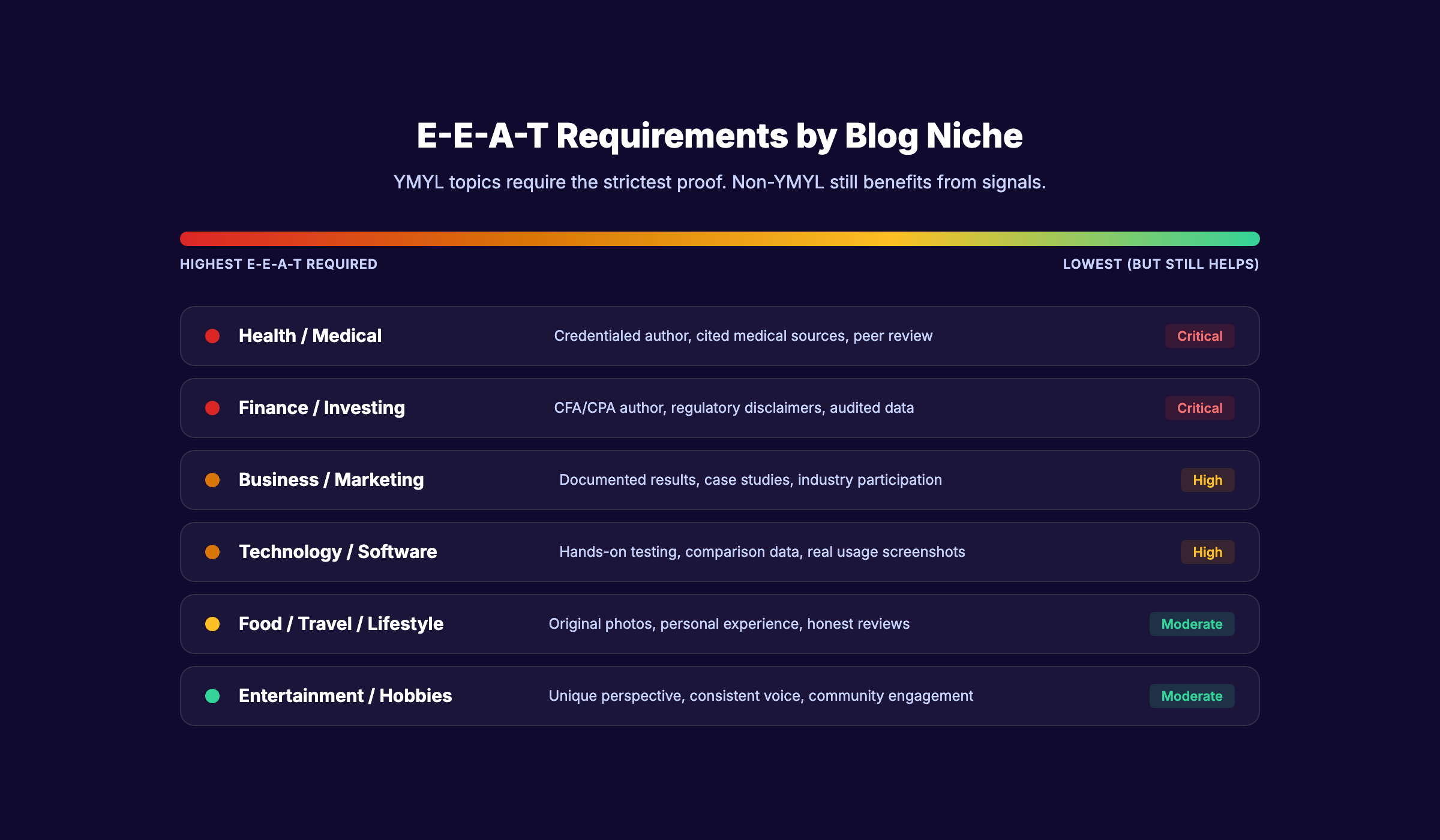
E-E-A-T requirements are not equal across all blog topics. Google categorizes certain topics as YMYL (Your Money or Your Life). These topics face the strictest E-E-A-T scrutiny because bad information can cause real harm.
YMYL Blog Categories (Highest E-E-A-T Required)
| Niche | Why It Is YMYL | What Google Expects |
|---|---|---|
| Health and medical | Bad advice can cause physical harm | Author with medical credentials, cited medical sources, peer-reviewed references |
| Finance and investing | Bad advice can cause financial harm | Author with financial credentials (CFA, CPA, CFP), regulatory disclaimers |
| Legal advice | Incorrect information can cause legal harm | Licensed attorney as author, jurisdiction-specific disclaimers |
| News and current events | Misinformation can cause societal harm | Journalistic standards, fact-checking process, editorial oversight |
For YMYL blogs, formal expertise is nearly mandatory. A personal finance blog by a Certified Financial Planner will outrank a similar blog by someone with no credentials, all else being equal.
Medium E-E-A-T Categories
| Niche | E-E-A-T Focus |
|---|---|
| Technology and software | Hands-on testing, comparison screenshots, real usage data |
| Business and marketing | Documented results, case studies, client outcomes |
| Education and tutorials | Step-by-step proof, teaching credentials or verifiable track record |
| Product reviews | Original photos, personal testing period, honest pros and cons |
Lower E-E-A-T Categories (But Still Matters)
| Niche | E-E-A-T Focus |
|---|---|
| Food and recipes | Original recipe photos, cooking process documentation |
| Travel | Personal travel photos, specific tips from recent visits |
| Lifestyle and hobbies | Personal experience, community participation |
| Entertainment | Unique opinions, consistent perspective, audience engagement |
Even in “low stakes” niches, E-E-A-T still affects rankings. A food blogger with original kitchen photos and documented recipe testing will outrank one using stock images and rewritten recipes from other sites.
How to Audit Existing Blog Posts for E-E-A-T
Do not just apply E-E-A-T to new content. Your existing posts are where the biggest gains hide. Run this audit on your top 20 posts by traffic.
Per-Post E-E-A-T Audit Checklist
Experience signals:
- Author byline with link to author page
- At least 1 original photo or screenshot per post
- At least 1 first-person experience statement (“I tested,” “We found,” “In my experience”)
- Specific numbers and dates from personal results
- Before-and-after evidence where applicable
Expertise signals:
- Content covers the topic in sufficient depth (not thin)
- Technical claims are accurate and current
- Post is part of a content cluster (not an orphan page)
- Internal links connect to related posts on the same topic
Authority signals:
- External links point to the post from other sites
- Post references authoritative external sources with links
- Author credentials are relevant to the post topic
Trust signals:
- “Last updated” date is visible and accurate
- All statistics have source links
- Affiliate/sponsorship disclosures present (if applicable)
- No broken links
- No outdated information
Scoring: Count the checked items. Posts with fewer than 8 out of 15 need immediate attention. Posts with 12+ are in good shape.
For posts that score poorly, prioritize fixing them by traffic volume. Update your highest-traffic posts first. The impact is faster and larger.
Skip the agency. Keep the results. Stacc starts at $99/mo with a $1 trial. Start for $1 →
E-E-A-T and AI-Generated Blog Content
83% of content marketers used AI to help create content in 2025. That number is climbing. But content with strong E-E-A-T signals outperforms pure AI-generated text by up to 40%, according to a Semrush study.
Google does not penalize AI-written content for being AI-written. It penalizes content that lacks helpfulness, originality, and E-E-A-T signals regardless of how it was produced.
The AI + E-E-A-T Workflow
Step 1: Use AI to generate a draft based on your outline and research.
Step 2: Layer in your personal experience. Add “I tested this” sections, original photos, specific results from your work, and opinions that only you can have.
Step 3: Verify all facts and add source links. AI drafts often include plausible-sounding but inaccurate claims.
Step 4: Add your author bio, update the publication date, and ensure all trust signals are in place.
The AI handles the structure and coverage. You add the experience, expertise, and trust that Google rewards. For more on this workflow, read our guide on humanizing AI content.
E-E-A-T for AI Search Citations
E-E-A-T now affects more than just Google Search rankings. Expert credentials appear in 96% of AI Overview citations. ChatGPT, Perplexity, and Gemini all favor citing sources that demonstrate clear expertise and authority.
If your blog posts include strong E-E-A-T signals, they are more likely to be cited by AI systems. If they lack these signals, AI models will cite your competitors instead. For more on optimizing for AI search, read our generative engine optimization guide.
FAQ
Is E-E-A-T a direct Google ranking factor?
No. E-E-A-T is not a ranking factor in the way that backlinks or page speed are. It is a framework that Google’s human quality raters use to evaluate search results. However, Google’s algorithms are designed to produce results that align with E-E-A-T principles. Pages with strong E-E-A-T signals have a 30% higher chance of ranking in the top 3. It is not a direct input, but it correlates strongly with ranking success.
How do I demonstrate Experience if I am new to a topic?
Start by documenting your learning process. Write “beginner’s journey” content where you share what you are learning, the mistakes you are making, and the results you are getting along the way. This is genuine first-hand experience, even if you are not an expert yet. Google values authentic experience at any level over manufactured authority.
Do author bios actually affect rankings?
Yes. Not because Google parses your bio text as a ranking signal, but because author bios connect your content to a verifiable identity. Google’s systems use entity recognition to link authors to their broader web presence. An author with a LinkedIn profile, published work, and consistent bylines across sites has a stronger entity signal than an anonymous post.
How does E-E-A-T differ for YMYL vs non-YMYL blog content?
YMYL (Your Money or Your Life) topics like health, finance, and legal advice require formal expertise. Google expects credentialed authors, cited sources, and peer-reviewed references. Non-YMYL topics like recipes, hobbies, and entertainment prioritize experience and authenticity over credentials. A food blogger does not need a culinary degree. They need original photos, tested recipes, and honest reviews.
Can a new blog with no authority rank well on E-E-A-T?
Yes, but it takes time. Start with the Experience E. Document your hands-on work. Publish consistently in a narrow niche to build topical depth. Seek guest posting opportunities for authority. Add proper schema markup and trust signals from day one. New blogs that focus on depth rather than breadth build E-E-A-T faster than those that publish thin content across many topics.
Does Stacc help with E-E-A-T for blog content?
Stacc publishes 30 SEO-optimized blog posts per month, each structured with proper headings, internal links, schema-ready formatting, and topical authority in mind. The content builds the depth and consistency that contribute to expertise and authority signals. For experience signals, you add your personal insights, photos, and results to the published drafts.
E-E-A-T for blogs is not a checklist you complete once. It is a set of signals you build into every page, every author profile, and every piece of content you publish. The Experience E is your unfair advantage as a blogger. No AI tool and no corporate content team can replicate your genuine, documented first-hand experience.
Build your author identity. Add experience markers to every post. Audit your existing content. The blogs that treat E-E-A-T as a publishing standard, not a one-time project, are the ones that keep ranking through every algorithm update.
Written and published by Stacc. We publish 3,500+ articles per month across 70+ industries. All data verified against public sources as of March 2026.
