
In-House vs Outsource Content Team: The Guide (2026)
Should you build an in-house content team or outsource? Real cost data, decision frameworks, and hybrid models. Updated March 2026.
84% of content marketers rely on external help for at least part of their content production. Yet the companies with the strongest results have in-house teams of 4 or more content specialists.
The question is not whether to build an in-house content team or outsource. The real question is which parts to keep internal and which to hand off. Most businesses get this wrong. They either hire too early and burn through budget, or outsource too cheaply and get generic content that ranks nowhere.
This guide breaks down the actual costs, trade-offs, and decision frameworks for building your content operation in 2026. We publish 3,500+ blog posts across 70+ industries with a 92% average SEO score. We have seen what works on both sides.
Here is what you will learn:
- The real cost of an in-house writer versus an agency or freelancer
- When in-house teams outperform outsourced content
- When outsourcing delivers better ROI than hiring
- How to build a hybrid model that captures the best of both
- The signals that tell you it is time to switch approaches
- A third option most companies overlook entirely
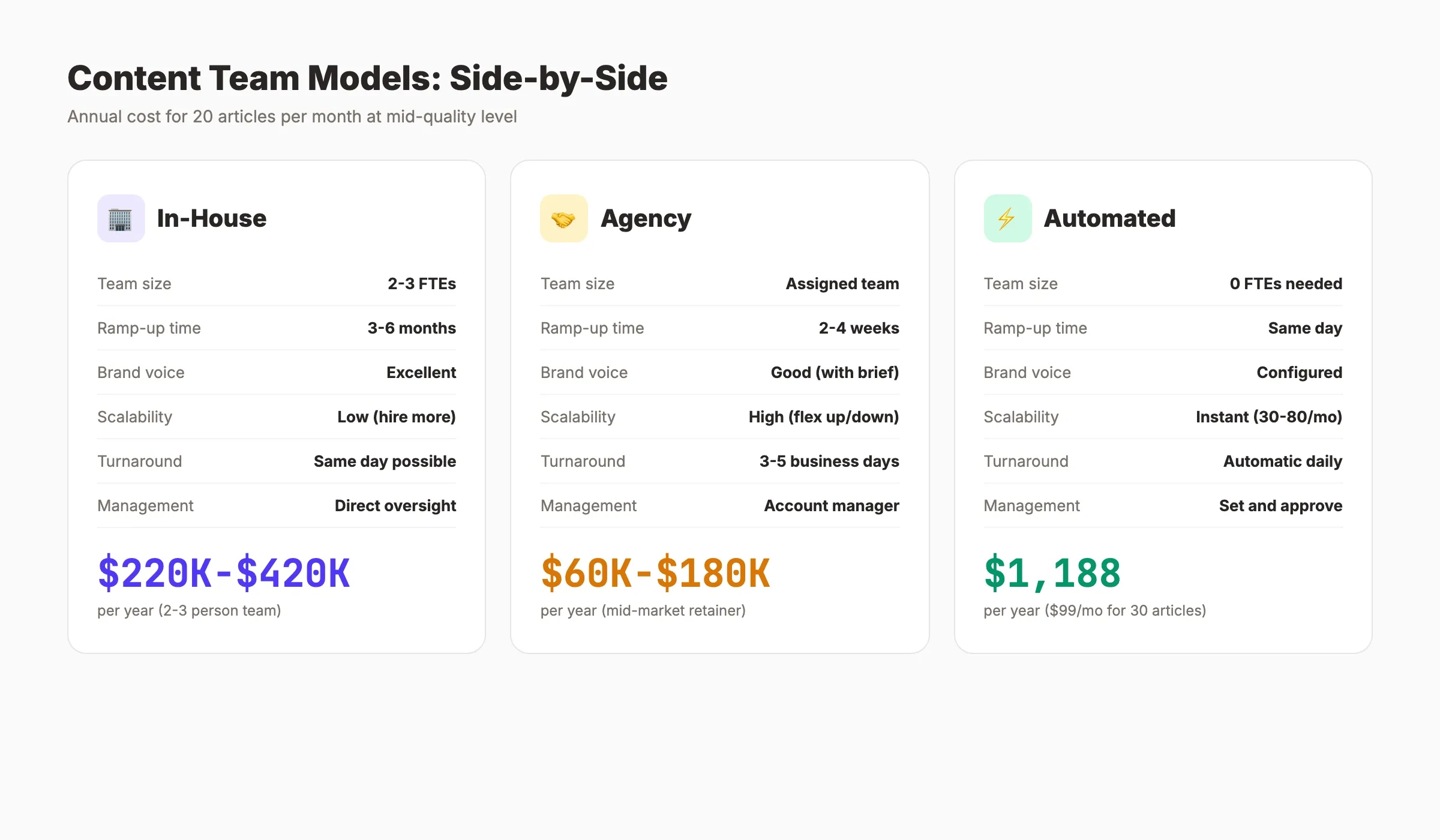
Chapter 1: What In-House vs Outsourced Content Means in 2026
The in-house versus outsource debate has changed. AI tools, remote talent pools, and content automation shifted the math. The old binary choice is now a spectrum.
The Three Models
In-house means full-time employees on your payroll. Content writers, editors, strategists, and designers who work exclusively for your company. They sit in your Slack channels. They attend your standups. They know your product cold.
Outsourced means external partners. Agencies, freelancers, or content services that produce content on your behalf. They work with multiple clients. They bring outside perspective. They scale up or down based on your needs.
Hybrid means a combination. An internal content strategist or editor who manages outsourced writers and agencies. This model is now the most common. 86% of content marketers outsource at least some work while keeping strategy in-house.
Why the Decision Matters More Now
70% of content marketers struggle to keep up with volume demands. Google rewards consistent publishing. AI search engines cite authoritative, frequently updated sites. The companies publishing 20 to 30 articles per month outrank those publishing 2 to 3.
Volume pressure makes the build-or-buy decision urgent. Hiring too slowly means falling behind. Outsourcing poorly means wasting budget on content that does not rank.
For a complete overview of content planning, see our content marketing strategy guide.
Chapter 2: The Real Cost of Each Model
Most comparisons undercount the true cost of in-house teams. Salary is only the starting point.
In-House Content Writer: Full Cost
| Cost Component | Entry-Level | Mid-Level | Senior |
|---|---|---|---|
| Base salary | $45,000-$55,000 | $58,000-$75,000 | $80,000-$113,000 |
| Benefits (30.5% of salary) | $13,700-$16,800 | $17,700-$22,900 | $24,400-$34,500 |
| Payroll taxes (~10%) | $4,500-$5,500 | $5,800-$7,500 | $8,000-$11,300 |
| Recruitment cost | $4,000 | $4,000 | $4,000 |
| Tools and software | $3,000-$8,000/yr | $3,000-$8,000/yr | $3,000-$8,000/yr |
| Total Year 1 | $70,200-$89,300 | $88,500-$117,400 | $119,400-$170,800 |
Source: Bureau of Labor Statistics data on benefits and payroll costs.
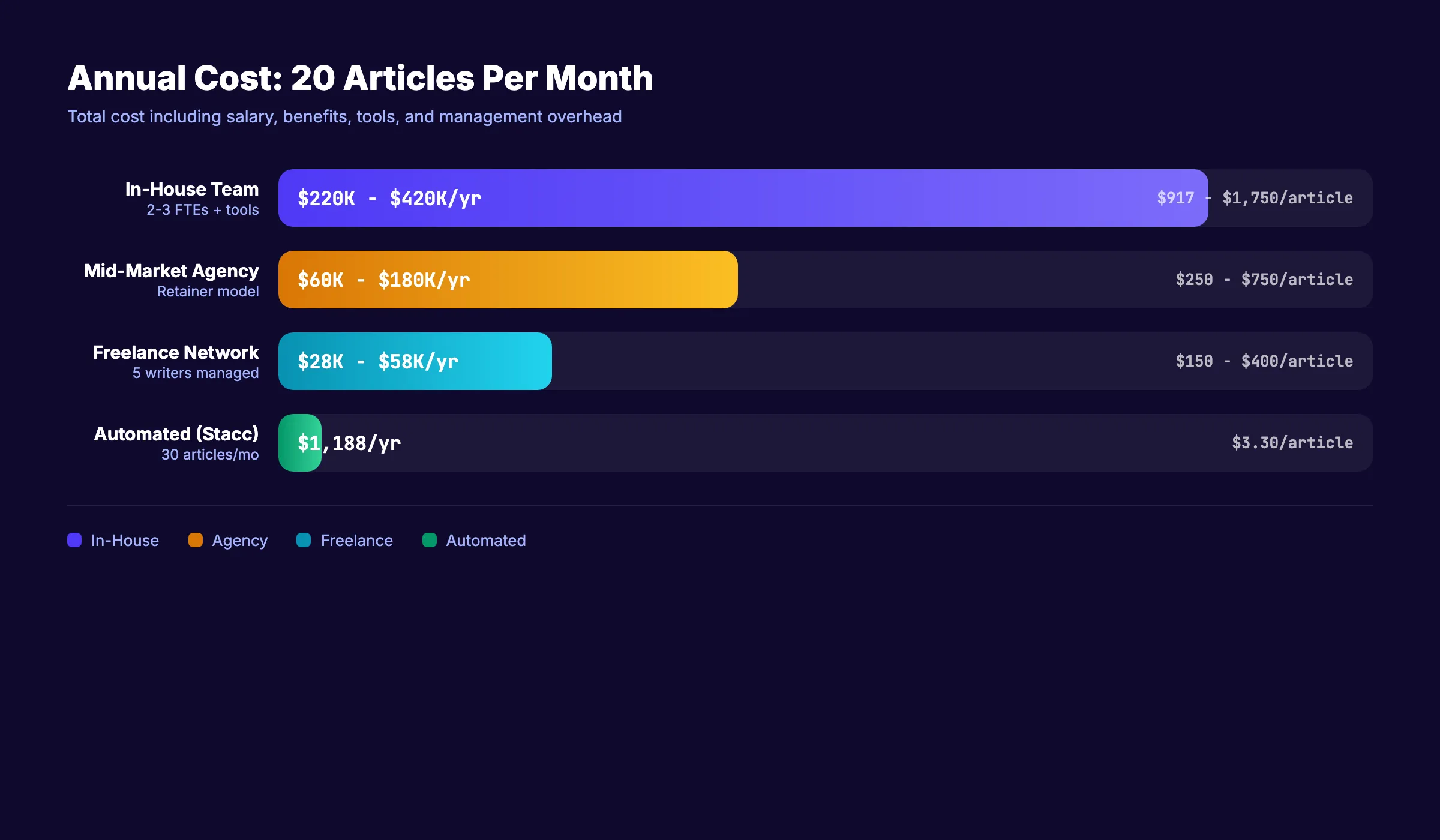
That is the cost for one writer. A self-sufficient content team (strategist, 2 writers, editor, designer) runs $220,000 to $420,000 per year at mid-level salaries. A high-volume team costs $490,000 to $940,000.
And those numbers do not include the 3 to 6 month ramp-up period where a new hire produces at 50 to 70% capacity while learning your industry, audience, and brand voice.
Agency Retainer Costs
| Agency Tier | Monthly Cost | Annual Cost | Typical Output |
|---|---|---|---|
| Small or boutique | $2,000-$5,000 | $24,000-$60,000 | 4-8 articles/mo |
| Mid-market | $5,000-$15,000 | $60,000-$180,000 | 8-20 articles/mo |
| Enterprise or full-service | $15,000-$50,000+ | $180,000-$600,000+ | 20-50+ articles/mo |
| Average across all | ~$3,500/mo | ~$42,000/yr | Varies widely |
78% of digital agencies use retainer-based pricing in 2026. That means a fixed monthly fee regardless of output volume. Some agencies also charge per piece or per project.
Freelance Writer Rates
| Experience Level | Per Article (1,500 words) | Monthly (8 articles) |
|---|---|---|
| Beginner (0-1 year) | $50-$150 | $400-$1,200 |
| Intermediate (2-4 years) | $150-$400 | $1,200-$3,200 |
| Experienced (4+ years) | $300-$600 | $2,400-$4,800 |
| Specialist (finance, legal, medical) | $500-$2,000 | $4,000-$16,000 |
Freelancers offer the most flexible pricing. But managing 3 to 5 freelancers takes 8 to 12 hours per week. That management time has a cost.
For tools that help manage content at scale, see our list of content marketing tools for small teams.
Stop writing. Start ranking. Stacc publishes 30 SEO articles per month for $99. Start for $1 →
Chapter 3: When In-House Content Teams Win
In-house is not always the right answer. But when it is, no amount of outsourcing can replicate it.
Deep Product Knowledge
An in-house writer uses your product daily. They sit in customer calls. They hear the exact language your buyers use. That proximity produces content with specificity that outsourced writers cannot match.
This matters most for technical products, complex B2B sales, and regulated industries. A SaaS company explaining API integrations needs a writer who has actually used the API. A financial services firm needs someone who understands compliance requirements without a 3-page brief explaining them.
Brand Voice Consistency
Your brand voice is a living thing. It evolves with every campaign, product launch, and customer interaction. In-house writers absorb those changes in real time. They hear the CEO’s keynote. They read the customer support tickets. They know which analogies land and which ones fall flat.
Outsourced writers get a brand guide and a brief. That covers 80% of voice consistency. The remaining 20% is the part that makes content feel genuinely yours.
Speed and Responsiveness
An in-house writer can turn around a response to a competitor announcement in hours. A trending topic gets covered the same day. A product update gets documented immediately.
Outsourced teams operate on schedules. Even the best agencies need 3 to 5 business days for a new piece. Freelancers often work with 7 to 14 day lead times. For time-sensitive content, in-house wins.
When In-House Makes Financial Sense
The breakeven point is volume. If you need more than 15 to 20 articles per month consistently, a mid-level in-house writer ($88,500 total cost) produces content at $370 to $490 per article. That beats mid-tier freelancers and most agencies on a per-piece basis.
But only if the writer stays productive. One writer at full capacity produces 15 to 25 articles per month depending on length and research depth. Below that volume, the per-article cost rises fast.
For tips on structuring content for rankings, see our guide on how to write SEO blog posts.
Chapter 4: When Outsourcing Content Wins
Most advice about outsourcing is wrong because it focuses on cost alone. The real advantage is capability.
Diverse Expertise on Demand
An agency employs writers across dozens of industries. Need a healthcare article this week and a fintech piece next week? An agency assigns the right specialist for each. An in-house generalist writes both, but with less depth.
48% of businesses outsource some content creation. The most commonly outsourced types are graphic design (47%), video production (43%), and copywriting (37%). These are skill areas where specialized expertise beats generalist effort.
Scalability Without Hiring
Outsourcing scales instantly. Need 10 articles this month and 40 next month for a product launch? An agency adjusts. An in-house team of 2 cannot triple output overnight.
This flexibility matters most for seasonal businesses, companies in growth phases, and teams running experiments. You can test a new content format or topic cluster without committing to a full-time hire.
Lower Fixed Costs
A freelancer at $300 per article costs $3,600 per year for 1 article per month. An in-house writer costs $88,500 per year minimum. If your content needs are under 10 articles per month, outsourcing saves $50,000 to $70,000 annually.
The math flips at higher volumes. But most small and mid-sized businesses do not publish enough to justify a full-time content hire.
Fresh Perspective
In-house teams develop blind spots. They stop questioning assumptions. They write about the same topics from the same angles because they are too close to the product.
Outsourced writers bring the perspective of someone encountering your industry for the first time. That perspective often produces the content that resonates most with new customers, because new customers have the same questions.
For a comparison of agency alternatives, see our list of content marketing agency alternatives.
Chapter 5: The Hybrid Model That Actually Works
The binary choice is a false one. The strongest content operations combine in-house strategy with outsourced execution.
What to Keep In-House
Always keep internal:
- Content strategy and editorial calendar
- Brand voice guidelines and approval workflows
- Performance measurement and analytics
- Core thought leadership and executive content
- Content briefs and topic selection
- Final editorial review before publishing
These functions require deep institutional knowledge. They shape what gets created and how it performs. Outsourcing strategy means outsourcing your competitive advantage.
What to Outsource Safely
Safe to hand off:
- Blog production at scale (standard informational and how-to content)
- Graphic design and visual content
- Video production and editing
- Technical SEO audits and implementation
- Social media content repurposing
- Link building and outreach
- Content localization and translation
These are execution tasks. They benefit from specialist skills and scalable capacity. The quality depends on clear briefs and good management, not on proximity to your product team.
The Hybrid Team Structure
| Role | Location | Responsibility |
|---|---|---|
| Content Strategist or Manager | In-house | Strategy, calendar, briefs, analytics, final approval |
| 1-2 Core Writers | In-house or outsourced | Product content, thought leadership, high-stakes pieces |
| Production Writers | Outsourced (agency or freelancers) | Blog posts, how-to guides, listicles at volume |
| Designer | Outsourced or fractional | Graphics, infographics, feature images |
| SEO Specialist | In-house or outsourced | Keyword research, technical SEO, audits |
This structure costs $120,000 to $200,000 per year for a company producing 20 to 40 articles per month. That is less than a full in-house team and produces more output than either model alone.
For help building your content pipeline, see our guide on creating a content calendar for SEO.
Your SEO team. $99 per month. 30 optimized articles, published automatically. Start for $1 →
Chapter 6: The Decision Framework
Stop guessing. Use these 4 variables to make the right call for your company.
Variable 1: Company Stage
| Stage | Revenue | Best Model | Why |
|---|---|---|---|
| Pre-revenue / startup | Under $1M | Freelancers or automation | Cash preservation. No volume to justify a hire. |
| Growth | $1M-$10M | Agency or fractional content lead + freelancers | Need volume but cannot afford a full team. |
| Scale | $10M-$50M | In-house strategist + outsourced production | Enough budget for strategy. Outsource execution. |
| Enterprise | $50M+ | Full in-house team + agency for overflow | Brand control matters. In-house anchors the operation. |
Variable 2: Content Volume
- Under 8 articles/month: Outsource. A full-time hire sits idle half the time.
- 8-15 articles/month: Hybrid. One in-house writer or manager. Freelancers for the rest.
- 15-30 articles/month: Full in-house writer + outsourced support. Or automated content service.
- 30+ articles/month: In-house team of 2-3. Or a done-for-you content service that handles everything.
Variable 3: Content Complexity
| Low Complexity | High Complexity | |
|---|---|---|
| Low Volume | Freelancers | In-house specialist |
| High Volume | Agency or automation | In-house team + agency support |
Low-complexity content (how-to guides, listicles, FAQ pages) outsources well. High-complexity content (technical documentation, industry analysis, regulatory content) needs in-house expertise or highly specialized freelancers.
Variable 4: Internal Bandwidth
Ask one question: “Do we have someone who can manage outsourced content?”
If yes, outsourcing works. A content manager who writes clear briefs, reviews drafts, and provides feedback can get excellent results from external writers.
If no, outsourcing often fails. Unmanaged freelancers produce generic content. Agencies without a client-side counterpart default to safe, bland output.
The management layer is the single biggest predictor of outsourcing success.
5 Signals It Is Time to Switch
You have outgrown outsourcing when:
- You spend more time editing outsourced content than it would take to write it
- Brand voice complaints come up in customer feedback
- Your agency cannot keep up with industry-specific depth
- You need content turnaround in under 48 hours regularly
- Content costs exceed what a full-time hire would cost at the same volume
You should start outsourcing when:
- Your in-house writer is consistently behind on the content calendar
- You need content in formats your team cannot produce (video, design, interactive)
- Seasonal demand spikes exceed your team capacity by 50%+
- Quality stagnates because the same 1-2 writers cover every topic
- You are spending more on tools and overhead than the content itself produces in ROI
For strategies on scaling your output, see our guide on how to scale blog content with AI.
Chapter 7: How to Make Outsourcing Work
Most outsourcing failures are management failures, not talent failures. These systems fix the most common breakdowns.
Build a Content Brief Template
Every outsourced piece needs a brief. Not a one-line topic suggestion. A structured document that includes:
- Target keyword and search intent
- Target word count and format
- H2/H3 outline or suggested structure
- Competitor URLs to reference (and beat)
- Internal links to include
- Brand voice notes specific to this piece
- Key points, data, or angles that must appear
- Examples of previous content the writer should match
A 15-minute brief saves 2 hours of revisions. Our guide on how to create content briefs with AI covers the full process.
Create a Living Style Guide
Your brand voice guide should be a document that outsourced writers can reference independently. Include:
- 5 to 10 “before and after” examples showing your voice
- A banned words list (industry jargon to avoid, competitor names to handle carefully)
- Formatting rules (heading style, list formats, CTA placement)
- Tone variations by content type (blog vs case study vs product page)
Update the guide quarterly based on patterns you see in outsourced drafts. If every writer makes the same mistake, the guide needs a new section.
Establish a Feedback Loop
The difference between good and great outsourced content is iteration. After every piece:
- Provide specific, actionable feedback (not “make it better” but “add a data point to support the claim in paragraph 3”)
- Track recurring issues in a shared document
- Celebrate what works so writers repeat successful patterns
- Review content performance data monthly and share it with writers
Writers who see their content ranking and driving traffic produce better work. They have skin in the game.
Quality Control Checklist
Before publishing any outsourced content, verify:
- Target keyword in title, first 100 words, and at least 1 H2
- All internal links point to real, existing pages
- External links go to authoritative, current sources
- No factual claims without supporting evidence
- Brand voice matches your style guide
- Word count meets the brief requirements
- No duplicate content (run a plagiarism check)
- Images have descriptive alt text
For more on content quality, see our guide on optimizing content for SEO.
3,500+ blogs published. 92% average SEO score. See what Stacc can do for your site. Start for $1 →
Chapter 8: The Third Option Most Companies Miss
The in-house versus outsource debate assumes you need human writers producing every piece. In 2026, a third category exists: automated content services.
What Automated Content Looks Like
Automated content services combine AI generation with human editorial oversight and SEO optimization. They produce volume that no in-house team or agency can match at a fraction of the cost.
| Model | Monthly Output | Monthly Cost | Cost Per Article |
|---|---|---|---|
| In-house writer (1 FTE) | 15-25 articles | $7,400+ | $300-$490 |
| Mid-market agency | 8-20 articles | $5,000-$15,000 | $625-$750 |
| Freelance network | 8-15 articles | $2,400-$6,000 | $300-$400 |
| Automated content service | 30 articles | $99 | $3.30 |
The cost difference is not a rounding error. It is a category shift.
When Automation Works Best
Automated content excels at:
- High-volume informational content (how-to guides, listicles, FAQ pages)
- SEO-focused blog posts targeting long-tail keywords
- Consistent publishing cadence (daily or weekly without gaps)
- Multi-topic coverage across industries and subject areas
It works less well for thought leadership, proprietary research, and content requiring original interviews or data collection. Those pieces still need human expertise.
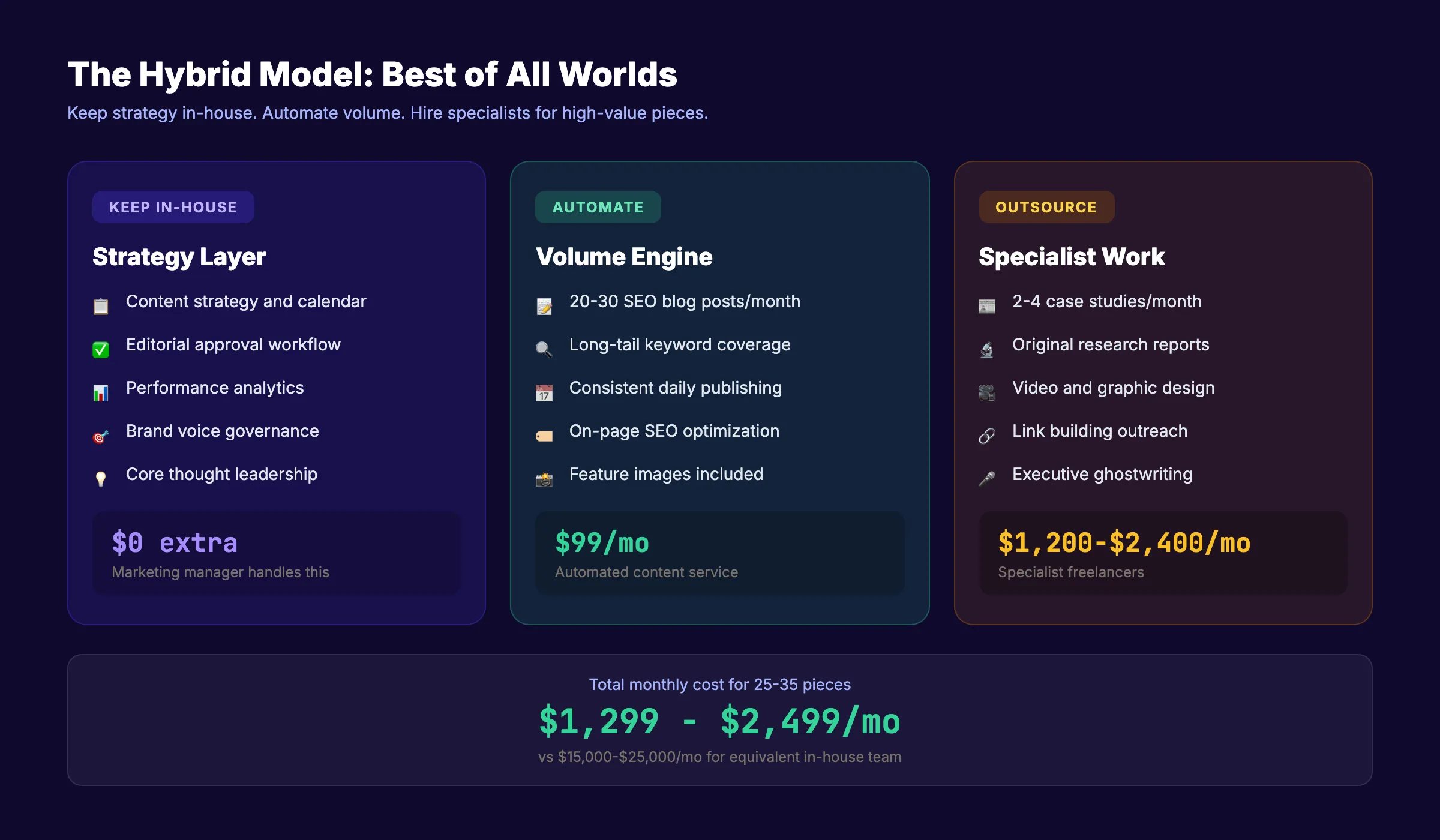
The New Hybrid: Strategy + Automation + Specialists
The most cost-effective content operation in 2026 looks like this:
- In-house: Content strategy, editorial calendar, performance analysis, brand voice governance
- Automated service: 20 to 30 SEO blog posts per month for organic traffic and keyword coverage
- Specialist freelancers: 2 to 4 high-value pieces per month (case studies, original research, executive thought leadership)
Total cost: $99 (automation) + $1,200-$2,400 (freelancers) + one part-time strategist or marketing manager who already handles this function.
That model produces 25 to 35 pieces per month for under $3,500. An equivalent agency retainer costs $10,000 to $15,000. An in-house team costs $15,000 to $25,000 per month.
For a full comparison of automated content publishing tools, see our ranked list. Or explore done-for-you SEO services for small business.
FAQ
Is it cheaper to outsource content or hire in-house?
Outsourcing is cheaper at low volumes (under 10 articles per month). An in-house writer costs $88,000+ per year including benefits. Freelancers producing 8 articles per month cost $2,400 to $4,800 per year at intermediate rates. The breakeven point is roughly 15 to 20 articles per month, where in-house per-article costs drop below freelancer rates. Automated services like Stacc change the math entirely at $99 per month for 30 articles.
What percentage of companies outsource content marketing?
84% of content marketers use external help for at least part of their content production. 48% outsource content creation specifically. The most commonly outsourced functions are graphic design, video, and copywriting.
How do I manage outsourced content writers effectively?
Three systems make the difference: structured content briefs with keyword targets and outlines, a brand voice style guide with before-and-after examples, and a feedback loop where you share specific revision notes and performance data. Writers who receive clear briefs and see their content’s impact produce dramatically better work. See our guide on creating content briefs with AI.
When should I hire my first in-house content writer?
Hire when you consistently need 15+ articles per month, your content requires deep product knowledge that outsiders struggle to learn, and you have a content strategy in place for the writer to execute. Hiring without a strategy means paying $88,000+ per year for someone to figure out what to write. Hire the strategist first, or define the strategy yourself before bringing on a writer.
What should I never outsource in content marketing?
Keep content strategy, brand voice governance, editorial approval, and performance analytics in-house. These functions require institutional knowledge and direct access to business goals. The strategy decides what to create and why. Outsource the execution of that strategy, not the strategy itself.
Can AI replace both in-house and outsourced content teams?
AI handles execution at scale but cannot replace strategic thinking, original research, or genuine expertise. The best approach combines AI-generated content for volume and keyword coverage with human oversight for quality, strategy, and high-value thought leadership. 73% of marketers see AI working alongside human teams, not replacing them.
The in-house versus outsource question has a third answer in 2026. Automate the volume. Keep the strategy. Hire specialists only for the content that demands original thinking. The companies winning at content are not choosing between building and buying. They are choosing what to build, what to buy, and what to automate.
Rank everywhere. Do nothing. Blog SEO, Local SEO, and Social on autopilot. Start for $1 →
Related Tools & Resources
Free SEO Tools:
Best Lists:

Written by
Siddharth GangalSiddharth is the founder of theStacc and Arka360, and a graduate of IIT Mandi. He spent years watching great businesses lose organic traffic to competitors who simply published more. So he built a system to fix that. He writes about SEO, content at scale, and the tactics that actually move rankings.
30 SEO blog articles published every month
Keyword-optimized, scheduled, and live on your site. Automatically.
30-day trial · Cancel anytime
theStacc
Stop writing SEO content manually
30 blog articles, 30 GBP posts, and social media content. Published every month. Automatically.
Start Your $1 Trial$1 for 3 days · Cancel anytime