
AEO vs SEO: What Changed and How to Optimize for Both
AEO vs SEO explained with data. Learn how answer engine optimization differs from SEO, which strategies overlap, and where to invest. Updated March 2026.
65% of Google searches now end without a click. AI Overviews appear in 48% of all queries. Voice assistants answer millions of questions daily without sending a single visitor to a website. The search result page is no longer a list of links. It is an answer.
AEO vs SEO is the question every marketer faces in 2026. Answer Engine Optimization (AEO) targets the systems that generate direct answers: Google AI Overviews, featured snippets, voice assistants, ChatGPT, and Perplexity. Search Engine Optimization (SEO) targets the traditional ranked results below them.
The two are not interchangeable. They share a foundation but diverge on tactics, measurement, and outcomes. We publish 3,500+ articles across 70+ industries and optimize every piece for both systems. This guide breaks down the real differences and the strategy that covers both.
Here is what you will learn:
- The core differences between AEO and SEO (with a comparison table)
- Why zero-click searches are not the threat most marketers assume
- How AEO, GEO, and AI Overviews relate to each other
- The 7 strategies that make content citable by answer engines
- Which schema markup matters most for AEO
- How to measure AEO success when clicks are not the metric
What Is Answer Engine Optimization (AEO)?
AEO is the practice of optimizing content so it appears as a direct answer in search results. The “answer engine” is any system that responds to a query with a synthesized answer rather than a list of links.
Answer engines include:
- Google AI Overviews. AI-generated summaries at the top of search results
- Featured snippets. The answer box that appears above organic result #1
- Google’s People Also Ask. Expandable Q&A sections in search results
- Voice assistants. Google Assistant, Siri, Alexa answering spoken questions
- AI search platforms. ChatGPT, Perplexity, Gemini, Microsoft Copilot
The goal of AEO is not a #1 ranking. The goal is being the source that the answer engine selects, quotes, or cites when generating its response. Your content becomes the answer itself.
What Is SEO?
SEO targets the traditional ranked results on search engines. Google indexes pages, evaluates them on relevance and authority, and displays a list of 10 blue links. The user clicks a link, visits the page, and consumes content on your site.
SEO operates on established signals:
- Keywords match user queries to relevant pages
- Backlinks indicate authority and trust
- Technical optimization ensures search engines can crawl and index content
- Content quality satisfies user intent and reduces bounce rates
- User experience keeps visitors engaged and returning
The SEO industry exceeds $80 billion. For most businesses, organic search remains the largest source of website traffic. The fundamentals have not changed in over a decade. What has changed is the surface area where results appear.
AEO vs SEO: Head-to-Head Comparison
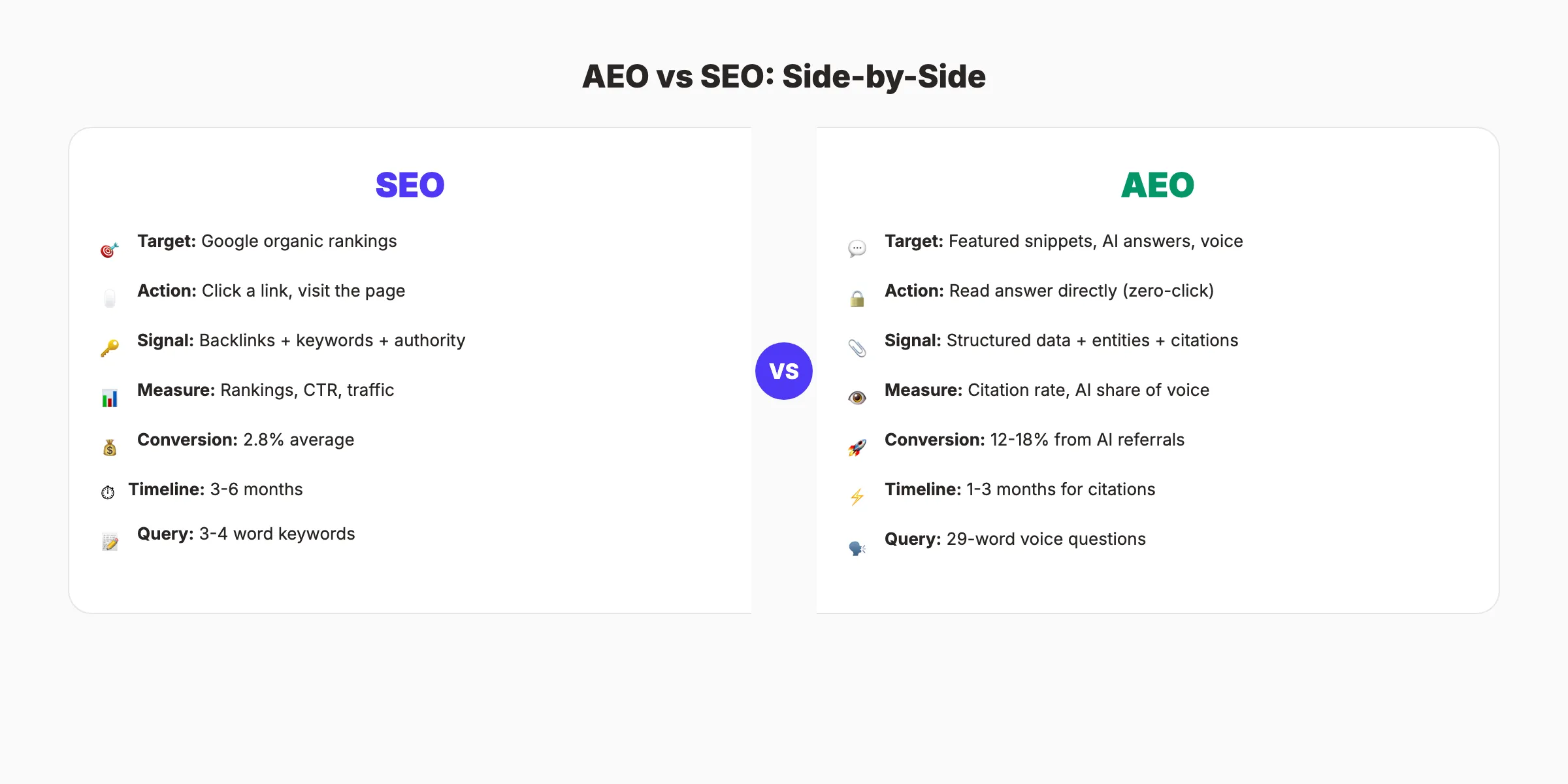
| Factor | SEO | AEO |
|---|---|---|
| Target | Google organic rankings (blue links) | Featured snippets, AI Overviews, voice answers, AI platforms |
| User behavior | Click a link, visit the page | Read the answer directly in search results |
| Query format | Short keywords (3-4 words average) | Conversational questions (29 words average for voice) |
| Content format | Keyword-optimized pages | Concise, structured answers (30-60 word answer blocks) |
| Primary signal | Backlinks + relevance + authority | Structured data + entity clarity + answer formatting |
| Measurement | Rankings, CTR, organic traffic | Citation rate, answer visibility, AI share of voice |
| Traffic model | Click-through to your website | Zero-click answers (65% of searches) |
| Conversion value | 2.8% average organic conversion | 12-18% conversion from AI-referred traffic |
| Time to results | 3-6 months | 1-3 months for citation presence |
| Market maturity | $80B+ established industry | Emerging (70% of marketers plan to adopt, only 20% have started) |
The fundamental shift: SEO earns clicks. AEO earns citations.
Stop writing. Start ranking. theStacc publishes 30 optimized articles per month for $99. Every piece is structured for both search rankings and answer engine citations. Start for $1 →
AEO vs GEO vs AI Overviews: Clearing Up the Confusion
Three terms. Overlapping concepts. Different scopes. Here is how they relate.
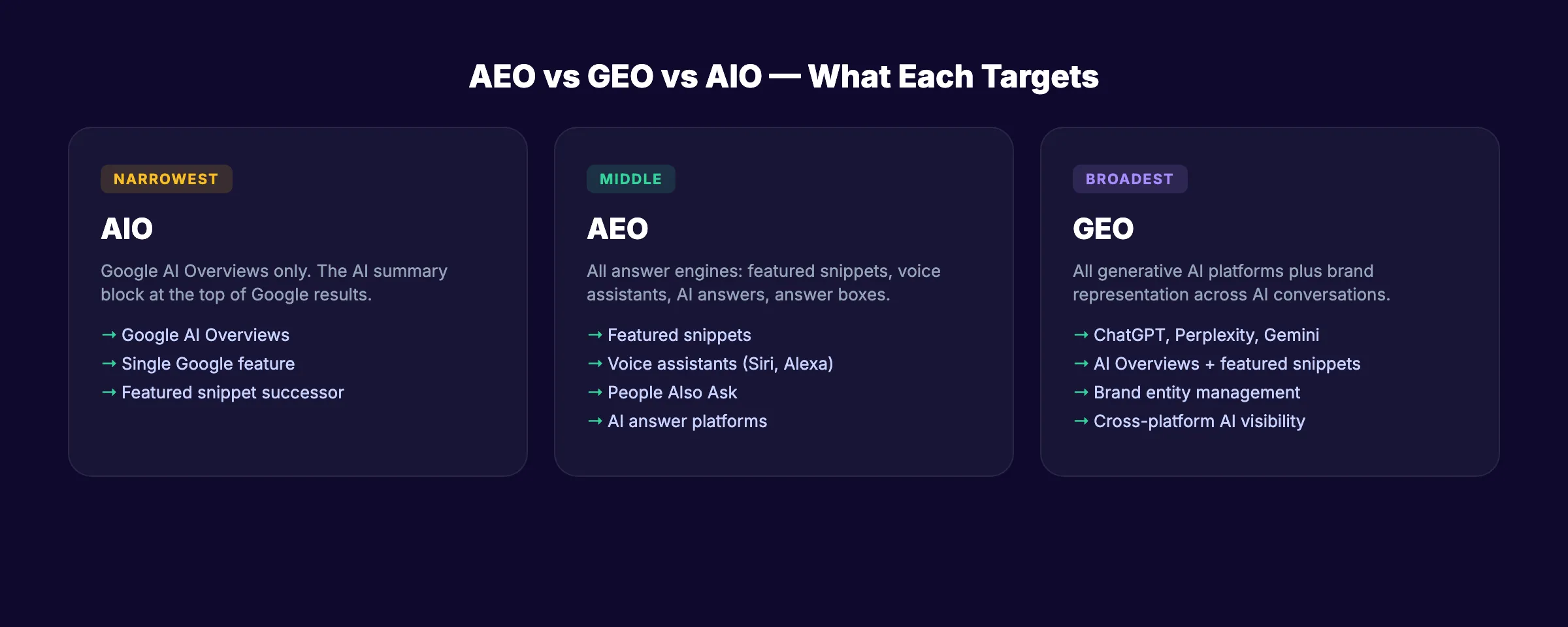
| Term | What It Targets | Scope | Origin |
|---|---|---|---|
| AEO (Answer Engine Optimization) | Featured snippets, voice assistants, answer boxes, AI answers | Narrow: single query → direct answer | Pre-AI era (featured snippets, voice search) |
| GEO (Generative Engine Optimization) | ChatGPT, Perplexity, Gemini, AI Overviews, Copilot | Broad: how AI represents your brand across conversations | AI era (Princeton 2023 paper) |
| AIO (AI Overview Optimization) | Google AI Overviews specifically | Narrow: Google’s AI-generated summary block | Google SGE/AI Overviews rollout (2024-2025) |
AEO is the oldest term. It emerged when featured snippets and voice search became prominent around 2017-2018. The concept was simple: format your content so Google pulls it as the direct answer.
GEO is the broadest term. It covers everything AEO covers plus AI platform optimization, brand entity management, and citation optimization across generative engines. For a deeper comparison, see our GEO vs SEO guide.
AIO is the most specific. It targets Google’s AI Overview feature exclusively.
In practice, most AEO tactics also serve GEO goals. The distinction matters for measurement. AEO tracks whether you win the featured snippet. GEO tracks whether ChatGPT mentions your brand. Both require structured, citable content, but GEO demands stronger third-party brand signals.
Why AEO Matters Now: The Data
The numbers explain the urgency.
The Zero-Click Reality
65% of Google searches end without a click. On mobile, the zero-click rate reaches 77.2%. When an AI Overview appears, the rate jumps to 83%. Traditional SEO assumes users will click your link. A growing majority never do.
But zero-click does not mean zero value. Being cited in an AI Overview generates 35% more organic clicks than a non-cited position-1 result. Being the answer builds brand recognition even when the user does not visit your site.
The Conversion Paradox
AI-referred visitors convert at 12-18% compared to 2.8% for traditional organic. According to Semrush’s AI search study, an AI search visitor is 4.4 times more valuable than a traditional organic visitor. Fewer clicks, but each click is worth dramatically more.
The Adoption Gap
70% of marketers say AEO will significantly impact their strategy in 2026. Only 20% have actually started implementing it. That gap is a window. Early AEO adopters are capturing 3.4 times more traffic from AI search than businesses that have not optimized.
Featured Snippets Are Declining
Featured snippet visibility dropped 64% in the first half of 2025 (from 15.41% to 5.53% of US desktop queries). AI Overviews are replacing traditional featured snippets as the primary answer format. Optimizing only for featured snippets is optimizing for a shrinking surface.
How to Optimize for AEO: 7 Core Strategies
1. Lead With a Direct Answer
Every AEO-targeted page should open with a 30-60 word answer block immediately after the H1 or introductory sentence. Answer engines extract concise passages. If your answer is buried in paragraph 6, the AI will find a competitor’s answer in paragraph 1 instead.
Format:
- State the answer clearly in 1-2 sentences
- Follow with supporting context and evidence
- Expand into full detail in the sections below
Pages that lead with a direct answer have 2.8 times higher AI citation rates than pages that build to the answer gradually.
2. Use Question-Based Headings
Voice queries average 29 words and almost always take a question format. Featured snippets trigger on question-intent queries 65% of the time. Structure your headings as questions.
Instead of: “Benefits of Content Marketing” Write: “What Are the Benefits of Content Marketing?”
Question headings match the way people speak to voice assistants and type into AI chat interfaces. They also align with Google’s People Also Ask format, which feeds both featured snippet selection and AI Overview content.
3. Build FAQ Sections on Every Post
Pages with FAQ schema are 3.2 times more likely to appear in Google AI Overviews. FAQ sections provide pre-formatted question-answer pairs that answer engines can extract directly.
Every blog post should include 4-6 FAQs at the end. Source questions from:
- Google’s People Also Ask results
- Reddit and Quora discussions
- Related searches at the bottom of SERPs
- Customer questions your sales team hears regularly
4. Use HTML Tables for Comparisons
Answer engines prefer HTML tables over images for data comparison. A table comparing “AEO vs SEO” in HTML is machine-readable. The same comparison as a PNG image is invisible to AI extraction.
Use tables for:
- Feature comparisons
- Pricing breakdowns
- Pros and cons
- Statistics summaries
- Timeline comparisons
5. Add Statistics With Source Citations
The Princeton GEO study proved that adding statistics with source citations increases AI visibility by 33%. Answer engines trust content that cites verifiable data. Unsourced claims get deprioritized.
Every major claim in your content should link to a credible source. Prioritize .edu, .gov, and established industry publications (Ahrefs, Semrush, HubSpot, Moz).
6. Optimize for Voice Search Specifically
Voice search answers pull from different content than text search results. Google Home, Siri, and Alexa share only 1% answer overlap for identical queries. Each voice assistant draws from different data sources.
For Google Assistant: Optimize Google Business Profile, use structured data, win featured snippets. For Siri: Ensure Apple Maps listing is complete and consistent. For Alexa: Optimize for Bing and Amazon ecosystem presence.
Voice search pages average 2,312 words. Long-form, authoritative content with a clear answer in the opening section performs best across all voice platforms.
7. Build Entity Clarity
Answer engines identify content by entities (people, businesses, products, topics) not just keywords. Make your brand entity consistent and clear across the web.
- Consistent business name, description, and category across all platforms
- Wikipedia or Wikidata presence (if eligible)
- Consistent author bios with credentials on all published content
- Organization schema on your homepage
- Brand mentions on Reddit, industry forums, and review platforms
- Active Google Business Profile with regular posts and reviews
3,500+ blogs published. 92% average SEO score. Every article we publish is structured for both search rankings and answer engine citations. See what theStacc can do for your business. Start for $1 →
Schema Markup for AEO: The Priority Stack
Not all schema types contribute equally to AEO performance. Here is the priority order based on citation impact data.
| Priority | Schema Type | AEO Impact | When to Use |
|---|---|---|---|
| 1 | FAQPage | 3.2x more likely to appear in AI Overviews | Every blog post with FAQ section |
| 2 | HowTo | High citation rate for procedural queries | Step-by-step guides and tutorials |
| 3 | Article / NewsArticle | Standard for blog content recognition | All blog posts |
| 4 | Organization | Homepage authority signal | Homepage |
| 5 | BreadcrumbList | Site hierarchy clarity for AI crawlers | All pages |
| 6 | Speakable | Voice search content targeting | News and high-priority answer pages |
For implementation details, see our schema markup SEO guide.
The key insight: structured data does not just help Google understand your content. It helps every answer engine extract, attribute, and cite your content accurately. Pages with clean structure plus schema markup earn 2.8 times higher AI citation rates.
How to Measure AEO Success
Traditional SEO metrics do not capture AEO performance. You need new KPIs.
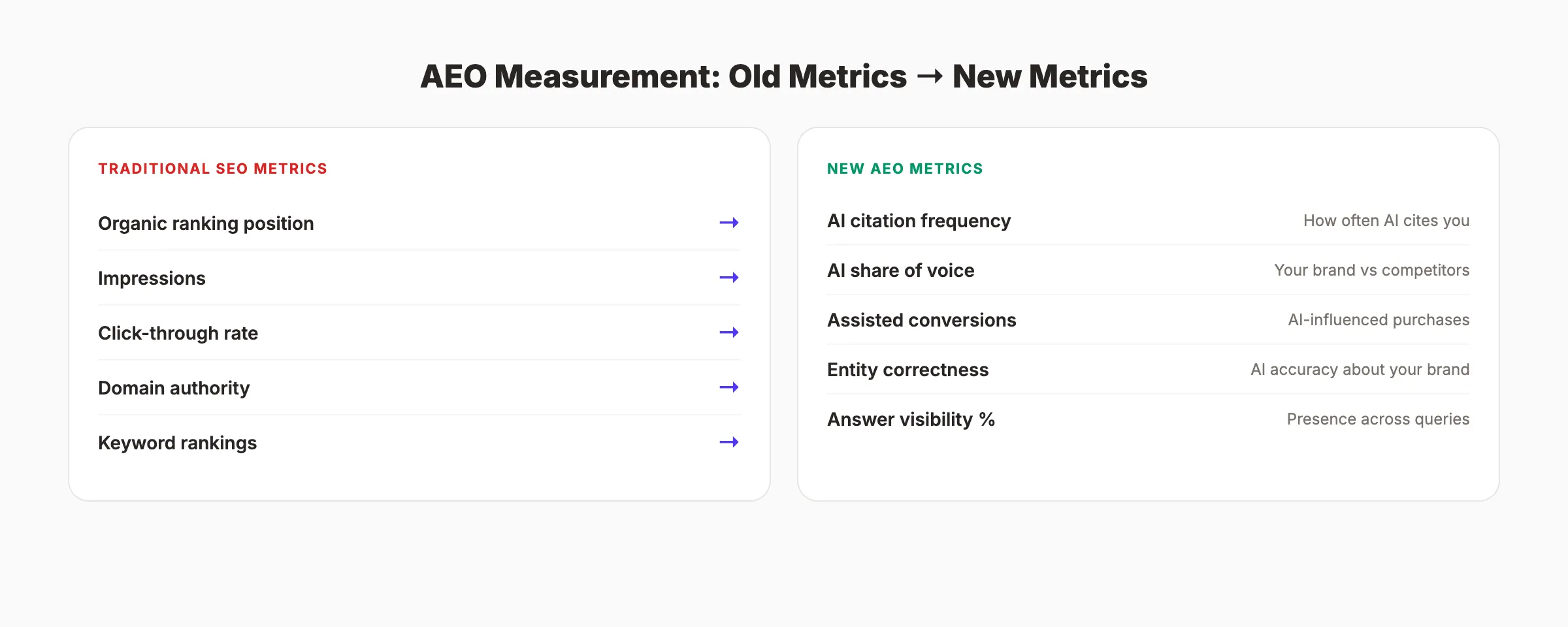
Old Metrics vs. New Metrics
| Traditional SEO Metric | AEO Equivalent |
|---|---|
| Organic ranking position | AI citation frequency |
| Impressions | AI share of voice (your brand vs. competitors in AI answers) |
| Click-through rate | Assisted conversions from AI-influenced sessions |
| Domain authority | Entity correctness and brand sentiment in AI outputs |
| Keyword rankings | Answer visibility percentage across target queries |
What to Track
Featured snippet ownership. Use Google Search Console to monitor which queries show your pages in position 0. Track gains and losses monthly.
AI citation rate. Manually check target queries in ChatGPT, Perplexity, and Google AI Overviews. Note whether your content or brand is cited. Tools like Semrush AI Visibility Index and Ahrefs Brand Radar automate this.
Referral traffic from AI platforms. Google Analytics 4 tracks referral traffic from chat.openai.com, perplexity.ai, and copilot.microsoft.com. Monitor this channel as a separate segment.
Conversion rate from AI referrals. AI-referred visitors convert at 4.4 times the rate of traditional organic. Track this in GA4 to quantify the revenue impact of AEO.
Brand mention frequency. Track how often AI platforms mention your brand when answering queries in your space. Monthly spot-checks across ChatGPT, Perplexity, and Gemini reveal trends.
AEO for Different Content Types
Not every page benefits equally from AEO optimization. Prioritize effort where answer engines are most active.
| Content Type | AEO Value | SEO Value | Best Approach |
|---|---|---|---|
| FAQ / Q&A pages | Very High | Moderate | AEO-first (direct answer extraction) |
| Definition / explainer pages | Very High | High | AEO-first (AI answers these directly) |
| How-to guides | High | High | Both (structure steps for extraction) |
| Product pages | Low | Very High | SEO-first (answer engines rarely cite products) |
| Comparison / best-of lists | High | High | Both equally |
| Local landing pages | Moderate | Very High | SEO + GBP optimization |
| Data / statistics pages | Very High | Moderate | AEO-first (AI loves citable data) |
FAQ and definition pages see the highest AEO returns because answer engines directly extract their content. Product pages see almost zero AEO value because AI rarely cites or recommends specific products outside of shopping-intent queries.
Do You Still Need SEO If You Are Doing AEO?
Yes. And the reverse is also true.
Why SEO Still Matters
40.58% of AI citations come from pages already in Google’s top 10 results. Strong SEO performance creates the authority foundation that AEO amplifies. A page with no organic ranking has far less chance of being cited by an answer engine.
Topical authority built through content clusters improves both SEO rankings and AEO citations. The content investment serves both channels.
Why AEO Cannot Replace SEO
Not all queries trigger answer engines. Product pages, transactional queries, and navigational searches still operate on the traditional click model. A business that optimizes only for AEO misses the 35% of searches that still result in clicks.
The Combined Strategy
| Business Stage | SEO Investment | AEO Investment |
|---|---|---|
| New site (0-12 months) | 80% | 20% |
| Growing site (1-3 years) | 65% | 35% |
| Established site (3+ years) | 50% | 50% |
SEO builds the foundation. AEO captures the growing share of answer-based discovery. Businesses that do both capture the full spectrum of search visibility.
The best approach: write every piece of content for humans first, structure it for answer engines, and optimize the technical layer for both. That is exactly how we optimize the 3,500+ articles we publish across 70+ industries.
Rank everywhere. Do nothing. Blog SEO, Local SEO, and Social Media on autopilot. theStacc starts at $99/mo with a $1 trial. Start for $1 →
FAQ
What is the main difference between AEO and SEO?
SEO optimizes content to rank in traditional search results (10 blue links). AEO optimizes content to appear as a direct answer in featured snippets, AI Overviews, voice assistant responses, and AI search platforms. SEO drives clicks to your site. AEO makes your content the answer users see without clicking.
Is AEO replacing SEO?
No. AEO builds on top of SEO. 40.58% of AI citations come from pages already ranking in Google’s top 10. Strong SEO performance increases the likelihood of being selected as an answer source. Businesses need both: SEO for click-based traffic and AEO for the growing share of zero-click answer queries.
What is the difference between AEO and GEO?
AEO targets direct answers to single queries (featured snippets, voice responses, answer boxes). GEO targets how AI platforms represent your brand across entire conversations and multiple queries. AEO is the narrower, older term focused on answers. GEO is the broader, newer term focused on AI brand representation. Both require structured, citable content.
How do I know if answer engines are citing my content?
Check manually by searching target queries in ChatGPT, Perplexity, and Google AI Overviews. Note whether your content or brand appears. For automated tracking, use Semrush AI Visibility Index, Ahrefs Brand Radar, or specialized tools like Profound.ai and AEO Radar. Track referral traffic from AI platforms in Google Analytics 4.
Does schema markup help with AEO?
Yes. Pages with FAQ schema are 3.2 times more likely to appear in Google AI Overviews. HowTo schema increases citation rates for procedural content. Organization schema strengthens homepage authority signals. Structured data helps every answer engine extract, attribute, and cite your content accurately.
How long does it take to see results from AEO?
AEO results appear faster than SEO. Featured snippet wins can happen within weeks if your page already ranks on page 1. AI citation presence develops within 1-3 months for authoritative content. The challenge: AI citations are volatile. 40-60% of cited sources change monthly, so maintaining AEO visibility requires ongoing content updates.
The Bottom Line
AEO and SEO serve the same goal through different mechanics. SEO earns the click. AEO earns the citation. In a world where 65% of searches end without a click, optimizing only for clicks means ignoring most of the search experience.
Start with SEO as the foundation. Layer AEO on top: direct answer formatting, FAQ schema, question-based headings, statistics with citations, and entity clarity. The content that wins in 2026 is content that ranks, answers, and gets cited.
Start for $1 → 30 articles optimized for search and answer engines
Related Tools & Resources
Free SEO Tools:
Best Lists:

Written by
Siddharth GangalSiddharth is the founder of theStacc and Arka360, and a graduate of IIT Mandi. He spent years watching great businesses lose organic traffic to competitors who simply published more. So he built a system to fix that. He writes about SEO, content at scale, and the tactics that actually move rankings.
30 SEO blog articles published every month
Keyword-optimized, scheduled, and live on your site. Automatically.
30-day trial · Cancel anytime
theStacc
Stop writing SEO content manually
30 blog articles, 30 GBP posts, and social media content. Published every month. Automatically.
Try for free$1 for 3 days · Cancel anytime