
GEO vs SEO: What Changed and What Still Works (2026)
GEO vs SEO explained with data from the Princeton study. See how AI search changes optimization, what still works, and where to invest. Updated March 2026.
Google AI Overviews now appear in 48% of all searches. ChatGPT processes 800 million weekly users. Perplexity handles 10 million daily queries. The question is no longer whether AI search matters. The question is how GEO vs SEO differ, where they overlap, and what your content strategy needs to cover both.
Most guides on this topic treat GEO as a replacement for SEO. That framing is wrong. GEO (Generative Engine Optimization) and SEO (Search Engine Optimization) are not competitors. They are two layers of the same visibility system. One without the other leaves traffic on the table.
We publish 3,500+ articles across 70+ industries, optimized for both traditional search and AI engines. This guide breaks down the real differences, the research, and the practical strategy behind both.
Here is what you will learn:
- The exact differences between GEO and SEO (with a side-by-side comparison)
- What the Princeton research says about which tactics work for AI visibility
- Why keyword stuffing hurts GEO performance (counterintuitive but proven)
- How each AI platform selects and cites content differently
- Where to invest your time and budget between the two
- A combined strategy that covers both traditional and AI search
What Is SEO?
Search Engine Optimization targets traditional search engines. Google, Bing, and Yahoo index web pages, rank them by relevance and authority, and display a list of 10 blue links. The user clicks a result, visits the page, and consumes the content there.
SEO has operated on the same core principles since the late 1990s:
- Keywords signal topical relevance
- Backlinks signal authority and trust
- Technical optimization ensures crawlability and speed
- Content quality keeps users engaged
- User experience reduces bounce rates
The SEO market exceeds $80 billion and drives the majority of organic web traffic. For most businesses, SEO remains the primary source of inbound leads. The mechanics are well understood, and the results compound over time.
What Is GEO?
Generative Engine Optimization targets AI search platforms. ChatGPT, Google AI Overviews, Perplexity, Gemini, and Microsoft Copilot do not show a list of links. They generate a direct answer and sometimes cite the sources that informed it.
GEO is the practice of making your content citable by AI. The goal is not a #1 ranking. The goal is being the source the AI chooses to quote, cite, or recommend when answering a user question.
The term GEO was introduced by researchers at Princeton, Georgia Tech, and IIT Delhi in a 2023 paper that tested 9 optimization methods across 10,000 queries. The research was accepted at KDD 2024, the top conference in data science.
GEO operates on different signals than SEO:
- Entity clarity matters more than keyword density
- Citations and statistics boost visibility more than backlinks
- Structured, extractable content outperforms keyword-optimized prose
- Third-party mentions across the web build AI recognition
- Content freshness is weighted more heavily by real-time AI engines
For a deeper breakdown of GEO tactics, see our generative engine optimization guide.
GEO vs SEO: Head-to-Head Comparison
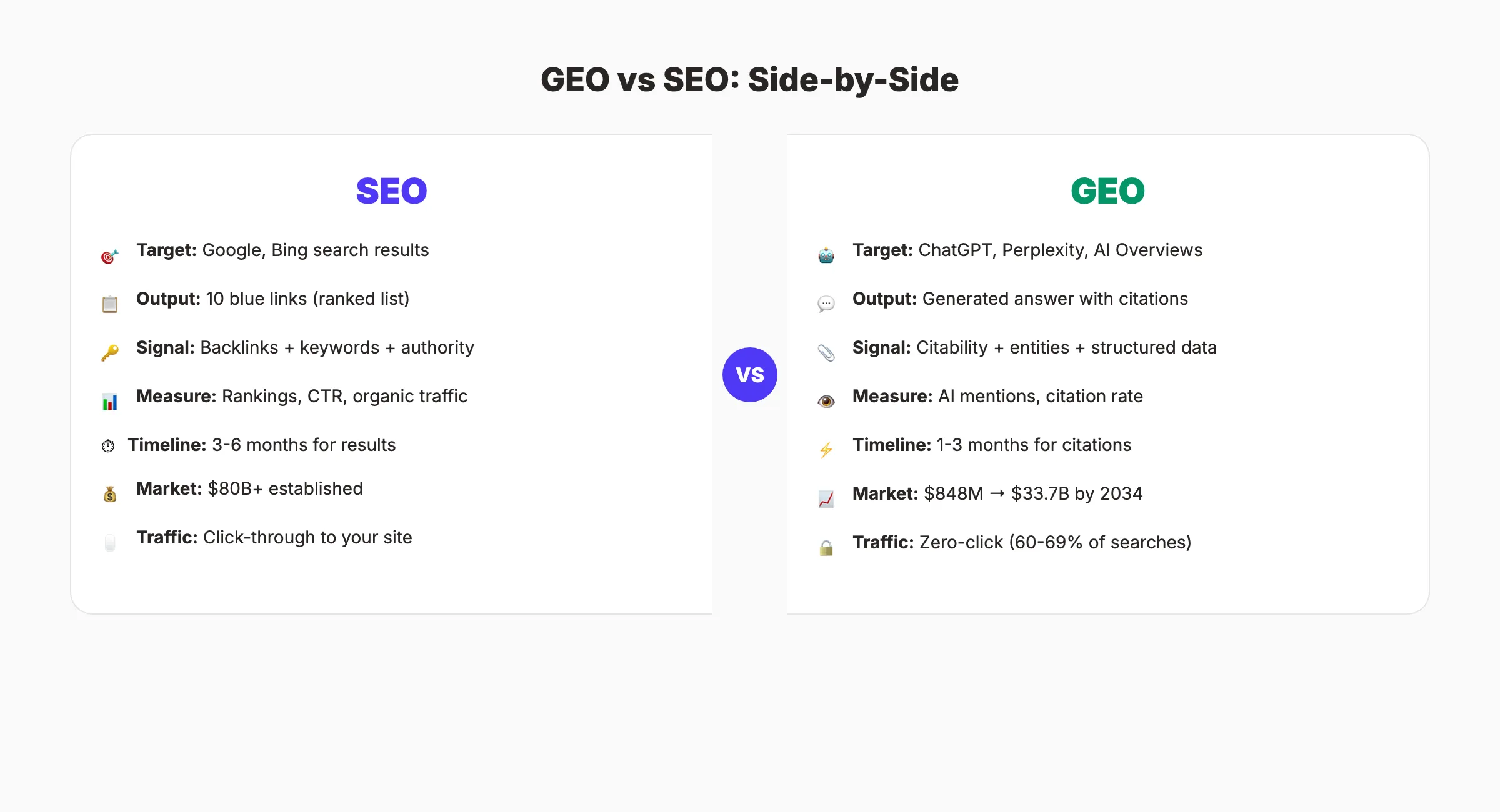
| Factor | SEO | GEO |
|---|---|---|
| Target | Google, Bing search results | ChatGPT, Perplexity, AI Overviews, Gemini, Copilot |
| Output format | 10 blue links (ranked list) | Generated answer with optional citations |
| User behavior | Click a link, visit the page | Read the answer in the AI interface |
| Query format | Short keywords (avg 4 words) | Conversational prompts (avg 23 words) |
| Session depth | Quick scan, fast clicks | 6-minute average sessions |
| Primary ranking signal | Backlinks + relevance + authority | Citability + entity clarity + structured data |
| Content format | Keyword-optimized pages | Extractable, quotable passages |
| Measurement | Rankings, CTR, organic traffic | AI mentions, citation rate, brand visibility |
| Traffic model | Click-through to your site | Zero-click answers (60-69% of searches) |
| Time to results | 3-6 months for meaningful rankings | 1-3 months for citation presence |
| Market maturity | $80B+ established industry | $848M in 2025, projected $33.7B by 2034 |
The fundamental difference: SEO drives users to your page. GEO gets your content into the answer itself.
Stop writing. Start ranking. theStacc publishes 30 optimized articles per month for $99. Every piece is optimized for both traditional search and AI engines. Start for $1 →
What the Princeton Research Proved
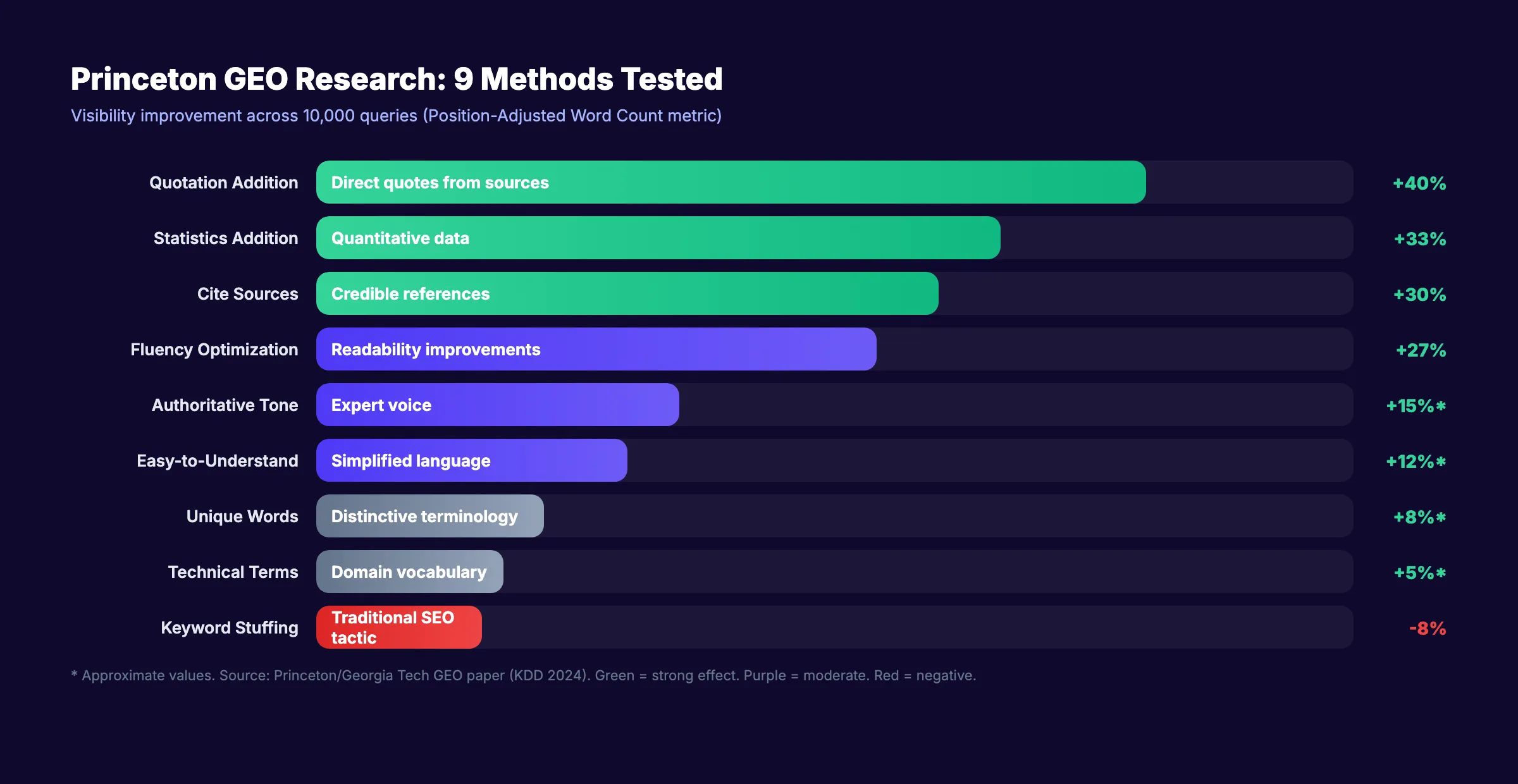
The Princeton/Georgia Tech study tested 9 GEO optimization methods across 10,000 search queries and measured their impact on AI visibility. The results challenged several long-held SEO assumptions.
The 9 Methods Tested (Ranked by Effectiveness)
| Method | What It Does | Visibility Impact |
|---|---|---|
| Quotation Addition | Add direct quotes from authoritative sources | +40% |
| Statistics Addition | Replace qualitative claims with quantitative data | +33% |
| Cite Sources | Add relevant citations from credible references | +30% |
| Fluency Optimization | Improve text readability and flow | +27% |
| Authoritative Tone | Enhance persuasive, expert voice | Positive (varies) |
| Easy-to-Understand | Simplify language and improve clarity | Positive |
| Unique Words | Add distinctive terminology | Moderate |
| Technical Terms | Include domain-specific vocabulary | Moderate |
| Keyword Stuffing | Increase keyword density (traditional SEO tactic) | -8% (harmful) |
Three Critical Findings
1. Keyword stuffing actively hurts AI visibility. The core mechanic of traditional SEO (optimizing for keyword density) produced an 8% decline in GEO performance. AI engines penalize content that reads like it was written for a search algorithm rather than a human reader.
2. Citations and statistics are the strongest signals. Adding direct quotes (+40%), quantitative data (+33%), and source citations (+30%) produced the largest visibility gains. AI engines prefer content they can verify and attribute.
3. Lower-ranked sites benefit more. Pages ranked 5th or lower in Google results saw a 115% improvement when applying GEO techniques. Traditional SEO favors incumbents. GEO creates an opening for newer sites that produce high-quality, citable content.
The Princeton findings mean that a page ranking #8 on Google with strong citations and statistics can outperform a page ranking #1 in AI search results. GEO democratizes visibility in a way SEO never did.
Where GEO and SEO Overlap
GEO does not replace SEO. The two strategies share a foundation that makes them complementary rather than competitive.
Shared Foundations
Content quality matters for both. Google rewards expertise and depth. AI engines cite content that demonstrates authority. The standard is the same: write genuinely useful content backed by evidence.
E-E-A-T applies to both. Experience, Expertise, Authoritativeness, and Trustworthiness influence Google rankings and AI citation decisions. A page with strong E-E-A-T signals performs well in both systems.
Technical optimization serves both. Fast load times, clean HTML structure, proper heading hierarchy, and mobile responsiveness matter for Google crawling and AI extraction. Server-side rendering ensures both search bots and AI crawlers can access your content.
Structured data helps both. Schema markup tells Google what your content is about. It also helps AI engines understand entities, relationships, and facts on your page. JSON-LD structured data is readable by both systems.
The Critical Overlap
40.58% of AI citations come from pages already in Google’s top 10 results. Strong SEO performance gives your content a higher baseline probability of being cited by AI. SEO is the foundation. GEO is the layer on top.
Where GEO and SEO Conflict
Despite the overlap, optimizing for one can sometimes work against the other. Understanding these conflicts prevents wasted effort.
Keyword Strategy
SEO rewards keyword placement in titles, headings, URLs, and body text. GEO penalizes keyword stuffing and rewards conversational, natural language. The resolution: use primary keywords in structural elements (title, H1, URL) but write body content conversationally.
Content Length and Density
SEO often rewards longer content (2,000-5,000 words) packed with keyword variations. AI engines extract short, quotable passages. Pages cited most by ChatGPT average 20,000+ characters, but AI extracts from the first third: 44.2% of citations come from the opening sections.
The resolution: write long, authoritative content for SEO. Front-load your most citable facts, statistics, and definitions in the first 30% of the article.
Link Building vs. Brand Mentions
SEO values backlinks as the primary authority signal. GEO values brand mentions across the web, even without hyperlinks. Unlinked mentions on Reddit, Quora, industry forums, and review sites influence how AI engines recognize and recommend your brand.
The resolution: pursue both. Build traditional backlinks for SEO. Also invest in brand presence on discussion forums, social platforms, and third-party review sites for GEO.
Click-Through vs. Zero-Click
SEO depends on users clicking through to your site. GEO often resolves the query without a click. Between 60-69% of searches now end without a click. Being cited in an AI Overview does not guarantee traffic.
The silver lining: pages cited in AI Overviews receive 35% more organic clicks than pages that appear in regular results but are not cited. Citation drives awareness that converts later.
How Each AI Platform Selects Content Differently
One of the biggest mistakes in GEO is treating all AI platforms the same. Each engine has different retrieval methods, data sources, and citation preferences.
Platform Comparison
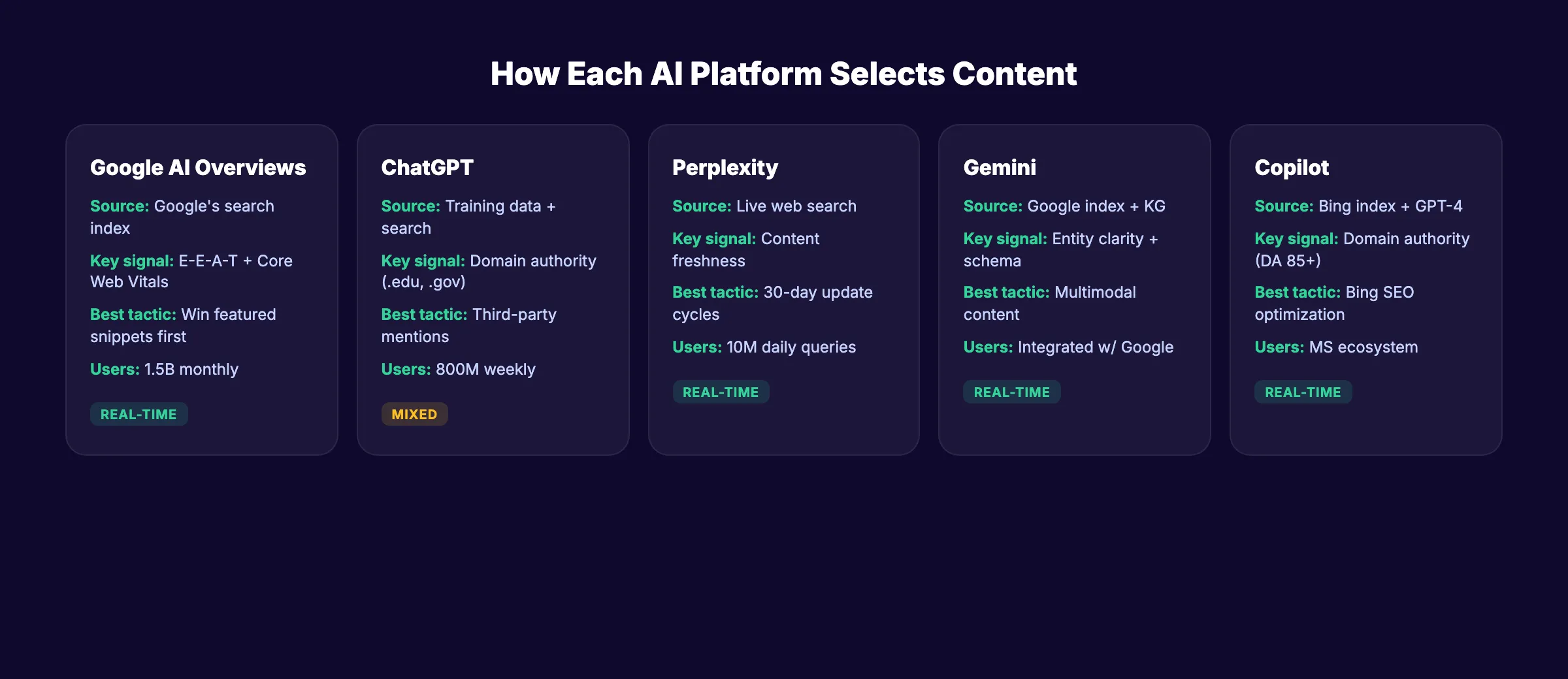
| Platform | Data Source | Citation Style | Update Frequency | Key Signal |
|---|---|---|---|---|
| Google AI Overviews | Google’s existing search index | Inline source links | Real-time (tied to index) | E-E-A-T + Core Web Vitals |
| ChatGPT | Training data + real-time search (SearchGPT) | Inline citations with links | Mixed (training + live) | Authority domains (.edu, .gov, Wikipedia) |
| Perplexity | Real-time web search every query | Mandatory inline citations | Real-time | Content freshness + structured data |
| Gemini | Google’s index + Knowledge Graph | Source attribution | Real-time | Multimodal schema + entity clarity |
| Copilot | Bing’s index + GPT-4 | Inline references | Real-time | Domain authority (DA 85+) |
Platform-Specific Tactics
For Google AI Overviews: Optimize for featured snippets first. Pages that win featured snippets are 3x more likely to be cited in AI Overviews. Use question-answer formatting, clear definitions, and numbered lists.
For ChatGPT: Focus on third-party authority signals. Sites with 32,000+ referring domains are 3.5x more likely to be cited. Build presence on Wikipedia, industry publications, and educational resources. ChatGPT leans heavily on training data, so historical authority matters.
For Perplexity: Content freshness is a direct ranking factor. Update key pages within 30-day cycles. Perplexity searches the live web for every query, making recency more important than on any other platform. Add “Last Updated” timestamps visibly.
For Gemini: Multimodal content wins. Add ImageObject, VideoObject, and AudioObject schema. Gemini processes images and video alongside text, giving rich-media pages an advantage. Also strong on Knowledge Graph entities.
Your SEO team. $99/month. 30 optimized articles published automatically. Every piece built for both Google rankings and AI citations. Start for $1 →
The Numbers: GEO Traffic vs. SEO Traffic
The conversion data makes a strong case for investing in both channels.
Traffic Quality Comparison
| Metric | Traditional SEO Traffic | AI Search Traffic |
|---|---|---|
| Average conversion rate | 2.8% | 14.2% |
| Session depth | Quick scan | 6-minute average |
| Query specificity | Broad keywords | Detailed, intent-rich prompts |
| User trust level | Variable (depends on brand recognition) | Higher (AI-endorsed recommendation) |
| Year-over-year growth | Flat to declining (mature market) | +527% (2024-2025) |
AI-referred visitors convert at 5x the rate of traditional organic visitors. The reason: AI queries are longer, more specific, and further down the decision funnel. Someone asking ChatGPT “what is the best scheduling tool for a 3-person marketing team under $50/month” has clearer intent than someone searching “social media tools.”
The Zero-Click Problem
Zero-click searches now represent 60-69% of all Google queries. AI Overviews correlate with a 58% lower CTR for the top-ranking page. Organic CTR for position #1 drops to just 2.6% when an AI Overview is present.
This does not mean SEO is dead. It means SEO alone is insufficient. Businesses that rank well in traditional search AND get cited in AI responses capture the full spectrum of visibility.
Citation Volatility
One underreported reality: 40-60% of AI-cited sources change from month to month. Unlike SEO rankings (which tend to be relatively stable), AI citations are volatile. A source cited by ChatGPT this month may not appear next month.
The implication: GEO requires ongoing optimization. It is not a set-and-forget strategy. Regular content updates, fresh statistics, and consistent brand mentions across the web maintain citation presence.
How to Build a Combined GEO + SEO Strategy
The most effective approach treats GEO and SEO as a unified strategy with shared foundations and complementary tactics.
The Combined Optimization Checklist
Foundation (serves both SEO and GEO):
- Clean site architecture with logical heading hierarchy
- Schema markup on all key pages (Article, FAQ, Organization, Product)
- Fast page load times (LCP under 2.5 seconds)
- Server-side rendering (not JavaScript-dependent content)
- E-E-A-T signals: author bios, credentials, editorial standards
- Mobile-responsive design
SEO-Specific Additions:
- Primary keyword in title, H1, URL, and meta description
- Internal linking between topically related content
- Backlink acquisition from high-authority domains
- Topical authority through content clusters
- Core Web Vitals optimization
- Regular content decay audits and refreshes
GEO-Specific Additions:
- Front-load key facts, definitions, and statistics in the first 30% of content
- Add direct quotes from authoritative sources
- Include quantitative data with source citations
- Write in question-answer format where appropriate
- Build brand mentions on Reddit, Quora, LinkedIn, and industry forums
- Allow AI crawler access in
robots.txt(OAI-SearchBot, PerplexityBot, ClaudeBot) - Add
llms.txtfile to your site root - Monitor AI citations monthly using tools like Otterly.ai or Ahrefs Brand Radar
Budget Allocation: Where to Invest
For most businesses in 2026, the split should look like this:
| Business Stage | SEO Investment | GEO Investment |
|---|---|---|
| New site (0-12 months) | 80% | 20% |
| Growing site (1-3 years) | 65% | 35% |
| Established site (3+ years) | 55% | 45% |
SEO remains the larger investment because it drives more total traffic and has a proven compound effect. GEO allocation increases over time as AI search platforms grow and as your site builds the authority foundation that GEO amplifies.
The exception: SaaS companies and tech brands should weight GEO more heavily (40-50% even early on) because their audiences adopt AI search tools faster. 35% of Gen Z uses AI tools first for research, compared to 19% of millennials and 7% of Gen X.
GEO vs SEO for Different Content Types
Not all content benefits equally from GEO optimization. Prioritize GEO effort where it has the highest return.
| Content Type | SEO Value | GEO Value | Priority Strategy |
|---|---|---|---|
| Definition/explainer pages | High | Very High | GEO-first (AI answers these directly) |
| Best-of/comparison lists | High | Very High | Both equally (43.8% of ChatGPT citations are best-of listicles) |
| How-to guides | High | High | SEO-first, GEO-optimize intro and steps |
| Product pages | Very High | Low | SEO-focused (AI rarely cites product pages) |
| Local landing pages | Very High | Moderate | SEO + GBP optimization |
| Data/research pages | Moderate | Very High | GEO-first (AI loves citable statistics) |
| Blog posts | High | High | Both equally |
| FAQ pages | Moderate | Very High | GEO-first (direct answer extraction) |
Rank everywhere. Do nothing. Blog SEO, Local SEO, and Social Media on autopilot. theStacc starts at $99/mo with a $1 trial. Start for $1 →
FAQ
What is the main difference between GEO and SEO?
SEO optimizes content to rank in traditional search engine results (10 blue links). GEO optimizes content to be cited and recommended by AI search platforms (ChatGPT, Perplexity, Google AI Overviews). SEO drives clicks to your site. GEO gets your content into the AI-generated answer itself.
Does GEO replace SEO?
No. GEO builds on top of SEO. 40.58% of AI citations come from pages already in Google’s top 10 results. Strong SEO performance creates the foundation for GEO success. Businesses that do both capture 60-70% of available search visibility, according to industry research.
Will ranking well on Google get my content cited in AI answers?
Not automatically. Fewer than 10% of sources cited by ChatGPT, Gemini, and Copilot rank in Google’s top 10 for the same query. SEO ranking helps, but GEO requires additional optimization: structured data, statistics, citations, entity clarity, and brand mentions across the web.
How do I know if AI engines are citing my content?
Use monitoring tools like Otterly.ai, Ahrefs Brand Radar, or manual spot-checks in ChatGPT, Perplexity, and Google AI Overviews. Search for your brand name, product names, and key topics. Track which queries mention or cite your pages over time.
How long does it take to see results from GEO?
GEO results appear faster than SEO. Citation presence can develop within 1-3 months for pages with strong authority signals. The caveat: AI citations are volatile. 40-60% of cited sources change month to month. Maintaining GEO visibility requires ongoing content updates and brand monitoring.
Is keyword stuffing bad for GEO?
Yes. The Princeton research showed that keyword stuffing produces an 8% decline in AI visibility. AI engines penalize content that reads like it was written for algorithms. Conversational writing with embedded statistics, quotes, and source citations outperforms keyword-dense content for GEO.
The Bottom Line
GEO and SEO are not enemies. They are layers. SEO captures the 40% of searches that still produce clicks. GEO captures the growing share of queries answered by AI. Businesses that optimize for one and ignore the other will lose visibility to competitors who do both.
Start with SEO as the foundation. Layer GEO tactics on top: front-loaded statistics, source citations, entity clarity, and cross-platform brand mentions. The content that performs best in 2026 is the content written for humans, structured for machines, and citable by AI.
Start for $1 → 30 articles optimized for search and AI
Related Tools & Resources
Free SEO Tools:
Best Lists:

Written by
Siddharth GangalSiddharth is the founder of theStacc and Arka360, and a graduate of IIT Mandi. He spent years watching great businesses lose organic traffic to competitors who simply published more. So he built a system to fix that. He writes about SEO, content at scale, and the tactics that actually move rankings.
30 SEO blog articles published every month
Keyword-optimized, scheduled, and live on your site. Automatically.
30-day trial · Cancel anytime
theStacc
Stop writing SEO content manually
30 blog articles, 30 GBP posts, and social media content. Published every month. Automatically.
Start Your $1 Trial$1 for 3 days · Cancel anytime