
Zero-Click Search: What It Is and How It Affects SEO
80% of searches end without a click. Learn what zero-click search means for your SEO strategy and how to adapt. Updated for 2026.
80% of all Google searches now end without a single click to any website. That number was 65% in 2020. It climbs every year and it will not reverse.
Zero-click search is the single biggest shift in SEO this decade. If your strategy still revolves around ranking #1 and collecting clicks, you are optimizing for a model that is disappearing. Google answers more queries directly on the results page through featured snippets, knowledge panels, People Also Ask boxes, local packs, and now AI Overviews. The click never happens.
This does not mean SEO is dead. It means SEO has changed. The businesses that adapt will capture visibility, brand recognition, and leads from zero-click results. The ones that do not will watch their traffic decline while wondering what went wrong.
We have published 3,500+ blog posts across 70+ industries and track zero-click trends across every one. This guide covers everything you need to know about zero-click search, why it matters, and exactly how to adapt your strategy.
Here is what you will learn:
- What zero-click search actually is (and the SERP features that cause it)
- The latest zero-click statistics broken down by device and query type
- How AI Overviews are accelerating the zero-click trend
- 8 strategies to win visibility without relying on clicks
- How to measure success in a zero-click world
- Which industries are most affected and what to do about it
What Is Zero-Click Search?
A zero-click search happens when a user gets the answer they need directly on the search results page without clicking through to any website. Google provides the answer itself through SERP features.
The most common zero-click SERP features:
| SERP Feature | What It Shows | Example Query |
|---|---|---|
| Featured Snippet | Direct answer in a box at position 0 | ”what is domain authority” |
| Knowledge Panel | Entity info card on the right side | ”Apple Inc” |
| People Also Ask | Expandable question boxes | ”how to fix a leaky faucet” |
| Local Pack / Map Pack | Top 3 local business results with map | ”dentist near me” |
| AI Overview | AI-generated summary at top of page | ”best way to remove mold” |
| Instant Answer | Calculator, weather, time, conversions | ”USD to EUR” |
| Image / Video Carousel | Visual results at the top | ”yoga poses for beginners” |
In each case, the user sees the information they need without leaving Google. The search is complete. No click.
Why Google Wants Zero-Click Results
Google’s business model depends on keeping users on Google. The longer users stay, the more ads they see. Every zero-click result is a success from Google’s perspective. It means the user got their answer fast and stayed within the Google ecosystem.
This is not a bug. It is a deliberate product strategy. Google has invested billions in knowledge graphs, featured snippets, and AI Overviews specifically to answer queries without sending users elsewhere.
Understanding this motivation is important. Google will not reverse this trend. They will accelerate it. Your SEO strategy must account for this reality.
Zero-Click Search Statistics (2026)
The data tells a stark story. Zero-click searches are not a niche concern. They are the majority of all search activity.
Overall Zero-Click Rates
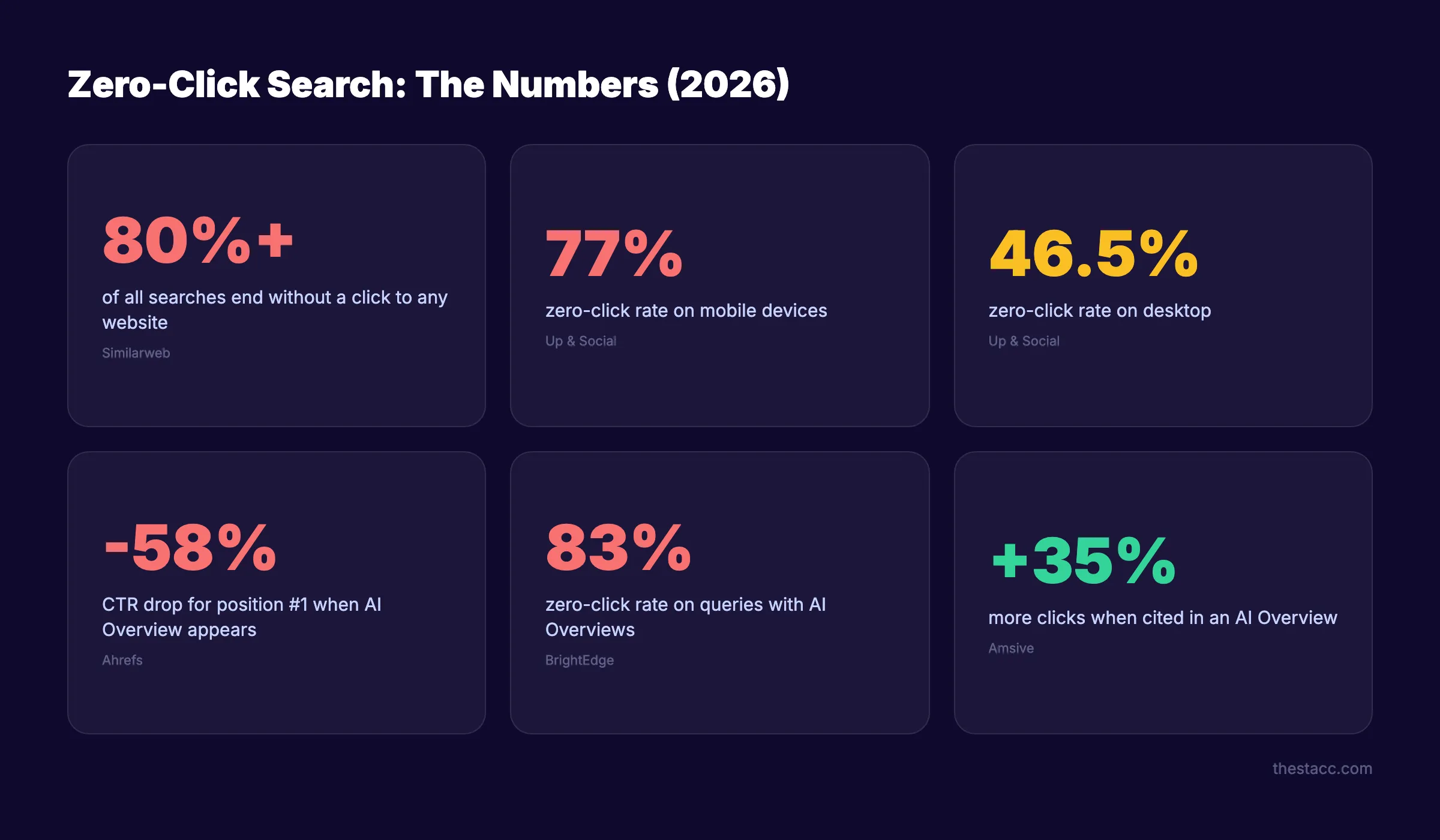
- Over 80% of all searches end without a click to any website (Similarweb, 2025-2026)
- 58.5% of US searches and 59.7% of EU searches result in zero clicks (SparkToro)
- For every 1,000 US Google searches, only 360 clicks reach the open web
- 80% of consumers rely on zero-click results for 40%+ of their searches (Bain & Company)
Mobile vs. Desktop
The gap between devices is enormous:
| Device | Zero-Click Rate | Why |
|---|---|---|
| Mobile | 77% | Smaller screens, local intent, voice queries |
| Desktop | 46.5% | More research intent, larger screen shows more results |
Mobile users are 66% more likely to experience a zero-click result. Since over 60% of all searches happen on mobile, this skews the overall zero-click rate heavily upward.
Year-Over-Year Trend
| Year | Zero-Click Rate |
|---|---|
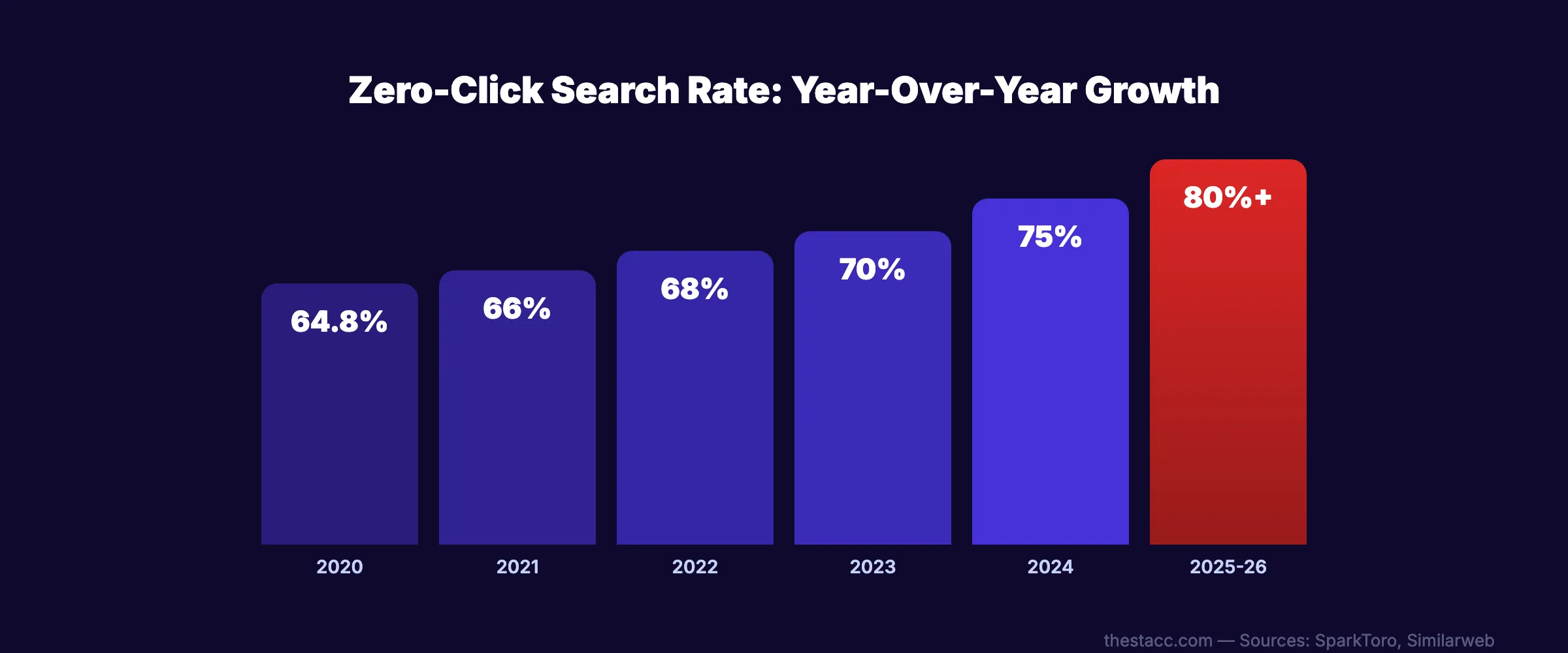
| 2020 | 64.8% |
| 2021 | 66% |
| 2022 | 68% |
| 2023 | 70% |
| 2024 | 75% |
| 2025-2026 | 80-85% |
The trend line is clear. Zero-click rates have increased every single year for 6 years. The introduction of AI Overviews in 2024-2025 accelerated the curve.
Stop writing. Start ranking. Stacc publishes 30 optimized SEO articles per month for $99. Start for $1 →
How AI Overviews Are Accelerating Zero-Click
AI Overviews are the biggest accelerant of zero-click search since featured snippets launched in 2014. Google now generates AI-written summaries at the top of search results for a growing percentage of queries.
The AI Overview Numbers
- AI Overviews now appear on 30%+ of all queries, up from 6.49% in January 2025
- Queries with AI Overviews have an 83% zero-click rate compared to 60% without
- AI Overviews reduce position #1 CTR by 58% (Ahrefs, December 2025)
- Only 1% of users click on sources cited within AI Overviews
- Being cited in an AI Overview delivers 35% more organic clicks compared to not being cited
That last stat is critical. While AI Overviews reduce total clicks, the sites that get cited within them actually benefit. The question is no longer “how do I rank #1?” It is “how do I get cited in the AI Overview?”
What Gets Cited in AI Overviews
Google’s AI pulls from content that is:
- Well-structured with clear headings, lists, and tables
- Directly answering specific questions in 1-2 sentences
- Data-backed with statistics, numbers, and specific claims
- From authoritative sources with strong E-E-A-T signals
- Freshly updated with current dates and recent data
For a full strategy on appearing in AI Overviews, read our guide on optimizing for Google AI Overviews.
Which Query Types Are Most Affected
Not all searches are equally affected by zero-click. Understanding which queries lose clicks helps you focus your strategy.
Zero-Click Rates by Query Type
| Query Type | Zero-Click Rate | Example |
|---|---|---|
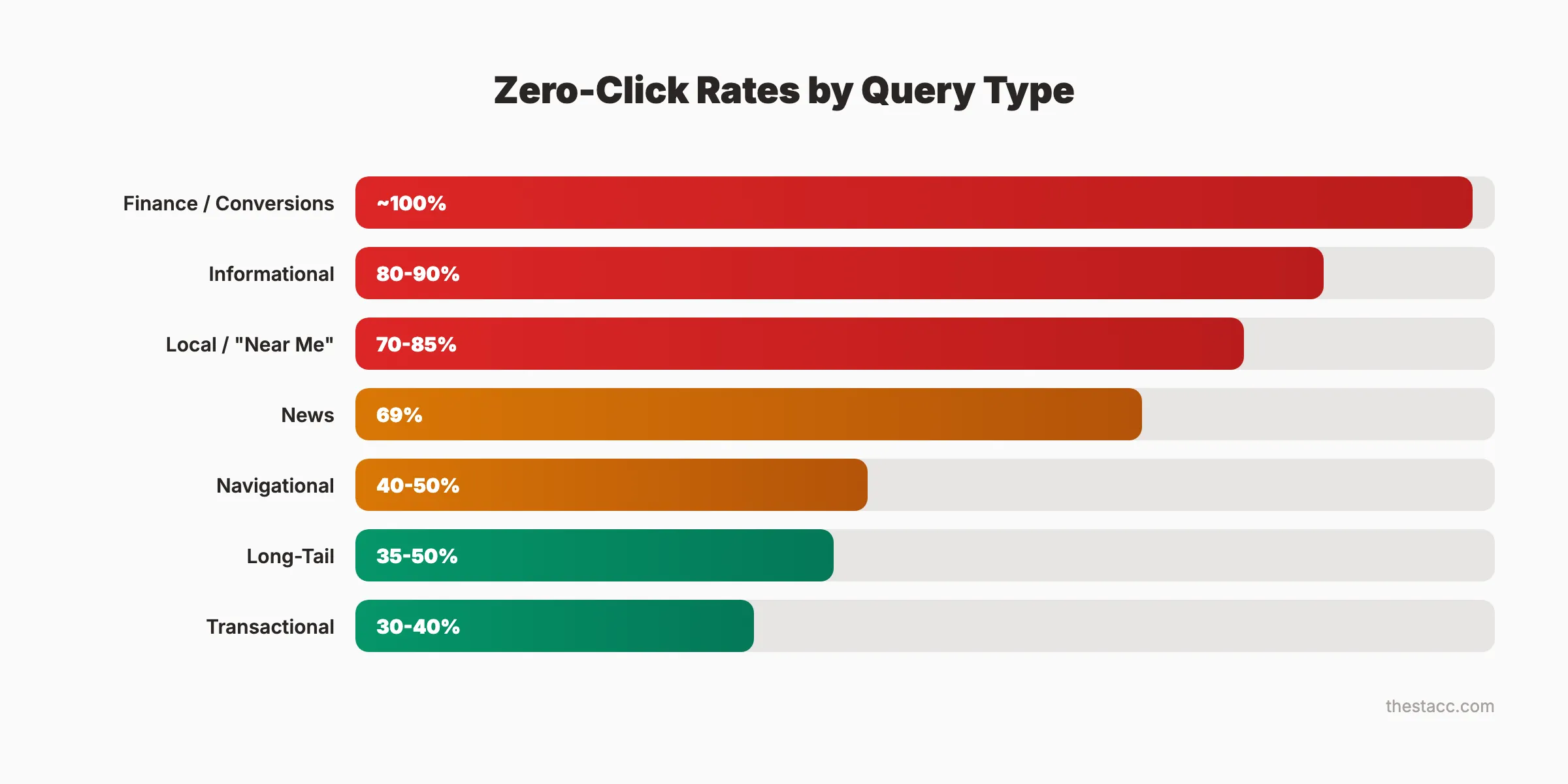
| Informational | 80-90% | “what is SEO” |
| Local / “near me” | 70-85% | “pizza near me” |
| Finance / conversions | ~100% | “100 USD to EUR” |
| Weather / time | ~100% | “weather in Dallas” |
| News | 69% | “latest Google update” |
| Navigational | 40-50% | “Facebook login” |
| Transactional | 30-40% | “buy running shoes” |
| Long-tail | 35-50% | “best CRM for 5-person team” |
The pattern is clear. Simple, factual, and local queries have the highest zero-click rates. Complex, commercial, and purchase-intent queries still generate clicks.
Industries Most Affected
High impact: Healthcare (symptom queries answered in snippets), local services (map pack answers the need), publishing and media (news snippets), finance (instant answers for rates and conversions).
Moderate impact: B2B and SaaS (complex purchase cycles still drive clicks), professional services (trust-dependent decisions require website visits).
Lower impact: E-commerce (product searches still drive clicks to stores), travel (booking requires clicking through).
The takeaway: if your business relies on informational or local queries for traffic, zero-click is hitting you hard right now. If you target commercial or transactional queries, you have more runway.
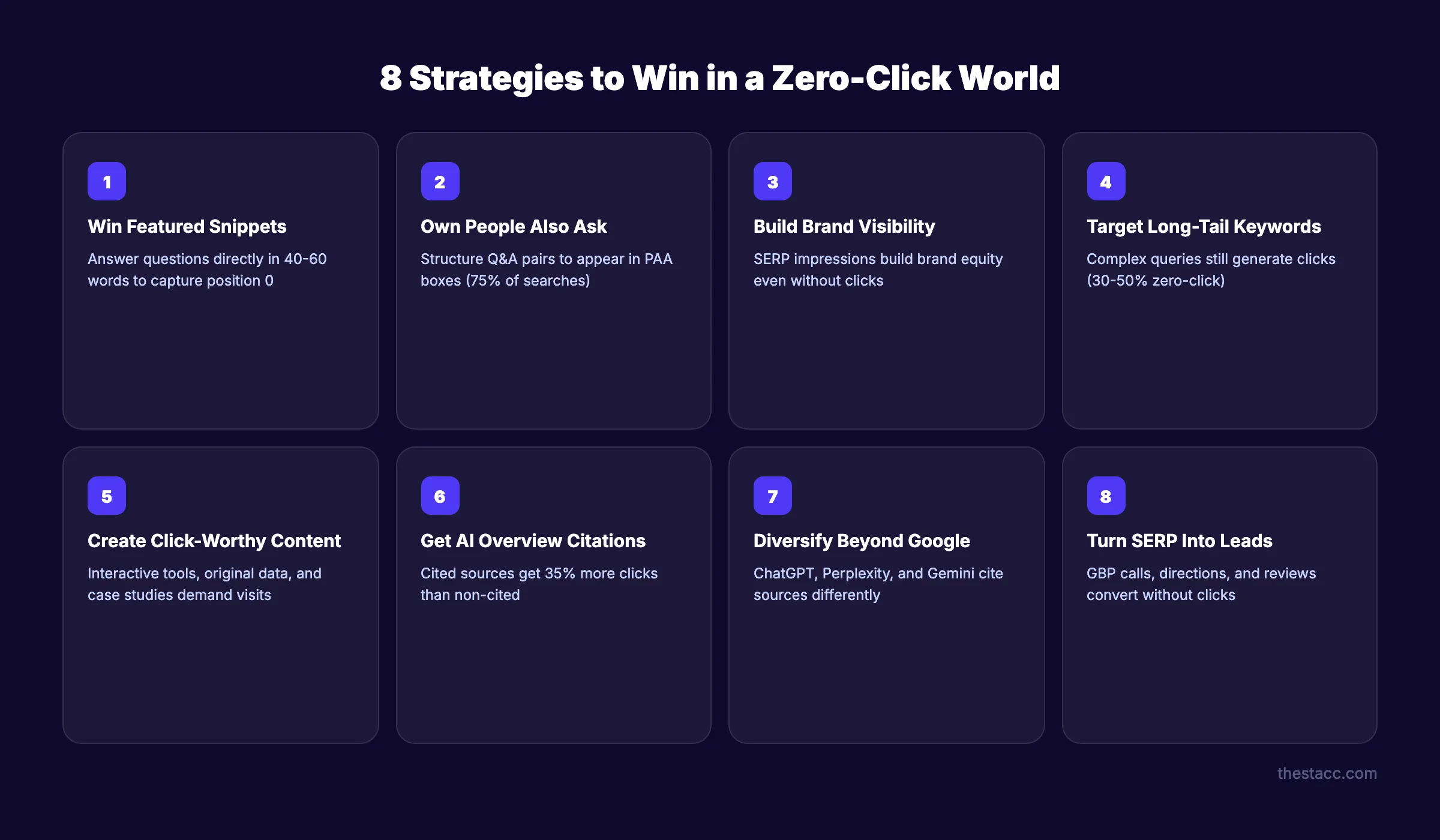
8 Strategies to Win in a Zero-Click World
Zero-click search does not mean SEO is useless. It means SEO requires a different approach. Here are 8 strategies that work.
1. Optimize for Featured Snippets
Featured snippets steal clicks from organic results, but they also give you position 0 visibility. If a zero-click result is going to happen anyway, your content should be the one Google pulls from.
To win featured snippets:
- Answer the target question directly in 40-60 words
- Use the question as an H2 or H3 heading
- Follow the answer with detailed supporting content
- Match the snippet format (paragraph, list, or table) that Google currently shows
Read our full guide on getting featured snippets for a step-by-step process.
2. Own the People Also Ask Boxes
People Also Ask boxes appear in 75% of all searches and 92% of informational queries. Each PAA expansion is a micro-impression for your brand.
To appear in PAA:
- Structure content as clear question-and-answer pairs
- Use the exact question phrasing that appears in PAA
- Keep answers concise (2-3 sentences), then expand
- Target 5-8 related questions per blog post
See our guide on optimizing for People Also Ask.
3. Build Brand Visibility, Not Just Traffic
In a zero-click world, brand impressions matter as much as clicks. A user who sees your brand name in a featured snippet, AI Overview, or knowledge panel 10 times will search for you directly.
Branded search is the antidote to zero-click. When someone searches “Stacc SEO” instead of “SEO service,” that search almost always results in a click. Build brand visibility by:
- Appearing consistently in SERP features for your topic cluster
- Creating original data and frameworks that get cited
- Publishing content that earns mentions across other sites
- Maintaining a strong Google Business Profile for local brand presence
4. Target Long-Tail and Transactional Keywords
Simple queries get zero-click answers. Complex queries still drive clicks. Shift your keyword strategy toward:
- Long-tail queries with specific modifiers (“best CRM for real estate teams under $50/month”)
- Comparison queries (“HubSpot vs Salesforce for small business”)
- Decision-stage queries (“is [product] worth it for [use case]”)
- Cost and pricing queries (“how much does SEO cost per month”)
These queries are too nuanced for a SERP feature to answer fully. Users click through to get the depth they need. Use our keyword research guide to find these opportunities.
Your SEO team. $99 per month. 30 optimized articles published automatically. No writers. No agencies. Start for $1 →
5. Create Content That Demands a Click
Some content formats are inherently resistant to zero-click because they cannot be summarized in a snippet:
- Interactive tools (calculators, analyzers, generators)
- Original research with charts and data visualizations
- Step-by-step tutorials with screenshots
- Case studies with real results and specific numbers
- Comparison tables that are too large for a snippet
The goal is to create value that only exists on your page. A 10-row comparison table or a dynamic calculator cannot be replicated in a featured snippet. The user must click.
6. Optimize for AI Overview Citations
AI Overviews are the new featured snippets. Getting cited in them is the new position 0. To increase your citation chances:
- Structure content with clear H2/H3 hierarchy
- Include specific numbers and data points
- Write direct answers to questions in the first sentence of each section
- Use schema markup (FAQ, HowTo, Article)
- Build topical authority by publishing depth across a topic cluster
Our generative engine optimization guide covers this in full detail.
7. Diversify Beyond Google
Google is not the only search engine. AI search platforms like ChatGPT, Perplexity, and Gemini are growing fast. These platforms cite sources differently than Google, often with direct links.
To appear in AI search results:
- Make your content accessible to AI crawlers
- Structure data clearly (tables, lists, FAQ)
- Build authority signals (reviews, citations, backlinks)
- Create an
llms.txtfile for AI discoverability
Read our guide on how AI search is changing SEO for platform-specific strategies.
8. Turn SERP Visibility Into Calls and Leads
For local businesses, zero-click search is not entirely negative. A user who calls your business from a Google Map Pack result without visiting your website is still a lead. A user who gets directions from your Google Business Profile is still a customer.
Optimize for zero-click conversions:
- Complete every field in your GBP (phone, hours, address, services)
- Add click-to-call buttons that work from SERP results
- Ensure your GBP has current photos and weekly posts
- Build review volume (reviews display directly in search results)
- Use schema markup to show ratings, prices, and availability in search
How to Measure Success in a Zero-Click World
Traditional SEO metrics focused on clicks and traffic. In a zero-click world, those metrics tell an incomplete story. You need new KPIs.
New Metrics That Matter
| Metric | What It Measures | Where to Find It |
|---|---|---|
| Search impressions | How often you appear in results | Google Search Console |
| SERP feature ownership | Which snippets, PAA, AI Overviews you own | Rank tracker + manual audit |
| Branded search volume | Direct searches for your brand name | Google Search Console / Trends |
| Click-through rate by query | Which queries still generate clicks | Google Search Console |
| GBP actions | Calls, directions, website clicks from GBP | GBP Insights |
| AI citation count | How often AI Overviews cite your content | Manual tracking / third-party tools |
| Share of SERP | Total real estate you occupy on page 1 | Manual audit |
Practical Tracking Setup
Step 1: In Google Search Console, compare impressions vs. clicks over time. A rising impression count with stable or declining clicks indicates zero-click growth in your niche.
Step 2: Track branded search volume monthly. If impressions are high and branded searches are growing, your zero-click visibility is building brand equity even without clicks.
Step 3: Monitor GBP Insights for call volume, direction requests, and website clicks. These are zero-click conversions. A user who calls from the Map Pack never visited your site but still became a lead.
Step 4: Set up Google Analytics 4 conversion tracking for calls, form submissions, and chat interactions. Measure the leads that reach your site, not just the traffic volume.
3,500+ blogs published. 92% average SEO score. See what Stacc can do for your site. Start for $1 →
Adapting Your Content Strategy
Zero-click search demands a shift in how you plan and create content. The old model was: research keywords, write a blog post, rank, get clicks. The new model is more nuanced.
The Information Layer Cake Approach
Think of your content in layers:
Layer 1 (SERP layer): A concise, direct answer that Google can pull into a snippet or AI Overview. This builds brand visibility even when users do not click.
Layer 2 (Click layer): Deeper analysis, original data, interactive elements, or detailed steps that require a page visit. This captures the users who need more than the snippet.
Layer 3 (Conversion layer): Clear CTAs, lead magnets, tools, or consultations that turn visitors into customers.
Most content only has Layer 1. The best content has all 3.
Content Formats That Resist Zero-Click
| Format | Why It Works |
|---|---|
| Original research with data | Cannot be fully summarized in a snippet |
| Interactive tools and calculators | Require page visit to use |
| Case studies with screenshots | Visual proof demands click-through |
| Template downloads | User must visit to access |
| Long-form comparisons (5+ items) | Too detailed for a snippet |
| Video walkthroughs | Cannot be consumed in text snippet |
Publishing Frequency Still Matters
Zero-click does not reduce the value of consistent publishing. More content means more SERP impressions, more snippet opportunities, and more brand visibility. The Content Compound Effect applies even when individual post click rates decline.
The Future of Zero-Click Search
Zero-click rates will continue climbing. Here is what to expect.
Short-Term (2026-2027)
- AI Overviews will expand to 50%+ of queries
- Voice search (already 27% of queries) will push mobile zero-click rates above 85%
- Google will add more interactive elements (forms, booking, comparisons) directly in search
- New metrics and tools for measuring SERP visibility will emerge
Medium-Term (2027-2029)
- AI chatbots (ChatGPT, Perplexity, Gemini) will capture 15-20% of search market share
- Google may face regulatory pressure (EU DMA, US antitrust) to send more traffic to publishers
- Brand authority will become the dominant ranking signal as generic content gets commoditized by AI
- Businesses that built brand equity through zero-click visibility will dominate their niches
What This Means for Your Strategy
Stop measuring SEO success by traffic alone. Start measuring by visibility, brand searches, and conversions. Build content that serves both the SERP layer and the click layer. Invest in brand building, original research, and interactive content that cannot be replicated in a snippet.
The businesses that thrive in a zero-click world are the ones that treat every SERP impression as a brand touchpoint, not just a potential click.
Rank everywhere. Do nothing. Blog SEO, Local SEO, and Social on autopilot. Start for $1 →
FAQ
What percentage of Google searches are zero-click?
Over 80% of all Google searches end without a click to any website as of 2025-2026. On mobile devices, the rate reaches 77%. On desktop, 46.5%. The rate has increased every year since 2020 and shows no signs of slowing.
Are zero-click searches bad for SEO?
Not necessarily. Zero-click searches change what SEO success looks like, but they do not eliminate it. Appearing in featured snippets, AI Overviews, and knowledge panels builds brand visibility. The key is adapting your strategy from click-focused to visibility-focused.
How do I optimize for zero-click search?
Target featured snippets by answering questions directly in 40-60 words. Optimize for People Also Ask boxes. Create content that gets cited in AI Overviews. Build brand visibility through consistent SERP presence. Use schema markup to display rich results. Shift to long-tail and transactional keywords that still generate clicks.
Does zero-click search affect local businesses differently?
Yes. Local businesses can benefit from zero-click because Google Map Pack results often drive phone calls and direction requests without a website visit. A complete Google Business Profile with reviews, photos, and accurate information converts directly from the SERP.
How do I measure SEO success if clicks are declining?
Track search impressions (not just clicks) in Google Search Console. Monitor branded search volume growth. Measure GBP actions (calls, directions, website clicks). Track AI Overview citations. Use share of SERP as a visibility metric. Focus on conversion rate from the traffic you do receive.
Will zero-click search get worse?
Yes. AI Overviews are expanding to more queries, voice search continues growing, and Google is adding more interactive SERP features. By 2027, zero-click rates are projected to exceed 85% for most query types. The trend is structural and will not reverse.
Zero-click search is not a problem to solve. It is a reality to adapt to. The businesses that treat every SERP impression as a brand moment, create content that demands a click, and measure visibility alongside traffic will win. The ones waiting for zero-click to go away will keep waiting.
Every article you publish is another chance to appear in a featured snippet, an AI Overview, or a People Also Ask box. The visibility compounds. And when a user finally does click, they are clicking on a brand they have already seen a dozen times.
Skip the agency. Keep the results. Stacc starts at $99/mo with a $1 trial. Start for $1 →

Written by
Siddharth GangalSiddharth is the founder of theStacc and Arka360, and a graduate of IIT Mandi. He spent years watching great businesses lose organic traffic to competitors who simply published more. So he built a system to fix that. He writes about SEO, content at scale, and the tactics that actually move rankings.
30 SEO blog articles published every month
Keyword-optimized, scheduled, and live on your site. Automatically.
30-day trial · Cancel anytime
theStacc
Stop writing SEO content manually
30 blog articles, 30 GBP posts, and social media content. Published every month. Automatically.
Start Your $1 Trial$1 for 3 days · Cancel anytime