
How AI Search Is Changing SEO: The Complete Guide (2026)
How AI search is changing SEO in 2026. Covers AI Overviews, zero-click trends, GEO tactics, and the strategies that drive visibility now. Updated March 2026.
SEO used to mean one thing: rank on Google, get clicks, drive traffic. That model is breaking. AI search engines now answer questions directly on the results page. They summarize your content, cite it, or skip it entirely.
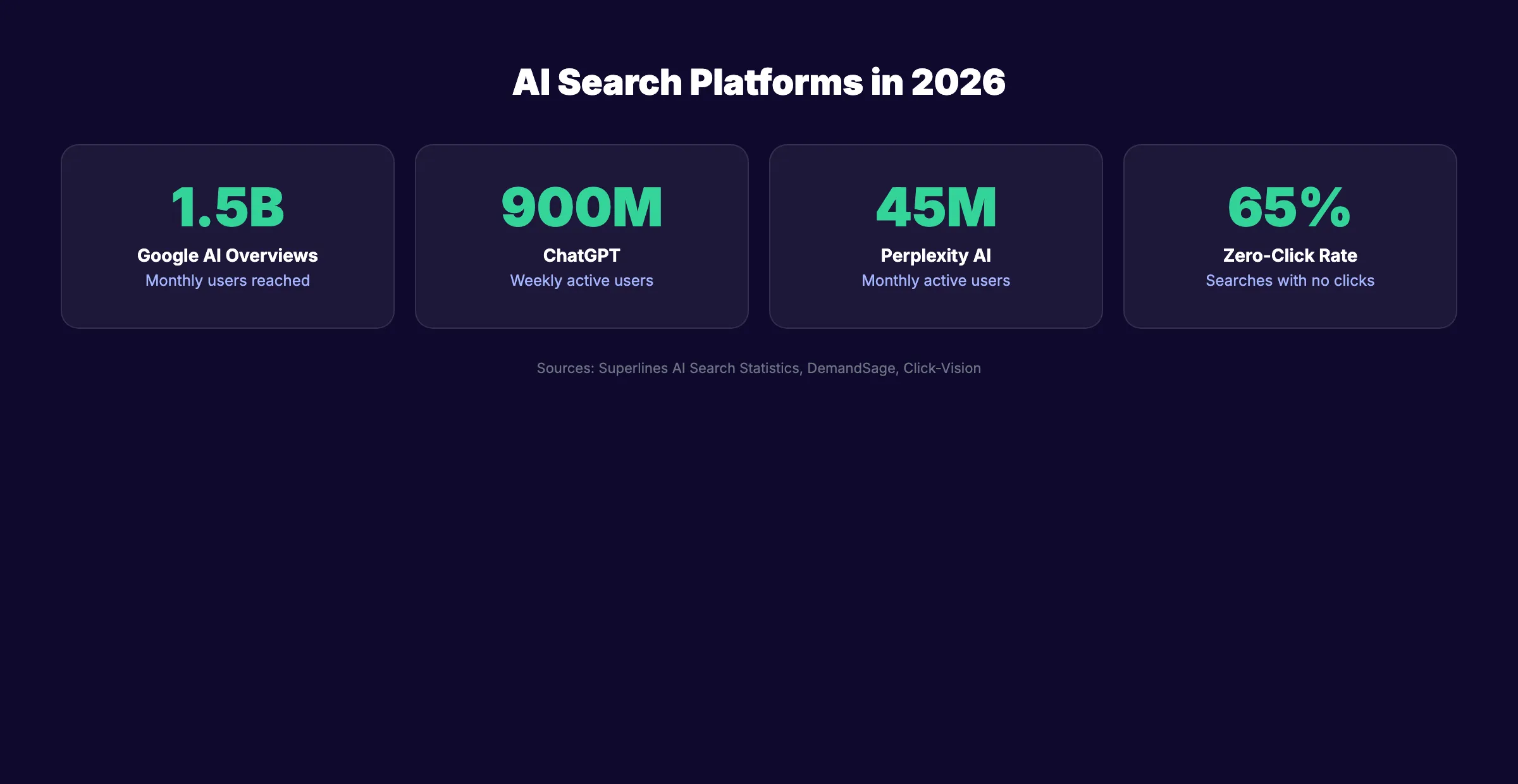
Google AI Overviews reach 1.5 billion monthly users. ChatGPT serves 900 million weekly active users. Perplexity processed 780 million search queries in a single month. Zero-click searches now exceed 65% of all queries. These numbers reshape every assumption about how organic search works.
This guide explains how AI search is changing SEO and what to do about it. We publish 3,500+ articles across 70+ industries and track AI visibility metrics daily. Every tactic here comes from real data, not speculation.
Here is what you will learn:
- What AI search engines are and how they differ from traditional search
- The exact statistics showing how AI search is reshaping click behavior
- Why traditional SEO and AI search optimization are splitting into 2 separate disciplines
- The 7 tactics that drive AI search visibility right now
- How to measure whether AI search engines cite your content
- What agentic search means for SEO strategy in late 2026 and beyond
Chapter 1: What AI Search Actually Is
AI search is not a feature update. It is a fundamental change in how people find information online.
Traditional search shows 10 blue links. The user clicks one, reads the page, and decides. AI search skips that step. It reads dozens of pages, synthesizes the information, and delivers a direct answer at the top of the results page.
The Major AI Search Engines
Four platforms now dominate AI-assisted search.
Google AI Overviews appear on approximately 25% of all Google searches. They show an AI-generated summary above the organic results. For informational queries, that number jumps to over 70%. Google also launched AI Mode, a deeper conversational search experience.
ChatGPT Search lets users ask questions and receive sourced answers. With 900 million weekly active users, ChatGPT drives 87.4% of all AI referral traffic to websites. It is the single largest source of AI-referred visits.
Perplexity AI processed 780 million queries in May 2025. That number tripled in under 12 months. Perplexity cites sources inline with every answer, making it a direct traffic driver for well-optimized content.
Google Gemini operates as both a standalone assistant and a layer within Google Search. It handles complex, multi-step queries that traditional search struggles with.
How AI Search Differs From Traditional Search
The core difference is simple. Traditional search retrieves pages. AI search retrieves answers.
| Feature | Traditional Search | AI Search |
|---|---|---|
| Result format | 10 blue links | Direct answer with citations |
| User action | Click, read, decide | Read answer, maybe click source |
| Ranking signal | Backlinks, on-page SEO | Authority, clarity, citation-worthiness |
| Traffic model | Click-through rate | Citation rate + brand visibility |
| Query length | 2-4 words | 8+ words, conversational |
Queries with 8 or more words are 7x more likely to trigger AI Overviews. Users are asking longer, more specific questions because AI can handle them.
This shift changes what “ranking” even means. Visibility now includes being cited in an AI answer, not just holding position 1 in organic results.
AI search is rewriting the rules of SEO visibility. Stacc publishes optimized content across 70+ industries, built for both traditional and AI search. Start for $1 →
Chapter 2: The Numbers Behind AI Search Growth
The growth of AI search is not gradual. It is exponential. Every major metric moved sharply upward between 2024 and 2026.
User Adoption Statistics
| Platform | Monthly Active Users | Growth Rate |
|---|---|---|
| Google AI Overviews | 1.5 billion | Present in 200+ countries |
| ChatGPT | 883 million monthly users | 900M weekly active users |
| Perplexity AI | 45 million monthly active users | 800% year-over-year growth |
| Google Gemini | Integrated into Google Search | Available across all Google products |
ChatGPT holds 64.5% market share among generative AI platforms. That dominance shapes where AI-referred traffic originates.
Query Volume Growth
Perplexity alone grew from 230 million queries in mid-2024 to 780 million by May 2025. That is a 3x increase in under a year.
Google AI Overviews went from appearing on 13.14% of searches in March 2025 to 25.11% one year later. At this pace, AI-generated answers will appear on the majority of informational searches by late 2026.
AI Referral Traffic
AI referral traffic now accounts for 1.08% of all website traffic and grows approximately 1% month over month. That sounds small until you consider the scale. For a site receiving 100,000 monthly visits, that is 1,080 visits from AI sources alone, and growing.
ChatGPT drives 87.4% of that AI referral traffic. Perplexity drives most of the remainder. Google AI Overviews send minimal direct referral traffic because users stay within Google.
The trend is clear. AI search user bases are expanding rapidly. Query volumes are doubling and tripling. And websites that earn AI citations capture a growing share of a new traffic source.
Chapter 3: How AI Overviews Are Reshaping Click Behavior
The most disruptive change is what happens to clicks. AI Overviews do not just add a new element to search results. They absorb the clicks that used to go to organic listings.
Zero-Click Search Rates
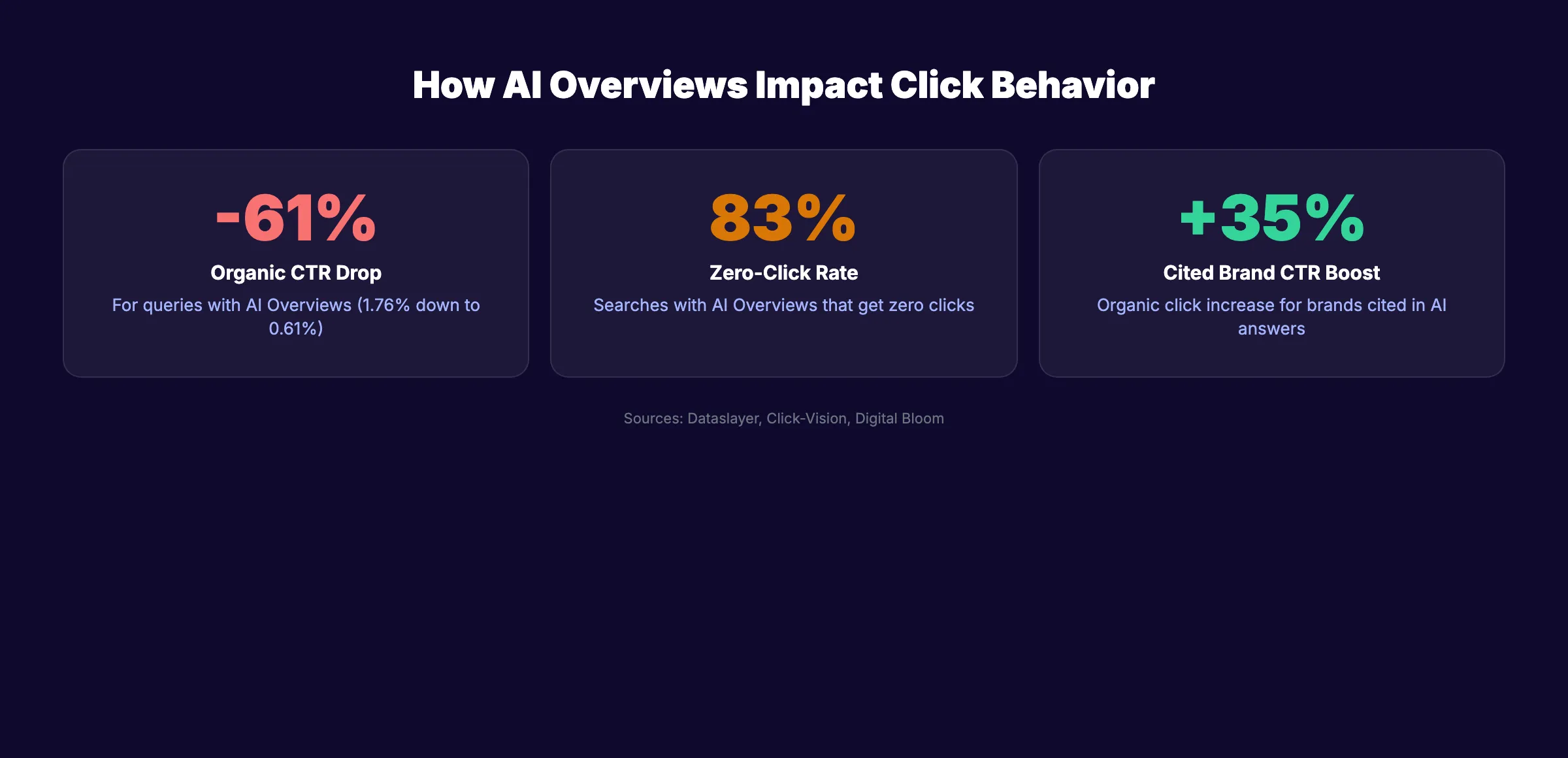
Zero-click searches now exceed 65% in Q1 2026, up from 58% in November 2025. For queries that trigger AI Overviews specifically, the zero-click rate hits 80-83%.
Google AI Mode sessions are even more extreme. 93% of AI Mode sessions end without a single click to an external website.
Mobile search amplifies this. Approximately 81% of AI Overview triggers happen on mobile devices, where screen space makes the AI answer even more dominant.
CTR Impact on Organic Results
Organic click-through rates dropped 61% for queries with AI Overviews, falling from 1.76% to 0.61%. That is a steep decline.
Some websites report search traffic drops of 20-40% since AI Overviews expanded. News publishers took the hardest hit. Organic visits fell from 2.3 billion in mid-2024 to under 1.7 billion by mid-2025 across major publishers.
The Citation Advantage
There is a counterbalance. Brands cited in AI Overviews earn 35% more organic clicks than those not cited. Being named as a source in an AI answer actually boosts your traditional organic performance.
This creates a two-tier system. Cited brands gain both AI visibility and organic traffic. Uncited brands lose clicks to the AI answer and get nothing in return.
| Scenario | Organic CTR Impact | AI Visibility |
|---|---|---|
| Cited in AI Overview | +35% organic clicks | High. Named as source |
| Not cited, but ranking | -61% organic CTR | None |
| Not ranking at all | Zero organic traffic | Zero AI visibility |
The message is straightforward. Getting cited in AI search results is now as important as ranking in position 1.
Your content should work in both traditional and AI search. Stacc writes content optimized for citations, structured data, and organic rankings. Start for $1 →
Chapter 4: The Split Between Traditional SEO and AI Search Optimization
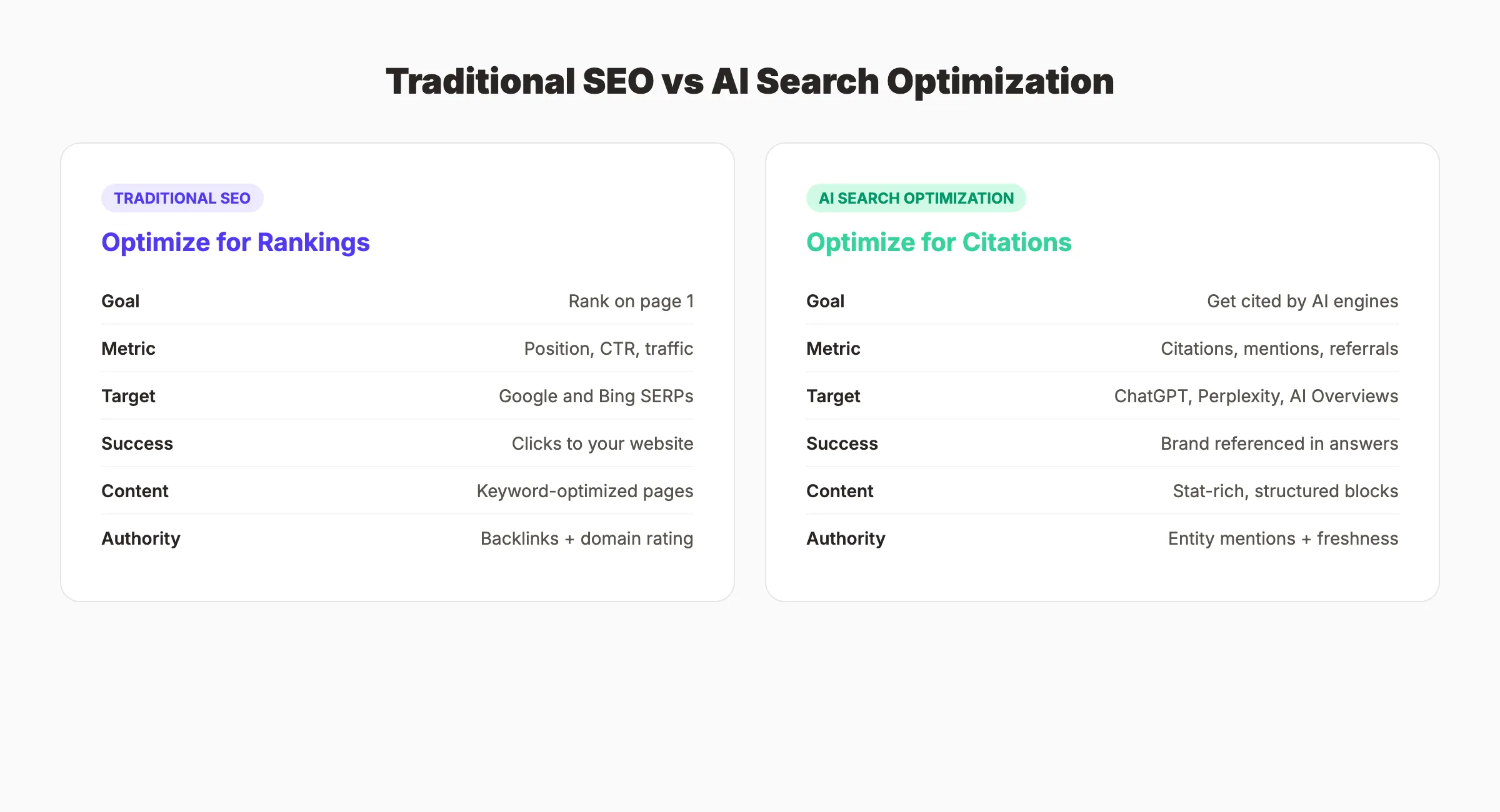
SEO is splitting into two distinct disciplines. Mike King, CEO of iPullRank, called this out directly: treating traditional SEO and AI search optimization as the same strategic problem is a mistake.
Traditional SEO: Still Necessary
Traditional SEO drives clicks from humans who browse, compare, and buy. These searchers want to visit websites. They click through product pages, read reviews, and fill out forms.
For commercial and transactional queries, traditional SEO remains the primary driver. AI Overviews appear on only 7% of local searches and have limited presence in product comparison queries.
The fundamentals still matter. On-page SEO, technical site health, internal linking, and topical authority continue to drive organic rankings.
AI Search Optimization: The New Discipline
AI search optimization focuses on making your content machine-readable, citable, and authoritative enough for AI engines to reference.
This is closer to what the industry calls Generative Engine Optimization (GEO). It requires different tactics.
| Traditional SEO | AI Search Optimization |
|---|---|
| Keyword placement | Entity clarity and structured data |
| Backlink building | Source authority and citation signals |
| Meta tags and titles | Machine-readable content formats |
| CTR optimization | Citation rate optimization |
| Page speed | Crawlability for AI bots |
Where the Two Overlap
Both disciplines reward the same core qualities: authoritative content, clear structure, factual accuracy, and strong brand signals.
Schema markup helps both Google and AI engines understand your content. XML sitemaps make your pages discoverable by both traditional and AI crawlers. Quality content earns both organic rankings and AI citations.
The overlap is significant. But the tactical execution differs. A page optimized only for traditional SEO may never appear in an AI answer. A page optimized only for AI citation may not rank in organic results.
Smart SEO strategy addresses both. You build topical authority with consistent content publishing. You structure that content for AI readability with clear headings, cited statistics, and proper schema. And you make your site technically accessible to both traditional crawlers and AI crawlers.
Chapter 5: What AI Search Engines Want From Your Content
AI search engines pull from content that meets specific criteria. Understanding those criteria is the difference between getting cited and getting ignored.
Authority and Trust Signals
AI engines favor content from authoritative sources. High-traffic sites earn 3x more citations than low-traffic sites. Brand mentions, backlink profiles, and domain reputation all influence whether an AI engine trusts your content enough to cite it.
This is why E-E-A-T matters more than ever. AI engines evaluate expertise, experience, authoritativeness, and trustworthiness before selecting sources.
Content Freshness
Content updated within the last 2 months earns 28% more AI citations than older content. AI engines prioritize recent information because users expect current answers.
This means updating old blog posts is not just a traditional SEO tactic. It directly affects your AI search visibility.
Structural Clarity
AI engines parse content structurally. They need clear headings, defined sections, and logical organization to extract accurate answers.
Best practices for AI-readable content:
- Use descriptive H2 and H3 headings that state the topic
- Front-load key information in each section
- Include direct, concise answers to common questions
- Use tables and lists for data and comparisons
- Add schema markup for FAQs, how-tos, and articles
- Define terms before using them
Factual Specificity
AI engines prefer content with specific data points, named sources, and verifiable claims. Vague statements get skipped. Precise statistics with citations get quoted.
Write “organic CTR dropped 61% for queries with AI Overviews” instead of “click rates have decreased.” The specific version is citable. The vague version is not.
Crawl Access
Your content must be accessible to AI crawlers. Many sites block AI bots without realizing it. Review your robots.txt configuration and consider implementing an llms.txt file to guide AI engines directly.
Stacc writes content built for AI citation and organic rankings. Every article follows structured data standards, freshness protocols, and authority-building frameworks. Start for $1 →
Chapter 6: 7 Tactics That Drive AI Search Visibility
These are the specific tactics that earn citations in AI search results. They work across Google AI Overviews, ChatGPT, Perplexity, and Gemini.
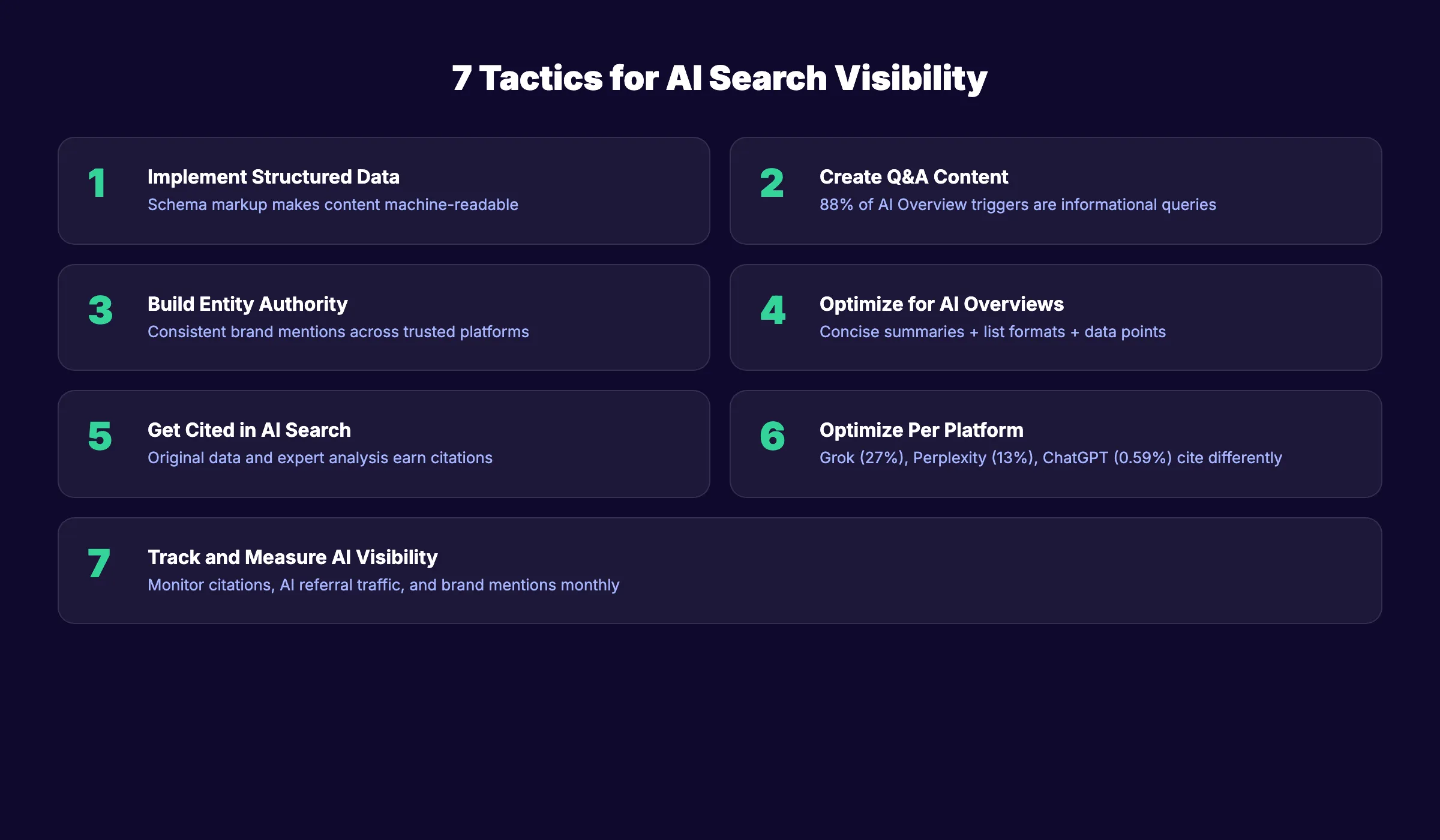
1. Implement Structured Data Across Your Site
Schema markup tells AI engines exactly what your content covers. Article schema, FAQ schema, HowTo schema, and Organization schema all improve machine readability. Use the schema markup generator to build structured data for every key page.
2. Create Question-and-Answer Content
88% of keywords triggering AI Overviews are informational intent. AI engines look for direct answers to direct questions. Structure content around specific questions your audience asks. Place the answer immediately after the question heading. This format aligns with how AI engines extract information.
Target the questions people actually search. Optimize for People Also Ask boxes and use those questions as H2 and H3 headings.
3. Build Entity Authority
AI search engines think in entities, not keywords. An entity is a clearly defined concept: a brand, a person, a product, a topic. Build your entity profile by:
- Publishing consistently on your core topics
- Getting mentioned on authoritative third-party sites
- Maintaining accurate information across all platforms
- Using consistent naming and terminology
Reddit is now cited in 40% of AI-generated responses. Building authentic presence on platforms that AI engines trust amplifies your entity signals.
4. Optimize for AI Overviews Specifically
Google AI Overviews have their own optimization playbook. Write concise, factual summaries at the top of key pages. Use list formats for multi-step processes. Include data points that AI Overviews can easily extract and present.
5. Get Cited in AI Search Results
Getting cited in AI search requires content that AI engines trust and can attribute. Include original data, unique analysis, or expert perspectives that AI models cannot generate on their own.
Citation sustainability matters too. Only 56.7% of brands that earn a citation maintain it across multiple AI sessions. Consistent publishing and content updates maintain citation persistence.
6. Optimize for Each Platform Separately
Different AI platforms cite differently. Grok cites sources at a 27% rate. Perplexity cites at 13%. ChatGPT cites at under 1%. Each platform has different preferences.
Optimize for Perplexity with well-sourced, factual content. Use ChatGPT strategically by understanding what types of content it pulls from.
7. Track and Measure AI Visibility
You cannot improve what you do not measure. Track your AI search visibility across platforms. Monitor which pages get cited, how often, and in response to which queries.
Use Google Search Console to track referral traffic from AI sources. Set up monitoring for brand mentions in AI responses. Compare your citation rate against competitors.
Chapter 7: How to Measure AI Search Performance
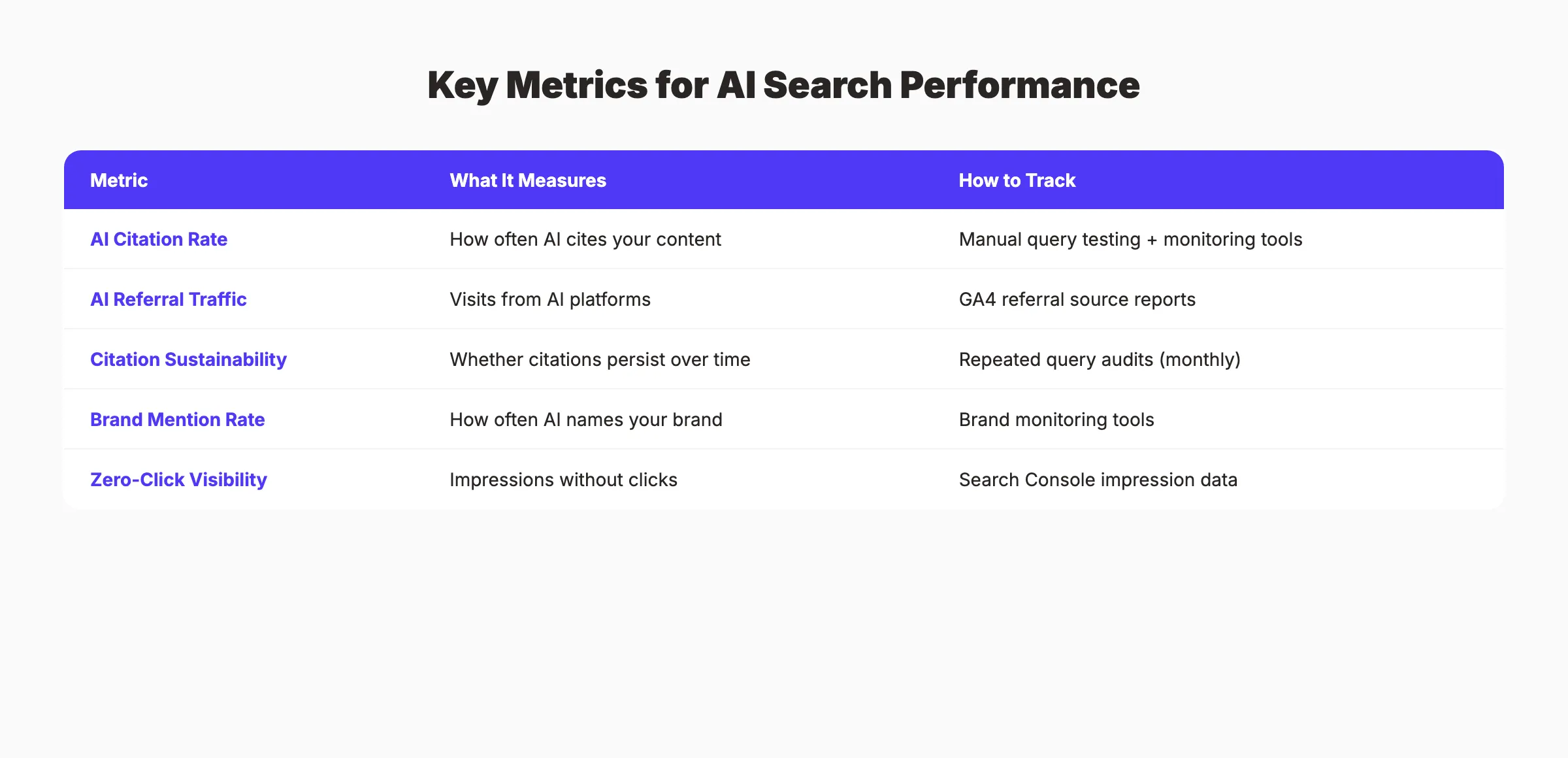
Traditional SEO metrics do not capture AI search performance. You need new measurements alongside the existing ones.
Metrics That Matter Now
| Metric | What It Measures | How to Track |
|---|---|---|
| AI citation rate | How often AI engines cite your content | Manual monitoring + third-party tools |
| AI referral traffic | Visits from AI search platforms | Google Analytics 4 referral reports |
| Citation sustainability | Whether citations persist over time | Repeated query testing |
| Brand mention frequency | How often AI engines name your brand | Brand monitoring tools |
| Zero-click visibility | Impressions without clicks that still build awareness | Search Console impression data |
Setting Up AI Traffic Tracking
Google Analytics 4 tracks referral traffic from ChatGPT, Perplexity, and other AI platforms. Create a custom segment for AI referral sources to isolate this traffic.
Key referral sources to monitor:
- chat.openai.com (ChatGPT)
- perplexity.ai (Perplexity)
- gemini.google.com (Gemini)
- copilot.microsoft.com (Copilot)
Running Citation Audits
Test your AI visibility manually. Enter 10-15 key queries into each major AI platform. Document which brands and pages get cited. Note whether your content appears, is partially quoted, or is absent entirely.
Repeat this test monthly. Track changes in citation frequency. Compare results after content updates or new publishing efforts.
Connecting AI Visibility to Revenue
AI search visibility affects revenue through 3 channels.
Direct referral traffic. Visitors who click through from AI citations. This is measurable in GA4.
Indirect brand lift. Users who see your brand cited in AI answers and later search for you directly. Track branded search volume in Search Console.
Citation-boosted organic CTR. Being cited in AI Overviews correlates with 35% higher organic CTR. Monitor organic click-through rate changes for pages that earn AI citations.
Stop guessing about AI search performance. Stacc tracks visibility across traditional and AI search for every article we publish. Start for $1 →
Chapter 8: What Comes Next. Agentic Search and Beyond
AI search is already evolving past answer engines. The next phase is agentic search, where AI does not just answer questions. It completes tasks.
The Rise of AI Agents in Search
Jim Yu, CEO of BrightEdge, predicts that AI will progress from answering questions to executing transactions. AI agents will search, compare products, check availability, and make purchases on behalf of users.
This changes SEO from “help users find information” to “help AI agents complete tasks.” Your content must be machine-readable enough for an AI agent to extract product details, pricing, availability, and comparison data.
Personalized Search Results
Search personalization is becoming standard. Mike King of iPullRank predicts that personalization becomes the operating system, not just a feature. Different users will see different AI answers for the same query based on their history, preferences, and context.
This means there is no single “position 1” for AI search results. Your content needs to be relevant across multiple user profiles and contexts.
Proprietary Data as a Competitive Moat
Generic content becomes less valuable as AI engines can generate it themselves. The content that earns citations is content with original data, unique research, and proprietary insights that AI cannot fabricate.
Brands that build what Britney Muller calls “entity moats”. Unique datasets, branded indices, original studies. Secure AI attribution that competitors cannot replicate.
Preparing Your SEO Strategy
The businesses that win in AI search are already taking action.
- Audit your content for AI readability and structured data
- Review your robots.txt and AI crawler access
- Implement an llms.txt file for direct AI engine guidance
- Start tracking AI search visibility monthly
- Build a consistent publishing cadence to maintain citation freshness
- Automate your SEO workflow so you can focus on strategy
The shift from traditional search to AI search is not a future prediction. It is already happening. The businesses that adapt their SEO strategy now will capture visibility that competitors miss.
Frequently Asked Questions
Is traditional SEO dead because of AI search?
No. Traditional SEO still drives the majority of commercial and transactional traffic. AI Overviews appear on only 7% of local searches. For product comparisons, service pages, and purchase-intent queries, traditional organic rankings remain the primary traffic driver. The smart approach is optimizing for both traditional and AI search simultaneously.
How do I know if AI search engines are citing my content?
Run manual citation audits. Enter your target queries into ChatGPT, Perplexity, and Google AI Mode. Check whether your brand or pages appear in the responses. Use GA4 to track referral traffic from AI platforms. Monitor branded search volume for indirect brand lift signals.
What type of content gets cited most in AI search?
Content with original data, specific statistics, expert analysis, and clear structure earns the most citations. AI engines favor factual content that is well-sourced and recently updated. Pages updated within 2 months earn 28% more citations than older content.
Should I block AI crawlers from my website?
For most businesses, no. Blocking AI crawlers means your content cannot appear in AI search results. You lose citation opportunities and AI referral traffic. Review your robots.txt settings to ensure AI crawlers have access to your most important pages. The exception is if you have proprietary content behind a paywall that you do not want AI engines to index.
How fast is AI search growing?
AI search is growing rapidly across every major platform. Google AI Overviews doubled their appearance rate in 12 months. Perplexity saw 800% year-over-year growth. ChatGPT now serves 900 million weekly active users. Zero-click search rates rose from 58% to over 65% between late 2025 and early 2026.
Does Stacc optimize content for AI search?
Yes. Every article Stacc publishes follows structured data standards, includes schema markup, and is built for both traditional rankings and AI citation. We publish 30+ articles per month starting at $99. See pricing.
AI search has already changed how people find and consume information. The shift from 10 blue links to AI-generated answers is accelerating, not slowing down. Businesses that optimize for both traditional rankings and AI citations will capture visibility across every search surface. Those that wait will watch their traffic decline as zero-click rates continue to climb.
Your SEO strategy needs to work in both traditional and AI search. Stacc handles both, automatically, for $99 per month. Start for $1 →

Written by
Siddharth GangalSiddharth is the founder of theStacc and Arka360, and a graduate of IIT Mandi. He spent years watching great businesses lose organic traffic to competitors who simply published more. So he built a system to fix that. He writes about SEO, content at scale, and the tactics that actually move rankings.
30 SEO blog articles published every month
Keyword-optimized, scheduled, and live on your site. Automatically.
30-day trial · Cancel anytime
theStacc
Stop writing SEO content manually
30 blog articles, 30 GBP posts, and social media content. Published every month. Automatically.
Start Your $1 Trial$1 for 3 days · Cancel anytime