
AI Content Workflows: Research to Publish (2026)
Build AI content workflows that go from research to publish without losing quality. The 7-phase system, tools, prompts, and metrics that scale output 5x.
Most content teams treat AI like a faster typewriter. They paste a topic into ChatGPT, copy the output, run a quick edit, and hit publish. The result reads like every other AI-generated page on the web. It does not rank. It does not convert. It does not build authority.
The teams winning in 2026 do something different. They build AI content workflows that connect research, briefing, drafting, editing, and publishing into a single repeatable system. According to Averi’s 2026 State of Content Workflows report, this approach cuts production time by 60 to 80 percent and triples or quintuples output. The catch is that you cannot stitch one together by accident.
This guide breaks down the exact AI content workflow we use at Stacc to publish 3,500 blogs per month across 70+ industries. You will learn the 7 phases, the tools that power each one, the prompts that produce ranking-quality output, and the metrics that prove the system works.
Here is what you will learn:
- The 7-phase AI content workflow that takes a keyword from idea to published post
- Which tasks AI should handle and which still need a human in the loop
- The exact prompts and briefs that make AI drafts rankable
- How to measure ROI and avoid the 74 percent failure rate most teams hit
- Real production data from our 3,500-blog-per-month operation
Time to set up: 6 to 10 hours Difficulty: Intermediate What you need: A keyword research tool, an LLM (GPT-5, Claude, or Gemini), a CMS, and a clear brand voice document
What Is an AI Content Workflow?
An AI content workflow is a documented sequence of steps that moves a topic from research to published asset, with AI handling specific tasks and humans handling others. The key word is documented. A workflow is not a vibe. It is a repeatable system anyone on your team can run.
Most teams confuse AI tools with AI workflows. A tool is a single application. ChatGPT is a tool. Surfer SEO is a tool. A workflow connects multiple tools into a chain where output from one step feeds into the next. Research becomes a brief. The brief becomes an outline. The outline becomes a draft. The draft becomes a published page with metadata, schema, and internal links.
The best AI content workflows share three traits. First, they assign every task to either AI or human based on what each does well. Second, they include quality gates between phases so bad output does not propagate. Third, they produce consistent results regardless of who runs them.
The 4 ingredients of every working AI content workflow:
| Ingredient | What It Is | Why It Matters |
|---|---|---|
| Documented phases | A written sequence of steps with clear inputs and outputs | Eliminates guesswork and makes the workflow repeatable |
| Tool stack | The specific AI tools and software for each phase | Reduces context switching and prevents tool sprawl |
| Quality gates | Checkpoints where humans review before the next phase | Catches errors before they compound downstream |
| Brand voice document | A 1 to 3 page reference of tone, terminology, and banned words | Keeps AI output consistent across writers and topics |
A workflow without quality gates is just automation. Automation without quality gates produces mediocre content at scale. The point of building a workflow is to scale your best output, not your average output.
Why AI Content Workflows Matter in 2026
The content production economy has flipped. Where teams used to ask “how do we produce more content?”, they now ask “how do we produce content that AI search and humans both trust?”. The answer is workflows that combine speed with quality controls.
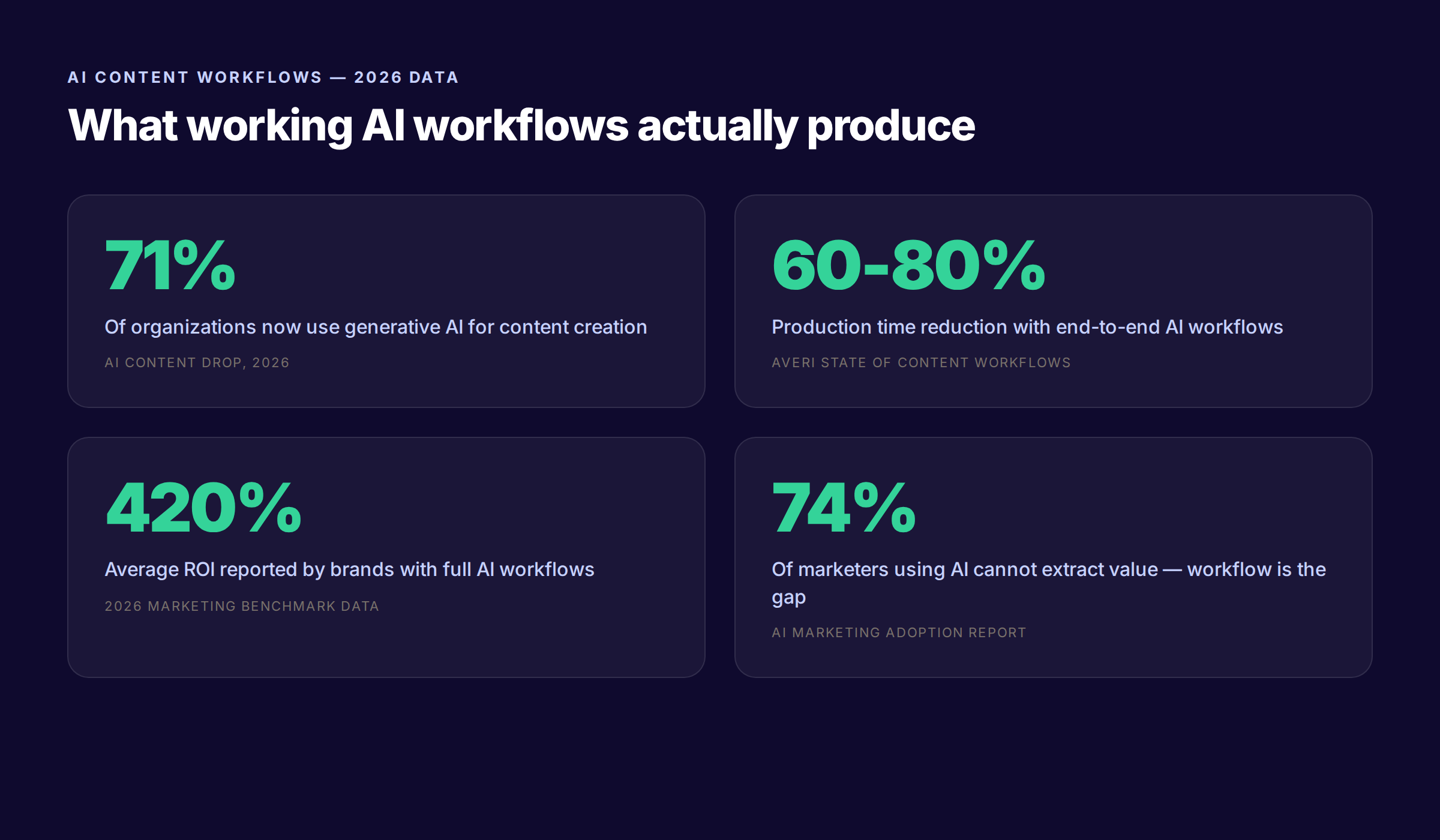
The data is stark. A study from AI Content Drop reports that 71 percent of organizations now use generative AI for content creation, and 88 percent of marketers rely on AI tools daily. But adoption is not the same as success. Another 74 percent of marketers who use AI cannot extract measurable value from it. The gap is workflow design.
The teams that win share one common pattern. They do not use AI to write more pages. They use AI to compress the time between research and publish, then invest the saved time into strategy, expertise injection, and distribution.
What the 2026 data shows:
- 71 percent of organizations use generative AI for content creation
- AI-first workflows reduce production time by 60 to 80 percent
- Teams using documented workflows produce 3 to 5 times more content
- Brands investing in AI workflows report 420 percent ROI within 12 months
- 38 percent of business web content published in 2026 involves AI assistance
- 74 percent of marketers who use AI cannot get value from it
- Brands using AI personalization see 43 percent higher email open rates
The 420 percent ROI number is real, but it is not automatic. It belongs to teams that built workflows, not teams that bought tools. Buying ChatGPT Plus does not produce ROI. Building a research-to-publish pipeline that uses ChatGPT inside a quality-controlled system does.
Want to skip the workflow build and just get content that ranks? We run the entire AI content workflow for you. 30 blog posts per month for $99. Start for $1 →
The 7 Phases of an AI Content Workflow
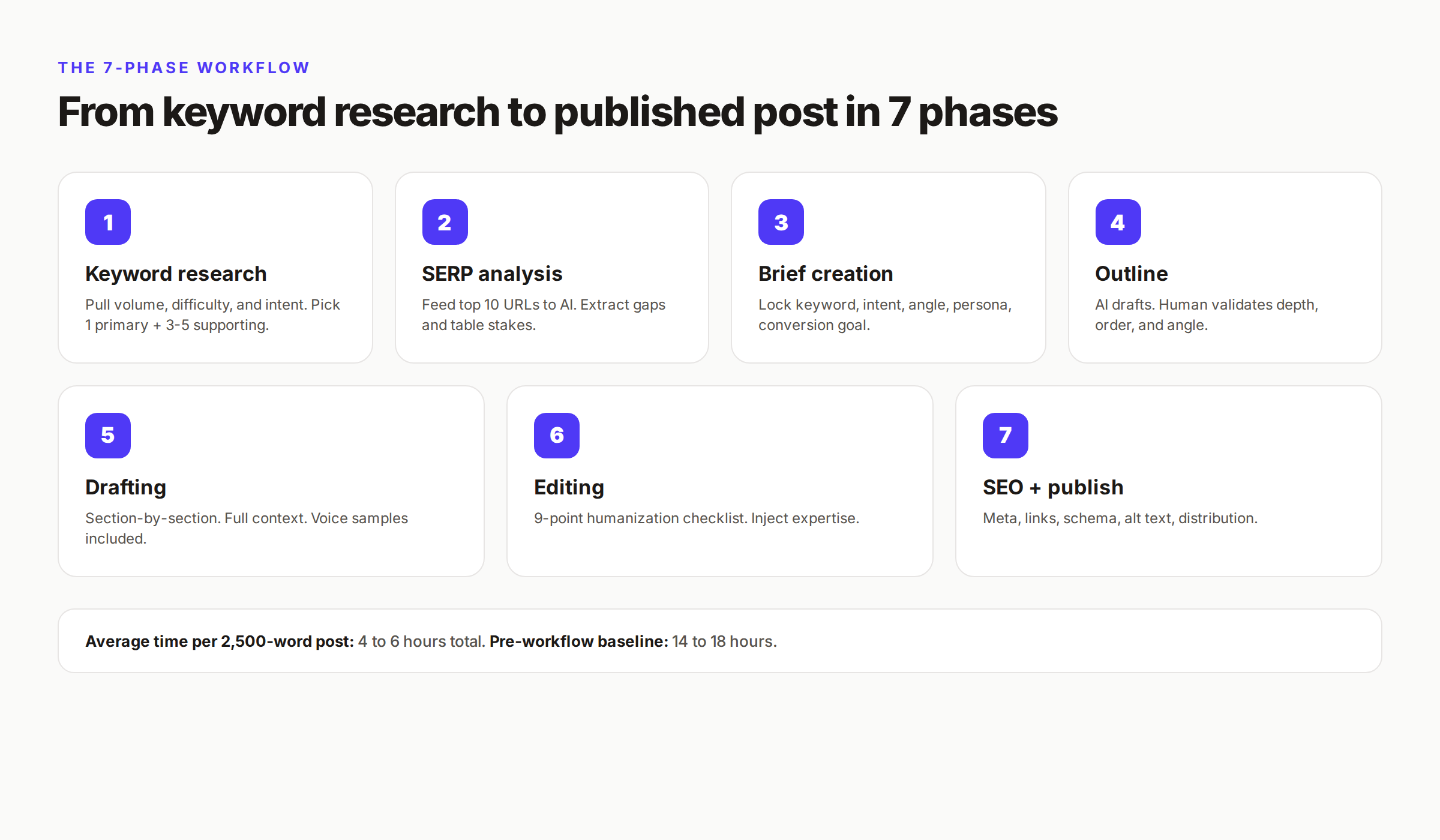
Every AI content workflow that produces ranking content moves through 7 phases. Skip any phase and the output quality drops. The phases run in order, but each one has its own inputs, tools, and outputs.
Phase 1: Keyword and Topic Research
Research starts with what humans want to know, not what AI thinks they want to know. Pull keyword data from a research tool before any AI prompt fires. We use a combination of DataForSEO, Ahrefs, and Google Search Console to surface keywords with real intent and volume.
The output of this phase is a research brief. It includes the primary keyword, secondary keywords, search volume, keyword difficulty, search intent, and the top 10 ranking URLs. AI does not generate this. AI consumes this in the next phase.
Specifically:
- Pull 10 to 20 candidate keywords from your keyword research tool
- Filter for keywords with intent that matches your funnel stage
- Pick 1 primary keyword and 3 to 5 supporting keywords
- Save the top 10 SERP results as a reference for the next phase
For a deeper dive on this step, read our guide on keyword research for blog posts.
Phase 2: SERP Analysis and Content Gap Identification
Once you have a keyword, the next job is reverse-engineering what already ranks. This is where AI starts pulling weight. Feed the top 10 ranking URLs into an LLM and ask it to extract heading structures, common subtopics, content gaps, and unique angles each competitor uses.
The output is a competitive map. It tells you what every ranking page covers, where they all agree, and where one or two outliers offer unique value. Your job in the next phase is to cover the table stakes and add something the SERP does not have yet.
Sample prompt for SERP analysis:
Analyze these 5 URLs ranking for the keyword [primary keyword]:
[URL 1]
[URL 2]
[URL 3]
[URL 4]
[URL 5]

Return:
1. Common H2 sections across all 5 (the table stakes)
2. Unique angles or sections only 1-2 cover
3. Content gaps (questions the SERP does not answer well)
4. Average word count
5. Number of images per post
Use content gap analysis techniques to systematize this step across multiple keywords.
Phase 3: Brief Creation
The brief is where most AI workflows succeed or fail. A weak brief produces a weak draft no amount of editing can save. A strong brief gives AI enough context to produce a draft that needs light editing instead of a rewrite.
Every brief should include the primary keyword, the search intent, the target persona, the angle, the conversion goal, the outline with H2s and H3s, the word count target, and 2 to 3 paragraphs of your brand voice in action. AI can draft the brief, but a human must review and lock it before drafting starts.
Brief template structure:
- Primary keyword and search volume
- Search intent (informational, commercial, navigational, transactional)
- Target persona (1 to 2 sentences)
- Unique angle (what we say that nobody else says)
- H2 outline with target word count per section
- 3 to 5 must-link internal pages
- 2 to 3 brand voice samples
- Conversion goal (newsletter signup, demo, free trial)
We have a full breakdown in our SEO content brief guide and a ready-to-use content brief template.
Phase 4: Outline Generation and Validation
The outline turns the brief into a section-by-section plan. AI handles the first draft of the outline based on the brief, then a human validates the depth, order, and angle. The mistake here is letting AI auto-generate without a human pass. AI will produce structurally correct outlines that miss the unique angle.
A good outline has H2s that tell a clear story when read in order. Each H2 has 2 to 4 H3s underneath. Each section has a target word count. The total adds up to your overall word count goal plus 10 percent for buffer.
Validation checklist:
- Does the outline cover every table-stakes topic from Phase 2?
- Does the outline include 1 to 2 unique angles competitors miss?
- Do the H2s flow in a logical order a reader would follow?
- Does each H2 have a clear purpose (define, instruct, prove, compare, or convert)?
- Are the word counts realistic given the topic depth?
For more on outline craft, see our blog post outline guide.
Phase 5: Drafting
This is the phase everyone thinks of as “AI content workflow”, but it is just one phase of seven. Drafting works best when you generate one H2 section at a time with the full brief, outline, and voice samples in context. Generating an entire 3,000-word post in one prompt produces generic output. Generating section by section produces output that needs less editing.
Use a structured prompt for each section. We follow a 5-part framework: role, brief, SERP context, voice samples, and output spec. The output spec includes banned words, sentence length limits, and required elements like stats or examples.
Drafting prompt template:
You are a senior SEO writer for [audience].

Section title: [H2 title]
Target words: [count]
Tone: [voice description]
Banned words: use, smooth, strong, move through, delve, in today's

Requirements:
- Open with a stat, example, or bold claim. No transition words.
- Sentences under 20 words.
- No contractions.
- Include [specific data point or example] in the section.
- End with an actionable sentence the reader can do today.
For prompt patterns that produce ranking-quality drafts, read our AI prompts for SEO articles playbook.
Phase 6: Editing, Humanization, and Quality Control
Every AI draft needs human editing. The question is what kind. The goal is not to make the draft “sound human” through a humanizer tool. The goal is to inject expertise, examples, opinions, and brand voice that AI cannot produce on its own.
Run a 9-point edit on every draft. Remove contractions. Cut transition words like furthermore and moreover. Replace vague references like “studies show” with specific named sources. Vary sentence length. Add at least one opinionated statement per 800 words. Add a nuance admission per 1,000 words. Read the draft aloud and rewrite anything that sounds robotic.
The 9-point humanization checklist:
| # | Edit | Why It Matters |
|---|---|---|
| 1 | Remove every contraction | AI overuses contractions; clean prose reads more authoritative |
| 2 | Cut transition words (furthermore, moreover, additionally) | AI tells; humans show |
| 3 | Replace vague references (“studies show”) with named sources | Builds E-E-A-T and citability for AI Overviews |
| 4 | Vary sentence length (mix 5-word and 18-word sentences) | Breaks AI rhythm patterns |
| 5 | Kill passive voice | ”We tested 50 tools” beats “50 tools were tested” |
| 6 | Add 1 opinion per 800 words | Original takes are uncrawlable by competitors |
| 7 | Add 1 nuance admission per 1,000 words | ”The exception is…” signals real expertise |
| 8 | Replace “today’s digital scene” type filler | Generic AI phrases tank trust |
| 9 | Read aloud and rewrite robotic passages | Your ear catches what your eye misses |
For more on this critical phase, our guide on AI content quality control covers the editorial standards we apply to every post. The follow-up on editing AI content for quality shows the line-edit patterns that turn drafts into published assets.
Phase 7: SEO Pass, Publishing, and Distribution
The final phase turns an edited draft into a live, optimized, distributed page. AI handles meta titles, meta descriptions, alt text generation, schema markup suggestions, and social copy variations. Humans review every output and validate against the SERP and brand voice.
The SEO pass covers internal links, external citations, image optimization, schema, meta tags, and structured data for AI Overviews. Distribution covers publishing to the CMS, syndication to social platforms, and email or newsletter inclusion.
Specifically:
- Generate 3 meta title variations and pick the strongest
- Write a 145 to 155 character meta description with the keyword
- Add 3 to 5 internal links per 1,000 words to relevant pillar and cluster pages
- Add 2 to 3 external links to authoritative sources with stats or data
- Generate alt text for every image, including the primary keyword in at least one
- Add FAQ schema markup for the FAQ section
- Schedule social posts and email mentions for the publish date
For the publishing automation side, read our breakdown on how to automate blog publishing.
The Tools That Power Each Phase
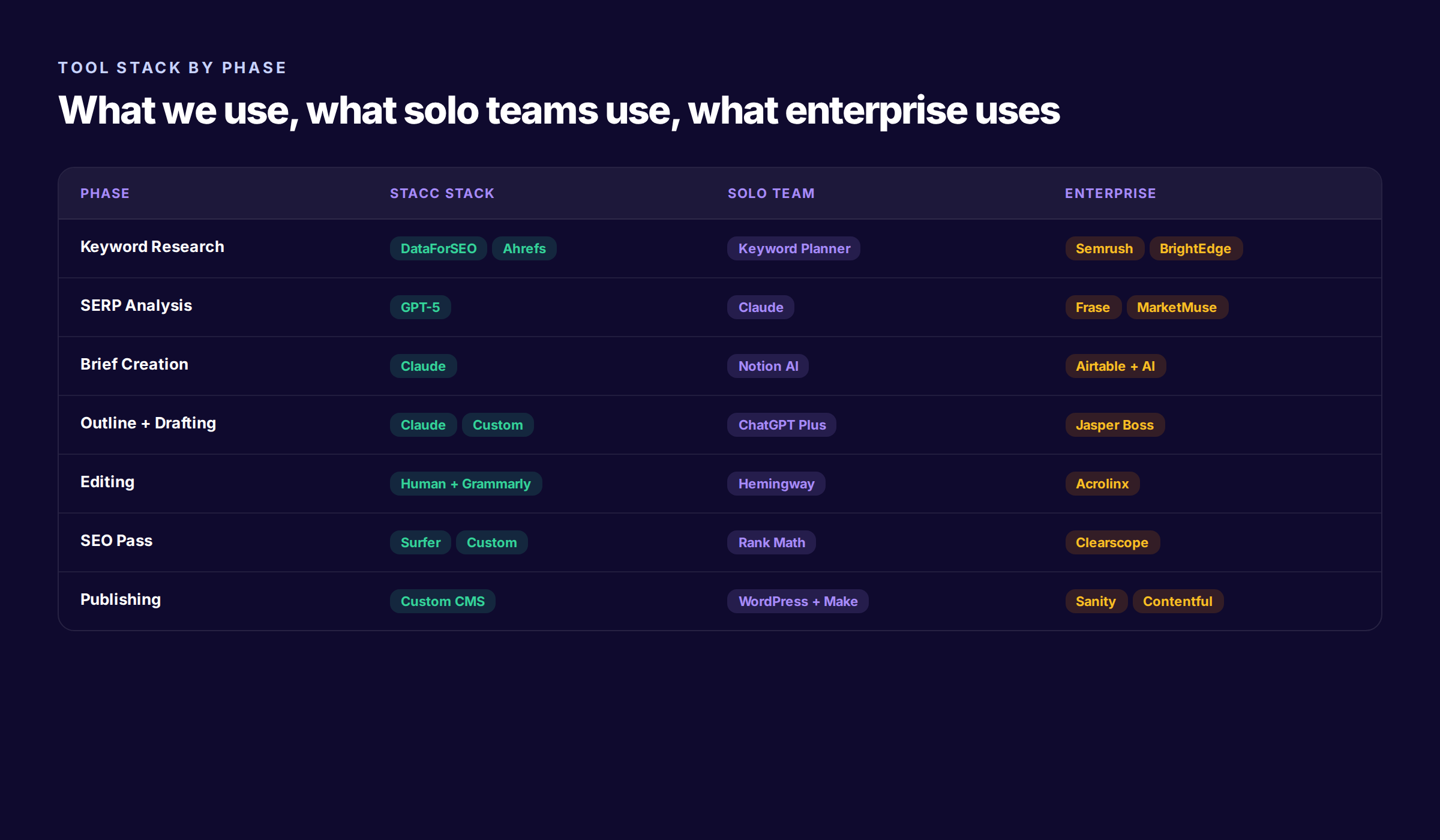
Tool choice matters less than workflow design, but the right tools cut friction. Below is the stack we run at Stacc and the alternatives we recommend for teams at different scales.
| Phase | Stacc Stack | Alternative for Solo Teams | Alternative for Enterprise |
|---|---|---|---|
| Keyword research | DataForSEO + Ahrefs | Free Google Keyword Planner | Semrush + BrightEdge |
| SERP analysis | Custom GPT-5 prompts | Claude with web access | Frase or MarketMuse |
| Brief creation | Internal template + Claude | Notion AI templates | Airtable + custom AI |
| Outline | GPT-5 with strict prompts | ChatGPT free tier | Jasper or Writer |
| Drafting | Claude (section by section) | ChatGPT Plus | Jasper Boss Mode |
| Editing | Human editors + Grammarly | Hemingway + manual edit | Acrolinx + human review |
| SEO pass | Surfer + custom checks | Rank Math (WordPress) | Clearscope + Yoast |
| Publishing | Custom CMS automation | WordPress + Make.com | Sanity, Contentful + workflows |
The stack matters less than the connections between tools. A perfect tool stack with no documented workflow produces nothing. A messy tool stack with a tight workflow produces consistent output.
A few principles that hold across stacks:
- Pick one primary LLM and learn its strengths. Switching constantly destroys context.
- Avoid tools that promise “end-to-end automation” without quality gates. The output is always generic.
- Build your tool stack around your CMS, not the other way around. Friction at the publish step kills consistency.
- Pay for tools that save 5+ hours per week. Skip tools that save 30 minutes.
For more on tool selection, see our roundup of AI tools for small business and our deep-dive on ChatGPT for SEO content.
Real Production Workflow: From Keyword to Published Post
Here is a real workflow from our operation, timed to the minute. The keyword for this example is “local seo for dentists”. The goal is a 2,500-word guide that ranks for the head term and 30+ related long-tails.
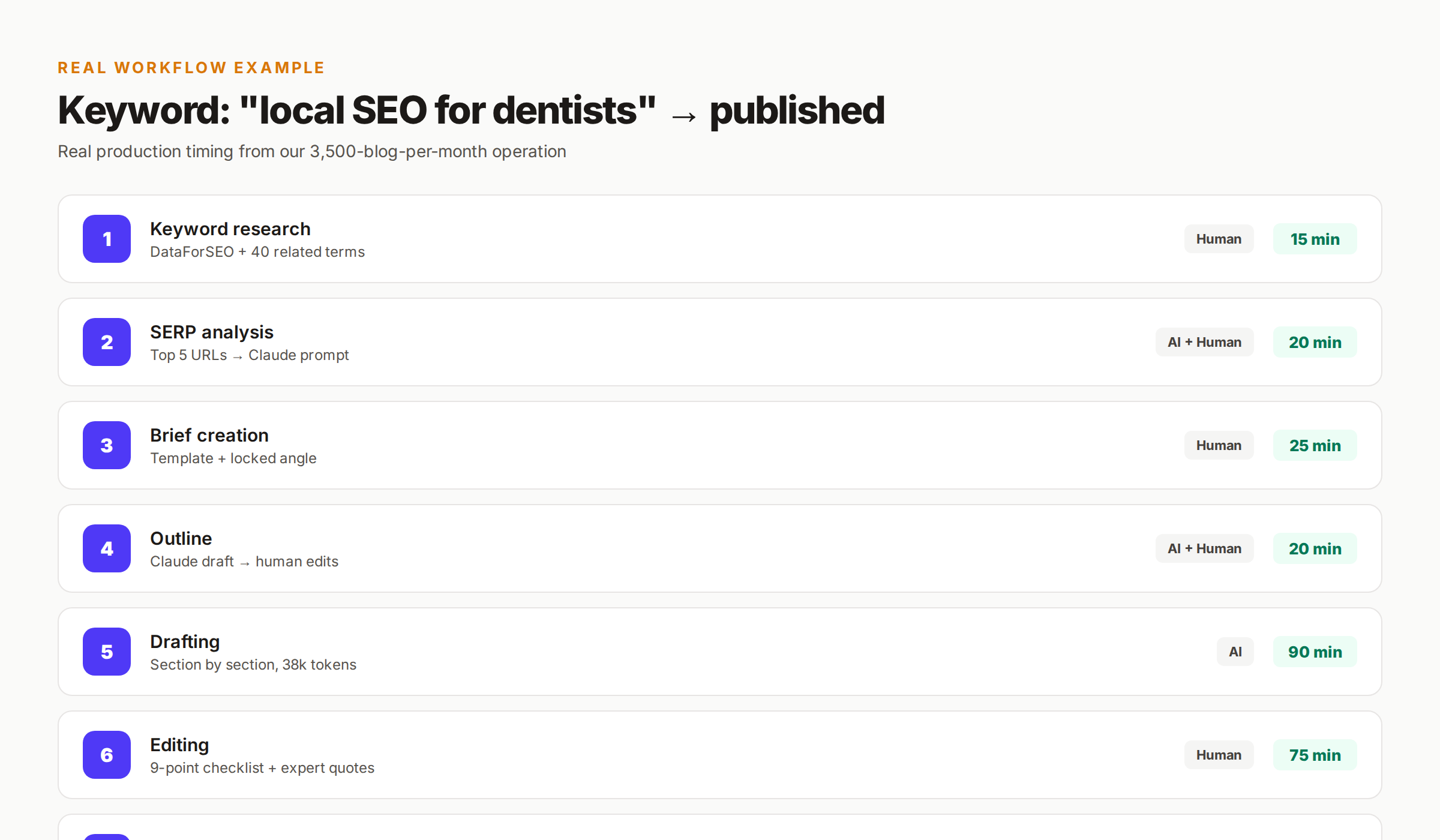
Phase 1 — Keyword research (15 minutes)
We pulled DataForSEO data for “local seo for dentists” and 40 related terms. Search volume on the head term was 590 per month with a difficulty of 38. We picked 4 supporting keywords with combined volume of 1,200 per month.
Phase 2 — SERP analysis (20 minutes)
We fed the top 5 ranking URLs into Claude with our SERP analysis prompt. It returned 7 common H2 sections, 2 unique angles only one competitor covered, and 4 questions the SERP did not answer well. We picked one of the unique angles (Google Business Profile review velocity for dentists) as our differentiator.
Phase 3 — Brief creation (25 minutes)
A staff editor wrote the brief using our template. The brief locked the primary keyword, the angle, the persona (dental practice owner with 1 to 5 locations), the conversion goal (free local SEO audit), and 6 must-link internal pages.
Phase 4 — Outline (20 minutes)
Claude drafted the outline from the brief. The editor moved 2 H2s for better flow, added an H3 on review response templates, and removed a section that did not match the persona.
Phase 5 — Drafting (90 minutes)
Claude generated each H2 separately using the full brief, the outline, and 3 voice samples from past dental posts. Total tokens used: 38,000. Total draft length: 2,640 words.
Phase 6 — Editing (75 minutes)
A human editor ran the 9-point checklist, replaced 4 vague stats with named sources, added 2 first-person observations from a dentist client, and rewrote 3 paragraphs that read robotic.
Phase 7 — SEO pass and publishing (30 minutes)
The editor added 14 internal links, 3 external links, alt text for 4 images, FAQ schema, and the meta description. The post went live 4 hours and 35 minutes after the keyword was picked.
Total time: 4 hours and 35 minutes for a 2,640-word post. Pre-AI, the same post took 14 to 18 hours. The system saves about 70 percent of production time without sacrificing ranking quality.
Stop building workflows. Start getting traffic. We run the entire AI content workflow for 3,500+ blogs per month. Your turn. Start for $1 →
Common Mistakes That Tank AI Content Workflows
Most failed AI workflows fail for the same 5 reasons. Avoid these and you skip 80 percent of the pain.
Mistake 1: Skipping the brief. Teams paste a keyword into an LLM and expect a publishable draft. The output is generic because the input was generic. The brief is not optional. It is the single highest-impact step in the entire workflow.
Mistake 2: Generating long posts in one prompt. A 3,000-word prompt produces 3,000 words of mediocre output. Generate section by section. Each section gets the full brief, the outline, and voice samples in context. Token cost is higher. Output quality is dramatically higher.
Mistake 3: Trusting humanizer tools. Tools that “humanize AI content” just rephrase the same generic prose. They do not add expertise, examples, opinions, or first-person observations. Real humanization is editorial work, not a button.
Mistake 4: Ignoring the SERP. Workflows that skip Phase 2 produce content that does not match the SERP. Even great writing does not rank if it misses what Google considers the table stakes for that query. Always feed the SERP into the brief.
Mistake 5: Publishing without a quality gate. AI drafts have predictable failure modes: vague references, banned words, missing examples, robotic transitions. A 9-point editorial checklist catches all of them. Skip the checklist and your readers (and Google) catch them instead.
According to research on whether AI content ranks on Google and a Semrush study of 42,000 posts, the deciding factor is not “AI vs human”. It is whether the content has been edited and enriched with expertise. Workflows that include real editorial quality gates rank. Workflows that do not, do not.
How to Measure AI Content Workflow ROI
ROI on AI content workflows comes from 3 metrics: production time saved, content output volume, and ranking performance. Track all three. The first two prove efficiency. The third proves effectiveness.
Time saved per post. Measure hours from keyword pick to published post, before and after the workflow is in place. A working AI workflow cuts this number by 50 to 70 percent within 90 days. If yours does not, the workflow is broken at one or more phases.
Output volume. Measure posts published per month. A workflow that does not increase output is not paying back the design cost. Most teams move from 4 to 8 posts per month pre-workflow to 20 to 40 posts per month post-workflow.
Ranking and traffic. Measure organic traffic per post at 30, 60, and 90 days post-publish. If AI-assisted posts underperform fully manual posts by more than 25 percent, the editing phase needs work. If they match or exceed, the workflow is paying back.
| Metric | Pre-Workflow Baseline | 90-Day Target | 12-Month Target |
|---|---|---|---|
| Hours per post | 12 to 18 hours | 4 to 6 hours | 3 to 4 hours |
| Posts per month | 4 to 8 | 15 to 25 | 25 to 50 |
| Avg traffic per post (90 days) | 200 to 400 | 200 to 400 | 300 to 600 |
| Cost per published post | $400 to $800 | $150 to $300 | $80 to $200 |
For deeper benchmarks, read our breakdown on AI content ROI data and AI content statistics.
The teams hitting 420 percent ROI did not get there in a quarter. They built a workflow, ran it for 90 days, measured, adjusted, ran it for another 90 days, and adjusted again. By month 12, the system produces predictable output at predictable cost.
Building Your First AI Content Workflow: A 7-Day Plan
You do not need to build the perfect workflow on day one. Build a working one in a week, then improve it over the next 90 days.
Day 1: Document your current process. Write down every step you currently take from keyword pick to publish. Note who does each step and how long it takes. This becomes your baseline.
Day 2: Pick your tool stack. Choose one LLM, one keyword tool, one SEO tool, and one CMS. Resist adding more. Tool sprawl kills workflows.
Day 3: Write your brand voice document. A 1 to 3 page reference with your tone, banned words, sample paragraphs, and brand promise. This document goes into every drafting prompt.
Day 4: Build your brief template. Use the structure from Phase 3. Make it a fillable document anyone on your team can use.
Day 5: Write your prompt library. SERP analysis prompt, brief drafting prompt, outline prompt, section drafting prompt, meta generation prompt. Save them in a shared doc.
Day 6: Build your editorial checklist. The 9-point humanization list plus your SEO checklist. Both should fit on one page.
Day 7: Run the full workflow end-to-end on one post. Pick a small keyword, run all 7 phases, time each one, and publish. Note where friction shows up.
The first post is the slow one. The fifth post is the fast one. Most teams hit their target velocity around post 10 to 15. After that, the workflow runs on muscle memory.
For more on building content systems, see our guide on building topical authority and our AI content strategy playbook.
FAQ
What is an AI content workflow?
An AI content workflow is a documented sequence of phases that takes a topic from research to published asset, with AI handling specific tasks like SERP analysis, outline drafting, and section generation, and humans handling brief approval, editing, and quality control. The best workflows have 7 phases: keyword research, SERP analysis, brief creation, outline, drafting, editing, and SEO/publish.
How long does it take to build an AI content workflow?
You can build a working AI content workflow in 1 week of focused effort. The first version will be rough. Teams reach their target output velocity around post 10 to 15 after launch. Refinement happens over the first 90 days as you find friction points and adjust phases.
Will AI content workflows hurt my SEO?
No, if you include editorial quality gates. Google’s official position is that they reward helpful content regardless of how it is produced. Studies show AI-assisted content that has been edited and enriched ranks comparably to fully manual content. AI content that skips the editing phase underperforms by 25 to 40 percent.
What is the difference between an AI tool and an AI content workflow?
A tool is a single application like ChatGPT or Claude. A workflow connects multiple tools into a chain where output from one step feeds into the next, with humans validating at quality gates between phases. Tools produce drafts. Workflows produce published, optimized, distributed content.
How much can AI content workflows save my team?
Working AI content workflows reduce production time by 50 to 70 percent and cost per post by 50 to 70 percent within 90 days. Teams moving from manual workflows to AI-assisted workflows typically go from 4 to 8 posts per month to 20 to 40 posts per month at the same headcount.
Do I need expensive tools to run an AI content workflow?
No. A working solo workflow runs on ChatGPT Plus ($20/mo), free Google Keyword Planner, free Hemingway editor, and a free WordPress install. Most of the cost is your time learning the workflow, not the tools. Scale your tool stack when output volume justifies the cost.
The Bottom Line on AI Content Workflows
The teams winning at content in 2026 are not the teams with the best AI tools. They are the teams with the best AI content workflows. Tools are commodities. Workflows are the moat.
Build your 7-phase workflow this week. Run it for 90 days. Measure time saved, output volume, and ranking performance. Adjust the phases where friction shows up. By month 12, your team will be producing 3 to 5 times more ranking content at a fraction of the cost.
Skip the workflow build. Get the output. We run the entire AI content workflow for you. 30 blogs per month for $99. No team to hire. No tools to learn. Start your $1 trial →
Related Tools & Resources
Free SEO Tools:
Best Lists:

Written by
Siddharth GangalSiddharth is the founder of theStacc and Arka360, and a graduate of IIT Mandi. He spent years watching great businesses lose organic traffic to competitors who simply published more. So he built a system to fix that. He writes about SEO, content at scale, and the tactics that actually move rankings.
30 SEO blog articles published every month
Keyword-optimized, scheduled, and live on your site. Automatically.
30-day trial · Cancel anytime
theStacc
Stop writing SEO content manually
30 blog articles, 30 GBP posts, and social media content. Published every month. Automatically.
Try for free$1 for 3 days · Cancel anytime