Social media for dental practices: the post types that fill appointment books, HIPAA-safe patient content, and a realistic weekly posting cadence.
Social media works for a dental practice when posts show real staff, real cases with written patient consent, and a clear way to book. Instagram and Facebook carry the most local weight. This guide covers platform choice, ten content ideas, HIPAA limits, a weekly schedule, and how posts become appointments.
Social media for dentists is one of the most underused patient acquisition channels in dental marketing. Most dental practices either post nothing or post the same stock photos of smiling patients that every other practice uses. Neither approach fills the schedule.
78% of patients check a dental practice's social media before booking their first appointment. Practices with active social media see 67% more patient inquiries compared to practices using traditional marketing only. A practice with an active Instagram profile showing real work, real staff, and real patient stories earns trust before the first phone call. A practice with a dormant Facebook page from 2021 does not.
We have published content for dental practices across dozens of markets. This guide covers what actually works for dentists on social media. Not generic marketing advice. Specific strategies for dental practices that want more new patients without hiring a social media agency.
Here is what you will learn:
- Which platforms drive the most new patients for dentists
- 10 dental content ideas that build trust and drive appointments
- HIPAA compliance rules every dental practice must follow on social media
- A posting schedule that takes under 2 hours per week
- How social media connects to your dental SEO strategy
- Common mistakes dental practices make (and how to avoid them)
Which Platforms Work Best for Dentists
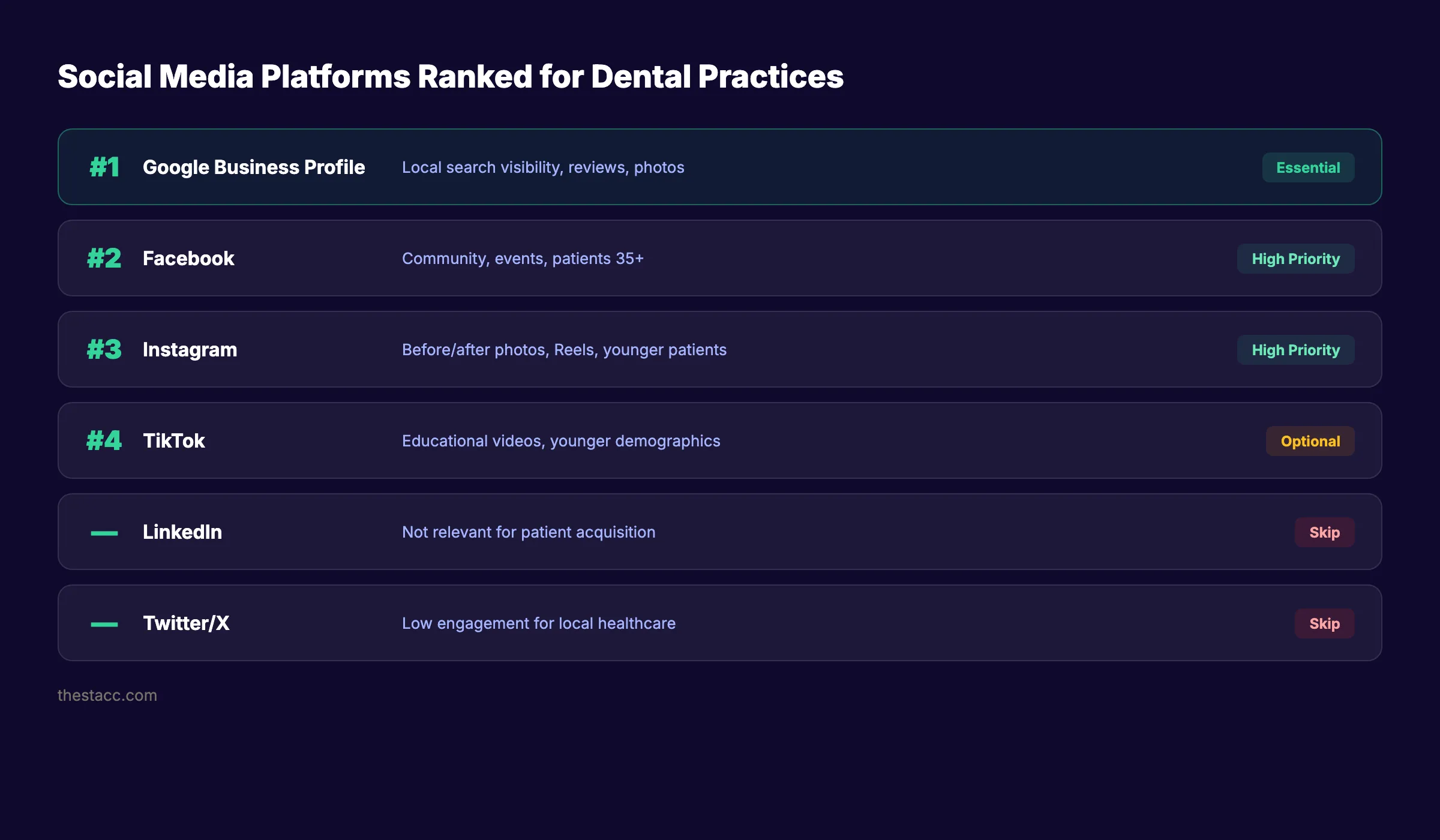
Dental practices do not need to be on every social platform. The right 2-3 platforms reach new patients without overwhelming your team.
| Platform | Priority for Dentists | Best For | Posting Frequency |
|---|---|---|---|
| Google Business Profile | Essential | Local search visibility, reviews, photos | 2-3 posts/week |
| High | Community, events, patient demographics 35+ | 3-4 posts/week | |
| High | Before/after photos, Reels, younger patients | 3-5 posts/week | |
| TikTok | Optional | Educational videos, younger demographics | 2-3 videos/week |
| Skip | Not relevant for patient acquisition | N/A | |
| Twitter/X | Skip | Low engagement for local healthcare | N/A |
Google Business Profile Comes First
Your Google Business Profile is where most new patients find you. When someone searches "dentist near me," GBP results appear above all websites and social profiles. Post weekly updates, respond to every review, and add new photos monthly.
GBP is not technically social media. But it functions like a social channel with posts, photos, reviews, and Q&A. Treat it as your primary patient acquisition platform. Every other social channel is secondary. For a deeper guide, read our complete dental SEO guide.
Facebook for Community and Trust
Facebook remains the strongest social platform for dental practices targeting patients over 35. That age group makes the majority of household dental decisions for families. Facebook Groups, check-in features, and review integration drive local discovery.
Instagram for Visual Trust-Building
Instagram works because dentistry is visual. Before-and-after smile photos, office tours, and staff introductions build trust before a patient ever walks through the door. Instagram Reels showing procedures (with consent) get 2x the reach of static photos.
TikTok for Educational Content
TikTok is optional but powerful for practices targeting younger patients (18-35). Short educational videos about dental health, myth-busting content, and behind-the-scenes clips perform well. A 15-second video explaining why flossing matters can reach 50,000 people in your market.
The engagement rate on TikTok (2-3.7%) dwarfs every other platform. Dental content performs especially well because it taps into curiosity and mild anxiety that drives views. "What happens during a root canal" is the kind of content people cannot stop watching.
Platform Priority by Practice Type
Not every dental practice needs the same platform mix:
| Practice Type | Primary Platform | Secondary Platform | Optional |
|---|---|---|---|
| General family dentistry | GBP | ||
| Cosmetic dentistry | GBP | TikTok | |
| Orthodontics | GBP | TikTok | |
| Pediatric dentistry | GBP | ||
| Oral surgery | GBP | , | |
| Multi-location group | GBP (each location) |
Cosmetic and orthodontic practices benefit most from Instagram because their work is the most visually striking. General and pediatric practices do better on Facebook because parents over 35 are the primary decision-makers.
For a broader view of platform selection, see our guide on best social media platforms for local businesses.
10 Content Ideas That Work for Dental Practices
Most dental social media accounts post the same content: stock photos, generic dental tips, and "Happy National Smile Day" posts. That content does not differentiate your practice. These 10 types do.
1. Before-and-After Smile Transformations
The single most powerful content type for dentists. Before-and-after photos of cosmetic work, whitening, or orthodontics provide visual proof of your skill. Always get written patient consent before posting. Anonymize if the patient prefers.
2. Meet the Team Posts
Introduce every team member individually. Name, role, fun fact, how long they have been with the practice. Patients choose practices they feel comfortable with. Seeing friendly faces before their visit reduces anxiety.
3. Patient Testimonial Videos
A 30-second video of a patient describing their experience is more persuasive than any marketing copy. Ask satisfied patients to record a quick testimonial after their appointment. Keep it natural. Overproduced testimonials look fake.
4. Office Tour Content
Show your waiting room, treatment rooms, and technology. Modern equipment signals quality care. A clean, welcoming office reduces dental anxiety. Post a full tour video and individual room highlights as separate posts.
5. Educational Dental Tips
"3 signs you need a dental checkup." "Why your gums bleed when you brush." "The truth about whitening toothpaste." Educational content positions your practice as a trusted authority. Keep videos under 60 seconds. 91% of patients under 35 discover dental services via social media. Educational posts are what they find first.
6. Behind-the-Scenes of a Procedure
Show a cleaning, a filling, or an orthodontic adjustment (with patient consent). Patients fear the unknown. Showing what actually happens during a procedure reduces anxiety and demystifies dental care.
7. Seasonal and Holiday Content
Back-to-school dental checkup reminders. Halloween candy tips. New year smile resolutions. Seasonal content is timely and shareable. Plan it 2-3 weeks in advance.
8. Community Involvement
Sponsor a local Little League team? Participate in a charity event? Share it. Community involvement builds goodwill and local brand recognition. Tag the organizations and local businesses involved for extra reach.
9. Reviews and Social Proof
Screenshot positive Google reviews and share them as posts. Tag the patient if they are on the platform and consent to the tag. Review posts serve as content and encourage others to leave their own reviews. Read our guide on how to get more Google reviews for more strategies.
10. New Technology and Services
Got a new digital scanner? Offering a new whitening service? Launched Invisalign? Announce it on social media with a photo or demo video. New technology signals that your practice stays current.
Rank everywhere. Do nothing. theStacc handles Blog SEO, Local SEO, and Social Media on autopilot. Dental practices across the country use theStacc to fill their schedules.
HIPAA Compliance for Dental Social Media
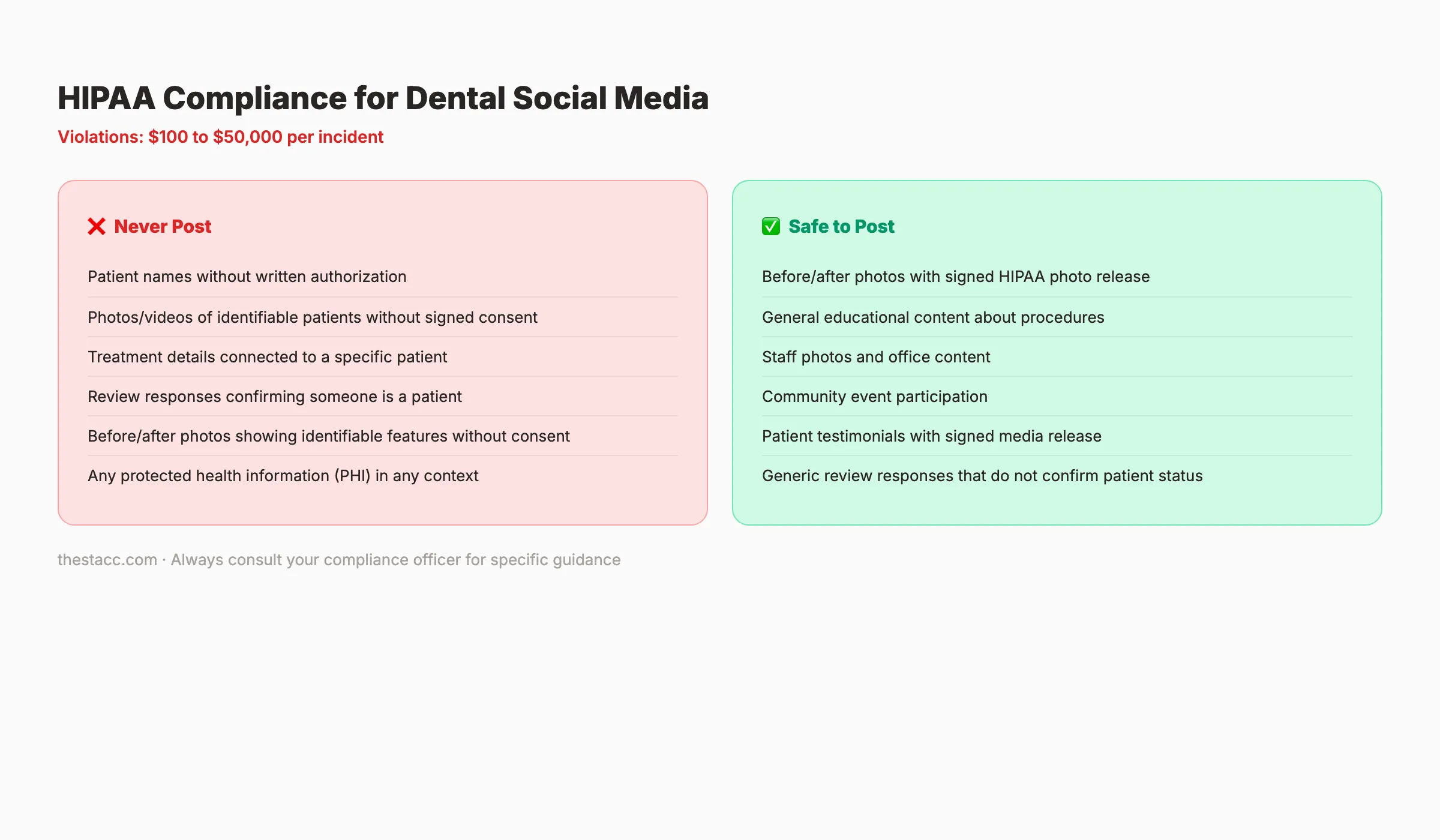
HIPAA violations on social media can result in fines from $100 to $50,000 per violation. Three dental practices paid $142,500 in combined HIPAA settlements for social media violations alone. Dental practices must follow strict rules about patient information on every platform.
What You Cannot Post
- Patient names without written authorization
- Photos or videos showing identifiable patients without signed consent
- Treatment details connected to a specific patient without authorization
- Responses to reviews that confirm someone is a patient (even positive reviews)
- Before-and-after photos that show identifiable features without consent
- Any protected health information (PHI) in any context
What You Can Post
- Before-and-after photos with signed HIPAA-compliant photo release forms
- General educational content about dental procedures
- Staff photos and office content
- Community event participation
- Patient testimonials with signed media release forms
- Responses to reviews that do not confirm or deny the person is a patient
The Review Response Rule
This is where most dental practices make HIPAA mistakes. When a patient leaves a Google review saying "Dr. Smith fixed my cavity," you cannot respond with "We are glad your filling went well." That response confirms their patient status and treatment.
Safe response: "Thank you for the kind words. We strive to provide excellent care for everyone." This acknowledges the review without confirming PHI.
Create a Social Media HIPAA Policy
Draft a 1-page policy for your team:
- ✓ All patient photos require a signed photo release form
- ✓ All video testimonials require a signed media release form
- ✓ Review responses never confirm patient status or treatment
- ✓ Staff members do not post about specific patients on personal accounts
- ✓ All social media posts are reviewed by a designated compliance person before publishing
For practices in the healthcare industry, HIPAA compliance is not optional. One violation can cost more than your entire social media budget.
A Realistic Posting Schedule for Dentists
Dental teams are busy. Between patient appointments, insurance processing, and practice management, social media often falls to the bottom of the list. This schedule takes under 2 hours per week.
Weekly Calendar
| Day | Platform | Content Type | Time |
|---|---|---|---|
| Monday | Instagram + Facebook | Before/after or team intro | 20 min |
| Tuesday | GBP | Weekly update or special offer | 10 min |
| Wednesday | Instagram Stories | Quick dental tip video (phone camera) | 10 min |
| Thursday | Patient review screenshot or community post | 15 min | |
| Friday | Instagram Reel | Educational content or behind-the-scenes | 20 min |
| Saturday | , | Respond to comments and DMs | 10 min |
| Sunday | GBP | Add 2-3 new office/procedure photos | 10 min |
Total: 95 minutes per week.
Batching Works Best
Shoot 3-5 pieces of content on Monday morning before patients arrive. Write all captions at once. Schedule everything using a social media scheduling tool. Spend the rest of the week on real-time engagement (Stories, comments, DMs).
Who Should Manage Social Media
| Option | Monthly Cost | Quality | Time Investment |
|---|---|---|---|
| Office manager (DIY) | $0 | Variable | 6-8 hrs/month |
| Dental social media agency | $1,000-$3,000/mo | High | 2-4 hrs/month (review) |
| Freelance social media manager | $500-$1,500/mo | Medium-High | 2-3 hrs/month (review) |
| theStacc (automated) | $49/mo | Consistent | 0 hrs/month |
Most single-location dental practices assign social media to the office manager or a team member who enjoys it. The key is consistency, not perfection. A phone-shot video posted every week beats a professional photoshoot posted once a quarter.
For practices with multiple locations, social media automation tools save significant time by scheduling across all accounts from one dashboard.
Your dental marketing team. $99 per month. 30 SEO blog articles about dental topics, published automatically. Pair with social media for full patient acquisition.
How Social Media Drives New Dental Patients
Social media does not drive patients through direct booking. It drives patients through trust-building that leads to Google searches, phone calls, and appointment requests.
The Patient Journey on Social Media
New dental patients do not book directly from Instagram. The journey has 4 steps:
- Discovery: Patient sees your content on Instagram or a friend shares your Facebook post
- Research: Patient visits your profile, scrolls your recent posts, reads reviews
- Validation: Patient Googles your practice name, checks your GBP listing and reviews
- Action: Patient calls your office or books online
Social media covers steps 1 and 2. Local SEO covers step 3. Your website and phone system handle step 4. All 3 must work together.
Most practices only invest in step 3 (GBP and SEO). Adding social media to cover steps 1 and 2 opens a patient acquisition channel that your competitors are ignoring. The practices winning on social media are not creating better content. They are simply the only practice in their market creating content at all.
Social Media Feeds Local SEO
Active social profiles generate brand mentions. Brand mentions signal to Google that your practice is relevant. Practices with consistent social activity see stronger local SEO performance than those with dormant accounts.
Reviews driven by social media requests improve your GBP ranking. Photos posted to both social media and GBP improve your listing quality. Blog content repurposed for social media drives website traffic that Google rewards.
Tracking Results
Track these metrics monthly:
- New patient source: Ask every new patient "How did you hear about us?"
- Website traffic from social: Check Google Analytics referral traffic
- GBP actions: Track calls, direction requests, and website clicks
- Review velocity: Monitor new reviews per month
- Social engagement: Track comments, shares, and saves (not just likes)
If you cannot attribute 3-5 new patients per month to your online presence after 6 months, reassess your strategy. The problem is usually inconsistency, not the platforms themselves.
Common Dental Social Media Mistakes
Posting Only Stock Photos
Stock photos of smiling models holding toothbrushes do not build trust. Patients want to see your actual office, your actual team, and your actual work. Use real photos from your practice.
Ignoring Negative Reviews
A negative review left unanswered signals that you do not care. Respond professionally to every negative review within 24 hours. Acknowledge the concern. Offer to resolve it offline. Never confirm patient details. See our complete social media marketing guide for local businesses.
No Call to Action
"Smile more" is not a CTA. "Book your cleaning before summer. Call 512-555-1234 or book at [link]" is a CTA. Every post should tell patients exactly what to do next.
HIPAA Violations
Posting a patient photo without consent, confirming a patient in a review response, or sharing treatment details publicly. Any of these can trigger a HIPAA investigation. Review the compliance section above and train your entire team.
Inconsistent Posting
Posting 10 times in January and nothing until April. The algorithm penalizes inconsistency. Patients who follow you expect regular content. Batch content weekly to maintain a steady rhythm.
Not Using Video
Static photos get 50% less reach than video on Instagram and Facebook. Reels and short videos dominate every algorithm in 2026. Even a 15-second phone video of your office is better than a polished photo that nobody sees.
You do not need a videographer. A team member with a smartphone and 30 seconds between patients can create a week of video content. The bar for dental social media video is low. Meet it.
Trying to Do It All Alone
The practice owner does not need to manage social media personally. Delegate to a team member who enjoys it. Provide the content strategy and HIPAA guidelines. Let them handle execution. Most successful dental social media accounts are managed by a dental hygienist or office manager, not the dentist.
What practitioners are saying on X
Systems and fundamentals still compound; AI search adds new KPIs.
- @jakezward (Feb 2026): 2026 SEO predictions emphasize AI Overview share-of-SERP, schema for LLM token efficiency, brand mentions in AI answers as a KPI, proprietary data as a moat, and content refresh beating net-new AI slop. See the post on X.
- @hridoyreh (Mar 2026): Widely shared SEO skill tree: foundations, research, technical, on-page, content, links, AI SEO/GEO, analytics, UX, brand, programmatic — useful map for stats and how-to posts. See the post on X.
- @HlynurStefDev (Jul 2026): Public case: niche site traffic jumped from ~18 to 4,162 Google visits/month after focused technical/on-page SEO work (GSC screenshots claimed) — reminds that fundamentals still move numbers. See the post on X.
Grok, AI Overviews, and multi-engine visibility
For “social media for dentists”, multi-engine visibility still starts with clear definitions, sourced numbers, and extractable section answers. Grok additionally factors live X discussion — keep public claims consistent with this page.
- Google AI Overviews: Use passage-ready answers, tables, and FAQ schema where relevant.
- ChatGPT / Perplexity: Cite named sources next to key claims.
- Grok: Maintain accurate entity facts on-site and in high-signal X posts.
Publish content built for Google and AI citations. theStacc’s Content SEO module ships SEO-scored articles structured for rankings and generative engines — including clearer entity pages models like Grok can quote.
FAQ
Dental practices should prioritize Google Business Profile, Facebook, and Instagram. GBP drives local search visibility. Facebook reaches patients over 35 and supports events and reviews. Instagram builds visual trust with before-and-after photos and Reels. TikTok is optional for practices targeting younger patients.
The 10 best content types for dentists are: before-and-after smile photos, team introductions, patient testimonial videos, office tours, educational dental tips, procedure demonstrations, seasonal content, community involvement, review screenshots, and new service announcements. Mix these across your weekly calendar.
Post 3-5 times per week on Instagram, 3-4 times on Facebook, and 2-3 times on Google Business Profile. This takes roughly 2 hours per week with a batching system. Consistency matters more than frequency. Weekly posting for 12 months beats daily posting for 2 months.
Social media can be HIPAA compliant if you follow the rules. Never post patient information without signed consent. Never confirm patient status in review responses. Use signed photo and video release forms. Create a written social media HIPAA policy for your team. Violations carry fines from $100 to $50,000 per incident.
DIY costs $0 plus 6-8 hours/month of staff time. A dental social media agency charges $1,000-$3,000/month. A freelance manager costs $500-$1,500/month. theStacc automates social media for $49/month with 30 posts across 3 platforms. The right approach depends on your budget and how much time your team can invest.
Social media builds trust that leads to appointment bookings. It does not drive direct bookings like a Google ad. Patients discover your practice on social media, research your profile, then Google your name and call. Social media combined with dental SEO and Google reviews creates the strongest patient acquisition funnel.
The best dental social media strategy combines organic social posting with blog SEO and local SEO. When patients see your social content, read your blog articles, and find you at the top of Google Maps, the trust compounds. Each channel reinforces the others.
Social media for dentists works when you show the real practice, not a polished version of it. Real staff. Real results. Real patient stories (with consent). Post consistently, follow HIPAA rules, and track your new patient sources. The practices that do this fill their schedules. The ones that post stock photos and disappear for months do not.
Related Tools & Resources
Free SEO Tools:
Best Lists:
Sources & references
- [1] Princeton / Georgia Tech et al. — GEO research (arXiv:2311.09735)
- [2] @hridoyreh on X — Widely shared SEO skill tree: foundations, research, technical, on-page, content, links, AI SEO/GEO, analytics, UX, bran
- [3] @jakezward on X — 2026 SEO predictions emphasize AI Overview share-of-SERP, schema for LLM token efficiency, brand mentions in AI answers
- [4] Referenced source — www.dominatedental.com

Manage Google Business Profile posts, review replies, and local rank tracking.
Weekly local SEO teardowns
One practical email a week. Map Pack, GBP, AI Overviews — no fluff. Unsubscribe anytime.
Explore this topic: Social Media Marketing · Keep your social calendar moving without starting from scratch..