
Best Social Media Platforms for Local Businesses
Which social media platforms work best for local businesses? Platform-by-platform breakdown with stats, posting tips, and ROI data. Updated March 2026.
Most local businesses are on 4-5 social media platforms and getting results from none of them. A dentist posting the same photo to Instagram, Facebook, LinkedIn, Twitter, and TikTok is wasting time on at least 3 of those platforms.
The best social media platforms for local businesses are not the ones with the most users. They are the ones where your customers already search for businesses like yours. A plumber does not need TikTok. A bakery does not need LinkedIn. But both need Google Business Profile, and neither is using it correctly.
We have published content for local businesses across 70+ industries. This guide breaks down every major platform with honest assessments of where each one works, where it does not, and how much time you should invest.
Here is what you will learn:
- The 6 platforms that matter for local businesses (ranked by ROI)
- Which platform fits your specific business type
- How much time each platform actually requires per week
- The biggest mistakes local businesses make on social media
- How social media connects to local SEO and Google rankings
- A simple framework for choosing your 2 platform focus
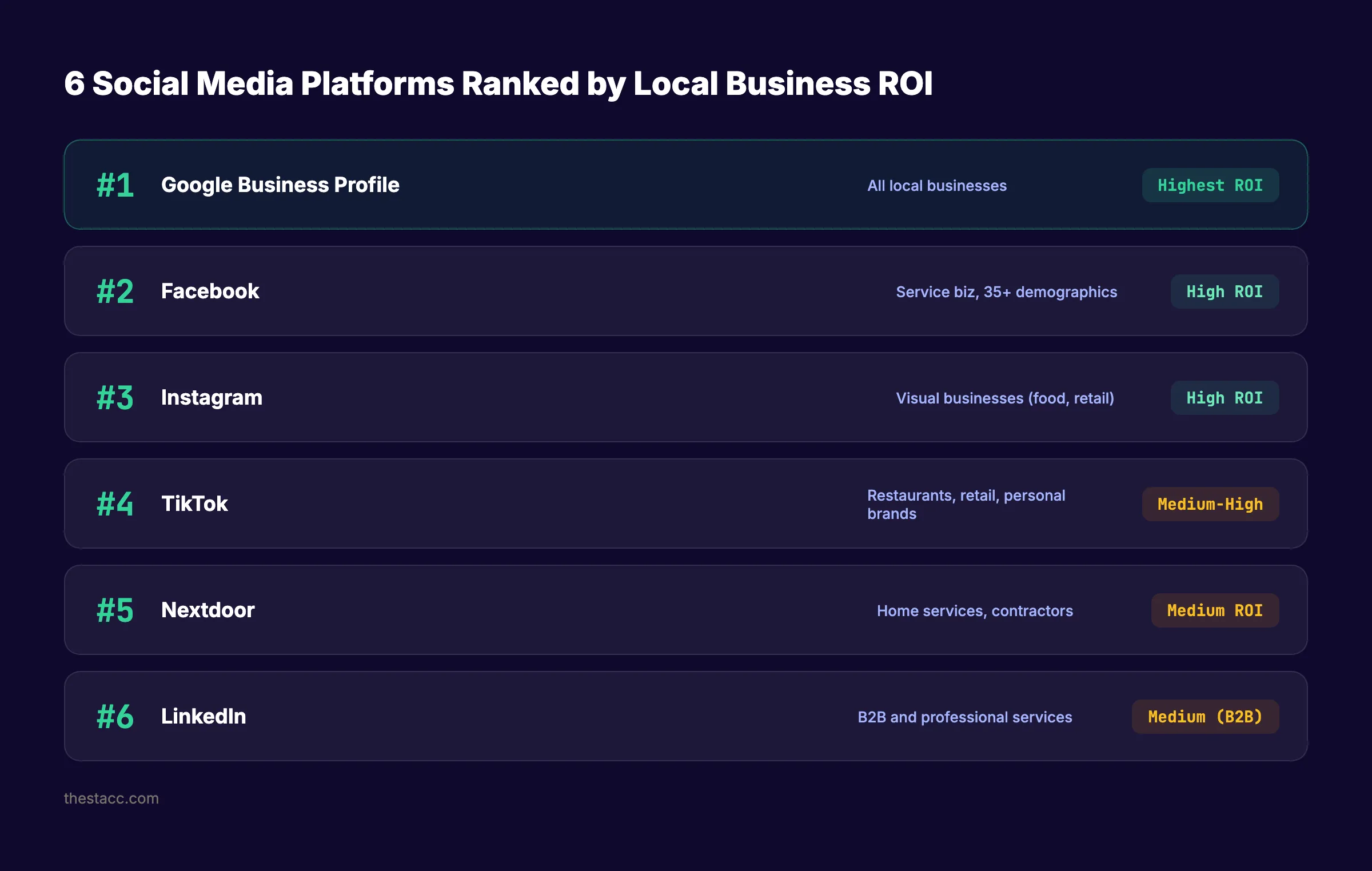
The 6 Platforms Ranked by Local Business ROI
Not every platform deserves your attention. Here is the honest ranking based on what drives foot traffic, phone calls, and revenue for local businesses.
| Rank | Platform | Best For | Time/Week | Local Business ROI |
|---|---|---|---|---|
| 1 | Google Business Profile | All local businesses | 1-2 hrs | Highest (direct search visibility) |
| 2 | Service businesses, 35+ demographics | 2-3 hrs | High (events, reviews, community) | |
| 3 | Visual businesses (food, retail, fitness) | 3-4 hrs | High (discovery, brand building) | |
| 4 | TikTok | Restaurants, retail, personal brands | 2-3 hrs | Medium-High (viral potential) |
| 5 | Nextdoor | Home services, contractors, real estate | 1 hr | Medium (hyper-local targeting) |
| 6 | B2B services, professional services | 1-2 hrs | Medium (for B2B only) |
The most common mistake is spreading effort across all 6. Focus on 2-3. Master them before adding another.
Google Business Profile: The Platform Most Businesses Ignore
Google Business Profile is not technically a social media platform. But it is the single most important local presence any business can have. When someone searches “dentist near me” or “plumber in Austin,” GBP results appear before any website or social profile.
Why GBP Is Number 1
46% of all Google searches have local intent. Those searches land on GBP listings first. Fully optimized profiles appear 80% more often in search results and generate 4x more website visits, 12% more calls, and 10% more direction requests. Profiles with regular post updates appear 2.8x more frequently in the top 3 map results.
GBP posts appear directly in search results and Google Maps. Unlike Instagram or TikTok posts that require users to open an app, GBP posts meet customers at the moment they are searching for your service.
What to Post on GBP
- Weekly updates about specials, events, or services
- New photos of your work, team, or location (at least 5 per month)
- Responses to every review within 24 hours
- Q&A answers covering your most common customer questions
Time Investment
1-2 hours per week. Post 2-3 updates. Add 2-3 photos. Respond to reviews. That is it. For a deeper guide, read our complete GBP optimization guide.
The businesses that treat GBP as their primary “social” platform see the fastest local SEO results. Reviews, photos, and posting frequency all factor into local pack rankings.
Facebook: Still Essential for Local Service Businesses
Facebook’s organic reach has declined for years. Most businesses reach only 2-5% of their followers with each post. Yet Facebook remains the second most important platform for local businesses. The reason: Facebook Groups, Events, Marketplace, and Reviews drive local discovery in ways no other platform matches.
Why Facebook Still Works
Facebook has 3.07 billion monthly active users. 70% of Facebook users visit a local business page at least once per week. For local businesses targeting homeowners, parents, and professionals over 35, Facebook is where decisions happen. A plumber recommended in a neighborhood Facebook Group gets more calls than one with 10,000 Instagram followers.
Facebook Events fill seats for local businesses. A restaurant posting a live music event, a gym announcing a free trial week, or a salon running a holiday promotion reaches local users who are actively looking for things to do.
What to Post on Facebook
- Local events and promotions (use Facebook Events for each one)
- Customer reviews and testimonials (screenshot + tag the customer)
- Behind-the-scenes content from your business
- Community involvement (sponsorships, charity events, local partnerships)
- Special hours, closures, and seasonal updates
Who Should Prioritize Facebook
- Home service businesses (HVAC, plumbing, electrical, landscaping)
- Professional services (dentists, lawyers, accountants)
- Restaurants and food businesses
- Fitness studios and gyms
- Any business targeting customers over 35
Who Can Skip Facebook
- Businesses targeting Gen Z as their primary audience
- Online-only businesses with no local presence
- B2B SaaS companies (LinkedIn is better)
Rank everywhere. Do nothing. Stacc handles Blog SEO, Local SEO, and Social Media on autopilot. 30 posts per month across 3 platforms. Start for $1 →
Instagram: The Discovery Engine for Visual Businesses
Instagram is the strongest discovery platform for local businesses that sell visual products or experiences. Restaurants, retail stores, salons, fitness studios, and event venues thrive on Instagram. Service businesses with less visual appeal (accountants, IT support) struggle to gain traction.
Why Instagram Works for Local Businesses
Instagram Reels get 2x the reach of static photo posts. For local businesses, that means a 15-second video of a finished kitchen remodel or a plated dish reaches users who have never followed you. Location tags and local hashtags connect your content to people searching in your area.
The platform is also where younger consumers (18-44) research local businesses. A clean Instagram grid with consistent, high-quality content signals that a business is active, professional, and worth visiting.
What to Post on Instagram
- Reels showing your work, process, or product (1-2 per week)
- Stories for daily specials, behind-the-scenes, or quick updates (2-3 per day)
- Carousel posts with tips, before/after transformations, or step-by-step content
- User-generated content (repost customer photos with credit)
- Location-tagged posts for every piece of content
Instagram Content Tips for Local Businesses
Use local hashtags. #AustinPlumber reaches your audience. #PlumbingLife does not. Mix 3-5 local hashtags with 3-5 industry hashtags per post.
Post Reels, not just photos. The algorithm prioritizes video content. A quick phone video of your team at work outperforms a polished studio photo.
Link to action. Your bio link should go to a reservation page, booking form, or contact page. Not your homepage. Update it monthly to match current promotions.
For a deeper guide on social media content, read our social media for restaurants guide. The content strategies apply to most visual local businesses.
TikTok: High Upside, Specific Use Cases
TikTok is the fastest-growing platform for local businesses. Restaurant adoption nearly doubled from 26% to 48% between 2023 and 2024. But TikTok is not for every local business. It rewards personality, raw video content, and trending formats. Businesses with a strong visual or entertainment angle thrive. Businesses that sell invisible services (tax prep, insurance) struggle.
Why TikTok Works for Some Local Businesses
TikTok’s engagement rate of 2-3.7% is the highest of any major platform. The algorithm surfaces content to users who have never followed you. A single video can reach 50,000-500,000 people if the content resonates. 88% of small businesses report that TikTok promotions led to higher sales.
61% of diners say TikTok food content influences where they eat. The platform drives real foot traffic for restaurants, cafes, and bars. Retail stores, salons, and fitness studios also see strong results.
What to Post on TikTok
- Day-in-the-life of running your business (30-60 seconds)
- Satisfying process videos (cooking, cleaning, building, styling)
- Quick tips related to your industry (under 30 seconds)
- Trending audio paired with your content
- Behind-the-scenes moments that show personality
Who Should Prioritize TikTok
- Restaurants, cafes, bars, and food trucks
- Retail stores with visual products
- Salons, barbershops, and beauty businesses
- Fitness studios and personal trainers
- Any business targeting customers under 40
Who Should Skip TikTok
- Home service contractors (plumbers, electricians, HVAC)
- Professional services (law firms, accounting firms)
- B2B service businesses
- Business owners who do not have time for video content
Nextdoor: The Hidden Gem for Home Services
Nextdoor is the most underrated social platform for local businesses. The platform connects neighbors in verified geographic areas. Recommendations on Nextdoor carry significant weight because they come from actual neighbors, not anonymous reviewers.
Why Nextdoor Works
Nextdoor has over 78 million weekly active users in the US. Nearly 1 in 3 US households is on the platform. 79% of neighbors say a Nextdoor recommendation influenced them to visit a business. 75% of users are homeowners with a median household income of roughly $90,000. When someone asks “who is a good electrician?” on Nextdoor, those recommendations generate real phone calls.
Business pages on Nextdoor include reviews, photos, and direct messaging. Local deals and sponsored posts target users by ZIP code. For home service businesses, the cost per lead on Nextdoor often beats Facebook and Google Ads.
What to Post on Nextdoor
- Respond to recommendation requests in your service area
- Share helpful tips related to your industry (seasonal home maintenance, etc.)
- Announce promotions targeted to your neighborhood
- Post photos of completed jobs in the area (with customer permission)
Who Should Prioritize Nextdoor
- Plumbers, electricians, HVAC technicians
- Landscapers and lawn care services
- House cleaners and handymen
- Real estate agents
- Pet services (groomers, dog walkers, vets)
Your SEO team. $99 per month. 30 optimized articles published automatically. Blog SEO + Local SEO + Social Media all handled. Start for $1 →
LinkedIn: For B2B and Professional Services Only
LinkedIn is the right platform for local businesses that sell to other businesses or professionals. Accountants, IT consultants, commercial real estate agents, and business coaches find clients on LinkedIn. Restaurants, retail stores, and consumer service businesses do not.
Why LinkedIn Works for B2B Local Businesses
LinkedIn has 1 billion members. The platform’s targeting is based on job title, industry, and company size. For a local IT consulting firm targeting small business owners, LinkedIn puts your content in front of decision-makers.
Long-form posts, articles, and thought leadership content perform well on LinkedIn. The algorithm rewards original content and engagement. A local accountant posting tax tips in January reaches small business owners preparing for tax season.
What to Post on LinkedIn
- Industry insights and tips relevant to your local market
- Case studies from local client work (with permission)
- Business milestones and team updates
- Commentary on industry news that affects local businesses
- Event announcements for professional networking events
Who Should Use LinkedIn
- Accountants and bookkeepers targeting small businesses
- IT consulting and managed service providers
- Commercial real estate agents and brokers
- Business coaches and consultants
- Staffing and recruitment agencies
Who Should Skip LinkedIn
- Consumer-facing local businesses (restaurants, salons, retail)
- Home service contractors
- Any business where customers are consumers, not businesses
How to Choose Your 2 Platform Focus
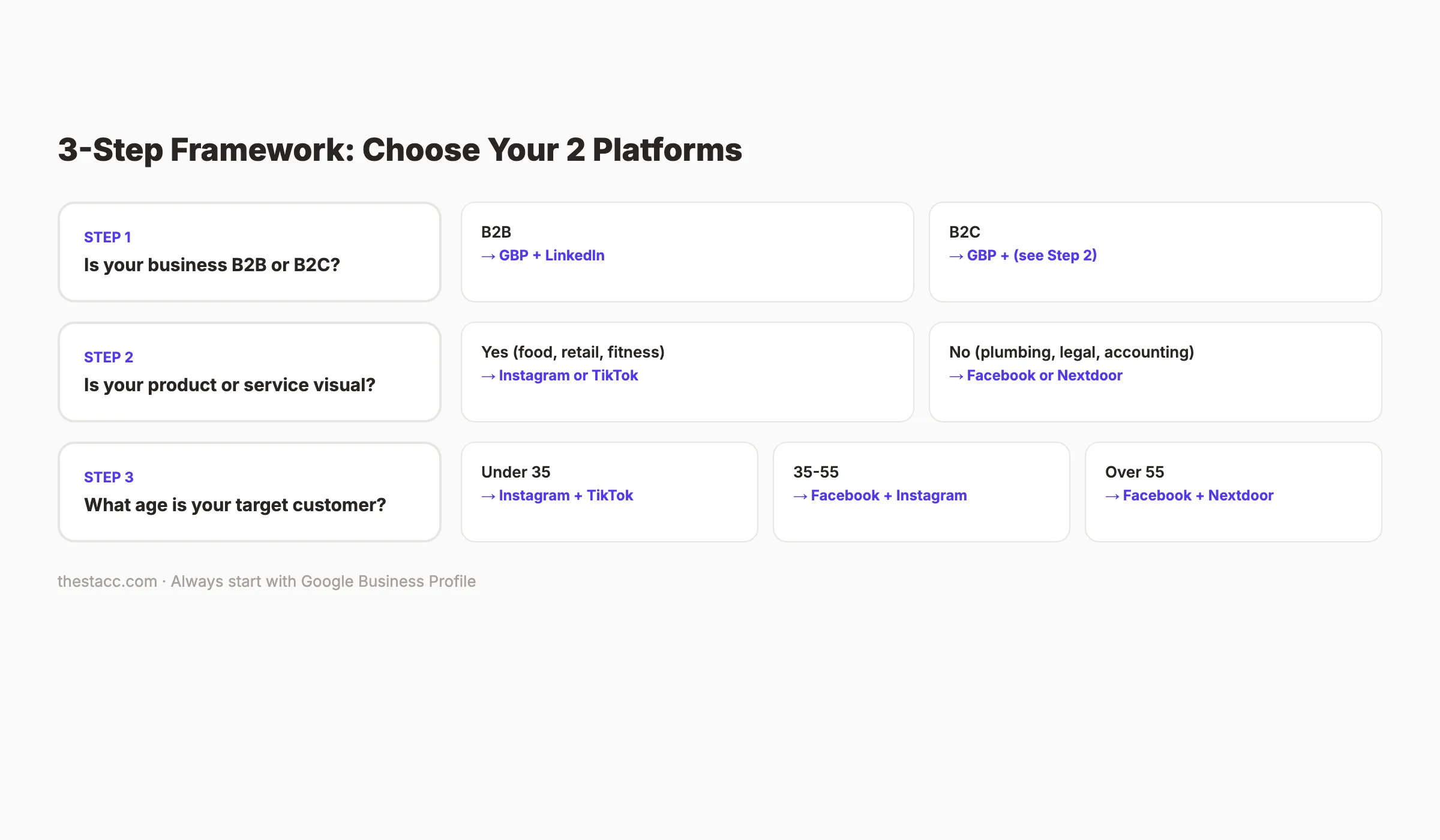
Trying to be active on every platform guarantees mediocre results everywhere. Pick 2 platforms. Master them. Add a third only after the first 2 are producing consistent results.
The Decision Framework
Step 1: Is your business B2B or B2C?
- B2B → GBP + LinkedIn
- B2C → GBP + one of the following based on business type
Step 2: Is your product/service visual?
- Yes (food, retail, fitness, beauty) → Instagram or TikTok
- No (plumbing, accounting, legal) → Facebook or Nextdoor
Step 3: What is your target customer age?
- Under 35 → Instagram + TikTok
- 35-55 → Facebook + Instagram
- Over 55 → Facebook + Nextdoor
| Business Type | Platform 1 | Platform 2 | Optional Platform 3 |
|---|---|---|---|
| Restaurant/Cafe | GBP | TikTok | |
| Plumber/Electrician/HVAC | GBP | Nextdoor | |
| Salon/Barbershop | GBP | TikTok | |
| Dentist/Doctor | GBP | ||
| Law Firm | GBP | ||
| Real Estate Agent | GBP | Nextdoor | |
| Retail Store | GBP | TikTok | |
| Gym/Fitness Studio | GBP | ||
| Accountant/Bookkeeper | GBP | ||
| Landscaper/Contractor | GBP | Nextdoor |
GBP appears in every row for a reason. It is non-negotiable for any business that serves local customers. The second platform depends on your business type, audience, and content strengths.
For tools to manage multiple platforms efficiently, see our guide on social media automation tools for small businesses.
Common Mistakes Local Businesses Make on Social Media
Spreading Across Too Many Platforms
A dentist posting once a week on 5 platforms reaches nobody. That same dentist posting 4 times per week on Facebook and GBP builds a real audience. Concentration beats distribution.
Ignoring Google Business Profile
Most local businesses set up GBP once and never touch it again. GBP is the only platform where your content appears directly in Google search results. Ignoring it is leaving the highest-ROI channel untouched.
Posting Without Local Context
Generic content does not drive local action. “5 Tips for Healthy Teeth” is generic. “Why Austin Water Causes More Cavities Than You Think” is local. Local context makes content relevant and shareable within your community.
Never Asking for Reviews
88% of consumers trust online reviews as much as personal recommendations. Social media is the easiest channel to drive review volume. Ask satisfied customers to leave a Google review. Share reviews as social proof content. Read our complete guide on how to get more Google reviews.
No Clear Call to Action
Every post needs a next step. “Call us at 512-555-1234.” “Book online at [link].” “DM for a free estimate.” Without a CTA, social content generates likes but not leads.
Not Measuring Results
Track phone calls, website visits, and appointment bookings from each platform. If you cannot attribute results to a platform after 90 days, reconsider your time investment. Focus on platforms that drive measurable business outcomes. Learn more about tracking in our local SEO statistics guide.
How Social Media Supports Local SEO
Social media does not directly affect Google search rankings. But active social profiles create the signals that do affect rankings.
Brand Mentions and Citations
Consistent social media activity generates brand mentions across the web. Google uses brand authority signals to evaluate local businesses. A business mentioned on Facebook, Instagram, Google Maps, and Nextdoor signals stronger local relevance than one with zero social presence.
Review Velocity
Social media drives review volume. More reviews signal trust and relevance to Google. Businesses with 200+ Google reviews rank higher in local pack results than those with 20 reviews. Social media is the fastest way to accelerate review collection.
Branded Search Volume
When someone sees your business on Instagram and searches your name on Google, that branded search tells Google your business is relevant. Higher branded search volume correlates with higher local rankings.
Content Repurposing
Blog content becomes social media posts. Social posts drive website visits. Website visits generate engagement signals. The cycle reinforces itself. Read our guide on repurposing blog content for social media for a step-by-step process.
The most effective local marketing strategy combines social media with blog SEO and local SEO. When all 3 channels publish consistently, each one amplifies the others.
Blog SEO + Local SEO + Social Media. One platform. Stacc publishes across all 3 channels automatically. Starting at $99/month. Start for $1 →
FAQ
What is the best social media platform for a local business?
Google Business Profile is the best platform for any local business. It is the only platform where your content appears directly in Google search results and Maps. Beyond GBP, the best second platform depends on your business type. Visual businesses (restaurants, salons) should use Instagram. Service businesses (plumbers, contractors) should use Facebook or Nextdoor.
How often should a local business post on social media?
Post 3-5 times per week on your primary platform and 2-3 times per week on your secondary platform. Consistency matters more than frequency. Five posts per week for 12 months beats 20 posts per week for 2 months. Use scheduling tools to batch content weekly.
Is TikTok worth it for local businesses?
TikTok is worth it for restaurants, retail stores, salons, and fitness businesses that can produce short video content. It is not worth it for home service contractors, law firms, or professional services. TikTok’s algorithm rewards raw, entertaining content. If you cannot commit to 3+ videos per week, skip it.
Does social media help with local SEO?
Social media does not directly affect Google rankings. But it drives branded searches, review volume, and brand mentions that do improve local SEO. Active social profiles signal to Google that your business is active and relevant. The combination of social media, blog content, and GBP optimization produces the strongest local SEO results.
How much should a local business spend on social media?
DIY social media costs $0 plus 5-10 hours per month of your time. A freelance social media manager costs $500-$2,000 per month. A social media agency costs $1,000-$5,000 per month. Stacc automates social media posting for $49/month with 30 posts across 3 platforms. The right budget depends on whether you value your time at $0 or at your actual hourly rate.
Should local businesses use paid social media ads?
Paid ads make sense after you have established an organic presence. Start with organic content for 60-90 days. Then use $5-$15/day in location-targeted ads to amplify your best-performing posts. Facebook and Instagram ads with a 10-mile radius targeting reach local customers at low cost. Paid ads without organic content look like spam.
The best social media platforms for local businesses are the ones where your customers are already looking. For every local business, that starts with Google Business Profile. After that, choose 1-2 platforms based on your business type, audience age, and content strengths. Master those before adding more.
Two platforms done well beats six platforms done poorly. Every time.

Written by
Siddharth GangalSiddharth is the founder of theStacc and Arka360, and a graduate of IIT Mandi. He spent years watching great businesses lose organic traffic to competitors who simply published more. So he built a system to fix that. He writes about SEO, content at scale, and the tactics that actually move rankings.
Stop researching. Start ranking.
30 SEO blog articles published to your site every month. No writers, no workflow, no waiting.
30-day trial · Cancel anytime
theStacc
Stop writing SEO content manually
30 blog articles, 30 GBP posts, and social media content. Published every month. Automatically.
Start Your $1 Trial$1 for 3 days · Cancel anytime