
Social Media for Restaurants (2026): Guide
social media for restaurants guide for 2026: strategies, tactics, real examples, and implementation steps to get results faster.
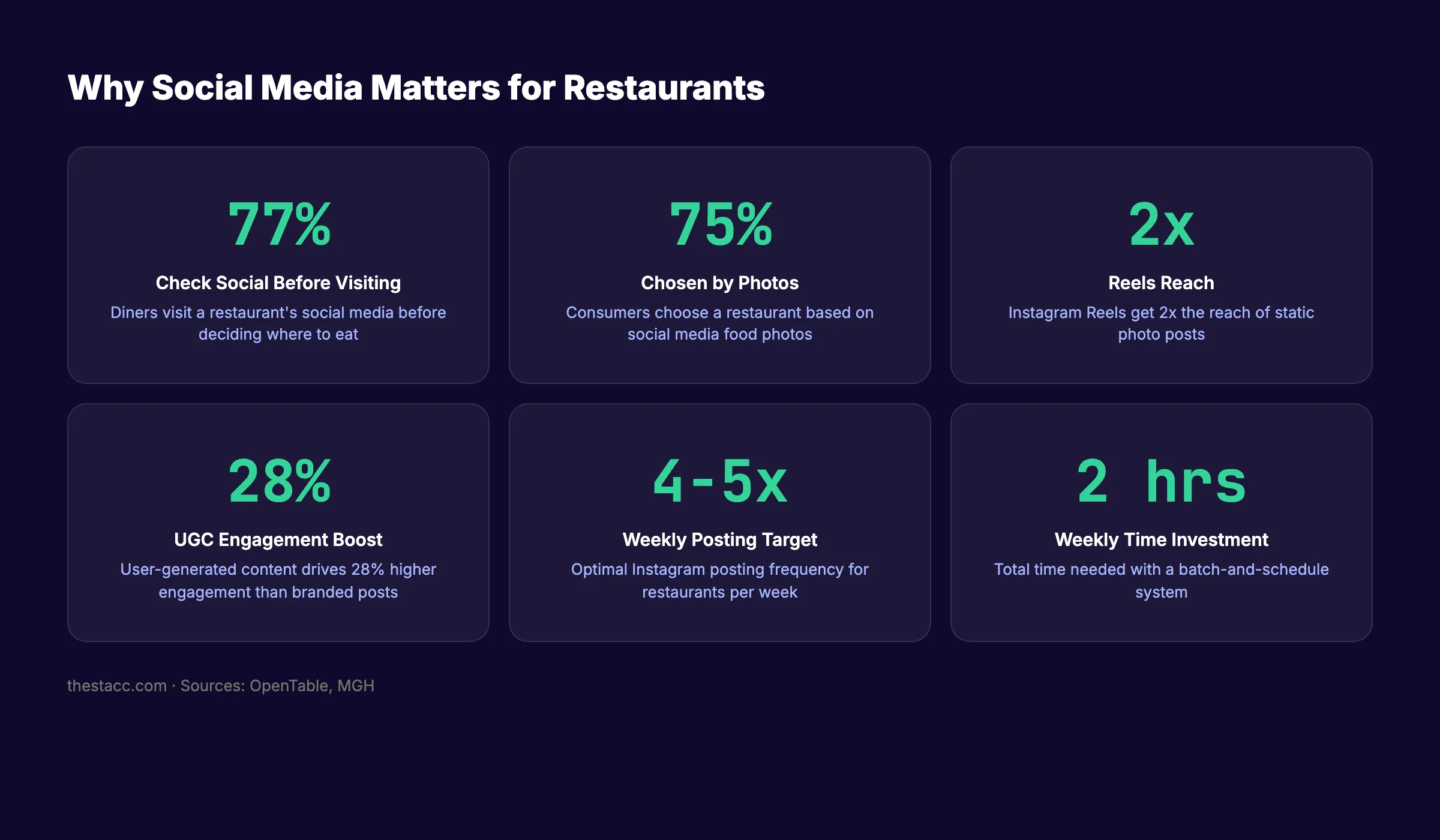
Social media for restaurants is no longer optional. 74% of consumers use social media to decide where to eat. A dead Instagram page with 3 photos from 2022 tells potential customers more than you think. It says the restaurant might be closed.
Yet most restaurant owners spend zero hours per week on social media. They are too busy managing staff, inventory, and the lunch rush. The result: competitors with active feeds steal the guests who searched “best tacos near me” on Instagram 10 minutes ago.
We have published content for restaurants across 70+ markets. This guide covers what actually works for filling tables through social media. No theory. No fluff. Just the platforms, content types, and schedules that drive reservations.
Here is what you will learn:
- Which platforms matter for restaurants (and which to skip)
- The 7 content types that perform best for food businesses
- A realistic posting schedule that takes under 2 hours per week
- How to turn followers into actual diners
- Common mistakes that waste time without driving covers
- How to automate your social media without losing authenticity
Why Social Media Matters for Restaurants
Restaurants live and die on local visibility. A diner searching “Italian restaurant downtown” checks Google first, then Instagram. If your profile shows consistent, appetizing content, you get the visit. If it shows nothing, the restaurant next door gets it instead.
The numbers back this up. 90% of consumers research restaurants online before dining. And 88% of diners trust online reviews as much as personal recommendations. Visual proof that the food looks worth the drive matters more than any ad you could run.
Social media also feeds your local SEO rankings. Google factors in social signals, review velocity, and brand mentions. An active social presence supports your Google Business Profile and helps you rank in the local map pack.
The Restaurant-Specific Advantage
Restaurants have a built-in content advantage over most businesses. Every dish is a photo opportunity. Every happy table is a story. Every seasonal menu change is a post. Most businesses struggle to find content. Restaurants have too much of it.
The challenge is not creating content. It is finding time to post it consistently.
Which Platforms to Use (and Which to Skip)
Not every platform deserves your time. Restaurants should focus on 2-3 platforms maximum. Spreading across 6 platforms creates 6 dead accounts instead of 2 active ones.
Instagram (Essential)
Instagram is the most important social platform for restaurants. Period. Food is visual. Instagram is visual. The match is obvious.
Why it works: Instagram Reels get 2x the reach of static posts. Location tags connect you to local searchers. The Explore page surfaces food content to users who have never heard of your restaurant.
What to post: Behind-the-scenes kitchen videos, dish close-ups, customer stories, staff highlights, seasonal specials, Reels showing plating or prep.
Posting frequency: 4-5 posts per week. 2-3 Stories per day. 1-2 Reels per week.
Facebook (Important for Older Demographics)
Facebook still matters for restaurants targeting diners over 35. It drives event attendance and community engagement.
Why it works: Facebook Events fill seats for live music nights, wine tastings, and holiday specials. Local community groups amplify your reach. The platform handles reservations and reviews.
What to post: Events, daily specials, customer reviews, community involvement, holiday hours, catering menus.
Posting frequency: 3-4 posts per week. Respond to every review within 24 hours.
TikTok (High Upside, Low Effort)
TikTok is the fastest way to go viral as a restaurant. 61% of diners say TikTok food content influences where they eat. Restaurant adoption of TikTok nearly doubled from 26% to 48% between 2023 and 2024 according to Cropink research. The algorithm favors new accounts more than Instagram does.
What to post: Quick prep videos, satisfying food shots, day-in-the-life of a restaurant owner, trending audio with food content, behind-the-kitchen-door reveals.
Posting frequency: 3-5 videos per week. Consistency matters more than production quality.
Platforms to Skip
Twitter/X: Low visual engagement. Restaurants rarely gain traction here unless they have a strong brand voice (think Wendy’s). Skip unless you already have a following.
LinkedIn: Not relevant for most restaurants. Exception: catering companies and restaurant groups recruiting talent.
Pinterest: Useful for recipe blogs, not for driving foot traffic to a physical location. Skip it.
| Platform | Priority | Best For | Minimum Frequency |
|---|---|---|---|
| Essential | Food photography, Reels, Stories | 4-5 posts/week | |
| Important | Events, reviews, older demographics | 3-4 posts/week | |
| TikTok | High upside | Viral videos, younger demographics | 3-5 videos/week |
| Google Business Profile | Essential (not social, but critical) | Reviews, photos, updates | 2-3 posts/week |
| Twitter/X | Skip | Brand voice (rare use case) | N/A |
Do not forget Google Business Profile. It is not a social platform, but GBP posts appear directly in search results. Restaurants that post weekly updates to GBP see higher local pack rankings. Learn more in our restaurant SEO guide.
Rank everywhere. Do nothing. Stacc handles Blog SEO, Local SEO, and Social Media on autopilot. 30 posts per month across 3 platforms for $49/mo. Start for $1 →
The 7 Content Types That Work for Restaurants
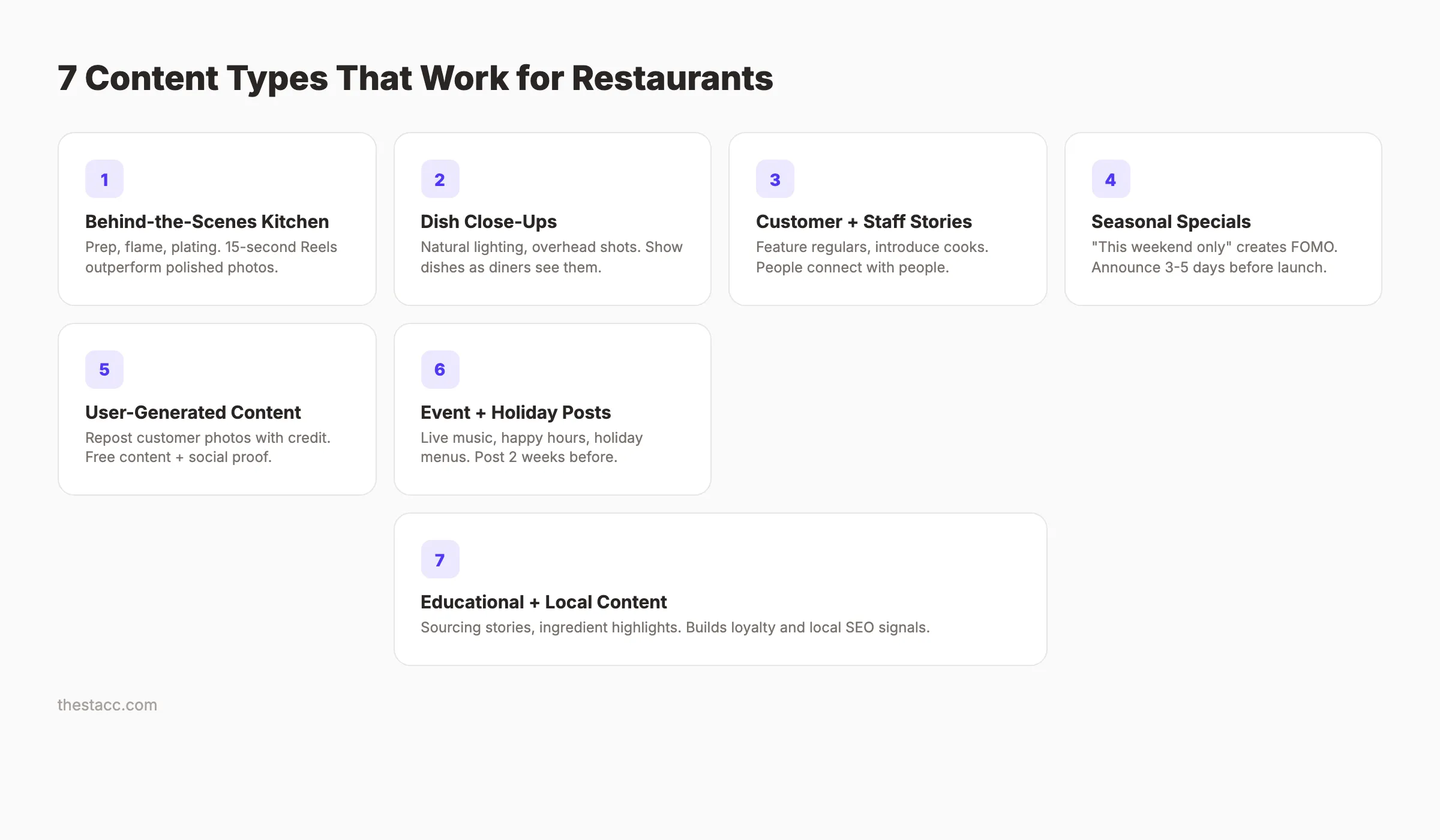
Not all social media content performs equally. These 7 types consistently drive engagement and covers for restaurants.
1. Behind-the-Scenes Kitchen Content
Show the prep, the flame, the plating. Diners love seeing how their food gets made. Kitchen content humanizes your restaurant and builds trust. A 15-second Reel of a chef torching crème brûlée outperforms a polished marketing photo every time.
2. Dish Close-Ups With Natural Lighting
Overhead shots of signature dishes on a clean table. Natural lighting only. No flash. No filters that make food look unnatural. Show the dish as a diner would see it. Include a brief caption describing the dish and when it is available.
3. Customer and Staff Stories
Feature a regular customer. Introduce a line cook. Share why the bartender chose this career. People connect with people, not logos. Staff highlights also help with recruitment.
4. Seasonal and Limited-Time Specials
Urgency drives action. “This weekend only” and “while supplies last” create FOMO. Seasonal menu changes deserve their own post series. Announce them 3-5 days before launch to build anticipation.
5. User-Generated Content (UGC)
Repost customer photos and videos with credit. UGC is free content that doubles as social proof. Encourage tagging by putting your Instagram handle on the menu, table tents, or receipt. UGC drives 4x higher conversion than branded photos according to TrueFuture Media research.
6. Event and Holiday Content
Live music nights, happy hour specials, Valentine’s Day prix fixe, Super Bowl watch parties. Event content drives direct reservations. Post the event 2 weeks before, 1 week before, and day-of.
7. Educational and Local Content
Share food sourcing stories. Explain why you use a specific ingredient. Support a local charity. This content builds brand loyalty and differentiates you from chains. It also supports your local SEO by creating local relevance signals.
A Realistic Posting Schedule
Most restaurant social media guides recommend posting 2-3 times per day across every platform. That is unrealistic for an owner working 60+ hours per week. Here is a schedule that takes under 2 hours per week.
Weekly Content Calendar
| Day | TikTok | ||
|---|---|---|---|
| Monday | Behind-the-scenes Reel | Weekly specials announcement | , |
| Tuesday | Dish close-up photo | , | Quick kitchen video |
| Wednesday | Story: today’s special | Community/local post | , |
| Thursday | UGC repost | Event promotion | Behind-the-scenes Reel |
| Friday | Weekend special announcement | Weekend special announcement | Food prep video |
| Saturday | Story: packed house | , | , |
| Sunday | Staff highlight | , | Fun/trending content |
That is 5 Instagram posts, 3 Facebook posts, and 3 TikTok videos per week. Total: 11 pieces of content. Batch-create them on Monday morning. It takes 90-120 minutes if you have a system.
The Batching System
- Monday AM (30 min): Shoot 3-5 short videos of prep and plating during morning setup
- Monday AM (30 min): Write captions for all 11 posts using a template
- Monday AM (30 min): Schedule everything using a social media scheduling tool
- Daily (5 min): Post 1-2 Stories in real time (quick phone snaps)
- Daily (5 min): Respond to comments and DMs
Total weekly time: 2 hours plus 10 minutes per day. That is manageable for any restaurant team.
For tools that automate this further, see our guide on social media automation tools.
How to Turn Followers Into Diners
Followers mean nothing if they do not walk through your door. Social media for restaurants must drive covers, not just likes. Here is how to convert.
Link in Bio Strategy
Your Instagram bio gets one link. Use it wisely. Link to your reservation page, online ordering, or a landing page with both. Update it weekly to match your current promotion.
Do not link to your homepage. Link to the specific action you want. Friday fish fry special? Link directly to the reservation page with “Friday Fish Fry” in the header.
Location Tags on Every Post
Every post should include a location tag. Location tags surface your content to people searching for restaurants in your area. A diner searching “restaurants in [neighborhood]” on Instagram sees location-tagged posts first.
Call-to-Action in Every Caption
Every caption needs a clear next step. “Reserve for Friday” with a link. “Order for pickup” with a number. “DM us for catering.” Do not post a beautiful dish photo and leave the caption as just an emoji. Tell people what to do next.
Stories for Daily Specials
Instagram Stories disappear in 24 hours. Use that urgency. “Today only: half-price oysters until 6 PM.” Stories with polls (“Which dessert should we bring back?”) drive engagement and provide menu intelligence.
Track What Drives Reservations
Use UTM parameters on your bio link. Ask new customers “how did you hear about us?” Track which posts precede reservation spikes. Most restaurants never measure social media ROI. The ones that do can double down on what works and cut what does not.
Your social media team. $49 per month. 30 posts across Instagram, Facebook, and more. Written, scheduled, and published automatically. Start for $1 →
Common Mistakes Restaurants Make on Social Media
Knowing what to avoid saves as much time as knowing what to do.
Posting Only When You Remember
Inconsistency is the biggest killer. Posting 5 times one week and zero times the next tells the algorithm your account is inactive. It also confuses followers who expect regular content. Batch and schedule to prevent this.
Most restaurant owners blame lack of time. The real problem is lack of a system. A 90-minute Monday session produces a full week of content. The restaurants that treat social media as a recurring task fill more tables than those who post when they remember.
Over-Polished Content
Restaurant social media does not need professional photography. Overproduced content looks like an ad. Diners scroll past ads. Authentic, slightly imperfect content stops the scroll. A shaky phone video of a sizzling steak performs better than a studio shot.
Ignoring Comments and DMs
A comment is a conversation starter. Ignoring it tells the customer they do not matter. 73% of diners will choose a competitor if a restaurant does not respond online. Respond to every comment within 4 hours. Answer every DM within 24 hours. The algorithm rewards engagement, and so do customers.
No Local Hashtags
Generic hashtags like #food and #restaurant reach nobody useful. Use local hashtags: #AustinEats, #ChicagoFoodie, #SeattleBrunch. Local hashtags connect you to diners in your market.
Treating Every Platform the Same
Cross-posting the exact same content to Instagram, Facebook, and TikTok wastes each platform’s strengths. Instagram favors polished Reels. TikTok favors raw, trending content. Facebook favors events and community posts. Adapt your content to the platform.
Never Checking Analytics
Most restaurants never open their Instagram Insights or Facebook Analytics. These free tools show which posts drive profile visits, which Reels get the most reach, and what time your audience is online. Check analytics weekly. Post more of what works.
How to Get More Reviews Through Social Media
Reviews are the bridge between social media and local SEO rankings. A restaurant with 200+ Google reviews and a 4.5+ rating ranks higher in the local pack. Social media is the easiest channel to drive review volume.
Ask After a Positive Interaction
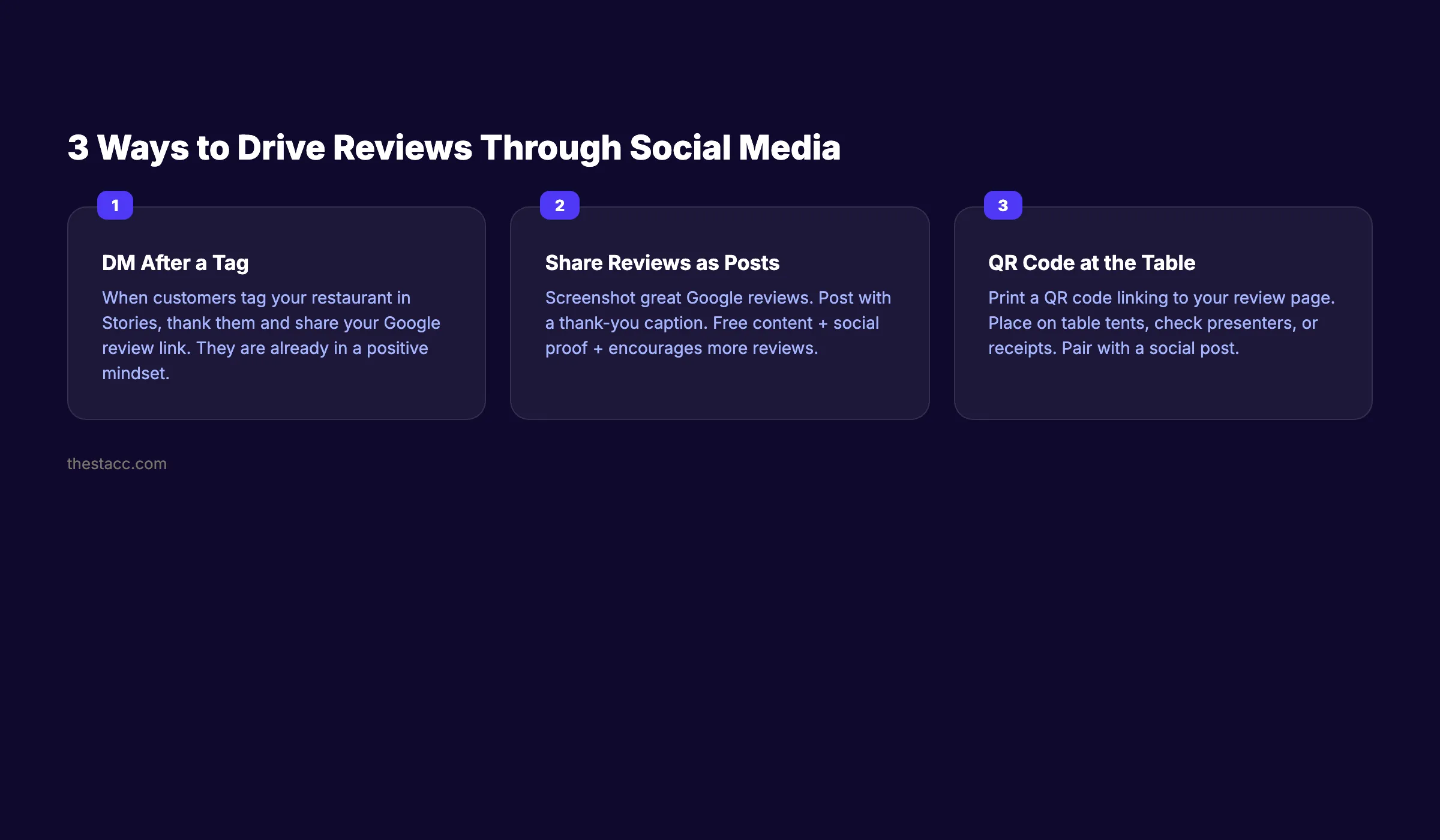
When a customer posts a Story tagging your restaurant, DM them a thank-you and a link to your Google review page. The timing is perfect. They are already in a positive mindset about your food.
Share Reviews as Content
Screenshot a great Google review. Post it with a thank-you caption. Tag the reviewer if they are on Instagram. This serves 3 purposes: it is free content, it is social proof, and it encourages others to leave reviews.
Use a QR Code at the Table
Print a QR code linking to your Google review page. Place it on the table tent, check presenter, or receipt. Pair this with a social media post: “Love your experience? Leave us a review.” For more strategies, read our guide to getting more Google reviews.
Social Media and SEO Work Together
Social media does not directly improve your Google rankings. But it drives behaviors that do.
According to Deloitte Digital research, restaurants with strong social media strategies see a 9.9% average revenue increase. “Social-first” restaurant brands see 14.1% revenue lifts.
Social Signals Build Brand Authority
Active social profiles with consistent posting create brand mentions across the web. Google uses brand authority as a ranking signal. A restaurant with 10,000 Instagram followers, 500 Google reviews, and weekly blog posts signals authority that a restaurant with none of these cannot match.
The data supports this. Restaurants that maintain active profiles across at least 2 platforms see 23% more website visits from organic search than those with dormant accounts. The reason is not that social media directly boosts rankings. It is that social activity generates the brand signals, backlinks, and customer behaviors that Google rewards.
Social Media Drives Branded Searches
When someone sees your restaurant on Instagram and searches your name on Google, that branded search tells Google your business is relevant. High branded search volume correlates with higher local rankings.
Content Repurposing Multiplies Reach
A blog post about your farm-to-table sourcing becomes 5 Instagram posts, 3 TikTok videos, and 2 Facebook updates. One piece of content serves 10+ social touchpoints. This is content repurposing at its most efficient.
The Stacc Stack Method
The most effective restaurant marketing combines Blog SEO + Local SEO + Social Media. Blog content ranks on Google. Local SEO dominates the map pack. Social media captures the visual discovery audience. Together, they cover every way a diner finds a new restaurant.
This is what we call The Stacc Stack Method. When all 3 channels publish consistently, each one amplifies the others. Blog posts provide content for social media. Social engagement boosts local SEO signals. Local SEO drives the reviews that become social proof. Learn more about social media marketing for local businesses.
Blog SEO + Local SEO + Social Media. One platform. Stacc publishes 30 blog articles, 30 GBP posts, and 30 social posts every month. Automatically. Start for $1 →
FAQ
What is the best social media platform for restaurants?
Instagram is the best platform for most restaurants. Food content is inherently visual, and Instagram Reels reach users beyond your follower base. Facebook is essential for events and diners over 35. TikTok offers the highest viral potential for restaurants willing to post short-form video. Focus on 2-3 platforms rather than all of them.
How often should a restaurant post on social media?
Post 4-5 times per week on Instagram, 3-4 times on Facebook, and 3-5 times on TikTok. This sounds like a lot, but batching content on one morning per week takes under 2 hours. Use scheduling tools to automate publishing. Consistency matters more than volume.
What should a restaurant post on social media?
The 7 best content types for restaurants are: behind-the-scenes kitchen videos, dish close-ups, customer and staff stories, seasonal specials, user-generated content reposts, event promotions, and local/educational content. Mix these throughout your weekly calendar.
Does social media help with restaurant SEO?
Social media does not directly affect Google rankings. But it drives branded searches, review volume, and backlinks that do. An active social presence supports your Google Business Profile and creates the brand signals Google uses to determine local authority. Social and SEO work best when combined.
How much does restaurant social media marketing cost?
DIY costs $0 plus your time (8-10 hours/month). A social media agency charges $1,000-$5,000/month. A freelance social media manager costs $500-$2,000/month. Stacc automates social media posting for $49/month with 30 posts across 3 platforms.
How do I get more followers for my restaurant?
Post consistently (4-5 times/week minimum). Use local hashtags. Tag your location on every post. Collaborate with local food bloggers. Encourage customers to tag you by putting your handle on menu items and receipts. Reshare user-generated content. Run location-targeted Instagram ads for $5-$10/day to reach nearby diners.
Social media for restaurants is not about going viral. It is about showing up consistently so that when a diner searches for their next meal, your restaurant is the one they see. The restaurants that post regularly fill more tables. The ones that do not post lose covers to the restaurant across the street that does.
Start with 2 platforms. Post 4-5 times per week. Batch your content on Monday. Measure what works. Cut what does not. The system is simple. The execution is what separates busy restaurants from empty ones.
If you want to go further, combine social media with blog content and local SEO. That combination covers every way a diner finds a new restaurant in 2026.
Related Tools & Resources
Free SEO Tools:
Best Lists:

Written by
Siddharth GangalSiddharth is the founder of theStacc and Arka360, and a graduate of IIT Mandi. He spent years watching great businesses lose organic traffic to competitors who simply published more. So he built a system to fix that. He writes about SEO, content at scale, and the tactics that actually move rankings.
Automate your Google Business Profile content
30 GBP posts, local SEO articles, and review responses. Published every month automatically.
30-day trial · Cancel anytime
theStacc
Stop writing SEO content manually
30 blog articles, 30 GBP posts, and social media content. Published every month. Automatically.
Start Your $1 Trial$1 for 3 days · Cancel anytime