
Dental SEO for 2026 (2026): Strategies, Tactics & Examples
Practical dental seo guide strategies for 2026: step-by-step tactics, real examples, and tools to improve rankings and drive organic traffic.
“Dentist near me” gets 1.2 million searches per month in the United States alone. Your practice either shows up for those searches or it does not.
Most dental practices rely on word-of-mouth referrals and paid ads. Both work. Neither compound over time. SEO does. A well-optimized dental website generates patient inquiries every day without ongoing ad spend.
The problem is that most dental SEO advice is written by agencies trying to sell you a retainer. This guide is different. It covers every tactic you need to rank your dental practice on Google, attract more patients, and reduce your dependence on paid advertising.
We have published 3,500+ blog posts across 70+ industries, including dozens for dental and healthcare practices. This guide covers everything we know about dental SEO.
Here is what you will learn:
- How to optimize your Google Business Profile for the local map pack
- Which keywords dental patients actually search for
- How to build service pages that rank and convert
- The content strategy that positions your practice as an authority
- Technical SEO fixes that most dental websites miss
- How to turn patient reviews into a ranking advantage
- How to measure whether your SEO efforts are working
What Is Dental SEO and Why It Matters
Dental SEO is the process of optimizing your practice’s online presence to rank higher in Google search results. It covers your website, your Google Business Profile, your directory listings, and the content you publish.
46% of all Google searches have local intent. Dental searches are almost entirely local. Patients search for a dentist in their city, their neighborhood, or “near me.” If your practice does not appear in those results, you lose patients to competitors who do.
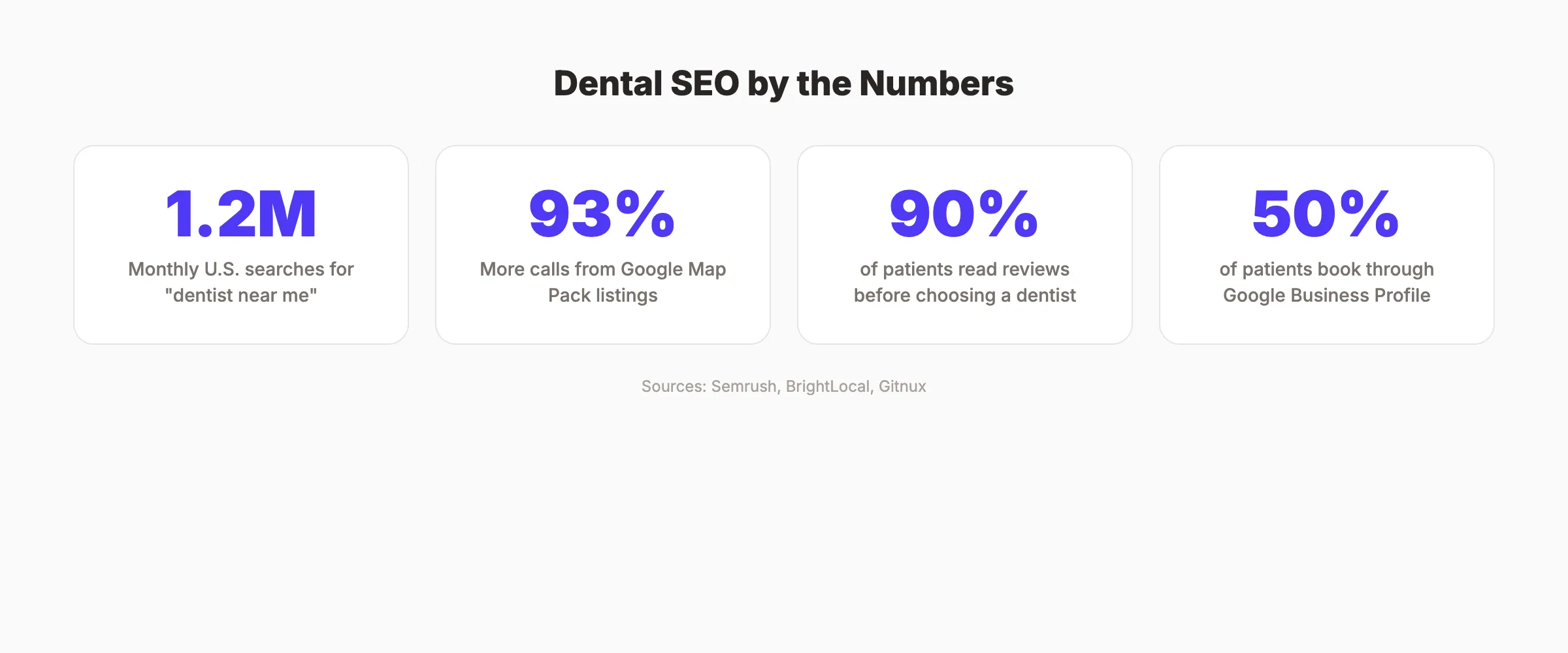
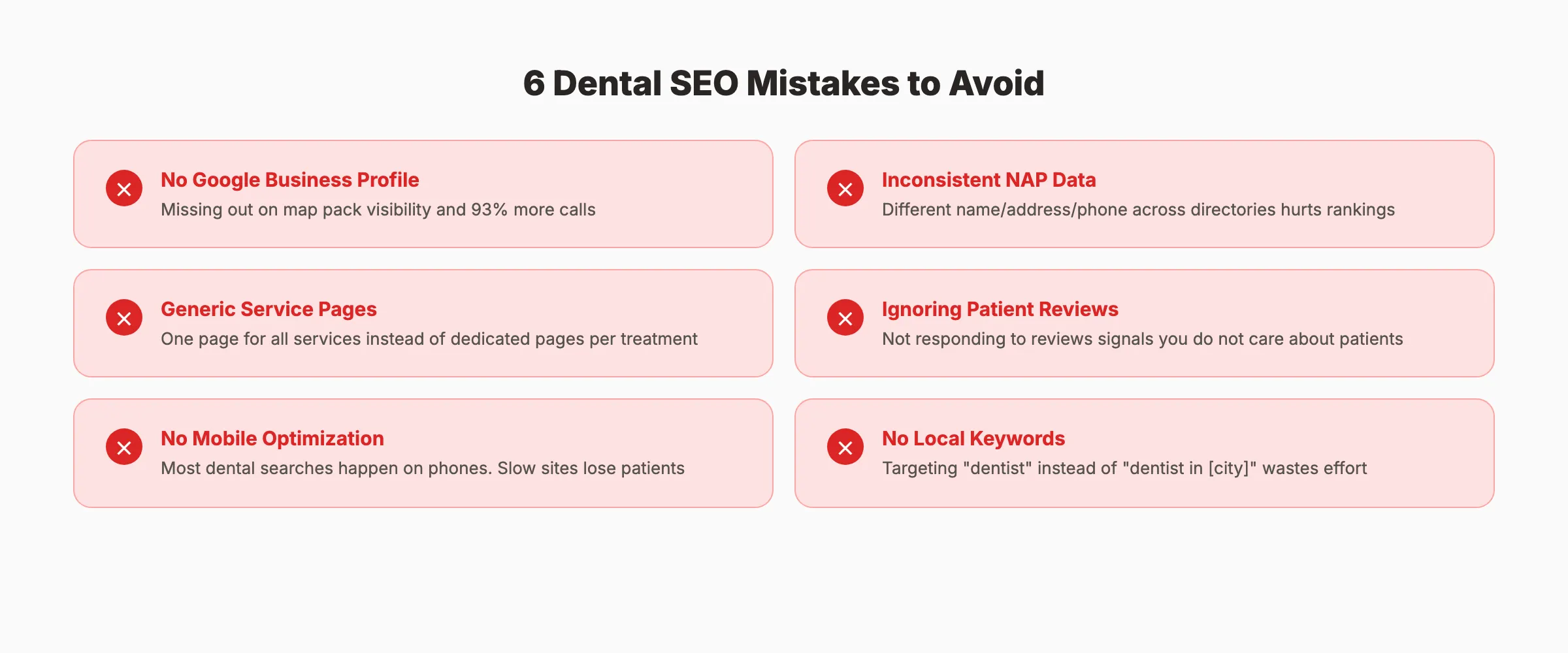
The data tells a clear story. 90% of patients read online reviews before choosing a dentist. 50% of patients prefer to book through Google Business Profile. Practices in the Google Map Pack receive 93% more calls than those below it.
Paid ads stop working the moment you stop paying. SEO builds an asset. A service page that ranks for “dental implants in [your city]” generates leads every month for years.
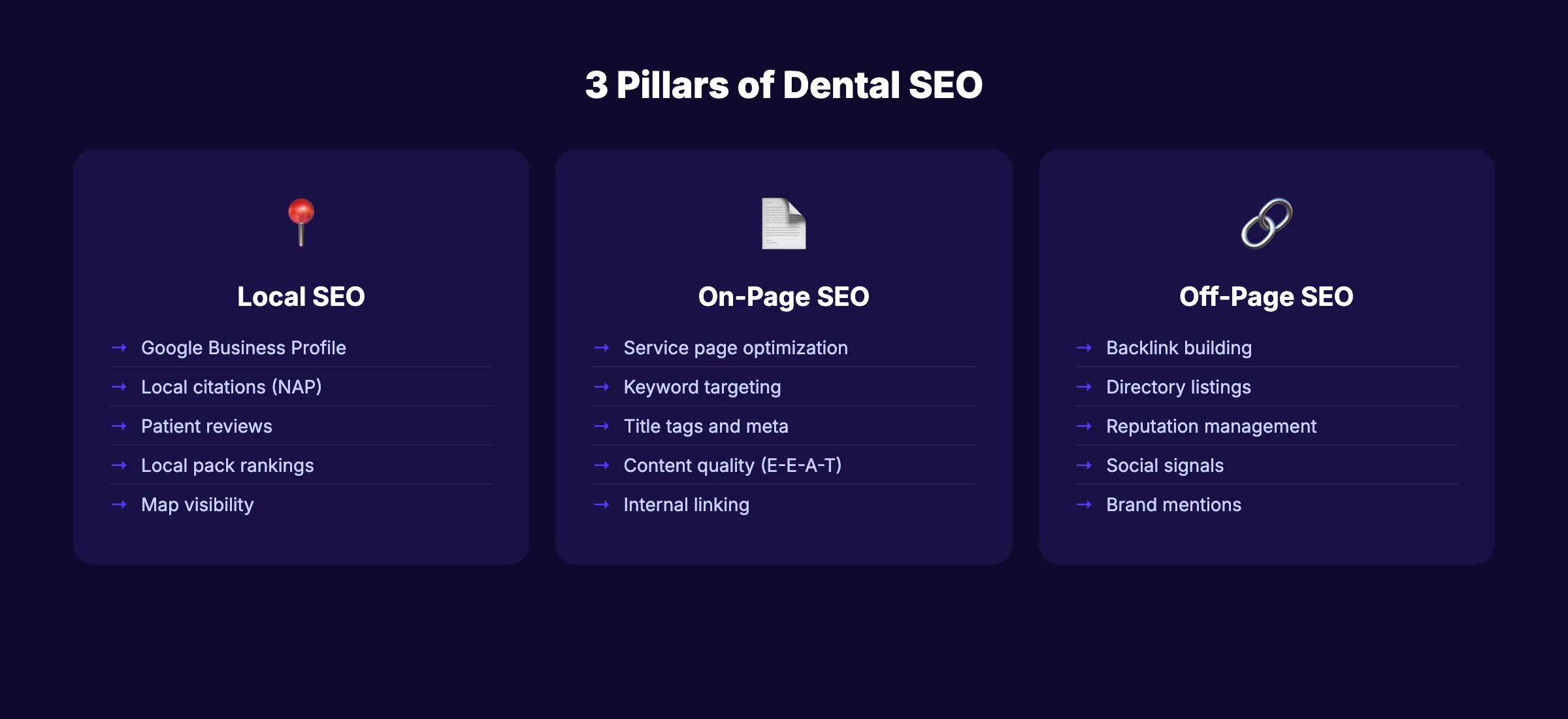
Dental SEO has 3 pillars: local SEO, on-page SEO, and off-page SEO. Each chapter in this guide covers a critical piece of the puzzle.
Google Business Profile: Your Most Important Ranking Asset
Your Google Business Profile (GBP) is the single most important factor for local dental SEO. It determines whether your practice appears in the map pack, the 3 listings Google shows above organic results for local searches.
48% of all clicks for local searches go to map pack listings. If your practice is not in the top 3, you are invisible to nearly half of potential patients.
How to Optimize Your GBP
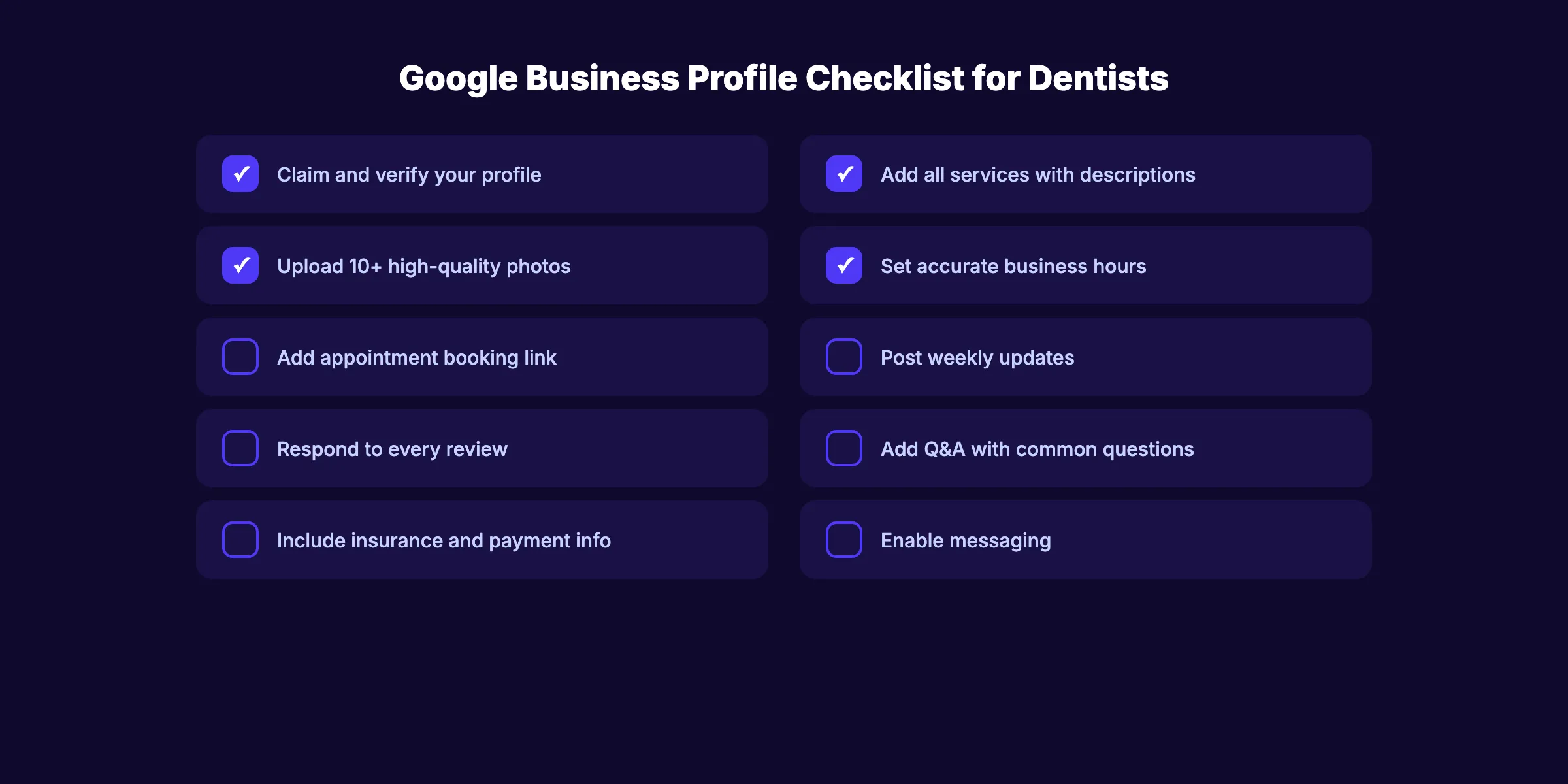
Claim and verify your profile. If you have not done this, stop reading and do it now. Go to Google Business Profile and follow the verification process.
Complete every field. Google rewards complete profiles. Add your practice name, address, phone number, website, business hours, appointment link, services, insurance accepted, and a detailed business description.
Choose the right categories. Your primary category should be “Dentist.” Add secondary categories for your specialties: “Cosmetic Dentist,” “Pediatric Dentist,” “Orthodontist,” “Emergency Dental Service.”
Add high-quality photos. Upload at least 10 photos of your office, team, and equipment. Practices with photos receive 42% more direction requests and 35% more website clicks.
GBP Posts and Updates
Post weekly updates to your GBP. Share new services, seasonal promotions, patient education tips, or team news. Google favors active profiles over dormant ones.
Each post should include a call-to-action button linking to your appointment booking page. For a deeper look at GBP optimization, read our Google Business Profile optimization guide.
NAP Consistency
NAP stands for Name, Address, and Phone number. Your NAP must be identical everywhere it appears online. Your website, your GBP, Yelp, Healthgrades, Zocdoc, and every other directory must show the exact same information.
Even small differences hurt rankings. “123 Main St” versus “123 Main Street” confuses Google. Use the same format everywhere.
Rank everywhere. Do nothing. Blog SEO, Local SEO, and Social on autopilot. Stacc handles it all. Start for $1 →
Keyword Research for Dental Practices
Most dentists target the wrong keywords. Ranking for “dentist” nationally is nearly impossible and largely useless. Your patients search locally.
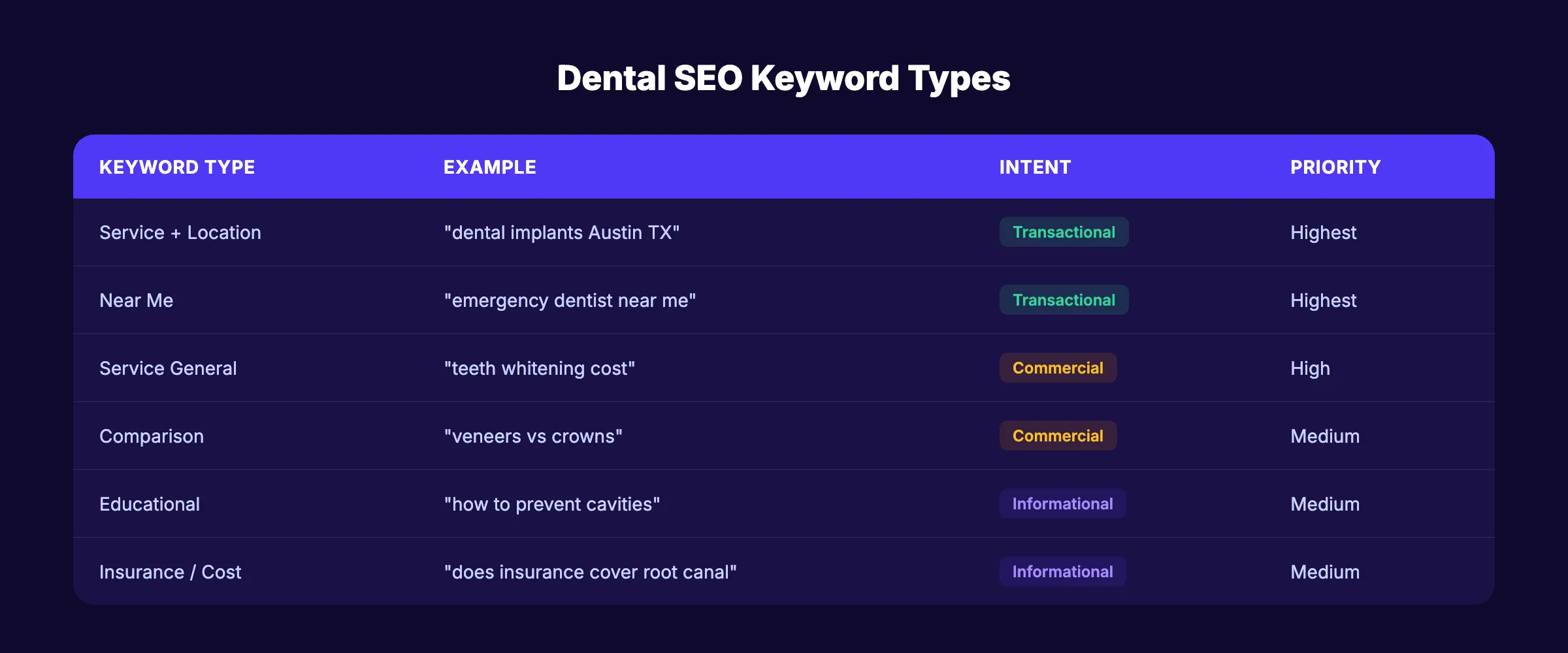
The highest-value dental keywords follow 3 patterns:
Service + Location Keywords
These are your top priority. They signal a patient ready to book an appointment.
- “dental implants Austin TX”
- “emergency dentist Portland”
- “teeth whitening near me”
- “pediatric dentist Brooklyn”
- “Invisalign provider Chicago”
Every service your practice offers should have a dedicated page targeting that service plus your city.
Treatment Comparison Keywords
These capture patients researching options before they book.
- “veneers vs crowns”
- “Invisalign vs braces cost”
- “dental implant vs bridge”
- “composite vs porcelain veneers”
These keywords have commercial intent. The patient is close to a decision. Comparison blog posts targeting these terms convert well.
Educational Keywords
These build authority and attract patients at the top of the funnel.
- “how to prevent cavities”
- “does insurance cover root canal”
- “how long do dental implants last”
- “what to expect during a root canal”
Educational content positions your practice as a trusted source. It also feeds topical authority signals that help your service pages rank higher.
For a complete process on finding the right keywords, read our keyword research guide.
On-Page SEO for Dental Websites
On-page SEO is what you do on your own website to help Google understand your content and rank it for the right searches. Most dental websites fail at on-page SEO because they treat their website like a digital brochure.
Create Dedicated Service Pages
This is the most common mistake dental practices make. One generic “Services” page listing all treatments does not rank for anything specific.
Create a dedicated page for each service you offer:
| Service | Page URL | Target Keyword |
|---|---|---|
| Dental Implants | /services/dental-implants | ”dental implants [city]“ |
| Teeth Whitening | /services/teeth-whitening | ”teeth whitening [city]“ |
| Root Canal | /services/root-canal | ”root canal dentist [city]“ |
| Invisalign | /services/invisalign | ”Invisalign provider [city]“ |
| Emergency Dental | /services/emergency-dentist | ”emergency dentist [city]“ |
| Pediatric Dentistry | /services/pediatric-dentist | ”pediatric dentist [city]” |
Each page should include: a clear description of the procedure, what patients can expect, pricing range (if possible), before-and-after photos, and a booking call-to-action.
Title Tags and Meta Descriptions
Your title tag is the blue link in Google search results. It is the first thing patients see.
Formula: [Service] in [City] | [Practice Name]
Example: “Dental Implants in Austin TX | Bright Smile Dental”
Keep titles under 60 characters. Include your target keyword and city. Write a unique title for every page.
For meta descriptions, follow our meta description writing guide. Include the service, city, a benefit, and a call-to-action. Stay under 155 characters.
Header Tags and Content Structure
Use H1 for the page title. Use H2 for major sections. Use H3 for subsections. Every page needs a logical hierarchy.
Your H1 should include your primary keyword. For example: “Dental Implants in Austin, TX. Permanent Tooth Replacement.”
Follow our on-page SEO guide for the complete checklist.
Schema Markup
Add Dentist and LocalBusiness schema to your website. Schema tells Google exactly what your practice offers, where you are located, and how patients can contact you.
Include your practice name, address, phone, hours, services, accepted insurance, and aggregate review rating. For implementation details, read our schema markup guide.
Your SEO team. $99 per month. 30 optimized articles published automatically every month. Start for $1 →
Content Marketing for Dental Practices
Publishing blog content is one of the fastest ways to build authority and attract organic traffic to your dental website.
A dental practice blog serves 3 purposes. It targets educational keywords that service pages cannot. It builds topical authority around dentistry. It gives patients a reason to trust your expertise before they book.
Blog Topics That Work for Dentists
The best dental blog topics answer real patient questions. Here are formats that perform consistently:
Treatment explainers:
- “What to Expect During a Root Canal”
- “How Long Do Dental Implants Last?”
- “Invisalign Timeline: Week by Week”
Cost and insurance guides:
- “How Much Do Dental Implants Cost in 2026?”
- “Does Dental Insurance Cover Cosmetic Procedures?”
- “Affordable Teeth Whitening Options”
Comparison posts:
- “Veneers vs Crowns: Which Is Right for You?”
- “Invisalign vs Traditional Braces: A Complete Comparison”
Prevention and care tips:
- “10 Ways to Prevent Cavities in Children”
- “How to Care for Your Teeth After Whitening”
Publishing Frequency
Consistency matters more than volume. Start with 2 to 4 blog posts per month. Each post should target a specific keyword and link back to the relevant service page.
The practices that rank fastest publish 8 to 12 posts per month. At that pace, you build topical authority within 3 to 6 months. For guidance on writing posts that rank, read our SEO content writing guide.
E-E-A-T: Why It Matters for Dental Content
Dental content falls under Google’s YMYL (Your Money or Your Life) category. Google holds health-related content to a higher standard.
Your content must demonstrate Experience, Expertise, Authoritativeness, and Trustworthiness (E-E-A-T). In practice, this means:
- List author credentials. Every blog post should include the dentist’s name, degree, and years of practice.
- Cite medical sources. Link to dental associations, peer-reviewed research, or official clinical guidelines.
- Include real patient outcomes. Before-and-after photos, case studies, and testimonials demonstrate experience.
- Keep content accurate and current. Review and update posts annually.
Technical SEO for Dental Websites
Technical SEO ensures Google can crawl, index, and rank your website without friction. Most dental websites have technical issues that silently hurt their rankings.
Mobile Performance
Over 60% of dental searches happen on mobile devices. Your website must load fast and work flawlessly on phones.
Test your site with Google PageSpeed Insights. Aim for a performance score above 80. Common fixes include compressing images, enabling browser caching, and minimizing JavaScript. For the full breakdown, read our Core Web Vitals guide.
Site Security
Your website must use HTTPS. Google penalizes insecure sites. Patients entering personal information or booking appointments need to trust that their data is protected.
If your site still runs on HTTP, contact your hosting provider. Most offer free SSL certificates through Let’s Encrypt.
XML Sitemap and Robots.txt
Submit an XML sitemap to Google Search Console. Your sitemap tells Google which pages to crawl and index. Read our XML sitemap guide for setup instructions.
Your robots.txt file controls what Google can access. Make sure you are not accidentally blocking important pages. Check your configuration against our robots.txt guide.
Site Speed and Page Structure
Dental websites often load slowly because of unoptimized images, heavy themes, and unnecessary plugins. Every second of load time increases bounce rate. Patients will leave and call the next dentist.
Run a full SEO audit to identify technical issues. Fix the critical ones first: broken links, missing meta tags, duplicate content, and slow pages.
3,500+ blogs published. 92% average SEO score. See what Stacc can do for your dental practice. Start for $1 →
Online Reviews and Reputation Management
Reviews are the second most important local ranking factor after your Google Business Profile. They also directly influence whether a patient chooses your practice or a competitor.
90% of patients read online reviews before choosing a dentist. 10 recent reviews from verified patients carry more weight than 200 old ones.
How to Get More Reviews
Ask at the right moment. The best time to request a review is immediately after a positive appointment. Train your front desk team to ask in person.
Send a follow-up text or email. Include a direct link to your Google review page. Make it one tap to leave a review on mobile.
Make it easy. Create a short URL that goes directly to your Google review form. Print it on appointment cards, display it in the office, and include it in post-appointment emails.
For a complete system, read our guide to getting more Google reviews.
How to Respond to Reviews
Respond to every review within 24 to 48 hours. Both positive and negative.
For positive reviews: Thank the patient by name. Mention the specific service if appropriate. Keep it genuine and brief.
For negative reviews: Stay professional. Acknowledge their concern. Offer to resolve the issue offline. Never argue publicly.
Google watches how practices handle reviews. Active, thoughtful responses signal trustworthiness to both patients and the algorithm.
Building Backlinks for Your Dental Practice
Backlinks are links from other websites to yours. They act as votes of confidence. The more high-quality sites that link to your practice, the higher you rank.
Most dental practices earn zero backlinks because they never try. Here are tactics that work for local dental practices:
Local Link Building
- Join your local Chamber of Commerce. They link to member businesses.
- Sponsor local events. Youth sports teams, charity runs, and school programs often link to sponsors.
- Partner with other local businesses. Cross-referrals with orthodontists, oral surgeons, and pediatricians can include website links.
Content-Driven Links
Publish original research or data that other sites want to reference. A blog post like “Average Cost of Dental Implants in [City]: 2026 Data” earns links from insurance sites, health blogs, and local news outlets.
For a deeper guide on link building tactics, read our complete backlink building guide.
Directory Listings
List your practice on reputable directories:
- Google Business Profile (most important)
- Yelp
- Healthgrades
- Zocdoc
- WebMD
- Dentistry.com
- Your state dental association directory
Ensure your NAP is identical on every listing. Inconsistent data hurts rankings.
Measuring Your Dental SEO Results
SEO without measurement is guesswork. Track these metrics monthly to know whether your efforts are working.
Key Metrics to Monitor
| Metric | Tool | What It Tells You |
|---|---|---|
| Organic traffic | Google Analytics | How many visitors find you through search |
| Keyword rankings | Google Search Console | Which keywords you rank for and their positions |
| Map pack position | Manual search or rank tracker | Whether you appear in the top 3 local results |
| Phone calls from GBP | GBP Insights | How many patients call directly from your profile |
| Direction requests | GBP Insights | How many patients look up directions to your office |
| Website bookings | Your booking system | How many appointments come from organic search |
| Review count and rating | Google Business Profile | Your reputation trend over time |
Timeline for Results
Set realistic expectations. Dental SEO is a 3 to 6 month investment before meaningful results appear.
- Month 1: Technical fixes, GBP optimization, and keyword research completed. No ranking changes yet.
- Month 2 to 3: Content starts getting indexed. GBP posts and reviews build momentum. Initial keyword movement.
- Month 4 to 6: Service pages start ranking for local keywords. Map pack position improves. Phone calls increase.
- Month 6 to 12: Authority compounds. Organic traffic grows month over month. Patient acquisition cost drops.
Use Google Search Console to track impressions, clicks, and average position for your target keywords. This is the most reliable free tool for measuring dental SEO progress.
FAQ
How much does dental SEO cost?
DIY dental SEO costs nothing but your time. Hiring an agency typically runs $1,000 to $5,000 per month. A service like Stacc publishes 30 SEO-optimized blog posts per month starting at $99 per month, covering the content side of dental SEO at a fraction of agency pricing.
How long does it take for dental SEO to work?
Most dental practices see initial ranking improvements within 3 to 6 months. Quick wins like GBP optimization and review generation can produce results in weeks. Competitive keywords in large cities may take 6 to 12 months of consistent effort.
Is SEO better than Google Ads for dentists?
Both have a role. Google Ads deliver immediate visibility but stop working when you stop paying. SEO takes longer to produce results but builds an asset that generates patients indefinitely. The best approach combines both: use ads for immediate patient flow while SEO builds long-term organic traffic.
What is the most important ranking factor for dental SEO?
Google Business Profile optimization is the single most impactful factor for local dental rankings. A complete, active profile with recent reviews and accurate information is the fastest path to the map pack.
Do I need a blog for my dental practice?
Yes. A blog targets educational and informational keywords that your service pages cannot. It builds topical authority, earns backlinks, and gives patients a reason to trust your practice before they book. Practices that publish 8 to 12 blog posts per month rank significantly faster than those that publish none.
Can I do dental SEO myself?
You can handle the basics: GBP optimization, review management, and directory listings. Content creation and technical SEO require more time and expertise. Many dentists handle GBP themselves and outsource content and technical work to keep costs manageable.
Dental SEO is not a one-time project. It is a system that compounds over time. Start with your Google Business Profile and reviews. Build service pages that target local keywords. Publish content that earns trust and backlinks.
The practices that commit to this process for 6 to 12 months do not just rank higher. They build a patient acquisition engine that works every day without ad spend.
Related Tools & Resources
Free SEO Tools:
Best Lists:

Written by
Siddharth GangalSiddharth is the founder of theStacc and Arka360, and a graduate of IIT Mandi. He spent years watching great businesses lose organic traffic to competitors who simply published more. So he built a system to fix that. He writes about SEO, content at scale, and the tactics that actually move rankings.
Automate your Google Business Profile content
30 GBP posts, local SEO articles, and review responses. Published every month automatically.
30-day trial · Cancel anytime
theStacc
Stop writing SEO content manually
30 blog articles, 30 GBP posts, and social media content. Published every month. Automatically.
Start Your $1 Trial$1 for 3 days · Cancel anytime