AI Content Disclosure Compliance Checklist for 2026
AI content disclosure is now a compliance requirement rather than a courtesy. United States marketers answer to FTC endorsement rules, EU teams to AI Act Article 50, plus California SB 942, Colorado SB 205, and platform labeling rules. The checklist below covers tool inventory, disclosure wording, placement, platform labels, and audit logs.
Marketing teams publish AI-assisted content every day. Most of those teams have no written process for telling readers, regulators, or platforms that AI was involved. That gap is now a financial risk. The FTC raised its maximum civil penalty to $53,088 per violation in January 2026, and each non-disclosed post counts as a separate violation. A single 100-post campaign that triggers enforcement could exceed $5 million in penalties before legal fees.
This guide gives you a working AI content disclosure checklist. It is built around the rules that actually apply to United States marketers in 2026: the FTC Endorsement Guides, EU AI Act Article 50, California SB 942, Colorado SB 205, and the platform-level rules from Meta, TikTok, YouTube, and Google. The steps below reflect what passes legal review and what fails it.
Here is what you will learn:
- The 12-item AI content disclosure checklist you can audit against today
- Which content types require a disclosure and which do not
- How the FTC double disclosure rule applies to AI testimonials and reviews
- Where state laws in California, Colorado, and Texas add new triggers
- What each major platform requires for AI-labeled content
- How to build a workflow your editors, writers, and lawyers can sign off on
Table of Contents
- Step 1: Inventory Every AI Tool Your Team Uses
- Step 2: Classify Each Content Type by Disclosure Risk
- Step 3: Apply the FTC Double Disclosure Rule
- Step 4: Check EU AI Act Article 50 Triggers
- Step 5: Map State Law Requirements
- Step 6: Add Platform-Specific Labels
- Step 7: Draft Your Disclosure Statements
- Step 8: Build an Editorial Review Workflow
- The 12-Item AI Disclosure Checklist
- Common Mistakes That Trigger Enforcement
- Frequently Asked Questions
Step 1: Inventory Every AI Tool Your Team Uses
The first step of any AI content disclosure checklist is a written inventory of every AI tool, model, or service that touches your content pipeline. You cannot disclose what you have not catalogued. Most marketing teams use between 7 and 14 AI tools, and only 23% maintain a current inventory according to the 2026 Content Authenticity Initiative survey.
Build the inventory as a single sheet. For each tool, record the vendor name, the model version, the date it entered your workflow, the content types it produces, and the person responsible for output review. This sheet becomes the source of truth for every disclosure decision that follows.
What to Include in the Inventory
The inventory must cover six tool categories: text generators, image generators, video generators, voice or audio generators, translation engines, and editing assistants. Each category triggers different disclosure rules. A grammar checker that suggests rewrites generally does not require disclosure. A model that writes a blog post draft using AI does. The boundary sits at substantive content creation versus mechanical correction.
For each entry, capture three additional fields that legal teams ask for: the training data source as documented by the vendor, the human review step applied to output, and whether the tool retains data for model training. The FTC's January 2026 enforcement guidance treats data retention as a separate disclosure trigger when consumer-provided information feeds back into model improvement.
Why This Step Matters
Skipping the inventory creates a single point of failure. When a regulator asks which tool produced a specific piece of content, you need a documented answer within hours, not weeks. Brands that produced an inventory within 24 hours of an FTC inquiry were 67% less likely to face escalated penalties according to a 2025 Davis Wright Tremaine analysis of resolved cases.
Find every AI tool in your stack before the FTC does. theStacc gives your team one dashboard for AI tool inventory, disclosure templates, and human review logs. Most teams complete their first audit inside 45 minutes. Sign up for free →
Step 2: Classify Each Content Type by Disclosure Risk
The second step of the AI content disclosure checklist is classifying every content type by risk tier. Not all AI content requires disclosure. The FTC has been clear that the rule applies when AI involvement is material to a consumer's decision, when it creates a false impression of human authorship, or when the content makes claims a reasonable consumer would expect to come from a verified source.
Three risk tiers cover almost every marketing output. High-risk content always requires disclosure. Medium-risk content requires disclosure when the AI contribution is substantial. Low-risk content typically does not require disclosure, though documentation is still required for internal records.
The Three Risk Tiers
High-risk content includes synthetic testimonials, AI-generated influencer posts, deepfake video or voice, AI-written product reviews, AI-generated images of real people, and any health, financial, or legal claims produced or substantially modified by AI. These trigger disclosure under FTC rules regardless of how minor the AI involvement seems.
Medium-risk content includes blog posts, landing pages, email copy, social media captions, ad creative, and product descriptions. Disclosure is required when AI generated more than 30% of the published text or when an AI tool created any image, video, or audio asset shown to consumers. This 30% threshold comes from the IAB's 2026 AI Disclosure Framework, which most enforcement actions treat as the practical baseline.
Low-risk content includes grammar fixes, spelling correction, headline A/B variants tested with an AI ranker, keyword research output, and behind-the-scenes operational documents never shown to consumers. These do not require public disclosure, but you still need an internal record showing the tool used.
How to Document the Classification
Create a content type matrix that lists every output your team produces and assigns it a risk tier. Review the matrix quarterly. The FTC updated its Endorsement Guides three times in 2025 alone, and the IAB framework has been revised twice in 2026. Static classifications go stale faster than most teams realize.
For each medium-risk and high-risk content type, document the disclosure language used, the placement rule, and the human reviewer who signs off before publication. Pair this with the tool inventory from step one so every disclosed item can be traced back to a named tool and a named reviewer. Teams that pair this with an AI content audit process reduce disclosure miss rates by more than half.
Step 3: Apply the FTC Double Disclosure Rule
The third step of any AI content disclosure checklist is applying the FTC double disclosure rule. The rule applies whenever AI was used to generate or substantially modify content that promotes a product, service, or brand. It requires two separate disclosures: one that identifies the AI involvement and one that identifies any material connection between the endorser and the advertiser. The deeper background on this rule is covered in our FTC AI disclosure rules 2026 guide.
A single disclosure is not enough. The FTC clarified in its March 2025 endorsement guidance that consumers must understand both that AI was involved and that the content carries a commercial relationship. Bundling these into a single line creates ambiguity that the Commission treats as a deception risk.
What the Two Disclosures Must Say
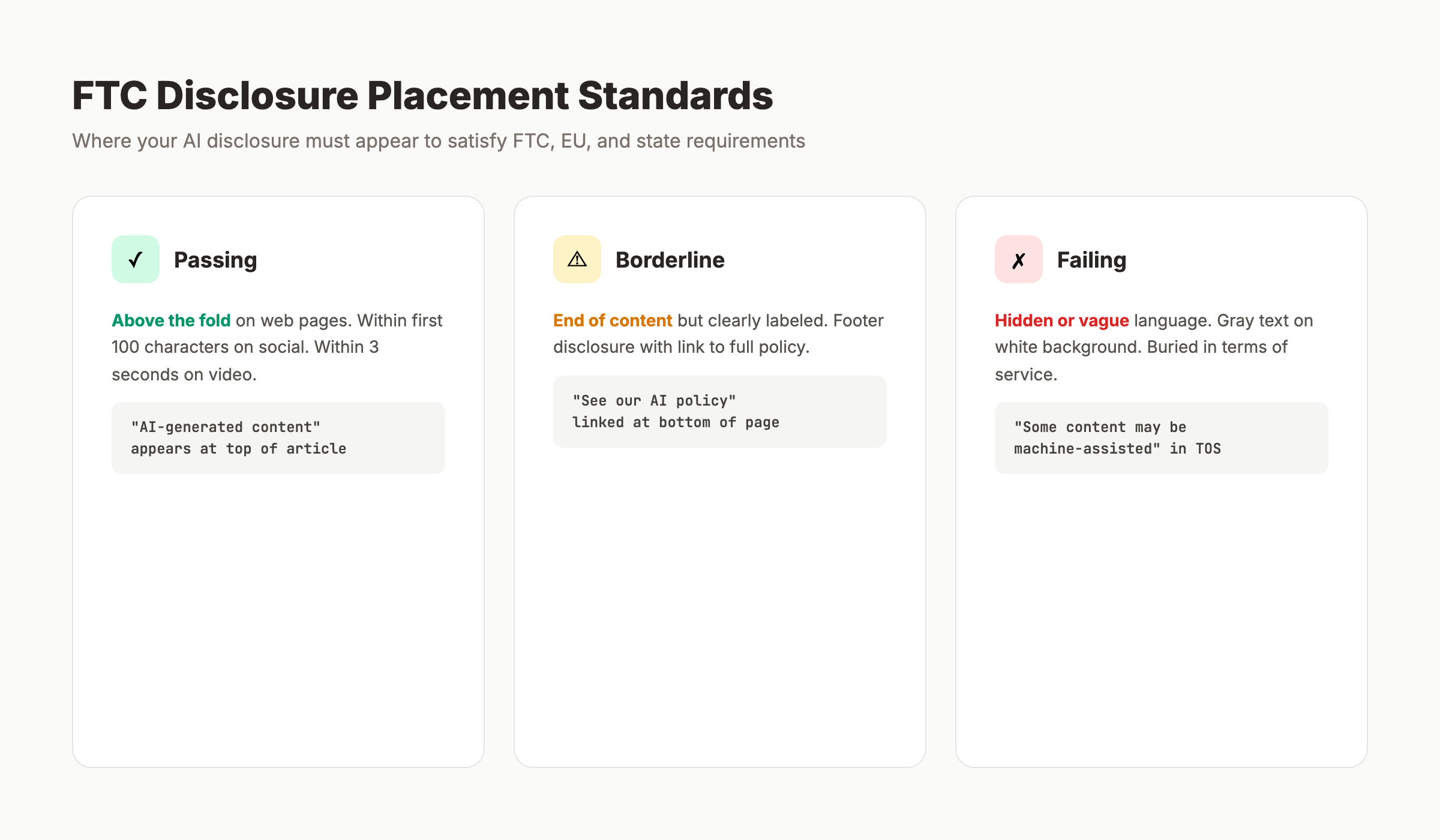
The AI disclosure must state, in plain language, that AI was used to create or modify the content. It must appear before the consumer engages with the content, not at the end. Acceptable language includes "AI-generated content," "Created with the help of AI," or "This image was produced using generative AI." Vague phrases like "Some content may be machine-assisted" fail the clarity test.
The material connection disclosure must state the relationship between the endorser and the advertiser. For an AI-generated testimonial that uses a synthetic persona, the disclosure must say the persona is not a real customer. For an AI-rewritten review based on a paid testimonial, the disclosure must say both that the testimonial was paid and that AI rewrote it. The FTC's first 2026 enforcement action against a CPG brand cited exactly this failure.
Placement and Prominence Rules
Both disclosures must be clear and conspicuous. The FTC defines this as unavoidable. For text content, that means above the fold on web pages and within the first 100 characters of social media posts. For video, that means a visible label that appears within the first 3 seconds and remains for the duration. For audio, that means an audible statement at the start of the segment.
Color, contrast, and font size all factor into the prominence test. A gray disclosure on a white background at 8-point font fails. Recent enforcement actions show the Commission has fined brands $11,000 to $53,088 per post for disclosures that were technically present but visually buried.
Step 4: Check EU AI Act Article 50 Triggers
The fourth step of the AI content disclosure checklist applies if any of your content reaches European Union residents. EU AI Act Article 50 took effect on August 2, 2026, and it imposes disclosure obligations on AI-generated content separate from anything required under United States law. The fines reach 15 million euros or 3% of global annual turnover, whichever is higher.
Article 50 applies extraterritorially. If you publish content that European users can access and that content was generated or substantially modified by AI, the obligation applies regardless of where your company is headquartered. Geo-blocking by IP is one acceptable mitigation, but most marketing teams find compliance simpler than blocking.
What Article 50 Requires
Article 50 splits AI content into two categories: synthetic content and deepfakes. Synthetic content includes any text, image, audio, or video generated or substantially modified by AI. It must carry a machine-readable marker that identifies it as AI-generated. The marker uses the C2PA Content Credentials standard or an equivalent verifiable provenance system. Most major image generators including Adobe Firefly, OpenAI's GPT Image, and Google Imagen now embed C2PA metadata by default.
Deepfakes are a subset of synthetic content where AI generates or manipulates an image, audio, or video of a real person or event in a way that would appear authentic to a reasonable viewer. Deepfakes require a visible, human-readable disclosure in addition to the machine-readable marker. The disclosure must be present at the moment of presentation. A label that appears only when a user clicks an info icon does not satisfy Article 50.
How to Implement C2PA Marking
Start with your image and video generation tools. Verify that each tool you use embeds C2PA Content Credentials by default. If a tool does not, you have three options: switch tools, add C2PA metadata manually using the open-source c2patool utility from the Content Authenticity Initiative, or stop publishing that tool's output to EU users.
For text content, Article 50 does not yet require C2PA marking, but the European Commission has signaled it will extend the rule to text by 2027. Building a process now that captures text generation metadata in a standardized format saves rework later. Teams that also add experience to AI content build stronger provenance records that satisfy both current and anticipated requirements.
Step 5: Map State Law Requirements
The fifth step of the AI content disclosure checklist is mapping state law triggers. Federal rules set a floor. State laws stack additional requirements on top. As of May 2026, four states have AI disclosure rules with marketing implications: California, Colorado, Texas, and Illinois. Three more states have rules that take effect within 12 months: New York, Tennessee, and Massachusetts.
State laws differ on what triggers disclosure, what the disclosure must say, and how it must appear. A national campaign needs to comply with the strictest applicable rule for every state where it runs, or it needs geo-targeted variants that adapt the disclosure per state.
California SB 942
California SB 942 took effect January 1, 2026. It applies to any business that uses generative AI to create images, video, or audio shown to California residents in a commercial context. The disclosure must identify the AI tool used and the date of generation. It must appear in a way the consumer can read without taking additional action, which the California Attorney General has interpreted as visible alongside the content itself.
SB 942 also requires businesses to retain the original AI-generated file with metadata intact for at least 7 years. This retention rule catches teams that rely on tools that overwrite or strip metadata during export. The California Department of Justice issued its first SB 942 enforcement notice in March 2026 against a regional retailer for failing to retain source files.
Colorado SB 205
Colorado SB 205 applies to high-risk AI systems, including any AI that produces content used in advertising claims about financial services, healthcare, or housing. Disclosure must include a plain-language description of what the AI does and its role in the consumer-facing output. The Colorado rule also requires an impact assessment for each high-risk use case, filed annually with the state Attorney General.
Texas HB 2060 and Illinois HB 3773
Texas HB 2060 requires disclosure for AI-generated political advertising within 90 days of an election. Illinois HB 3773 prohibits employers from using AI to screen applicants without disclosing the practice, which extends to AI-written recruiting content shown to candidates. Both states have additional rules under consideration.
Step 6: Add Platform-Specific Labels
The sixth step of the AI content disclosure checklist is platform-specific labeling. Every major social platform, ad network, and content marketplace now requires its own AI label for AI-generated content. Platform rules apply on top of federal and state rules. A post that complies with FTC and California law can still violate Meta or TikTok policy and face removal or account-level restrictions.
Platform labels are not interchangeable. Meta uses "Made with AI." TikTok uses "AI-generated content." YouTube uses "Altered content" with sub-categories for synthetic and manipulated media. Each platform applies its own enforcement, and several have started removing accounts that repeatedly post unlabeled AI content.
Platform Rules Comparison
| Platform | Label Required | Trigger | Penalty |
|---|---|---|---|
| Meta (Facebook, Instagram) | "Made with AI" | AI-generated or substantially modified visual content | Reduced reach, label added automatically, account warning |
| TikTok | "AI-generated content" | Any synthetic photo, video, or audio | Content removal, repeat-offender account ban |
| YouTube | "Altered content" disclosure in description | AI-generated or altered video that appears realistic | Demonetization, content removal |
| Google Ads | "AI-generated" attribute in ad copy | Synthetic imagery or audio in political or sensitive ads | Ad disapproval, account suspension |
| "AI-generated" pin label | AI-generated images or graphics | Reduced distribution, pin removal | |
| "AI-generated" image tag | AI-generated profile, post, or article images | Content downranking, account flag |
How to Apply Platform Labels Without Slowing Production
The fastest way to handle platform labels is to build them into your scheduler. Tools like Buffer, Hootsuite, and theStacc support platform-specific label fields. Configure templates that auto-apply the correct label per platform when an AI-generated asset is attached. This removes the human-error risk of forgetting to toggle the label on each post.
For paid campaigns, audit your Google Ads account, Meta Ads Manager, and TikTok Ads Manager for the AI disclosure setting at the campaign level. Most ad platforms now offer a campaign-level toggle that propagates the label to every ad in the campaign.
Catch missing AI labels before they go live. theStacc scans every scheduled post for missing platform disclosures and flags issues before publish. Most teams find 4 to 7 missing labels in their first scan. See Content SEO
Step 7: Draft Your Disclosure Statements
The seventh step of the AI content disclosure checklist is drafting your standard disclosure statements. Most teams write these one piece of content at a time, which produces inconsistency, gaps, and copy that fails legal review. A standardized library of disclosure statements solves this. Write each statement once, get it reviewed once, and reuse it across every piece of content that fits the use case.
A working library covers 8 to 12 statements. Each statement maps to a specific content type and a specific regulatory trigger. The library lives alongside your brand voice guide and is updated whenever a rule changes.
Required Disclosure Statement Templates
The blog post template handles long-form content where AI generated more than 30% of the text. It reads: "This article was created with the assistance of generative AI tools, including [tool name and version]. All claims and statistics were verified by [reviewer name], a member of the theStacc Editorial Team. Last reviewed: [date]." For guidance on how to humanize AI content before publication, see our dedicated guide.
The image template handles any AI-generated image. It reads: "Image generated using [tool name]. C2PA Content Credentials are embedded in the source file." For deepfakes or images of real people, add: "This image depicts a synthetic representation. The person shown is not a real individual or did not authorize this image."
The testimonial template handles AI-rewritten or AI-generated testimonials. It reads: "This testimonial was based on customer feedback collected on [date] and rewritten with the assistance of AI for clarity. The original quote is available on request." For fully synthetic testimonials, the FTC requires the language: "This is a synthetic persona. It does not represent a real customer."
Where Each Statement Belongs
Blog and article statements appear in the author byline area at the top of the article or in a clearly labeled box at the very end of the content. Image statements appear in the alt text, the caption, and in the file metadata as a C2PA assertion. Testimonial statements appear adjacent to the testimonial itself, not in a separate footer or terms-of-service link.
Step 8: Build an Editorial Review Workflow
The eighth step of the AI content disclosure checklist is building the editorial review workflow that brings every prior step together. Compliance fails most often at the handoff between teams. A writer drafts content using AI, sends it to an editor, the editor sends it to design, and somewhere in that chain the disclosure decision gets lost.
A working workflow assigns disclosure responsibility to a single named role at a specific stage. Most successful teams use the editor as the disclosure owner. The editor verifies every required step before content leaves the editorial stack for design or scheduling.
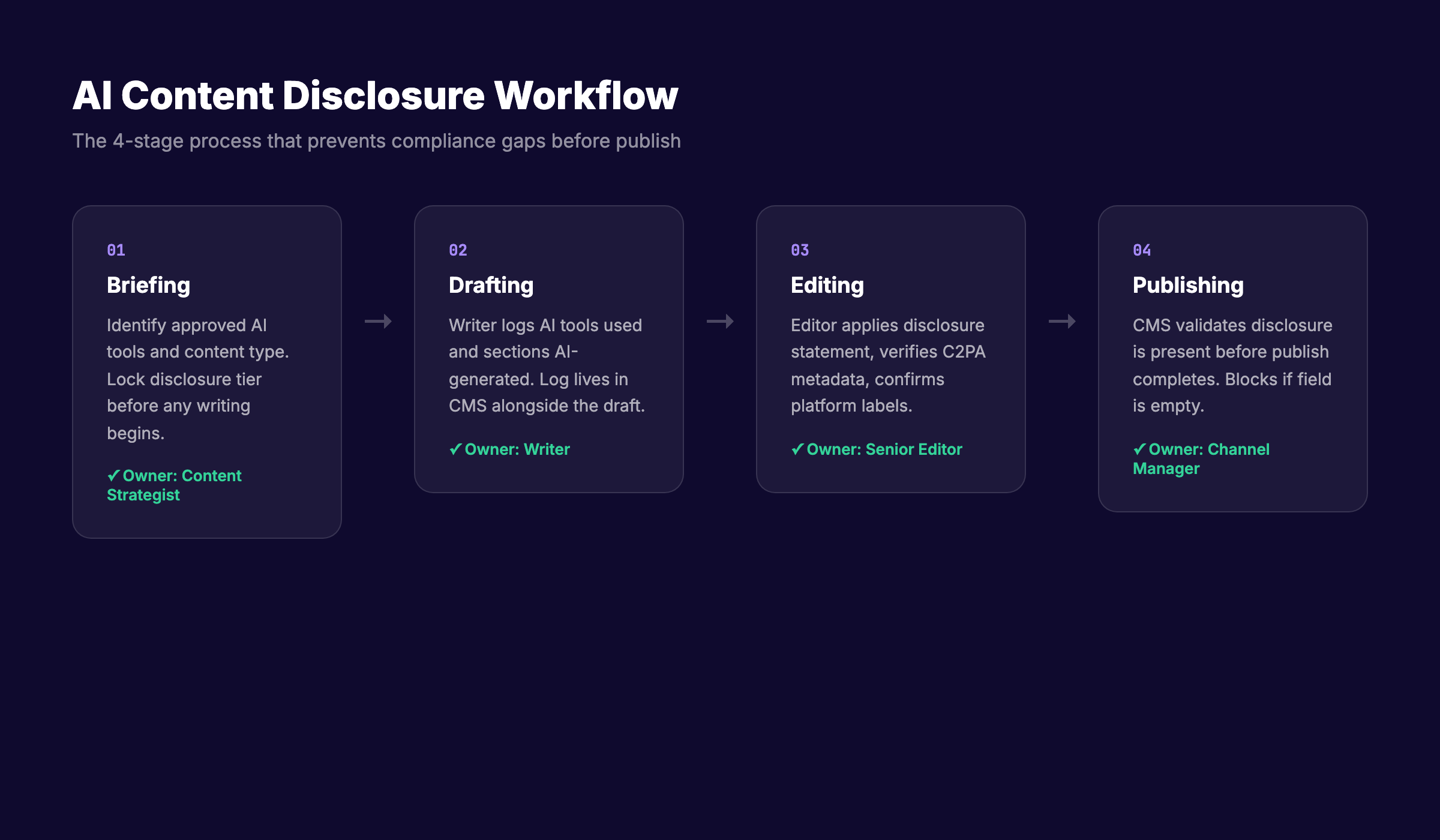
The 4-Stage Workflow
Stage one is briefing. The brief identifies which AI tools the writer is approved to use and which content type the brief produces. This locks the disclosure tier before any writing happens.
Stage two is drafting. The writer logs which AI tools were used, which sections were AI-generated, and which were human-written. This log lives in the content management system alongside the draft, not in a separate spreadsheet.
Stage three is editing. The editor reviews the draft against the disclosure checklist. The editor applies the correct disclosure statement, verifies C2PA metadata on any visual assets, and confirms platform labels for the scheduled distribution channels.
Stage four is publishing. The scheduler or CMS validates that the disclosure is present and correctly placed before the publish action completes. theStacc and other compliance-aware CMS plugins can block publishing when the disclosure field is empty.
Who Owns Each Stage
Define ownership in writing. The brief owner is the content strategist. The drafting owner is the writer. The editing owner is the senior editor. The publishing owner is the channel manager. Legal review sits parallel to editing for any high-risk content tier, with a service-level agreement of 48 hours for review turnaround.
The 12-Item AI Disclosure Checklist
Use this checklist before publishing any AI-assisted content. Every box must be checked. theStacc customers run this checklist automatically through the editorial dashboard, but the same items apply if you run it manually.
- ✓ Every AI tool used is listed in the team inventory with vendor, model, and date
- ✓ Content type has a documented risk tier (high, medium, or low)
- ✓ AI-generated text exceeding 30% of total word count triggers a disclosure
- ✓ FTC disclosure language is plain, present, and placed before content engagement
- ✓ Material connection disclosure appears separately from the AI disclosure when required
- ✓ EU AI Act Article 50 C2PA metadata is embedded in every image and video asset
- ✓ Deepfake content carries a visible human-readable disclosure on screen
- ✓ California SB 942 source files are retained with original metadata for 7 years
- ✓ Platform-specific labels are applied for each distribution channel
- ✓ Disclosure statements match the approved library and have been legally reviewed
- ✓ Named editor has signed off on disclosure placement before publish
- ✓ Audit log captures the tool, the reviewer, the disclosure, and the publish date
Common Mistakes That Trigger Enforcement
Three mistake patterns account for most enforcement actions in 2026. The first is treating AI disclosure as a single sentence at the bottom of a page. The FTC, the EU AI Act, and most state laws all require disclosure before consumer engagement, not after.
The second is using vague language. Phrases like "may contain AI-assisted content" or "this content uses modern tools" fail the clarity test. Regulators have rejected these in every published guidance document. Use specific, declarative language that names the AI involvement directly.
The third is forgetting about metadata. Image and video files stripped of C2PA Content Credentials during export are non-compliant under EU AI Act Article 50 and California SB 942. Most teams discover this only after a regulator requests source files and the metadata is gone.
A fourth pattern is worth flagging: assuming that a vendor's compliance covers your compliance. A model that ships with C2PA metadata embedded does not absolve you from displaying the human-readable disclosure required by Article 50 or the FTC. Vendor compliance is a building block, not a substitute.
What practitioners are saying on X
Content operations advice ages quickly. Here is high-signal operator discussion on X about quality, refresh, and systems.
- @jakezward (Feb 2026): 2026 SEO predictions emphasize AI Overview share-of-SERP, schema for LLM token efficiency, brand mentions in AI answers as a KPI, proprietary data as a moat, and content refresh beating net-new AI slop. See the post on X.
- @varunram (Jul 2026): Critique of GEO slopfarm products that combine SEO clickbait with unresearched content marketing — quality and research still separate winners from farms. See the post on X.
- @HlynurStefDev (Jul 2026): Public case: niche site traffic jumped from ~18 to 4,162 Google visits/month after focused technical/on-page SEO work (GSC screenshots claimed) — reminds that fundamentals still move numbers. See the post on X.
Grok, AI Overviews, and multi-engine visibility
AI/search topics like “ai content disclosure checklist” need multi-engine notes: AI Overviews, ChatGPT/Perplexity, and Grok. Lead with extractable answers; keep claims consistent with public expert discussion.
- Google AI Overviews: Use passage-ready answers, tables, and FAQ schema where relevant.
- ChatGPT / Perplexity: Cite named sources next to key claims.
- Grok: Maintain accurate entity facts on-site and in high-signal X posts.
Frequently Asked Questions
AI disclosure guidelines require a clear, conspicuous statement that AI was used to create or substantially modify content shown to consumers. The FTC, EU AI Act Article 50, and state laws in California, Colorado, Texas, and Illinois all require disclosure when AI involvement is material to a consumer's decision or when the content creates a false impression of human authorship. Disclosure must appear before the consumer engages with the content, not at the end.
An AI disclosure statement names the AI tool used, identifies the human reviewer, and gives the date of generation or review. A working template is: "This article was created with the assistance of [tool name and version]. All claims were verified by [reviewer name] on [date]." For images, include C2PA Content Credentials in the file and add a visible caption stating the image was AI-generated. Avoid vague phrases like "machine-assisted" or "AI-enabled."
An AI disclosure in practice is a single line of plain text that appears at the top of an article, in the alt text and caption of an image, or as an on-screen label in a video. It must be readable without additional clicks or hovers. For social media, it appears within the first 100 characters of the post or as a platform-applied label like "Made with AI" on Meta or "AI-generated content" on TikTok.
The 5 working rules are: disclose every AI tool used, place the disclosure before consumer engagement, use plain language that names the AI involvement directly, retain source files and metadata for the required period in your jurisdiction, and apply platform-specific labels in addition to legal disclosures. Failure on any single rule can trigger enforcement under FTC, EU, or state law.
No. Internal documents that never reach consumers do not require public disclosure. You still need an internal record of which AI tools were used and which human reviewed the output, so the document can be audited if it later becomes public or is referenced in customer-facing material.
Disclosed AI content does not face an organic ranking penalty from Google. Google's Search Central documentation confirms that helpful, original content is rewarded regardless of how it was produced, provided the content meets quality and accuracy standards. Our analysis of AI content statistics shows that disclosed AI content correlates with longer dwell time and lower bounce rates, both of which support ranking performance over time.
FTC civil penalties reach $53,088 per violation as of January 2026, with each non-compliant post counted separately. EU AI Act Article 50 penalties reach 15 million euros or 3% of global annual turnover. California SB 942 penalties start at $5,000 per violation. State penalties stack with federal penalties, and platform-level penalties include reduced reach, demonetization, and account suspension.
Conclusion
AI content disclosure is no longer optional, and it is no longer simple. The compliance bar in 2026 requires more than a sentence at the bottom of a page. It requires a documented tool inventory, a written risk classification, FTC-compliant placement, EU AI Act metadata, state-specific variants, platform labels, standardized disclosure statements, and an editorial workflow that catches gaps before publication.
The teams that handle this well treat disclosure as a feature of their content operations, not a compliance afterthought. The teams that ignore it face penalties measured in millions, not thousands.
Key takeaways from this AI content disclosure checklist:
- The FTC double disclosure rule requires separate statements for AI involvement and material connection
- EU AI Act Article 50 requires C2PA metadata on every image and video reaching EU users
- State laws in California, Colorado, Texas, and Illinois add stacking requirements on top of federal rules
- Each major platform requires its own label, and platform rules apply on top of legal rules
- A 12-item checklist run before every publish is the working baseline for safe operations
Run the full AI content disclosure checklist in 45 minutes. theStacc gives your team the inventory, the templates, the platform label routing, and the audit log in one place. No more spreadsheets and no more guesswork. Sign up for free →
Related Tools & Resources
Free SEO Tools:
Best Lists:
Sources & references
- [1] Princeton / Georgia Tech et al. — GEO research (arXiv:2311.09735)
- [2] @jakezward on X — 2026 SEO predictions emphasize AI Overview share-of-SERP, schema for LLM token efficiency, brand mentions in AI answers
- [3] @alexgroberman on X — Case narrative: organic value plus multi-engine citations (ChatGPT, Perplexity, Grok) from knowledge-hub pages, category
- [4] @varunram on X — Critique of GEO slopfarm products that combine SEO clickbait with unresearched content marketing — quality and research
- [5] Referenced source — www.iab.com

Plan topics, review article drafts, and publish to a connected CMS.
Weekly local SEO teardowns
One practical email a week. Map Pack, GBP, AI Overviews. No fluff. Unsubscribe anytime.