FTC fines hit $53,088 per undisclosed AI post. Learn the double disclosure rule, state law changes, and how to comply before your next campaign.
The FTC does not require you to label every AI-assisted draft, but it does require disclosure whenever AI creates an impression a reasonable consumer would find material. That covers synthetic endorsements, AI-generated testimonials, and undisclosed AI personas. Penalties reach $53,088 per violation, and each non-compliant post counts separately.
The Federal Trade Commission is not waiting for Congress to pass AI legislation. It is using existing authority to enforce disclosure requirements on AI-generated advertising content right now.
In January 2026, the FTC established a dedicated AI enforcement unit. The maximum penalty for disclosure violations increased to $53,088 per violation. Each non-compliant post counts as a separate violation, meaning a 100-post campaign could theoretically exceed $5 million in penalties. Advertising enforcement cases increased 40% in 2025, and the first enforcement action specifically targeting undisclosed AI-generated advertising content began in late 2025.
The core rule is straightforward: if AI was used to create or substantially modify advertising content, consumers must know. The FTC applies its existing deception, endorsement, and fake-testimonial rules to AI-driven content with the same force as human-created content. There is no AI exemption.
This guide covers everything marketers need to know: the double disclosure rule, what requires disclosure and what does not, state-level requirements taking effect in 2026, platform-specific rules, and a practical compliance checklist.
Here is what you will learn:
- How the FTC's double disclosure rule applies to AI-generated content
- What types of AI content require disclosure and which are exempt
- How state laws in New York, California, and Tennessee add new requirements
- What platform rules from Meta, TikTok, and Google require
- How to build a compliance workflow for your marketing team
- What penalties you face for non-compliance
Table of Contents
- Chapter 1: The FTC Double Disclosure Rule Explained
- Chapter 2: What Requires AI Disclosure and What Does Not
- Chapter 3: State-Level AI Disclosure Laws in 2026
- Chapter 4: Platform-Specific AI Labeling Requirements
- Chapter 5: Synthetic Influencers and AI Testimonials
- Chapter 6: Building Your FTC Compliance Checklist
- Chapter 7: Enforcement Actions and Penalties
- Frequently Asked Questions
Chapter 1: The FTC Double Disclosure Rule Explained
The FTC's approach to AI disclosure centers on a simple principle: consumers have a right to know when AI is involved in the content they see. This is not a new law. It is the application of existing consumer protection rules to a new technology.
The Foundation: Section 5 of the FTC Act
Section 5 of the FTC Act prohibits unfair or deceptive acts and practices in commerce. The FTC has interpreted this to mean that undisclosed AI-generated advertising content can be deceptive when consumers would reasonably expect real people, real experiences, or unaltered products. The Commission's updated Endorsement Guides, which took effect in October 2023 and were further clarified in March 2025, explicitly address AI-generated endorsements.
What Is Double Disclosure
The FTC now requires dual disclosure for AI-involved sponsored content. This means two separate disclosures, not one combined label:
- The commercial relationship: That the content is an advertisement, sponsored post, or paid partnership. This is the existing FTC endorsement requirement.
- The AI involvement: That artificial intelligence was used to create or substantially modify the content. This is the new layer for 2026.
One label does not cover both. A post marked with #ad does not satisfy the AI disclosure requirement. A post marked "AI-generated" does not satisfy the commercial relationship requirement. Both must be present and clear.
Where Disclosures Must Appear
For video content, both disclosures should appear in the first 3-5 seconds as on-screen text. For static images, disclosures must be visible without clicking or expanding. For text content, disclosures must appear near the content, not buried in footnotes, terms of service, or general disclaimers.
The FTC has repeatedly stated that a hashtag buried among a dozen others does not meet the clear and conspicuous standard. Disclosures must be unavoidable.
The Clear and Conspicuous Standard
The FTC's disclosure standard requires that consumers notice and understand the disclosure. Factors the FTC considers include:
- Proximity: The disclosure must be near the claim it qualifies
- Prominence: The disclosure must be large enough and in a color that contrasts with the background
- Clarity: The disclosure must use plain language that consumers understand
- Unavoidability: The disclosure must appear before or with the claim, not after
For AI-generated content, this means disclosures must appear on the content itself, not just in a profile bio or a separate page.
Build disclosure into your content workflow from the start. theStacc helps marketing teams track content provenance and maintain transparent publishing processes with built-in disclosure flags. See how it works →
Chapter 2: What Requires AI Disclosure and What Does Not
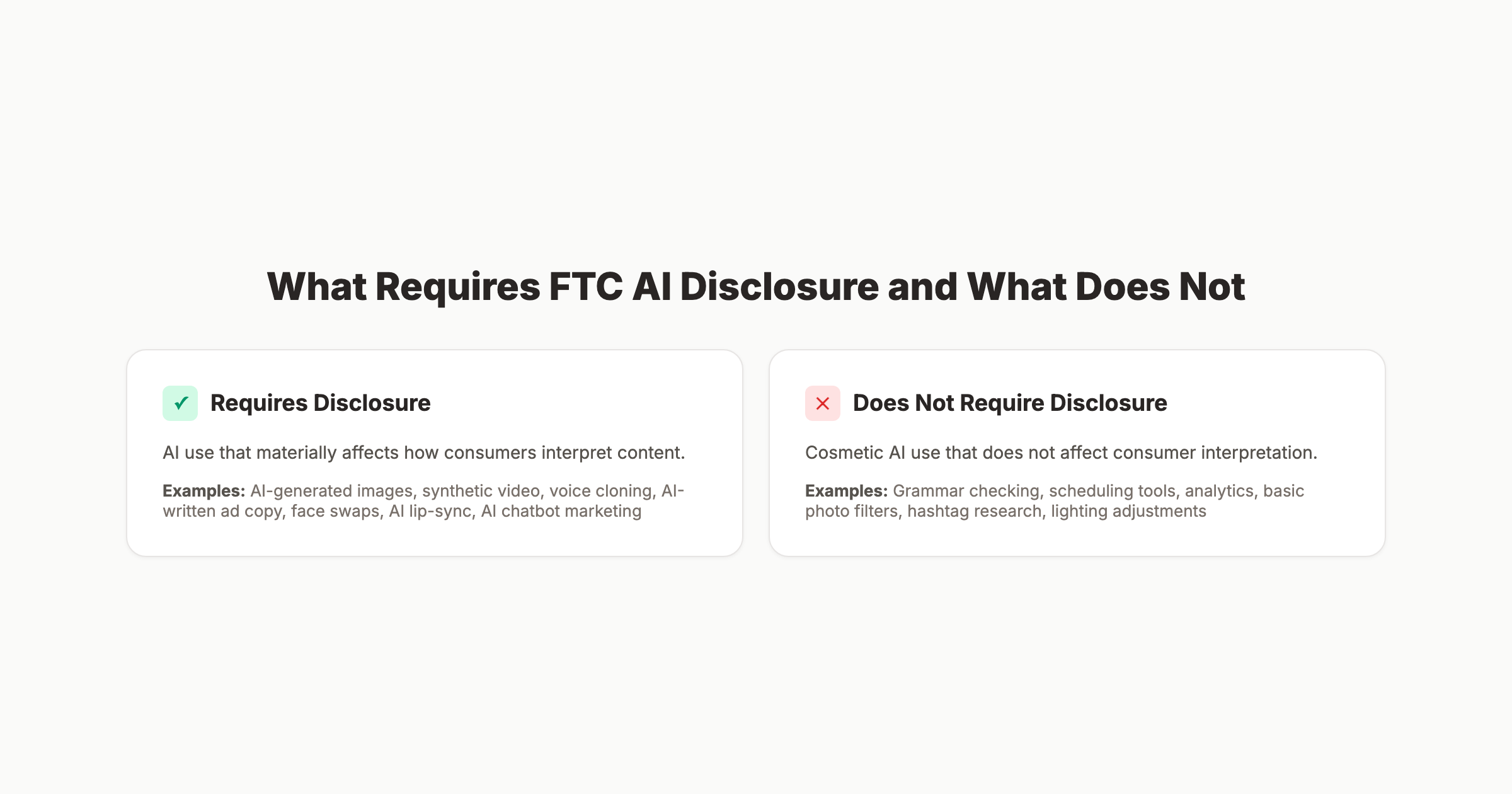
Not every use of AI in marketing requires disclosure. The FTC distinguishes between cosmetic uses of AI and substantive uses that affect how consumers interpret the content.
Content That Requires AI Disclosure
| Content Type | Why Disclosure Is Required |
|---|---|
| AI-generated images in ads | Consumers may believe the product looks different than it does |
| AI-generated video content | Synthetic scenes or people may mislead viewers about reality |
| AI voice cloning or synthetic speech | Listeners may believe a real person spoke when they did not |
| AI-written ad copy and scripts | Consumers may attribute claims to human expertise rather than AI generation |
| AI-generated testimonials | The FTC prohibits fake reviews regardless of disclosure |
| AI chatbot marketing | Users may believe they are interacting with a human |
| AI-translated content for ads | Translation quality may affect claim accuracy |
| Substantially AI-edited content | Modifications that affect consumer interpretation |
| Face swaps in influencer content | Viewers may believe the influencer actually appeared |
| Age alteration or AI lip-sync | Changes that affect how consumers evaluate the endorser |
| AI-generated backgrounds that alter context | Scenes that mislead about location or setting |
Content That Does Not Require AI Disclosure
| Content Type | Why Disclosure Is Not Required |
|---|---|
| Grammar and spell checking | Does not affect consumer interpretation of claims |
| Scheduling tools | Administrative function, not content creation |
| Analytics tools | Back-end function, not consumer-facing |
| Photo filters and basic editing | Cosmetic changes that do not alter material claims |
| Hashtag and keyword research | Planning function, not content generation |
| Autocomplete and predictive text | Assistive function that does not create claims |
| Lighting and color grading | Cosmetic enhancement that does not mislead |
| Basic retouching | Minor adjustments that do not change product appearance |
The Substantive vs. Cosmetic Test
The FTC applies a substantive versus cosmetic test. If the AI use materially affects how consumers interpret the content, disclosure is required. If the AI use is purely cosmetic and does not affect interpretation, disclosure is not required.
For example, using AI to smooth skin in a beauty product ad may be cosmetic. Using AI to generate a before-and-after image showing results the product cannot actually achieve is substantive and deceptive.
Chapter 3: State-Level AI Disclosure Laws in 2026
Federal FTC rules are not the only requirements marketers must follow. Several states have enacted or are enacting AI disclosure laws that add additional obligations.
New York: Synthetic Performer Law (A8887-B)
Effective June 9, 2026, New York's law requires disclosure when AI-generated synthetic performers are used in advertising. Key requirements include:
- Disclosure for "substantially generated" AI content, defined as content where more than 50% was created by AI
- Penalties of $5,000 per violation for first offenses
- Penalties of $10,000 per violation for subsequent offenses
- Applies to advertising that uses digital replicas of recognizable performers
This law gives marketers a clearer statutory hook when covered synthetic performers are used in advertising. The FTC's general deception authority applies broadly, but New York's law creates specific requirements for synthetic performers.
California: AB 3211 and Content Labeling
California has enacted multiple AI disclosure laws:
AB 3211 requires platform-level labeling and watermarking of AI-generated content. Platforms must display visible labels on AI-generated content and embed C2PA metadata. Stripping metadata can result in license revocation for platforms.
AB 1836 and AB 2602 protect digital replica rights for both deceased and living performers. Using AI to create digital replicas without consent is prohibited.
SB 1050 requires clear disclosure for synthetic performers in advertising, with sample wording provided by the state.
California's penalties include $5,000 per day for violations. The state's laws apply to any content consumed by California residents, which effectively means national compliance for most brands.
Tennessee: ELVIS Act
Tennessee's Ensuring Likeness Voice and Image Security Act, effective since July 2024, makes unauthorized AI voice cloning a criminal misdemeanor. Violators face up to 11 months in jail and $2,500 in fines. The law also creates civil liability for unauthorized use of a person's voice or likeness in AI-generated content.
For marketers, this means any AI-cloned voice in advertising requires explicit consent from the person whose voice is being cloned. This applies even if the voice is partially modified or combined with other audio.
Colorado: AI Ad Targeting Impact Assessments
Colorado requires impact assessments for AI-driven ad targeting. The law was set to take effect on June 30, 2026, but enforcement is currently paused pending Department of Justice litigation. Marketers should monitor this space, as Colorado's requirements could become active later in 2026.
Cross-State Campaign Compliance
For campaigns running across multiple states, marketers must satisfy the union of all applicable state-level requirements. This means complying with the strictest standard in any state where the campaign runs. For national campaigns, this effectively means complying with California and New York standards at minimum.
| State | Effective Date | Key Requirement | Penalty |
|---|---|---|---|
| New York | June 9, 2026 | Disclosure for synthetic performers | $5,000-$10,000 per violation |
| California | August 2, 2026 | Visible labels + C2PA metadata | $5,000 per day |
| Tennessee | July 2024 | Voice cloning consent required | Up to 11 months jail + $2,500 |
| Colorado | Pending DOJ review | AI ad targeting impact assessments | TBD |
Chapter 4: Platform-Specific AI Labeling Requirements
Major advertising and social media platforms have implemented their own AI labeling systems. Platform rules operate in parallel with FTC and state requirements. Meeting platform rules does not guarantee FTC compliance, and FTC compliance does not guarantee platform compliance.
Meta (Facebook and Instagram)
Meta requires "AI-generated" or "Made with AI" labels for:
- Synthetic people or realistic AI-generated characters
- AI-altered product demonstrations
- Realistic AI-generated audio or video
- Content created using Meta's own generative AI tools (auto-labeled)
Meta uses C2PA metadata detection to automatically label some AI-generated content. However, not all AI tools embed C2PA metadata, so manual disclosure may still be necessary. Meta's labels appear on the content itself and in the platform's content information panel.
TikTok
TikTok requires a built-in "synthetic media" content label for realistic AI-generated content. This is not optional. Creators must use TikTok's native labeling tool. Simply adding a caption disclosure is not sufficient.
For TikTok Shop content, AI disclosure is mandatory for all AI-generated product images and descriptions. TikTok participates in the C2PA Content Credentials initiative and may auto-label content with embedded metadata.
Google and YouTube
Google requires disclosure for AI-generated content in election-related advertising. The company has indicated it is extending disclosure requirements to commercial synthetic content as well.
YouTube has integrated AI labeling features that allow creators to mark content as altered or synthetic. YouTube's system displays labels on the video player and in search results.
Platform Compliance Checklist
- ✓ Verify which platforms your campaign runs on
- ✓ Check each platform's specific AI labeling requirements
- ✓ Use platform-native labeling tools where available
- ✓ Add text disclosures even when platform labels are present
- ✓ Test that labels appear correctly before campaign launch
- ✓ Monitor platform policy updates quarterly
Track AI content across all platforms in one place. theStacc helps marketing teams maintain consistent disclosure practices across Meta, TikTok, Google, and other platforms with automated content tagging. Start your compliance workflow →
Chapter 5: Synthetic Influencers and AI Testimonials
Synthetic influencers and AI-generated testimonials represent two of the highest-risk areas for FTC enforcement. The Commission has made clear that existing rules apply fully to these use cases.
Synthetic Influencer Disclosure
The FTC considers undisclosed virtual influencer endorsements inherently deceptive. Consumers cannot evaluate the credibility of an endorser who does not exist. The FTC requires:
- Disclosure that the influencer is virtual or AI-generated in the bio
- Per-post reinforcement of the synthetic nature where the character could be mistaken for real
- Disclosure of the commercial relationship with the brand
- Placement that is not buried in fine print
Example compliant disclosure:
"This is a virtual character created with AI. #ad [Brand Name]"
A hashtag alone is insufficient. The disclosure must be in plain language that consumers understand.
AI-Generated Testimonials
AI-generated testimonials are treated as fake reviews by the FTC. The Commission has taken the position that testimonials must reflect the honest opinion of a real person who has actually used the product. AI-generated testimonials, by definition, do not meet this standard.
The FTC prohibits fake reviews regardless of disclosure. Adding "generated by AI for illustrative purposes" does not make an AI testimonial compliant. Marketers should not use AI-generated testimonials under any circumstances.
AI-Augmented Creator Content
When real creators use AI to augment their content, disclosure requirements depend on the nature of the augmentation:
| Augmentation Type | Disclosure Required? |
|---|---|
| Lighting and color grading | No |
| Basic retouching | No |
| Face swap | Yes |
| Voice clone | Yes |
| Age alteration | Yes |
| AI lip-sync | Yes |
| Background manipulation that alters context | Yes |
The test is whether the augmentation materially affects how consumers interpret the content. Cosmetic changes do not require disclosure. Substantive changes do.
AI-Cloned Voice Endorsements
Using AI to clone a real person's voice for an endorsement requires:
- Explicit consent from the person whose voice is being cloned
- Prominent disclosure that the voice is AI-cloned
- Compliance with state laws, including Tennessee's ELVIS Act
- Documentation of consent retained for the duration of the campaign
Deepfake celebrity endorsements without consent are categorically prohibited and may result in both FTC action and state criminal liability.
Chapter 6: Building Your FTC Compliance Checklist
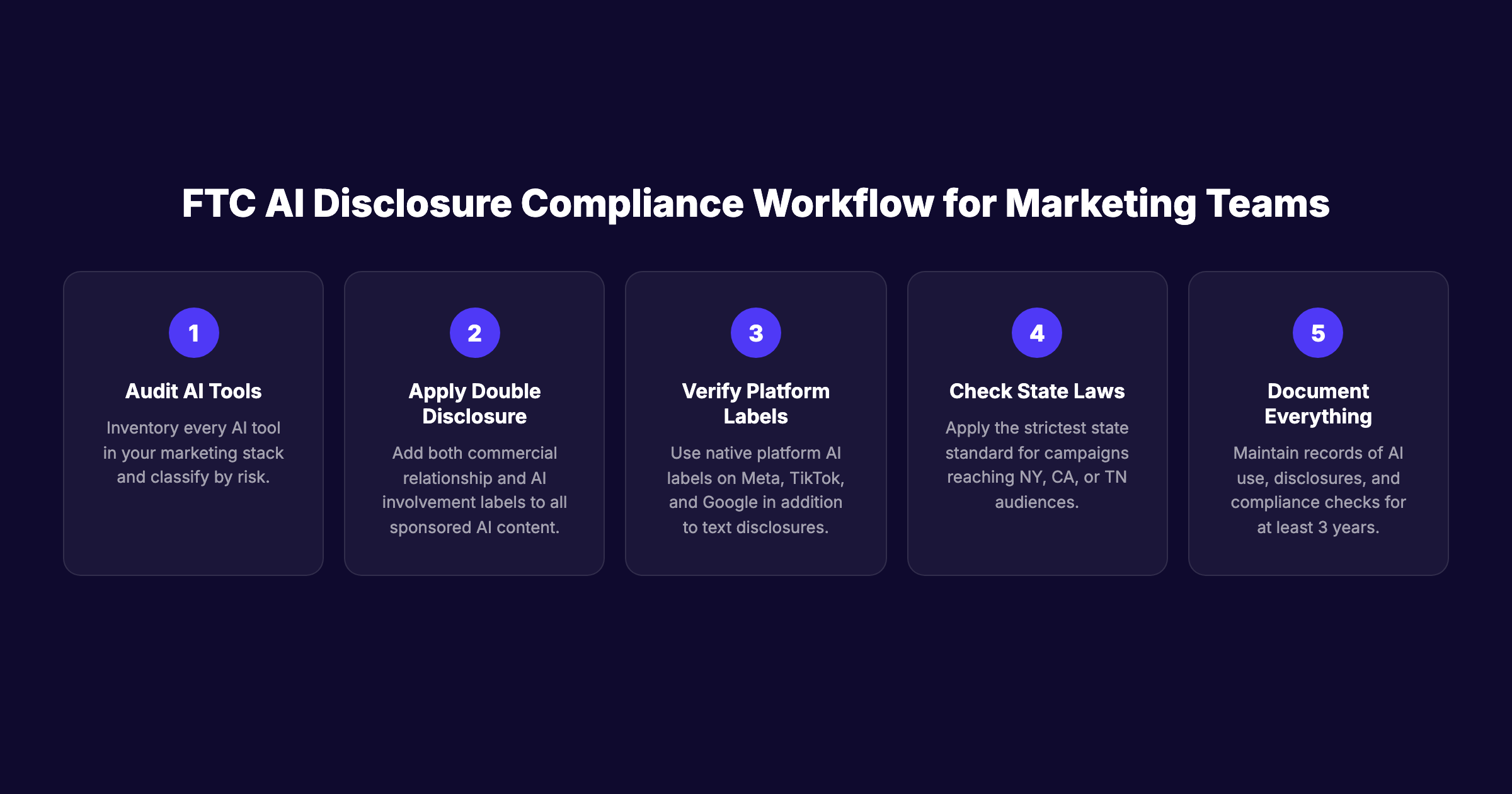
A practical compliance checklist helps your team apply FTC rules consistently. Here is a framework organized by marketing function.
Content Creation Compliance
- ✓ Inventory all AI tools used for content creation
- ✓ Classify each use as cosmetic or substantive
- ✓ Document which content pieces are AI-generated versus human-created
- ✓ Implement dual disclosure for all AI-involved sponsored content
- ✓ Add AI disclosure near the content, not in footnotes or bios alone
- ✓ Use plain language that consumers understand, not technical jargon
- ✓ Test disclosures for prominence and clarity on all devices
- ✓ Maintain documentation of AI use and disclosure application
Influencer and Creator Compliance
- ✓ Update all creator contracts to include AI disclosure obligations
- ✓ Brief creators on the double disclosure requirement
- ✓ Provide specific disclosure language for creators to use
- ✓ Verify synthetic influencers are disclosed as AI-generated in bio and posts
- ✓ Prohibit AI-generated testimonials in all creator agreements
- ✓ Review creator content for undisclosed AI augmentation before publication
- ✓ Document creator training and compliance verification
Advertising Compliance
- ✓ Audit all active campaigns for AI-generated or AI-altered content
- ✓ Add AI disclosure to all AI-generated creative assets
- ✓ Ensure disclosures appear in the first 3-5 seconds of video ads
- ✓ Verify that image disclosures are visible without clicking
- ✓ Test ad disclosures on mobile devices where most ads are viewed
- ✓ Review claims in AI-generated copy for substantiation
- ✓ Document the human oversight process for AI-generated campaigns
Platform Compliance
- ✓ Use platform-native AI labeling tools where available
- ✓ Add text disclosures even when platform labels are present
- ✓ Verify labels appear correctly across all platforms
- ✓ Check that C2PA metadata is embedded in AI-generated images
- ✓ Monitor platform policy updates quarterly
- ✓ Test content on each platform before campaign launch
State Law Compliance
- ✓ Identify which states your campaign reaches
- ✓ Apply the strictest applicable state standard
- ✓ For New York campaigns, verify synthetic performer disclosure
- ✓ For California campaigns, embed C2PA metadata and visible labels
- ✓ For Tennessee campaigns, obtain consent for any voice cloning
- ✓ Document state-specific compliance measures
Chapter 7: Enforcement Actions and Penalties
The FTC has made clear that AI disclosure violations will be enforced with the same vigor as traditional endorsement violations. Understanding the penalty structure helps marketers communicate the business case for compliance.
FTC Penalty Structure
The maximum civil penalty for FTC disclosure violations is $53,088 per violation for 2026. This is an increase from $50,120 in 2024. Each individual piece of non-compliant content counts as a separate violation.
A campaign with 100 non-compliant posts could theoretically exceed $5 million in penalties. The FTC can also seek disgorgement of profits from deceptive practices, meaning the financial exposure extends beyond penalties to include all revenue attributable to the non-compliant content.
Recent Enforcement Trends
| Metric | Detail |
|---|---|
| Advertising enforcement increase in 2025 | 40% year-over-year |
| Agency enforcement increase since 2021 | 340% |
| First AI-specific enforcement action | Late 2025 |
| Dedicated FTC AI enforcement unit | Established January 2026 |
| Maximum penalty per violation | $53,088 |
Notable Enforcement Actions
Air AI Settlement (March 2026): The FTC secured an $18 million judgment against Air AI for deceptive AI business opportunity marketing. The case involved misleading claims about AI-generated business results.
Undisclosed AI Advertising Cases (Late 2025): The FTC initiated its first enforcement actions specifically targeting undisclosed AI-generated advertising content. Multiple additional cases are pending as of early 2026.
Creator Liability
Creators bear independent liability regardless of brand contract allocations. A brand cannot contract away FTC liability. If a creator fails to disclose AI involvement in sponsored content, both the creator and the brand may face penalties.
The FTC has three levels of creator liability:
- Disclosure compliance: Did the creator make required disclosures clearly and conspicuously
- Substantiation: Can the creator substantiate claims made in the content
- Truthful representation: Did the creator actually use the product or have the experience claimed
Class Action Exposure
Beyond FTC enforcement, brands face class action lawsuits for undisclosed AI content. Recent cases include:
- Revolve: $50 million class action settlement
- Shein: $500 million+ class action exposure
These cases typically allege that consumers would not have purchased products if they had known the content was AI-generated.
Consumer Trust Impact
The business cost of non-compliance extends beyond penalties. Consumer trust statistics show:
- 63% of U.S. consumers believe brands have a duty to disclose AI use in advertising
- 50% of consumers prefer to give business to brands that avoid generative AI in consumer-facing content
- One-third of customers will stop interacting with a brand if they discover content is AI-generated rather than human-made
- 66% of consumers rank transparency as the single most important brand trait, surpassing price for the first time
Major brands including Aerie and Le Creuset are now running "no AI" pledges as affirmative marketing positions, proactively disclosing AI-free production to counter consumer skepticism.
Protect your brand from FTC penalties and consumer backlash. theStacc helps marketing teams build transparent content workflows with automated disclosure tracking and provenance documentation. Start your compliance audit →
What practitioners are saying on X
Fundamentals plus AI-search measurement remain the dual stack.
- @jakezward (Feb 2026): 2026 SEO predictions emphasize AI Overview share-of-SERP, schema for LLM token efficiency, brand mentions in AI answers as a KPI, proprietary data as a moat, and content refresh beating net-new AI slop. See the post on X.
- @hridoyreh (Mar 2026): Widely shared SEO skill tree: foundations, research, technical, on-page, content, links, AI SEO/GEO, analytics, UX, brand, programmatic — useful map for stats and how-to posts. See the post on X.
- @HlynurStefDev (Jul 2026): Public case: niche site traffic jumped from ~18 to 4,162 Google visits/month after focused technical/on-page SEO work (GSC screenshots claimed) — reminds that fundamentals still move numbers. See the post on X.
Grok, AI Overviews, and multi-engine visibility
AI/search topics like “ftc ai disclosure rules 2026” need multi-engine notes: AI Overviews, ChatGPT/Perplexity, and Grok. Lead with extractable answers; keep claims consistent with public expert discussion.
- Google AI Overviews: Use passage-ready answers, tables, and FAQ schema where relevant.
- ChatGPT / Perplexity: Cite named sources next to key claims.
- Grok: Maintain accurate entity facts on-site and in high-signal X posts.
Publish content built for Google and AI citations. theStacc’s Content SEO module ships SEO-scored articles structured for rankings and generative engines — including clearer entity pages models like Grok can quote.
Frequently Asked Questions
No. The FTC does not have a standalone federal AI disclosure statute. Instead, the Commission applies existing consumer protection and endorsement frameworks to AI uses. Section 5 of the FTC Act prohibits unfair or deceptive acts and practices, and the FTC interprets undisclosed AI-generated content as potentially deceptive when consumers would reasonably expect human-created content.
The double disclosure rule requires two separate disclosures for AI-involved sponsored content: one disclosing the commercial relationship (such as #ad or #sponsored) and one disclosing that AI was used to create or substantially modify the content. One label does not cover both requirements.
No. Cosmetic uses of AI, including grammar checking, spell-checking, basic editing, and photo filters, do not require disclosure. The FTC requires disclosure only when AI use materially affects how consumers interpret the content.
The maximum FTC civil penalty is $53,088 per violation for 2026. Each non-compliant post counts as a separate violation. The FTC can also seek disgorgement of profits from deceptive practices. State laws add additional penalties, such as New York's $5,000-$10,000 per violation and California's $5,000 per day.
No. Platform labels and FTC requirements operate in parallel. Meta's "Made with AI" label does not satisfy the FTC's commercial relationship disclosure requirement, and an #ad hashtag does not satisfy the AI disclosure requirement. Marketers must comply with both sets of rules independently.
No. The FTC prohibits fake reviews and testimonials regardless of disclosure. AI-generated testimonials, by definition, do not reflect the honest opinion of a real person who has actually used the product. The FTC considers them inherently deceptive.
Synthetic influencers must disclose both their AI-generated nature and their commercial relationship with the brand. The FTC considers undisclosed virtual influencer endorsements inherently deceptive because audiences cannot evaluate the credibility of a non-existent endorser.
Yes. State AI disclosure laws apply to any content consumed by residents of that state. For national campaigns, this means complying with the strictest applicable standard, which is typically California or New York. Cross-state campaigns must satisfy the union of all applicable state-level requirements.
Do not work with that creator. Both the creator and the brand face independent FTC liability. Update your creator contracts to require AI disclosure and verify compliance before content goes live. Document your compliance efforts in case of an FTC inquiry.
Maintain records of:
- All AI tools used in content creation
- Which content pieces used AI and how
- Disclosures applied to each piece of content
- Creator training and compliance verification
- Platform labels applied
- State law compliance measures taken
Retain documentation for at least three years, which is the typical statute of limitations for FTC enforcement actions.
Key Takeaways
- The FTC applies existing consumer protection rules to AI-generated content with no AI exemption
- The double disclosure rule requires separate disclosures for commercial relationships and AI involvement
- Penalties are $53,088 per violation, with each non-compliant post counting separately
- State laws in New York, California, and Tennessee add additional requirements
- Platform rules from Meta, TikTok, and Google operate in parallel with FTC rules
- AI-generated testimonials are prohibited regardless of disclosure
- Synthetic influencers must disclose both their AI nature and commercial relationships
- 63% of consumers believe brands have a duty to disclose AI use
- Documentation is critical for defending against FTC inquiries
- Compliance is both a legal requirement and a competitive advantage
The FTC's message is clear: AI does not get a free pass. The same rules that apply to human-created advertising content apply to AI-generated content. Marketers who build transparency into their workflows now will avoid penalties, maintain consumer trust, and gain a competitive advantage as the regulatory environment tightens.
Build FTC-compliant AI disclosure into your marketing workflow. theStacc helps teams track content provenance, apply consistent disclosures across platforms, and maintain compliance documentation. Start your compliance audit today →
Related Tools & Resources
Free SEO Tools:
Best Lists:
Sources & references
- [1] Princeton / Georgia Tech et al. — GEO research (arXiv:2311.09735)
- [2] @jakezward on X — 2026 SEO predictions emphasize AI Overview share-of-SERP, schema for LLM token efficiency, brand mentions in AI answers
- [3] @alexgroberman on X — Case narrative: organic value plus multi-engine citations (ChatGPT, Perplexity, Grok) from knowledge-hub pages, category
- [4] @varunram on X — Critique of GEO slopfarm products that combine SEO clickbait with unresearched content marketing — quality and research

Researched, written, and published articles that compound organic traffic.
Weekly local SEO teardowns
One practical email a week. Map Pack, GBP, AI Overviews — no fluff. Unsubscribe anytime.