78% of enterprises are not ready for EU AI Act rules. What marketers must do before the August 2026 deadline — Article 50 labeling and more.
The EU AI Act is not a future problem. From August 2, 2026, Article 50 transparency obligations apply to any business whose AI output reaches EU users, wherever the company is based. Marketers using AI images, synthetic video, chatbots, or automated content creation must label that output or face penalties.
On August 2, 2026, the most significant transparency obligations for marketers take effect under Article 50 of the EU AI Act. If your team uses AI-generated images, synthetic video, chatbots, or automated content creation, you are in scope. The law applies to any business whose AI output reaches EU users, regardless of where your company is headquartered.
The stakes are real. Violations of Article 50 carry penalties of up to €15 million or 3% of global annual turnover. A May 2026 report from Vision Compliance found that 78% of enterprises have not taken meaningful compliance steps. Only 18% of European employers feel very prepared.
This guide covers everything marketers need to know: what changed with the May 2026 Omnibus agreement, which AI tools fall under which risk categories, what Article 50 requires for disclosure and labeling, and the exact steps your team should take before the deadline.
Here is what you will learn:
- How the May 2026 Omnibus agreement changed key deadlines
- Which marketing AI tools are classified as high-risk, limited-risk, or minimal-risk
- What Article 50 requires for synthetic content, chatbots, and deepfakes
- How to build a compliance checklist for your marketing stack
- What the EU Code of Practice means for your disclosure workflow
- How to prepare your team and vendors before enforcement begins
Table of Contents
- Chapter 1: What Changed in the May 2026 Omnibus Agreement
- Chapter 2: How the EU AI Act Risk Categories Apply to Marketing
- Chapter 3: Article 50 Transparency Obligations Explained
- Chapter 4: What the EU Code of Practice Requires
- Chapter 5: Building Your Marketing Compliance Checklist
- Chapter 6: How to Audit Your AI Marketing Stack
- Chapter 7: Preparing Your Team and Vendors
- Frequently Asked Questions
Chapter 1: What Changed in the May 2026 Omnibus Agreement
The EU AI Act entered into force on August 1, 2024. Its provisions have been rolling out in phases. On May 7, 2026, the European Council and European Parliament reached a provisional political agreement on the Digital Omnibus, a package of amendments that extends several key deadlines.
This matters for marketers because the timeline for compliance has shifted. Some obligations you thought were due in August 2026 have been pushed back. Others remain unchanged. Understanding which deadlines apply to your tools is the first step toward compliance.
The New Deadline Calendar
| Provision | Original Deadline | New Deadline | Status |
|---|---|---|---|
| Article 5: Prohibited AI practices | February 2, 2025 | February 2, 2025 | Already in force |
| Article 4: AI literacy obligations | February 2, 2025 | February 2, 2025 | Already in force |
| Articles 51-55: GPAI model rules | August 2, 2025 | August 2, 2025 | Already in force |
| Article 50(2): Synthetic content marking | August 2, 2026 | December 2, 2026 | Extended by 4 months |
| High-risk Annex III systems | August 2, 2026 | December 2, 2027 | Extended by 16 months |
| High-risk Annex I regulated products | August 2, 2027 | August 2, 2028 | Extended by 12 months |
The Omnibus agreement gives marketers more time to prepare for high-risk system compliance, but the Article 50 transparency obligations for synthetic content remain the most immediate concern. The new December 2, 2026 deadline for watermarking and labeling is only about six months away.
Why the Deadlines Were Extended
The European Commission acknowledged that harmonized standards were not finished, notified bodies were not in place, and most member states were behind on designating competent authorities. Demanding compliance without supporting infrastructure would, in the Commission's own assessment, set the law up to fail.
The new deadlines are firm long-stop dates. Even if standards and guidance are not ready by then, the dates will not move again. This is likely the only delay that will be granted.
What Marketers Should Do Now
Treat the new deadlines as binding. The original August 2026 dates technically remain in effect until the Omnibus is formally adopted, but adoption is expected well before August 2, 2026. The safest approach is to prepare for the original deadlines while using the extension as a buffer for complex implementations.
Build your AI compliance workflow before the rush. Most marketing teams are still unaware that their AI tools fall under the Act. theStacc helps businesses document content provenance and maintain transparent publishing workflows. Book a demo →
Chapter 2: How the EU AI Act Risk Categories Apply to Marketing
The EU AI Act uses a risk-based framework. Not all AI systems face the same rules. The classification of your marketing tools determines which obligations apply and when.
The Four Risk Levels
| Risk Level | Definition | Marketing Examples | Key Obligations |
|---|---|---|---|
| Unacceptable risk | AI that manipulates, exploits, or causes harm | Subliminal manipulation, social scoring, real-time biometric identification in public | Banned outright |
| High risk | AI affecting safety, rights, or access to essential services | Automated hiring, credit scoring, insurance pricing, biometric identification | Risk management, data governance, human oversight, conformity assessment, registration |
| Limited risk | AI interacting with humans or generating content | Chatbots, AI content generators, recommendation engines, synthetic media | Transparency and disclosure obligations |
| Minimal risk | Standard AI with low impact | Grammar checkers, spell-check, basic analytics, scheduling tools | No specific AI Act obligations |
According to EU estimates, approximately 85% of AI systems fall into the minimal-risk category. For marketers, this means your grammar checker and social media scheduler are likely not in scope. Your AI image generator, chatbot, and automated content creation tools are.
Marketing Tools by Risk Category
High-risk marketing applications:
- Automated CV screening and candidate ranking for recruitment marketing
- Credit scoring or insurance risk assessment in financial services marketing
- Biometric identification systems for personalized advertising
- AI systems used for law enforcement or migration-related marketing
Limited-risk marketing applications:
- AI chatbots and virtual assistants on websites
- Generative AI tools for images, video, audio, and text (Midjourney, DALL-E, ChatGPT, Claude)
- AI-drafted email campaigns and social media posts
- Synthetic voiceovers in video ads
- Deepfake-style content for advertising
- Emotion recognition in customer interactions
Minimal-risk marketing applications:
- Grammar and spelling checkers (Grammarly basic)
- Basic A/B testing tools
- Standard marketing analytics dashboards
- Social media scheduling tools without AI generation
- Email automation with rule-based triggers
The Extraterritorial Reach
The EU AI Act applies to any business placing AI systems on the EU market or whose AI output is used in the EU. A US-based SaaS company using AI-generated content to market to EU customers is in scope. A UK marketing agency deploying chatbots for EU clients is in scope. The law follows the GDPR model of extraterritorial application.
This means your location does not matter. What matters is whether your AI output reaches EU users.
Chapter 3: Article 50 Transparency Obligations Explained
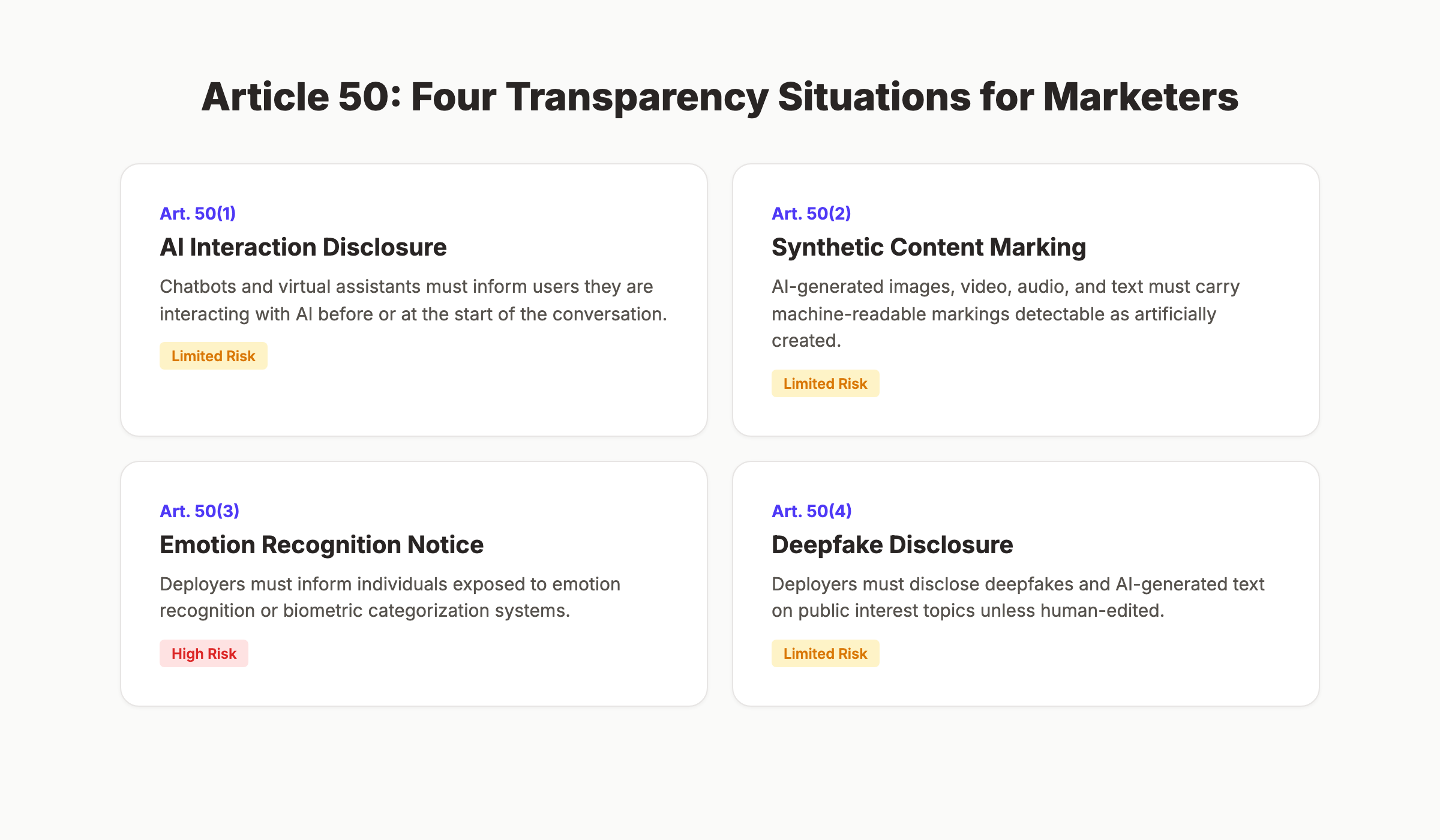
Article 50 of the EU AI Act contains the transparency rules that most directly affect marketers. These obligations apply from December 2, 2026, and cover four specific situations.
The Four Transparency Situations
Situation 1: AI Interaction Disclosure (Article 50(1))
Providers of chatbots, virtual assistants, and AI agents must design systems so users know they are interacting with AI. The exception is when it is obvious from the point of view of a reasonably well-informed, observant, and circumspect person.
For marketers, this means your website chatbot must disclose its AI nature before or at the start of the conversation. A small note in the terms of service is not sufficient. The disclosure must be clear and distinguishable.
Situation 2: Synthetic Content Marking (Article 50(2))
Providers of generative AI systems must ensure outputs are marked in a machine-readable format and detectable as artificially generated or manipulated. This applies to text, images, audio, and video.
The technical standard emerging for this is C2PA, the Content Authenticity Initiative. C2PA embeds cryptographically signed metadata into files to show provenance. However, most social platforms strip metadata during upload, so C2PA alone may not be enough. A combined approach using C2PA metadata plus steganographic watermarks is the most defensible compliance posture.
Assistive editing functions that do not substantially alter input data semantics, such as basic grammar correction, are exempt from marking requirements.
Situation 3: Emotion Recognition and Biometric Categorization (Article 50(3))
Deployers using emotion recognition or biometric categorization systems must inform individuals who are exposed to them. This is distinct from the Article 5 prohibition on emotion recognition in workplaces and education, which is already banned.
For marketers, if you use AI to analyze customer emotions during video calls or chat interactions, you must disclose this.
Situation 4: Deepfakes and Public Interest Text (Article 50(4))
Deployers must disclose when content constitutes a deepfake, defined as content that would falsely appear authentic or truthful. For AI-generated text published to inform the public on matters of public interest, deployers must disclose unless the content underwent human review or editorial control with a person holding editorial responsibility.
Evidently artistic, creative, satirical, or fictional content gets lighter disclosure requirements.
What Fails as Disclosure
The EU has been clear about what does not meet the clear and distinguishable standard:
- A very small snippet of text hidden in the footer
- A faint label that is hard to notice
- Brief flashing labels in video content
- Disclosures buried in terms and conditions
- Generic statements without specificity about AI involvement
Penalties for Non-Compliance
| Violation Type | Maximum Penalty |
|---|---|
| Prohibited AI practices | €35 million or 7% of global annual turnover |
| High-risk system violations | €15 million or 3% of global annual turnover |
| Article 50 transparency violations | €15 million or 3% of global annual turnover |
| Supplying incorrect information | €7.5 million or 1.5% of global annual turnover |
Chapter 4: What the EU Code of Practice Requires
The European Commission is developing a Code of Practice on AI labeling and transparency. A second draft was published in March 2026, with the final version expected by June 2026. This Code will provide practical guidance on how to meet Article 50 obligations.
What the Code of Practice Covers
The draft Code of Practice addresses several elements that marketers need to understand:
Standardized EU AI Visual Label: The Commission is developing a common icon or badge that indicates AI-generated content. This will create consistency across platforms and reduce confusion.
Taxonomy for Content Types: The Code distinguishes between fully AI-generated content and AI-assisted content. This matters for marketers because the disclosure requirements may differ based on how much human involvement occurred.
Technical Standards for Watermarking: The Code provides guidance on metadata embedding, imperceptible watermarking, and fingerprinting approaches. It recognizes that no single technical solution is perfect and recommends layered approaches.
Modality-Specific Labeling: Different rules apply to images, video, audio, and text. The Code provides modality-specific guidance for each.
Platform-Specific Rules
Major platforms are already implementing their own AI labeling systems:
| Platform | AI Labeling Approach | Status |
|---|---|---|
| Meta | Auto-labels ads using its generative AI tools | Active |
| TikTok | Participates in C2PA Content Credentials | Active |
| YouTube | Requires disclosure for meaningfully altered or synthetically generated realistic content | Active |
| Displays labels on AI-generated content in Search and Ads | Active |
Platform rules and EU AI Act obligations operate in parallel. Meeting platform requirements does not automatically mean you are compliant with the AI Act, and vice versa.
The UK ASA Parallel Enforcement
The UK Advertising Standards Authority is also increasing scrutiny of AI in advertising. In 2026, the ASA's Active Ad Monitoring System is scanning 40 million advertisements, shifting from reactive complaint-based enforcement to proactive intervention. UK rules apply regardless of how advertising content is generated, meaning AI-generated ads must meet the same standards as human-created ads.
Do not wait for the final Code of Practice to start preparing. The core obligations in Article 50 are already clear. theStacc helps marketing teams build transparent content workflows that satisfy both current platform rules and upcoming regulatory requirements. Book a demo →
Chapter 5: Building Your Marketing Compliance Checklist
A compliance checklist gives your team a concrete action plan. Here is a framework organized by marketing function.
Content Marketing Compliance
- ✓ Inventory all AI tools used for content creation (text, images, video, audio)
- ✓ Classify each tool by risk level under the EU AI Act
- ✓ Document which content pieces are AI-generated versus human-edited
- ✓ Implement disclosure labels for AI-generated blog posts on public interest topics
- ✓ Add machine-readable markings (C2PA metadata) to AI-generated images
- ✓ Create a human editorial review process for AI-drafted content
- ✓ Train content creators on AI Act disclosure requirements
- ✓ Establish a content provenance tracking system
Advertising Compliance
- ✓ Audit all AI-generated creative assets (images, video, audio)
- ✓ Implement watermarking or metadata for synthetic media in EU campaigns
- ✓ Add visible AI disclosure labels to deepfake-style ad content
- ✓ Review ad copy for claims that may trigger additional scrutiny
- ✓ Document the human oversight process for AI-generated ad campaigns
- ✓ Verify that AI providers are implementing Article 50 technical requirements
- ✓ Create a pre-flight compliance check for EU-targeted campaigns
Website and Chatbot Compliance
- ✓ Add clear AI disclosure to all chatbot interfaces
- ✓ Test that disclosures appear before or at the start of AI interactions
- ✓ Review chatbot scripts for prohibited practices (manipulation, deception)
- ✓ Document the AI systems used for personalization and recommendation
- ✓ Add disclosure for emotion recognition or biometric analysis if used
- ✓ Ensure accessibility compliance for all AI disclosures
Email and Social Media Compliance
- ✓ Label AI-generated email content where required
- ✓ Add AI disclosure to social posts generated by AI tools
- ✓ Document which posts are AI-generated versus human-created
- ✓ Review automated direct message campaigns for AI disclosure needs
- ✓ Ensure AI-generated influencer content is properly disclosed
Vendor and Tool Compliance
- ✓ Request Article 50 compliance documentation from all AI vendors
- ✓ Verify that generative AI tools embed machine-readable markings
- ✓ Review vendor contracts for liability allocation
- ✓ Confirm that vendors have EU authorized representatives if based outside the EU
- ✓ Document vendor risk classifications and compliance status
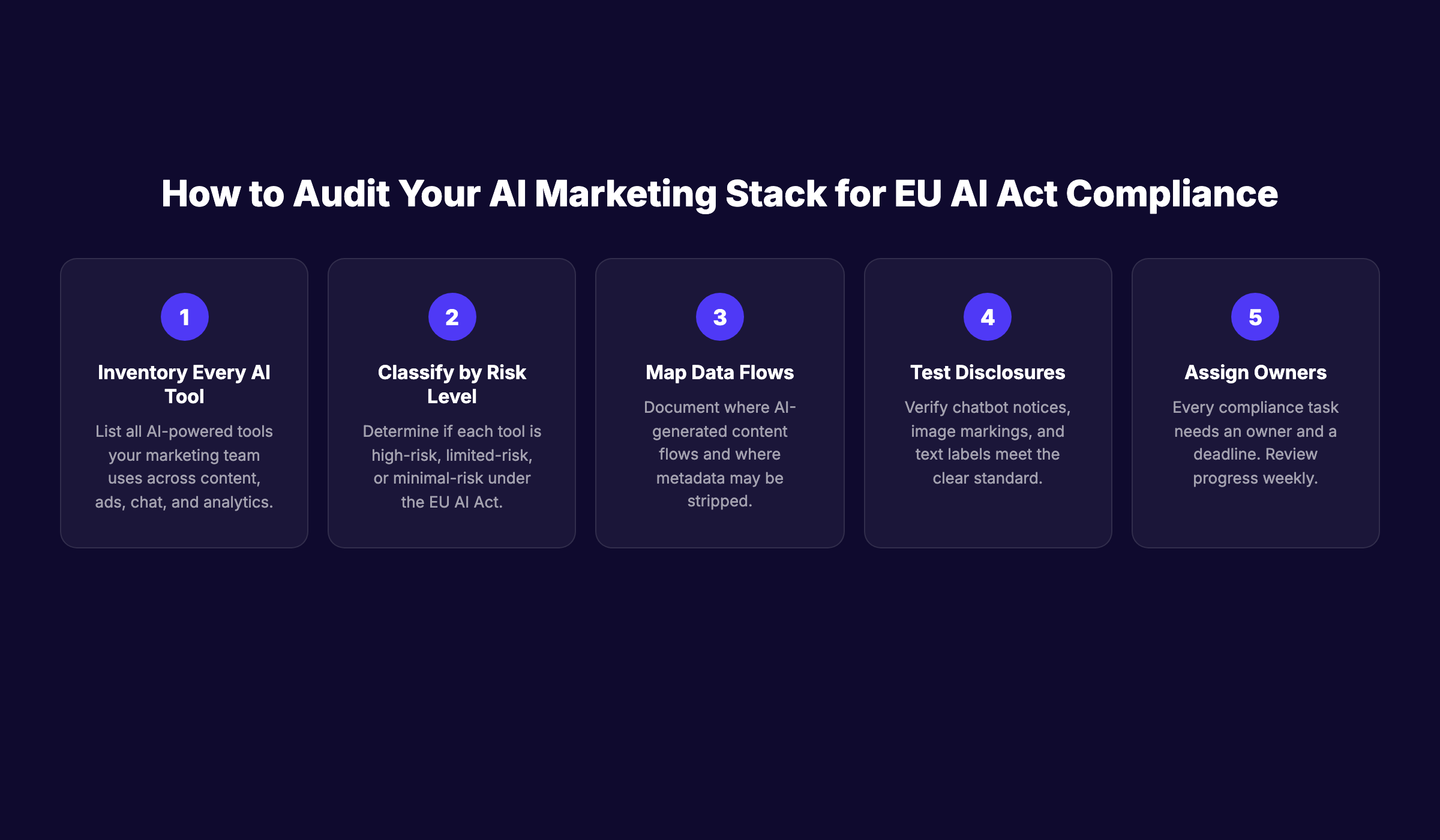
Chapter 6: How to Audit Your AI Marketing Stack
An AI stack audit identifies which tools fall under the EU AI Act and what compliance steps each requires. Here is how to conduct one.
Step 1: Inventory Every AI Tool
Create a complete list of every AI-driven tool your marketing team uses. Include:
- Content generation tools (ChatGPT, Claude, Jasper, Copy.ai)
- Image generation tools (Midjourney, DALL-E, Stable Diffusion)
- Video generation tools (Synthesia, Runway, Pictory)
- Audio and voice tools (ElevenLabs, Murf, Descript)
- Chatbot platforms (Intercom, Drift, HubSpot Chatbot)
- Analytics and personalization tools (Clearbit, Segment, Amplitude)
- Email automation tools (Klaviyo, Mailchimp, ActiveCampaign)
- Social media tools (Buffer, Hootsuite, Sprout Social)
- SEO and content optimization tools (Clearscope, Surfer SEO, MarketMuse)
Step 2: Classify Each Tool by Risk Level
For each tool, determine which EU AI Act risk category applies:
- Does the tool make decisions about individuals (hiring, credit, access)? If yes, high-risk.
- Does the tool generate synthetic content or interact with users as AI? If yes, limited-risk.
- Does the tool perform basic automation without generative capabilities? If yes, minimal-risk.
Step 3: Map Data Flows
Document where AI-generated content flows. If you create AI images in Midjourney, edit them in Photoshop, and publish them on Instagram, each step has compliance implications. The full chain matters because metadata can be stripped at any point.
Step 4: Test Current Disclosure Practices
Review your current AI disclosures against the clear and distinguishable standard:
- Are chatbot disclosures visible before the first interaction?
- Are AI-generated images marked with metadata?
- Is AI-generated text labeled in a way readers can see?
- Are disclosures accessible to users with disabilities?
Step 5: Identify Gaps and Prioritize
Rate each gap by risk level and effort required:
| Gap | Risk Level | Effort | Priority |
|---|---|---|---|
| Missing chatbot disclosure | High | Low | Fix immediately |
| No C2PA metadata on images | Medium | Medium | Fix before December 2026 |
| No human review process for AI content | Medium | High | Start building now |
| Vendor compliance documentation missing | High | Low | Request immediately |
| No AI tool inventory | High | Low | Complete immediately |
Step 6: Assign Owners and Deadlines
Every compliance task needs an owner and a deadline. Without accountability, preparation stalls. Assign specific team members to each priority item and review progress weekly.
Chapter 7: Preparing Your Team and Vendors
Compliance is not just a technical problem. It is an organizational problem. Your team and your vendors both need to be ready.
AI Literacy Training
Article 4 of the EU AI Act requires AI literacy for staff involved in developing, deploying, or overseeing AI systems. This obligation has been in force since February 2, 2025. If your marketing team uses AI tools, they need training on:
- What the EU AI Act requires and why it matters
- How to identify AI-generated versus human-created content
- When and how to apply AI disclosures
- What constitutes a high-risk versus limited-risk use case
- How to document AI use for compliance purposes
- Who to contact with compliance questions
Training should be documented. Regulators may ask for evidence that your team has received appropriate AI literacy education.
Vendor Management
Your AI vendors are a critical part of your compliance chain. Here is what to ask them:
For generative AI providers:
- Do you embed machine-readable markings in AI outputs?
- Are you C2PA-compliant?
- Do you provide technical documentation per Article 11?
- Have you appointed an EU authorized representative?
- What is your risk classification under the EU AI Act?
- Can you provide a compliance certificate or attestation?
For deployers using third-party AI:
- Document that you have requested and received compliance information
- Verify that vendor claims are accurate
- Include AI Act compliance requirements in new vendor contracts
- Build vendor compliance review into your procurement process
Documentation Requirements
The EU AI Act requires extensive documentation for high-risk systems and specific records for limited-risk systems. At minimum, maintain:
- An inventory of all AI systems used in marketing
- Risk classification documentation for each system
- Records of AI literacy training for staff
- Copies of vendor compliance attestations
- Documentation of disclosure mechanisms implemented
- Logs of AI-generated content and associated disclosures
- Human oversight procedures and evidence of their application
For high-risk systems, deployers must retain automated logs for six months. Providers must retain records for ten years.
Working with Legal and Compliance Teams
Marketing cannot handle EU AI Act compliance alone. Partner with your legal, compliance, and data protection teams early. They can help with:
- Risk classification decisions
- Vendor contract reviews
- Documentation templates
- Regulatory interpretation
- Incident response planning
If your organization does not have dedicated AI compliance resources, consider engaging external counsel or consultants with EU AI Act expertise.
Get your marketing team AI Act-ready with documented workflows. theStacc helps businesses maintain transparent content creation processes with built-in disclosure tracking and provenance documentation. Sign up for free →
What practitioners are saying on X
AI search advice ages quickly. Here is high-signal public discussion from SEO and growth operators — context for your roadmap, not a substitute for primary data.
- @jakezward (Feb 2026): 2026 SEO predictions emphasize AI Overview share-of-SERP, schema for LLM token efficiency, brand mentions in AI answers as a KPI, proprietary data as a moat, and content refresh beating net-new AI slop. See the post on X.
- @alexgroberman (Jul 2026): Case narrative: organic value plus multi-engine citations (ChatGPT, Perplexity, Grok) from knowledge-hub pages, category authority links, commercial intent content, and tight internal linking — not thin product copy. See the post on X.
- @varunram (Jul 2026): Critique of GEO slopfarm products that combine SEO clickbait with unresearched content marketing — quality and research still separate winners from farms. See the post on X.
Grok, AI Overviews, and multi-engine visibility
AI/search topics like “eu ai act 2026 marketers” need multi-engine notes: AI Overviews, ChatGPT/Perplexity, and Grok. Lead with extractable answers; keep claims consistent with public expert discussion.
- Google AI Overviews: Use passage-ready answers, tables, and FAQ schema where relevant.
- ChatGPT / Perplexity: Cite named sources next to key claims.
- Grok: Maintain accurate entity facts on-site and in high-signal X posts.
Publish content built for Google and AI citations. theStacc’s Content SEO module ships SEO-scored articles structured for rankings and generative engines — including clearer entity pages models like Grok can quote.
Frequently Asked Questions
Yes, if your AI output reaches EU users. The EU AI Act has extraterritorial reach similar to GDPR. Any business placing AI systems on the EU market or whose AI output is used in the EU is in scope, regardless of where the company is headquartered.
AI-generated content is created primarily by an AI system with minimal human input. AI-assisted content involves significant human editing, direction, or creative control. The EU Code of Practice is developing a taxonomy that may treat these categories differently for disclosure purposes. Content that undergoes substantial human editorial review with a person holding editorial responsibility may qualify for reduced disclosure requirements under Article 50(4).
Yes, if the content is synthetic media or AI-generated text on matters of public interest. For standard marketing content, the requirements depend on the platform and the specific use of AI. Platform rules from Meta, TikTok, and YouTube already require disclosure for AI-generated content, and the EU AI Act adds a legal obligation on top of platform policies.
As the deployer, you remain liable for compliance. The EU AI Act places obligations on both providers (the companies building AI tools) and deployers (the companies using them). If your vendor fails to embed required metadata or provide necessary documentation, you may face penalties even though the vendor caused the problem. This is why vendor due diligence is critical.
No. Assistive editing functions that do not substantially alter the input data or its semantics are exempt from Article 50 marking requirements. Basic grammar correction, spell-checking, and similar assistive functions fall outside the scope of synthetic content marking obligations.
Article 50(2) synthetic content marking obligations take effect on December 2, 2026, following the Omnibus agreement extension. High-risk system obligations for Annex III standalone systems have been extended to December 2, 2027. However, AI literacy training has been required since February 2, 2025, and prohibited AI practices have been banned since the same date.
Article 50 transparency violations carry penalties of up to €15 million or 3% of global annual turnover, whichever is higher. Prohibited AI practice violations can reach €35 million or 7% of global turnover. Supplying incorrect information to authorities can result in fines up to €7.5 million or 1.5% of turnover.
If you are a non-EU company placing AI systems on the EU market or whose AI output is used in the EU, you may need to appoint an EU authorized representative. This requirement applies to providers of high-risk AI systems and is recommended for any non-EU business with significant EU exposure.
The EU AI Act and GDPR operate in parallel. GDPR covers personal data protection, while the AI Act covers AI system safety and transparency. If your marketing AI processes personal data, you must comply with both. Organizations already GDPR-compliant are generally better positioned for AI Act readiness, particularly in data governance, impact assessments, and documentation practices.
Start with an AI tool inventory. Vision Compliance found that 83% of organizations have no formal inventory of the AI systems they use or deploy. Without an inventory, you cannot classify risk, identify gaps, or build a compliance plan. After the inventory, classify each tool by risk level, request compliance documentation from vendors, and begin implementing disclosure mechanisms for limited-risk tools.
Key Takeaways
- The EU AI Act Article 50 transparency obligations for synthetic content take effect on December 2, 2026, following the May 2026 Omnibus agreement
- The law applies to any business whose AI output reaches EU users, regardless of location
- 78% of enterprises have not taken meaningful compliance steps, but the new deadlines provide additional preparation time
- Marketers must focus on four areas: AI interaction disclosure, synthetic content marking, emotion recognition notification, and deepfake disclosure
- C2PA metadata and steganographic watermarks are the emerging technical standards for compliance
- The EU Code of Practice, expected in June 2026, will provide detailed implementation guidance
- Vendor compliance is your compliance: deployers remain liable even when vendors fail
- AI literacy training has been mandatory since February 2025
- Penalties for Article 50 violations reach €15 million or 3% of global turnover
- The first step is an AI tool inventory, which 83% of organizations still lack
The EU AI Act is the most significant AI regulation to date. For marketers, it creates new obligations around transparency and disclosure that affect daily workflows. The businesses that prepare now will avoid penalties and build trust with audiences. The businesses that wait risk fines, reputational damage, and disrupted operations.
Prepare your marketing team for EU AI Act compliance before the December 2026 deadline. theStacc helps businesses build transparent content workflows with built-in disclosure tracking, provenance documentation, and compliance-ready publishing processes. Book a demo →
Related Tools & Resources
Free SEO Tools:
Best Lists:
Sources & references
- [1] Princeton / Georgia Tech et al. — GEO research (arXiv:2311.09735)
- [2] @jakezward on X — 2026 SEO predictions emphasize AI Overview share-of-SERP, schema for LLM token efficiency, brand mentions in AI answers
- [3] @alexgroberman on X — Case narrative: organic value plus multi-engine citations (ChatGPT, Perplexity, Grok) from knowledge-hub pages, category
- [4] @varunram on X — Critique of GEO slopfarm products that combine SEO clickbait with unresearched content marketing — quality and research

Plan topics, review article drafts, and publish to a connected CMS.
Weekly local SEO teardowns
One practical email a week. Map Pack, GBP, AI Overviews. No fluff. Unsubscribe anytime.