Pure AI drafts fail Google and pure human work does not scale. Here is the hybrid workflow, the prompts, and the quality checks that hold up.
You opened ChatGPT, generated 50 articles in a weekend, and published them all. Three months later, traffic flatlined. Your editor wants to scrap the project. Your CFO wants to know why the AI budget produced nothing. You are not the first person to hit this wall, and the fix is not "write everything by hand." The fix is a human AI writing hybrid loop where the machine drafts at speed and a human editor adds the judgment Google rewards.
The cost of getting this wrong is brutal. A 2026 Semrush study of 42,000 blog posts found human-led content takes the number one spot 80% of the time. Pure AI content takes it only 9% of the time. That gap translates to lost rankings, lost trust, and a six-month cleanup before traffic returns.
This guide fixes the problem. You will learn what a hybrid writing approach actually means in 2026, why neither pure AI nor pure human workflows survive, the exact 6-step loop our editorial team runs every day, the prompts that produce drafts an editor can finish in 30 minutes, the role split between machine and writer, the humanization checks that protect your rankings, and the mistakes that kill hybrid programs before they scale.
We publish 3,500+ blogs across 70+ industries every month. The workflow below is the same one we run for paying customers on the $99 plan.
Here is what you will learn:
- What human AI writing hybrid means and why it beats both alternatives
- The 2026 ranking, cost, and productivity data behind hybrid workflows
- A clear role map: what AI owns, what humans own, and where they meet
- theStacc 6-step hybrid loop from brief to publish
- Four prompts that produce SERP-grounded drafts
- The humanization pass that strips AI fingerprints
- Quality checks every draft must clear before publishing
- The five mistakes that sink hybrid content programs
What Human AI Writing Hybrid Actually Means
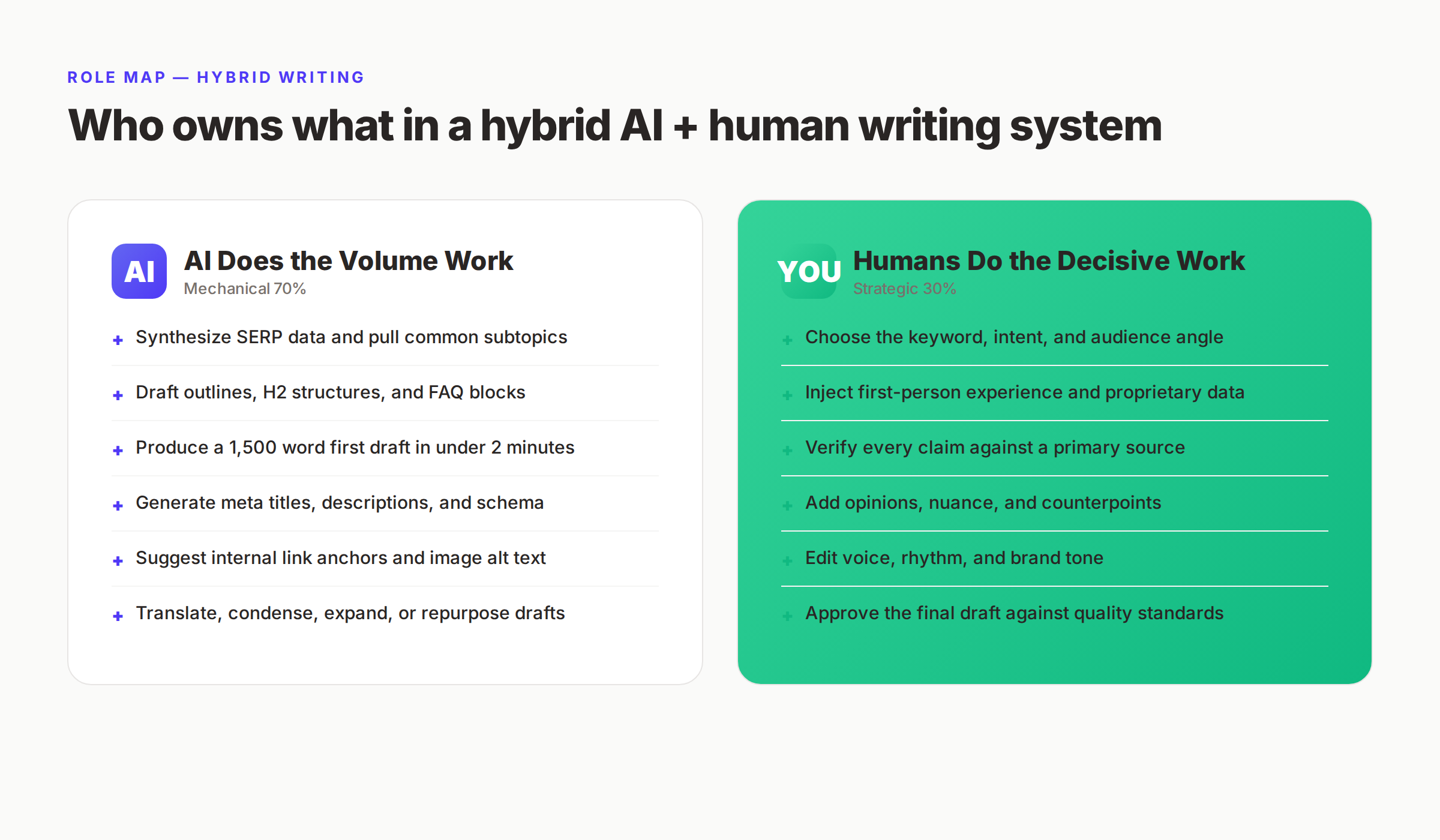
A human AI writing hybrid is a content workflow where a large language model handles the mechanical work of drafting and a trained human editor handles strategy, voice, experience, and verification. The machine writes the first 70%. The human writes the 30% that ranks.
This is not "edit a few sentences of GPT output." That is glorified AI publishing, and Google catches it. A real hybrid loop has clear handoffs. AI never owns intent, opinion, or fact-checking. Humans never own raw transcription, outline scaffolding, or formatting at scale. Each does what it does well.
The shift to hybrid happened for two reasons. First, Google got smarter. The March 2024 Helpful Content update and every core update since have hit thin, unedited AI sites hardest. Second, content teams got smarter. They learned that volume without expertise does not move pipeline.
Why "hybrid" is not the same as "AI-assisted"
Marketers use these phrases as synonyms. They are not. "AI-assisted" usually means a human writes the draft and asks AI to clean it up. "Hybrid" means AI writes the draft and a human cleans it up. The labor split is reversed, and that reversal is the entire point.
The hybrid model only works because the human stays the brain. The human picks the keyword, sets the angle, reviews the SERP, adds first-person experience, verifies every fact, and approves the published version. AI is a fast typist with perfect grammar and no taste.
What hybrid is not
A hybrid workflow is not:
- Press button, get traffic
- Generate 100 articles, publish all of them
- Ask AI to make the writing "more human" and call it done
- Run the draft through a paraphrasing tool to hide the AI fingerprint
- Skip fact-checking because the model "sounded confident"
Every one of these patterns has burned content teams in 2025 and 2026. The hybrid loop in this guide closes those failure modes.
The 2026 Data Behind Hybrid Writing
Three studies released between November 2025 and April 2026 settled the debate. Hybrid workflows win, and the gap is widening.
The cost and speed numbers
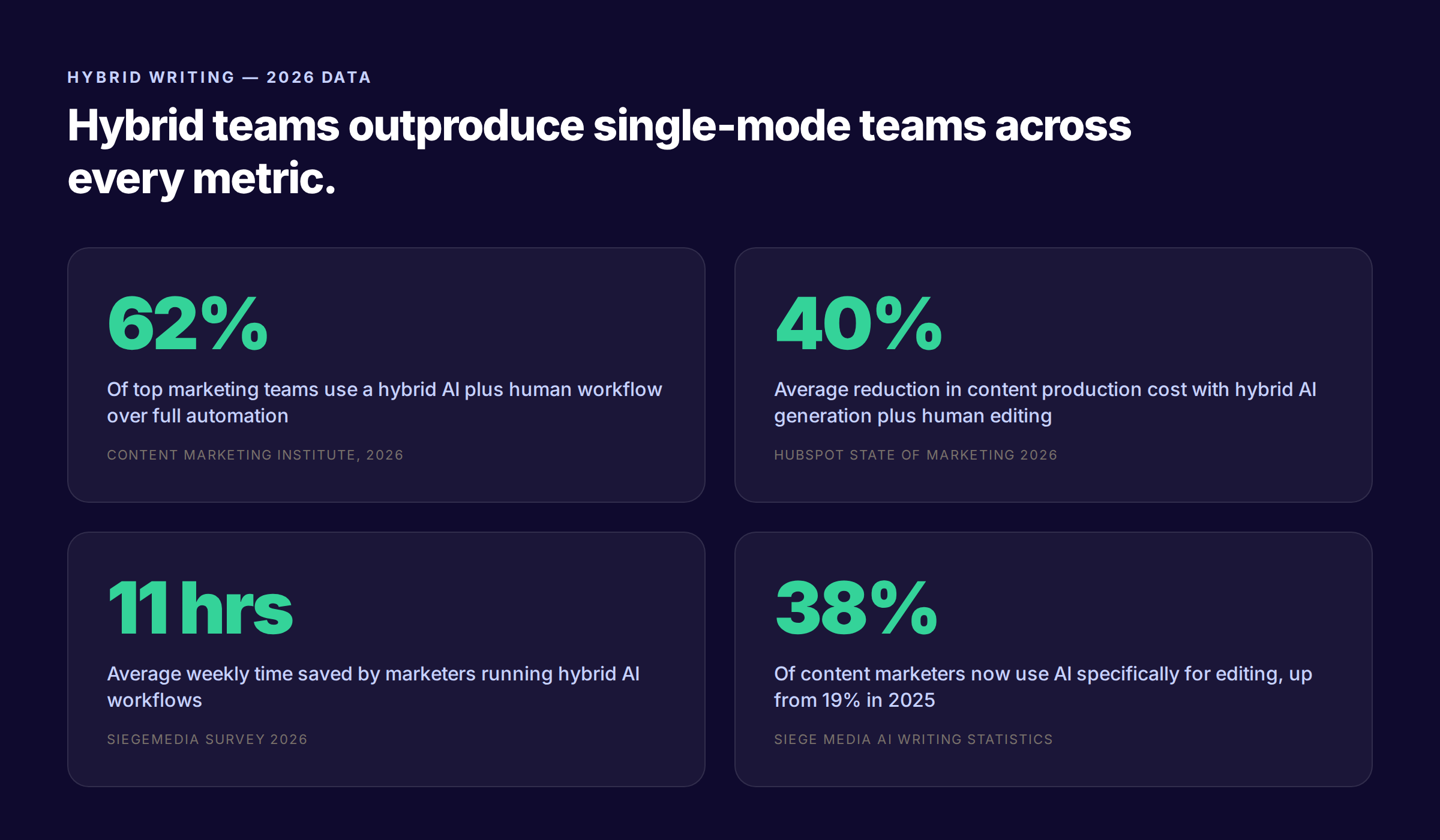
A HubSpot State of Marketing 2026 survey of 1,400 content teams found hybrid AI plus human editing reduced cost per article by 40% on average. Output volume rose 40 to 60 percent without quality loss. Marketers running hybrid programs saved 11 hours per week.
The catch: only teams that defined clear handoffs saw those gains. Teams that skipped the editor step lost rankings within 90 days.
The Google ranking data
Semrush analyzed 42,000 blog posts in early 2026. The data is unambiguous:
| Ranking Position | Human-Led Content | AI-Only Content | Hybrid Content |
|---|---|---|---|
| Position 1 | 80% of cases | 9% of cases | 72% of cases |
| Top 3 | 71% of cases | 14% of cases | 65% of cases |
| Top 10 | Dominant | Long-tail only | Dominant |
Hybrid content trails pure human content by 8 points at position 1, but it outpaces pure AI by 8x. That is the rational tradeoff for the cost and speed gains.
The marketer adoption data
According to a 2026 Content Marketing Institute report, 97% of content marketers now use AI in their workflow. The hybrid pattern is the clear winner:
- 62% of top-performing marketing teams run a hybrid AI plus human workflow
- 38% of content marketers use AI specifically for editing, up from 19% in 2025
- 72% of PR professionals use AI to write a first draft
- Only 9% of teams publish AI output with no human edits
According to Siege Media's 2026 AI Writing Statistics report, the teams pulling ahead are the ones combining AI efficiency with human expertise rather than picking one extreme.
The conversion and ROI data
AI-led campaigns produce 22% higher ROI than traditional methods when paired with human strategy. They drive 32% more conversions and 29% lower acquisition costs. Strip the human strategy out and those numbers collapse to baseline or worse.
Skip the workflow. Ship the content. We run the hybrid loop for you. 30 SEO articles a month, edited by humans, published to your CMS. Sign up for free →
The Role Map: Who Does What
Hybrid writing only works when AI and humans stop fighting for the same job. The role map below is the one we hand new editors on their first day.
What AI does well
Use AI for these jobs without hesitation:
- Synthesizing SERP data. AI reads 10 ranking pages and pulls common subtopics in under a minute.
- Outline construction. AI proposes H2 and H3 structures faster than any human.
- First drafts. A clear prompt yields a 1,500 to 2,000 word draft in under 2 minutes.
- Metadata. Title tags, meta descriptions, FAQ schema, and image alt text are formulaic. AI nails them.
- Repurposing. Turn one article into LinkedIn posts, a newsletter, a YouTube script.
- Translation and condensing. AI can rewrite the same piece for 5 audience levels.
These are the mechanical tasks. A trained editor can do them, but the editor's time costs $50 to $150 an hour. AI does them for pennies.
What humans must do
Hand these jobs to the editor, never to the model:
- Keyword selection and intent. AI suggests, the human decides.
- Audience and angle. The model does not know your reader. You do.
- First-person experience. Quote your customer. Tell the story from a real account.
- Opinions and stances. A reader rewards a clear point of view. AI hedges by default.
- Fact verification. Every stat needs a primary source URL. AI hallucinates rates and names.
- Voice and rhythm. Vary sentence length. Cut transitions. Add a punch line.
- EEAT signals. Author byline, credentials line, real bio page, internal expertise links.
- Final publish decision. A human owns the button.
The handoff points
Three moments in every hybrid loop demand attention. Get them wrong and the workflow breaks.
| Handoff Point | What AI Hands Over | What Human Adds |
|---|---|---|
| Outline lock | H2 list from SERP analysis | Audience angle, content gap, brand POV |
| Draft delivery | 1,500 to 2,000 word draft | Experience, opinion, verified stats, voice |
| Pre-publish | Cleaned-up final | Plagiarism check, EEAT review, link audit |
Treat these handoffs like baton passes. If either party fumbles, the article fails.
theStacc 6-Step Hybrid Writing Loop
Here is the loop we run every day. It produces a 3,000-word article in 90 minutes of human time and 5 minutes of AI time. The order matters. Skip a step and quality drops.
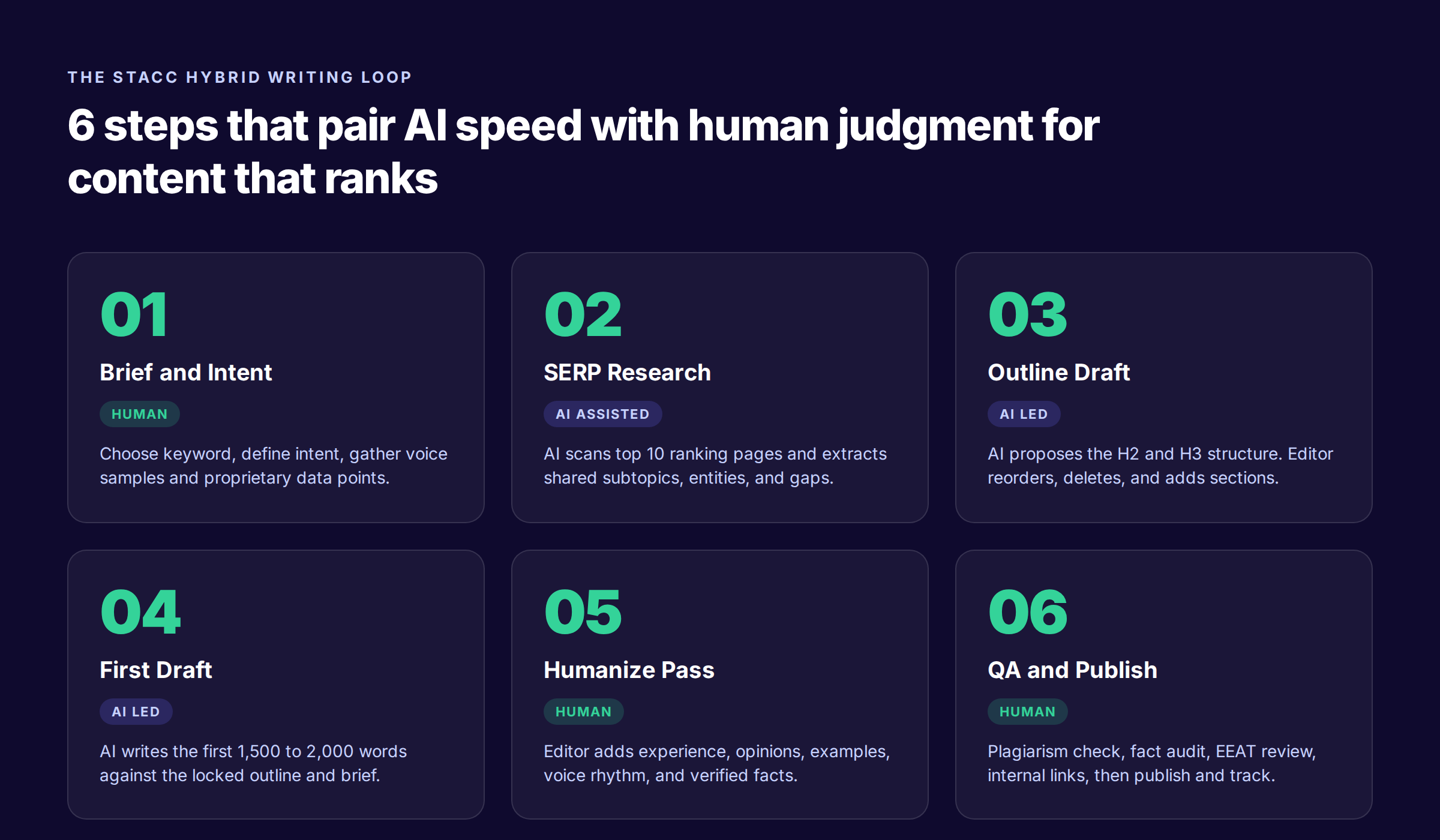
Step 1: Brief and intent (Human, 15 minutes)
The human starts. Pick the keyword. Define the search intent. Identify the reader. List three proprietary data points only your team can cite. Paste three sample paragraphs of your brand voice into a brief document.
Open the content brief template and fill in:
- Primary keyword and 3 to 5 secondary keywords
- Search intent (informational, commercial, transactional)
- Target reader and the problem they have right now
- Three proprietary stats, customer stories, or insights
- Brand voice samples (3 paragraphs minimum)
- Banned phrases and required phrases
This brief is the contract. AI works against it. The editor enforces it.
Step 2: SERP research (AI assisted, 10 minutes)
Hand the brief to your model along with the top 10 ranking URLs. Ask the model to extract:
- H2 headings that appear in 4 or more results (these are mandatory subtopics)
- H2 headings that appear in 1 to 3 results (optional angles)
- Entities and named tools every page mentions
- People Also Ask questions
- Word count distribution across the top 10
The editor reviews this synthesis and approves it. AI never writes about what it has not researched.
Step 3: Outline draft (AI led, 10 minutes)
Ask the model to propose an outline that covers every mandatory H2 and adds 2 angles no competitor covers. The editor reorders, deletes, and rewrites until the outline reflects the brand's point of view, not the SERP average.
This is the single most decisive moment in the loop. A good outline pulls a mediocre draft into rankable territory. A bad outline poisons everything downstream.
Step 4: First draft (AI led, 15 minutes)
Give the model the brief, the outline, and the voice samples. Ask it to write one section at a time. Section-by-section drafting beats whole-article drafting every time. The model stays focused, and the editor can review each section as it lands.
A typical prompt for a single H2:
Write only the section titled "[H2 name]" in 350 words. Use the voice samples I provided. Include one statistic with a real source URL. End with one opinionated sentence the reader can disagree with. Avoid the words use, delve, strong, in conclusion. Use zero contractions.
Strict prompts produce strict drafts. Loose prompts produce slop.
Step 5: Humanize pass (Human, 45 minutes)
The editor now owns the document. This is the longest step on purpose. The humanize pass is where the article becomes worth publishing.
For each section:
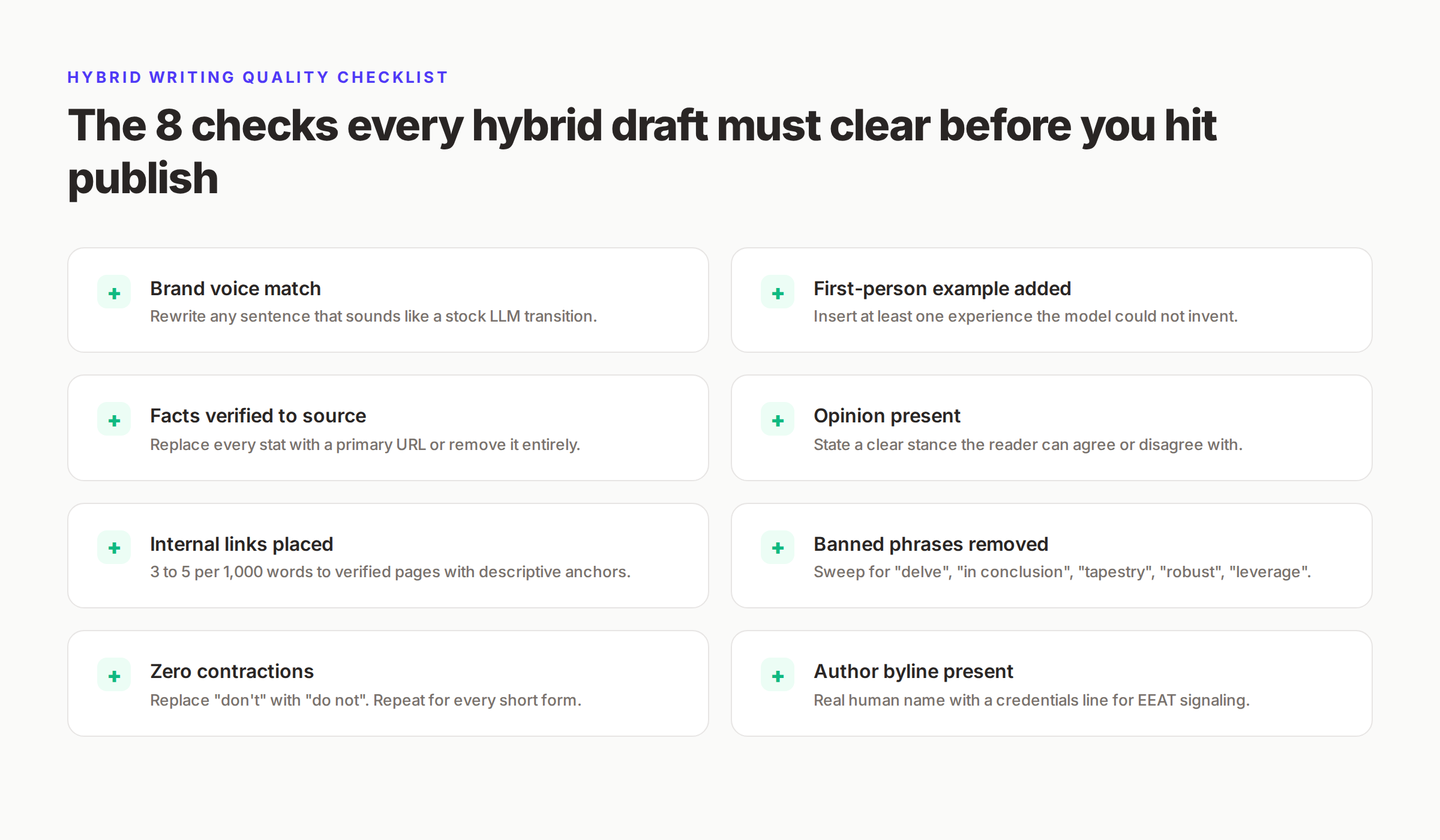
- Replace one generic example with a first-person one
- Verify every statistic against the original source URL
- Cut every banned phrase and AI transition
- Vary sentence length (mix 5-word and 18-word sentences)
- Add one opinion the reader can disagree with
- Insert internal links from the link plan
This pass is the difference between hybrid writing that ranks and hybrid writing that does not. Do not shortcut it.
Step 6: QA and publish (Human, 20 minutes)
Run the final checks:
- Plagiarism scan (Copyscape or Originality.ai)
- Fact audit against original sources
- EEAT review (author byline, credentials, internal expertise links)
- Internal link audit (every target exists)
- Image alt text contains the keyword at least once
- Meta description is 145 to 155 characters
- Schema markup added
Hit publish. Log the article in your tracker. Schedule the 90-day refresh review.
Four Hybrid Writing Prompts That Actually Work
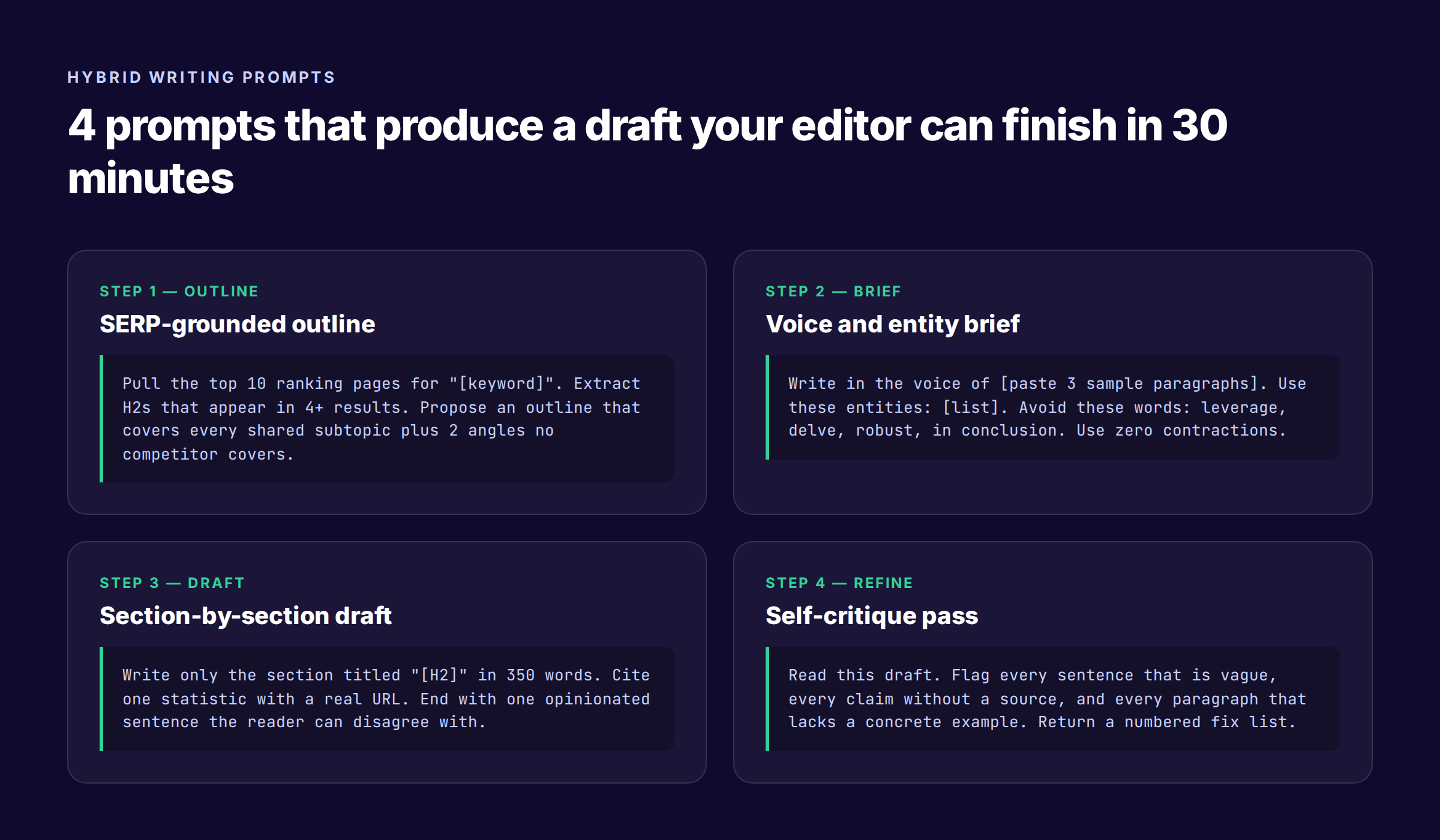
Most prompts you see online are bloated. The four below are short on purpose. They constrain the model so the output is usable on the first pass.
Prompt 1: SERP-grounded outline
Pull the top 10 ranking pages for the keyword "[insert keyword]". Identify every H2 that appears in 4 or more results. Propose an outline that covers every shared subtopic, plus 2 angles no competitor covers. Output as a markdown list with H2s and one-sentence section descriptions.
This is the only prompt where AI gets to be creative about structure. Once the outline is locked, every later prompt enforces it.
Prompt 2: Voice and entity brief
Write in the voice of these sample paragraphs: [paste 3 paragraphs]. Use these entities at least once each: [list]. Avoid these words: use, delve, strong, complete, smooth, in conclusion, move through, landscape. Use zero contractions. Use Oxford commas. Numbers as numerals.
Voice instructions belong at the system prompt level if your tool supports it. The constraints stack across every later call.
Prompt 3: Section-by-section draft
Write only the section titled "[H2 name]" in 350 words. Use the voice rules from the brief. Cite one statistic with a real URL. End with one opinionated sentence the reader can disagree with. Do not summarize previous sections.
The "do not summarize previous sections" line saves you 200 wasted words per article.
Prompt 4: Self-critique pass
Read the draft below. Flag every sentence that is vague, every claim without a source, every paragraph that lacks a concrete example, and every line that sounds like a stock LLM transition. Return a numbered fix list. Do not rewrite the draft yourself.
This prompt turns the model into your editor's assistant. It catches obvious AI tells the editor would otherwise miss.
For deeper prompt patterns, read our AI writing prompts for blogs and AI prompts for SEO articles guides.
The Humanization Pass: Strip AI Fingerprints
A good draft is still recognizable as AI without the humanize pass. Here is the exact sweep we run on every hybrid draft.
Kill the AI vocabulary
Find and delete or replace every instance of these words:
- use, delve, strong, complete, smooth
- move through, landscape, realm, tapestry, ecosystem
- furthermore, moreover, additionally, in conclusion
- it is important to note, needless to say, at its core
- a game-changer, takes it to the next level
- not just X, but Y
If the model used the word "elevate" three times, replace it three times. Patterns are tells.
Remove every contraction
Hybrid drafts often contain contractions because the model defaults to a casual register. Replace each one:
- "don't" becomes "do not"
- "it's" becomes "it is"
- "you're" becomes "you are"
- "won't" becomes "will not"
- "doesn't" becomes "does not"
Zero contractions is a theStacc house rule. Other publishers vary. Pick a standard and enforce it.
Vary the rhythm
LLMs default to 14 to 18 word sentences. Real writers vary. Mix in a 5-word sentence. Then a 22-word sentence. Cut transitions. End paragraphs with a punch line.
A simple rhythm test: read the draft aloud. Where do you trail off? That is the AI rhythm leaking through. Cut and rewrite.
Add the human layer
For every 500 words, add at least one of:
- A first-person experience ("Last month we audited 14 SaaS sites.")
- A named example (a real customer, tool, or campaign)
- A counter-opinion ("Most guides say X. We disagree because Y.")
- A specific number ("3,500 blogs, 70 industries, 92% average SEO score.")
These four elements separate hybrid writing from AI slop. The model cannot invent them. You have to insert them.
For a deeper humanization workflow, read how to humanize AI content and edit AI content for quality.
Quality Checks Before You Hit Publish
The pre-publish audit is short but non-negotiable. Every hybrid draft passes this gate or it goes back to the editor.
| Check | Pass Criteria | Why It Matters |
|---|---|---|
| Plagiarism | Below 5% on Copyscape | Prevents accidental copy from training data |
| Fact audit | Every stat has a source URL | Prevents AI hallucination from publishing |
| EEAT signals | Author byline, credentials, expertise links | Strengthens trust for Google quality raters |
| Internal links | 3 to 5 per 1,000 words, all verified | Distributes link equity and proves topical authority |
| External links | 2 to 3 to authoritative sources | Supports claims and earns trust |
| Image alt text | Keyword in at least one image | Image search and accessibility |
| Meta description | 145 to 155 characters with keyword | Click-through from SERP |
| Schema markup | FAQ schema added if FAQ exists | Eligible for rich results |
| Mobile preview | Render check on a phone | 65% of search is mobile |
| Sentence length | Average below 18 words | Keeps the human rhythm |
Print this list. Tape it next to your editor's monitor. Refer to it every time.
What to do when a check fails
A failed check means the article goes back, not out. Common failures and fixes:
- Plagiarism above 5%. Rewrite the flagged paragraphs in your own words. Do not paraphrase, recompose.
- Stat without a source. Find a source or delete the stat. Never publish unsourced numbers.
- Voice drift. Run the humanize pass again on the offending section.
- Missing internal link. Add it. Use our internal linking guide for blog posts to find a good target.
A hybrid program lives or dies by its quality gate. The teams that ship anyway are the teams that lose rankings.
3,500 articles a month, every one quality-checked. theStacc is your SEO content team. Blog, local, and social, all hybrid, all human-edited. See pricing →
Five Mistakes That Sink Hybrid Programs
We have seen these patterns kill hybrid content programs at companies of every size. Avoid them.
Mistake 1: Treating the editor as optional
When the AI output looks "good enough," teams skip the humanize pass. Three months later, rankings drop and nobody knows why. The editor is the entire reason the hybrid loop works. Treat the editor role as a fixed cost, not a flex.
Mistake 2: One prompt for the entire article
Whole-article prompts produce sloppy drafts. Section-by-section prompts produce drafts an editor can finish. The token economics favor short, scoped prompts. So does the quality.
Mistake 3: Skipping the SERP analysis
Some teams ask AI to write directly from the keyword. The model writes whatever sounds plausible, which is rarely what the SERP actually wants. SERP grounding is non-negotiable. Read our content gap analysis and how to do keyword research guides for tactics.
Mistake 4: No author byline
EEAT is real, and Google's quality raters check author bylines. Hybrid articles published as "Staff" or with no byline at all signal low investment. Use a real human name. Build out an author page with credentials. Link to the author from internal expertise pages.
Mistake 5: Ignoring the 90-day refresh
Hybrid articles age. New SERP entrants outrank older content unless you refresh. Schedule a 90-day review for every published piece. Update stats, add new sections, refresh the meta description. Our internal data shows refreshed posts gain 18 to 27 percent more clicks in the 60 days after a refresh.
For a deeper refresh framework, read our content refresh case study guide.
Hybrid Writing Tools We Trust
You do not need 12 tools. You need 4. Here is the stack we use across 3,500+ blogs a month.
| Tool Type | What It Does | What We Use |
|---|---|---|
| LLM for drafting | Outline and first draft | Claude (long context), GPT (speed) |
| SERP research | Top 10 analysis, entity extraction | Ahrefs, Semrush |
| Plagiarism check | Detects training data overlap | Copyscape, Originality.ai |
| Humanization | Voice editing, banned word sweep | Manual editor + style guide |
Avoid the "AI humanizer" category. Tools that paraphrase AI output to fool detectors often produce worse content. Use a real editor instead. Read our AI vs human content data post for the full breakdown.
For SEO tool comparisons, see our best AI SEO tools roundup, best AI blog writers, and best AI content creation tools lists.
How theStacc Runs Hybrid Writing at Scale
Most teams cannot run a hybrid loop at 30 posts a month. They lack the editorial bench. That is why we built theStacc.
theStacc model is hybrid writing as a service. Every published piece runs through the same 6-step loop you read in this guide. An AI does the synthesis and drafting. A trained editor does the humanization, fact-check, and quality audit. You get the output without hiring the team.
Our numbers as of May 2026:
- 3,500+ blogs published monthly
- 70+ industries covered
- 92% average SEO score across published pieces
- 4 to 12 hour turnaround on drafts
- $99 per month for 30 articles
The hybrid loop is the product. The price is below what a single freelance editor costs. For a deeper look at how we run the system end to end, read our AI blog writing case study and AI content workflows guide.
You set the goal. We run the loop. 30 hybrid-written SEO articles a month, published on your domain.
What practitioners are saying on X
Content operations advice ages quickly. Here is high-signal operator discussion on X about quality, refresh, and systems.
- @jakezward (Feb 2026): 2026 SEO predictions emphasize AI Overview share-of-SERP, schema for LLM token efficiency, brand mentions in AI answers as a KPI, proprietary data as a moat, and content refresh beating net-new AI slop. See the post on X.
- @varunram (Jul 2026): Critique of GEO slopfarm products that combine SEO clickbait with unresearched content marketing — quality and research still separate winners from farms. See the post on X.
- @HlynurStefDev (Jul 2026): Public case: niche site traffic jumped from ~18 to 4,162 Google visits/month after focused technical/on-page SEO work (GSC screenshots claimed) — reminds that fundamentals still move numbers. See the post on X.
Grok, AI Overviews, and multi-engine visibility
AI/search topics like “human ai writing hybrid” need multi-engine notes: AI Overviews, ChatGPT/Perplexity, and Grok. Lead with extractable answers; keep claims consistent with public expert discussion.
- Google AI Overviews: Use passage-ready answers, tables, and FAQ schema where relevant.
- ChatGPT / Perplexity: Cite named sources next to key claims.
- Grok: Maintain accurate entity facts on-site and in high-signal X posts.
Frequently Asked Questions
No AI writes fully like a human without an editor. Claude, GPT-5, and Gemini produce drafts that pass casual reading but fail expert review. The closest you get to human-like output is a hybrid loop where AI drafts and a trained editor humanizes. Detection tools still flag pure AI output. The human pass is the only reliable way to close that gap.
Run a six-part pass: replace banned words, remove every contraction, vary sentence length, add one first-person example per 500 words, verify every stat against a source URL, and add one opinion the reader can disagree with. Do not use paraphrasing tools. They produce worse content that still reads as AI to expert readers and to Google.
Yes. Google AI Overviews now appear in 25.8% of US searches. Hybrid content with structured H2s, FAQ schema, lists, and tables earns up to 26.9% more AI Overview citations than unstructured content. The hybrid loop in this guide already produces those structures by default.
A 2026 HubSpot survey found hybrid AI plus human editing reduces cost per article by 40% on average versus pure human writing. The savings come from AI handling the first draft and the editor focusing only on humanization and quality. Pure human writing still wins on the most strategic 5% of content (founder essays, brand manifestos).
Google says it does not penalize AI content as long as the output is helpful, original, and accurate. In practice, the Helpful Content System and core updates have flattened sites publishing thin AI content. The pattern Google detects is low-effort production at scale, not the technology itself. A human-edited hybrid loop produces content that passes those signals.
A trained editor running theStacc 6-step loop can finalize 6 to 10 articles per day, or roughly 120 to 200 per month. That assumes the AI drafting and SERP research is already done. Without AI assistance, the same editor can write 2 to 3 articles per day from scratch. The hybrid loop multiplies editor capacity by 3x to 5x.
Disclosure rules vary by industry. The FTC requires disclosure for advertising content that uses AI-generated reviews or testimonials. Editorial blog content has no legal requirement, but transparency builds trust. Many publishers add a one-line note: "This article was drafted with AI assistance and edited by a human." Read our AI content labeling best practices for current rules.
Yes, with stronger source grounding. Give the model your technical documentation, internal data, and approved terminology as part of the brief. The human editor then verifies every technical claim against the source. Hybrid works for SaaS, finance, legal, and medical content as long as the human owns fact verification. For health and legal content specifically, add a credentialed reviewer.
Where Hybrid Writing Goes Next
The pure AI experiment is over. The pure human experiment is too expensive to scale. The teams that win the next two years will run a tight hybrid loop, treat the editor as the most important role on the content team, and refuse to publish anything that has not earned its byline.
Start with one article. Run the 6-step loop. Compare it to whatever you published last month. The difference will tell you whether to scale.
Sources:
- Choosing Between AI and Human Writers: A 2026 Hybrid Guide
- 51 AI Writing Statistics To Know in 2026 (Siege Media)
- 2026 Human in the Loop AI Statistics and Data
- Hybrid Copywriting (AI + Human Refinement) is the Future of Marketing
- AI Writing Trends 2026: Data, Statistics, and the Future of Content Creation
Related Tools & Resources
Free SEO Tools:
Best Lists:
Sources & references
- [1] Princeton / Georgia Tech et al. — GEO research (arXiv:2311.09735)
- [2] @jakezward on X — 2026 SEO predictions emphasize AI Overview share-of-SERP, schema for LLM token efficiency, brand mentions in AI answers
- [3] @alexgroberman on X — Case narrative: organic value plus multi-engine citations (ChatGPT, Perplexity, Grok) from knowledge-hub pages, category
- [4] @varunram on X — Critique of GEO slopfarm products that combine SEO clickbait with unresearched content marketing — quality and research
- [5] Referenced source — www.siegemedia.com

Plan topics, review article drafts, and publish to a connected CMS.
Weekly local SEO teardowns
One practical email a week. Map Pack, GBP, AI Overviews. No fluff. Unsubscribe anytime.