AI is not replacing writers wholesale, but it is already replacing specific writing tasks. Roughly 97% of content marketers plan to use AI alongside their teams, while only about 5% of firms using it report job displacement. This guide covers what AI does well, what it cannot do, and which skills hold value.
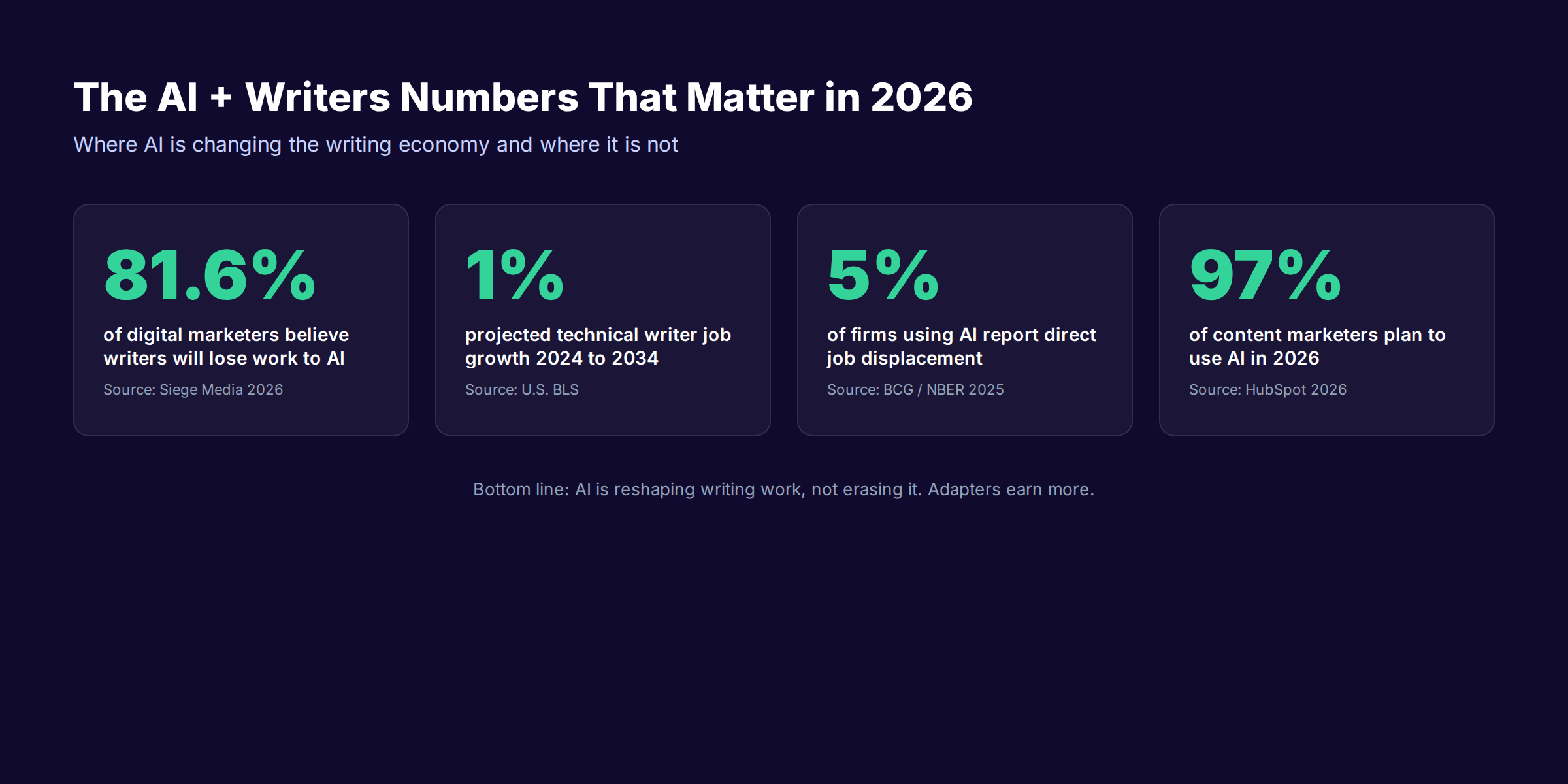
Will AI replace writers? 81.6% of digital marketers think it will. The Bureau of Labor Statistics projects 1% growth in technical writing jobs through 2034. Yet only 5% of firms using AI report actual job displacement, and 97% of content marketers plan to use AI in 2026 alongside their writing teams. The gap between fear and data is enormous.
The honest answer is more nuanced than either side wants to admit. AI will not replace writers wholesale. AI is already replacing certain writing tasks at scale. The writers who survive are the ones who understand the difference and adapt their work accordingly.
We have published 3,500+ blog posts across 70+ industries using AI-assisted workflows. We hire writers. We pay editors. We use AI every day. Here is what we have learned about which writing work disappears, which work pays more than ever, and how to position yourself for the next four years.
This guide answers the question with data, not opinions. Here is what you will learn:
- The exact tasks AI now does better than most writers
- What 2024 to 2034 BLS data says about writing employment
- Why 81.6% of marketers are wrong about full replacement
- The 6 skills that make writers AI-proof through 2030
- A year-by-year timeline of how writing work changes
- Which writing jobs disappear first and why
- How much AI-augmented writers earn versus pure human or pure AI
- The 90-day plan to become an AI-resistant writer
- 7 myths about AI replacing writers, debunked with data
Will AI Replace Writers? The Short Answer
No. AI will not replace writers as a profession. AI will replace specific writing tasks, eliminate certain low-end roles, and dramatically reshape what writers do every day. Writers who treat AI as a tool earn more. Writers who ignore it earn less or exit the profession.
This is the pattern every major writing technology has followed. Word processors did not replace writers. They eliminated typists. The internet did not replace journalists. It eliminated typesetters and reshaped newsrooms. AI will not replace writers. It will eliminate volume writing roles and reshape what professional writing means.
The data backs this up. A BCG analysis published in 2026 found that only 5% of firms using AI report direct job displacement, while 27% report replacing specific worker tasks. The task layer is where AI lives. The job layer holds, for now.
The trap is binary thinking. People ask "will AI replace writers" and want a yes or no. The accurate answer is "AI will replace 40 to 60% of what most writers spend their day on, and pay more to the writers who handle the other 40 to 60% better than ever."
The Three Tiers of Writers in 2026
Not all writers face the same risk. Three tiers exist, and the AI exposure differs across each.
| Tier | What They Do | AI Risk | 2030 Outlook |
|---|---|---|---|
| Volume tier | Product descriptions, SEO listicles, generic blogs | High | Most roles automated or outsourced |
| Skilled tier | Strategy, brand voice, editing, original reporting | Low | Pay rising, demand growing |
| Specialist tier | Investigative journalism, longform, technical experts | Very low | Premium pricing, AI tools accelerate output |
The volume tier is shrinking fast. Marketing agencies that used to pay $25 per article for AI-detection-safe content are now using AI directly. The skilled and specialist tiers are growing because someone has to direct, edit, fact-check, and brand-align the AI output.
What AI Already Does Better Than Most Writers
Stop pretending AI is bad at writing. In 2026, AI handles a surprising amount of routine writing work better, faster, and cheaper than most human writers. This is the honest part most writers do not want to hear.
AI now beats the median freelance writer on:
- Product descriptions at scale, with consistent voice across thousands of SKUs
- Meta titles and meta descriptions that follow SEO best practices
- Summarizing long documents into briefs, executive summaries, and TL;DRs
- First drafts of formulaic content like "10 ways to" listicles
- Standardized email sequences and transactional copy
- Routine API documentation and standardized format changelogs
The data on technical writing is striking. According to a recent industry analysis, roughly 74% of enterprise technical writing tasks like drafting API docs and standardizing formats are now automated by large language models. The BLS projects just 1% growth in technical writing jobs from 2024 to 2034, translating to about 500 new jobs over the entire decade.
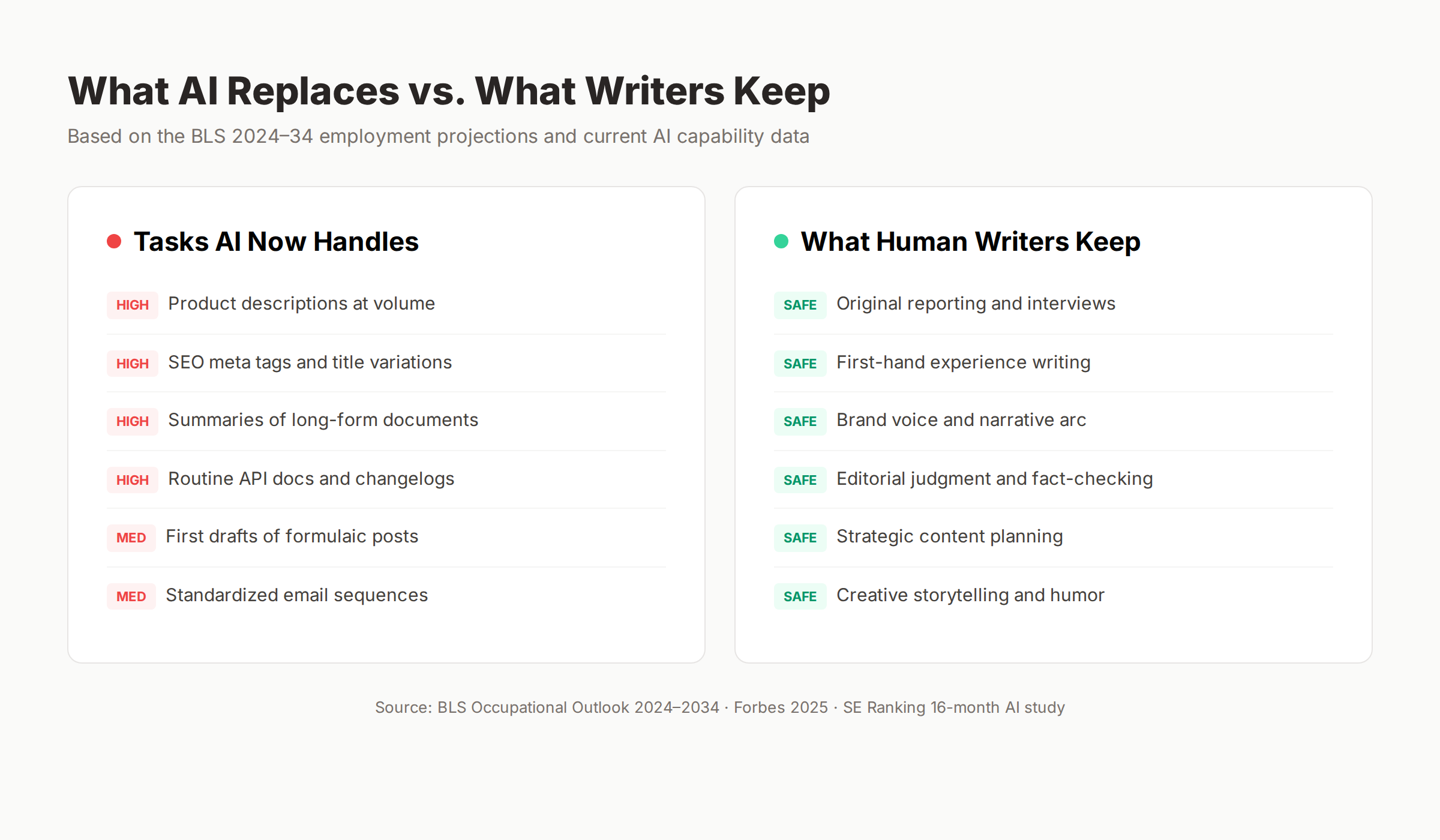
The pattern is consistent. AI excels at any writing work that has a known structure, predictable inputs, and limited need for original judgment. That covers a lot of what professional writing used to mean.
Why the Volume Tier Is Disappearing
A writer producing 30 product descriptions a day at $15 per description cannot compete with an AI that produces 30 product descriptions in 4 minutes at a marginal cost approaching zero. The math does not work. It will never work again.
This is not a temporary disruption. The volume tier is structurally obsolete. The agencies, marketplaces, and content mills that supplied this work are shifting to AI internally and laying off staff writers. Forbes reported in March 2025 that digital marketing writing jobs are expected to drop 50% by 2030, with the cuts concentrated in volume-tier roles.
The strategy here is brutal but clear. If your writing work could be replaced by a competent prompt and 20 seconds, AI will replace it. Plan accordingly.
Stop competing with AI. Start directing it. theStacc publishes 30 SEO-optimized articles per month for $99. Every post is AI-drafted, human-edited, and quality-checked before it goes live.
What AI Cannot Do (And Probably Will Not Soon)
The question "will AI replace writers" gets a different answer when you look at what AI fails at consistently. Six years of large language model development have made the failure modes clear.
AI cannot do original reporting. It cannot interview a source, attend an industry event, or run a customer survey. Every piece of original information that has not yet been published cannot be in the training data. Writers who produce original information remain irreplaceable.
AI cannot have first-hand experience. A language model has never run a restaurant, managed a plumbing crew, or negotiated a commercial lease. Google's E-E-A-T framework specifically weights experience-based content higher. Our analysis of AI versus human ranking studies shows AI-only content losing rankings within 90 days when it lacks experience signals.
AI cannot maintain a recognizable voice across thousands of pieces. It averages. Voice is what makes someone read a writer for years. AI produces competent prose that sounds like every other competent prose on the internet. The few brands with truly distinct voices use human writers or fine-tuned models with extensive human direction.
AI cannot exercise editorial judgment. Knowing what to cut is the single most undervalued writing skill in 2026. AI generates more. Editors decide what survives. The editing layer is the highest-paid part of professional writing right now.
AI cannot fact-check itself reliably. Hallucination rates dropped through 2024 and 2025 but never reached zero. Every AI-produced piece of content with stats, names, or claims needs human verification before publication. Skip this step and you get sued, fined, or de-ranked.
AI cannot create genuinely novel ideas. It interpolates between known concepts. The writers who get cited, quoted, and shared are the ones generating ideas that did not exist before. AI is a powerful research assistant for those writers. It is not a substitute for them.
The Capability Gap Will Persist
Will AI eventually handle these things? Maybe. The current architecture of large language models has limits on each of these capabilities. Improvements happen at the margin. Reporting, first-hand experience, and original judgment require something fundamentally different from next-token prediction.
For the foreseeable future through 2030, these gaps remain. Writers who specialize in them are not at risk. Writers who avoid them are.
The 6 Skills That Make Writers AI-Proof Through 2030
If you are a writer wondering how to survive, this is the section that matters. Six skills make writers AI-proof through at least 2030. Build any one of them deeply and your career compounds. Build all six and you become uncopyable.
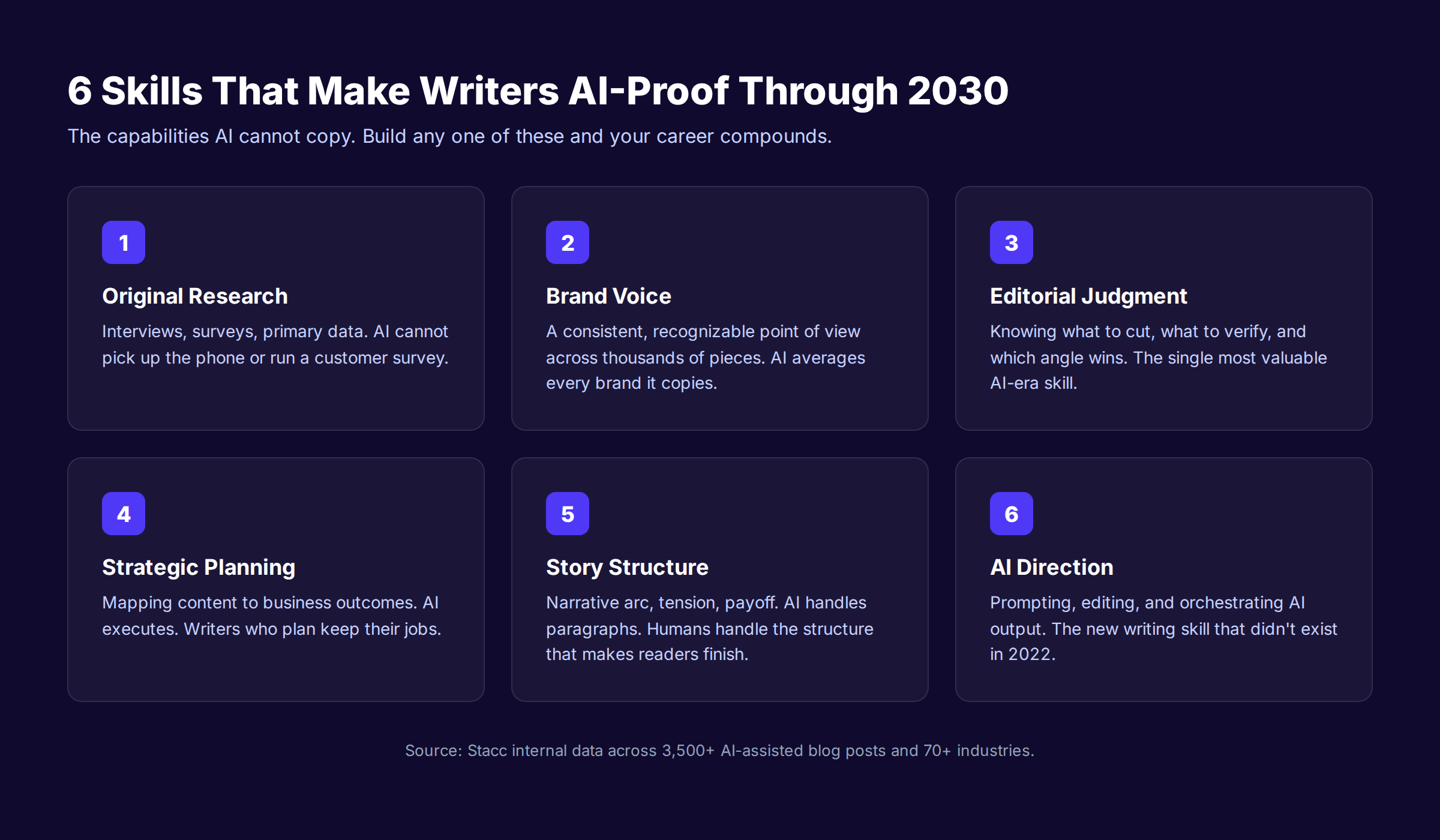
1. Original Research
Pick up the phone. Run a survey. Interview customers. Publish data nobody else has. This single skill protects more writing careers than every other tactic combined. We see this every day in our content workflows. The pieces that earn backlinks, get cited by competitors, and win AI Overview placements are the ones built on original data.
How to develop it: commit to one piece of original research per month. Survey 50 readers. Interview 5 customers. Pull internal data nobody has published. Make the data the headline.
2. Brand Voice
A consistent, recognizable point of view across thousands of pieces. AI averages every brand it copies. Humans can hold a voice that compounds over years. This skill is rare and increasingly valuable.
How to develop it: study one writer or brand you admire. Reverse-engineer their voice. Practice writing in different voices on demand. Build a brand voice document so detailed an AI cannot fake it.
3. Editorial Judgment
Knowing what to cut. Knowing which claim needs a source. Knowing which angle wins. The single most valuable AI-era skill. AI generates more. Editors decide what survives publication.
How to develop it: edit AI drafts to publication quality every day for 90 days. Read the theStacc humanize AI content guide. Track which cuts make pieces stronger. The pattern becomes intuition.
4. Strategic Content Planning
Mapping content to business outcomes. AI executes. Writers who plan keep their jobs because they sit closer to revenue. A strategist who briefs AI is worth ten writers who only write.
How to develop it: own one channel for one quarter. Set traffic, lead, or revenue goals. Plan the content. Measure the results. Iterate. This is exactly what our AI content strategy guide teaches.
5. Story Structure
Narrative arc, tension, payoff. AI handles paragraphs. Humans handle the structure that makes readers finish. Long-form writing that converts depends on structural choices AI does not make well.
How to develop it: study screenwriting and journalism structure. Read our content writing tips for the structural patterns that work. Practice plotting before drafting.
6. AI Direction
Prompting, editing, and orchestrating AI output. The new writing skill that did not exist in 2022. Writers who direct AI well produce 5 to 10 times more output without quality loss.
How to develop it: spend 2 hours a week building a personal prompt library. Test prompts against each other. Document what works for your specific use cases. Read our AI writing SEO guide for the prompting patterns that produce rankable content.
The Writer + AI Timeline: 2026 to 2030
Will AI replace writers gets a different answer depending on the year. Here is the realistic timeline for how writing work transforms over the next four years.
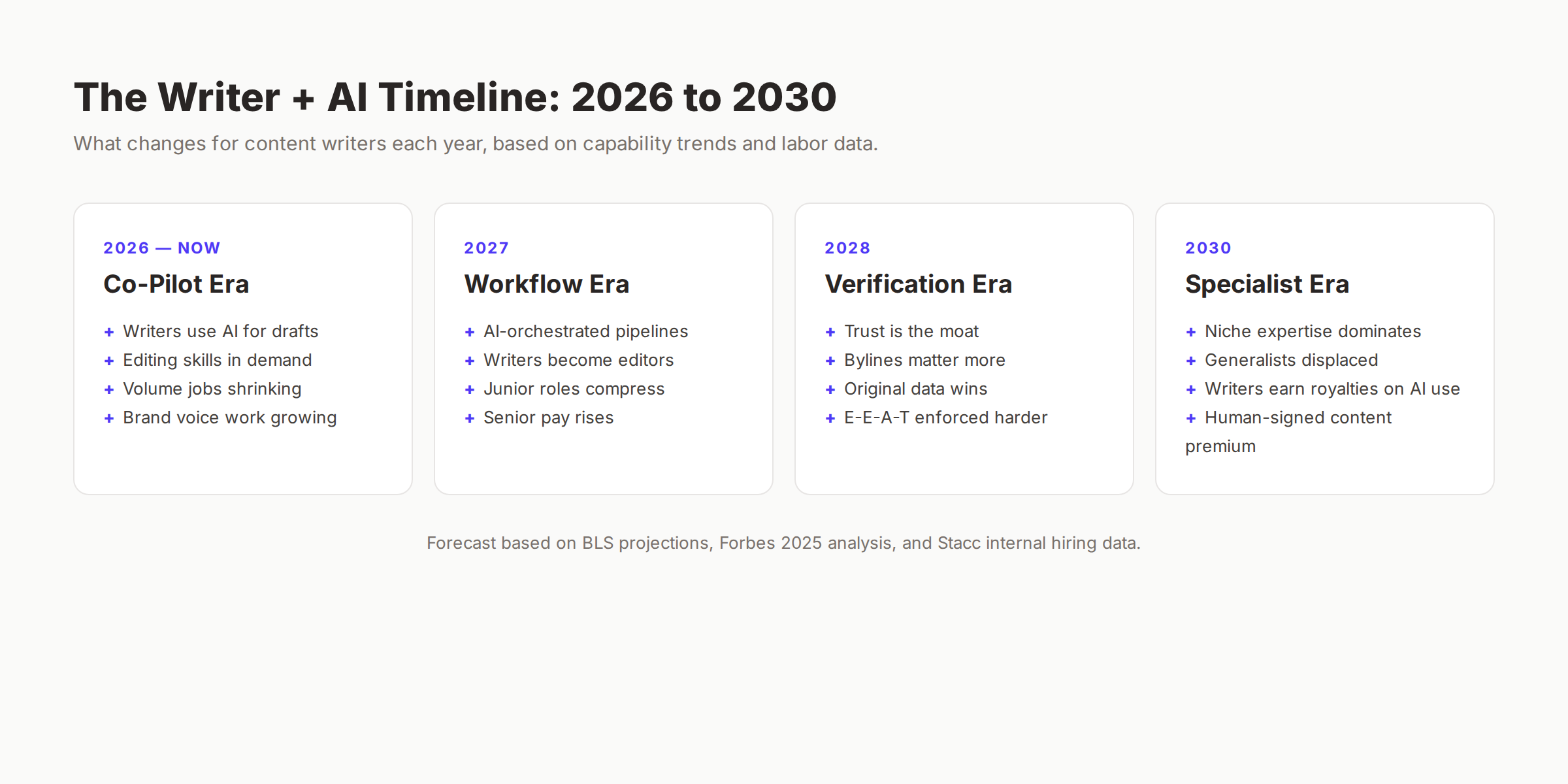
2026 — The Co-Pilot Era (Now)
Writers use AI for drafts. Editing skills are in heavy demand. Volume writing jobs are shrinking fast. Brand voice work is growing. Many writers still avoid AI publicly while using it privately. Pay is bifurcating: AI-resistant writers earn premium rates, volume writers earn less than 2023.
The opportunity is mastery of the new workflow. Writers who openly build AI skills now move ahead of writers who resist.
2027 — The Workflow Era
AI-orchestrated content pipelines become standard at every company over 50 employees. Writers shift from drafting to editing and prompt design. Junior writing roles compress further. Senior writer pay rises because editorial judgment becomes the bottleneck. Marketing teams hire fewer writers but pay each one more.
The opportunity is becoming the senior editor or content strategist who runs AI-augmented teams. The role exists at almost every mid-sized company by mid-2027.
2028 — The Verification Era
Trust becomes the moat. Bylines matter more, not less. Original data wins citations and rankings. Google enforces E-E-A-T signals harder. Publications without verifiable human authorship lose traffic. AI-only content gets flagged consistently in search results.
The opportunity is becoming a named, credible byline in a specific niche. Build a body of work nobody can replicate. Get cited by AI search engines as a primary source.
2030 — The Specialist Era
Niche expertise dominates. Generalists displaced by AI for routine work. Writers earn royalties on AI training and content reuse. Human-signed content commands a premium across every category. The "AI written" label becomes a negative signal in many markets.
The opportunity is owning a niche so deep that AI cannot compete on accuracy or insight. Vertical specialists earn senior software engineer salaries by 2030.
Which Writing Jobs Disappear First
Some writing jobs will not exist by 2030. Knowing which ones helps writers avoid dead-end positions. Here is the order of disappearance based on current AI capability and labor data.
| Writing Job | Disappearance Risk | Timeline |
|---|---|---|
| Product description writer | Very high | 2025–2026 (already happening) |
| Generic SEO listicle writer | Very high | 2025–2027 |
| Junior copywriter (volume) | High | 2026–2028 |
| Basic news rewriter / aggregator | High | 2026–2028 |
| Standardized technical writer | High | 2027–2029 |
| Junior B2B content writer | Moderate | 2027–2030 |
| Senior content strategist | Low | Growing through 2030 |
| Brand voice lead | Low | Growing through 2030 |
| Investigative journalist | Very low | Premium through 2030 |
| Niche subject matter expert | Very low | Premium through 2030 |
The pattern is consistent with the BLS data. Medical transcriptionist and customer service representative employment is projected to decline 4.7% and 5.0% respectively from 2023 to 2033. Both roles involve high-volume, low-judgment writing or text work. Writers in similar positions face similar pressure.
The safe path is up the value chain. Move from drafting to editing. Move from editing to strategy. Move from strategy to original research and named expertise. Each step makes you harder to replace.
AI handles the typing. theStacc handles the strategy. We brief, write, edit, and publish 30 SEO articles per month for $99 with full quality control. See how it works →
How Much Do AI-Augmented Writers Earn?
The compensation picture is the clearest signal about whether AI is replacing writers. Earnings tell you what the market actually values, not what people fear or hope.
The data shows clear bifurcation in 2026:
- Volume writers (product descriptions, generic listicles): $15 to $30 per article, down from $50 to $75 in 2023
- General freelance content writers: $100 to $300 per article, flat or slightly down
- AI-augmented content writers: $150 to $500 per article, up because they deliver faster
- Editorial leads with AI workflows: $80K to $160K salary, up 15 to 25%
- Specialist writers (legal, medical, financial): $300 to $1,500 per article, up
- Investigative journalists at major publications: stable, with AI tools accelerating research
The conclusion is clear. AI is not depressing writer pay across the board. AI is depressing pay for writing work AI does well. AI is increasing pay for writing work it cannot do.
Our internal hiring data at theStacc confirms this. We have raised our editor pay 20% since 2023 because editorial judgment on AI drafts is the bottleneck in production. Writers who edit AI well earn more than writers who only draft.
The Real Compensation Strategy
If you are a writer, your compensation strategy through 2030 is simple in concept and hard in execution. Build skills AI cannot copy. Get paid to direct AI. Own a niche.
Specifically:
- ✓ Choose one specialization with technical or experiential depth
- ✓ Build a public body of work in that niche over 12 months
- ✓ Master one AI-augmented workflow that doubles your output
- ✓ Develop one original research practice (surveys, interviews, data analysis)
- ✓ Position yourself as a senior editor or strategist, not a drafter
Writers who do these things see compensation rising. Writers who do not see compensation falling. The split is permanent.
Why 81.6% of Marketers Are Wrong About Full Replacement
A 2026 industry survey found 81.6% of digital marketers believe content writers will lose their jobs to AI. This is one of the most cited statistics in the debate. It is also misleading on its own.
The fear comes from a confusion between tasks and roles. Marketers see AI do specific writing tasks well and project full role replacement. The economic and labor data show something different.
The BLS 2025 analysis on AI's impact on jobs found very little evidence of artificial intelligence taking away jobs on a large scale, with the correlation between AI exposure and job decline remaining low. A separate study from the Dallas Fed in 2025 reached similar conclusions, finding that AI is unlikely to replace most jobs in the next decade.
Here is what the 81.6% statistic actually measures: marketer perception, not labor outcomes. Marketers are watching AI replace certain writing tasks they used to outsource. They are extrapolating to full role replacement. The extrapolation is wrong because:
- Writing roles include many tasks AI cannot do (judgment, voice, original research, fact-checking)
- AI increases demand for writing overall by reducing the cost of production
- New writing roles emerge (prompt designer, AI editor, content operations lead)
- Legal and brand risks of pure AI content keep human writers in the loop
The replacement narrative also ignores the supply side. Many people who do volume writing today were never going to make it a long-term career. They are leaving the field, not being replaced. The professional core of skilled writers remains stable in size and grows in compensation.
What Google Thinks About AI Writers
Google's position matters because it determines whether AI-only writing can compete on the open web. The answer in 2026 is that AI-only writing struggles to rank long-term while human-edited AI writing competes well.
Google has been explicit. Their official guidance states that appropriate use of AI or automation is not against their guidelines. The focus is on content quality, not production method.
What ranks consistently is content that demonstrates E-E-A-T (Experience, Expertise, Authoritativeness, Trustworthiness). AI content can fake expertise and authoritativeness if directed well. AI content struggles with experience and trustworthiness without human input. This is why our research on whether AI content ranks on Google found AI-only content losing rankings within 90 days.
The practical implication for writers is clear. AI-augmented writing wins SEO in 2026. Pure AI loses to E-E-A-T over time. Pure human is too slow to compete on volume. The writer who pairs AI speed with human experience signals owns the middle ground.
A 16-month SE Ranking experiment confirmed this. Purely AI-generated pages on new domains without editorial enhancement lost rankings fast. Pages combining AI production with human editing, original data, and proper E-E-A-T signals maintained or improved their positions. You can read the full analysis in our AI versus human content data study.
7 Myths About AI Replacing Writers, Debunked
Misinformation about AI and writing is everywhere. Here are the seven biggest myths and what the data actually shows.
Myth 1: "AI will replace 90% of writers by 2030"
The actual number from labor data is closer to 20 to 30% reduction in total writing jobs, concentrated in volume roles. Skilled and specialist writing is growing.
Myth 2: "Google penalizes AI content"
Google does not penalize content based on production method. Google penalizes thin, unhelpful, or inaccurate content. AI just makes it easier to produce thin content at scale.
Myth 3: "AI can do anything a writer can do"
AI cannot interview sources, run surveys, have first-hand experience, maintain consistent brand voice over years, or exercise editorial judgment reliably. These are 30 to 40% of professional writing work.
Myth 4: "Writers should refuse to use AI"
This is career suicide in 2026. Writers who use AI well produce 3 to 5 times more output at similar or higher quality. Refusing AI means being outcompeted by writers who use it.
Myth 5: "AI content can be detected reliably"
Detection tools are unreliable and getting worse. Major detection tools have false positive rates of 10 to 30% on human content. Google does not use them. Schools are abandoning them.
Myth 6: "All AI writing sounds the same"
Generic AI writing sounds the same. Directed AI writing with good prompts, brand voice documents, and editorial polish sounds distinct. The difference is the human in the loop.
Myth 7: "AI is just hype that will pass"
AI writing capabilities have improved consistently every 6 months since 2022. The trend is not slowing. Writers betting on AI being a fad are betting against five years of compounding evidence.
The 90-Day Plan to Become an AI-Resistant Writer
If you are a working writer and you want a concrete plan, here is the 90-day playbook based on what we have seen work for the writers we hire and partner with.
Days 1 to 30: Skill Audit and AI Setup
Audit your current work. List every type of writing you do. Categorize each as "AI can do this," "AI can help with this," or "AI cannot do this." This is your map.
Set up your AI workflow. Pick one primary model (Claude, GPT-5, Gemini). Build a personal prompt library. Practice prompting against your real work. Read the AI writing benchmarks to understand where each model excels.
Start building one AI-proof skill from the six listed above. Pick the one closest to your current work. Commit 5 hours per week to deliberate practice.
Days 31 to 60: Output and Specialization
Double your output using AI augmentation. Track speed and quality. The goal is producing more, not less, while quality stays equal or improves.
Choose your specialization. Pick a niche where you have or can build genuine expertise. Industries that pay well in 2026: legal, financial, medical, B2B SaaS, climate, and AI itself (meta, we know).
Publish at least 4 pieces of original research, opinion, or analysis in your specialization. Build the body of work that defines you in the niche.
Days 61 to 90: Positioning and Pricing
Rewrite your bio, portfolio, and outbound pitches around your new positioning. You are no longer "a content writer." You are "a [niche] specialist who pairs deep expertise with AI-augmented production."
Raise your rates. Writers who direct AI deliver more value and should charge accordingly. Volume rates are dying. Strategic rates are rising. Move yourself up.
Build one signature workflow that clients pay you to deliver. The workflow could be "monthly thought leadership pipeline for B2B SaaS founders" or "weekly market analysis for fintech investors." The workflow is your product. AI is your tool. Expertise is your moat.
After 90 days, you have an AI-resistant practice. Six months later, you have a body of work that compounds. By 2030, you are not asking will AI replace writers because you are running a specialist practice AI cannot touch.
What This Means for Companies Hiring Writers
If you run a company that hires content writers, the question changes. You are not asking will AI replace writers. You are asking which production model gives you the best content economics.
There are three viable models in 2026:
Model 1: Full in-house human writers. Expensive, slow, high quality if you hire well. Best for brands where voice is core to differentiation. Cost: $80K to $150K per writer per year, producing 2 to 4 articles per week.
Model 2: AI tools plus your existing team. Faster, cheaper, requires team training and editorial discipline. Quality depends entirely on your editing layer. Cost: $200 to $500 per month in tools plus existing labor.
Model 3: Done-for-you AI-augmented service. A managed service that handles drafting, editing, and publishing using AI plus human editors. Predictable cost. No team management overhead. Best for companies that need consistent volume without building a content team.
This is exactly what we built. theStacc publishes 30 SEO-optimized blog posts per month for $99 across 70+ industries. Every post is AI-drafted, human-edited, fact-checked, and SEO-optimized before it auto-publishes to WordPress, Webflow, or Ghost. You get the speed of AI with the quality of human editorial. The full economic logic is in our state of AI blog writing report.
For most small and mid-sized businesses, the done-for-you model wins on math. You spend more per article than pure AI and far less than full in-house. You get the human editorial layer that keeps you out of Google trouble. You skip the management overhead.
Stop asking "will AI replace writers." Start publishing. theStacc publishes 30 SEO articles per month for $99 with full AI-plus-human quality control.
What practitioners are saying on X
AI search advice ages quickly. Here is high-signal public discussion from SEO and growth operators — context for your roadmap, not a substitute for primary data.
- @jakezward (Feb 2026): 2026 SEO predictions emphasize AI Overview share-of-SERP, schema for LLM token efficiency, brand mentions in AI answers as a KPI, proprietary data as a moat, and content refresh beating net-new AI slop. See the post on X.
- @alexgroberman (Jul 2026): Case narrative: organic value plus multi-engine citations (ChatGPT, Perplexity, Grok) from knowledge-hub pages, category authority links, commercial intent content, and tight internal linking — not thin product copy. See the post on X.
- @varunram (Jul 2026): Critique of GEO slopfarm products that combine SEO clickbait with unresearched content marketing — quality and research still separate winners from farms. See the post on X.
Grok, AI Overviews, and multi-engine visibility
AI/search topics like “will ai replace writers” need multi-engine notes: AI Overviews, ChatGPT/Perplexity, and Grok. Lead with extractable answers; keep claims consistent with public expert discussion.
- Google AI Overviews: Use passage-ready answers, tables, and FAQ schema where relevant.
- ChatGPT / Perplexity: Cite named sources next to key claims.
- Grok: Maintain accurate entity facts on-site and in high-signal X posts.
Publish content built for Google and AI citations. theStacc’s Content SEO module ships SEO-scored articles structured for rankings and generative engines — including clearer entity pages models like Grok can quote.
Will AI Replace Writers FAQ
No. AI will replace specific writing tasks and eliminate certain low-end writing roles, but not the profession. Skilled writers, editors, strategists, and specialists are seeing demand and pay rise. The BLS projects only 1% growth in technical writing through 2034, but skilled content roles continue to grow.
Investigative journalism, niche subject matter expertise, brand voice leads, senior content strategists, editorial leads with AI workflows, and any writing job that requires original research or first-hand experience. These roles benefit from AI tools rather than competing with them.
No job is 100% safe from AI, including non-writing jobs. The writing roles closest to 100% safe involve original reporting, primary research, deep expertise, and human-only legal or medical authority. Specialist writers in regulated industries face the lowest replacement risk.
Yes, a brighter future for writers who adapt. AI-augmented writers earn more than pure-human or pure-AI competitors. The skill set is shifting from drafting to editing, prompting, strategy, and original research. Writers who build these skills see rising compensation through 2030.
You can publish AI-assisted books, but pure AI content has limited copyright protection under current U.S. law. The U.S. Copyright Office requires meaningful human authorship for copyright registration. Most successful AI-published books have substantial human editorial input. Disclosure requirements vary by platform.
AI-augmented writers earn 20 to 50% more than equivalent traditional writers in 2026, because they deliver more output at similar or higher quality. Volume writers earn 30 to 50% less than they did in 2023. The split is widening every quarter.
Yes, but specialize. Generalist content writing is a difficult career path. Specialist writing in a vertical you understand deeply is one of the highest-paid writing careers available. Pair AI fluency with niche expertise and you are in demand for the foreseeable future.
Three signals: your work has predictable structure, your work does not require original information, and your work can be evaluated by a non-expert. Three or three signals means high risk. Zero of three means very low risk. One or two means start adapting now.
The Bottom Line
Will AI replace writers? Not as a profession. AI will replace volume writing, eliminate certain roles, and dramatically reshape what professional writing means. The writers who adapt build careers that compound. The writers who resist watch the work dry up.
The pattern is the same as every prior technology disruption in writing. Word processors, the internet, content marketing, and now AI. Each shift killed certain roles and created bigger ones. The pattern repeats. The smart play is to bet on it.
For companies, the question is simpler. You need content. You can hire writers, hand them AI tools, and manage a team. You can build a pure AI pipeline and accept the quality and ranking penalties. Or you can use a managed service that handles drafting, editing, and publishing with both AI speed and human editorial quality. The math for most businesses points to the third option.
Whatever path you choose, the writers who win in 2026 are the ones who treat AI as the most powerful writing tool ever invented and use it accordingly. Will AI replace writers? Only the writers who refuse to learn it.
Related Tools & Resources
Free SEO Tools:
Best Lists:
Sources & references
- [1] Princeton / Georgia Tech et al. — GEO research (arXiv:2311.09735)
- [2] @jakezward on X — 2026 SEO predictions emphasize AI Overview share-of-SERP, schema for LLM token efficiency, brand mentions in AI answers
- [3] @alexgroberman on X — Case narrative: organic value plus multi-engine citations (ChatGPT, Perplexity, Grok) from knowledge-hub pages, category
- [4] @varunram on X — Critique of GEO slopfarm products that combine SEO clickbait with unresearched content marketing — quality and research
- [5] Referenced source — www.bcg.com

Plan topics, review article drafts, and publish to a connected CMS.
Weekly local SEO teardowns
One practical email a week. Map Pack, GBP, AI Overviews. No fluff. Unsubscribe anytime.