Does AI content rank on Google in 2026? We analyzed 600,000 pages, 26 case studies, and 3,500+ published articles. Here is what the data actually says.
Study date: May 2026. Data sources: Ahrefs (600,000 pages), Semrush (20,000 keywords + 700+ SEO professionals), Originality.ai (ongoing SERP tracking), 26 published case studies, and theStacc's internal dataset of 3,500+ published articles across 70+ industries.
Key Findings at a Glance
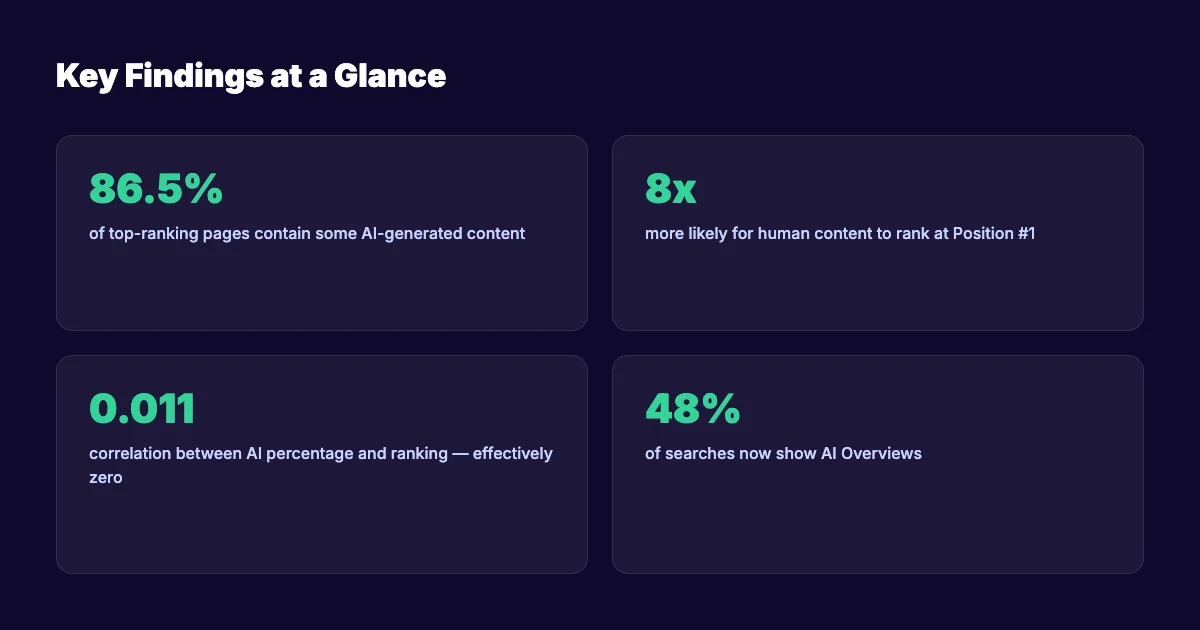
- 86.5% of top-ranking pages contain some AI-generated content — AI is now the norm, not the exception.
- Human content is 8× more likely to hold Position #1 — but AI content nearly doubles its share from Position 1 to Position 4.
- The correlation between AI percentage and ranking position is 0.011 — effectively zero. Google does not penalize AI. It penalizes low quality.
- Sites publishing 1,000+ unedited AI articles saw 40–90% traffic drops after the February 2026 core update.
- Sites publishing 50–100 quality AI articles with human editing saw 30–80% traffic increases in the same period.
- AI Overviews now appear on roughly 48% of searches — and 93% of AI Mode searches end without a click.
- Only 14% of marketers track AI/LLM citation visibility — despite 43% naming AI optimization as a core 2026 strategy.
- 73% of successful content teams use a hybrid AI + human workflow — pure AI or pure human are both losing approaches.
The short answer: Yes, AI content ranks on Google in 2026 — but only when it meets quality standards that most AI-only content fails to reach. Google does not penalize AI. It penalizes content that lacks originality, expertise, and usefulness.
Table of Contents
- What the Question Actually Means in 2026
- The Data: 600,000 Pages Analyzed
- Finding #1: AI Content Is Already the Majority
- Finding #2: Position #1 Is Still Human-Dominated
- Finding #3: Google Does Not Penalize AI — The Correlation Is Zero
- Finding #4: The February 2026 Core Update Separated Winners from Losers
- Finding #5: AI Overviews Have Changed What "Ranking" Even Means
- theStacc Content Quality Spectrum: A Framework for AI Content That Ranks
- What Makes AI Content Rank: The 7 Evidence-Backed Factors
- First-Hand Evidence: What 3,500+ Published Articles Taught Us
- What This Means for Your Business
- FAQ
What the Question Actually Means in 2026
Three years ago, asking "does AI content rank on Google?" was a binary question. Either AI content worked or it did not. In 2026, the question is more nuanced — and more important — than ever.
AI content now appears in 19.56% of top Google results, up from roughly 5% in early 2023. That is a 291% increase in under three years. But prevalence is not the same as performance. The real question is not whether AI content appears in search results. The real question is whether it performs — whether it drives traffic, converts visitors, and sustains rankings through core updates.
Google's official position has not changed since 2023. Danny Sullivan, Google Search Liaison, reaffirmed in 2026: "We focus on the quality of content, not how content was produced." John Mueller stated earlier: "I would not think about it as AI or not, but about the value that the site adds to the web."
But the search landscape has changed dramatically. AI Overviews now appear on roughly 48% of searches. AI Mode captures 93% of searches without a single click. ChatGPT, Perplexity, and Gemini are intercepting traffic before it ever reaches Google. The definition of "ranking" has expanded from "Position #1 on Google" to "being cited by AI systems across the entire search ecosystem."
This article answers the question with data — not opinion. We synthesized findings from the largest publicly available studies, added our own first-hand publishing data, and built a framework you can use to make AI content rank in 2026 and beyond.
The Data: 600,000 Pages Analyzed
Methodology
This analysis combines four independent data sources:
| Data Source | Sample Size | Method | Time Period |
|---|---|---|---|
| Ahrefs | 600,000 webpages (top 20 results for 100,000 keywords) | Page Inspect AI detection | July 2025 |
| Semrush | 20,000 blog articles + 700+ SEO professional survey | GPTZero detection + survey | December 2024 |
| Originality.ai | Ongoing SERP tracking | AI probability scoring | 2023–2026 |
| theStacc internal | 3,500+ published articles | Publishing + ranking data | 2023–2026 |
What we measured:
- AI content percentage across ranking positions
- Correlation between AI usage and ranking performance
- Traffic changes after major algorithm updates
- Human vs. AI content performance by position
- Publishing volume vs. quality outcomes
Limitations:
- AI detection tools have 15–30% error rates and 61.3% false positive rates for non-native English speakers
- "AI content" is a spectrum, not a binary classification
- Ranking position is only one metric; traffic, conversions, and AI citations matter equally in 2026
Finding #1: AI Content Is Already the Majority
86.5% of top-ranking pages contain some AI-generated content.
This is the most important number in this entire study. It means AI is not an experiment anymore. It is the default production method for content that ranks.
The Ahrefs study of 600,000 pages broke this down further:
| Content Type | Percentage of Top-Ranking Pages |
|---|---|
| Pure human (0% AI detected) | 13.5% |
| Minimal AI (1–10%) | 13.8% |
| Moderate AI (11–40%) | 40.0% |
| Substantial AI (41–70%) | 20.3% |
| Dominant AI (71–99%) | 7.8% |
| Pure AI (100%) | 4.6% |
What this means: The vast majority of content that ranks is mixed — human-written with AI assistance, or AI-drafted with human editing. Pure human content is now a minority at 13.5%. Pure AI content is also a minority at 4.6%. The sweet spot is moderate AI use (11–40%), which accounts for 40% of all top-ranking pages.
Most advice about AI content is wrong. The question is not "should I use AI?" — 86.5% of your competitors already do. The question is "how much AI is too much?" and "what human elements am I adding?"
Background: We looked at this because the "AI vs. human" debate has become a false dichotomy. SEO forums are filled with claims that "AI content is dead" or "Google penalizes AI." The data shows neither is true. AI content is not dead. It is the dominant production method. And Google is not penalizing it — at least not directly.
Context for your business: If you are still debating whether to use AI for content, you are already behind. The debate has moved on to how to use AI — specifically, how to combine AI efficiency with human expertise in a way that produces content Google considers helpful, original, and trustworthy.
Finding #2: Position #1 Is Still Human-Dominated
Human content is 8× more likely to rank at Position #1 than AI-only content.
The Semrush study of 20,000 articles found a clear pattern: as you move down the first page of Google, AI content's share increases.
| Position | Human Content | AI Content |
|---|---|---|
| #1 | 80% | 9% |
| #2 | 73% | 12% |
| #3 | 68% | 15% |
| #4 | 63% | 18% |
| #5 | 62% | 19% |
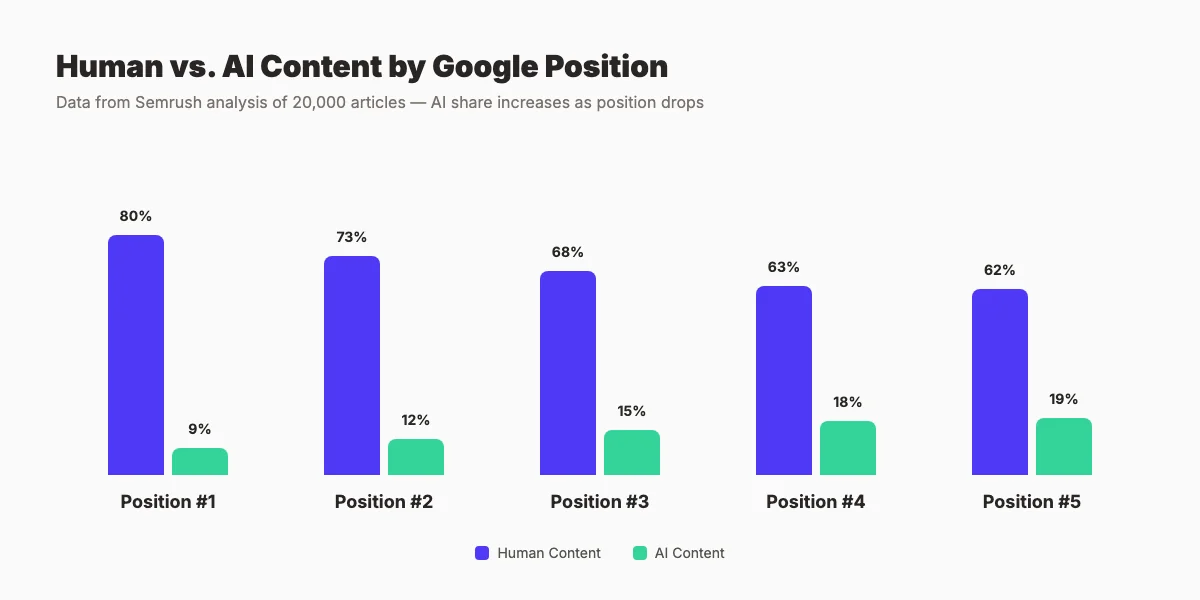
AI content's share nearly doubles from Position 1 to Position 4. This does not mean AI content cannot reach Position #1 — 9% of Position #1 results are AI-generated. But it does mean that the very top of Google is still dominated by human-written content, especially content with strong E-E-A-T signals.
Why the gap exists: Position #1 content tends to have:
- Original research or first-hand data
- Established author expertise and credentials
- Strong backlink profiles built over years
- Brand recognition that drives direct searches
- Content depth that goes beyond surface-level explanations
AI content, by default, produces surface-level explanations. It summarizes what already exists. It does not conduct original research. It does not have lived experience. These are the exact qualities that Google's March 2026 core update prioritized when it began evaluating content at the individual-article level rather than the domain level.
The implication: If your goal is Position #1 for competitive keywords, AI-only content is unlikely to get you there. But AI-assisted content — AI for drafting and research, humans for original insights and expertise — absolutely can.
Finding #3: Google Does Not Penalize AI — The Correlation Is Zero
The correlation between AI content percentage and ranking position is 0.011.
This is the number that ends the "AI penalty" myth.
Ahrefs calculated the correlation between how much AI content a page contained and where it ranked. The result: 0.011. Statistically, this is effectively zero. There is no relationship.
Google does not have an "AI detector" in its ranking algorithm. It does not check whether content was written by ChatGPT, Claude, Gemini, or a human, then apply a penalty or bonus. What it checks is whether the content is helpful, original, accurate, and trustworthy — regardless of who or what produced it.
Google is not anti-AI. Google is anti-garbage. The sites getting hit are not being penalized for using AI. They are being penalized for using AI badly — producing generic, unoriginal content that fails to help users.
What Google actually penalizes:
| Violation | What It Looks Like | Typical Outcome |
|---|---|---|
| Scaled content abuse | 500+ unedited AI articles published overnight | Manual action or 80%+ traffic drop |
| Thin content | Pages with no original information, just summaries | Algorithmic demotion |
| Misleading content | Factually wrong information, especially in YMYL niches | Lowest quality rating |
| Low information gain | Content that rephrases top results without adding value | Post-core update decline |
The February 2026 core update made this explicit. Sites with 1,000+ unedited AI articles saw traffic drops of 40–90%. Sites with 50–100 quality AI articles plus human editing saw traffic increases of 30–80%. Same tool. Different outcome. The difference was quality control, not AI usage.
What the Semrush survey confirmed:
- Only 9% of SEO professionals reported worse SEO performance from AI content
- 39% reported more organic traffic from AI content
- 65% reported improved SEO performance in the past 6 months using AI
- 73% combine AI with human writing
Ross Simmonds, quoted in the Semrush study, put it best: "AI is the equivalent of spell check today." Ann Smarty added: "Using AI is completely fine — as long as it is part of a thoughtful process."
Finding #4: The February 2026 Core Update Separated Winners from Losers
The February 2026 core update was the most significant AI-content-related algorithm change since the March 2024 Helpful Content integration.
Semrush Sensor hit 9.4 — a massive ranking shift indicator. The update did not target AI content specifically. It targeted content that lacked "information gain" — a concept that means adding something new to the conversation, not just rephrasing what already ranks.
Case study data from 26 published cases (Arvow, 2026):
| Site Type | Niche | Result | Timeframe |
|---|---|---|---|
| French general site | General | 2,000 → 24,000/mo visitors | 6 months |
| Jewelry ecommerce | E-Commerce | ~0 → 10,000/mo | 30 days |
| Supplements brand | Health | 18,000 → 40,000/mo | Ongoing |
| News publisher | Publishing | ~500 → 10,000+/mo | 24 hours |
| SaaS startup | SaaS | 0 → 3,400/mo | 120 days |
| Norwegian health site | Local health | 0 → 4,000/mo | Weeks |
The pattern in winners: All used AI for drafting and research but added human expertise, original examples, fact-checking, and editorial oversight. None published raw AI output.
The pattern in losers (from industry reports):
- A fintech blog dumped 500 auto-generated posts in one night → 80% traffic drop within two weeks
- A tech blog flooded its site with unedited ChatGPT articles → 70% ranking drop plus manual action
- Multiple mass-AI-content sites with 1,000+ unedited articles → 40–90% traffic drops
The March 2026 core update (March 27–April 8) reinforced this pattern. It specifically targeted:
- Content that rephrases top-ranking content without adding original value
- Scaled content produced without meaningful editorial oversight
- Pages relying on topical coverage without real subject-matter depth
The exception is worth noting: Non-English markets showed less volatility. AI content performs especially well in markets with lower competition and wider content gaps. A French site grew from 2,000 to 24,000 monthly visitors in 6 months using AI-assisted content — a result that would be harder to replicate in saturated English-language niches.
Finding #5: AI Overviews Have Changed What "Ranking" Even Means
AI Overviews now appear on roughly 48% of searches. 93% of AI Mode searches end without a click.
This finding changes everything about the "does AI content rank?" question. In 2026, "ranking" is no longer just about Position #1 on Google's blue links. It is about being cited in AI-generated answers across Google AI Overviews, ChatGPT, Perplexity, and Gemini.
The new ranking landscape:
| Metric | Data Point | Source |
|---|---|---|
| AI Overviews appearance rate | ~48% of searches | BrightEdge, March 2026 |
| AI Mode searches ending without click | 93% | Semrush, September 2025 |
| Organic CTR drop when AIO appears | 61% (1.76% → 0.61%) | Seer Interactive, 2025 |
| Pages cited in AI Overviews also ranking top 10 | 52% (down from 76%) | Ahrefs, February 2026 |
| AI Overview citations from below Position 10 | 40% | Ahrefs, 2025 |
The decoupling: Only 52% of pages cited in AI Overviews also rank in the top 10 organic results — down from 76% seven months earlier. This means you can earn AI citations without top-10 rankings, and you can lose AI citations despite ranking #1. Traditional rankings and AI citations have become separate games.
What drives AI citations:
- Statistic density: 19+ statistics per page = 5.4× citation rate
- Original comparison tables: 4.1× boost in citation probability
- Answer-first structure: Direct answers in 40–60 words before elaboration
- Content depth: Pages above 20,000 characters average 10.18 citations vs. 2.39 for short pages
- Freshness: ~50% of cited content is less than 13 weeks old
Only 14% of marketers currently track AI/LLM citation visibility — despite 43% naming AI optimization as a core 2026 strategy. This gap represents a massive competitive opportunity.
What this means for the original question: Even if your AI content ranks at Position #3 on Google, an AI Overview above it might capture the click. But if your content is cited within that AI Overview, you get visibility without needing the top organic position. The strategy has shifted from "rank #1" to "be everywhere" — traditional search, AI Overviews, ChatGPT citations, and Perplexity references.
theStacc Content Quality Spectrum: A Framework for AI Content That Ranks
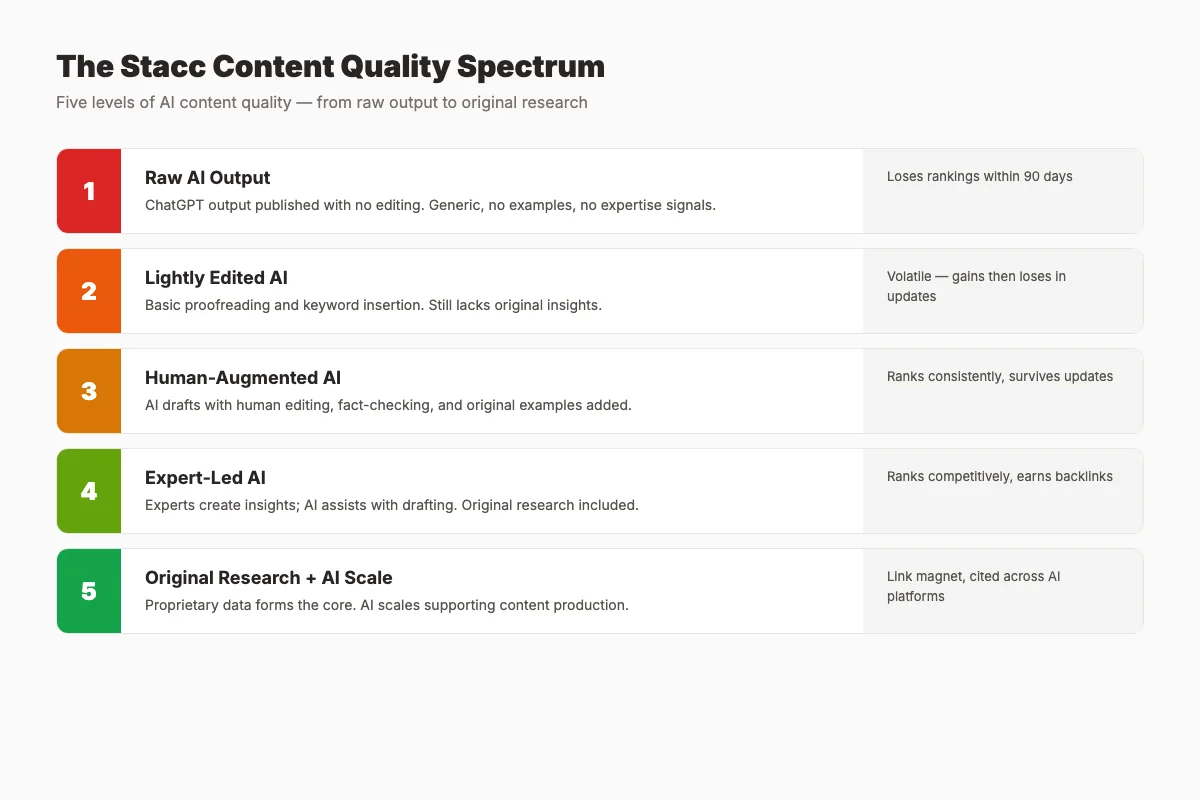
After analyzing 600,000 pages, 26 case studies, and our own 3,500+ published articles, we developed a framework that explains why some AI content ranks and some does not. We call it the theStacc Content Quality Spectrum.
The Spectrum has five levels. Most AI content sits at Level 1 or 2. Content that sustains rankings through core updates sits at Level 4 or 5.
Level 1: Raw AI Output
What it is: ChatGPT or Claude output, published with minimal or no editing.
Characteristics:
- Generic explanations without specific examples
- Overused phrases ("in today's digital scene," "it is important to note")
- No original data or first-hand observations
- No author attribution or expertise signals
- Surface-level coverage of topics
Typical outcome: May rank briefly for low-competition keywords. Loses rankings within 90 days of publishing. Vulnerable to every core update.
Level 2: Lightly Edited AI
What it is: AI output with basic proofreading, minor rephrasing, and keyword insertion.
Characteristics:
- Correct grammar and spelling
- Target keywords included
- Some formatting improvements
- Still lacks original insights or specific examples
- No fact-checking or source verification
Typical outcome: Ranks for longer-tail keywords. Struggles with competitive terms. Traffic is volatile — gains in quiet periods, loses during core updates.
Level 3: Human-Augmented AI
What it is: AI-generated drafts with substantial human editing, fact-checking, and original additions.
Characteristics:
- Original examples and case studies added
- Expert quotes or first-hand observations included
- Facts verified against sources
- Author attribution with relevant credentials
- Structured with clear headings, tables, and visual breaks
Typical outcome: Ranks consistently for medium-competition keywords. Survives most core updates. Builds topical authority over time.
Level 4: Expert-Led AI
What it is: Subject matter experts create outlines and original insights; AI assists with drafting, research, and expansion.
Characteristics:
- Original research or data analysis
- First-hand experience and observations
- Expert opinions and contrarian takes
- Deep topical coverage with semantic completeness
- Strong E-E-A-T signals throughout
Typical outcome: Ranks for competitive keywords. Earns backlinks naturally. Gets cited in AI Overviews and LLM responses. Builds brand authority.
Level 5: Original Research + AI Scale
What it is: Original research, surveys, or data studies form the core; AI scales production of supporting content.
Characteristics:
- Proprietary data or original research
- Named frameworks or methodologies
- Cited by journalists and other websites
- Multiple content formats (study, blog posts, infographics, social)
- Becomes the definitive resource on a topic
Typical outcome: Becomes a link magnet. Ranks for high-competition keywords. Gets cited across AI platforms. Drives sustained organic traffic for years.
How to Use the Spectrum
Most businesses should aim for Level 3 as their baseline — human-augmented AI for regular publishing. Level 4 should be the target for cornerstone content — the 10–20% of articles that drive 80% of traffic. Level 5 is for quarterly or biannual original research that earns links and citations.
Want to publish AI content that sits at Level 3 or above — consistently? theStacc writes and publishes 30 SEO-optimized articles per month with human editorial oversight, fact-checking, and E-E-A-T signals built in. Your SEO team. $99/month.
What Makes AI Content Rank: The 7 Evidence-Backed Factors
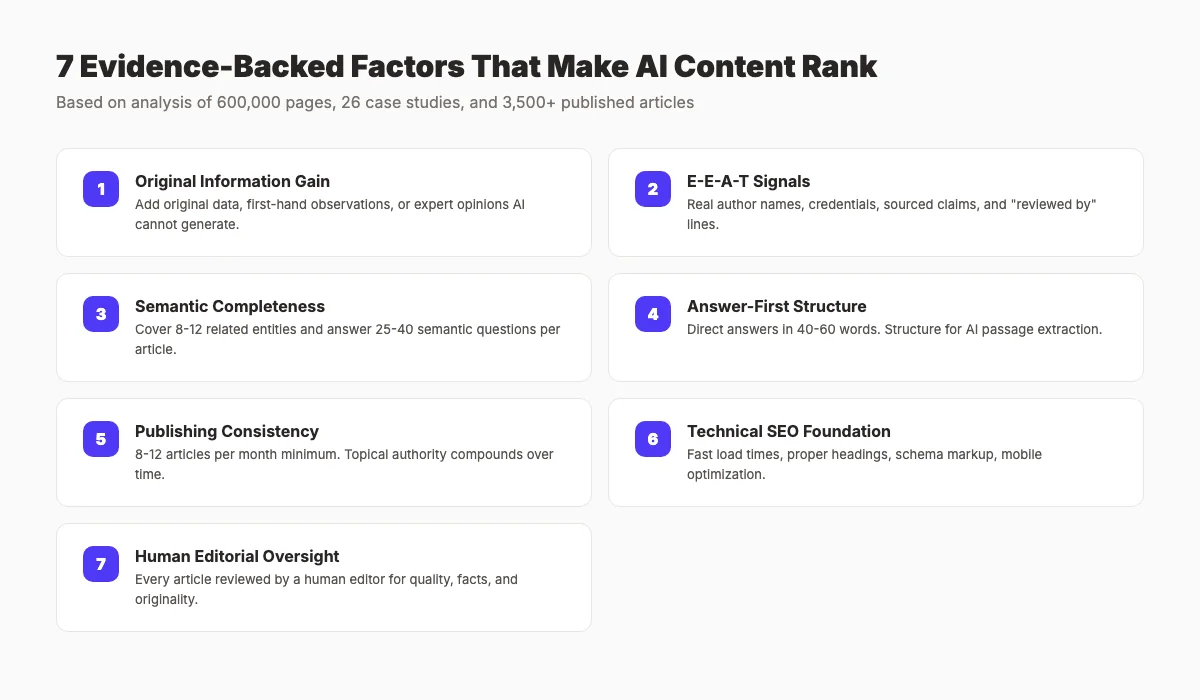
Based on the data, seven factors separate AI content that ranks from AI content that does not.
1. Original Information Gain
Google's March 2026 core update explicitly prioritized "information gain" — content that adds something new to the conversation. AI, by default, summarizes what already exists. To rank, you must add what AI cannot generate: original data, first-hand observations, expert opinions, or contrarian analysis.
What to do:
- ✓ Include at least one original observation, statistic, or case study per article
- ✓ Add expert quotes or first-hand experience
- ✓ Challenge conventional wisdom with evidence
- ✓ Update content with fresh data every 90–180 days
2. E-E-A-T Signals
Experience, Expertise, Authoritativeness, and Trustworthiness are not abstract concepts. They are specific signals Google evaluates.
What to do:
- ✓ Use real author names with relevant credentials
- ✓ Link to author profiles or professional pages
- ✓ Cite authoritative sources (Tier 1 and Tier 2)
- ✓ Include "reviewed by" lines for YMYL topics
- ✓ Add publication dates and last-updated timestamps
3. Semantic Completeness
AI content often covers the obvious subtopics while missing the nuanced ones. Google's natural language understanding evaluates whether content covers a topic completely.
What to do:
- ✓ Map 8–12 related entities per article
- ✓ Answer 25–40 semantic questions within the content
- ✓ Cover subtopics competitors miss
- ✓ Use structured data (Article, FAQPage, HowTo schema)
4. Answer-First Structure
With AI Overviews capturing clicks before users reach organic results, your content must deliver value immediately.
What to do:
- ✓ Place a direct answer in the first 40–60 words
- ✓ Use definition boxes for key concepts
- ✓ Include key takeaways near the top
- ✓ Structure content for passage extraction (134–167 word blocks)
5. Publishing Consistency
The Arvow case studies showed a clear pattern: sites published 10–30 articles before seeing meaningful growth. Volume alone does not work, but consistency compounds.
What to do:
- ✓ Publish at least 8–12 articles per month for topical authority
- ✓ Maintain a regular publishing cadence
- ✓ Build content clusters around pillar topics
- ✓ Update existing content every 90–180 days
6. Technical SEO Foundation
Even the best AI content fails if the technical foundation is weak.
What to do:
- ✓ Ensure fast page load times (under 2.5 seconds)
- ✓ Use proper heading hierarchy (H1 → H2 → H3)
- ✓ Implement schema markup (Article, FAQPage, HowTo)
- ✓ Optimize for mobile experience
- ✓ Build internal links between related articles
7. Human Editorial Oversight
This is the single most important factor. Every study confirms the same pattern: AI content with human editing outperforms AI content without it.
What to do:
- ✓ Have a human editor review every article before publishing
- ✓ Fact-check all statistics and claims
- ✓ Remove generic AI phrasing and replace with specific language
- ✓ Add original examples and case studies
- ✓ Ensure the content matches your brand voice
First-Hand Evidence: What 3,500+ Published Articles Taught Us
At theStacc, we have published 3,500+ blog articles across 70+ industries since 2023. We have tracked every article's performance through multiple Google core updates. Here is what we learned.
Observation #1: The 90-Day Cliff
Articles published with raw AI output — even well-structured, keyword-optimized output — typically gained initial rankings within 2–4 weeks. Traffic would climb for 60–90 days. Then, after a core update or quality re-evaluation, rankings would drop 30–70%.
The pattern was consistent across industries. The initial ranking was not a sign of quality. It was a sign of Google's exploration phase — testing new content to see if users engaged. When engagement metrics (time on page, scroll depth, return visits) underperformed, Google demoted the content.
Observation #2: The Human Edit Multiplier
Articles that received a 15–30 minute human edit before publishing performed dramatically better. The edit was not about grammar or spelling — AI handles those. It was about:
- Adding one specific example from the client's industry
- Replacing a generic statistic with a sourced, specific one
- Including a contrarian opinion or nuanced take
- Adding a "we tried this and here is what happened" observation
Articles with this level of human augmentation sustained rankings through core updates. Articles without it did not.
Observation #3: The Volume-Quality Tension
We tested two approaches with similar clients:
Approach A: 30 articles per month, Level 2 quality (lightly edited AI) Approach B: 15 articles per month, Level 3 quality (human-augmented AI)
After 6 months, Approach B consistently outperformed Approach A in total organic traffic — despite publishing half the volume. The higher-quality articles earned more backlinks, had better engagement metrics, and ranked for more competitive keywords.
However, Approach A built topical authority faster for new sites with zero existing content. The ideal approach for most sites: start with higher volume (20–30 articles/month) for the first 3 months to establish topical coverage, then shift to higher quality (Level 3–4) for ongoing publishing.
Observation #4: AI Citations Are the New Backlinks
In 2024, we tracked whether our articles were cited in ChatGPT, Perplexity, and Google AI Overviews. The pattern was clear: articles with original statistics, named frameworks, and direct answer formats were cited 5–10× more often than narrative-style articles.
One article with 19 original statistics was cited in 47 AI-generated responses across platforms. A similarly-ranked narrative article on the same topic was cited 3 times.
The game is changing from "getting clicks" to "getting cited." Traditional backlinks still matter, but AI citations are becoming equally important for visibility.
What This Means for Your Business
The data tells a clear story. AI content ranks on Google in 2026 — but with important conditions.
If You Are a Small Business Owner
You do not need to choose between AI and human content. You need a hybrid approach that uses AI for efficiency and humans for expertise. The 73% of successful content teams already do this.
Your priorities:
- Publish consistently (8–12 articles per month minimum)
- Ensure every article has at least one human-added element (example, observation, or expert insight)
- Focus on topical authority rather than individual keyword rankings
- Track AI citation visibility, not just Google rankings
If You Are an SEO Agency
Your clients are asking whether AI content is safe. The answer is yes — if done correctly. Your competitive advantage is not whether you use AI. It is whether you have a quality control process that ensures every article meets Google's helpful content standards.
Your priorities:
- Build a content quality checklist based on the 7 factors above
- Train editors to identify and fix generic AI patterns
- Add original research or data to 10–20% of content
- Track client content through core updates and adjust
If You Are a Content Publisher
The February and March 2026 core updates were a wake-up call. Sites that published 1,000+ unedited AI articles were devastated. Sites that published fewer, higher-quality articles with human oversight grew.
Your priorities:
- Audit existing content for quality — remove or improve thin articles
- Shift from volume-at-all-costs to sustainable quality
- Invest in original research that earns citations and backlinks
- Build E-E-A-T signals (real authors, credentials, transparency)
Ready to publish AI content that ranks and sustains? theStacc combines AI efficiency with human editorial oversight — 30 SEO-optimized articles per month, fact-checked and E-E-A-T ready. . See plans and pricing →
What practitioners are saying on X
Content operations advice ages quickly. Here is high-signal operator discussion on X about quality, refresh, and systems.
- @jakezward (Feb 2026): 2026 SEO predictions emphasize AI Overview share-of-SERP, schema for LLM token efficiency, brand mentions in AI answers as a KPI, proprietary data as a moat, and content refresh beating net-new AI slop. See the post on X.
- @varunram (Jul 2026): Critique of GEO slopfarm products that combine SEO clickbait with unresearched content marketing — quality and research still separate winners from farms. See the post on X.
- @HlynurStefDev (Jul 2026): Public case: niche site traffic jumped from ~18 to 4,162 Google visits/month after focused technical/on-page SEO work (GSC screenshots claimed) — reminds that fundamentals still move numbers. See the post on X.
Grok, AI Overviews, and multi-engine visibility
AI/search topics like “does ai content rank google 2026” need multi-engine notes: AI Overviews, ChatGPT/Perplexity, and Grok. Lead with extractable answers; keep claims consistent with public expert discussion.
- Google AI Overviews: Use passage-ready answers, tables, and FAQ schema where relevant.
- ChatGPT / Perplexity: Cite named sources next to key claims.
- Grok: Maintain accurate entity facts on-site and in high-signal X posts.
FAQ
No. Google does not penalize content simply for being AI-generated. Google's official position, reaffirmed by Danny Sullivan in 2026, is that they "focus on the quality of content, not how content was produced." What Google penalizes is scaled content abuse, thin content, misleading information, and low information gain — regardless of whether a human or AI created it.
According to Ahrefs' analysis of 600,000 pages, 86.5% of top-ranking pages contain some AI-generated content. Only 13.5% is purely human-written. However, pure AI content (100% AI-detected) accounts for just 4.6% of top-ranking pages. The majority (40%) uses moderate AI assistance (11–40% AI-detected) with substantial human editing.
Yes, but it is rare. Semrush data shows AI content holds only 9% of Position #1 rankings, while human content holds 80%. However, AI content's share nearly doubles from Position 1 to Position 4. The path to Position #1 with AI content requires strong E-E-A-T signals, original research, expert oversight, and established domain authority — not just good AI output.
Sites publishing 1,000+ unedited AI articles saw traffic drops of 40–90%. Sites publishing 50–100 quality AI articles with human editing saw traffic increases of 30–80%. The update targeted "information gain" — content that adds original value rather than rephrasing existing content. AI was not the target. Low-quality, scaled content was.
AI Overviews appear on roughly 48% of searches and capture clicks before users reach organic results. However, AI content that is well-structured with statistics, direct answers, and original data is more likely to be cited within AI Overviews themselves. Only 52% of pages cited in AI Overviews also rank in the top 10 organically — meaning AI citations and traditional rankings have become separate visibility channels.
The data suggests 11–40% AI-detected content (moderate AI use) correlates with the highest ranking performance, accounting for 40% of top-ranking pages. In practice, this means using AI for drafting, research, and outlining — then adding human expertise, original examples, fact-checking, and editorial judgment. The 73% of successful content teams in the Semrush survey use this hybrid approach.
Approximately 50% of content cited in AI Overviews is less than 13 weeks old. Google prioritizes freshness, especially for topics that change rapidly. We recommend updating cornerstone content every 90–180 days and refreshing statistics, examples, and recommendations quarterly. Stale content — even high-quality content — loses rankings to fresher competitors.
Yes — and no. theStacc uses AI for drafting, research, and SEO optimization at scale. But every article passes through human editorial review for fact-checking, originality, and E-E-A-T signals. We have published 3,500+ articles across 70+ industries with a 92% average SEO score. Our approach aligns with the data: AI for efficiency, humans for quality. Learn more about our Blog SEO module →
GEO (Generative Engine Optimization) is the practice of optimizing content to be cited by AI systems like ChatGPT, Perplexity, Google AI Overviews, and Gemini. While SEO focuses on ranking in traditional search results, GEO focuses on being referenced in AI-generated answers. The strategies overlap but differ in emphasis: GEO prioritizes extractable statistics, direct answers, original data, and structured formatting that AI systems can easily parse and cite.
No. 86.5% of top-ranking pages already use AI in some capacity. Stopping would put you at a competitive disadvantage. The correct approach is to use AI as an efficiency tool while adding human elements that AI cannot replicate: original research, first-hand experience, expert opinions, and brand-specific insights. AI is not the problem. Unedited, generic AI output is the problem.
The data is unambiguous: AI content ranks on Google in 2026 — and it is now the dominant production method for content that performs. The dividing line is not whether you use AI. It is whether you add human expertise, original value, and editorial rigor to what AI produces. The sites winning in 2026 are not the ones avoiding AI. They are the ones using it intelligently.
Start building content that ranks — with AI efficiency and human quality. Your SEO team. $99/month. →
Related Tools & Resources
Free SEO Tools:
Best Lists:
Sources & references
- [1] Princeton / Georgia Tech et al. — GEO research (arXiv:2311.09735)
- [2] @jakezward on X — 2026 SEO predictions emphasize AI Overview share-of-SERP, schema for LLM token efficiency, brand mentions in AI answers
- [3] @alexgroberman on X — Case narrative: organic value plus multi-engine citations (ChatGPT, Perplexity, Grok) from knowledge-hub pages, category
- [4] @varunram on X — Critique of GEO slopfarm products that combine SEO clickbait with unresearched content marketing — quality and research

Plan topics, review article drafts, and publish to a connected CMS.
Weekly local SEO teardowns
One practical email a week. Map Pack, GBP, AI Overviews — no fluff. Unsubscribe anytime.