How to hire content writers who produce quality work on the first draft. Vetting tests, real 2026 rate ranges, red flags, and a 6-step process.
Most businesses that hire content writers end up disappointed within the first 30 days. The drafts read like Wikipedia stubs. The rankings never come. The invoices keep arriving. You replace the writer, pay another retainer, and the cycle repeats.
This is not a writer-supply problem. It is a hiring-process problem.
Hiring content writers for quality is a system. Skip a step and you pay for it later in revisions, missed deadlines, or a blog that nobody reads. Run the system and you find writers who beat your in-house drafts on their first week.
We publish 3,500+ blog posts across 70+ industries with a 92% average SEO score. We have hired, fired, trained, and replaced hundreds of writers. Most of what gets repeated online about hiring content writers is wrong. The "ask for samples" advice fails. The "use Upwork" advice fails. The "pay top dollar" advice fails too.
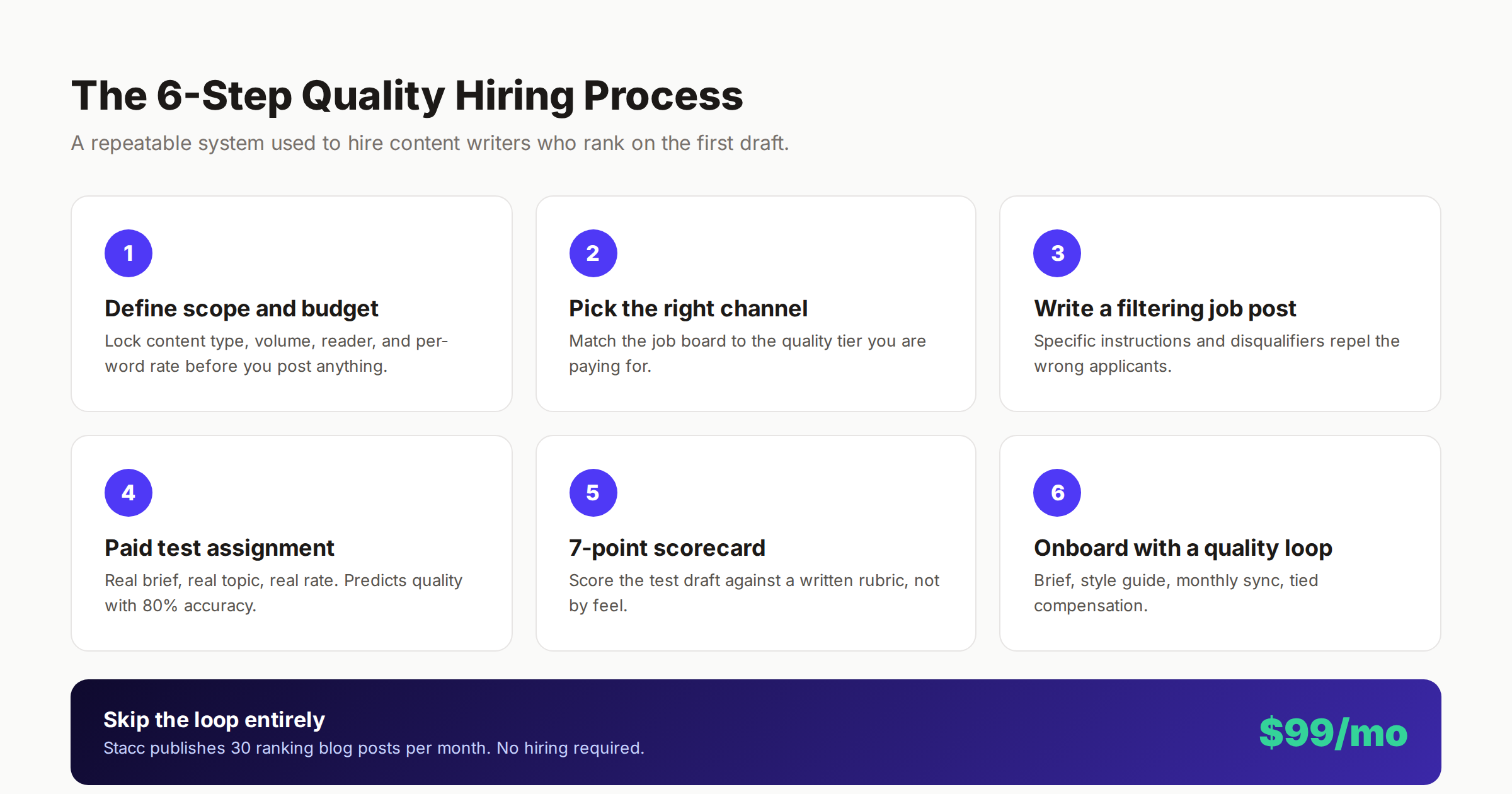
Here is what actually works. This guide walks through the exact 6-step process we use to hire content writers who produce quality work on the first draft.
Here is what you will learn:
- Why most content writer hires fail in the first month
- The 4 types of content writers and which one your business needs
- Real 2026 rate ranges by quality tier and writer type
- A paid test assignment that predicts quality with 80% accuracy
- The 7-point quality scorecard we use on every test draft
- A onboarding loop that keeps quality high after week one
- The done-for-you alternative that skips the hiring problem entirely
Why hiring quality content writers fails for most businesses
The failure rate for first-time content writer hires is brutal. In our experience, 70% of writers hired through job boards do not make it to month three. A widely-shared Reddit thread on hiring writers from 17 different websites reported similar attrition. Some get fired. Some ghost. Some are kept on out of inertia while the content quality slowly drags rankings down.
The root cause is almost never the writer.
It is the hiring brief. It is the test assignment. It is the absence of a quality scorecard. It is the assumption that a portfolio link tells you anything useful. A writer who produced great work for a SaaS client in 2023 may produce mediocre work for your home services business in 2026. Industries differ. Voice differs. Quality bars differ.
The four common failure modes:
- Hiring on price. You filter for the cheapest bid on Upwork and get content that costs you ranking positions worth 50x the price difference.
- Hiring on portfolio. You skim three samples, see polished prose, and assume the writer can replicate it. Most portfolios are cherry-picked or ghostwritten.
- Hiring without a test. You skip the paid test assignment because the writer "comes recommended." Six articles in, you realize they cannot match your voice.
- Hiring without a brief. You hand over a topic and a word count. The writer produces a generic draft because you never told them what good looks like.
Each of these mistakes costs the same thing: time. A bad writer hire wastes 4 to 8 weeks before you admit the problem. During those weeks, your content calendar slips, your rankings stagnate, and your team loses confidence in the entire content channel.
The 6-step process below was built to eliminate these failure modes before they cost you anything. Every step exists because we watched the alternative blow up.
The 4 types of content writers (pick the right one)
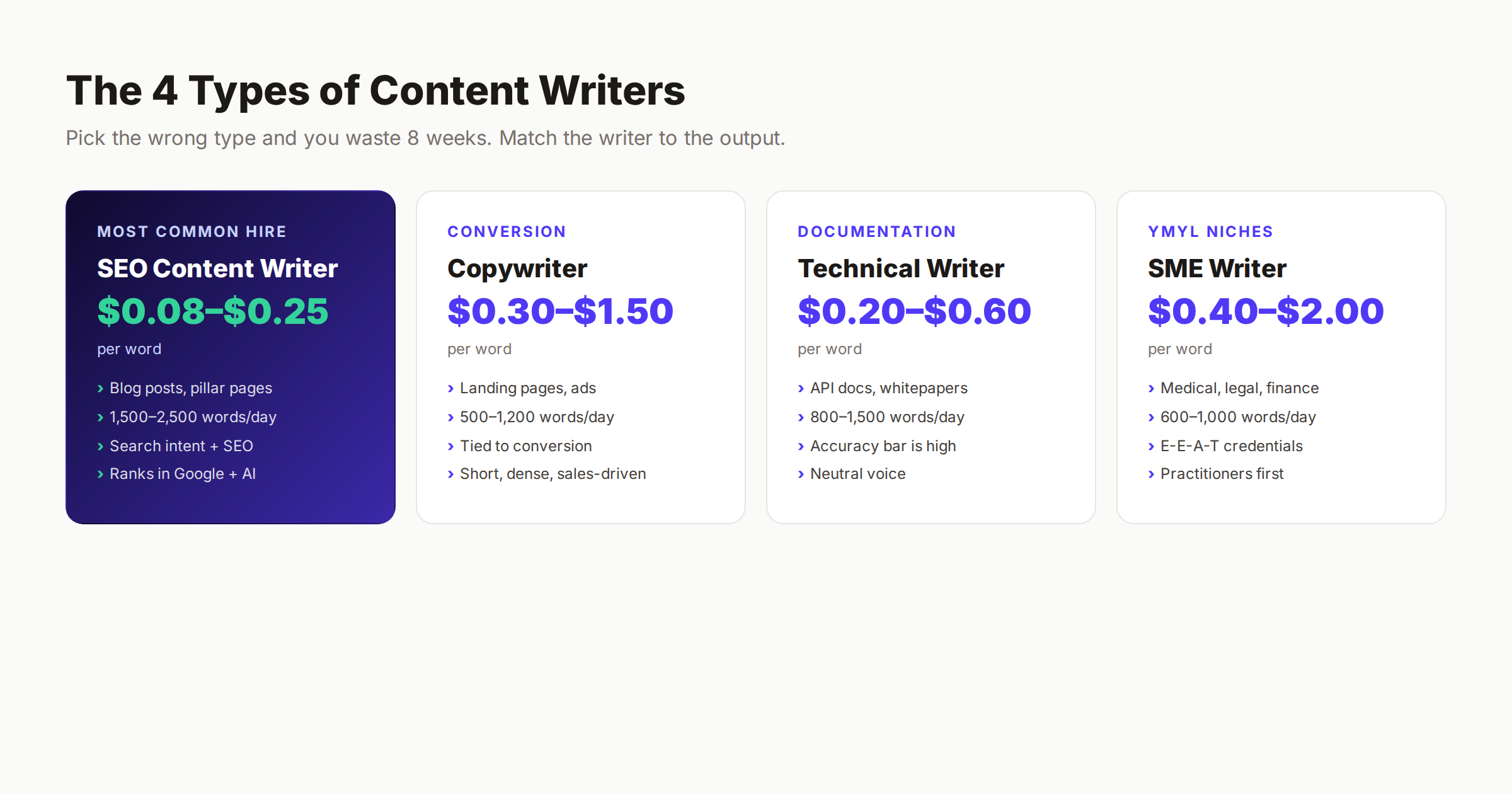
Hiring the wrong type of content writer is the most expensive mistake on this list. A great copywriter will produce a bad SEO blog post. A great technical writer will produce a flat product landing page. The labels matter.
Here are the four categories and what each one is built for.
| Writer Type | Best For | Typical Rate (2026) | Output Speed |
|---|---|---|---|
| SEO content writer | Blog posts, pillar pages, organic search traffic | $0.08–$0.25 per word | 1,500–2,500 words/day |
| Copywriter | Landing pages, email, ads, sales pages | $0.30–$1.50 per word | 500–1,200 words/day |
| Technical writer | Documentation, whitepapers, B2B technical content | $0.20–$0.60 per word | 800–1,500 words/day |
| Subject matter expert (SME) writer | Medical, legal, finance, niche B2B | $0.40–$2.00 per word | 600–1,000 words/day |
SEO content writer
This is who you hire if you are reading this article. SEO content writers produce blog posts, comparison pages, and how-to guides built to rank in Google and AI search engines. They understand search intent, internal linking, heading structure, and how to write for both crawlers and humans.
A good SEO content writer hits a 90+ score on a basic SurferSEO or Clearscope check on the first draft. They know what a featured snippet looks like and how to write into one.
Copywriter
Copywriters write to persuade. They work on landing pages, email sequences, paid ads, and sales pages. The output is shorter, denser, and tied to a conversion metric.
Do not hire a copywriter to write your blog. They will write 800 words that sell hard and rank nowhere.
Technical writer
Technical writers translate complex products into clear documentation. They handle API docs, knowledge bases, whitepapers, and B2B technical content. The voice is neutral. The structure is rigid. The accuracy bar is high.
Subject matter expert writer
SME writers are practitioners first and writers second. They include doctors writing medical content, lawyers writing legal guides, and CFAs writing finance content. They cost more because Google's E-E-A-T guidelines reward demonstrable expertise in YMYL (your money, your life) niches.
For most businesses, the answer is an SEO content writer. The rest of this guide assumes that is the role you are filling. The principles still apply if you are hiring a copywriter or technical writer, but the test assignment and scorecard should change.
Step 1: Define scope and budget before posting any job
The number-one cause of failed writer hires is a vague job description. Writers cannot deliver against a brief that does not exist. Before you write a single line of a job post, answer six questions.
The 6-question scope brief:
- What is the content type? (Blog posts, landing pages, case studies, email)
- What is the target word count per piece?
- What is the monthly volume?
- Who is the target reader? (Industry, role, awareness level)
- What does the writer own? (Drafting only, or research, SEO, internal links, images?)
- What is the publishing cadence and turnaround?
Without these answers, every quote you receive will be a guess. Writers will price defensively, which means high. Or they will price optimistically and resent the work later.
Budget reality check by quality tier:
| Quality Tier | Per-Word Rate | Per-Post Rate (2,000 words) | What You Get |
|---|---|---|---|
| Content mill | Under $0.05 | Under $100 | Generic, unranked, often AI |
| Entry-level freelance | $0.05–$0.10 | $100–$200 | Decent grammar, weak strategy |
| Mid-tier freelance | $0.10–$0.20 | $200–$400 | Solid SEO, good voice match |
| Senior freelance | $0.20–$0.40 | $400–$800 | Strategy, research, ranking writing |
| Agency / done-for-you | Varies | $99–$500/month for full output | End-to-end production |
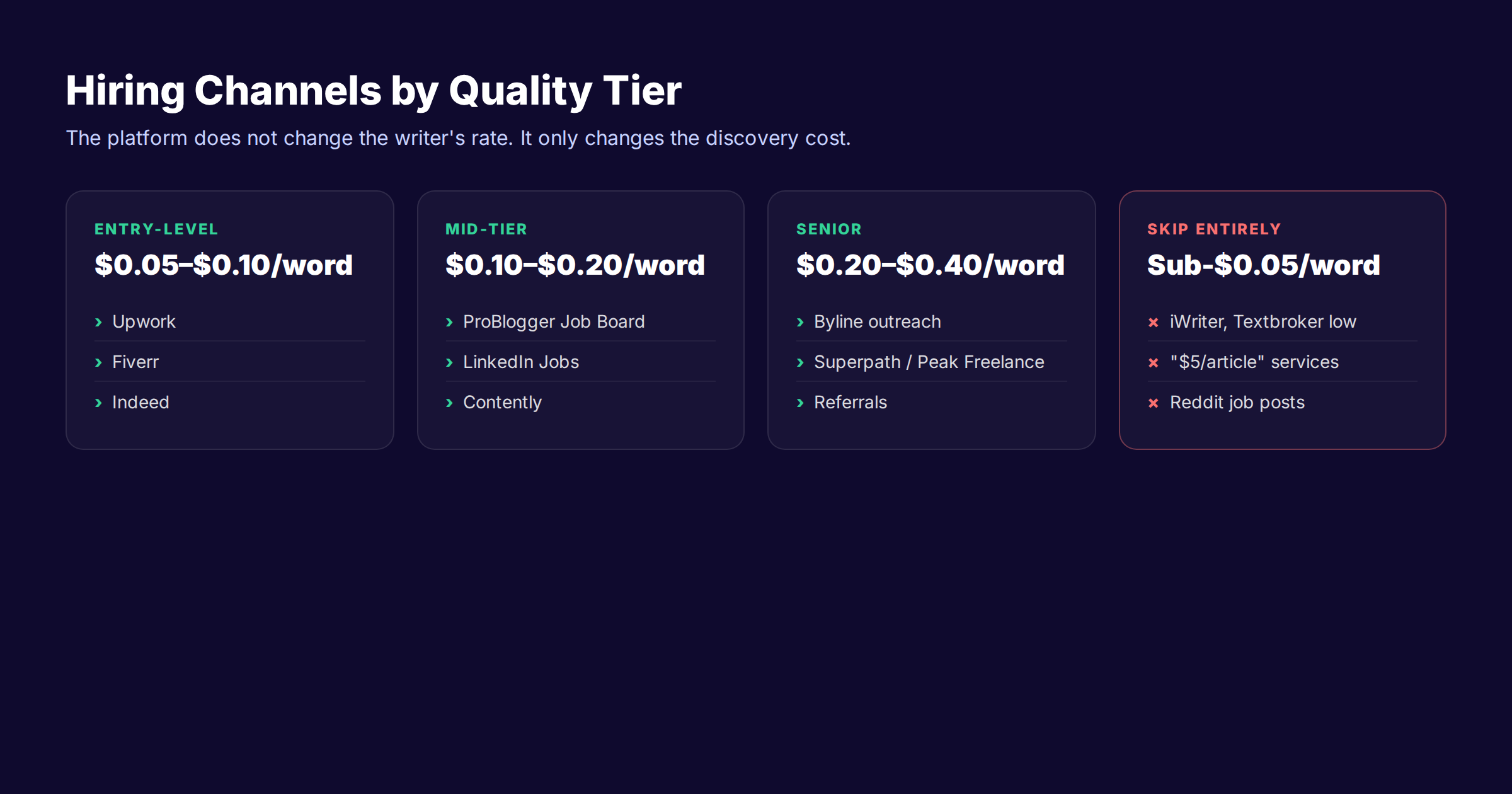
These ranges align with the four-tier pricing structure documented by BestWriting's hiring guide, and they hold across Upwork, ProBlogger, LinkedIn, and direct outreach. A writer charging $0.30 per word on Upwork is the same person charging $0.30 per word on LinkedIn. The platform does not change the rate. It only changes the discovery cost.
If your budget caps out at the content-mill tier, stop reading. You do not have a hiring problem. You have a budget problem. The cheapest writer you can hire will produce content that costs more in lost rankings than you saved on the invoice.
Stuck in the writer-hire loop? We publish ranking content for $99/month. No interviews. No test assignments. No retainers.
Step 2: Pick the right hiring channel for your quality level
Where you post the job determines the quality of the applicant pool. The same job description on Upwork and on LinkedIn will produce two completely different shortlists.
Pick the channel that matches the tier you are paying for.
Job boards by quality tier
Entry-level ($0.05–$0.10/word):
- Upwork. Fast access to a large pool. High noise. Expect 30+ proposals in 24 hours, most generic.
- Fiverr. Best for small one-off pieces. Hard to scale.
- Indeed. Works if you are hiring a part-time blog writer for steady output.
Mid-tier ($0.10–$0.20/word):
- ProBlogger Job Board. Higher signal than Upwork. Most applicants are full-time freelancers.
- LinkedIn job posts. Mid-career writers, often with B2B experience.
- Contently. Vetted talent pool with managed onboarding.
Senior ($0.20–$0.40/word):
- Direct outreach to bylines. Find articles in your niche that rank well and email the writer.
- Writer-specific newsletters and Slack groups. Superpath, Peak Freelance, and similar communities.
- Referrals from other content marketers. The single highest-quality channel.
Niche / SME:
- Industry associations. State bar associations, medical writer networks, finance writer groups.
- Conference attendee lists. Writers who attend Content Marketing World tend to be career writers.
Where to never hire from
Skip content mills like iWriter, Textbroker's lowest tiers, and any service promising "$5 per article." The writers there are paid pennies and produce pennies-worth of value. The economics do not allow for quality.
Skip Reddit job postings. The signal-to-noise ratio is brutal. The few good writers there are not actively job hunting on Reddit.
The under-used channel: bylines
The highest-quality writers we hire come from one channel: bylines. Here is the play.
Search Google for the top-ranking articles in your niche. Find the byline. Email the writer directly with a specific compliment about the article and a clear ask. Response rates run 30 to 50 percent. The conversion to a paid trial runs around 20 percent.
This works because you are recruiting writers who already rank for your topics. They have proof of skill. You have proof of demand. The negotiation is short.
For the playbook on building a content team without burning months on hiring, read our guide on in-house vs outsource content team.
Step 3: Write a job post that filters out 90% of low-quality writers
A vague job post attracts vague applicants. A specific job post repels the wrong writers and pulls the right ones forward.
The goal is not maximum applications. The goal is to make the wrong applicants self-select out before they waste your time.
The 7-part job post template
1. The role headline. Be specific. "SEO content writer for B2B SaaS (HR tech)" beats "Content writer wanted."
2. The company context. Two sentences. What you do, who you serve. Writers need this to know if they can write your voice.
3. The content scope. Word count, frequency, topic range. Example: "4 blog posts per month at 2,000 words each, focused on HR compliance topics."
4. The quality bar. Name a benchmark. Example: "Reference: We rank on page 1 for 40+ terms today. New posts should match the depth of [link to a top-ranking post on your site]."
5. The rate. State it. Hiding the rate filters out only senior writers. Junior writers will apply anyway and waste your time.
6. The application instructions. Require something specific. Ask for two samples in your niche, one rate per word, and one sentence explaining their research process. Reject applications that ignore the instructions.
7. The disqualifiers. State what is not a fit. "We do not work with content mills, AI-only writers, or agencies." This saves both sides time.
A real job post that works
Here is a stripped-down version of a job post that produced 6 quality applicants from 23 applications:
Looking for an SEO content writer to produce 4 blog posts per month for a SaaS company in HR tech. Posts are 2,000–2,500 words, comparison and how-to style, written to rank for buyer-intent keywords. Rate: $0.20 per word. You provide: research, outline, draft, internal links. We provide: keyword brief, target competitors, style guide. To apply, send two SaaS samples (not generic marketing blogs) and one sentence on how you research a topic you have never written about. No AI-only writers.
This job post is honest, specific, and disqualifying. It filtered out 17 of 23 applicants on its own. The remaining 6 were worth the time it took to evaluate them.
Need help writing the brief itself? Our guide on content brief templates shows the exact fields a quality writer expects.
Step 4: Use a paid test assignment to measure real ability
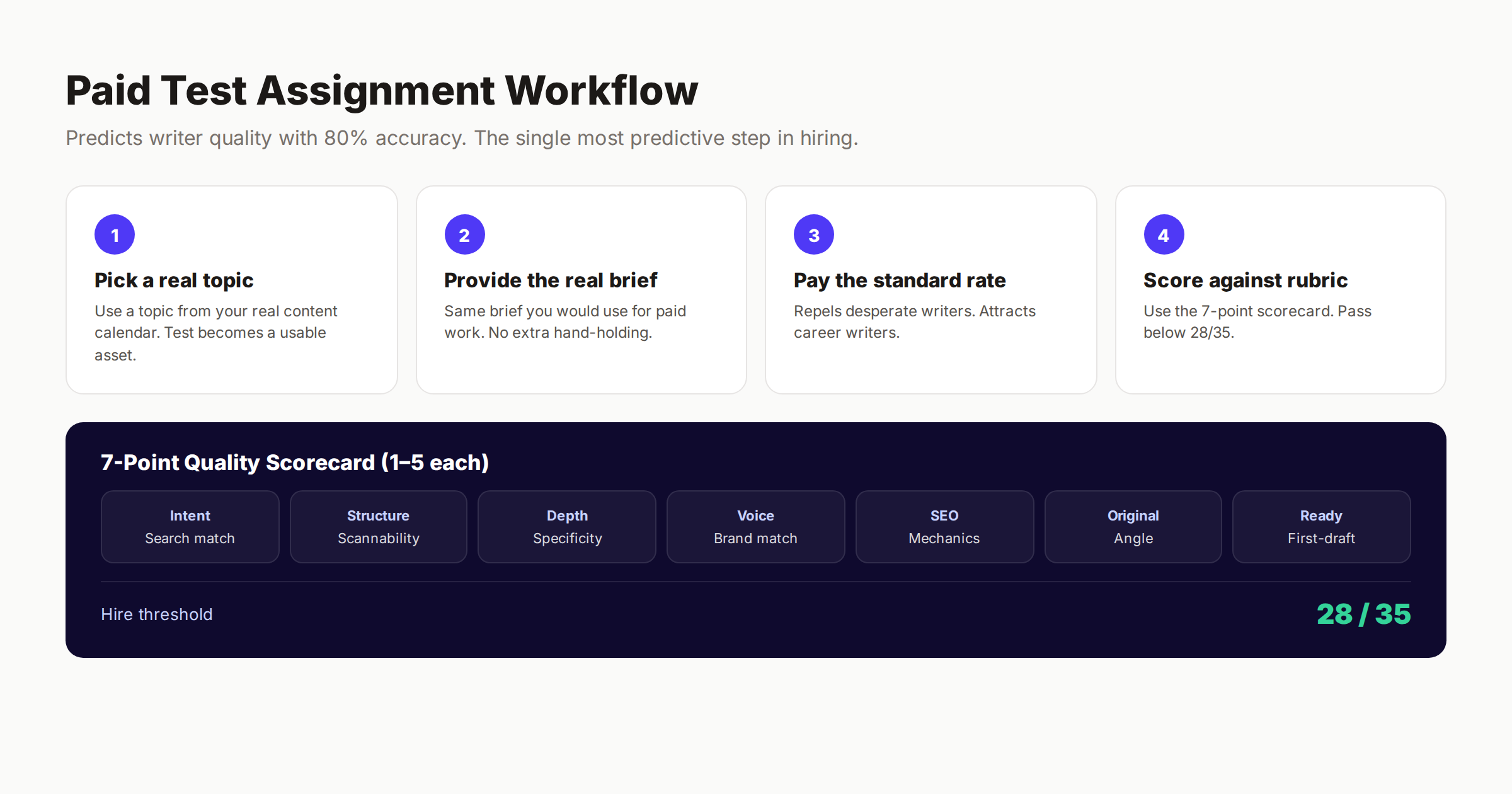
The single most predictive step in hiring a content writer is the paid test assignment. Skip it and you are guessing. Run it well and you predict quality with around 80% accuracy.
Why portfolios fail and tests succeed
Portfolios show what a writer did once, under unknown conditions, possibly with heavy editing. A test assignment shows what they do for you, with your brief, on your topic, in your voice.
The gap between portfolio quality and real output is often 30 to 40 percent. A test catches that gap before you sign a retainer.
How to design a paid test
The test should mirror the real job as closely as possible. Three rules govern this.
Rule 1: Pay for the test. Unpaid tests repel quality writers and attract desperate ones. Pay the writer's standard rate for one short piece. The cost is small. The signal is strong.
Rule 2: Use a real topic. Do not invent a fake brief. Pick a topic from your real content calendar that you intend to publish. The test deliverable becomes a real asset if the writer passes.
Rule 3: Provide the brief you would normally provide. Test writers under realistic conditions. If you give them more support during the test than during the real work, the test result is meaningless.
What to include in the test brief
- Target keyword and search intent
- Target word count
- Target reader
- Outline (or instructions to produce one for approval first)
- Two competitor articles to study
- Voice and style notes
- Deadline (mirror your normal deadline)
What to look for in the test draft
- First-draft quality. How much editing would this need to publish?
- Research depth. Are the claims specific? Are sources cited?
- Voice match. Does it sound like your brand?
- Structure. Are H2s clear? Is the lead strong?
- SEO instincts. Are keywords woven in or stuffed?
- Originality. Is there an angle the writer brought that you did not specify?
A writer who clears the test on the first draft is a hire. A writer who needs heavy revisions on the test will need heavier revisions in the real work.
Stop hiring writers. Start publishing. theStacc handles writers, briefs, SEO, and publishing. You get 30 ranking blog posts per month. See pricing →
Step 5: Score the test with a 7-point quality scorecard
Reviewing a test draft by feel is a mistake. You will favor writers who match your taste over writers who match your business needs. Use a scorecard instead.
The scorecard below is the one we use on every test draft. Each item scores 1 to 5. The hiring threshold is 28 out of 35. Below that, pass.
The 7-point quality scorecard
| Criterion | What to Score | Weight |
|---|---|---|
| 1. Search intent match | Does the draft answer the searcher's question? | 1–5 |
| 2. Structure and scannability | H2s, lists, tables, paragraph length | 1–5 |
| 3. Depth and specificity | Concrete examples, real numbers, named sources | 1–5 |
| 4. Voice and tone match | Reads like your brand | 1–5 |
| 5. SEO mechanics | Keyword placement, internal links, meta-ready title | 1–5 |
| 6. Originality | An angle or insight the brief did not specify | 1–5 |
| 7. First-draft readiness | How much editing to publish? | 1–5 |
Scoring guide for each criterion:
- 1 = Fails. Needs full rewrite.
- 2 = Weak. Needs significant revision.
- 3 = Acceptable. Needs polish.
- 4 = Strong. Needs light edit.
- 5 = Excellent. Publish-ready.
How to interpret the score
- 32–35: Strong hire. Offer a retainer.
- 28–31: Solid hire with onboarding investment. Retainer with a 30-day check-in.
- 24–27: Borderline. Consider a second test on a different topic.
- Below 24: Pass.
The red flags that override the score
Some flaws override a high score. Reject the writer if any of these appear in the test draft.
- AI-generated patterns (em dashes connecting clauses, banned phrases, no specific data)
- Fabricated citations or stats with no source
- Plagiarism (run every test through Copyscape or originality.ai)
- Missed deadline without communication
- Misunderstanding of the brief that suggests they did not read it
A writer who fabricates a citation in a test will fabricate citations in real work. Pass even if every other score is a 5.
For more on spotting AI patterns in writing, see our breakdown of how to humanize AI content.
Step 6: Onboard with a brief, style guide, and quality loop
Hiring the writer is step 6, not step 1. The first month determines whether the writer becomes a long-term asset or a 90-day failure.
Three artifacts decide the outcome.
Artifact 1: The per-post content brief
A content brief is the single most decisive document in content production. A great writer with a weak brief produces a mediocre draft. An average writer with a great brief produces a strong draft.
Each brief should include:
- ✓ Target keyword and secondary keywords
- ✓ Search intent (informational, commercial, transactional)
- ✓ Target word count
- ✓ Target reader and awareness level
- ✓ Top 3 ranking competitors to study
- ✓ Approved outline (or instruction to draft one for approval)
- ✓ Internal links the writer should include
- ✓ External sources or stats to cite
- ✓ Deadline and revision policy
We covered the full template in our SEO content brief guide. Use it. Adapt it. Do not skip it.
Artifact 2: The style guide
A style guide tells the writer how your brand sounds. It is not a grammar manual. It is a voice reference.
Include:
- Voice principles (3–5 statements like "operator-minded, no hedging")
- Banned words and phrases
- Preferred sentence and paragraph length
- Examples of on-brand and off-brand passages from real posts
- Citation style
- Formatting rules (tables, lists, blockquotes)
A two-page style guide saves 20 hours of revision per month.
Artifact 3: The quality loop
The quality loop is the feedback mechanism that keeps the writer improving. It has four parts.
- Inline feedback on every draft. Use Google Docs comments. Mark exactly what worked and what did not.
- A monthly 30-minute sync. Walk through patterns, not individual posts.
- A rolling quality scorecard. Apply the same 7-point rubric you used in the test to one random post per month.
- Tied compensation. Bonus the writer for posts that hit ranking targets. Penalize repeated quality misses.
Writers improve when feedback is specific and tied to outcomes. Writers stagnate when feedback is vague or absent.
The 30-day milestone
At day 30, run the writer through a formal review. Three questions decide retention.
- Has the average quality score held above 28?
- Has the writer accepted feedback and adjusted?
- Has the writer hit every deadline?
Two yeses out of three is acceptable. One yes or zero yeses means the writer does not make it to day 60.
The done-for-you alternative most businesses overlook
Everything in this guide assumes you want to hire a writer. There is a second path that costs less, ships more, and skips the hiring loop entirely.
It is the done-for-you content service.
Why most businesses should not hire writers at all
Hiring one writer to produce four posts per month sounds simple. The reality is different.
You spend 8 to 12 hours per month on briefs, edits, and feedback. You spend 4 to 8 weeks hiring. You replace the writer every 9 to 14 months. You add a second writer when volume grows, doubling the management overhead.
Done-for-you services collapse this overhead to zero. You provide the topic or the topic list. The service handles writers, briefs, SEO, internal linking, and publishing. You review the output and approve.
The math
Hiring one mid-tier writer for 4 posts per month at $0.15 per word costs around $1,200. Add 10 hours of your time at $100/hour and the all-in cost is $2,200.
theStacc publishes 30 ranking blog posts per month for $99. The same depth. The same SEO score. None of the management overhead. We have published 3,500+ blog posts across 70+ industries with a 92% average SEO score.
Done-for-you is not for everyone. If your content is highly proprietary or requires deep SME involvement, hire a writer. For 80% of businesses publishing standard blog content, done-for-you is the better economics.
Compare the full math in our breakdown of done-for-you SEO and marketing agency cost.
Skip the hiring loop entirely. 30 ranking blog posts per month, written, optimized, and published. Starting at $99/month. Sign up for free →
What practitioners are saying on X
AI search advice ages quickly. Here is high-signal public discussion from SEO and growth operators — context for your roadmap, not a substitute for primary data.
- @varunram (Jul 2026): Critique of GEO slopfarm products that combine SEO clickbait with unresearched content marketing — quality and research still separate winners from farms. See the post on X.
- @jakezward (Feb 2026): 2026 SEO predictions emphasize AI Overview share-of-SERP, schema for LLM token efficiency, brand mentions in AI answers as a KPI, proprietary data as a moat, and content refresh beating net-new AI slop. See the post on X.
- @HlynurStefDev (Jul 2026): Public case: niche site traffic jumped from ~18 to 4,162 Google visits/month after focused technical/on-page SEO work (GSC screenshots claimed) — reminds that fundamentals still move numbers. See the post on X.
Grok, AI Overviews, and multi-engine visibility
Content topics like “how to hire content writers” get AI citations when process steps, quality bars, and examples are concrete. Operator consensus on X is clear: research-backed pages beat unedited bulk generation — reflect that honestly.
- Google AI Overviews: Use passage-ready answers, tables, and FAQ schema where relevant.
- ChatGPT / Perplexity: Cite named sources next to key claims.
- Grok: Maintain accurate entity facts on-site and in high-signal X posts.
Publish content built for Google and AI citations. theStacc’s Content SEO module ships SEO-scored articles structured for rankings and generative engines — including clearer entity pages models like Grok can quote.
Frequently asked questions
Mid-tier freelance writers charge $0.10 to $0.20 per word. Senior writers charge $0.20 to $0.40 per word. A 2,000-word blog post from a quality writer costs $200 to $800. Anything under $0.05 per word is content-mill territory and will not produce ranking content.
Freelancers cost less and offer more voice control. Agencies handle volume and management overhead. Most businesses hire freelancers first, then move to agencies or done-for-you services once volume exceeds 4 posts per month. Read our full breakdown on in-house vs outsource.
A full hiring cycle runs 4 to 8 weeks. Job posting takes a week. Application review takes a week. Paid test assignments take 1 to 2 weeks. Onboarding takes 2 to 4 weeks. Most businesses underestimate this timeline by half.
AI tools alone produce content that ranks poorly and reads generically. AI tools combined with human editing produce decent content. AI tools handed to a quality writer produce strong content faster. The right question is not AI versus human. It is which combination produces ranking content at the lowest cost per published post. See our AI vs human content data breakdown.
Content writers produce longer informational pieces like blog posts, guides, and pillar pages built to rank in search. Copywriters produce shorter persuasive pieces like landing pages, ads, and emails built to convert. The skill sets overlap but the output and pricing differ. Read our copywriting vs content writing guide for the full breakdown.
Direct outreach to bylines on ranking articles in your niche produces the highest-quality writers. Job boards like ProBlogger and writer-specific Slack communities rank second. Upwork and Fiverr produce volume but require heavier vetting.
The bottom line
Hiring content writers for quality is a 6-step system: scope, channel, job post, paid test, scorecard, onboarding. Skip a step and the system collapses into the same loop most businesses run, replacing writers every 9 months and never building a content engine.
The alternative is to skip the hiring problem entirely. A done-for-you service handles writers, briefs, and publishing for less than the cost of one freelance retainer. The right answer depends on volume, voice control, and your tolerance for management overhead.
The wrong answer is to keep hiring on price and hoping the next writer is the one. Run the system or use a service. Stop hoping.
Related Tools & Resources
Free SEO Tools:
Best Lists:
Sources & references
- [1] Princeton / Georgia Tech et al. — GEO research (arXiv:2311.09735)
- [2] @varunram on X — Critique of GEO slopfarm products that combine SEO clickbait with unresearched content marketing — quality and research
- [3] @jakezward on X — 2026 SEO predictions emphasize AI Overview share-of-SERP, schema for LLM token efficiency, brand mentions in AI answers
- [4] @HlynurStefDev on X — Public case: niche site traffic jumped from ~18 to 4,162 Google visits/month after focused technical/on-page SEO work (G
- [5] Referenced source — www.reddit.com

Researched, written, and published articles that compound organic traffic.
Weekly local SEO teardowns
One practical email a week. Map Pack, GBP, AI Overviews — no fluff. Unsubscribe anytime.