Learn how to create content briefs with AI using ChatGPT prompts, SERP data, and a proven 8-step process. Templates and examples included. Updated 2026.
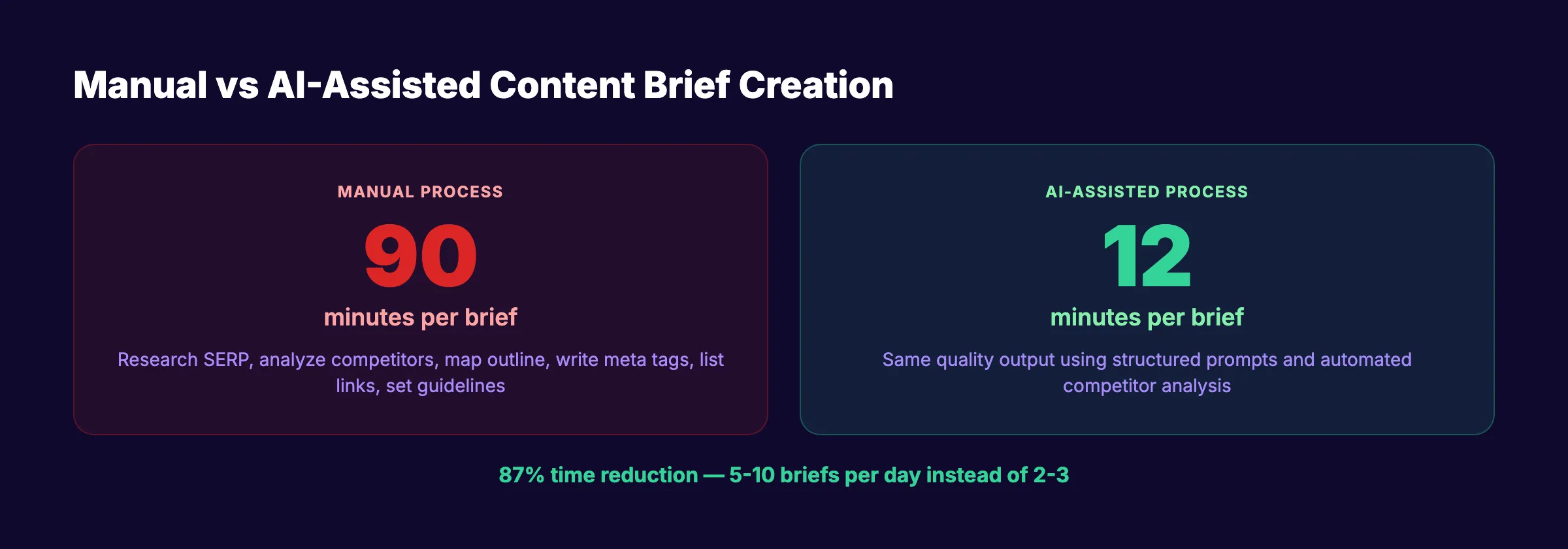
A content brief takes 1 to 2 hours to build manually. Research the keyword. Analyze 10 competitors. Map the outline. List internal links. Write the meta description. Set the tone guidelines. Then do it again for the next article.
Most content teams skip briefs entirely because of this time cost. The result is writers guessing at structure, missing keywords, and producing content that needs 3 rounds of revisions before it is publishable.
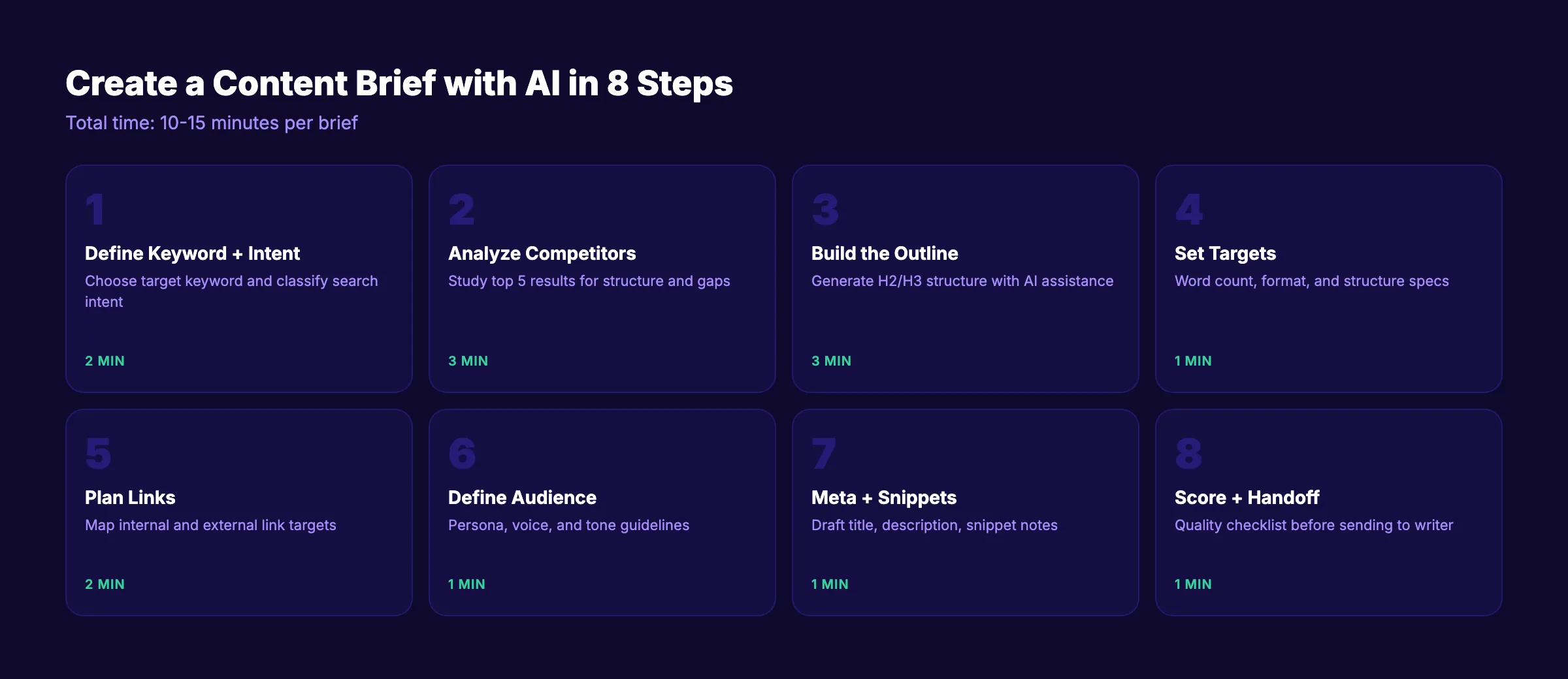
AI cuts brief creation time by up to 90%, according to Keyword Insights. A brief that took 90 minutes now takes 10. The quality does not drop. In many cases it improves, because AI pulls data from more competitor pages than a human would analyze manually.
We have published 3,500+ blogs across 70+ industries. Every article starts with a structured brief. This guide walks through the exact 8-step process we use to create content briefs with AI, including the prompts, the tools, and the quality checks that turn a brief into a ranking article.
Here is what you will learn:
- How to build a complete content brief using AI in under 15 minutes
- The exact ChatGPT prompts for each stage of the process
- Which elements belong in every brief (and which are optional)
- How to score a brief before handing it to a writer
- Common mistakes that make AI-generated briefs useless
What Is a Content Brief?
A content brief is a document that tells a writer exactly what to produce. It defines the keyword, structure, audience, tone, word count, links, and unique angle for a single piece of content.
Think of it as a blueprint. Without one, writers build based on assumptions. With one, they build based on data.
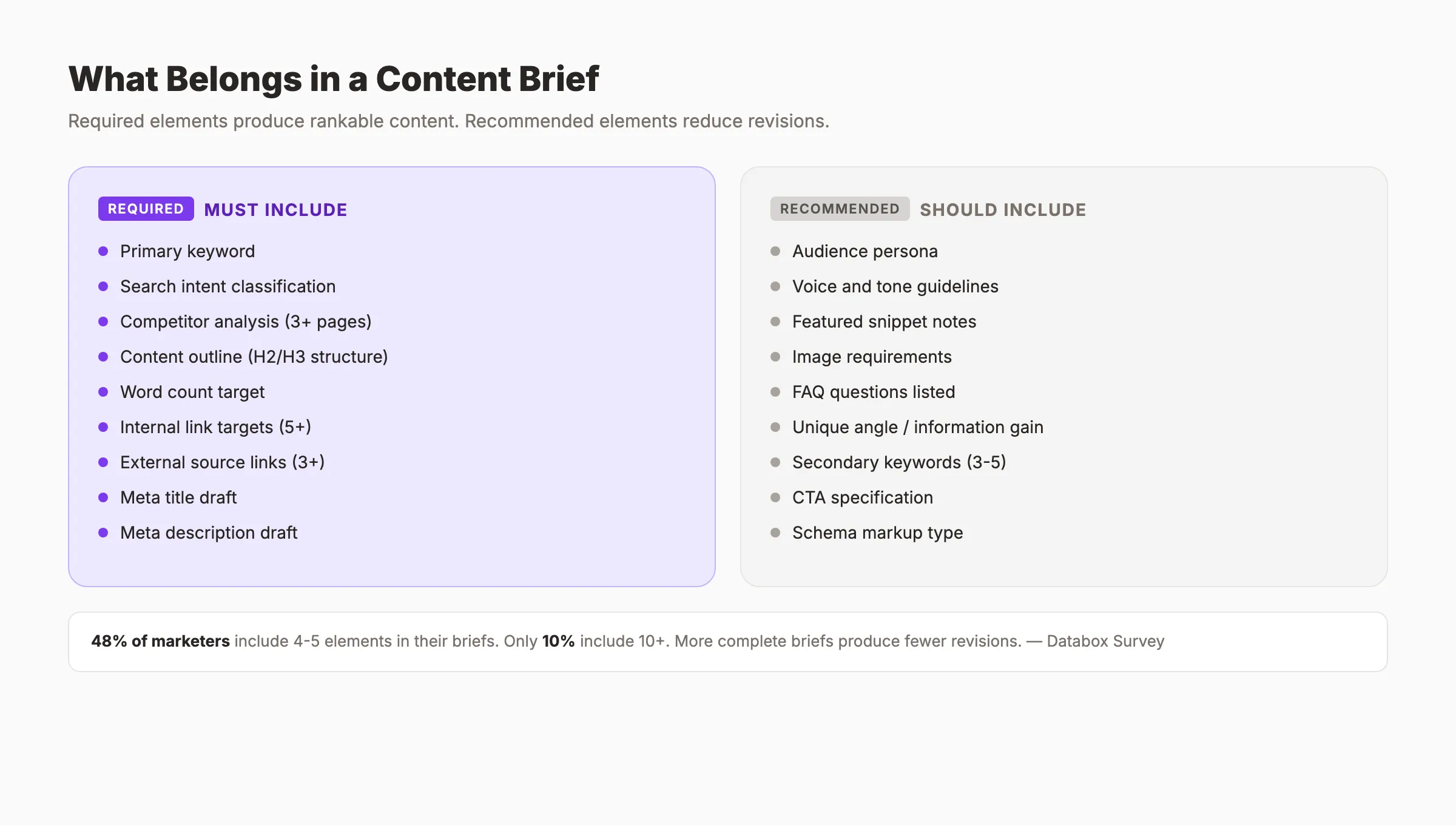
A complete content brief includes:
| Element | Purpose |
|---|---|
| Primary keyword | What the page should rank for |
| Search intent | Informational, commercial, or transactional |
| Target audience | Who the content is written for |
| Content outline | H2/H3 structure with key points |
| Word count target | Length based on SERP analysis |
| Internal links | Pages to link to within your site |
| External links | Authoritative sources to reference |
| Meta title and description | SERP-ready title and description |
| CTA | What action the reader should take |
| Voice and tone notes | How the content should sound |
A Databox survey found that 48% of marketers include 4 to 5 key elements in their briefs. Only 10% include 10 or more. The difference shows in content quality. More complete briefs produce fewer revisions and higher-ranking pages.
Overview: What You Will Need
Time required: 10 to 15 minutes per brief
Difficulty: Beginner
What you will need:
- ChatGPT (Plus recommended for GPT-4o access) or Claude
- A keyword research tool (Ahrefs, Semrush, or Google Search Console)
- Access to Google search results
- A document template (Google Docs, Notion, or similar)
Step 1: Define the Target Keyword and Search Intent
Every brief starts with one keyword. Not a topic. Not a vague idea. A specific keyword with search demand behind it.
If you have not done keyword research yet, do that first. Pull your target keyword from a tool with real search volume data. ChatGPT cannot provide accurate search volume numbers.
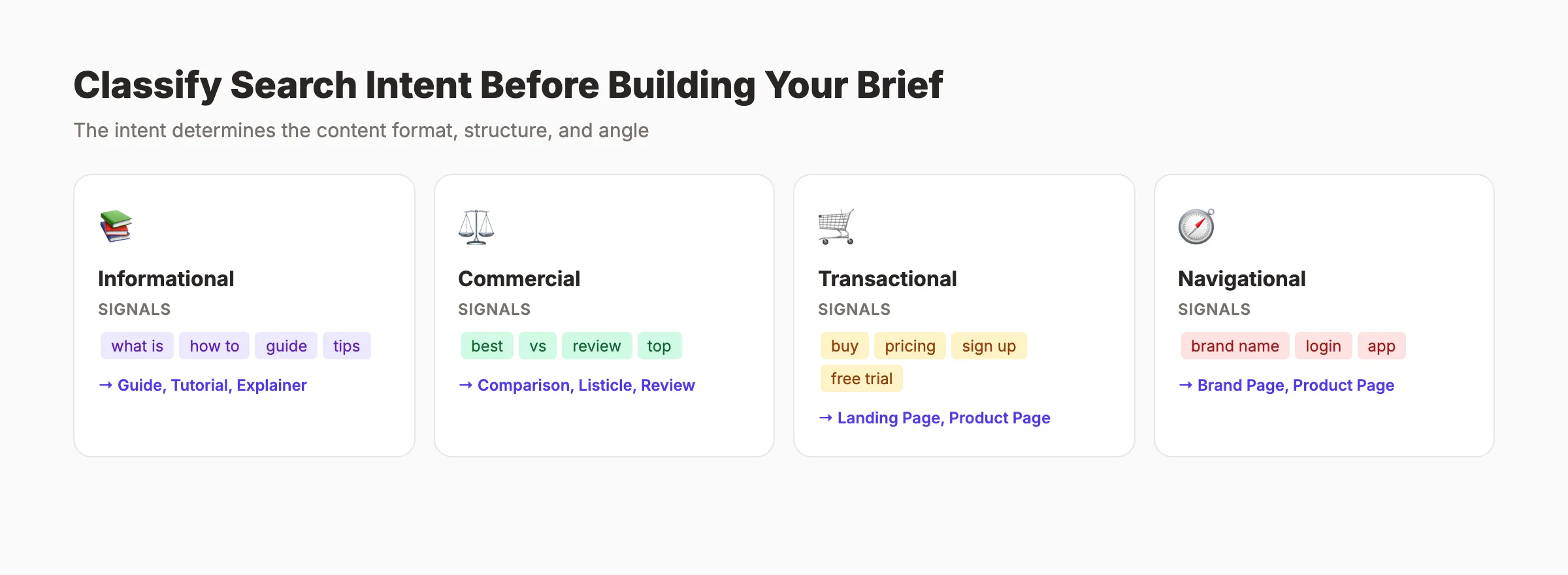
Once you have the keyword, classify the search intent:
| Intent | Signal | Content Format |
|---|---|---|
| Informational | "what is," "how to," "guide" | Tutorial, guide, explainer |
| Commercial | "best," "vs," "review," "top" | Comparison, listicle, review |
| Transactional | "buy," "pricing," "sign up" | Landing page, product page |
| Navigational | Brand name, product name | Brand page |
ChatGPT prompt:
I am targeting the keyword "[keyword]". Based on this keyword,
what is the most likely search intent? What content format would
best match this intent? What questions would a searcher have
before and after searching this term?
Why this step matters: A brief built for the wrong intent produces content that Google ignores. An informational keyword needs a guide, not a sales page. Getting intent wrong wastes the entire workflow.
Pro tip: Search the keyword yourself. Look at what Google shows on page 1. If all results are listicles, your content should be a listicle. If all results are guides, write a guide. SERP format tells you more about intent than any tool.
Step 2: Analyze the Top-Ranking Competitors
Open the top 5 Google results for your keyword. Document their structure, length, and approach.
What to extract from each competitor:
- ✓ H2 and H3 heading structure
- ✓ Approximate word count
- ✓ Content format (guide, listicle, how-to, comparison)
- ✓ Topics they cover
- ✓ Topics they miss
- ✓ Types of media (tables, images, videos, infographics)
- ✓ Internal and external linking patterns
ChatGPT prompt:
Analyze these 5 articles targeting the keyword "[keyword]":
[paste titles and URLs]

For each, list:
1. Their H2 heading structure
2. Unique topics they cover that others miss
3. What content format they use
4. One weakness or gap in their content

Then suggest: what angle would make a NEW article stand out
from all 5?
You can also paste the full text of 2 to 3 competitor articles into ChatGPT and ask for a deeper structural analysis. This gives the AI more context than just titles and URLs.
Why this step matters: Your content needs to match or exceed what already ranks. A brief based on guesswork produces content that is structurally weaker than existing results. Data-driven briefs produce data-driven content.
Your SEO team. $99 per month. 30 optimized articles, published automatically.
Step 3: Build the Content Outline with AI
The outline is the backbone of the brief. It defines every H2, every H3, and the key points under each heading.
Do not ask ChatGPT to generate an outline from scratch. Feed it the competitor analysis from Step 2 first. The output improves dramatically when the AI has context.
ChatGPT prompt:
Based on my competitor analysis, create a detailed outline for a
[word count]-word [format] targeting "[keyword]".

Include:
- 7-10 H2 sections
- 2-3 H3 subsections under each H2
- 2-3 bullet points of key points under each subsection
- A suggested FAQ section with 5 questions

The outline should cover everything the top competitors cover
PLUS these gaps I identified: [list gaps from Step 2].

Unique angle: [describe your differentiator or perspective].
Review the AI output for these issues:
- Generic headings ("Introduction," "Conclusion"). Replace with specific, benefit-driven titles
- Missing sections that competitors cover. Add them
- Sections that overlap or repeat. Merge them
- Ordering that does not match the reader's logical journey. Rearrange
A good outline answers every question a searcher would have, in the order they would ask them.
Why this step matters: The outline determines 80% of the final article quality. A weak outline produces a wandering, unfocused article regardless of how good the writer is. Invest time here.
Pro tip: Run your outline against the People Also Ask questions for your keyword. Every PAA question should have a corresponding section in your outline or FAQ.
Step 4: Set Word Count, Format, and Structure Targets
Your brief needs specific, measurable targets. Not "write a long article." Specific numbers.
Word count: Average the word counts of the top 3 ranking articles. Add 20 to 30%. That is your target.
| Competitor | Word Count |
|---|---|
| #1 result | 2,400 |
| #2 result | 2,800 |
| #3 result | 3,200 |
| Average | 2,800 |
| Your target (+25%) | 3,500 |
Format specifications to include:
- ✓ Content format (guide, listicle, how-to, comparison)
- ✓ Number of H2 sections
- ✓ Minimum images or visuals
- ✓ Table requirements (comparison tables, data tables)
- ✓ Checklist or interactive element requirements
- ✓ Featured snippet format (paragraph, list, or table)
ChatGPT prompt:
Based on this outline, suggest the ideal word count per section.
The total target is [X] words. Distribute the word count across
these H2 sections proportionally, giving more weight to the core
tutorial sections and less to the intro and FAQ:
[paste outline headings]
Why this step matters: Without specific targets, writers either produce 800-word thin content or 6,000-word bloated pieces. Precise targets keep the content focused and competitive.
Step 5: Add Internal and External Link Targets
Every brief should include a link plan. Writers should not guess which pages to link to.
Internal Links
Pull a list of your existing pages and identify 8 to 15 topically related URLs. Include the exact URL and suggested anchor text.
ChatGPT prompt:
Here is a list of pages on my website: [paste URL list].
I am writing an article about "[keyword]".
Suggest 10 internal link placements. For each, provide:
1. The target URL
2. Suggested anchor text
3. Which section of the outline it fits in
Only suggest links that are topically relevant.
Rules for the link plan:
- 3 to 5 internal links per 1,000 words
- Use descriptive anchor text (not "click here")
- Distribute links across sections
- Link to related blog posts, tool pages, and glossary terms
- Never link to pages that do not exist
External Links
Identify 3 to 5 authoritative external sources that support claims in the article.
Include in the brief:
| Source | URL | What It Supports | Section |
|---|---|---|---|
| Google Search Central | [specific URL] | Official guidance on [topic] | Section 3 |
| Semrush study | [specific URL] | Stat: "[specific claim]" | Section 5 |
| Backlinko research | [specific URL] | Data on [topic] | Section 7 |
Why this step matters: Internal links distribute authority across your site. External links add credibility. Without a link plan, writers either skip links entirely or add random ones that do not support the content.
3,500+ blogs published. Every article is SEO-scored before publish. See what theStacc can do for your site.
Step 6: Include Audience and Voice Guidelines
The same keyword can produce very different articles depending on who the reader is and how the content sounds.
Audience definition to include:
- Job title or role (e.g., "marketing manager at a 20-person company")
- Experience level with the topic (beginner, intermediate, advanced)
- What they already know (do not explain basics they understand)
- What they are trying to achieve (the outcome they want)
- What they have tried that did not work (the frustration)
ChatGPT prompt:
I am writing for [audience description]. They are searching for
"[keyword]" because [reason/pain point].

Write a 2-sentence reader persona statement and suggest:
1. What tone to use (formal, casual, technical, conversational)
2. What assumptions I can make about their knowledge
3. What level of detail is appropriate
4. Three phrases or patterns to avoid for this audience
Voice specifications to include:
- Active voice only
- Maximum sentence length (20 words)
- Maximum paragraph length (3 sentences)
- Banned phrases (list your organization's banned words)
- Specific terminology to use or avoid
- First-person vs. second-person preference
Why this step matters: A brief without audience and voice guidelines produces generic content. The writer does not know if they are explaining to a CEO or teaching a junior marketer. Specific audience details eliminate the guesswork.
Step 7: Generate the Meta Tags and Featured Snippet Notes
The brief should include draft meta tags so the writer knows how the article will appear in search results.
ChatGPT prompt for meta tags:
Write 3 title tag variations for a blog post about "[keyword]".
Each must be under 60 characters. Include the primary keyword
and a power word (proven, complete, essential, expert).

Write 3 meta description variations between 145-155 characters.
Each must include the keyword, a benefit, and a freshness signal.
Featured snippet optimization:
Check if the SERP for your keyword shows a featured snippet. If it does, note the format in the brief.
| Snippet Format | How to Optimize |
|---|---|
| Paragraph | Write a 40-60 word direct answer below the relevant H2 |
| List | Use a numbered or bulleted list under the H2 |
| Table | Include a comparison table with clear headers |
Also include in this step:
- Suggested image alt text with keyword placement
- Image count requirement (1 per 500 words minimum)
- Schema markup type (FAQ, HowTo, Article)
Why this step matters: Meta descriptions and titles determine click-through rate. A brief that includes these elements ensures the writer optimizes for the SERP display, not just the on-page content.
Step 8: Review and Score the Brief Before Handoff
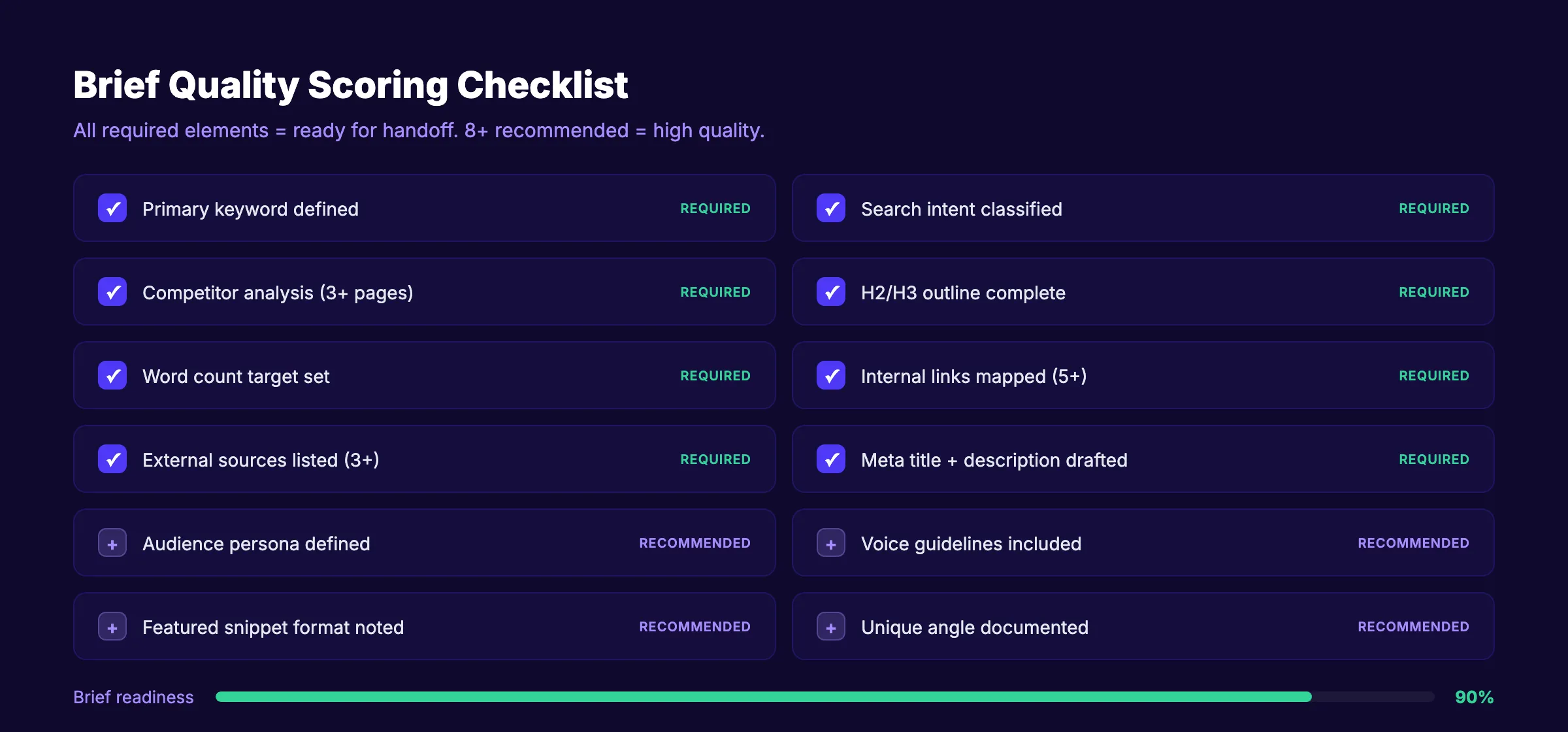
A brief is not done until it passes a quality check. Use this checklist to score every brief before sending it to a writer.
Content Brief Scoring Checklist:
| Element | Weight | Check |
|---|---|---|
| Primary keyword defined | Required | - ✓ |
| Search intent classified | Required | - ✓ |
| Competitor analysis completed (3+ pages) | Required | - ✓ |
| Content outline with H2/H3 structure | Required | - ✓ |
| Word count target set | Required | - ✓ |
| Internal link targets (5+) | Required | - ✓ |
| External source links (3+) | Required | - ✓ |
| Meta title draft | Required | - ✓ |
| Meta description draft | Required | - ✓ |
| Audience persona defined | Recommended | - ✓ |
| Voice and tone guidelines | Recommended | - ✓ |
| Featured snippet notes | Recommended | - ✓ |
| Image requirements | Recommended | - ✓ |
| FAQ questions listed | Recommended | - ✓ |
| Unique angle or information gain noted | Recommended | - ✓ |
Scoring:
- All "Required" elements present: Brief is ready for handoff
- 8+ of 10 "Recommended" elements present: Brief is high quality
- Fewer than 8 "Recommended": Add the missing elements before sending
ChatGPT prompt for final review:
Review this content brief for completeness and quality:
[paste the full brief]

Check for:
1. Missing elements that should be included
2. Vague instructions that need more specificity
3. Conflicting guidance (e.g., "keep it short" but "target 4,000 words")
4. Any sections where the writer would need to guess
Suggest specific improvements.
Why this step matters: An incomplete brief creates revision cycles. A complete brief creates a first draft that is 80 to 90% ready to publish. The 5 minutes spent scoring the brief saves hours of back-and-forth editing.
Pro tip: Track which brief elements correlate with higher-performing content. Over time, you will learn which elements matter most for your specific audience and keywords.
Stop writing. Start ranking. theStacc publishes 30 SEO articles per month for $99.
Results: What to Expect
After using this 8-step process, here is a realistic outcome:
- Brief creation time: 10 to 15 minutes per brief (down from 60 to 90 minutes)
- First-draft quality: Fewer revisions because writers have clearer direction
- Content consistency: Every article follows the same structural standard
- Keyword coverage: No missed keywords or topics because the brief is data-driven
- Scaling capacity: A single content manager can produce 5 to 10 briefs per day instead of 2 to 3
The brief itself does not rank. The content produced from it does. Treat the brief as the most important 15 minutes in your content workflow.
Troubleshooting
Problem: ChatGPT generates a generic outline that matches competitors exactly.
Fix: Add a "unique angle" instruction to your prompt. Tell it what perspective, data, or experience you bring that competitors do not. Without this constraint, AI defaults to the consensus structure.
Problem: The AI recommends too many keywords, making the brief feel keyword-stuffed.
Fix: Limit your brief to 1 primary keyword and 3 to 5 secondary keywords. Delete any keyword the AI suggests that does not appear naturally in the outline. Forced keywords produce unnatural content that hurts readability.
Problem: Writers ignore the brief and write whatever they want.
Fix: Make the brief a checklist, not a document. Writers are more likely to follow bullet points and checkboxes than paragraphs of instructions. Include a "brief compliance" review step before publishing.
AI Tools for Content Briefs: Quick Comparison
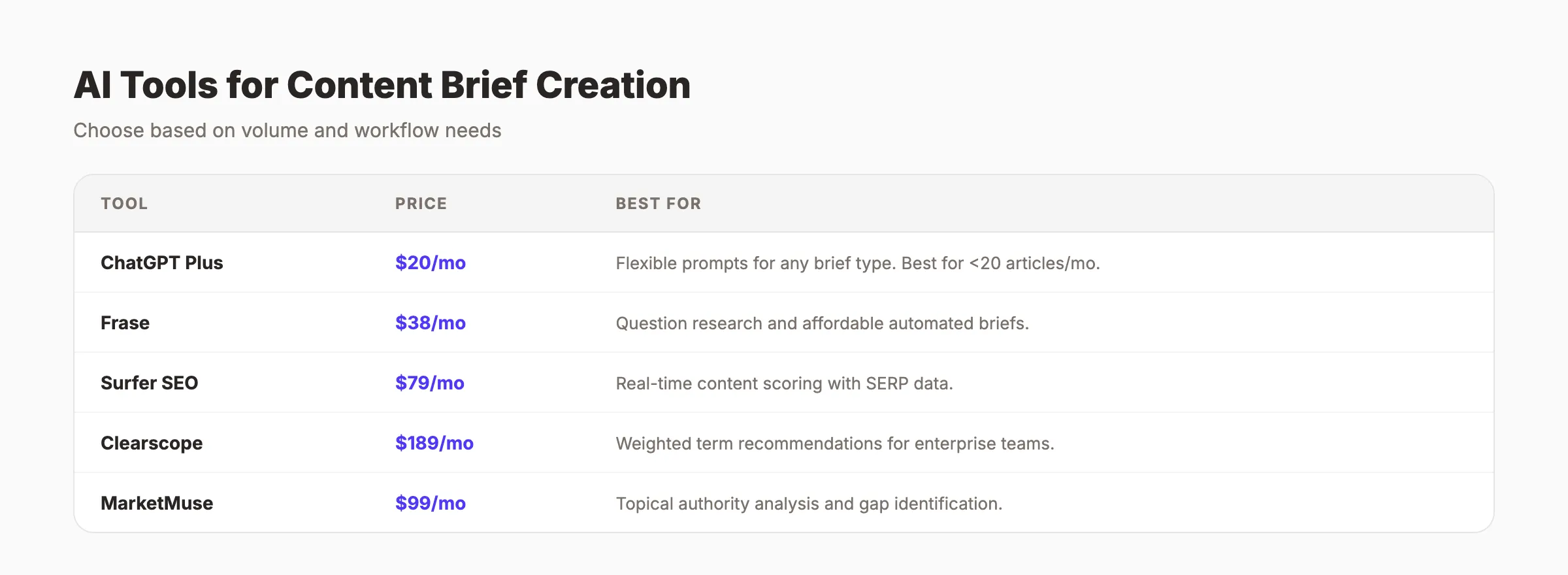
If you want a dedicated tool beyond ChatGPT, here is how the main options compare:
| Tool | Starting Price | Best For |
|---|---|---|
| Frase | $38/mo | Question research and affordable briefs |
| Surfer SEO | $79/mo | Real-time content scoring with SERP data |
| Clearscope | $189/mo | Weighted term recommendations |
| MarketMuse | $99/mo | Topical authority and gap analysis |
| ChatGPT Plus | $20/mo | Flexible prompts for any brief type |
For most teams producing fewer than 20 articles per month, ChatGPT Plus with a structured prompt workflow handles brief creation effectively. Dedicated tools add value at higher volumes where automated SERP analysis saves significant time.
For teams publishing 30 or more articles monthly, a done-for-you service handles the entire pipeline from brief to published article. That is what theStacc does.
What practitioners are saying on X
AI search advice ages quickly. Here is high-signal public discussion from SEO and growth operators — context for your roadmap, not a substitute for primary data.
- @varunram (Jul 2026): Critique of GEO slopfarm products that combine SEO clickbait with unresearched content marketing — quality and research still separate winners from farms. See the post on X.
- @jakezward (Feb 2026): 2026 SEO predictions emphasize AI Overview share-of-SERP, schema for LLM token efficiency, brand mentions in AI answers as a KPI, proprietary data as a moat, and content refresh beating net-new AI slop. See the post on X.
- @HlynurStefDev (Jul 2026): Public case: niche site traffic jumped from ~18 to 4,162 Google visits/month after focused technical/on-page SEO work (GSC screenshots claimed) — reminds that fundamentals still move numbers. See the post on X.
Grok, AI Overviews, and multi-engine visibility
Content topics like “create content briefs ai” get AI citations when process steps, quality bars, and examples are concrete. Operator consensus on X is clear: research-backed pages beat unedited bulk generation — reflect that honestly.
- Google AI Overviews: Use passage-ready answers, tables, and FAQ schema where relevant.
- ChatGPT / Perplexity: Cite named sources next to key claims.
- Grok: Maintain accurate entity facts on-site and in high-signal X posts.
Publish content built for Google and AI citations. theStacc’s Content SEO module ships SEO-scored articles structured for rankings and generative engines — including clearer entity pages models like Grok can quote.
FAQ
A content outline is the H2 and H3 heading structure. A content brief includes the outline plus keyword data, search intent, audience persona, link targets, meta tags, voice guidelines, and format specifications. The outline is one component of the brief.
AI produces a strong first draft of a brief. Human input is still required for audience knowledge, brand voice, unique angles, and quality review. The best workflow is AI-assisted, not AI-only. Expect to spend 5 to 10 minutes reviewing and refining what the AI generates.
One to two pages. Longer briefs get ignored. Include only actionable instructions. If a writer needs to read 5 pages before starting, the brief is too long. Use tables, checklists, and bullet points instead of paragraphs.
The primary keyword and search intent. According to a Databox survey, marketers rank the primary keyword as the single most important brief element. Everything else in the brief exists to help the writer rank for that keyword.
ChatGPT works well for teams producing fewer than 20 articles per month. The prompts in this guide produce briefs comparable to dedicated tools. For higher volumes, tools like Frase or Surfer add automated SERP analysis and content scoring that save time at scale.
Briefs improve E-E-A-T by requiring writers to include specific sources, cite data, add first-hand experience examples, and follow expert-level structural patterns. Without a brief, writers default to surface-level content that lacks the depth Google's quality framework rewards.
Rank everywhere. Do nothing. Blog SEO, Local SEO, and Social on autopilot.
Related Tools & Resources
Free SEO Tools:
Best Lists:
Sources & references
- [1] Princeton / Georgia Tech et al. — GEO research (arXiv:2311.09735)
- [2] @varunram on X — Critique of GEO slopfarm products that combine SEO clickbait with unresearched content marketing — quality and research
- [3] @jakezward on X — 2026 SEO predictions emphasize AI Overview share-of-SERP, schema for LLM token efficiency, brand mentions in AI answers
- [4] @HlynurStefDev on X — Public case: niche site traffic jumped from ~18 to 4,162 Google visits/month after focused technical/on-page SEO work (G
- [5] Referenced source — www.keywordinsights.ai

Plan topics, review article drafts, and publish to a connected CMS.
Weekly local SEO teardowns
One practical email a week. Map Pack, GBP, AI Overviews — no fluff. Unsubscribe anytime.