How to use ChatGPT for SEO content without publishing filler: where prompts help, where they fail, and the review steps that keep quality up.
ChatGPT helps with SEO content at specific points: research summaries, outlines, first drafts, and rewriting. It does not verify facts, judge search intent reliably, or replace editing. This guide covers the prompts worth using, the failure modes to expect, and the review steps that keep quality up.
78% of SEO professionals now use ChatGPT in their workflow. Most of them use it wrong.
The typical approach is to paste a keyword into ChatGPT, ask it to write a blog post, and publish the output. The result is generic, repetitive content that reads like every other AI article on page 2 of Google. No original insight. No first-hand experience. No reason for anyone to link to it.
ChatGPT for SEO content works when you treat it as a research and drafting assistant, not a content factory. The difference between ranking and wasting time comes down to how you prompt, how you edit, and how you layer human expertise on top of the output.
We have published 3,500+ blogs across 70+ industries. We use AI at specific stages of the content workflow. This guide covers exactly how to use ChatGPT for SEO content in a way that produces pages Google actually wants to rank.
Here is what you will learn:
- Which SEO tasks ChatGPT handles well (and which it cannot)
- A prompt-chaining workflow that produces better output than one-shot prompts
- How to avoid the quality traps that get AI content filtered or ignored
- Google's official stance on AI-generated content in 2026
- How to edit ChatGPT drafts so they pass E-E-A-T quality signals
What ChatGPT Can and Cannot Do for SEO
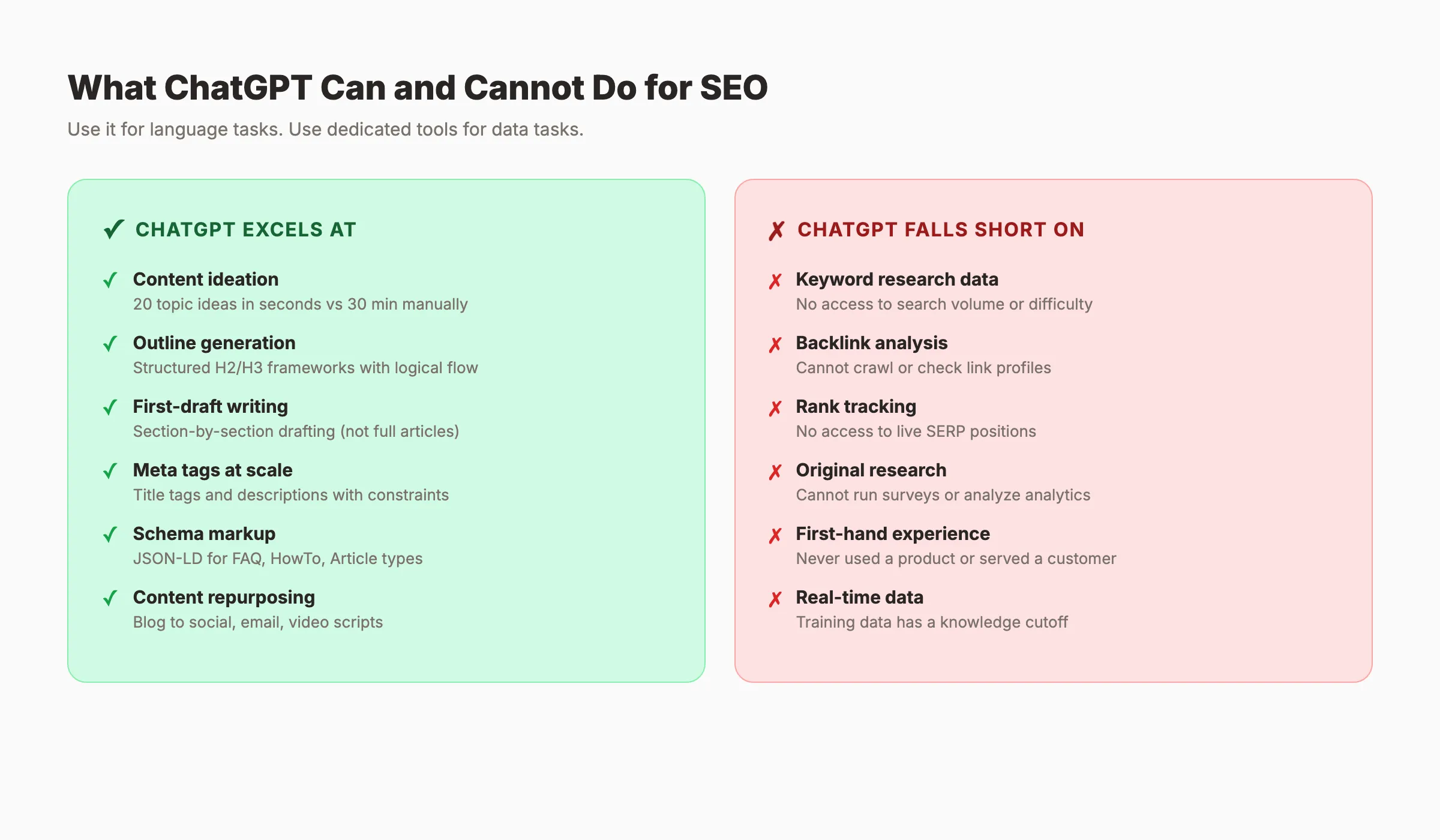
Most guides list 20 or 30 ChatGPT use cases for SEO. The honest answer is simpler. ChatGPT excels at language tasks and fails at data tasks.
Where ChatGPT Performs Well
Content ideation and brainstorming. Ask ChatGPT to generate topic variations, subtopic clusters, or content angles around a seed keyword. It produces 20 ideas in seconds that would take 30 minutes to brainstorm manually.
Outline generation. Feed it a keyword, search intent, and target audience. It returns a structured outline with H2 and H3 headings, subpoints, and a logical flow. Use it as a starting framework, then reshape based on your own expertise.
First-draft writing. ChatGPT writes passable first drafts for sections of a blog post. The key word is "sections." Never ask it to write an entire article in one prompt. The quality degrades after 500 to 600 words as the model rushes toward a conclusion.
Meta tags at scale. Writing meta descriptions and title tags for dozens of pages is tedious. ChatGPT generates variations quickly. Give it character-count constraints and it stays within limits.
Schema markup generation. ChatGPT reliably produces JSON-LD schema markup for FAQ, HowTo, Article, and LocalBusiness types. Faster than writing it by hand.
Content repurposing. Turn a 3,000-word blog post into social media snippets, email summaries, or video scripts. ChatGPT handles format transformation well.
Where ChatGPT Falls Short
Keyword research with real data. ChatGPT cannot check search volume, keyword difficulty, or competition metrics. It does not have access to Google Search Console, Ahrefs, or Semrush data. When it suggests a keyword, it is guessing based on language patterns, not search demand.
Backlink analysis. It cannot crawl the web, check your link profile, or identify link opportunities based on real data.
Rank tracking and SERP analysis. ChatGPT does not know where your pages rank. It cannot pull live SERP results or analyze featured snippets.
Original research and data. It cannot run surveys, analyze your analytics, or generate original statistics. Every "stat" it produces is either from its training data (potentially outdated) or fabricated.
First-hand experience. Google's E-E-A-T framework includes "Experience" as a ranking signal. ChatGPT has never used a product, visited a location, or served a customer. It cannot provide the personal experience that quality content requires.
The rule is straightforward: use ChatGPT for language tasks. Use dedicated tools and human judgment for data tasks and experience signals.
Google's Official Stance on AI Content
There is a persistent myth that Google penalizes all AI-generated content. That is not true. Google's official guidance on AI content is clear on 3 points.
AI content is not automatically spam. Google states: "Appropriate use of AI or automation is not against our guidelines." The method of production does not matter. The quality of the output does.
Scaled content abuse IS spam. Using AI to mass-produce low-quality pages without adding unique value violates Google's spam policies. The February 2025 algorithm update specifically targets sites publishing hundreds of thin AI articles to manipulate rankings.
E-E-A-T still applies. Content must demonstrate Experience, Expertise, Authoritativeness, and Trustworthiness regardless of how it was created. Pure, unedited ChatGPT output rarely meets this standard because it lacks first-hand experience and original perspective.
The practical takeaway: Google does not care if you used ChatGPT. Google cares if the content is useful, accurate, and adds value beyond what already exists. Publish AI-assisted content that meets those criteria and you are fine. Publish unedited ChatGPT dumps and you risk being filtered.
Your SEO team. $99 per month. 30 optimized articles, published automatically.
The Prompt-Chaining Workflow for SEO Content
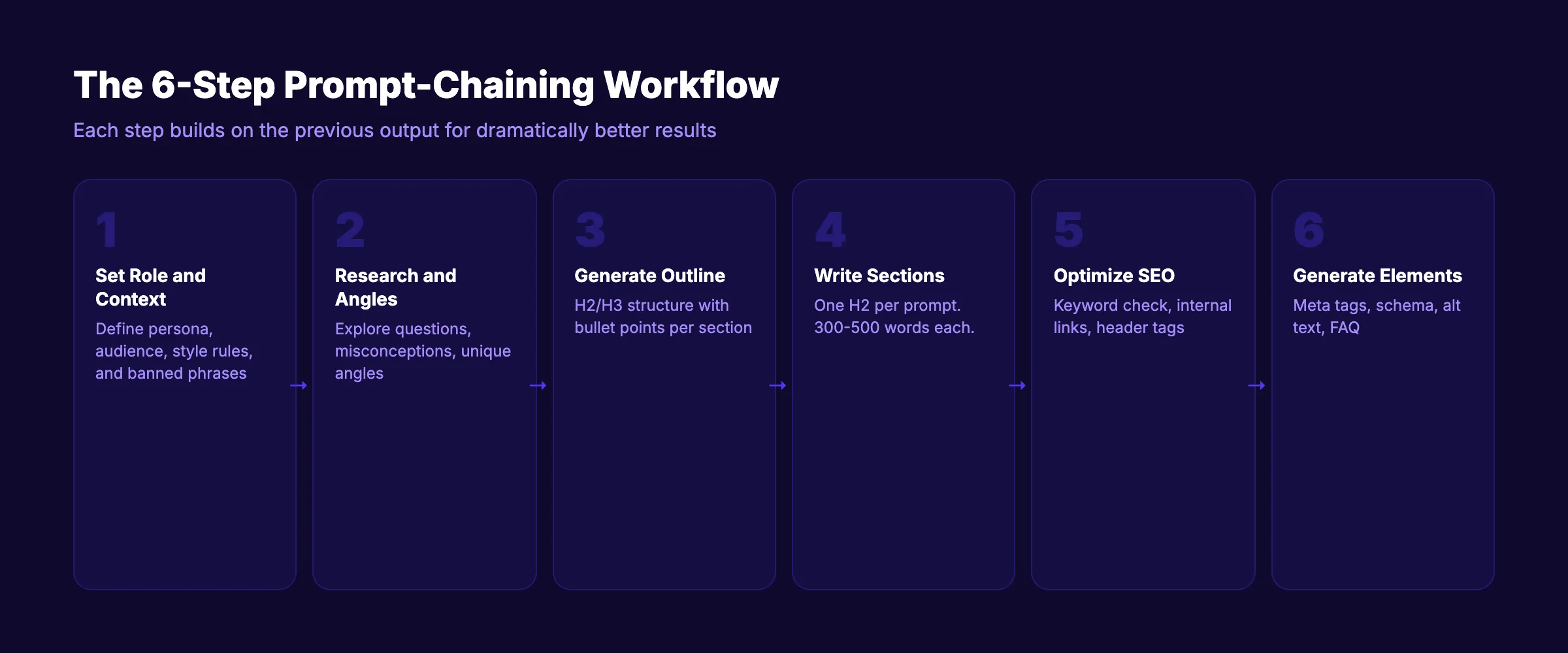
One-shot prompts produce mediocre content. Prompt chaining produces dramatically better results. The concept is simple: break the content creation process into sequential steps where each prompt builds on the output of the previous one.
Here is the exact workflow.
Step 1: Set the Role and Context
Before asking ChatGPT to write anything, establish who it is and what it knows.
Prompt:
You are an SEO content writer for a [industry] company. Your audience
is [target reader]. You write in a clear, direct style with short
sentences. No fluff. No filler transitions. Every paragraph has a
maximum of 3 sentences. You never use the words: use, strong,
smooth, new, or game-changer.
This single prompt eliminates 80% of the generic AI voice that makes content feel robotic. Every subsequent prompt in the conversation inherits these constraints.
Step 2: Research and Angle Discovery
Do not ask ChatGPT to write yet. First, use it to explore the topic.
Prompt:
I am writing a blog post targeting the keyword "[keyword]". Before
writing, help me research. What are the 5 most common questions
people have about this topic? What are the biggest misconceptions?
What angle would make this article different from the top 10 Google
results?
Use the questions and angles as input for your outline. Cross-reference against actual People Also Ask data and SERP results.
Step 3: Generate the Outline
Prompt:
Create a detailed outline for a [word count]-word blog post targeting
"[keyword]". Include H2 and H3 headings. Under each heading, list
2-3 bullet points of what to cover. The article should follow this
structure: problem → agitate → solution → evidence → action.
Review the outline. Rearrange sections. Remove anything generic. Add sections that address gaps you found in competing content.
Step 4: Write Section by Section
Never ask ChatGPT to write the full article at once. Write one H2 section per prompt.
Prompt:
Write the section "[H2 heading]" based on this outline:
[paste the relevant outline section]

Requirements:
- 300-500 words
- Include a specific example or data point
- End with an actionable takeaway
- No filler transitions at the start
Repeat for each section. This approach prevents the "quality collapse" that happens when ChatGPT tries to write 3,000 words in a single response.
Step 5: Optimize for On-Page SEO
After the draft is complete, run a separate optimization pass.
Prompt:
Review this article section and optimize for SEO:
[paste section]

Check for:
- Keyword placement (natural, not stuffed)
- Internal link opportunities for [list your existing pages]
- Header tag optimization
- Readability (short sentences, active voice)
This step catches keyword gaps and structural issues before you move to human editing.
Step 6: Generate Supporting Elements
Prompt for meta tags:
Write 3 title tag variations under 60 characters for this article.
Primary keyword: "[keyword]". Include a power word and year.

Write 3 meta description variations between 145-155 characters.
Include the keyword and a benefit statement.
Prompt for FAQ schema:
Based on this article, generate 5 FAQ questions and answers. Each
answer should be 2-3 sentences. Format as JSON-LD FAQPage schema.
Prompt for alt text:
Write alt text for [number] images in this article. Each alt text
should be under 125 characters, describe the image content, and
include the keyword naturally when relevant.
10 ChatGPT SEO Prompts That Actually Work
Generic prompt lists fill most competing articles. These 10 prompts are specific, tested, and designed for real workflows.
1. Keyword Cluster Generation
Generate 30 keyword variations for "[seed keyword]" organized into
4 clusters based on search intent: informational, commercial,
navigational, transactional. For each keyword, note the likely
content format (guide, listicle, comparison, how-to).
2. Content Gap Finder
Here is my list of published blog topics: [list]. Here are my top 3
competitors: [URLs]. What topics are they likely covering that I am
missing? Suggest 10 content gaps I should fill, ordered by estimated
business impact.
3. Search Intent Classifier
Classify these keywords by search intent (informational, commercial,
transactional, navigational) and explain your reasoning for each:
[keyword list]
4. Blog Post Introduction Writer
Write an introduction for a blog post about "[topic]". Start with a
surprising stat or bold claim. Then state the problem the reader
faces. Then preview what the article delivers. Maximum 150 words.
No fluff. No "in today's digital scene."
5. H2 Section Expander
Expand this outline point into a full H2 section:
[outline point]
Requirements: 300-400 words, include one data point or example,
end with an actionable insight, no transition phrases at the start.
6. Meta Description Batch Generator
Generate meta descriptions for these 10 pages. Each description
must be 145-155 characters, include the primary keyword, state a
clear benefit, and include a freshness signal (year or "updated").
[page list with keywords]
7. Schema Markup Generator
Generate FAQPage schema in JSON-LD for these questions and answers:
[Q&A pairs]
Also generate Article schema for: title "[title]", author
"[author]", datePublished "[date]", description "[description]".
8. Internal Link Suggestion Engine
Here is a list of all pages on my site: [URL list with titles].
Here is the article I am writing: [paste article or outline].
Suggest 10 internal link placements with specific anchor text
and target URLs. Only suggest links that are topically relevant.
9. Content Refresher
This blog post was published [date] and targets "[keyword]":
[paste content]
What sections are outdated? What should be added to match current
search intent? Suggest specific updates, not vague improvements.
10. Competitor Content Analyzer
Analyze this article structure and tell me:
- What topics it covers
- What topics it misses
- How it could be improved for the keyword "[keyword]"
- What unique angle could differentiate a competing article
[paste competitor article or URL summary]
3,500+ blogs published. Every article is SEO-scored before publish. See what theStacc can do for your site.
Quality Traps to Avoid
ChatGPT produces content that looks right but often fails quality checks. Here are the patterns that get AI content filtered, ignored, or outranked.
The Generic Opening Trap
ChatGPT defaults to openings like "In the ever-evolving world of digital marketing..." or "In 2026, SEO continues to be a critical factor for businesses." These phrases signal AI content to readers and potentially to Google. Delete them. Start with a specific stat, bold claim, or direct problem statement.
The Hallucination Problem
ChatGPT fabricates statistics, cites nonexistent studies, and confidently states incorrect facts. Every data point in an AI draft must be verified against a real source. If you cannot find the source, delete the claim.
A Scribbr analysis documented that ChatGPT regularly generates plausible-sounding but entirely fabricated citations. Treat every number and attribution as unverified until you confirm it yourself.
The Duplicate Content Risk
Multiple sites generating content about the same topic using ChatGPT produce near-identical articles. Same structure. Same points. Same phrasing patterns. The fix is original research, unique data, first-hand experience, and a distinct perspective. These are the elements ChatGPT cannot provide.
The E-E-A-T Gap
Google's quality framework requires Experience, Expertise, Authoritativeness, and Trustworthiness. Pure ChatGPT output demonstrates none of these. Every AI draft needs human expertise layered on top:
- Experience: Add specific examples from your work. "When we audited 50 sites, we found..." beats "studies show that..."
- Expertise: Include technical depth that goes beyond surface-level explanations
- Authoritativeness: Reference your own published work, case studies, or results
- Trustworthiness: Cite real sources, acknowledge limitations, avoid overclaiming
The AI Voice Detector
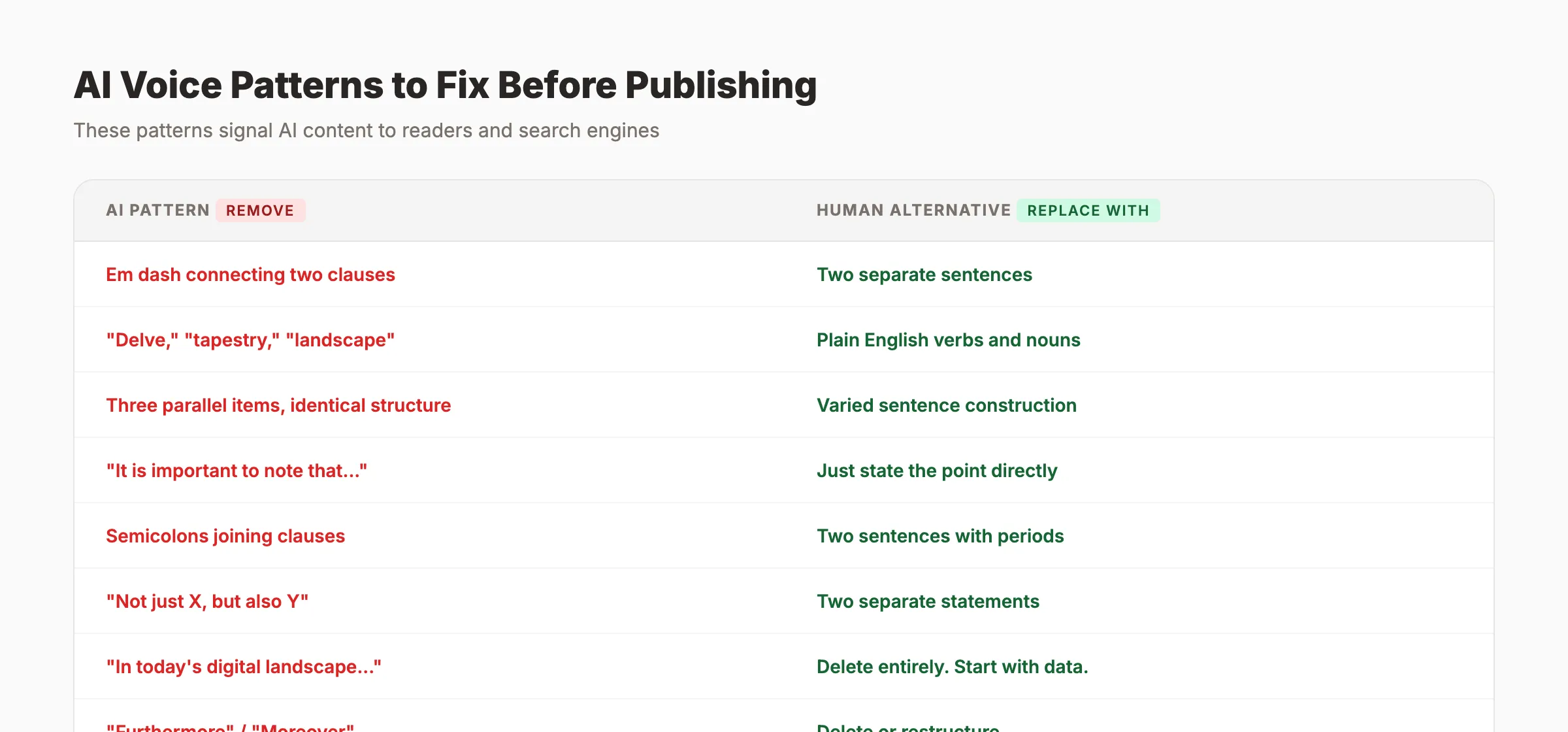
Trained readers (and increasingly, software) spot AI writing through these patterns:
| AI Pattern | Human Alternative |
|---|---|
| Em dash connecting two clauses | Two separate sentences |
| "Delve," "tapestry," "landscape" | Plain English verbs and nouns |
| Three parallel items with identical structure | Varied sentence construction |
| "It is important to note that..." | Just state the point directly |
| Semicolons joining independent clauses | Two sentences with periods |
| "Not just X, but also Y" | Two separate statements |
Run every draft through a humanization pass before publishing. Remove the patterns above. Vary sentence length. Add personality.
The Post-Draft Editing Workflow
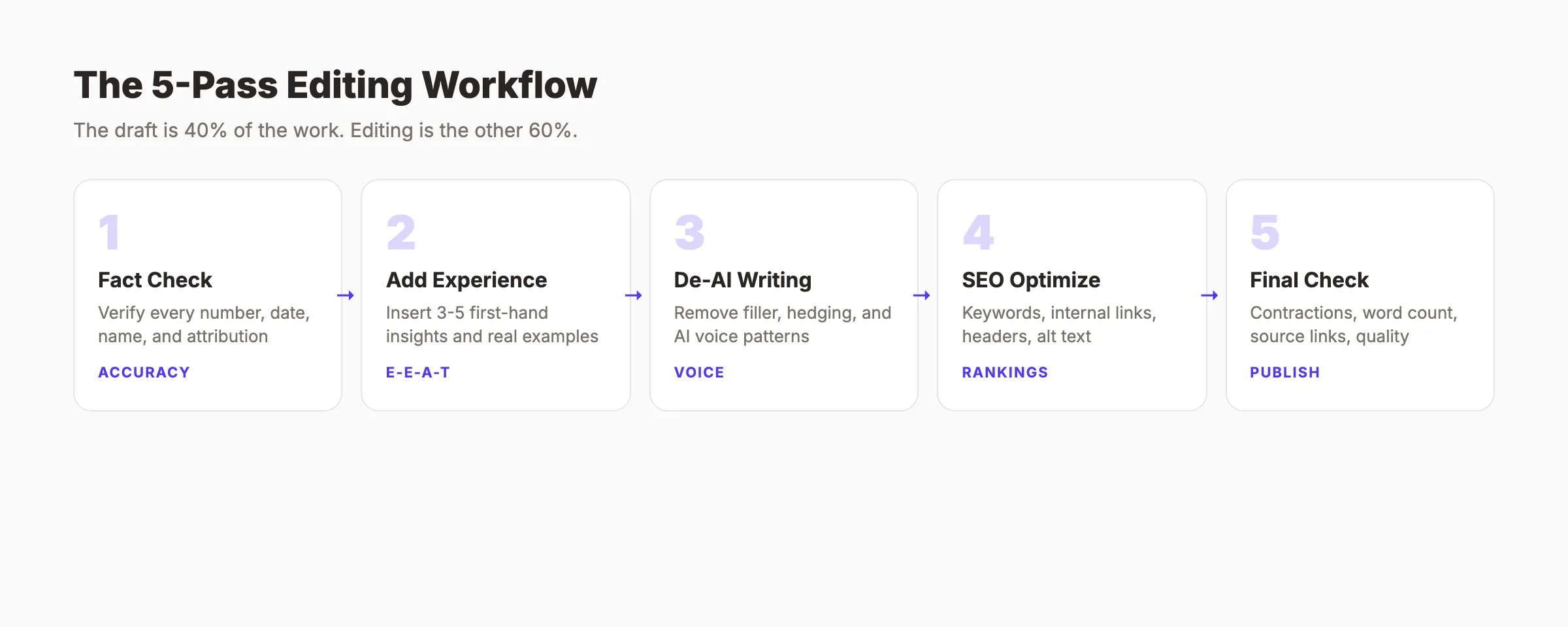
The draft is 40% of the work. Editing is the other 60%. Here is the sequence that turns a ChatGPT draft into content worth ranking.
Pass 1: Fact Check Everything
Open every claim that includes a number, date, name, or attribution. Verify it against the original source. Replace anything you cannot verify. Add source links for statistics.
Pass 2: Add First-Hand Experience
Identify 3 to 5 places in the draft where you can add original insight. Examples:
- "We tested this approach on 10 client sites and found..."
- "In our experience publishing 3,500+ articles, the pattern is..."
- "A common mistake we see in client audits is..."
These additions are what separate rankable content from commodity AI text.
Pass 3: De-AI the Writing
Read every paragraph out loud. If it sounds like a textbook or corporate press release, rewrite it. Specifically:
- Replace every hedge ("might," "could potentially") with a direct statement
- Delete every filler transition ("Furthermore," "Moreover," "Additionally")
- Break compound sentences into shorter ones
- Remove every instance of "it is important to note" or similar padding
- Add at least 2 opinionated statements ("Most advice about X is wrong because...")
Pass 4: SEO Optimization
- Verify the primary keyword appears in the title, first 100 words, at least 1 H2, and the meta description
- Add internal links to related pages (3 to 5 per 1,000 words)
- Add external links to authoritative sources (2 to 3 per article)
- Check header hierarchy: H1 → H2 → H3, no skipped levels
- Verify all images have descriptive alt text
Pass 5: Final Quality Check
- ✓ Zero contractions (use "do not" instead of "don't")
- ✓ No AI-pattern phrases remaining
- ✓ Every stat has a source link
- ✓ Word count meets or beats top SERP competitors
- ✓ Content adds something new beyond what already ranks
ChatGPT Model Selection for SEO Tasks
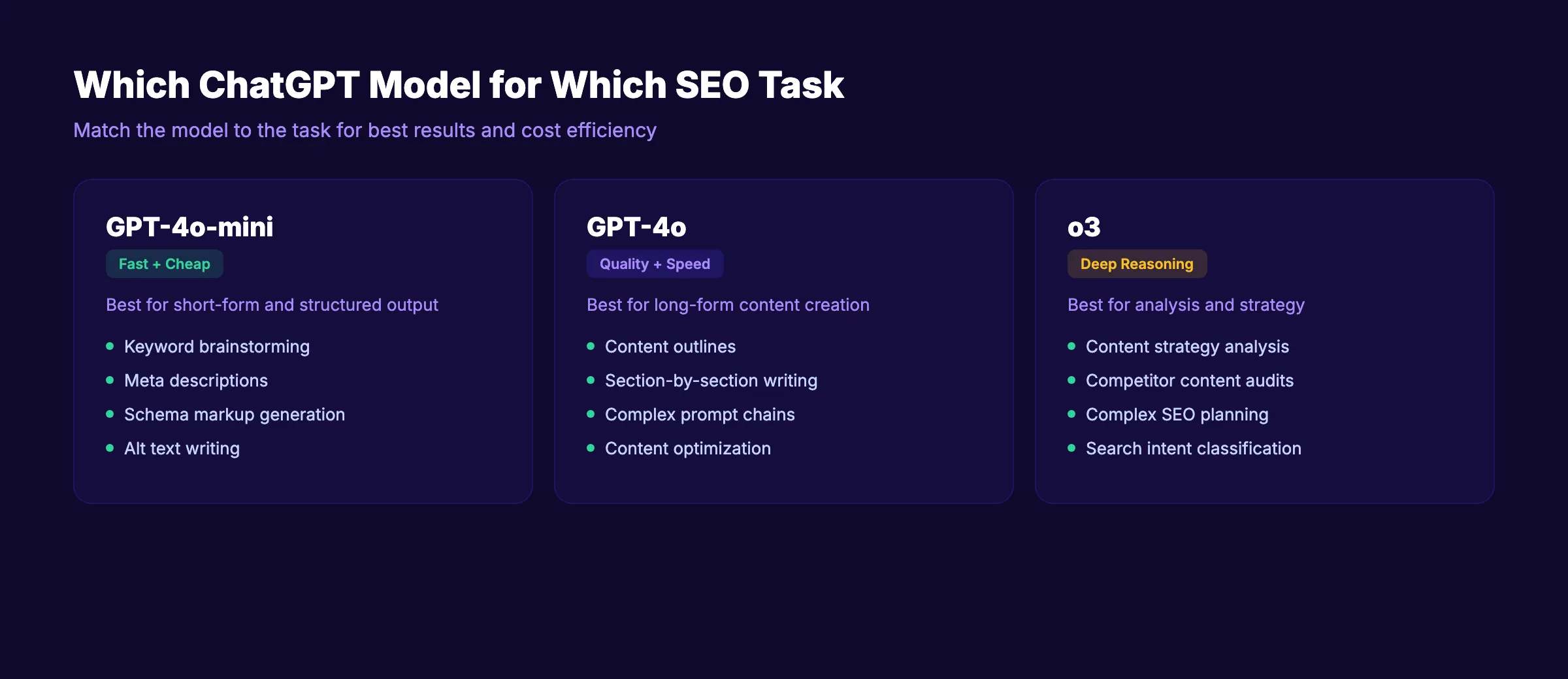
Not every ChatGPT model handles SEO tasks equally. Picking the wrong model wastes tokens and produces weaker output.
| Task | Best Model | Why |
|---|---|---|
| Keyword brainstorming | GPT-4o-mini | Fast, cheap. Quality is sufficient for ideation. |
| Content outlines | GPT-4o | Better structure and logic than mini. |
| Section-by-section writing | GPT-4o | Best balance of quality and speed for long-form. |
| Schema markup generation | GPT-4o-mini | Structured output. Mini handles it well. |
| Meta tag generation | GPT-4o-mini | Short-form text. Mini is fast and accurate. |
| Content analysis and strategy | o3 | Deep reasoning needed. Worth the higher cost. |
| Complex prompt chains | GPT-4o | Maintains context across long conversations. |
Free vs Plus vs Team:
The free tier limits you to GPT-4o-mini with usage caps. For serious SEO work, ChatGPT Plus at $20 per month gives you access to GPT-4o and o3. If your team produces content regularly, the Team plan at $25 per user per month adds shared workspaces and longer context windows.
For most SEO content workflows, GPT-4o handles 90% of tasks. Use o3 only for complex analysis where deeper reasoning justifies the cost.
What NOT to Publish Without Human Review
Some SEO professionals treat ChatGPT as a publish button. These are the content types that should never go live without thorough human review.
YMYL content. Your Money or Your Life topics (health, finance, legal) require verified expertise. ChatGPT hallucinations in YMYL content create real liability. A fabricated health statistic or incorrect legal claim can damage your credibility permanently.
Local business content. ChatGPT does not know your city, your customers, or your local market. Local SEO content must reference real locations, local data, and community-specific details that AI cannot provide.
Product and service pages. These pages drive revenue. They need your actual product features, real pricing, genuine customer outcomes, and specific differentiators. ChatGPT produces generic feature lists that could describe any competitor.
Case studies. A case study requires real data from a real client. ChatGPT can help structure and write a case study, but the underlying facts, numbers, and outcomes must come from your records.
Content about your brand. ChatGPT does not know your brand voice, your positioning, or your competitive advantages. It produces copy that sounds like every other company in your space.
Skip the agency. Keep the results. theStacc starts at $99/mo with a free trial.
Using ChatGPT for Technical SEO Tasks
ChatGPT handles several technical SEO tasks faster than manual work. These are the most reliable use cases.
Robots.txt Generation
Prompt:
Generate a robots.txt file for a [type] website. Allow all major
search engine crawlers. Block /admin/, /cart/, /demo/, and
/internal/ directories. Add a Sitemap directive pointing to
https://example.com/sitemap.xml.
Review the output against your robots.txt best practices before deploying.
Hreflang Tag Generation
Prompt:
Generate hreflang tags for a website with these language/region
versions: [list URLs with language codes]. Include an x-default
tag pointing to the English version.
Redirect Mapping
Prompt:
I am migrating my website. Here are the old URLs and their new
equivalents: [URL mapping]. Generate a redirect map in the format:
old URL → new URL → redirect type (301 or 302).
Flag any potential redirect chains or loops.
Structured Data Validation
Prompt:
Review this JSON-LD schema markup for errors:
[paste schema]
Check for: missing required properties, incorrect @type values,
deprecated fields, and Schema.org compliance issues.
These tasks produce clean, usable output because they follow strict formats. ChatGPT excels when the expected output has clear rules.
Measuring the ROI of ChatGPT for SEO
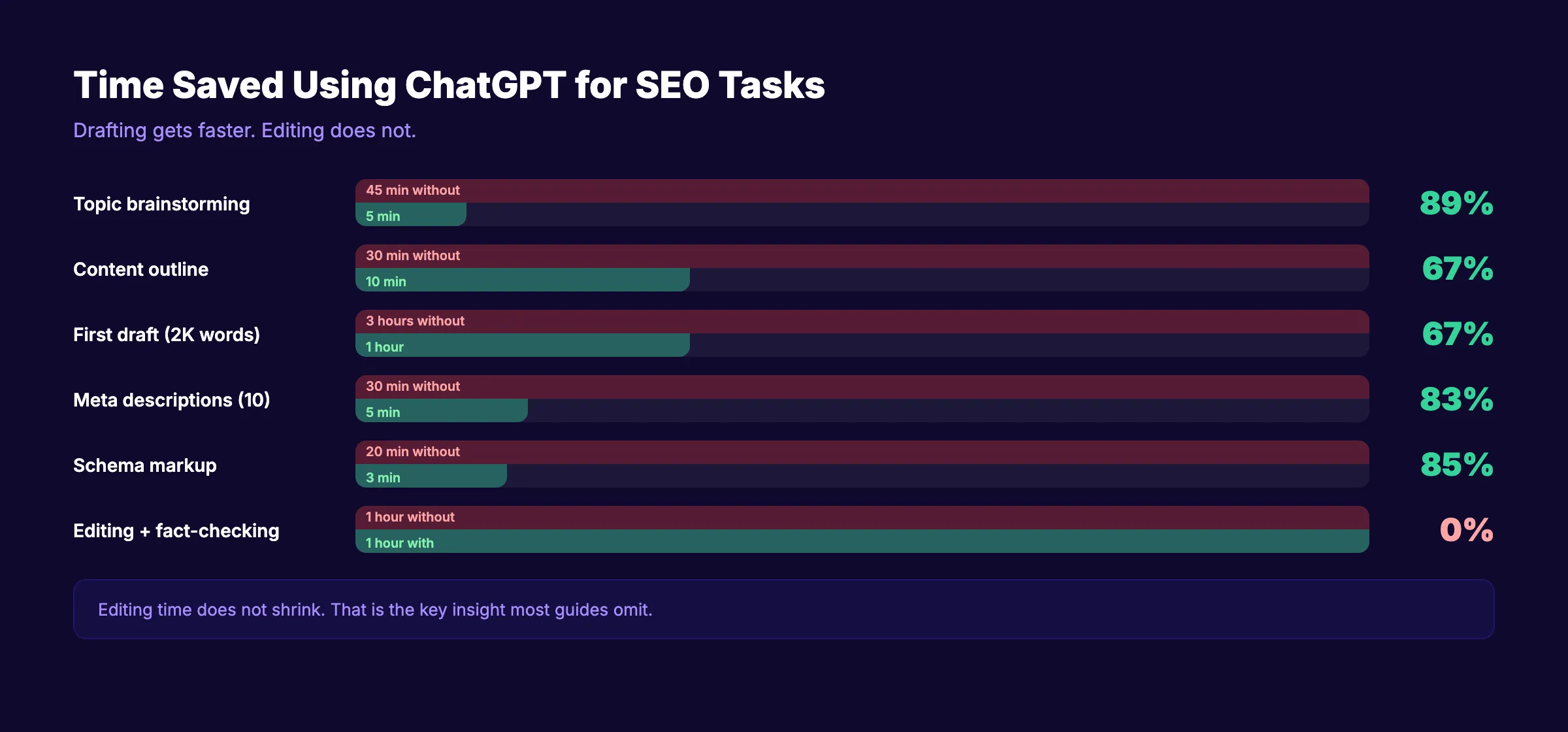
Time saved is the primary metric. Content quality is the constraint.
Realistic time savings by task:
| Task | Without ChatGPT | With ChatGPT | Time Saved |
|---|---|---|---|
| Topic brainstorming (20 ideas) | 45 min | 5 min | 89% |
| Content outline | 30 min | 10 min | 67% |
| First draft (2,000 words) | 3 hours | 1 hour | 67% |
| Meta descriptions (10 pages) | 30 min | 5 min | 83% |
| Schema markup | 20 min | 3 min | 85% |
| Editing and fact-checking | 1 hour | 1 hour | 0% |
The editing step does not get faster. That is the key insight most guides omit. ChatGPT reduces drafting time by 60 to 85%. It reduces editing time by zero. And editing is what separates content that ranks from content that sits on page 4.
Cost comparison:
Hiring a freelance writer for a 2,000-word SEO article costs $150 to $300. Using ChatGPT Plus ($20 per month) to draft the same article costs effectively $0.50 to $1 in AI usage. But you still need 1 to 2 hours of human editing, which has a real cost.
The break-even point: if your editing time is worth less than the freelancer's all-in rate, ChatGPT saves money. If you spend 3 hours editing every AI draft, you are not saving anything.
What practitioners are saying on X
AI search advice ages quickly. Here is high-signal public discussion from SEO and growth operators — context for your roadmap, not a substitute for primary data.
- @jakezward (Feb 2026): 2026 SEO predictions emphasize AI Overview share-of-SERP, schema for LLM token efficiency, brand mentions in AI answers as a KPI, proprietary data as a moat, and content refresh beating net-new AI slop. See the post on X.
- @alexgroberman (Jul 2026): Case narrative: organic value plus multi-engine citations (ChatGPT, Perplexity, Grok) from knowledge-hub pages, category authority links, commercial intent content, and tight internal linking — not thin product copy. See the post on X.
- @varunram (Jul 2026): Critique of GEO slopfarm products that combine SEO clickbait with unresearched content marketing — quality and research still separate winners from farms. See the post on X.
Grok, AI Overviews, and multi-engine visibility
For topics covered in “chatgpt for seo content”, multi-engine visibility still starts with clear definitions, sourced statistics, and extractable section answers. Grok additionally factors live X discussion — keep public claims consistent with this page.
- Google AI Overviews: Use passage-ready answers and structured data.
- ChatGPT / Perplexity: Cite named sources next to key claims.
- Grok: Maintain accurate entity facts on-site and in high-signal X posts.
How to measure multi-engine visibility in 2026
Split KPIs across classic search, AI Overview citations, chat referrals, and Grok-ready brand accuracy.
- GSC: non-brand clicks and query annotations.
- Citations: named in AI answers?
- Referrals: ChatGPT / Perplexity in GA4.
- Grok: on-site claims match public X discussion.
FAQ
No. Google's official guidelines state that AI-generated content is not automatically spam. The quality of the content determines how Google treats it. Thin, unedited AI dumps violate spam policies. Well-edited, expert-reviewed AI-assisted content ranks like any other content.
GPT-4o offers the best balance of quality and speed for long-form SEO content. Use it for outlines and section-by-section drafting. GPT-4o-mini works well for shorter tasks like meta descriptions and schema markup. Use o3 for complex content strategy analysis.
Not entirely. ChatGPT handles content drafting, ideation, and technical markup generation. It cannot perform keyword research with real search data, build backlinks, track rankings, or provide strategic direction based on your specific competitive situation. It replaces some of the work an agency does, not all of it.
Set a specific persona and writing style in your first prompt. Write section by section instead of all at once. After drafting, run a humanization pass that removes AI patterns: delete filler transitions, vary sentence length, add opinionated statements, and replace hedge words with direct claims. Read every paragraph out loud before publishing.
Yes, if you produce content regularly. The free tier restricts you to GPT-4o-mini with usage limits. ChatGPT Plus gives access to GPT-4o (better long-form output), o3 (deeper reasoning), and higher usage caps. At $20 per month, it pays for itself if it saves you 2 or more hours of content work monthly.
Google recommends transparency about how content is created but does not require disclosure. The SEO impact is neutral either way. The more important factor is whether the content demonstrates expertise and adds unique value. If it does, disclosure does not hurt. If it does not, disclosure will not save it.
Rank everywhere. Do nothing. Blog SEO, Local SEO, and Social on autopilot.
Related Tools & Resources
Free SEO Tools:
Best Lists:
Sources & references
- [1] Princeton / Georgia Tech et al. — GEO research (arXiv:2311.09735)
- [2] @jakezward on X — 2026 SEO predictions emphasize AI Overview share-of-SERP, schema for LLM token efficiency, brand mentions in AI answers
- [3] @alexgroberman on X — Case narrative: organic value plus multi-engine citations (ChatGPT, Perplexity, Grok) from knowledge-hub pages, category
- [4] Referenced source — developers.google.com

Plan topics, review article drafts, and publish to a connected CMS.
Weekly local SEO teardowns
One practical email a week. Map Pack, GBP, AI Overviews — no fluff. Unsubscribe anytime.