Most websites publish blog posts at random. A productivity tip on Monday. A product update on Wednesday. A thought leadership piece on Friday.
Topical authority comes from covering a subject completely rather than publishing at random. Pick a topic you can genuinely own, map the questions buyers ask across it, publish a hub page and its supporting articles, and link them so search engines can see the full coverage.
Most websites publish blog posts at random. A productivity tip on Monday. A product update on Wednesday. A thought leadership piece on Friday. Google indexes all of them and rewards none of them.
That is the core problem. Search engines do not rank individual pages in isolation anymore. They evaluate whether your entire site demonstrates deep, structured expertise on a topic. The sites that build topical authority dominate rankings. Everyone else fights for scraps.
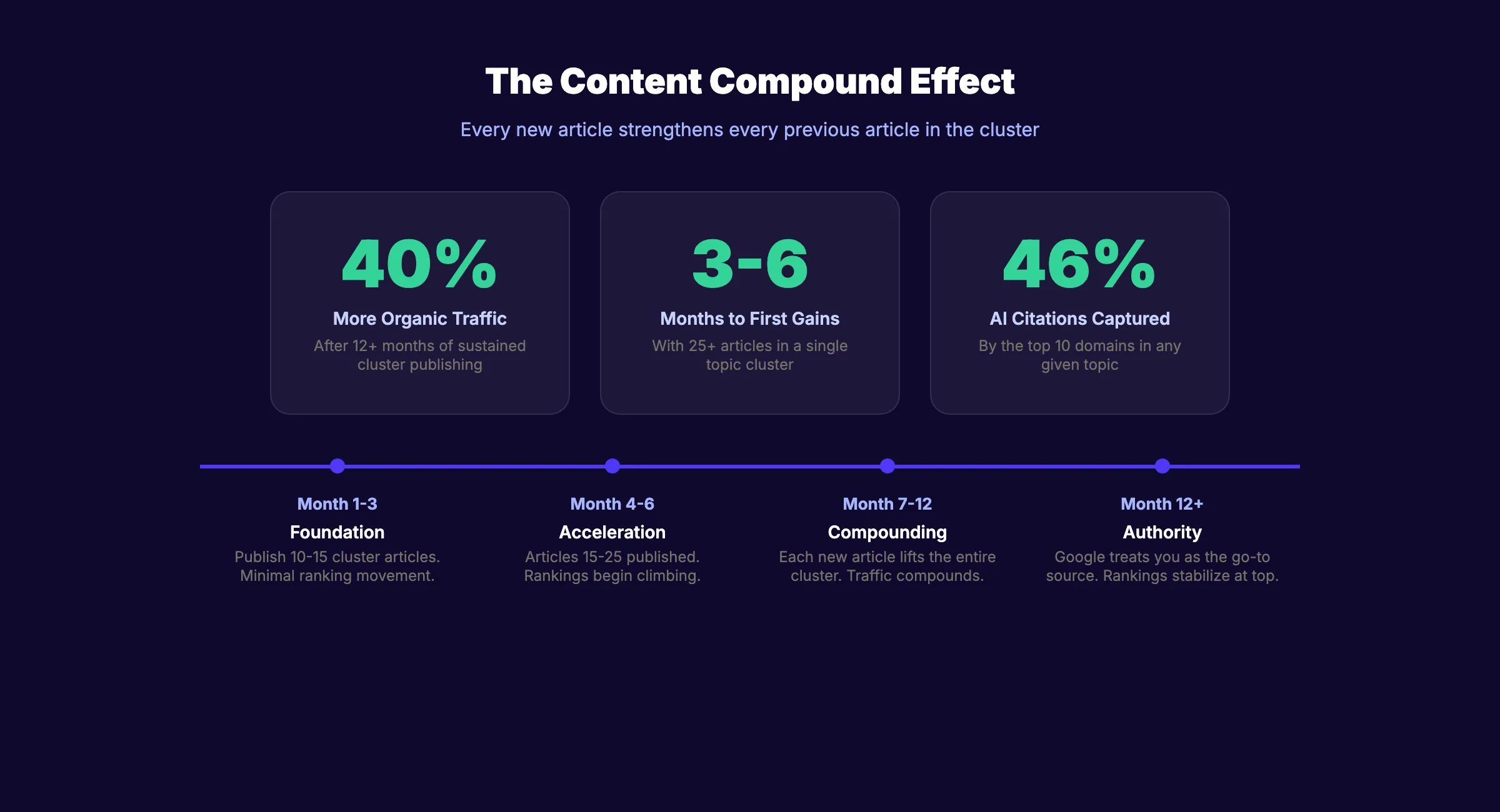
Publishing 25 or more articles within a single content cluster produces a 40 to 70% increase in keyword rankings within 3 to 6 months. Sites that sustain cluster publishing for 12 or more months see 40% higher organic traffic than those relying on single-page strategies.
We publish 3,500+ blog posts across 70+ industries. Every article we produce fits into a topical cluster. Our average on-page SEO score is 92%. Topical authority is not a theory for us. It is the system we run every day.
Here is what you will learn:
- What topical authority is and why Google rewards it over domain authority
- How to choose a core topic that drives revenue
- How to build a topical map from scratch using keyword research and search intent
- The content cluster architecture that connects pillar pages to supporting posts
- Internal linking rules that pass authority where it matters
- Why publishing cadence compounds over time (The Content Compound Effect)
- How to measure topical authority with real signals
- The 3 mistakes that destroy topical authority fastest
Table of Contents
- Chapter 1: What Topical Authority Is and Why Google Rewards It
- Chapter 2: How to Choose Your Core Topic
- Chapter 3: How to Build a Topical Map From Scratch
- Chapter 4: Content Cluster Architecture That Ranks
- Chapter 5: Internal Linking That Builds Authority
- Chapter 6: Publishing Cadence and The Content Compound Effect
- Chapter 7: How to Measure Topical Authority
- Chapter 8: Common Mistakes That Destroy Topical Authority
- FAQ
Chapter 1: What Topical Authority Is and Why Google Rewards It
Google no longer evaluates pages one at a time. It evaluates your entire site as a knowledge source. If you cover a topic deeply, consistently, and with clear structure, Google treats you as an authority on that subject. Every page in that topic cluster benefits.
That shift changed everything about SEO strategy. One excellent article on a topic you rarely cover will lose to a mediocre article on a site that covers the topic exhaustively. Depth and breadth across a subject matter more than any single page.
If you need a deeper conceptual foundation, read our guide on what topical authority is before continuing.
How Search Engines Measure Topical Authority
Google measures topical authority through several signals working together. Content coverage is the first. How many pages on your site address subtopics within a given subject? Second is semantic depth. Do your articles use the entities, related terms, and co-occurring phrases that experts naturally include?
Third is structural clarity. Are your pages connected through internal links that show relationships between subtopics? Fourth is freshness. Does your site update and expand its coverage over time?
The algorithm evaluates all 4 signals together. A site with 50 articles about email marketing, connected through internal links, with recent updates, will outrank a site with 3 articles on the same topic. Even if those 3 articles are individually better.
Topical Authority vs. Domain Authority
Domain authority is a third-party metric based on backlink profiles. Topical authority is Google's own assessment of your expertise on a specific subject. They are not the same thing.
A new site with zero backlinks can build topical authority in 6 months by publishing structured content clusters. A high-DA site that covers 100 topics superficially can lack topical authority in every single one.
This distinction matters for E-E-A-T signals too. Google wants to see that a site demonstrates experience, expertise, authoritativeness, and trustworthiness on a specific topic. Topical authority is how E-E-A-T manifests in practice.
The Rankings Boost Is Real
The data backs this up. An analysis of over 250,000 search results found that topical authority is now the strongest on-page ranking factor. Sites with complete topic coverage earn faster indexing, more stable rankings, and higher visibility in AI-generated answers.
The top 10 domains in any topic capture 46% of all ChatGPT citations. Building topical authority is no longer just about Google rankings. It is about visibility across every search surface, including AI Overviews, Perplexity, and conversational search tools.
Websites that build topical authority see measurable gains in organic traffic within 3 to 6 months of consistent publishing.
Chapter 2: How to Choose Your Core Topic
Topic selection is the most consequential decision in this entire process. Choose the wrong topic and 6 months of content production delivers nothing. Choose the right one and every article compounds on the last.
The mistake most businesses make is picking topics based on search volume alone. High volume means high competition. A 50-person law firm does not need to build topical authority around "personal injury law" as a whole. It needs to own a subtopic like "truck accident claims in Texas."
Align Topics With Revenue, Not Just Volume
Your core topic must connect directly to what your business sells. A SaaS company selling project management software should not build topical authority around "productivity tips." It should own "project management for remote teams" or "agile project management."
The test is simple. If someone reads every article in your topic cluster, would they be more likely to buy your product or service? If the answer is no, pick a different topic.
Read our content marketing strategy guide for a full framework on aligning content with business goals.
The 3-Question Test for Topic Selection
Before committing to a core topic, answer these 3 questions:
| Question | Good Answer | Bad Answer |
|---|---|---|
| Does this topic connect to our product or service? | Directly supports a buying decision | Loosely related at best |
| Can we publish 30+ articles on subtopics? | Yes, with clear subtopic variety | Runs out of ideas at 10 |
| Is the competition beatable in 6 to 12 months? | Mix of high and low DR sites ranking | Only DR 80+ sites on page 1 |
If you answer "good" to all 3, you have a viable core topic. If any answer is "bad," narrow or pivot.
Examples by Industry
A dental practice should not target "dentistry." That is too broad. Instead, build topical authority around "cosmetic dentistry procedures" or "dental implant recovery." Every article supports the service page.
A local HVAC company should own "home heating efficiency" or "AC maintenance guides." A marketing agency should own a niche like blog SEO or "B2B lead generation."
The narrower the topic, the faster you build authority. You can always expand later.
Topical authority starts with publishing. theStacc writes and publishes 30 SEO-optimized articles per month, all structured into topic clusters.
Chapter 3: How to Build a Topical Map From Scratch
A topical map is the blueprint for your content cluster. It lists every subtopic, every article, and every search intent you need to cover. Without one, you are guessing. With one, every article you publish fills a specific gap in your authority.
Building the map requires 3 steps: subtopic discovery, keyword research, and intent grouping.
Map Subtopics Across the Funnel
Start by listing every question a potential customer might ask about your core topic. Organize them by funnel stage.
Top of funnel. Awareness: "What is [topic]?" and "Why does [topic] matter?"
Middle of funnel. Consideration: "How to [do specific thing]" and "[Topic A] vs. [Topic B]"
Bottom of funnel. Decision: "Best [tools/services] for [topic]" and "[specific product] review"
A complete topical map covers all 3 stages. Most sites only publish top-of-funnel content and wonder why it does not convert. Cover the middle and bottom too.
Keyword Research for Topic Clusters
Use keyword research to validate every subtopic. For each potential article, identify the primary keyword, monthly search volume, keyword difficulty, and search intent.
Group keywords that share the same intent into a single article. Two keywords with the same intent do not need 2 separate posts. Google will rank one page for both. Creating 2 posts on the same intent causes cannibalization.
Use tools like Google Search Console, Ahrefs, or Semrush to find content gaps in your existing coverage.
Start with your pillar topic and work outward. List every "what is," "how to," "best," and "vs." variation. A strong cluster for "topical authority" might include 8 to 12 subtopic articles: what it is, how to build it, how to measure it, common mistakes, tools, case studies, and comparisons to related concepts.
Prioritize subtopics by a combination of search volume and strategic importance. Not every article needs high volume. Some exist purely to fill a gap that competitors have not covered. Those gap-filling articles often become your strongest authority signals because they prove exhaustive coverage.
Group by Search Intent
Every article in your topical map must serve a distinct search intent. The 4 intent types are:
| Intent Type | Example Query | Content Format |
|---|---|---|
| Informational | "What is topical authority?" | Definition guide |
| Navigational | "Ahrefs topical authority tool" | Tool review |
| Commercial | "Best tools to build topical authority" | Comparison list |
| Transactional | "Buy SEO content service" | Landing page |
Map each article to one intent type. If 2 articles serve the same intent for overlapping keywords, merge them. A clean topical map has zero overlap between articles.
Chapter 4: Content Cluster Architecture That Ranks
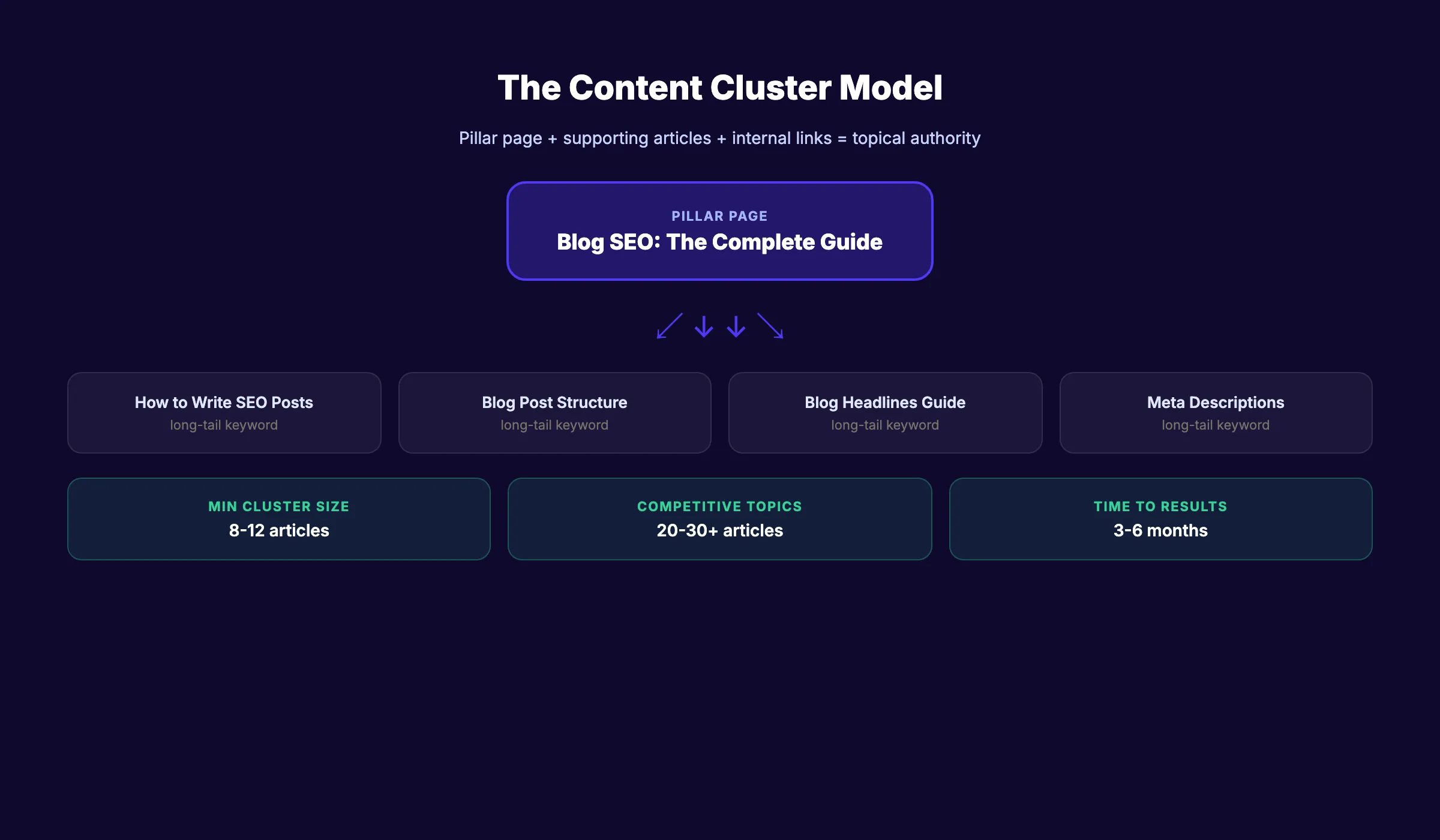
A content cluster is a group of interlinked articles covering one core topic. It has 2 parts: a pillar page and cluster pages. The pillar page covers the broad topic. Cluster pages dive deep into specific subtopics.
This architecture tells Google exactly what your site is about. Every cluster page reinforces the pillar. Every pillar page distributes authority to its clusters. The structure itself is a ranking signal.
Pillar Pages vs. Cluster Pages
A pillar page is a broad, long-form guide covering your core topic at a high level. It links to every cluster page. Think of it as the table of contents for your topic.
Cluster pages are focused articles targeting specific subtopics. Each one links back to the pillar and to 2 to 3 related cluster pages. They go deeper than the pillar on their specific subtopic.
| Element | Pillar Page | Cluster Page |
|---|---|---|
| Scope | Broad topic overview | Narrow subtopic deep-dive |
| Word count | 3,000 to 5,000 words | 1,500 to 3,000 words |
| Internal links | Links to all clusters | Links to pillar + 2-3 clusters |
| Target keyword | Head term (high volume) | Long-tail (lower volume) |
| Update frequency | Quarterly | As needed |
Follow our blog post structure guide to format each page for maximum readability and SEO performance.
The Hub-and-Spoke Model
The hub-and-spoke model places your pillar page at the center. Cluster pages radiate outward like spokes. Every spoke connects back to the hub and to adjacent spokes.
This model works because Google crawls links to understand relationships. When 15 articles all link to one pillar page about "topical authority," Google understands that page is the most important resource on your site for that topic.
The model also helps readers. Someone landing on a cluster page about "keyword research for topic clusters" can follow a link to the pillar for a broader overview, or to a sibling cluster about "internal linking strategy."
How to Avoid Keyword Cannibalization
Cannibalization happens when 2 or more pages compete for the same keyword. It confuses Google and splits your ranking potential.
Prevent it by assigning one primary keyword per page. No 2 pages in your cluster should target the same primary keyword. If you find overlap, merge the pages or differentiate their intent.
Use SEO content writing best practices to ensure each page has a distinct angle even when topics are closely related.
Chapter 5: Internal Linking That Builds Authority
Internal links are the plumbing of topical authority. Without them, Google cannot see the relationships between your pages. With them, authority flows from strong pages to new ones. Rankings improve across the entire cluster.
A site with 50 unlinked articles has 50 orphan pages. A site with 50 articles connected through strategic internal links has a topical authority engine.
Link Architecture Rules
Every cluster page must link to its parent pillar page. Every pillar page must link to every cluster page. Cluster pages should link to 2 to 3 sibling clusters. No page should exist without at least 3 internal links pointing to it.
Follow these rules and your site structure mirrors the topical map. Google can crawl from any page and understand the full scope of your expertise.
Use descriptive anchor text that includes the target keyword of the destination page. "Click here" tells Google nothing. "Keyword research for blog posts" tells Google exactly what the linked page covers.
Anchor Text Best Practices
Anchor text should be natural, varied, and descriptive. Do not use the same anchor text for every link to a page. Rotate between the primary keyword, a variation, and a natural phrase.
Good examples:
- "Learn how to write meta descriptions that earn clicks"
- "Follow our blog post outline guide to structure your drafts"
- "Start with an SEO audit to find gaps"
Bad examples:
- "Click here for more"
- "Read this article"
- Using the exact same anchor text 10 times
Audit Your Existing Internal Links
If you already have content published, audit your internal links before building new clusters. Look for orphan pages with zero internal links pointing to them. Look for pages with broken links. Look for opportunities to connect existing content into clusters.
Run a full content audit to identify which pages belong to which clusters and where the link gaps are.
Internal linking at scale is hard to do manually. theStacc builds internal links into every article automatically, connecting your content into clusters that search engines reward.
Chapter 6: Publishing Cadence and The Content Compound Effect
Publishing 1 or 2 blog posts per month does not build topical authority. It barely registers. Google needs to see consistent, sustained publishing within a topic to treat your site as an authoritative source.
The data is clear. 45% of marketers say "creating more content and publishing more often" is the most effective tactic for improving search rankings. Frequency matters.
Why 1 to 2 Posts a Month Does Not Work
At 2 posts per month, building a 30-article content cluster takes over a year. During that time, competitors publishing 8 to 10 posts per month will complete their clusters 4 times faster. They build topical authority first. You rank second.
The math works against you at low velocity. Google re-evaluates topic coverage regularly. A site that adds 2 pages to a cluster every month signals slow, inconsistent investment. A site that adds 8 to 10 pages per month signals commitment and expertise.
Check our analysis of how many blog posts you need to rank for specific benchmarks by industry and competition level.
The Content Compound Effect
We call this The Content Compound Effect. Every article you publish does not just rank on its own. It strengthens every other article in the cluster. Article 10 helps articles 1 through 9 rank higher. Article 20 helps all 19 previous articles.
The effect is not linear. It is exponential. The first 10 articles in a cluster might produce modest results. Articles 11 through 20 produce 2 to 3 times the impact per article. By article 30, every new post lifts the entire cluster.
This is why publishing velocity determines who wins topical authority races. Two sites targeting the same topic with equal content quality will produce very different results based on speed.
| Monthly Publishing Rate | Time to 30-Article Cluster | Authority Signal |
|---|---|---|
| 2 posts/month | 15 months | Weak |
| 4 posts/month | 7.5 months | Moderate |
| 8 posts/month | 3.75 months | Strong |
| 15 posts/month | 2 months | Dominant |
How to Scale Without Sacrificing Quality
Speed without quality produces thin content that hurts rankings. The answer is not to lower standards. It is to build systems that maintain quality at higher volume.
Use a content calendar to plan topics in advance. Batch research across related articles. Create templates for recurring content formats. Scale content production with AI while maintaining editorial standards.
The businesses that build topical authority fastest are the ones that systematize publishing. They do not rely on one writer producing when they feel inspired. They run a content operation.
Chapter 7: How to Measure Topical Authority
Topical authority is not a metric you can pull from a dashboard. No tool gives you a single "topical authority score." Instead, you track a set of signals that together indicate whether Google treats your site as an authority on your chosen topic.
Track Cluster Rankings, Not Just Pages
Do not measure success by tracking individual page rankings. Measure success by tracking how your entire cluster performs. If you have 25 articles in a content cluster, track the average ranking position across all 25.
A rising average position means Google is recognizing your topical authority. A flat or declining average means you need more depth, better links, or fresher content.
Use a spreadsheet or rank tracking tool to monitor cluster-level performance weekly. Group keywords by cluster. Track the percentage of cluster keywords ranking on page 1.
Here is a simple framework for cluster-level tracking:
| Metric | What It Tells You | Check Frequency |
|---|---|---|
| Avg. position across cluster keywords | Overall authority strength | Weekly |
| % of cluster keywords on page 1 | Coverage completeness | Bi-weekly |
| Total cluster impressions (GSC) | Google's trust in your topic | Monthly |
| Cluster click-through rate | Content quality signal | Monthly |
| New queries triggering cluster pages | Authority breadth expansion | Monthly |
GSC Signals That Prove Authority
Google Search Console reveals topical authority through several patterns. Look for these signals.
Impressions growth across a cluster. When Google shows more of your pages for related queries, it trusts your topic coverage. If impressions rise across the cluster (not just one page), that is a strong authority signal.
Query breadth expansion. Open the Performance report and filter by pages in your cluster. If the number of unique queries triggering your pages is growing, Google is matching your content to a wider range of related searches.
Position improvements without new backlinks. If pages in your cluster are climbing in rankings without acquiring new external links, the lift is coming from topical authority. Internal signals are doing the work.
Run regular on-page SEO checks to ensure technical factors are not holding back your authority signals. Optimize existing content in clusters where signals are stalling.
When to Expand vs. Deepen
Once a cluster reaches 20 to 30 articles and shows strong ranking signals, you face a choice. Do you add more depth to the existing cluster or start a new one?
The answer depends on opportunity. If your cluster covers 80% of relevant subtopics and most pages rank on page 1, start a new cluster. If gaps remain and competitors outrank you on specific subtopics, deepen first.
A good rule: finish one cluster before starting another. Incomplete clusters produce weaker authority signals than complete ones.
Tracking topical authority across multiple clusters is complex. theStacc handles the publishing, linking, and optimization so you can focus on your business.
Chapter 8: Common Mistakes That Destroy Topical Authority
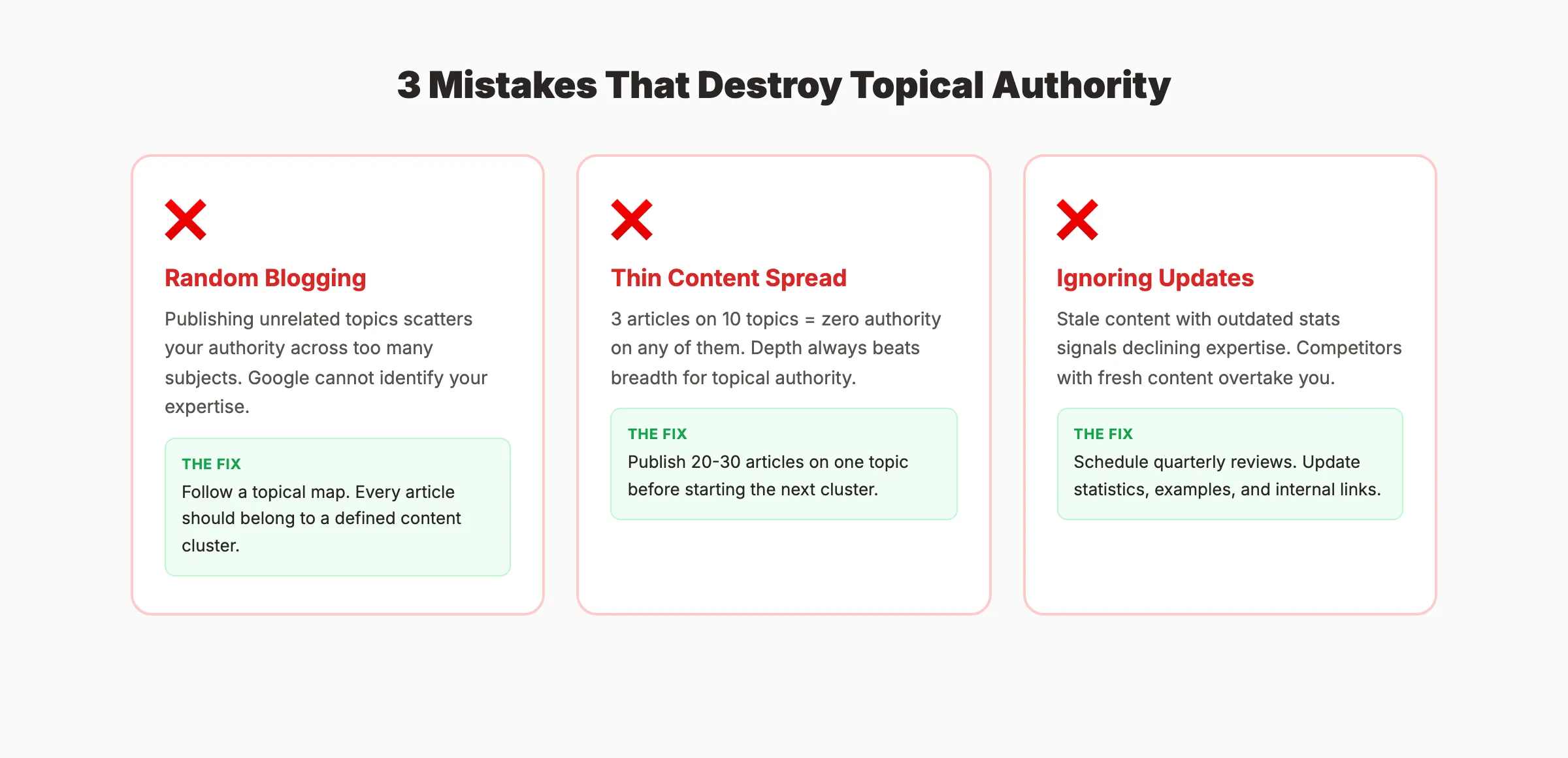
Building topical authority takes months of focused effort. Destroying it takes one bad decision. These are the 3 mistakes we see most often across the 70+ industries we serve.
Random Blogging
The number 1 killer of topical authority is publishing without a plan. A post about email marketing, then one about social media, then one about web design, then one about SEO. Google cannot identify what your site is about because your site does not know what it is about.
Random blogging spreads your authority thin across dozens of topics. You never build enough depth in any single one. The fix is committing to a topical map and following it.
Thin Content Across Too Many Topics
Some sites try to cover 10 topics at once with 3 articles each. Thirty articles sounds productive. But 3 articles per topic does not register as topical authority for any of them.
Better to publish 30 articles on 1 topic than 3 articles on 10 topics. Depth beats breadth every time. Once you dominate one topic, expand to the next.
The same principle applies to word count. Every page in your cluster must deliver real value. Follow blog post length guidelines to match the depth your topic requires. Thin 300-word posts do not contribute to topical authority.
Ignoring Content Updates
Topical authority erodes when content goes stale. An article published in 2023 with outdated statistics signals to Google that your expertise is not current. Competitors who update old blog posts with fresh data will overtake you.
Schedule quarterly reviews of your top-performing cluster content. Update statistics, refresh examples, add new internal links to recently published articles, and expand sections where competitors now offer more depth.
The sites that maintain topical authority long-term treat their content like a product. They iterate, improve, and expand. They do not publish and forget.
What practitioners are saying on X
AI search advice ages quickly. Here is high-signal public discussion from SEO and growth operators — context for your roadmap, not a substitute for primary data.
- @hridoyreh (Mar 2026): Widely shared SEO skill tree: foundations, research, technical, on-page, content, links, AI SEO/GEO, analytics, UX, brand, programmatic — useful map for stats and how-to posts. See the post on X.
- @jakezward (Feb 2026): 2026 SEO predictions emphasize AI Overview share-of-SERP, schema for LLM token efficiency, brand mentions in AI answers as a KPI, proprietary data as a moat, and content refresh beating net-new AI slop. See the post on X.
Grok, AI Overviews, and multi-engine visibility
For “build topical authority”, multi-engine visibility still starts with clear definitions, sourced numbers, and extractable section answers. Grok additionally factors live X discussion — keep public claims consistent with this page.
- Google AI Overviews: Use passage-ready answers, tables, and FAQ schema where relevant.
- ChatGPT / Perplexity: Cite named sources next to key claims.
- Grok: Maintain accurate entity facts on-site and in high-signal X posts.
Publish content built for Google and AI citations. theStacc’s Content SEO module ships SEO-scored articles structured for rankings and generative engines — including clearer entity pages models like Grok can quote.
FAQ
Most sites see measurable ranking improvements within 3 to 6 months of consistent cluster publishing. Full topical authority, where Google treats you as the go-to source, typically takes 12 to 18 months. Publishing velocity is the biggest variable. At 8 to 10 posts per month, you reach authority faster than at 2 posts per month.
There is no fixed number, but most competitive topics require 20 to 40 articles in a cluster. Less competitive niches may need 10 to 15. The key is covering every meaningful subtopic and search intent within your chosen topic. Completeness matters more than a specific article count.
Yes. Topical authority is not based on domain age or backlink count. A new site that publishes 30 focused articles on one topic within 6 months can outrank a large site that covers that topic with only 5 generic posts. Focus and depth win over size and age.
E-E-A-T is Google's quality framework for evaluating content creators. Topical authority is one way E-E-A-T manifests at the site level. A site with deep topical authority demonstrates expertise and authoritativeness on that subject. They are connected but not identical. E-E-A-T also considers author credentials, first-hand experience, and trustworthiness signals.
Yes. AI search tools like Google AI Overviews, ChatGPT, and Perplexity pull information from sites with strong topical authority. The top 10 domains in any topic capture 46% of all AI citations. Building topical authority today positions your site for visibility across both traditional and AI-driven search.
Building topical authority is the highest-return investment in SEO. It compounds over time, strengthens every page on your site, and protects your rankings from algorithm updates. Start with one topic, build the map, publish consistently, and link strategically. The results will follow.
Ready to build topical authority on autopilot? theStacc publishes 30 SEO-optimized blog posts per month, structured into topic clusters with internal links built in.
Sources & references
- [1] Princeton / Georgia Tech et al. — GEO research (arXiv:2311.09735)
- [2] @hridoyreh on X — Widely shared SEO skill tree: foundations, research, technical, on-page, content, links, AI SEO/GEO, analytics, UX, bran
- [3] @jakezward on X — 2026 SEO predictions emphasize AI Overview share-of-SERP, schema for LLM token efficiency, brand mentions in AI answers
- [4] Referenced source — searchengineland.com

Plan topics, review article drafts, and publish to a connected CMS.
Weekly local SEO teardowns
One practical email a week. Map Pack, GBP, AI Overviews — no fluff. Unsubscribe anytime.
Explore this topic: Topical Authority.