7 ways digital marketing agencies make money. Retainers, project fees, ad commissions, and more. Includes real profit margin data by agency size. 2026.
Digital marketing agencies make money through seven revenue models: monthly retainers, project fees, hourly billing, performance pricing, media commissions, reselling white-label services, and productized offers. Retainers carry the highest margin because delivery is systematized. This guide breaks down each model with profit margin data by agency size.
The global digital marketing services market crossed $455 billion in 2025. So how do digital marketing agencies make money from that. And how much do they actually keep?
Most clients writing those checks have no idea where their money goes or how the margin is built. If you are building an agency, evaluating one, or trying to understand what you are paying for, the revenue model matters. The same service can yield a 10% margin or a 60% margin depending on how it is structured. Two agencies charging identical rates can have wildly different profitability based on their delivery setup.
In this guide, you will learn:
- How the 7 core agency revenue models work
- Which pricing structures generate the highest margins
- What agencies actually earn at different sizes
- How white label services change the economics entirely
- Why some agencies plateau at $500K and others scale past $5M
We have published 3,500+ SEO articles across 70+ industries and work directly with marketing agencies as clients. This is what the numbers actually look like.
Table of Contents
- Chapter 1: Service Fees. The Primary Revenue Engine
- Chapter 2: Retainer-Based Pricing. Why 78% of Agencies Use It
- Chapter 3: Project-Based and Hourly Fees
- Chapter 4: Performance-Based and Commission Models
- Chapter 5: White Label Margins. The Scalability Unlock
- Chapter 6: Passive and Secondary Revenue Streams
- Chapter 7: What Agencies Actually Earn. Real Profit Data
Chapter 1: Service Fees. The Primary Revenue Engine
Most agency revenue starts in one place: selling marketing services directly to clients.
An agency assembles specialists. SEO analysts, content writers, paid media buyers, web designers, social media managers. And charges clients for access to that expertise. The client gets a marketing function without hiring full-time staff. The agency profits on the gap between what the work costs to deliver and what the client pays.
That gap is the business.
The Core Services Agencies Sell
The services vary by agency type, but the most common include:
- SEO. On-page optimization, technical audits, link building, and content production
- Paid advertising. Google Ads, Meta Ads, LinkedIn Ads, and programmatic display
- Content marketing. Blog posts, landing pages, email sequences, and white papers
- Social media management. Content creation, scheduling, and community management
- Web design and development. Website builds, landing pages, and conversion rate optimization
- Email marketing. List management, campaign design, and automation setup
- Local SEO. Google Business Profile optimization, citation building, and review management
A content marketing strategy is typically one of the first services an agency builds around, because content touches every other channel.
The Markup Structure
Every service has a cost to deliver. A blog post might cost $80 in writer time and $20 in editorial review. The agency charges $300. That $200 margin covers project management, overhead, and profit.
The same logic applies across every service line. SEO work billed at $150/hour might cost the agency $60-$80 in actual labor. Paid media management charged at 15% of ad spend costs less than 5% to deliver operationally.
Understanding the markup structure is how you understand the actual business model. And why some agencies make real money while others spin their wheels at breakeven.
Stop writing. Start ranking. theStacc writes and publishes SEO articles for agencies and their clients. Fully optimized, automatically delivered.
Chapter 2: Retainer-Based Pricing. Why 78% of Agencies Use It
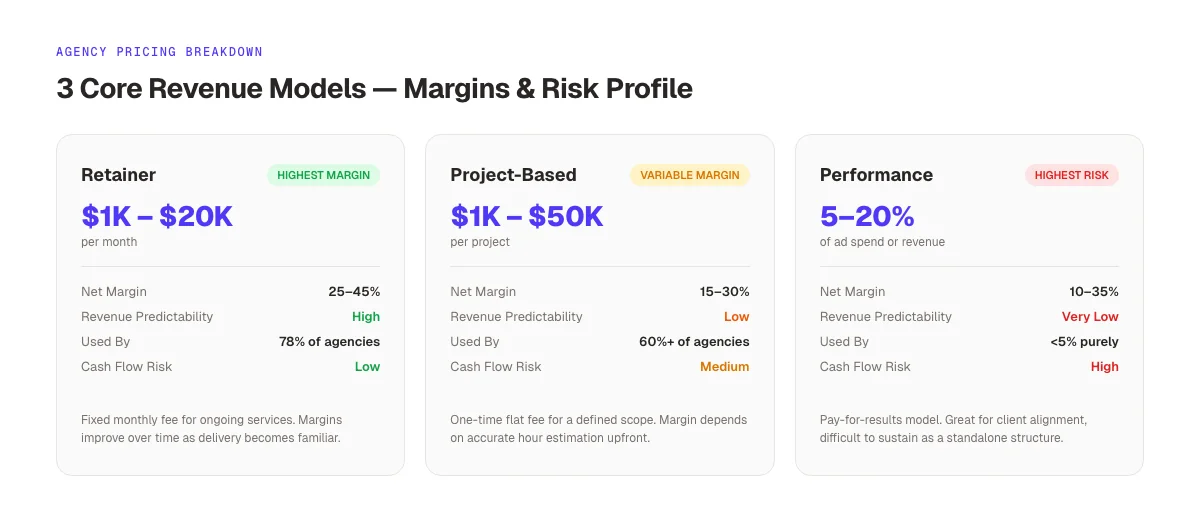
Retainers are the backbone of agency revenue. A 2026 survey by Influencer Marketing Hub found that 78% of digital agencies use retainer-based pricing as their primary model. Up from 64% in 2023.
The reason is straightforward: predictable cash flow.
How Retainers Work
The client pays a fixed monthly fee in exchange for ongoing access to the agency's services. That fee is calculated based on estimated hours multiplied by a blended hourly rate, plus a margin for account management and overhead.
A typical retainer breakdown:
| Service Block | Hours | Rate | Monthly Cost |
|---|---|---|---|
| SEO work | 10 | $150/hr | $1,500 |
| Content creation | 8 | $125/hr | $1,000 |
| Account management | 5 | $100/hr | $500 |
| Agency margin (30%) | , | , | $900 |
| Client invoice | $3,900 |
The average digital marketing retainer in 2026 runs around $3,500/month. Most agencies set minimums between $1,000 and $1,500/month. Enterprise retainers for larger clients can reach $15,000-$20,000/month.
For a full breakdown of what agencies charge by service and market, see the real cost of a marketing agency.
Why Retainers Generate the Highest Margins
The first month of a retainer is expensive. The agency spends time onboarding, auditing, and learning the client's business. At full cost against the fee.
Month two and month three are where the economics improve. The work becomes familiar. Delivery speeds up. The hours required drop without the invoice changing. A retainer client at month 12 typically generates significantly higher margins than a new project client, even at the identical monthly price.
Industry benchmarks show that agencies with 80%+ of revenue in retainers report 30% higher average margins than project-heavy shops. Because recurring clients do not require reselling every month.
The Scope Creep Problem
The primary risk with retainers is scope creep. Clients request work outside the agreed deliverables. Without strict scope documentation and a formal change order process, the agency absorbs that time against the fixed fee. Steadily eroding the margin.
The highest-margin agencies document scope down to the deliverable level (not just "SEO services") and handle every out-of-scope request as a separate line item.
Chapter 3: Project-Based and Hourly Fees
Not every client relationship starts with a retainer. Project-based work is how most agencies land new clients, test compatibility, and build trust before committing to an ongoing engagement.
Project-Based Pricing
Project fees cover a defined scope of work at a flat rate. The most common project types in 2026:
| Project Type | Typical Price Range |
|---|---|
| Website redesign | $5,000 – $50,000 |
| SEO audit + strategy | $1,500 – $8,000 |
| Brand identity package | $3,000 – $15,000 |
| Email sequence setup | $1,000 – $5,000 |
| PPC campaign launch | $1,500 – $6,000 |
| Social media strategy | $2,000 – $8,000 |
| Content strategy + brief | $2,500 – $10,000 |
The margin on project work depends entirely on how accurately the agency scoped the hours. Underestimate, and the project loses money. Overestimate, and the client goes elsewhere.
About 60% of agencies rely on project-based billing as a secondary revenue stream alongside retainers. Less than 10% run project-only models. The revenue unpredictability makes sustainable growth nearly impossible.
Hourly Rates
Hourly billing covers consulting, strategy work, overflow capacity, or specialized tasks that are difficult to scope upfront. Rates in 2026 range from $75 to $400+ depending on:
- Agency tier. Boutique vs. established vs. full-service enterprise
- Service specialization. Niche experts command premium rates
- Geography. US/UK agencies typically charge more than Eastern European or Southeast Asian operations
- Seniority level. Senior strategists at $250+/hour vs. junior execution at $75-$100/hour
Hourly billing is most common for strategy and consulting engagements. For production work (writing, design, ads management), fixed fees are more predictable for both sides.
Why Project-Only Revenue Plateaus
An agency surviving entirely on project work faces a constant pipeline problem. Every month starts at zero revenue. The team is either overworked or idle depending on what closed last quarter.
That volatility caps hiring, limits reinvestment, and makes the business hard to scale past a certain point. The best agencies treat projects as a conversion opportunity. A gateway to retainer relationships, not a permanent model.
Chapter 4: Performance-Based and Commission Models
Performance-based pricing ties agency compensation to measurable outcomes: leads generated, sales closed, rankings achieved, or revenue attributable to the agency's work.
In theory, it aligns incentives. In practice, fewer than 5% of agencies operate on pure performance models.
How Performance Fees Work
The agency sets a baseline metric and charges a fee for results delivered above it. Common structures:
- Cost per lead. Agency earns a fixed amount per qualified lead delivered
- Revenue share. Agency takes 5-15% of attributed sales
- Ranking-based fees. Monthly bonuses tied to first-page Google placements achieved
- Hybrid retainer + bonus. Fixed monthly base plus performance kicker when KPIs are hit
The hybrid model is the crowd favorite. A lower monthly retainer covers baseline work and keeps the agency financially stable, while performance bonuses align incentives and reward exceptional results.
Ad Spend Commission: The Paid Media Revenue Engine
For agencies managing paid advertising, the standard compensation model is a percentage of monthly ad spend. Typically 10-20%.
A client spending $20,000/month on Google Ads generates $2,000-$4,000/month in management fees, in addition to any setup or strategy retainer. As the client scales their ad budget, agency revenue scales automatically. Without proportional increases in operational workload.
This is why paid media management is one of the highest-margin services an agency can offer at scale. Managing a $50,000/month ad account is not five times harder than managing a $10,000/month account. The margin advantage is real.
For agencies considering adding paid media to their service mix, the SEO ROI calculator helps demonstrate channel value to clients before they commit budgets.
Why Pure Performance Models Are Rare
Performance-based arrangements expose the agency to variables entirely outside its control. The client's sales team close rate, product pricing, website conversion rate, and market conditions. An agency can drive 500 qualified leads and still see no revenue if the client's follow-up process is broken.
Most agencies avoid pure performance models for exactly this reason. Hybrid arrangements with a floor retainer are far more common, and far more financially stable.
Your SEO team. $99/month. theStacc writes and publishes fully optimized SEO articles straight to your CMS. The content foundation that makes every other agency service work better. See the results →
Chapter 5: White Label Margins. The Scalability Unlock
White labeling is one of the most underused revenue models in agency economics. It is also one of the most structurally powerful.
Under a white label model, the agency sells services to clients but outsources actual delivery to a third-party provider. The client sees only the agency's branding. The agency keeps the markup between what it charges and what it pays for delivery.
How White Label Works in Practice
Here is a concrete example:
- Agency sells an SEO retainer to a client for $3,000/month
- Agency outsources content production to a white label SEO content provider for $1,200/month
- Agency manages the client relationship and reporting: 5 hours at $100/hour = $500
- Net margin: $3,000 - $1,200 - $500 = $1,300/month per client (43% net margin)
Scale that to 20 clients and you have $26,000/month in net margin from one service line, without adding a single employee.
Markup Ranges by Service Type
| Service | Typical White Label Markup |
|---|---|
| Blog content production | 150-250% |
| Technical SEO audits | 100-200% |
| Link building | 80-150% |
| PPC management | 80-120% |
| Social media content | 100-200% |
| Local SEO / GBP management | 100-150% |
Markup potential correlates with how systematized the delivery is. High-volume, repeatable services (content production, social posts, GBP updates) support larger markups. Highly custom, high-skill work (link acquisition, technical SEO strategy) has lower markup potential because the underlying cost is harder to compress.
The Growth Ceiling Without White Label
Agencies that rely entirely on in-house delivery face a hard ceiling: revenue is bounded by the hours the team can work. Each new client requires more headcount. As the team grows, salaries eat into margins. Revenue grows but profitability stays flat or declines.
White label removes that ceiling. The agency becomes a client management and sales operation, with delivery handled by specialized partners. This structural shift. From production agency to management agency. Is what allows shops to cross $1M, $5M, and $10M+ in revenue without linear headcount expansion.
The difference between an agency doing $500K and one doing $5M often comes down to this single decision: are you building a production team or a delivery network?
For a deeper comparison of agency models vs. alternative approaches, done-for-you vs. DIY vs. agency SEO covers the structural differences and how clients evaluate them.
Chapter 6: Passive and Secondary Revenue Streams
Beyond core services, established agencies generate revenue from several secondary sources. These rarely become the primary revenue driver. But they compound over time and improve margin quality.
Referral Partnerships
Many agencies earn referral commissions by connecting clients to software tools, vendors, or specialist service providers. A CRM referral might pay $200-$500 per sign-up. A web hosting or email marketing referral might pay $50-$150/month recurring.
Across a client base of 50 companies, referral income adds meaningful recurring revenue without incremental delivery work.
Digital Products and Training
Agencies that build proprietary frameworks often package them as:
- Online courses: $500-$5,000 per enrollment
- Templates and SOPs: $50-$500 one-time
- Workshops and intensives: $1,000-$10,000 per seat
The margin on digital products is near 100% after initial development. A well-positioned agency training program also builds authority, which attracts higher-quality clients who are easier to close at higher rates.
SaaS and Software Revenue
Some agencies spin up software products that serve the same audience they work with. An SEO agency might build a rank tracking tool. A social media agency might build a scheduling platform.
These command recurring subscription revenue fully independent of service delivery. The SaaS model is a significant investment. Development costs, ongoing maintenance, customer support. But agencies that successfully cross the SaaS threshold unlock valuation multiples that pure service businesses cannot achieve.
Subcontracting and Overflow Work
Agencies with excess capacity (or rare specialized expertise) earn revenue by acting as delivery partners for other agencies. One agency's overflow becomes another's billable project. This is especially common among boutique technical specialists. A technical SEO agency might fulfill work for a full-service agency lacking in-house depth.
Chapter 7: What Agencies Actually Earn. Real Profit Data
Revenue models explain how money comes in. Profit margins explain how much actually stays.
Agency Revenue by Size
| Agency Type | Annual Revenue Range |
|---|---|
| Solo / freelance (1 person) | $80,000 – $250,000 |
| Small (under 10 employees) | $200,000 – $500,000 |
| Mid-sized (10-50 employees) | $500,000 – $2,000,000 |
| Large (50-100 employees) | $2,000,000 – $5,000,000 |
| Enterprise (100+ employees) | $5,000,000 – $10,000,000+ |
A high-performing mid-sized agency serving 15-20 clients at $5,000-$9,000/month per client hits $1M+ in annual revenue. Most agencies at that scale run 8-12 clients before needing to add team members. A ratio that keeps margins healthy.
Revenue per employee is a useful efficiency benchmark. The 2024 industry average is approximately $163,000 per full-time employee. Agencies above $200,000 per employee are operating lean. Below $100,000 per employee typically signals overstaffing, underpricing, or both.
Profit Margins by Agency Type
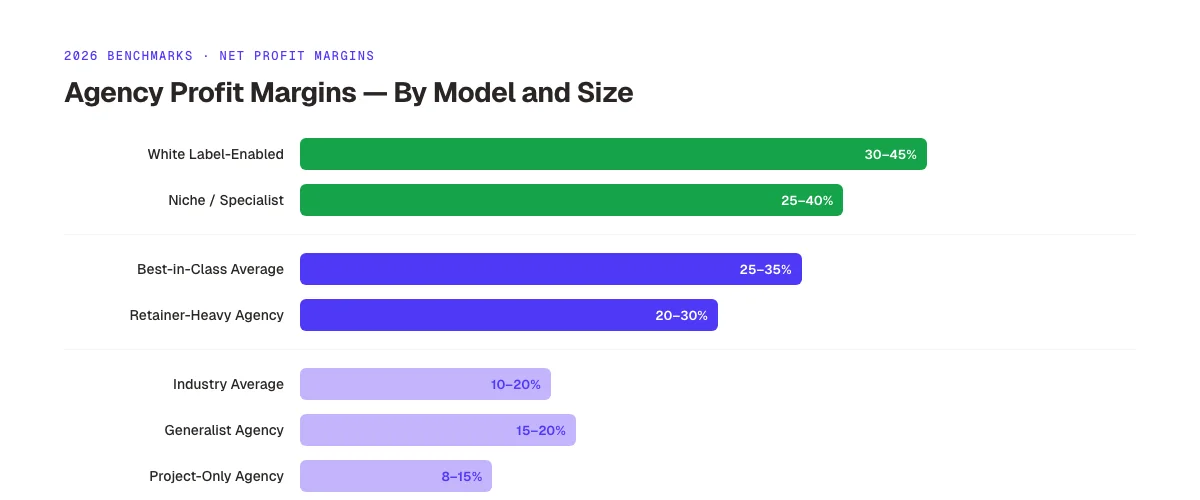
Gross margins (revenue minus direct delivery costs) typically run 50-75% for digital services. Net margins. After salaries, overhead, tools, and taxes. Are a very different story.
| Agency Type | Net Profit Margin |
|---|---|
| Average agency | 10-20% |
| Best-in-class agency | 25-40% |
| Generalist (all services, all clients) | 15-20% |
| Niche/specialist | 25-40% |
| White label-enabled | 30-45% |
The most profitable agencies share three structural characteristics:
- Retainer-heavy: 80%+ of revenue on recurring monthly contracts, not one-off projects
- White label-enabled. Delivery costs controlled through specialist partners rather than growing headcount
- Niche-focused. Deeper expertise commands higher rates with lower client acquisition costs
The Specialization Premium
The economics of specialization are significant and underappreciated.
A dental marketing agency charging $4,000/month per client needs 21 clients for $1M in annual revenue. A generalist agency with the same revenue goal might need 30+ clients, because their average contract value is lower. More clients means more project management, more account calls, more churn surface area.
Niche specialists working with a defined ICP on retainer can build to $1M-$2M/year with a team of 5-8 people and margins above 30%. Generalist agencies often need 15-20 employees to hit the same revenue, with half the margin.
For agencies comparing their cost structure against what clients actually pay in the market, the real cost of a marketing agency covers the full client-side pricing picture.
The Revenue Model Most Agencies Underuse
The data is clear: agencies that combine retainer pricing with white label delivery consistently outperform peers on both revenue and margin. Yet the majority of agencies. Especially younger or smaller shops. Still rely primarily on in-house project work.
The shift to white label delivery does not require losing quality control. It requires building partner vetting processes, clear brief standards, and a review layer before client delivery. Agencies that invest in that infrastructure early gain the structural advantage that allows compounding growth.
Compare this against the marketing agency vs AI tools question. Where the same white label economics explain why AI-assisted delivery is now the fastest-growing cost reduction strategy in agency operations.
Skip the agency. Keep the results. theStacc delivers SEO articles from $99 a month. The white label engine agencies use to scale content without scaling headcount.
What practitioners are saying on X
Agency and white-label models evolve fast. Here is operator signal from X on tooling and service delivery.
- @syedbalkhi (Sep 2024): White-label pro services can add multi-six-figure revenue without building an in-house services org — partner delivery behind the brand. See the post on X.
- @ConnorGillivan (Jul 2026): 2026 SEO stack favorite list: Semrush/Ahrefs, GSC, Surfer, KeywordInsights, ChatGPT, SEOwind, Screaming Frog, ClearScope, GA4, Notion/Airtable — tools amplify systems, they don’t replace them. See the post on X.
- @jakezward (Feb 2026): 2026 SEO predictions emphasize AI Overview share-of-SERP, schema for LLM token efficiency, brand mentions in AI answers as a KPI, proprietary data as a moat, and content refresh beating net-new AI slop. See the post on X.
Grok, AI Overviews, and multi-engine visibility
For “how do digital marketing agencies make money”, multi-engine visibility still starts with clear definitions, sourced numbers, and extractable section answers. Grok additionally factors live X discussion — keep public claims consistent with this page.
- Google AI Overviews: Use passage-ready answers, tables, and FAQ schema where relevant.
- ChatGPT / Perplexity: Cite named sources next to key claims.
- Grok: Maintain accurate entity facts on-site and in high-signal X posts.
Publish content built for Google and AI citations. theStacc’s Content SEO module ships SEO-scored articles structured for rankings and generative engines — including clearer entity pages models like Grok can quote.
FAQ
Small and mid-sized agencies typically earn $2,000-$9,000 per client per month, depending on scope and pricing model. A retainer client generating $4,000/month creates roughly $400-$1,600 in net profit monthly depending on the agency's delivery setup and operating margins.
Retainer-based pricing with white label delivery generates the highest sustained margins. The retainer provides predictable recurring revenue. White label reduces delivery costs. Widening the gap between what the agency charges and what it spends. Hybrid retainer-plus-performance models are a close second for growth-oriented agencies that want incentive alignment with clients.
Yes. Most agencies managing paid media charge a management fee equal to 10-20% of monthly ad spend, in addition to any strategy retainer or setup fees. A client spending $30,000/month on paid ads pays the agency an additional $3,000-$6,000/month in management fees on top of other services.
Average net profit margins run 10-20%. Well-run, niche-focused agencies achieve 25-40%. Gross margins (before overhead) typically run 50-75% for digital services. The gap between gross and net is primarily salary costs. The single largest expense line for most agencies.
An agency resells white label services at a 150-250% markup. For content production: pay $1,200/month to deliver 30 articles, charge the client $3,000/month. The agency earns $1,800 in gross margin while spending only 5-8 hours per month on account management. At 20 clients, that single service line generates $36,000/month in gross margin with minimal headcount. Read the full breakdown in the white label SEO content guide.
Yes. Solo operators frequently earn $100,000-$250,000 annually by combining a small number of high-value retainer clients with strategic white label partnerships for delivery. The ceiling is client relationship capacity. Typically 8-12 active retainer clients at $1,500-$4,000/month each. With white label delivery, a solo operator can handle clients that would normally require a 3-5 person team.
Paid media management (10-20% of ad spend, low hourly cost), retainer-based SEO (recurring with decreasing delivery time per client), and white label content production consistently generate the highest net margins. Strategy and consulting work billed at $200-$400/hour also runs 60-70% margins when the agency principal is billing their own time.
Digital marketing agencies make money through multiple overlapping models. But the most profitable ones are not the most diverse. They are the most disciplined.
The agencies compounding past $1M in revenue all share the same structural pattern: retainer-heavy client portfolios, white label delivery infrastructure, and a narrow enough niche that they can charge a premium without having to win every client conversation.
If you are building or scaling an agency, the math points clearly toward monthly retainers over project churn, white label partnerships over in-house production, and deep niche expertise over trying to serve everyone.
For the content delivery side specifically, theStacc handles the SEO article pipeline. Fully optimized, automatically published, at a fraction of in-house content costs. That is the white label margin advantage, deployed in practice.
Sources & references
- [1] Princeton / Georgia Tech et al. — GEO research (arXiv:2311.09735)
- [2] @hridoyreh on X — Widely shared SEO skill tree: foundations, research, technical, on-page, content, links, AI SEO/GEO, analytics, UX, bran
- [3] @jakezward on X — 2026 SEO predictions emphasize AI Overview share-of-SERP, schema for LLM token efficiency, brand mentions in AI answers

Researched, written, and published articles that compound organic traffic.
Weekly local SEO teardowns
One practical email a week. Map Pack, GBP, AI Overviews — no fluff. Unsubscribe anytime.