White Label SEO Content: The Complete Guide (2026)
Everything agencies need to know about white label SEO content. Covers pricing, workflows, quality control, and provider selection. Updated March 2026.
Siddharth Gangal • 2026-03-28 • Content Strategy
In This Article
89% of agencies now consider white label SEO essential for staying competitive. The reason is simple. Clients want content that ranks. Agencies cannot hire fast enough to meet demand. White label SEO content fills that gap without adding headcount, training costs, or management overhead.
The global SEO services market exceeds $83 billion in 2026. A growing share of that spend flows through white label partnerships where specialized providers create the content and agencies deliver it under their own brand.
But not all white label content is equal. Some providers deliver generic filler. Others produce SEO content writing that actually ranks. The difference comes down to process, quality control, and knowing what to look for.
We publish 3,500+ blog posts across 70+ industries with a 92% average SEO score. This guide covers everything you need to know about white label SEO content in 2026.
Here is what you will learn:
- What white label SEO content is and how it works
- Who benefits most from white label content partnerships
- The 5 content types you can white label
- How to evaluate and choose a provider
- Pricing models and realistic cost expectations
- Quality control systems that protect your brand
- How white label compares to in-house, freelancers, and agencies
What Is White Label SEO Content
White label SEO content is search-optimized written content produced by a third-party provider and delivered under your brand name. The end client never knows someone else wrote it. Your agency takes credit for the work, maintains the client relationship, and sets the price.
The “white label” part means the content arrives unbranded. You add your logo, your byline, and your client’s voice. The “SEO” part means every piece follows a structured optimization process: keyword targeting, search intent matching, on-page optimization, internal linking, and readability standards.
This is different from generic content writing. A general content writer produces articles. A white label SEO content provider produces articles designed to rank on page 1 of Google. The difference shows up in traffic within 60 to 90 days.
What White Label SEO Content Includes
A quality white label SEO content provider delivers more than just words on a page. A complete deliverable typically includes:
- Keyword research and targeting for each article
- Competitor SERP analysis to identify content gaps
- Optimized title tags and meta descriptions
- Header hierarchy following blog post structure best practices
- Internal and external link suggestions
- Image alt text recommendations
- Readability scoring and sentence structure optimization
- Plagiarism checks on every deliverable
Without these elements, you are buying content writing. With them, you are buying a ranking asset.
How White Label SEO Content Works
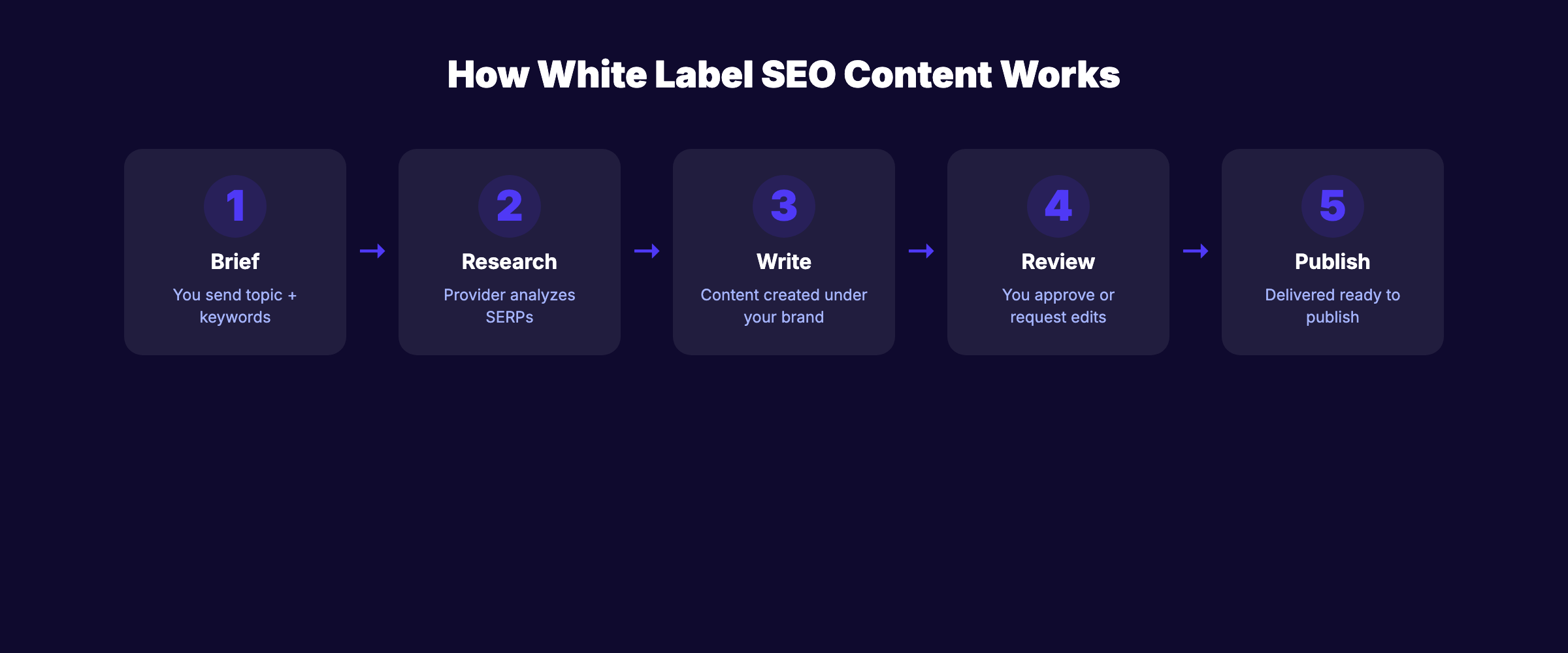
The workflow between your agency and a white label provider follows a predictable pattern. Most providers operate on one of two models: brief-based or full-service.
Brief-Based Model
You send the provider a content brief with the target keyword, search intent, competitor URLs, word count, and tone guidelines. The provider writes the article and returns it for review. You handle strategy and quality control. The provider handles execution.
This model works best for agencies with strong SEO strategists who want to offload writing. You maintain strategic control while scaling output.
Full-Service Model
The provider handles everything from keyword research to final delivery. You approve topics and review finished content. This model works for agencies that want a completely hands-off content operation for their clients.
Full-service costs more but requires less internal bandwidth. It suits agencies scaling quickly across many client accounts.
The Delivery Cycle
A typical white label content cycle looks like this:
| Stage | Who Does It | Timeline |
|---|---|---|
| Topic and keyword selection | You or provider | Day 1 |
| SERP analysis and brief creation | Provider | Day 2-3 |
| Content writing and optimization | Provider | Day 4-7 |
| Quality review and revisions | You + provider | Day 8-10 |
| Final delivery (unbranded) | Provider | Day 10-12 |
| Branding, publishing, client delivery | You | Day 12-14 |
Most providers deliver within 5 to 10 business days per batch. Rush delivery is available at premium pricing from many providers.
Your SEO team. $99/month. Stacc publishes 30 optimized articles per month. Done for you, branded to you. Start for $1 →
Who Needs White Label SEO Content
White label SEO content is not for every business. It works best for organizations that resell content as part of a broader service offering.
Marketing Agencies
The primary buyer. Agencies promise clients SEO results but often lack the writing capacity to deliver 20 to 50 articles per month per client. White label content lets them sell content packages without hiring writers. Margins range from 40% to 70% when reselling white label content at agency rates.
SEO Consultants and Freelancers
Solo SEO practitioners who advise clients on strategy but cannot produce content at scale. White label content lets a single consultant serve 5 to 10 clients with consistent content output. The consultant handles strategy. The provider handles production.
Web Design and Development Firms
Design shops increasingly get asked “can you also do SEO?” by their clients. White label SEO content lets them say yes without building an SEO department. It becomes an add-on revenue stream with minimal operational complexity.
Managed Service Providers (MSPs)
IT companies offering marketing services as an upsell. White label content lets them bundle SEO with their core technology services without deviating from their expertise.
Who Should NOT Use White Label Content
- Brands with a highly specialized voice that requires deep industry expertise (medical journals, legal publications)
- Companies where the founder’s personal brand IS the content (thought leadership platforms)
- Organizations with regulatory content requirements that demand in-house legal review of every word
For these cases, in-house content teams make more sense despite the higher cost.
5 Types of White Label SEO Content
Not all white label content is blog posts. The best providers offer multiple content formats that serve different stages of the buyer journey.
1. Blog Posts and Articles
The most common white label deliverable. Long-form articles (1,500 to 3,000 words) targeting informational and commercial keywords. These build topical authority over time and drive organic traffic.
Best for: Top-of-funnel traffic, keyword coverage, and domain authority building.
2. Landing Pages and Service Pages
Conversion-focused pages targeting commercial and transactional keywords. These require tighter copy, clear CTAs, and persuasive structure. White label landing pages typically cost 2 to 3 times more than blog posts due to the strategic work involved.
Best for: Bottom-of-funnel conversions, local SEO, and paid traffic destinations.
3. Product Descriptions
Ecommerce-focused content for product pages, category pages, and comparison pages. Each description needs unique copy (no duplicating manufacturer descriptions), keyword optimization, and conversion-oriented language.
Best for: Ecommerce clients with hundreds or thousands of SKUs.
4. Website Copy
Full website copywriting including homepage, about page, service pages, and FAQ sections. This requires understanding the client’s brand voice and value proposition at a deeper level than blog content.
Best for: Web design agencies bundling copy with design projects.
5. Local SEO Content
Location-specific pages, Google Business Profile posts, and city landing pages. Local content requires geo-specific keywords, NAP consistency, and local schema understanding.
Best for: Agencies serving multi-location businesses or local service providers.
How to Choose a White Label SEO Content Provider
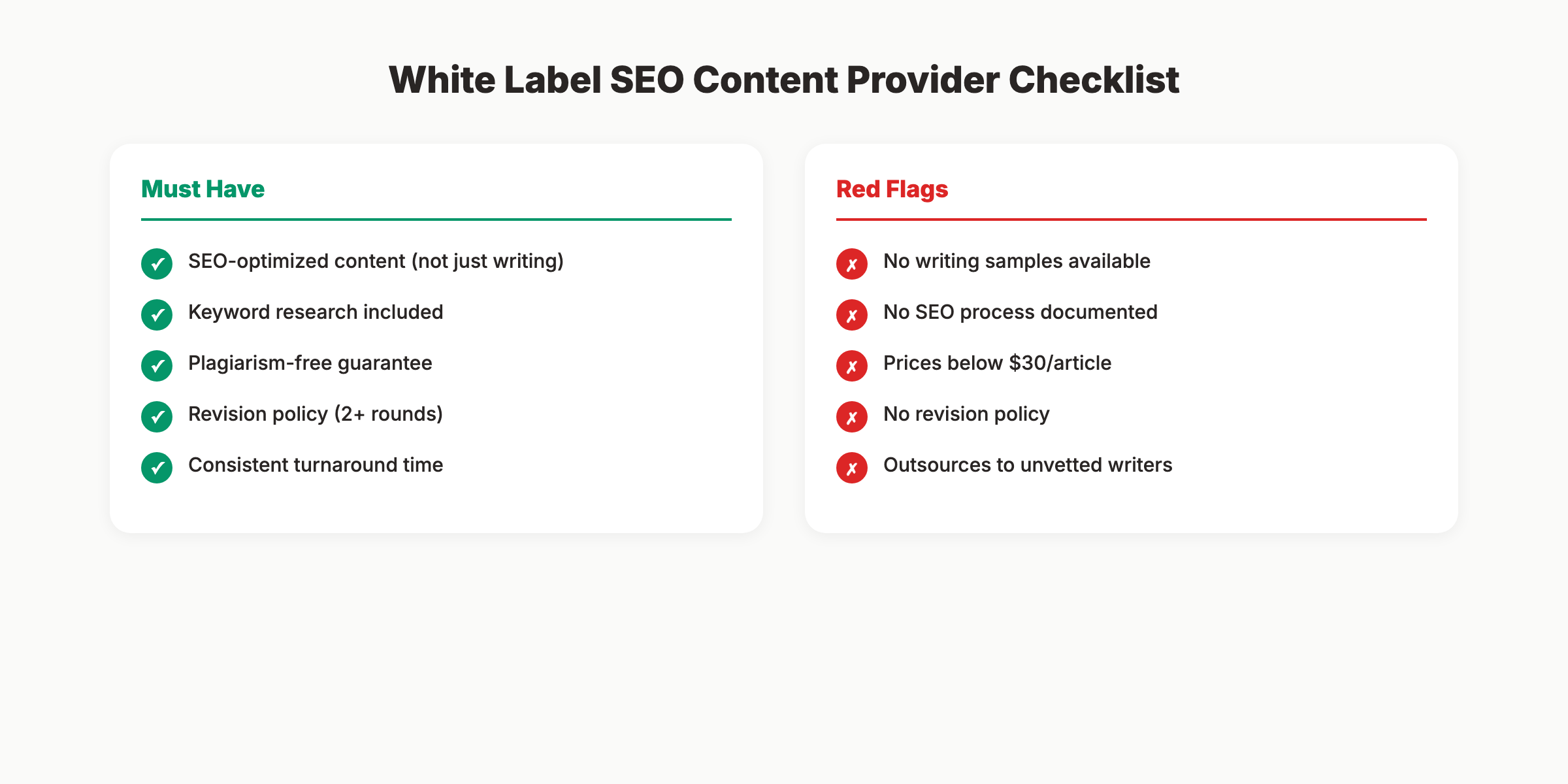
The provider you choose determines whether your clients rank or churn. Evaluate candidates on these 7 criteria.
1. SEO Process Over Writing Quality Alone
Ask to see their SEO workflow. Do they analyze SERPs before writing? Do they optimize for search intent? Do they include header hierarchy, internal links, and meta data? If a provider only talks about “great writing” without mentioning SEO process, they are a content mill, not an SEO content provider.
2. Writing Samples With Ranking Proof
Any provider can show polished samples. Ask for URLs of published content that currently ranks on page 1. If they cannot provide ranking examples, their content looks good but does not perform.
3. Revision Policy
You need at least 2 rounds of revisions included. Some providers charge extra for revisions, which creates friction when content does not match your standards. Unlimited revisions sound good but often signal a provider confident in first-draft quality.
4. Turnaround Time and Reliability
A provider that delivers late disrupts your entire client workflow. Ask about their average turnaround, their on-time delivery rate, and what happens when they miss a deadline. The best providers maintain 95%+ on-time rates.
5. Scalability
Can they handle 10 articles per month today and 100 next quarter? Providers with small writer pools hit capacity limits fast. Ask about their writer network size, their vetting process, and their maximum monthly capacity.
6. Industry Coverage
If your clients span healthcare, legal, home services, and SaaS, your provider needs writers who understand each vertical. Ask how they match writers to industries and whether they have subject matter experts in your clients’ niches.
7. Communication and Account Management
You need a dedicated point of contact, not a ticket system. The best white label relationships feel like an extension of your team. Ask about their communication channels, response times, and whether you get a dedicated account manager.
Red Flags to Watch For
- Prices below $30 per article (quality is almost always compromised)
- No writing samples or ranking proof available
- No documented SEO process
- Outsourcing to unvetted offshore writers without disclosure
- No revision policy or extra charges for basic edits
- Requiring long-term contracts with no trial period
Pricing Models and What to Expect
White label SEO content pricing varies widely. Understanding the models helps you set realistic margins and client expectations.
Per-Article Pricing
The most straightforward model. You pay a fixed rate per article based on word count and complexity.
| Word Count | Standard Rate | Premium Rate |
|---|---|---|
| 500-1,000 words | $50-$80 | $100-$150 |
| 1,000-1,500 words | $80-$120 | $150-$250 |
| 1,500-2,500 words | $120-$180 | $250-$400 |
| 2,500-4,000 words | $180-$270 | $400-$600 |
Standard rate includes basic SEO optimization. Premium rate includes deep SERP analysis, custom graphics briefs, and advanced optimization.
Monthly Retainer Pricing
A fixed monthly fee for a set number of deliverables. Retainers typically offer 10% to 20% discounts over per-article pricing. They also guarantee capacity, which matters when you have predictable monthly client needs.
Typical retainer ranges:
- 10 articles/month: $800-$1,500
- 20 articles/month: $1,400-$2,800
- 50 articles/month: $3,000-$6,000
Per-Word Pricing
Some providers charge by the word. Rates range from $0.05 to $0.25 per word depending on quality tier and SEO depth. Per-word pricing makes budgeting predictable but can incentivize filler content from less disciplined providers.
Credit-Based Pricing
Newer model where you purchase credits redeemable for different content types. One credit might equal a 1,000-word blog post. Three credits might equal a landing page. This model offers flexibility when content needs vary month to month.
Setting Your Resale Margins
Most agencies mark up white label content by 2x to 4x. If you pay $150 per article, you sell it to clients for $300 to $600 as part of a content package. The markup covers your strategy, account management, quality review, and client communication.
| Your Cost | Client Price | Your Margin |
|---|---|---|
| $100/article | $300/article | 67% |
| $150/article | $500/article | 70% |
| $200/article | $600/article | 67% |
Higher margins come from bundling content with other services (SEO audits, link building, reporting) rather than selling articles individually.
Skip the agency. Keep the results. Stacc starts at $99/mo for 30 articles. White label ready. Start for $1 →
Quality Control: Ensuring White Label Content Ranks
The biggest risk with white label content is quality inconsistency. One bad article can damage your client relationship. Build these quality gates into your workflow.
Pre-Production Standards
Before a single word gets written, establish clear standards:
- Brand voice guidelines for each client (tone, vocabulary, formatting preferences)
- SEO requirements per article (primary keyword, secondary keywords, word count minimum, internal link targets)
- Content briefs with competitor analysis, target SERP position, and content angle
- Prohibited topics or claims specific to the client’s industry
Review Checklist
Run every delivered article through this checklist before sending to clients:
- Primary keyword in title, H1, first 100 words, and at least 1 H2
- Meta description under 155 characters with keyword and benefit
- No plagiarized content (run through Copyscape or similar)
- E-E-A-T signals present (experience statements, data citations, expert references)
- Internal links to 3+ relevant pages on the client’s site
- External links to 2+ authoritative sources with data
- No AI-detectable patterns (run through humanization check)
- Header hierarchy correct (H1 → H2 → H3, no skipped levels)
- Images have descriptive alt text with keywords
- Readability score appropriate for the target audience
- Factual accuracy verified for all statistics and claims
Performance Tracking
Quality control does not end at publication. Track these metrics per article:
- Indexed within 7 days — If Google does not index the article quickly, something is wrong with technical SEO or content quality
- Ranking movement within 30-60 days — Target keywords should show movement in Google Search Console
- Organic traffic within 90 days — Compare to projections from keyword research
- Engagement metrics — Time on page, scroll depth, and bounce rate
If a provider’s content consistently fails to rank after 90 days, the SEO process is broken regardless of how well the writing reads.
White Label SEO Content vs Other Options
Understanding where white label content fits helps you make the right build-or-buy decision.
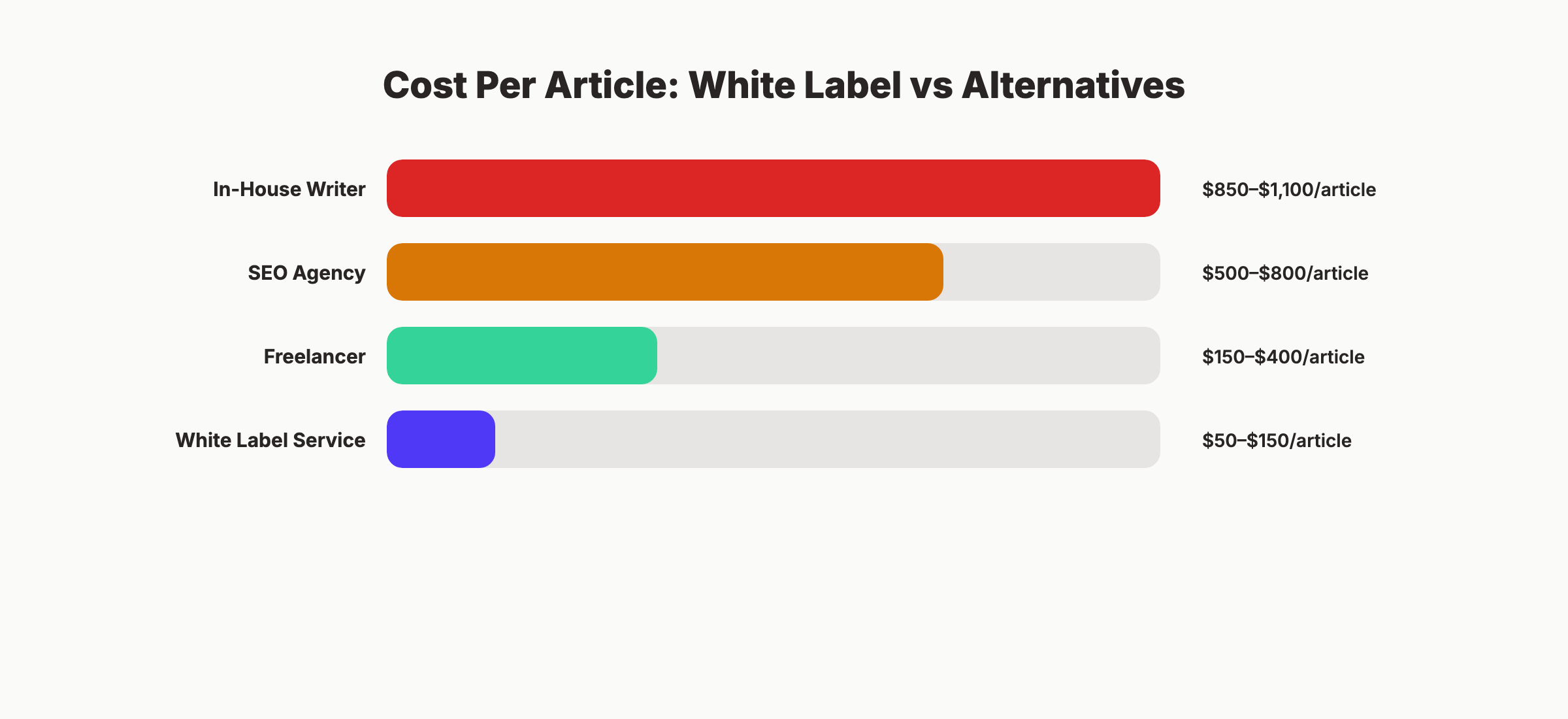
| Factor | In-House Team | Freelancers | SEO Agency | White Label |
|---|---|---|---|---|
| Cost per article | $850-$1,100 | $150-$400 | $500-$800 | $50-$150 |
| SEO optimization | Varies | Rarely included | Usually included | Always included |
| Scalability | Limited by headcount | Hit-or-miss | Good | Excellent |
| Brand consistency | High | Low | Medium | Medium-High |
| Management overhead | High | High | Low | Low |
| Turnaround time | 1-2 weeks | 1-3 weeks | 1-2 weeks | 5-10 days |
| Your margin | 0% (cost center) | 40-60% | 20-40% | 50-70% |
When White Label Wins
- You need to scale content production across multiple clients quickly
- Your team handles strategy but lacks writing capacity
- You want to offer SEO content services without building an internal team
- You need predictable per-article costs for client pricing
When In-House Wins
- You need deep industry expertise that only a dedicated specialist can provide
- Brand voice control is mission-critical
- You have enough volume to justify full-time salaries
- Regulatory requirements demand internal content oversight
When Freelancers Win
- You need occasional content for a specific niche
- You have found a reliable writer who understands your style
- Volume is low enough that management overhead stays minimal
For a deeper comparison with real cost data, see our guide on in-house vs outsourced content teams.
3,500+ blogs published. 92% average SEO score. See what Stacc can do for your content operation. Start for $1 →
How to Scale White Label Content Operations
Starting with white label content is straightforward. Scaling it to serve 10, 20, or 50 clients without quality degradation takes systems.
Start With One Provider and One Client
Do not sign 5 clients for content packages before you have tested your white label workflow end to end. Pick your easiest client. Run one full cycle: brief → delivery → review → publish → measure. Iron out every friction point before scaling.
Build Standardized Briefs
Create a content brief template that works across all clients. Customize the brand voice section per client but standardize the SEO requirements, formatting rules, and deliverable specs. This reduces back-and-forth and speeds up production.
Create a Review and Approval Workflow
Define who reviews what, and set time limits:
- Provider delivers content (Day 0)
- Your SEO reviewer checks optimization (Day 1)
- Your editor checks voice, accuracy, and readability (Day 2)
- Revisions requested if needed (Day 2)
- Final approval and client delivery (Day 3-4)
Without a defined workflow, articles sit in review limbo for weeks. That kills your turnaround time and client satisfaction.
Use a Content Calendar
A content calendar prevents publishing gaps and keeps all client accounts on track. Plan 30 to 60 days ahead. Batch content briefs monthly rather than sending them one at a time.
Diversify Providers (Eventually)
Once you scale beyond 30 to 50 articles per month, consider splitting work across 2 to 3 providers. This reduces single-provider risk and lets you match providers to client industries. One provider might excel at SaaS content while another handles local service businesses better.
Measure and Optimize
Track these numbers monthly:
- Articles delivered vs. planned
- First-draft approval rate (target: 80%+)
- Average revisions per article (target: under 1.5)
- Time from brief to delivery
- Client content ranking within 90 days
- Content marketing ROI per client
The agencies that scale white label content successfully treat it as a system, not a one-off purchase. They measure, refine, and improve the process every quarter.
FAQ
What is white label SEO content?
White label SEO content is search-optimized written content created by a third-party provider and delivered unbranded. Your agency adds its own branding and delivers the content to clients as if your team wrote it. The end client never interacts with the provider directly.
How much does white label SEO content cost?
Prices range from $50 to $270 per article depending on word count, SEO depth, and provider quality. A standard 1,500-word SEO blog post typically costs $80 to $180 from a reputable provider. Agencies mark up this cost by 2x to 4x when reselling to clients.
Is white label content the same as AI-generated content?
No. White label SEO content can be written by humans, AI-assisted, or fully AI-generated depending on the provider. The best providers use AI for research and drafting but have human editors review every piece for accuracy, voice, and SEO quality. Always ask your provider about their writing and editing process.
Can Google detect white label content?
Google does not penalize content based on who wrote it. Google evaluates content based on quality, relevance, and E-E-A-T signals. Whether content is written in-house, by a freelancer, or by a white label provider, it ranks the same if the quality and optimization are equal.
How do I maintain quality with white label content?
Build a quality control system with standardized briefs, a review checklist, and performance tracking. Review every article before client delivery. Track ranking performance over 90-day windows. Replace providers whose content consistently fails to rank.
Should I tell my clients I use white label content?
Most agencies do not disclose white label partnerships. It is standard industry practice, similar to how restaurants do not reveal their ingredient suppliers. Your value is the strategy, account management, and results you deliver, not whether your team personally typed every word.
White label SEO content is not a shortcut. It is a scaling strategy. The agencies growing fastest in 2026 are the ones that figured out how to deliver consistent, ranking content across 20 or 50 client accounts without hiring 20 or 50 writers. The model works when you treat content as a system. Pick the right provider. Build quality gates. Track performance. Scale from there.
Written and published by Stacc. We publish 3,500+ articles per month across 70+ industries. All data verified against public sources as of March 2026.