
Does Social Media Help SEO? The Complete Guide
Does social media help SEO? Yes, indirectly. Learn how social signals, backlinks, brand search, and content distribution boost rankings. Updated 2026.
You post on social media every week. Your organic search traffic stays flat. So you wonder: does social media help SEO at all, or is it a waste of time?
The short answer is yes. But not in the way most marketers assume. Google has confirmed that social signals like shares, likes, and followers are not direct ranking factors. Yet pages with strong social presence consistently outrank pages without one. A 2023 CognitiveSEO study found a clear correlation between social engagement and higher search rankings across 23 million shares.
The relationship is indirect but measurable. Social media drives content distribution, earns backlinks, increases branded search volume, and builds the E-E-A-T signals that Google uses to evaluate quality. We publish 3,500+ blog posts across 70+ industries and see firsthand how social amplification accelerates ranking timelines.
Here is what you will learn in this guide:
- Whether social media directly or indirectly affects Google rankings
- The 6 specific ways social media supports SEO performance
- What the data actually shows about social signals and search rankings
- How to use each social platform to boost your SEO strategy
- Profile optimization tactics that make social pages rank in Google
- The most common social media SEO mistakes and how to avoid them
Does Social Media Directly Affect SEO Rankings?
Google’s official position has been consistent since 2014. Social signals are not a direct ranking factor.
Matt Cutts, former head of Google’s webspam team, stated that social metrics like Facebook likes and Twitter followers do not influence how Google ranks pages. Google’s Search Central documentation makes no mention of social signals as a ranking input. John Mueller has reaffirmed this position multiple times since then.
The reason is practical. Social platforms control their own data. Facebook, Instagram, and LinkedIn can restrict crawler access at any time. Google cannot rely on signals it does not fully control.
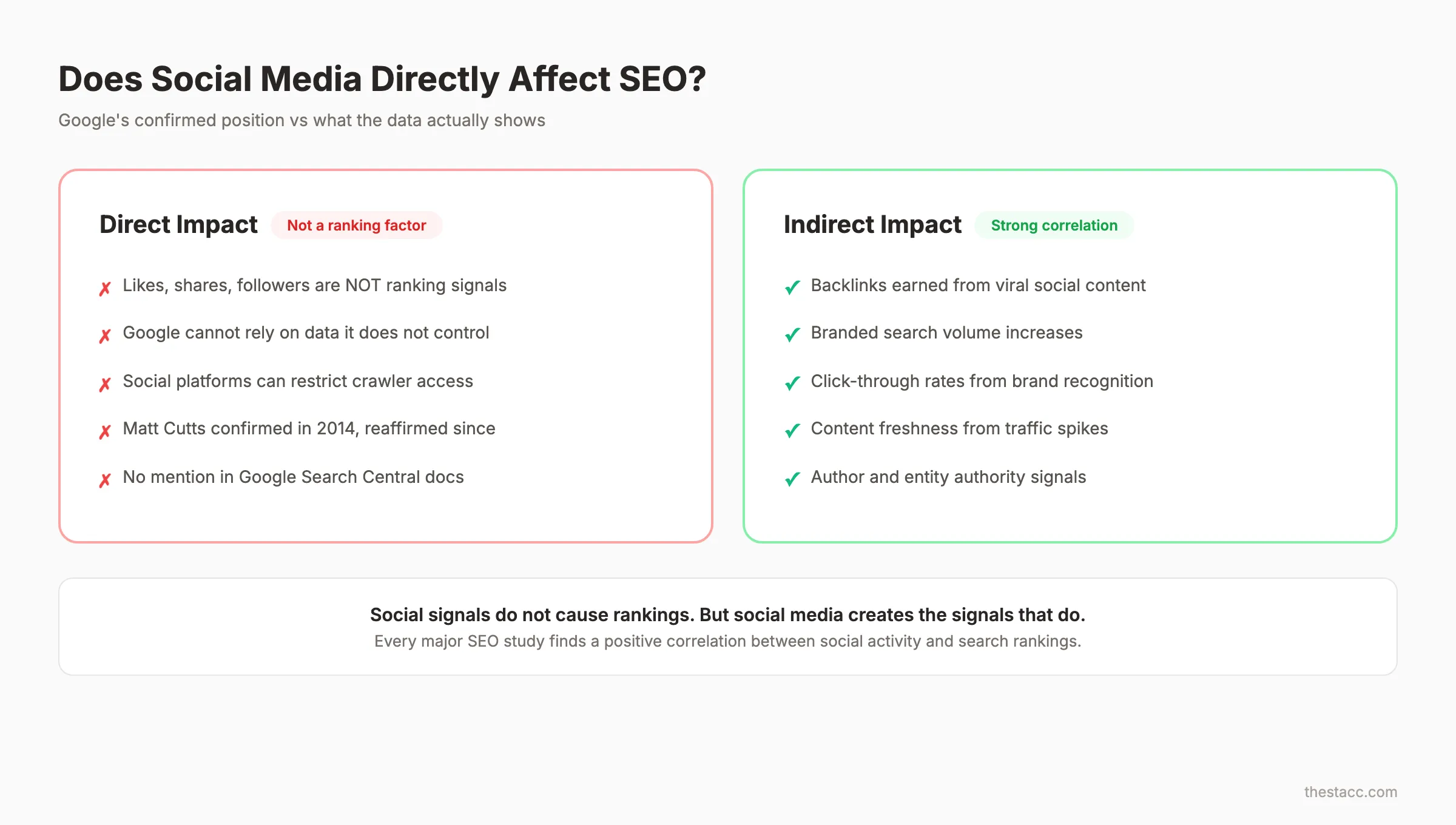
But correlation tells a different story. Every major SEO study that has measured the relationship between social activity and search rankings finds a positive correlation. Pages with more shares, more engagement, and more social visibility tend to rank higher.
That is not because the shares cause the rankings. It is because social media creates a chain reaction of indirect benefits that Google does pick up on. Backlinks, brand mentions, traffic spikes, and engagement patterns all flow from social activity into search performance.
The distinction matters for strategy. Chasing vanity metrics like follower counts will not move your rankings. Building a social distribution engine that feeds your SEO pipeline will.
What Google Actually Measures
Google does not count shares. But Google does track:
- Backlinks earned from content that went viral on social media
- Branded search volume that increases when people see your brand on social feeds
- Click-through rates from users who recognize your brand in search results
- Content freshness signaled by traffic spikes to recently published pages
- Author and entity authority built through consistent social presence
These are measurable, confirmed ranking factors. Social media influences every single one of them.
6 Ways Social Media Helps SEO Indirectly
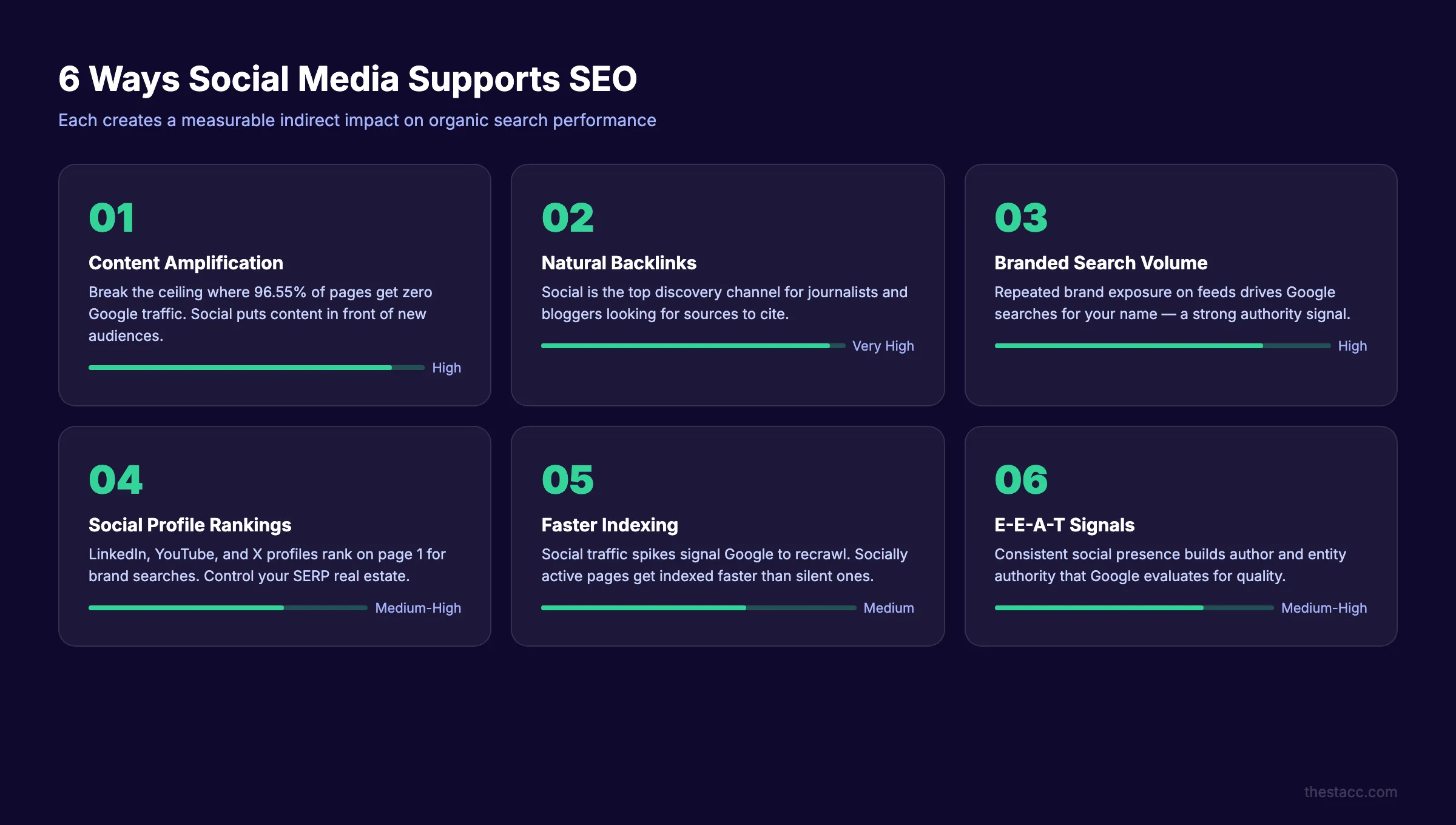
The indirect benefits are not abstract. Each one has a clear mechanism and a measurable impact on organic traffic.
1. Content Amplification and Distribution
Every blog post you publish reaches a limited audience through search alone. 96.55% of all indexed pages get zero traffic from Google. Social media breaks that ceiling by putting your content in front of people who would never find it through search.
A single LinkedIn post sharing your latest article can generate hundreds of clicks within 48 hours. That initial traffic burst sends positive engagement signals. Users who arrive from social media spend time on the page, click internal links, and sometimes share the content again. Each of those actions feeds signals that support your blog SEO strategy.
2. Natural Backlink Acquisition
Social media is the top discovery channel for journalists, bloggers, and content creators looking for sources to cite. When your article gets traction on X or LinkedIn, people in your industry notice. Some of them link to it from their own websites.
That is how organic link building works at scale. You do not pitch. You distribute. The right people find your content and decide it is worth referencing. Building backlinks for your blog becomes faster when you have a social distribution system running alongside your content calendar.
3. Branded Search Volume Growth
When users see your brand name repeatedly on social feeds, they search for it on Google. Branded search volume is a strong signal of authority. Google interprets a growing volume of branded queries as evidence that your brand is gaining trust and recognition.
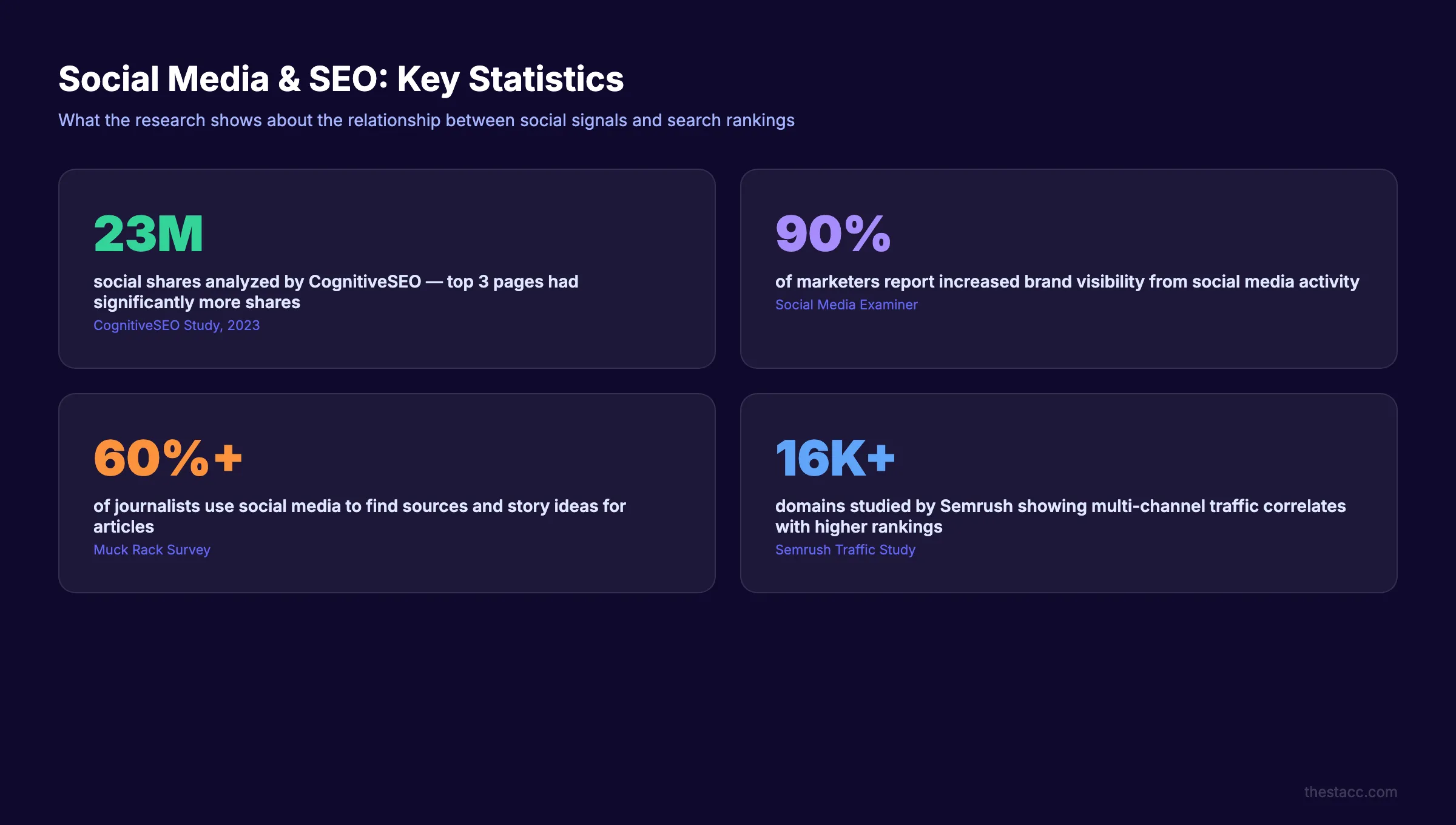
HubSpot reports that 90% of marketers say social media increases brand exposure. That exposure translates directly into more branded searches, higher click-through rates on search results, and better overall domain authority.
4. Faster Content Indexing
Google discovers new URLs through crawling links. Social media posts create immediate, high-visibility links to your content. While most social links carry nofollow attributes, Google still discovers URLs through them.
A new blog post shared on X and LinkedIn gets found by Googlebot faster than a post sitting on your site with no external references. Faster indexing means faster ranking. For businesses publishing at volume, this time advantage compounds across dozens of posts each month.
5. SERP Real Estate From Social Profiles
Search your brand name on Google. Your social profiles likely appear on page 1. LinkedIn, X, Facebook, Instagram, and YouTube profiles all rank for branded terms.
This is free SERP real estate. Every social profile that ranks for your brand name pushes competitors and negative results further down the page. It also gives searchers multiple entry points to learn about your business. A complete set of optimized social profiles can occupy 3 to 5 positions on page 1 for your brand name.
6. E-E-A-T Signal Building
Google’s quality raters evaluate Experience, Expertise, Authoritativeness, and Trustworthiness. An active social media presence strengthens all 4 signals.
Authors who publish thought leadership on LinkedIn demonstrate expertise. Brands with engaged communities on multiple platforms show authoritativeness. Consistent, helpful content across social channels builds trust. E-E-A-T is not a direct ranking factor itself, but it influences how Google’s algorithms evaluate your content quality.
Your SEO team, running on autopilot. Stacc publishes 30 SEO blog posts and 30 social media updates every month. No writers. No agencies. No busywork. Start for $1 →
Social Signals and Search Rankings: What the Data Shows
The debate about social signals and SEO has produced several notable studies. Here is what the data actually reveals.
The CognitiveSEO Study: 23 Million Shares
CognitiveSEO analyzed the correlation between social signals and search rankings across 23 million social shares. The results showed that pages ranking in the top 3 positions on Google had significantly more social shares than pages ranking in positions 4 through 10.
The correlation was strongest for Facebook shares and Google+ activity (at the time). The study concluded that while social signals are not a direct ranking factor, the content that earns social engagement also tends to earn the backlinks and traffic that Google rewards.
The Hootsuite Experiment
Hootsuite ran a controlled experiment in which they promoted some blog posts on social media and left others without any social promotion. The promoted posts saw measurable improvements in search rankings compared to the non-promoted control group.
The mechanism was clear. Social promotion drove traffic. Traffic led to engagement. Engagement attracted links. Links improved rankings. The chain is indirect but the outcome is real.
Semrush and Social Traffic Correlation
Semrush data shows that websites with diverse traffic sources, including social referrals, tend to rank better than sites that rely solely on organic search. Google interprets multi-channel traffic as a signal of a legitimate, authoritative website.
Sites that receive traffic only from Google look like they were built exclusively for search. Sites that receive traffic from social media, email, direct, and referral sources look like real businesses with real audiences.
| Study | Sample Size | Key Finding |
|---|---|---|
| CognitiveSEO (2023) | 23 million shares | Top 3 ranking pages had significantly more social shares |
| Hootsuite Experiment | Controlled A/B test | Socially promoted posts ranked higher than unpromoted ones |
| Semrush Traffic Study | 16,000+ domains | Multi-channel traffic correlates with higher rankings |
| Social Media Examiner | 5,000+ marketers | 90% report increased brand visibility from social media |
The Reddit and AI Overview Factor
In 2025 and 2026, a new dimension emerged. Google now surfaces Reddit threads directly in search results for thousands of queries. Reddit discussions also appear as cited sources in Google AI Overviews.
This means social media content itself now ranks in Google. A helpful Reddit comment about your product can appear on page 1 of Google. A YouTube video you published can appear in video carousels. Social content is no longer just a traffic driver. It is searchable content in its own right.
How Social Media Drives Backlinks and Authority
Backlinks remain one of the top 3 ranking factors in Google’s algorithm. Social media is one of the most effective channels for earning them.
The Amplification Loop
The process follows a predictable pattern:
- You publish a high-quality blog post on your website
- You share it on LinkedIn, X, and relevant Reddit communities
- Industry professionals see the post in their feed
- Some of them reference or link to it from their own content
- Those backlinks improve your search rankings
- Higher rankings drive more organic traffic, which creates more social shares
This is the Content Compound Effect. Each cycle reinforces the next. The more content you distribute on social media, the more backlinks you earn. The more backlinks you earn, the higher you rank. The higher you rank, the more social shares your content gets.
Journalist and Blogger Discovery
A Muck Rack survey found that over 60% of journalists use social media to find sources and story ideas. When your content appears in their feeds, you become a potential source for their articles.
This is organic digital PR. You do not need to pitch journalists cold. You need to publish content worth citing and distribute it where journalists already spend time. LinkedIn and X are the 2 most effective platforms for this.
Strategic Content Distribution for Links
Not all social posts earn backlinks equally. The content types that generate the most links from social distribution:
- Original research and data. Studies with unique data get cited repeatedly
- Step-by-step guides. Detailed tutorials become reference resources
- Industry analysis. Opinionated takes on trends attract commentary and links
- Infographics and visual data. Easy to embed and reference from other sites
Posting a generic “check out our new blog post” with a link will not earn backlinks. Sharing a specific insight, stat, or framework from the post will.
Platform-by-Platform Social Media SEO Strategy
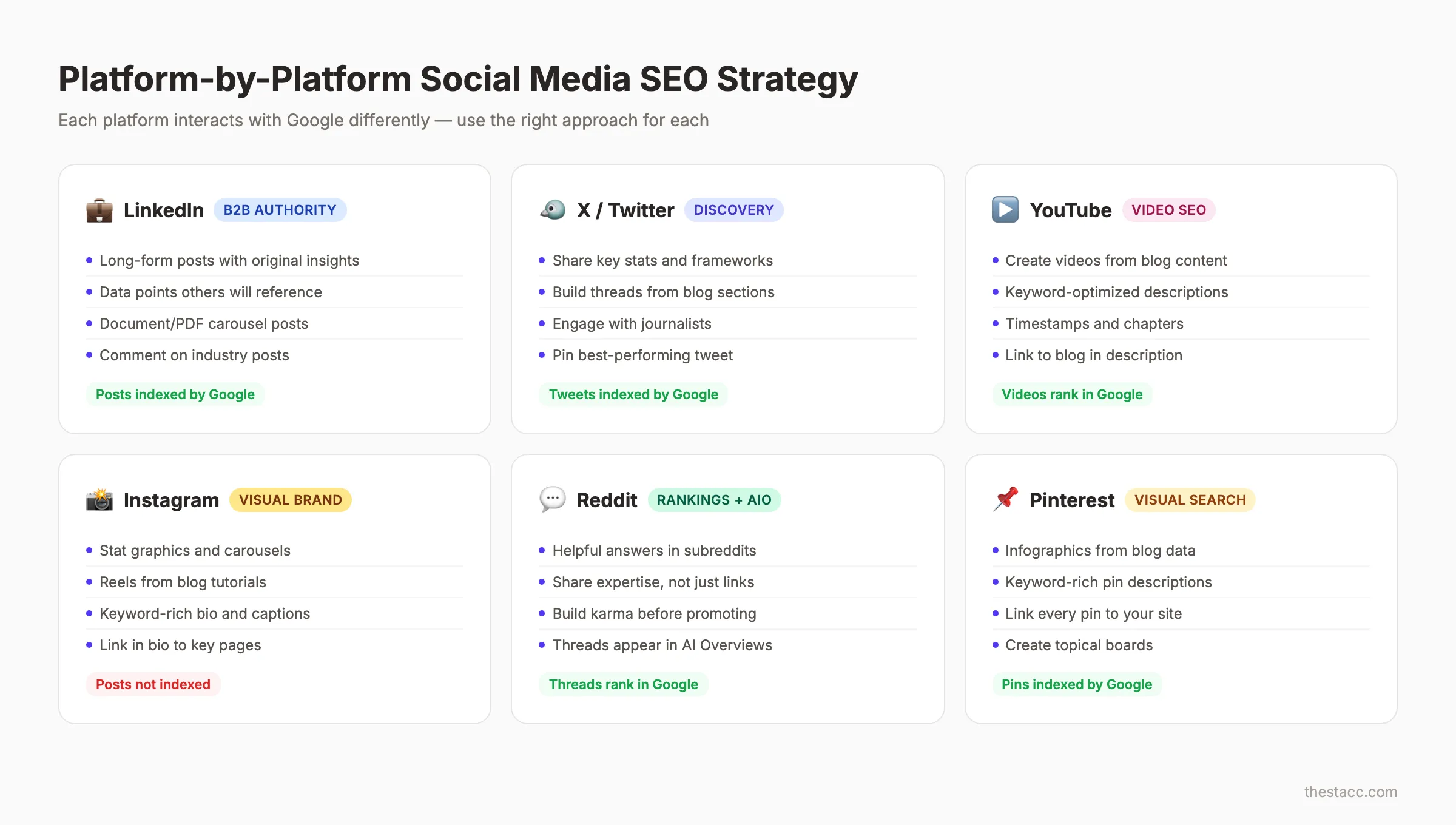
Each social platform interacts with Google differently. A one-size-fits-all approach wastes effort. Here is how to use each platform for maximum SEO impact.
LinkedIn: Best for B2B Authority and Backlinks
LinkedIn posts get indexed by Google. Your LinkedIn profile ranks for your name and job title. Document posts (PDF carousels) drive high engagement and often get shared to other platforms.
For SEO impact, focus on:
- Publishing long-form posts with original insights from your blog content
- Sharing data points and frameworks that other professionals will reference
- Engaging in comments on industry posts to increase your content visibility
- Linking to your website in your profile and in relevant posts
LinkedIn is the strongest platform for earning backlinks from B2B sites, industry blogs, and marketing publications.
YouTube: The Second Largest Search Engine
YouTube is not just a social platform. It is a search engine with over 2 billion monthly users. Videos rank in Google search results, Google image results, and Google video results.
Every video you publish creates another entry point to your website. Include your site URL in video descriptions. Add timestamps that Google can use for key moment markup. Create content that answers the same questions your blog posts target.
YouTube videos also appear in AI search results and can drive significant referral traffic to your site.
X (Twitter): Real-Time Indexing and Trending Content
X posts get indexed by Google within minutes. Trending threads appear in Google’s Top Stories carousel. For time-sensitive content, X provides the fastest path from publication to Google indexing.
Focus on:
- Sharing blog post highlights as thread format for higher engagement
- Using relevant hashtags that align with your target keywords
- Engaging with industry conversations to build follower base
- Pinning your highest-performing content to your profile
Reddit: Direct SERP Rankings and AI Citations
Reddit has become one of the most SEO-relevant social platforms. Reddit threads rank on page 1 of Google for thousands of queries. Google’s AI Overviews frequently cite Reddit discussions as source material.
With 430 million monthly active users, Reddit drives real traffic. Participate in relevant subreddits. Provide genuinely helpful answers. Reference your content only when it directly answers the question being asked. Spammy self-promotion on Reddit backfires quickly.
Instagram and TikTok: Brand Awareness and Gen Z Search
46% of Gen Z users prefer social media over Google for search. Instagram Reels and TikTok videos now appear in Google search results. Both platforms drive massive brand awareness that converts into branded search volume.
For SEO benefit, optimize your profile bio with keywords. Use descriptive captions that include terms people search for. Create content that answers common questions in your industry.
Blog SEO + Social Media in one platform. Stacc publishes and distributes your content automatically across blog and social channels. No content team required. Start for $1 →
How to Optimize Social Profiles for Search Visibility
Your social profiles are landing pages that rank in Google. Treat them that way.
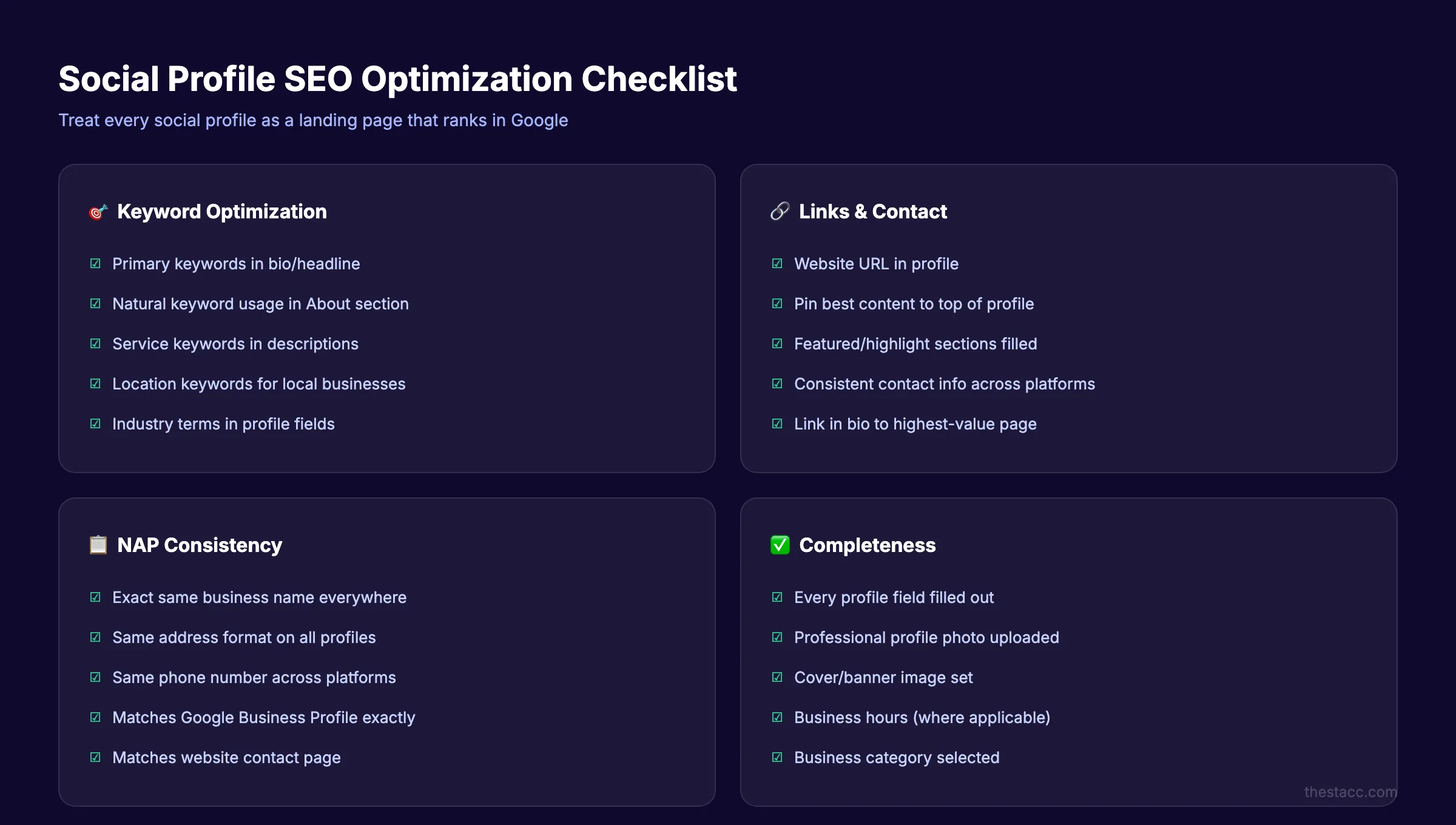
Keyword-Rich Bios and Descriptions
Every social platform has a bio, headline, or About section. Use your primary keywords naturally in these fields. A LinkedIn headline that reads “SEO Consultant Helping Local Businesses Rank on Google” performs better for search than “Marketing Enthusiast.”
The same principle applies across platforms. Your Instagram bio, X bio, Facebook About section, and YouTube channel description should all contain the keywords your target audience searches for.
Consistent NAP Information
NAP stands for Name, Address, Phone number. For local SEO, keeping this information consistent across every social profile is critical. Google cross-references NAP data across the web to verify business legitimacy.
If your business name is “Smith Dental Care” on your website but “Smith Dental” on Facebook and “Dr. Smith Dentistry” on LinkedIn, you are sending conflicting signals. Pick one version and use it everywhere.
Complete Every Profile Field
Half-completed profiles look abandoned. Google and users both interpret incomplete profiles as low-quality signals. Fill out every available field on every platform:
- Business name (consistent across platforms)
- Website URL
- Location and service area
- Business category
- Description with target keywords
- Profile photo and cover image
- Contact information
- Business hours (where applicable)
An optimized Google Business Profile follows the same principle. Completeness signals legitimacy.
Link to Your Best Content
Most platforms allow pinned posts or featured content sections. Use these to highlight your highest-performing blog posts, lead magnets, or service pages. These pinned links drive consistent referral traffic to the pages you want to rank.
Content Distribution: The Bridge Between Social and Search
Publishing content is half the job. Distribution is the other half. Most businesses skip it entirely.
The math is straightforward. You invest 2 to 4 hours creating a blog post. Sharing it across 4 social platforms takes 30 minutes. That 30-minute investment can double or triple the total traffic that post receives over its lifetime.
The Repurposing Framework
One blog post contains enough material for 10 to 15 social media updates. Here is how the breakdown works:
| Content Source | Social Format | Platform |
|---|---|---|
| Blog introduction | Hook + link post | LinkedIn, X |
| Key statistics | Stat graphic or carousel | Instagram, LinkedIn |
| Step-by-step section | Thread or carousel | X, LinkedIn |
| Quotes or bold claims | Text post with commentary | X, LinkedIn |
| Full tutorial | Video summary | YouTube, TikTok |
| FAQ answers | Short-form video | TikTok, Instagram Reels |
Repurposing blog content for social media is one of the highest-ROI activities in content marketing. It costs almost nothing in extra time and multiplies the reach of every piece you publish.
Building a Content Calendar That Feeds Both Channels
Your content calendar should integrate blog publishing and social distribution into one workflow. Every blog post gets a corresponding set of social posts scheduled across the following week.
This approach creates the consistency that both social algorithms and Google reward. Sporadic posting produces sporadic results. A systematic schedule produces compounding returns. That is the Content Compound Effect in action.
The Stacc Stack Method
The most effective approach combines blog SEO with social media and local SEO into one integrated strategy. Blog content feeds social media posts. Social media posts drive traffic back to the blog. Local SEO posts on Google Business Profile reinforce geographic relevance.
Each channel amplifies the others. This compounding effect is what separates businesses that see steady organic growth from those stuck at a traffic plateau.
Social Media SEO Mistakes That Hurt Rankings
Avoiding these mistakes is as important as executing the right tactics.
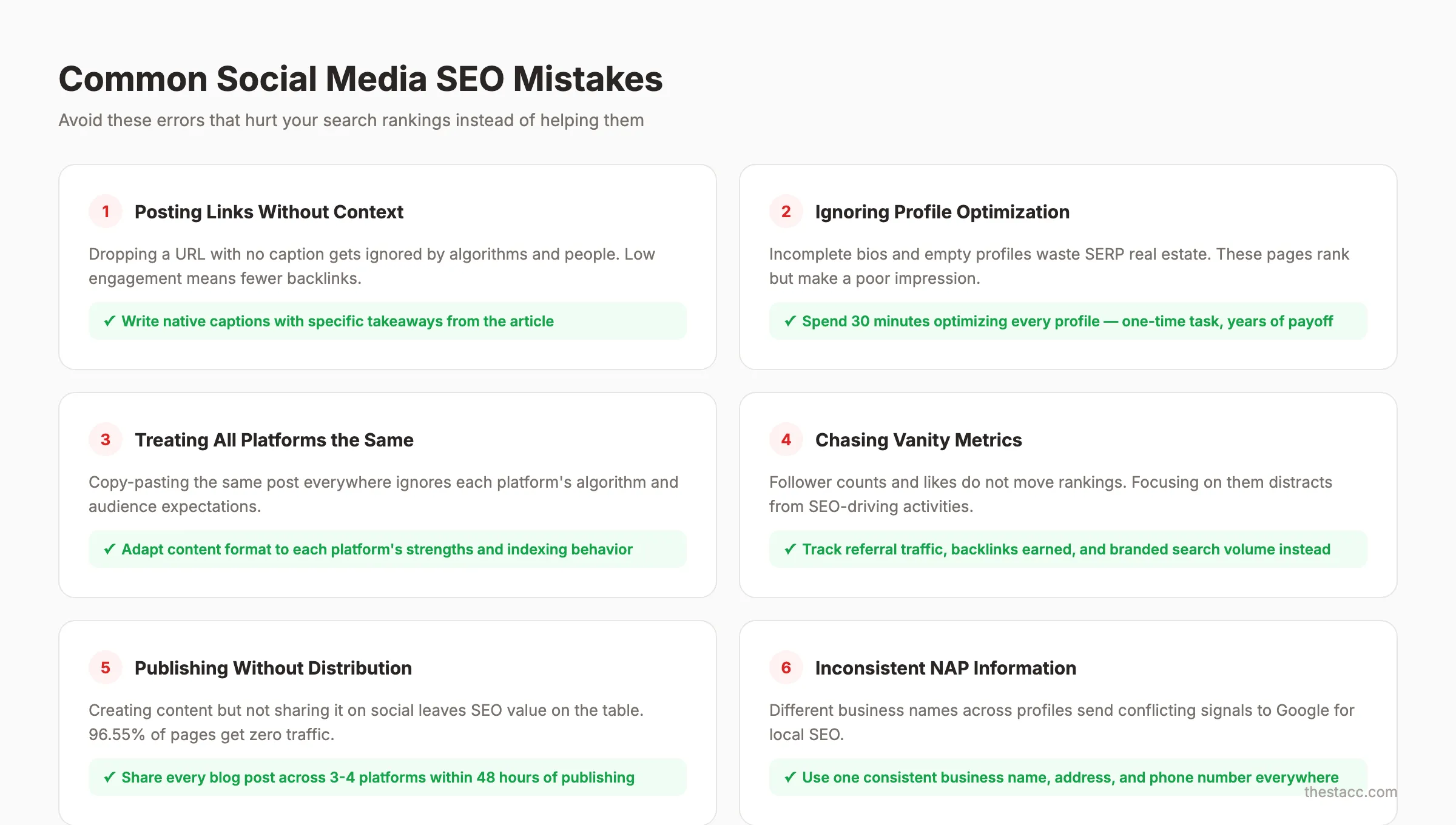
Posting Links Without Context
Dropping a URL on social media with no caption, no insight, and no reason to click is the fastest way to get ignored. Social algorithms deprioritize posts that look like spam. Low engagement on your social posts means fewer people see your content, which means fewer potential backlinks and less referral traffic.
Write a native caption for every post. Share a specific takeaway from the article. Explain what the reader will learn and why it matters. Make the social post valuable on its own.
Ignoring Profile Optimization
An incomplete LinkedIn profile, an empty Instagram bio, or an X account with no pinned tweet represents wasted SERP real estate. These profiles still rank for your brand name, but they make a poor impression when someone finds them.
Spend 30 minutes optimizing every social profile. It is a one-time task that pays dividends for years.
Treating All Platforms Identically
A LinkedIn post is not a tweet. A TikTok video is not a YouTube tutorial. Each platform has its own format, audience, and algorithm. Copy-pasting the same content across every platform produces mediocre results on all of them.
Adapt your content to each platform. Use the native format that performs best on that specific channel.
Inconsistent Posting
Google values freshness. Social algorithms reward consistency. Posting 10 times in one week and then going silent for a month signals an inactive brand. Aim for a minimum of 3 to 5 posts per week on your primary platforms.
A content marketing strategy built on consistency will always outperform one built on sporadic bursts of activity.
Consistent content without the workload. Stacc publishes blog posts and social media updates on a fixed monthly schedule. Your brand stays active across every channel. Start for $1 →
Frequently Asked Questions
Does social media directly affect Google rankings?
No. Google has confirmed that social signals like shares, likes, and follower counts are not direct ranking factors. The relationship is indirect. Social media drives traffic, earns backlinks, increases brand search volume, and builds authority signals that Google does use for ranking decisions.
Which social media platform helps SEO the most?
YouTube and LinkedIn provide the strongest SEO benefits. YouTube videos rank directly in Google search results. LinkedIn posts get indexed by Google and are effective for earning backlinks from B2B and industry sites. Reddit is increasingly important because Reddit threads now rank on page 1 for many queries.
Do social media backlinks count for SEO?
Most social media links carry nofollow attributes, which means they do not pass PageRank directly. But social links still help Google discover new URLs for indexing. More importantly, social distribution leads to natural backlinks from websites that do pass authority. The link from LinkedIn itself does not count. The link from the blogger who discovered your content on LinkedIn does.
How often should I post on social media for SEO benefit?
A minimum of 3 to 5 posts per week on your primary platforms. Consistency matters more than volume. Two high-quality posts with genuine engagement carry more weight than 20 posts with zero interaction. Focus on platforms where your target audience actively spends time.
Can social media help with local SEO?
Yes. Social profiles with consistent NAP (Name, Address, Phone) information reinforce local SEO signals. Active social presence in local communities increases brand awareness and branded search volume. Google Business Profile posts specifically help local rankings, and social media activity drives more Google reviews and local engagement.
Social media does not replace SEO. It accelerates it. The businesses that rank fastest in 2026 are the ones using social distribution to amplify every piece of content they publish. Start with one platform, build a consistent posting schedule, and measure the impact on your organic traffic over 90 days.
The results compound from there.
Related Tools & Resources
Free SEO Tools:
Best Lists:

Written by
Siddharth GangalSiddharth is the founder of theStacc and Arka360, and a graduate of IIT Mandi. He spent years watching great businesses lose organic traffic to competitors who simply published more. So he built a system to fix that. He writes about SEO, content at scale, and the tactics that actually move rankings.
30 SEO blog articles published every month
Keyword-optimized, scheduled, and live on your site. Automatically.
30-day trial · Cancel anytime
theStacc
Stop writing SEO content manually
30 blog articles, 30 GBP posts, and social media content. Published every month. Automatically.
Start Your $1 Trial$1 for 3 days · Cancel anytime