
Domain Authority: What It Is and How to Improve It
What is domain authority? Learn how DA works, what affects your score, and 8 proven ways to improve it. Includes DA vs DR comparison. Updated March 2026.
You check your domain authority. It is 12. Your competitor sits at 45. You want to know what that number means and how to close the gap.
Domain authority is the most referenced metric in SEO. It is also the most misunderstood. People chase it like a ranking factor. It is not. Google does not use domain authority in its algorithm. But the signals that build domain authority are the same signals that build real rankings.
This guide breaks down what domain authority actually measures, why it matters despite not being a ranking factor, and the specific tactics that increase it. No vague advice. No shortcuts. Just the methods that work.
We have published 3,500+ blog posts across 70+ industries. We track domain authority growth across every client site. This guide covers everything we know about building site authority that translates into rankings.
Here is what you will learn:
- What domain authority is and how Moz calculates it
- How DA differs from Ahrefs Domain Rating (DR) and Semrush Authority Score
- Why DA is not a Google ranking factor but still matters for SEO
- The 8 most effective ways to increase your domain authority
- Common DA myths that waste your time and money
- How to audit your backlink profile and remove toxic links
What Is Domain Authority
Domain authority (DA) is a metric created by Moz that predicts how likely a website is to rank in search engine results. It scores websites on a scale from 1 to 100. Higher scores indicate stronger ranking potential.
Moz calculates DA using machine learning and data from their Link Explorer index. The calculation considers over 40 factors, but the most influential ones are:
- Number of referring domains (unique websites linking to you)
- Quality of those linking domains (their own authority scores)
- Total number of backlinks
- Relevance of linking sites to your content
- Link diversity (variety of sources)
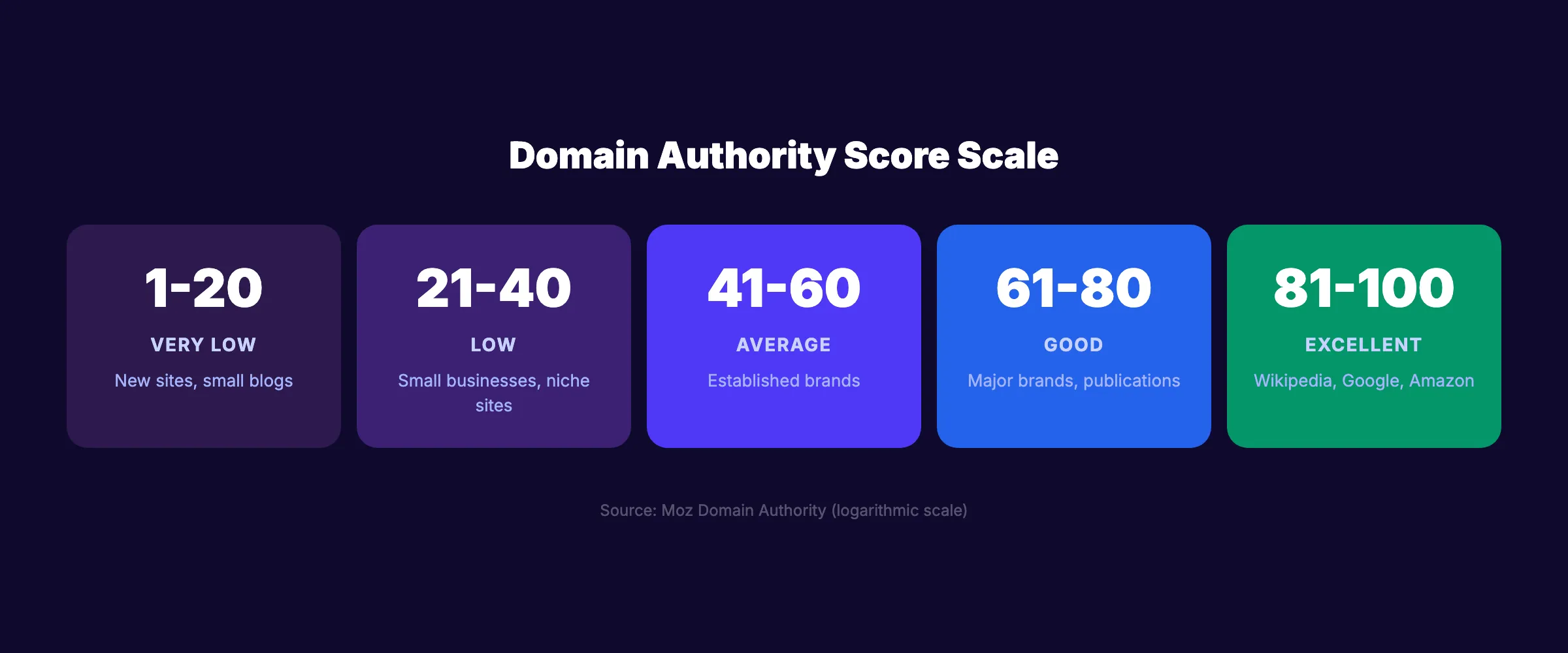
What DA Scores Mean
| DA Range | Level | Who Falls Here |
|---|---|---|
| 1-20 | Low | New websites, blogs with few backlinks |
| 21-40 | Below Average | Growing sites building their backlink profile |
| 41-60 | Good | Established businesses with quality backlinks |
| 61-80 | Very Good | Major brands, popular publications |
| 81-100 | Excellent | Google, Facebook, Wikipedia, NYT |
DA uses a logarithmic scale. Moving from DA 10 to DA 20 is relatively easy. Moving from DA 60 to DA 70 requires significantly more effort and links. Each point becomes harder to earn as you climb.
What DA Is Not
DA is not a Google ranking factor. Google has confirmed this repeatedly. Google does not use Moz’s metric in any part of its algorithm.
A DA 30 site can outrank a DA 70 site for specific keywords. It happens every day. Content relevance, on-page optimization, and search intent alignment matter more than DA for individual keyword rankings.
DA is a comparative metric. It helps you benchmark your site against competitors. It helps you evaluate the quality of potential backlink sources. But it does not directly determine your Google rankings.
Domain Authority vs Domain Rating vs Authority Score
DA is not the only authority metric. Ahrefs uses Domain Rating (DR). Semrush uses Authority Score. Each measures something slightly different.
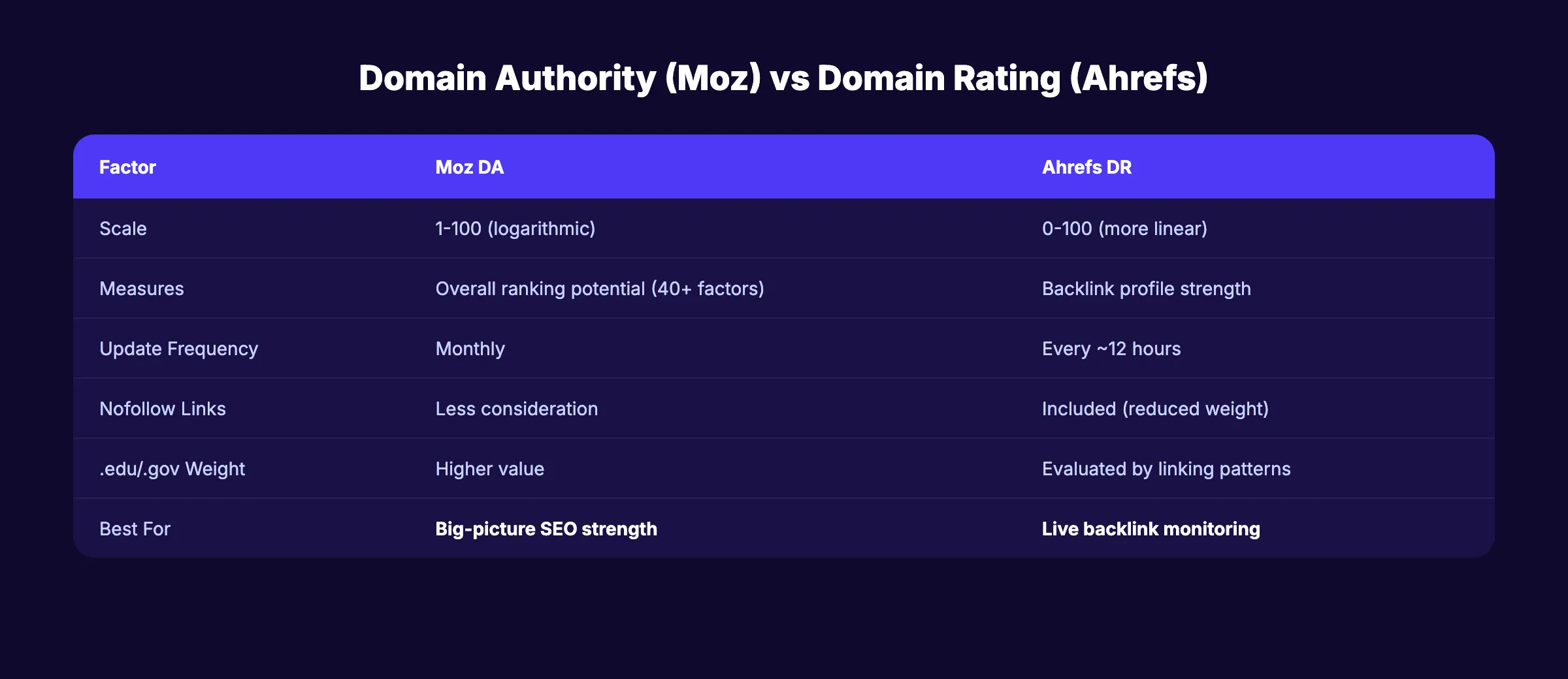
Moz Domain Authority (DA)
DA considers over 40 factors including backlinks, content quality, and SEO performance. It updates monthly. It uses a logarithmic scale where gains become harder at higher levels.
Best for: Getting a broad picture of your overall SEO strength relative to competitors.
Ahrefs Domain Rating (DR)
DR focuses almost entirely on backlink profile strength. It updates every 12 hours. It uses a more linear scale and includes nofollow links with reduced weight.
Best for: Monitoring backlink progress in real time and evaluating link building campaigns.
Semrush Authority Score
Authority Score combines backlink data, organic traffic estimates, and spam signals. It updates regularly and penalizes sites with spammy link profiles more aggressively.
Best for: Evaluating the overall quality of a domain including spam risk.
Why Scores Differ Between Tools
Your DA and DR scores will almost never match. A site with DA 35 may have DR 48 or vice versa. This is normal. Each tool uses different data sources, different crawl indexes, and different weighting formulas.
Do not panic if one metric drops while another stays flat. Compare apples to apples. Track DA over time in Moz. Track DR over time in Ahrefs. Do not compare DA to DR directly.
Which One Should You Track?
Track all 3 if you have access. If you choose one, use Moz DA for competitive benchmarking and Ahrefs DR for backlink campaign tracking. The specific number matters less than the trend. If your chosen metric increases over 6 to 12 months, your site authority is growing.
For more on tracking SEO metrics, use Google Search Console.
Stop writing. Start ranking. Stacc publishes 30 SEO articles per month that build your site authority. Automatically. Start for $1 →
Why Domain Authority Matters Even Though Google Ignores It
If Google does not use DA, why care about it? Because the activities that increase DA are the same activities that increase real rankings.
A site with DA 50 did not reach that score by accident. It earned hundreds of quality backlinks, published substantial content, maintained strong technical SEO, and built trust over time. Those are the exact things Google rewards.
Think of DA as a proxy metric. You cannot improve DA directly. You improve the underlying signals. Those signals are what Google actually uses.
How DA Helps Your SEO Strategy
Competitive analysis. Compare your DA to competitors ranking for your target keywords. If they sit at DA 50 and you sit at DA 15, you know you need significantly more authority-building work before competing for high-difficulty keywords.
Link prospecting. When evaluating potential backlink sources, DA helps you prioritize. A link from a DA 60 site carries more weight than a link from a DA 10 site. Use DA to qualify outreach targets.
Progress tracking. DA provides a single number that reflects your overall authority growth. Track it monthly alongside organic traffic to validate your SEO strategy.
Client reporting. For agencies and consultants, DA is one of the most widely recognized SEO metrics. Clients understand “your DA increased from 18 to 32 in 12 months” more readily than backlink diversity ratios.
The DA Trap: Do Not Obsess Over the Number
Some businesses fixate on DA to the exclusion of everything else. They chase DA 50 while ignoring on-page SEO, content quality, and conversion optimization.
DA is one metric among many. A site with DA 25 and perfectly optimized pages, strong E-E-A-T signals, and excellent on-page SEO can generate more organic revenue than a DA 50 site with thin content and poor user experience.
Use DA as a directional indicator. Not a scorecard. The goal is not a high DA score. The goal is organic traffic that converts into business outcomes. DA is just one signal that tells you whether you are moving in the right direction.
For a full picture of your content quality beyond domain metrics, read our E-E-A-T guide.
8 Proven Ways to Increase Domain Authority
DA increases when you improve the signals Moz’s algorithm measures. Backlinks are the primary driver. Content and technical SEO support them.
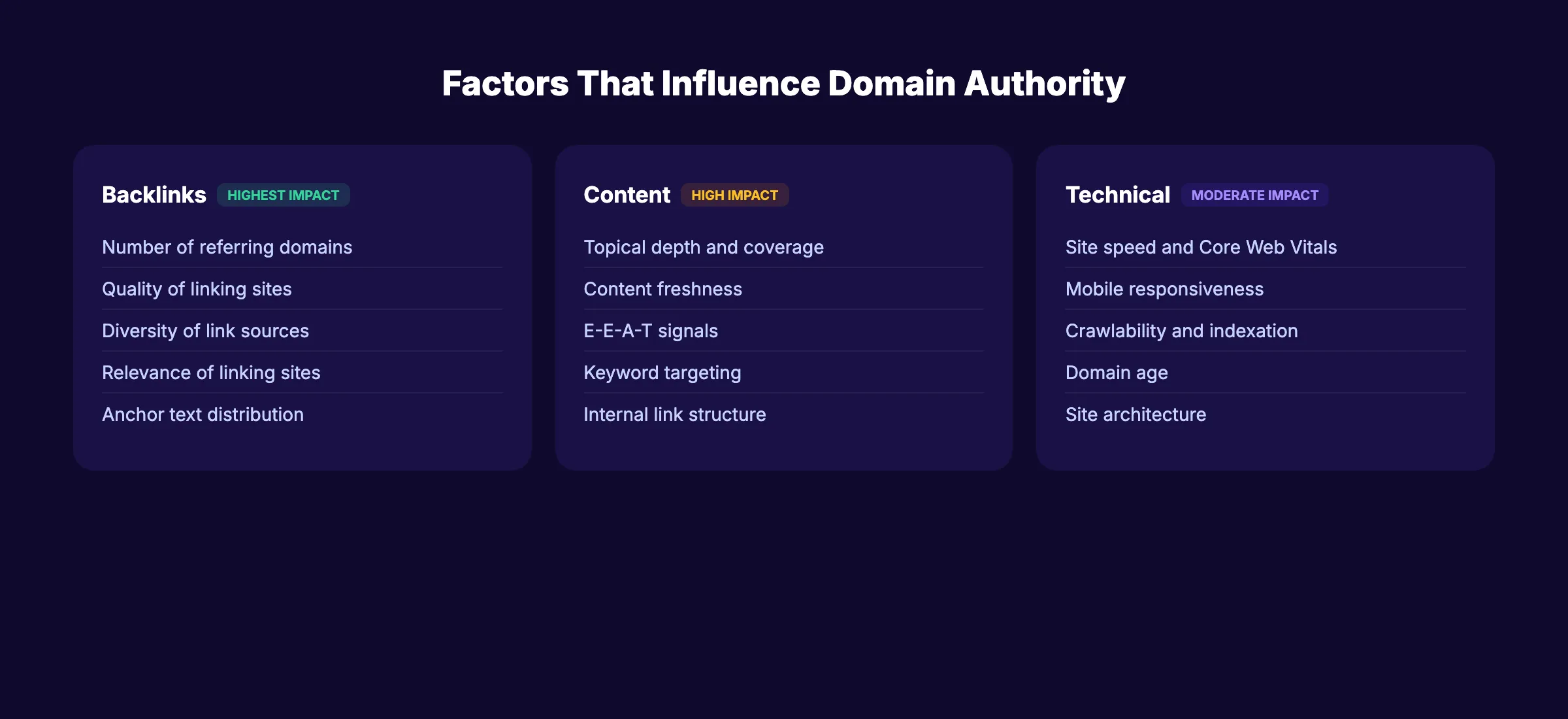
1. Earn Backlinks From High-Authority Sites
Backlinks from high-DA sites pass the most authority. One link from a DA 70 publication moves your score more than 50 links from DA 5 blogs.
How to earn them:
- Write guest posts for industry publications
- Respond to journalist requests on HARO, Help a B2B Writer, and Terkel
- Create original research and data that journalists cite
- Get featured in local news, trade magazines, and industry roundups
Quality over quantity. Always. Read our complete backlink building guide for the full playbook.
2. Remove or Disavow Toxic Backlinks
Spammy, irrelevant, or purchased backlinks drag your DA down. A backlink profile full of low-quality links signals manipulation to both Moz and Google.
How to clean your profile:
- Run a backlink audit using Moz, Ahrefs, or Semrush
- Identify links from spam sites, link farms, foreign-language directories, and irrelevant niches
- Contact webmasters to request removal
- Upload a disavow file to Google Search Console for links you cannot remove
Read our backlink audit guide for the step-by-step process.
3. Create Content That Earns Links Naturally
The best way to build DA over time is to publish content other sites want to reference. Data studies, original research, and definitive guides attract backlinks without outreach.
Link-worthy content types:
- Industry statistics pages (“Average [Metric] in [Industry]: 2026 Data”)
- Original surveys and research findings
- Definitive guides that become go-to resources
- Free tools and calculators
- Infographics and data visualizations
Follow our SEO content writing guide for content that ranks and earns links.
4. Build Topical Authority Through Content Clusters
Publishing 20 related articles on a single topic signals deeper expertise than 20 articles on 20 random topics. Google and Moz both reward focused authority.
Create content clusters: a pillar page covering the broad topic, supported by 10 to 15 specific articles linking back to the pillar. This structure builds authority faster than scattered publishing.
Read our topical authority guide for the complete framework.
Your SEO team. $99 per month. 30 optimized articles published automatically. Building your authority month after month. Start for $1 →
5. Fix Broken Links and Technical Issues
Broken internal links waste the authority your site already has. Every 404 error is a dead end where link equity disappears.
Technical fixes that protect DA:
- Find and fix broken internal links across your site
- Redirect deleted pages to relevant alternatives using 301 redirects
- Fix crawl errors in Google Search Console
- Ensure all pages load in under 3 seconds
- Maintain a clean, crawlable XML sitemap
Read our broken links repair guide and Core Web Vitals guide for detailed instructions.
6. Strengthen Your Internal Link Structure
Internal links distribute authority across your site. A strong internal linking strategy turns one earned external backlink into lifted rankings for multiple pages.
Internal linking best practices:
- Link from high-authority pages to important target pages
- Use descriptive anchor text that includes relevant keywords
- Add contextual links within body content (not just navigation)
- Link new posts to existing related content and vice versa
- Create hub pages that link to all related articles in a cluster
Follow our internal linking guide for the full process.
7. Publish Consistently Over Time
DA rewards sustained effort over quick sprints. A site that publishes 4 to 8 quality articles per month for 12 months builds more authority than one that publishes 50 articles in a single month and then goes silent.
Consistency signals that your site is active, maintained, and worthy of trust. Google and Moz both favor sites with regular publishing cadences.
8. Build Local Citations and Directory Listings
For local businesses, citations from reputable directories contribute to domain authority. List your business on:
- Google Business Profile
- Yelp, BBB, and industry-specific directories
- Local Chamber of Commerce websites
- Professional association directories
Ensure your NAP (Name, Address, Phone) is consistent across every listing. Inconsistencies confuse search engines and weaken authority signals.
For a full guide on optimizing your Google Business Profile, read our GBP optimization guide. For broader SEO tips on climbing Google rankings, check our guide to ranking higher on Google.
Domain Authority Myths Debunked
Most DA advice online is wrong. These myths waste your time and money.
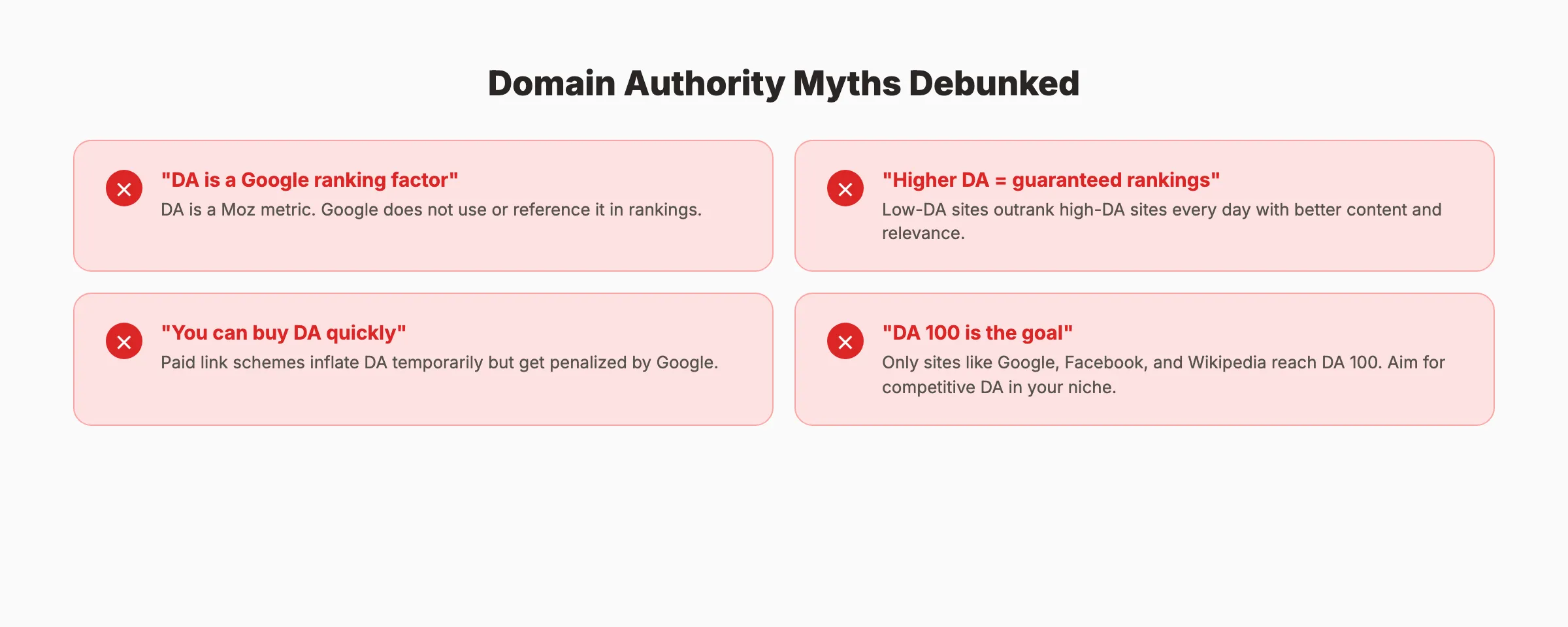
Myth: “DA is a Google ranking factor.”
Reality: Google does not use DA. Moz created it as a predictive metric. Google has its own internal quality signals that DA approximates but does not replicate.
Myth: “Higher DA guarantees higher rankings.”
Reality: Low-DA sites outrank high-DA sites constantly. A DA 25 page with perfect on-page SEO, strong content relevance, and exact search intent match beats a DA 60 page that loosely covers the topic.
Myth: “You can buy DA quickly.”
Reality: Purchasing links from link farms inflates DA temporarily. Google’s spam detection catches these schemes. The result is a manual penalty that destroys your organic traffic. The DA increase is not worth the risk.
Myth: “DA 100 is the goal.”
Reality: Only sites like Google.com, Facebook.com, and Wikipedia.org reach DA 100. For most businesses, a DA between 30 and 50 is competitive. Focus on reaching a DA that matches or exceeds your direct competitors, not an arbitrary perfect score.
Myth: “New content directly increases DA.”
Reality: Publishing content does not directly increase DA. Content increases DA indirectly by attracting backlinks. A blog post with zero backlinks adds zero DA value. A blog post that earns 15 backlinks from quality sites moves the needle.
Myth: “Social media sharing increases DA.”
Reality: Social signals do not factor into Moz’s DA calculation. Social media can expose your content to people who then link to it. But the shares themselves do not affect DA.
Myth: “You need DA 50+ to rank for anything.”
Reality: Keyword difficulty varies enormously. Long-tail keywords with low competition can rank with DA as low as 10 to 15. Target keywords appropriate for your current DA level while building authority for harder terms. Use keyword research to find terms where your current authority is competitive.
How to Check Your Domain Authority
You can check DA using several free and paid tools.
Free options:
- Moz Link Explorer (free account, limited queries)
- MozBar Chrome extension (shows DA for any site you visit)
- Small SEO Tools DA Checker
Paid options:
- Moz Pro (full DA tracking and backlink analysis)
- Ahrefs (Domain Rating, updated every 12 hours)
- Semrush (Authority Score with spam detection)
Check your DA monthly. Compare it to your top 5 competitors. Track the trend over time rather than fixating on single-month fluctuations. A steady upward trend over 6 to 12 months indicates healthy authority growth.
Record your DA alongside organic traffic, referring domains, and keyword rankings in a spreadsheet. This lets you correlate DA changes with actual business impact. A DA increase that coincides with traffic growth validates your strategy. A DA increase without traffic growth means you are building authority in the wrong areas.
For a full picture of your SEO health beyond DA, run a complete SEO audit.
3,500+ blogs published. 92% average SEO score. See what Stacc can do for your site authority. Start for $1 →
FAQ
What is a good domain authority score?
“Good” depends on your competition. For most small businesses, DA 20 to 40 is a reasonable target. For competitive industries, DA 40 to 60 puts you in contention for difficult keywords. Compare your DA to the sites ranking for your target keywords rather than aiming for an arbitrary number.
How long does it take to increase domain authority?
DA increases slowly. Most sites see a 5 to 10 point increase over 6 to 12 months of consistent link building and content publishing. Quick DA jumps are rare and often suspicious. Sustainable growth comes from earning quality backlinks month after month.
Does domain age affect domain authority?
Domain age is a minor factor. Older domains tend to have accumulated more backlinks and content over time, which increases DA. But a 1-year-old site with 200 quality backlinks will have a higher DA than a 10-year-old site with 5 backlinks. Activity matters more than age.
Can domain authority decrease?
Yes. DA can drop if you lose backlinks, if linking sites lose their own authority, or if Moz updates their algorithm. DA is relative. If competitors gain authority faster than you, your score can decrease even without losing links. Monitor your backlink profile monthly to catch losses early.
Is it worth buying backlinks to increase DA?
No. Purchased backlinks from link farms violate Google’s spam policies. They inflate DA temporarily but risk manual penalties that destroy your organic traffic. Invest in earning links through quality content, guest posting, and digital PR. Those links build real, lasting authority.
What is the fastest way to increase domain authority?
The fastest legitimate way is earning backlinks from high-DA sites through guest posting, digital PR, and HARO responses. A single link from a DA 70+ publication can move your score noticeably. Combine this with removing toxic backlinks from your profile. Most sites see measurable DA improvement within 3 to 6 months of consistent link building.
How does Stacc help improve domain authority?
Stacc publishes 30 optimized blog posts per month that target strategic keywords and attract organic backlinks. Consistent publishing builds topical authority and gives your site more pages that can earn natural links. Over 6 to 12 months, this consistent content velocity compounds into measurable DA growth.
Domain authority is a proxy for real SEO strength. You cannot game it. You build it the same way you build rankings: quality backlinks, deep content, clean technical SEO, and consistent effort over months.
Start by auditing your current backlink profile. Remove anything toxic. Then focus on earning 5 to 10 quality backlinks per month through content, outreach, and digital PR. Publish consistently. Fix technical issues. Build topical depth in your core subject areas.
The sites that treat DA as a byproduct of genuine quality work are the ones that see it climb steadily. Focus on the underlying signals. The DA score follows. And so do the rankings.
Related Tools & Resources
Free SEO Tools:
Best Lists:

Written by
Siddharth GangalSiddharth is the founder of theStacc and Arka360, and a graduate of IIT Mandi. He spent years watching great businesses lose organic traffic to competitors who simply published more. So he built a system to fix that. He writes about SEO, content at scale, and the tactics that actually move rankings.
30 SEO blog articles published every month
Keyword-optimized, scheduled, and live on your site. Automatically.
30-day trial · Cancel anytime
theStacc
Stop writing SEO content manually
30 blog articles, 30 GBP posts, and social media content. Published every month. Automatically.
Start Your $1 Trial$1 for 3 days · Cancel anytime