
How to Build an Online Presence for Local Business
Step-by-step guide to build an online presence for your local business. Website, Google, reviews, social, and content strategies that drive customers.
Building an online presence for a local business is no longer a project. It is a requirement. 99% of consumers use the internet to discover local businesses. 88% of mobile users who do a local search visit a business within 24 hours. A plumber without a Google Business Profile, a dentist without reviews, or a restaurant without an Instagram page is invisible to most potential customers.
Yet most local businesses treat their online presence as an afterthought. A website built 5 years ago. A Google listing claimed but never updated. Zero blog content. No social media strategy. The result: competitors who invest in their online presence capture the customers that should have been yours.
We have published content for local businesses across 70+ industries. This guide covers the 7 channels that make up a complete local online presence and exactly how to build each one.
Here is what you will learn:
- The 7 channels that form a complete local online presence
- How to prioritize them based on your budget and time
- The connection between online presence and local SEO rankings
- A 90-day action plan for going from invisible to visible
- How each channel reinforces the others for compounding results
The 7 Channels of a Local Online Presence
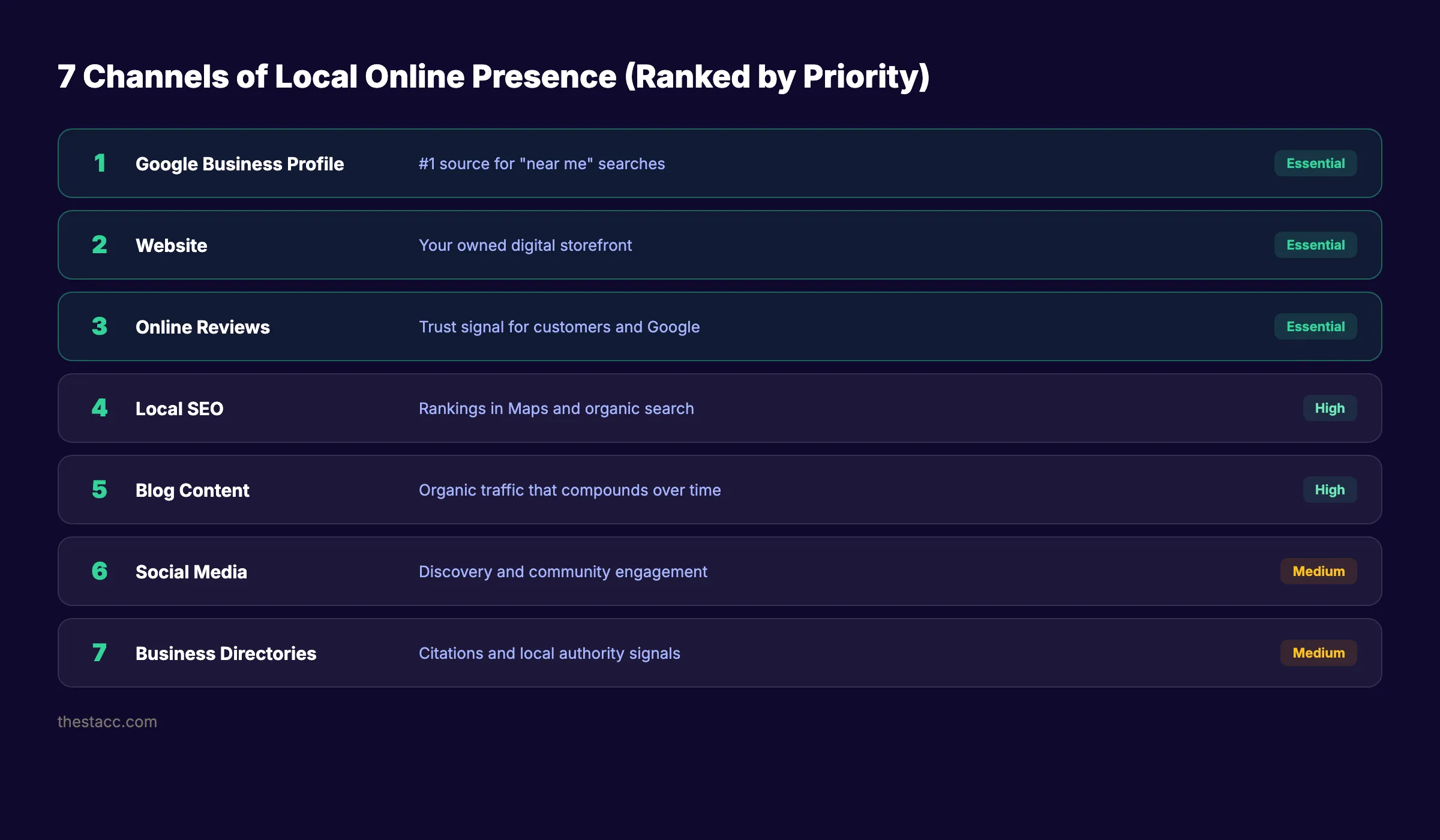
A local business’s online presence is not one thing. It is 7 channels working together. Weakness in any single channel creates a gap that competitors fill.
| Channel | Priority | Why It Matters | Time to Set Up |
|---|---|---|---|
| 1. Google Business Profile | Essential | #1 source for “near me” searches | 1-2 hours |
| 2. Website | Essential | Your owned digital storefront | 1-2 weeks |
| 3. Online Reviews | Essential | Trust signal for customers and Google | Ongoing |
| 4. Local SEO | High | Rankings in Google Maps and organic search | Ongoing |
| 5. Blog Content | High | Organic traffic that compounds over time | Ongoing |
| 6. Social Media | Medium | Discovery and community engagement | 2 hrs/week |
| 7. Business Directories | Medium | Citations and local authority signals | 2-4 hours |
Most guides tell you to do everything at once. That is unrealistic. Start with channels 1-3. They take the least time and deliver the fastest results. Add channels 4-7 as capacity allows.
Channel 1: Google Business Profile
Your Google Business Profile is the single most important element of your local online presence. When someone searches “plumber near me” or “dentist in Dallas,” GBP results appear above all websites, ads, and social profiles.
What to Do
- Claim and verify your GBP listing at business.google.com
- Complete every section (name, address, phone, hours, categories, description)
- Add 10+ high-quality photos of your business, team, and work
- Write a business description that includes your services and location
- Add your service areas and service list
- Post weekly updates (specials, events, tips)
- Respond to every review within 24 hours
Why It Matters
Fully optimized GBP profiles appear 80% more often in search results and generate 4x more website visits than incomplete profiles. GBP posts, photos, and review activity all factor into your local map pack ranking.
Time Investment
Initial setup: 1-2 hours. Ongoing maintenance: 30 minutes per week.
Channel 2: Your Website
Your website is the only online property you fully own and control. Social platforms change algorithms. Google updates policies. Your website stays constant.
What Your Website Needs
- Mobile-first design. Over 60% of local searches happen on mobile devices. 56% of consumers will not consider a business without a website. If your site does not work perfectly on a phone, you lose more than half your visitors.
- Fast load speed. Pages that take longer than 3 seconds to load lose 53% of visitors. Users leave within 2 seconds if a site is slow or confusing. Test your site speed with Google PageSpeed Insights.
- Clear contact information. Phone number, address, and hours visible on every page. Click-to-call on mobile.
- Service pages. One page per major service you offer. “Emergency Plumbing” and “Water Heater Installation” should be separate pages, not one paragraph on your homepage.
- Location pages. If you serve multiple cities, create a page for each one with unique content. “Plumber in Austin” and “Plumber in Round Rock” target different searches.
SEO Fundamentals
Every page needs a title tag, meta description, and H1 heading containing your target keyword. Internal links connect related pages. Schema markup helps Google understand your business type and location. For a complete setup guide, read our SEO for new websites guide.
Common Website Mistakes
No SSL certificate. A site without HTTPS shows a “Not Secure” warning in Chrome. Customers leave immediately. Free SSL certificates are available through most hosting providers.
No Google Analytics or Search Console. Without tracking, you cannot measure what works. Set up Google Analytics 4 and Google Search Console on day one. Both are free.
Outdated information. Old hours, discontinued services, and previous addresses confuse both customers and Google. Audit your website quarterly to ensure accuracy.
No conversion path. A beautiful website with no contact form, no phone number above the fold, and no booking link wastes every visitor. Every page should have a clear next step: call, book, or request a quote. Read our on-page SEO guide for the complete optimization framework.
Time Investment
Initial build: 1-2 weeks with a web developer or website builder. Ongoing maintenance: 2-4 hours per month.
Stop writing. Start ranking. Stacc publishes 30 SEO articles per month for $99. Build the content foundation your online presence needs. Start for $1 →
Channel 3: Online Reviews
Reviews are the bridge between discovery and decision. A customer finds your GBP listing. They see 4.8 stars with 200+ reviews. They call. A customer finds your competitor. They see 3.5 stars with 12 reviews. They skip.
The Numbers
- Businesses with 100+ Google reviews rank significantly higher in local results
- Each additional star rating increases revenue by 5-9%
- 88% of consumers trust online reviews as much as personal recommendations
How to Build Your Review Profile
- Ask every satisfied customer in person (70%+ conversion rate)
- Send a follow-up text or email with a direct link to your Google review page
- Respond to every review, positive and negative, within 24 hours
- Never buy fake reviews (FTC penalties up to $53,088 per violation)
For the complete review strategy, read our guides on getting more Google reviews, responding to positive reviews, and handling fake reviews.
Channel 4: Local SEO
Local SEO is the ongoing optimization that keeps your business visible in Google Maps and local search results. It connects your GBP, website, reviews, and citations into a unified signal that Google ranks.
The 3 Pillars of Local SEO
Relevance: Does your business match what the searcher is looking for? Accurate categories, detailed service descriptions, and keyword-targeted pages improve relevance.
Distance: How close is your business to the searcher? You cannot change your location, but you can expand your service area through location-specific content and pages.
Prominence: How well-known is your business? Reviews, citations, backlinks, and brand mentions all build prominence. The more signals Google finds about your business across the web, the higher you rank.
For a deep dive, read our local SEO guide and check the latest local SEO statistics.
Time Investment
Local SEO is ongoing. Budget 2-4 hours per month for citation building, review management, and content updates. Or automate it.
Channel 5: Blog Content
A blog turns your website from a digital business card into a traffic-generating asset. Every blog post targets a keyword that potential customers search. Over time, hundreds of posts create a foundation of organic traffic that reduces dependence on paid advertising.
Why Blog Content Matters for Local Businesses
Sites that publish 16+ blog posts per month get 3.5x more traffic than those publishing 0-4 per month. Most local businesses publish zero blog posts. That is a competitive advantage for any business willing to start.
What to Blog About
- Answers to common customer questions (“How much does a roof replacement cost in Austin?”)
- Service area pages targeting specific neighborhoods and cities
- Industry tips and seasonal advice
- Case studies and project showcases
- Local news commentary relevant to your industry
Every blog post should target a specific keyword, include internal links to your service pages, and end with a clear call to action. Read our guides on how to start a business blog and blog SEO for the complete framework.
Time Investment
Writing 4-8 blog posts per month takes 10-20 hours. Or Stacc publishes 30 optimized articles per month for $99.
Your SEO team. $99 per month. 30 optimized articles published automatically to your website. The content engine your online presence needs. Start for $1 →
Channel 6: Social Media
Social media creates the discovery layer of your online presence. Potential customers find your business on Instagram, Facebook, or TikTok before they ever search Google. Social activity also creates the brand signals that support local SEO rankings.
Which Platforms to Use
The right platforms depend on your business type. Read our platform selection guide for the full breakdown. The short version:
- Google Business Profile: Every local business (posts and photos)
- Facebook: Service businesses, 35+ demographics
- Instagram: Visual businesses (food, retail, fitness, beauty)
- TikTok: Restaurants, retail, younger audiences
- Nextdoor: Home services, contractors, real estate
- LinkedIn: B2B and professional services
Focus on 2-3 platforms. Master them before adding more. Consistency beats presence on every platform.
The biggest mistake local businesses make with social media is creating accounts on 5 platforms and posting to none of them. A dormant social profile is worse than no profile at all. It signals to customers that your business may be inactive or closed.
Post 3-5 times per week on your primary platform. Use a batching system to create a full week of content in one sitting. Respond to every comment and message within 24 hours. Social media rewards engagement, not just publishing.
Time Investment
2-3 hours per week with a batching system. See our social media marketing guide for local businesses.
Channel 7: Business Directories and Citations
Citations are mentions of your business name, address, and phone number (NAP) on websites other than your own. Directories like Yelp, Yellow Pages, BBB, and industry-specific platforms create citations that Google uses to verify your business.
The Key Directories
| Directory | Priority | Industry |
|---|---|---|
| Google Business Profile | Essential | All |
| Yelp | High | All (especially restaurants, services) |
| High | All | |
| Apple Maps | High | All |
| Bing Places | Medium | All |
| BBB | Medium | Service businesses |
| Industry-specific | Medium | Varies (Healthgrades, Avvo, Houzz, etc.) |
What Matters
NAP consistency. Your business name, address, and phone number must be identical across every directory. “123 Main St” on Google and “123 Main Street” on Yelp creates a discrepancy that weakens your local SEO signals.
Claim your listings. Unclaimed listings may contain inaccurate information. Claim your profiles on the top 10 directories and verify the details.
Monitor for changes. Third parties can submit edits to your listings. Google allows anyone to “suggest an edit” to your GBP profile. Check your listings monthly for unauthorized changes to hours, phone numbers, or categories.
Industry-specific directories matter. Healthgrades for healthcare providers. Avvo for lawyers. Houzz for contractors. These niche directories carry more authority weight than general directories for your specific industry.
Time Investment
Initial setup: 2-4 hours to claim and update the top 10 directories. Ongoing: Check quarterly for accuracy.
The 90-Day Action Plan
Building a complete online presence takes time. Here is a realistic timeline that prioritizes the highest-impact actions first.
Days 1-7: Foundation
- Claim and complete your Google Business Profile
- Verify your website loads fast on mobile (under 3 seconds)
- Ensure your phone number and address are visible on every page
- Ask 10 satisfied customers to leave a Google review this week
Days 8-30: Optimization
- Add 10+ photos to your GBP listing
- Create service pages for every major service you offer
- Claim your business on Yelp, Facebook, Apple Maps, and Bing Places
- Set up your 2 primary social media accounts
- Respond to all existing reviews (positive and negative)
- Run a website SEO audit to identify technical issues
Days 31-60: Content
- Publish your first 4-8 blog posts targeting local keywords
- Start posting on social media 3-4 times per week
- Post weekly updates to your GBP listing
- Generate 10+ new Google reviews this month
- Fix any NAP inconsistencies across directories
Days 61-90: Growth
- Publish 8-16 more blog posts (building topical authority)
- Increase social media posting frequency if time allows
- Track organic traffic growth in Google Analytics
- Review your local rankings for target keywords
- Evaluate: which channels are driving the most phone calls?
By day 90, you should see meaningful improvement in local search visibility. Organic SEO typically shows results in 3-6 months. The first 90 days build the foundation.
What Happens After 90 Days
The work does not stop at day 90. Online presence is a compounding asset. Month 4 is when blog content starts ranking. Month 6 is when review volume hits a tipping point. Month 12 is when the combination of content, reviews, and social activity creates a moat that competitors cannot easily replicate.
The businesses that treat their online presence as a 12-month project, not a 90-day sprint, see the largest returns. Consistency across all 7 channels is what separates businesses that dominate local search from those that show up on page 3.
For tools that help manage all these channels, see our guides on marketing tools for local businesses and SEO tools for small businesses. Check your current website health with our free website SEO score tool.
The Compounding Effect
Every channel you build reinforces the others. Blog content gives you material for social media posts. Social media drives branded searches that improve GBP rankings. GBP rankings drive phone calls that lead to reviews. Reviews improve your GBP ranking further. Each channel feeds the next.
This is the Stacc Stack Method. Blog SEO + Local SEO + Social Media. All 3 channels publishing consistently. All 3 amplifying each other. The compound effect is what makes a strong online presence almost impossible for competitors to catch once you build it.
Blog SEO + Local SEO + Social Media. One platform. Stacc handles all 3 channels automatically. Starting at $99/month. Start for $1 →
FAQ
How do I build an online presence for my local business from scratch?
Start with 3 channels: Google Business Profile, your website, and online reviews. Claim and complete your GBP listing. Ensure your website is mobile-friendly with clear contact information. Ask 10 satisfied customers to leave Google reviews. These 3 steps create immediate visibility. Add blog content, social media, and directories over the next 90 days.
How long does it take to build an online presence?
The foundation (GBP, website, reviews) takes 1-2 weeks. Meaningful local search visibility takes 60-90 days with consistent effort. Full organic traffic growth from blog content takes 3-6 months. The earlier you start, the sooner results compound.
What is the most important channel for local business visibility?
Google Business Profile. GBP listings drive an average 37% increase in local search visibility compared to unclaimed listings, and GBP results appear above all other search results for local queries. A complete, active GBP profile with 50+ reviews and weekly posts is the single highest-ROI investment for local visibility.
How much does it cost to build an online presence?
DIY costs $0-$500 for domain, hosting, and initial setup plus 10-20 hours of time per month. A marketing agency charges $2,000-$10,000/month. Stacc automates blog content ($99/month for 30 articles), local SEO ($49/month), and social media ($49/month). The right approach depends on your budget and available time.
Do I need a blog for my local business?
Yes. Blog content drives organic traffic that reduces dependence on paid advertising. Businesses publishing 16+ posts per month get 3.5x more traffic. Every blog post targets a keyword potential customers search. Over time, hundreds of posts create a traffic asset that grows without additional ad spend.
How do I measure my online presence?
Track 5 metrics monthly: organic website traffic (Google Analytics), local search rankings for target keywords, Google review count and average rating, social media engagement, and most importantly, phone calls and appointment bookings attributed to online channels.
Building an online presence is not a one-time project. It is a system that runs every week, every month, and compounds every quarter.
The local businesses that dominate their markets in 2026 are the ones with strong online presence across all 7 channels. The ones that ignore their digital footprint lose customers to the competitor who shows up first on Google, has better reviews, and posts content that builds trust before the first phone call. Start with GBP, your website, and reviews. Build from there. The compound effect of consistent effort across channels is how local businesses win online.

Written by
Siddharth GangalSiddharth is the founder of theStacc and Arka360, and a graduate of IIT Mandi. He spent years watching great businesses lose organic traffic to competitors who simply published more. So he built a system to fix that. He writes about SEO, content at scale, and the tactics that actually move rankings.
Automate your Google Business Profile content
30 GBP posts, local SEO articles, and review responses. Published every month automatically.
30-day trial · Cancel anytime
theStacc
Stop writing SEO content manually
30 blog articles, 30 GBP posts, and social media content. Published every month. Automatically.
Start Your $1 Trial$1 for 3 days · Cancel anytime