
Local Business Marketing Plan (2026): Guide
local business marketing plan strategies for 2026: proven tactics, real case studies, tools, and metrics to drive growth and ROI.
Most local businesses market without a plan. They run a Facebook ad one month, try SEO the next, then abandon both when results are slow. That scattered approach wastes money and produces nothing.
A local business marketing plan eliminates the guesswork. It defines which channels to use, how much to spend, what to publish, and how to measure results. According to the SBA, businesses with a documented marketing strategy are 313% more likely to report success than those without one.
Nearly 40% of small businesses plan to increase their marketing budgets in 2026. The question is not whether to invest. The question is where.
We publish content across 70+ industries and 3,500+ articles with a 92% average SEO score. We see what channels produce results for local businesses. This guide covers the complete marketing plan based on what actually works.
Here is what you will learn:
- The 7 marketing channels every local business needs
- How to allocate your budget across channels
- A 90-day roadmap to launch your marketing plan
- The specific actions to take on each channel
- How to measure what is working and cut what is not
- How to automate the hardest parts of local marketing
Chapter 1: Why Local Businesses Need a Marketing Plan
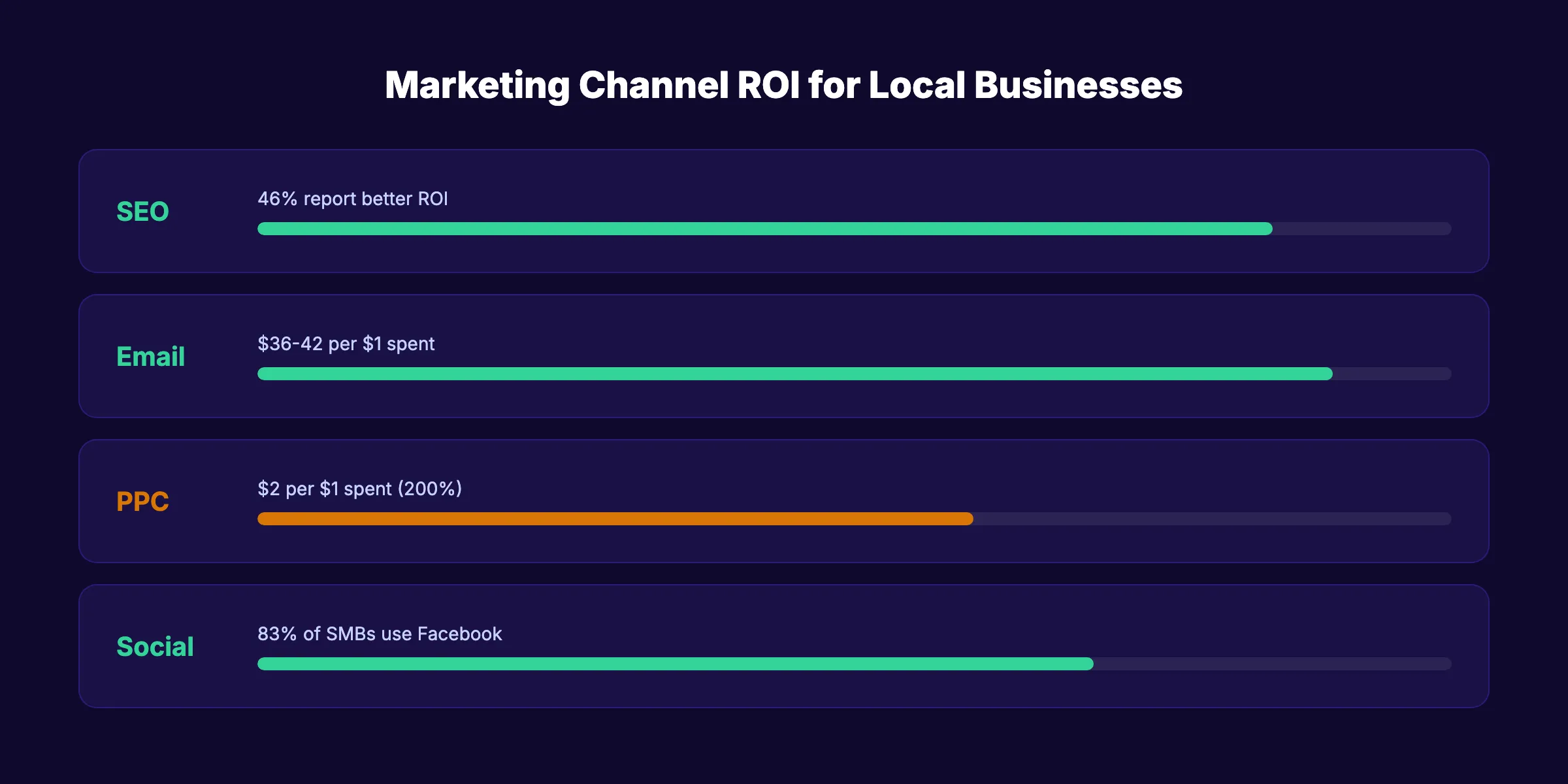
46% of marketers who invest in local SEO report better ROI than any other channel. Email marketing returns $36 to $42 for every $1 spent. And 65% of businesses now prioritize local SEO in their strategy.
Without a plan, you cannot prioritize. You spread $500 across 6 channels and get nothing from any of them. A plan focuses your budget on the 2 to 3 channels that match your business, audience, and goals.
What a Local Marketing Plan Includes
| Component | What It Covers |
|---|---|
| Target audience | Who your customers are and where they search |
| Channel selection | Which 2-3 marketing channels to prioritize |
| Budget allocation | How much to spend on each channel monthly |
| Content plan | What to publish and how often |
| Review strategy | How to collect and manage customer reviews |
| Measurement | Which metrics to track and how often |
| Timeline | 90-day roadmap with specific milestones |
The Local Marketing Reality
Most local businesses compete within a 5 to 30 mile radius. Your customers search for “[service] near me” on Google. They check your reviews. They look at your social media. They ask friends for recommendations. Your marketing plan needs to show up in all 4 of those moments.
The good news: local marketing has a natural advantage over national marketing. Your competition is limited to businesses in your service area. A dentist in Tulsa competes with 50 other dentists. A national e-commerce brand competes with thousands. That smaller competitive set means well-executed local marketing produces faster, more visible results.
The Budget Reality
Nearly 40% of small businesses plan to increase marketing budgets in 2026. The businesses increasing spend are the ones who measured results in 2025 and saw positive ROI. The businesses cutting spend are the ones who never measured and assumed marketing was not working. Measurement changes everything.
Chapter 2: The 7-Channel Marketing Stack
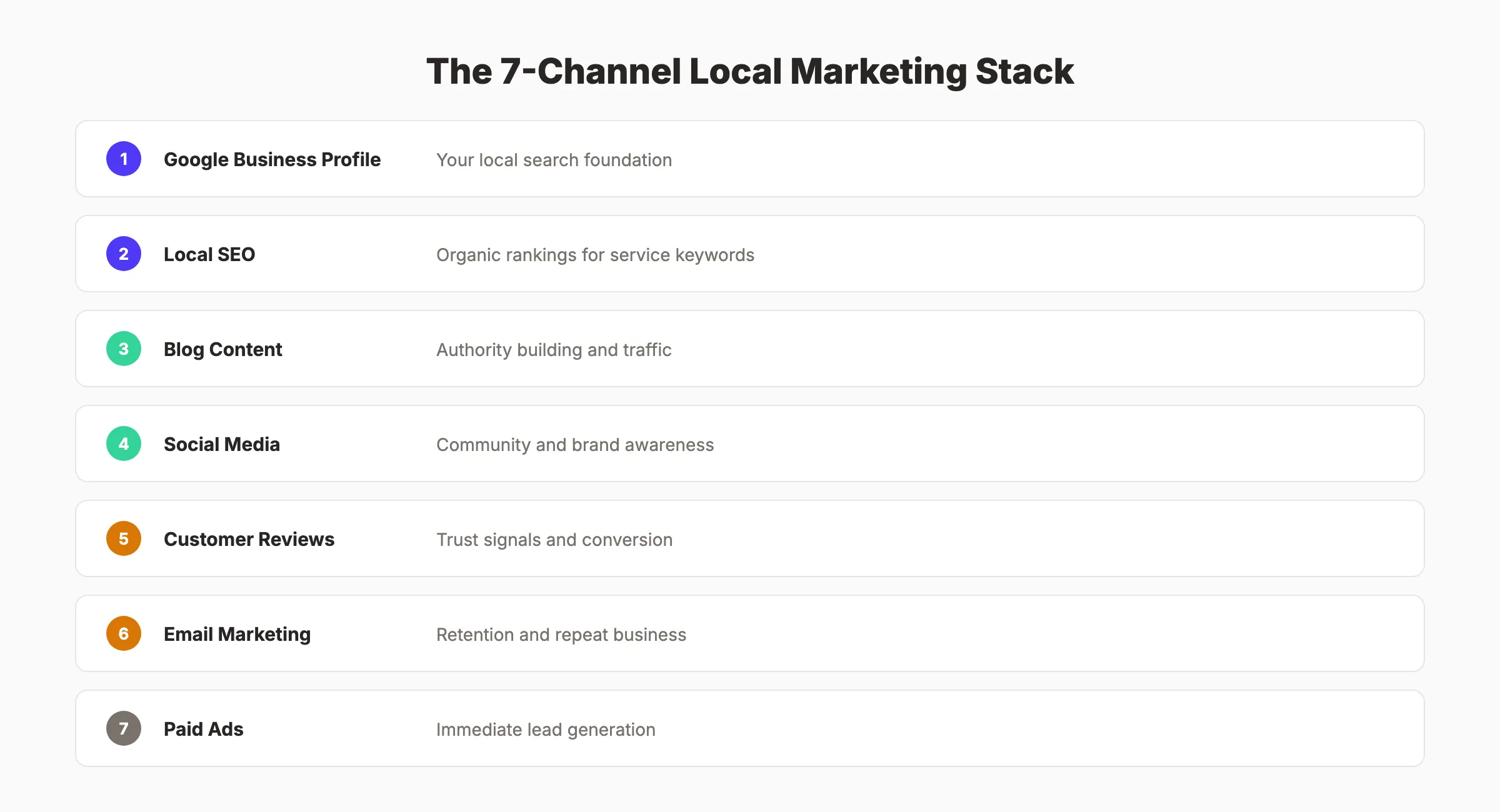
Every local business marketing plan should include these 7 channels. You do not need to master all 7 at once. Start with 3 and expand over time.
Channel 1: Google Business Profile
Your Google Business Profile is the foundation of local marketing. When someone searches “plumber near me” or “best dentist in [city],” your GBP listing appears in the local pack. 83% of US consumers use Google to evaluate local businesses.
Monthly actions:
- Post 1 to 2 GBP updates per week (specials, tips, photos)
- Upload fresh photos of your work, team, and location
- Respond to every customer review within 24 hours
- Update hours, services, and contact information as needed
Channel 2: Local SEO
Local SEO ranks your website for location-based searches. “AC repair Dallas” or “family lawyer Chicago” are high-intent keywords that drive calls and bookings. Local SEO includes on-page optimization, local citations (NAP consistency), and link building.
Monthly actions:
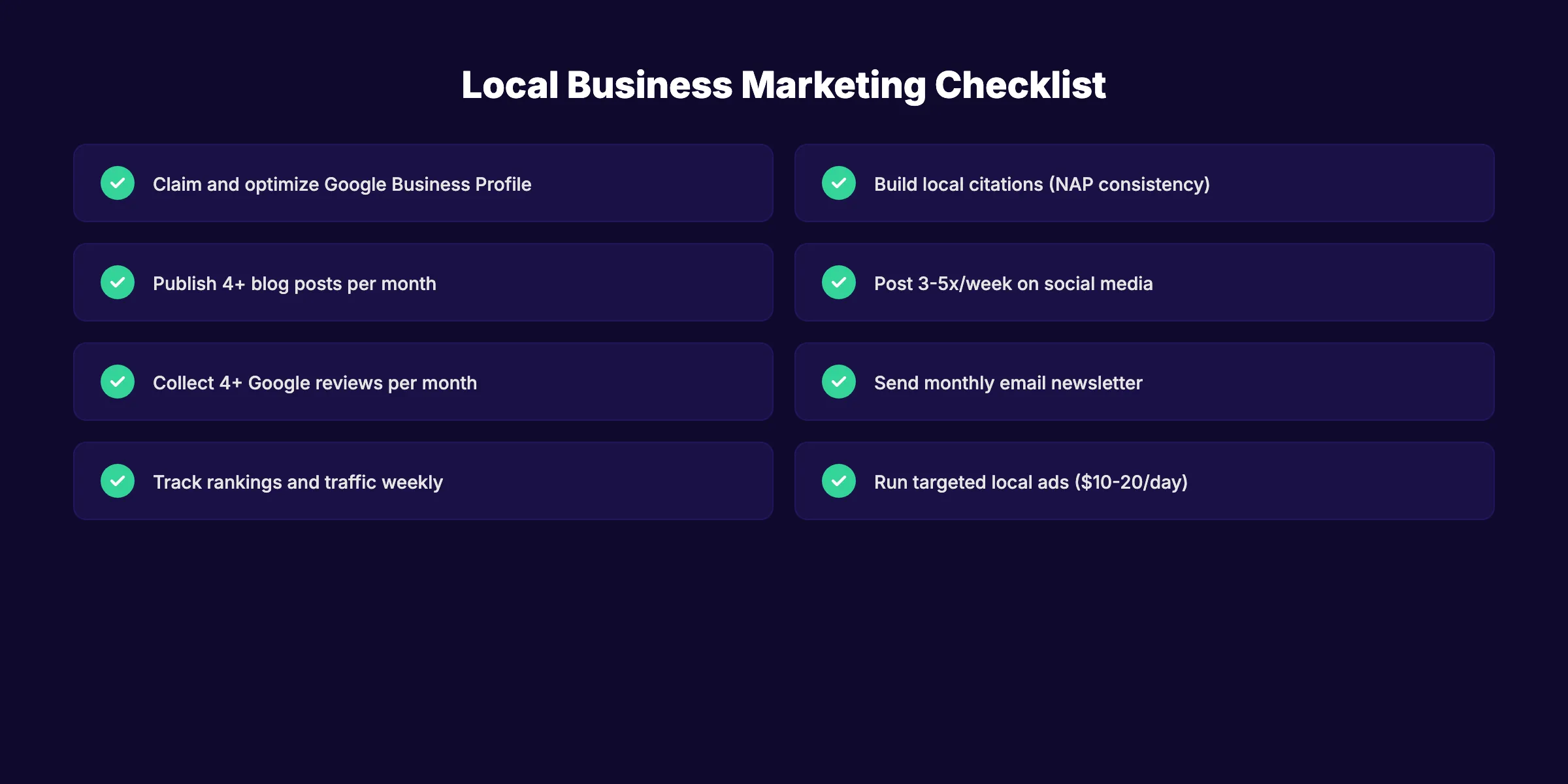
- Publish 4+ blog posts targeting local keywords
- Build citations on relevant directories (Yelp, BBB, industry sites)
- Ensure name, address, and phone number match across all listings
- Track keyword rankings and organic traffic weekly
Channel 3: Blog Content
A business blog drives organic traffic for months after each post publishes. “How much does a roof replacement cost in [city]?” and “best restaurants in [neighborhood]” are searches that bring local customers to your site. Each post compounds over time.
Monthly actions:
- Publish 4 to 8 SEO-optimized blog posts
- Target questions your customers actually ask
- Link each post to relevant service pages
- Share blog posts on social media and in email newsletters
Channel 4: Social Media
Social media builds brand awareness and community trust. For local businesses, Facebook and Instagram drive the most value. Facebook Groups and local community pages generate organic referrals. Instagram showcases your work visually.
Monthly actions:
- Post 3 to 5 times per week on your primary platform
- Share behind-the-scenes, customer stories, and tips
- Respond to all comments and direct messages within 1 hour
- Run $10 to $15/day local ads during peak seasons
For platform-specific strategies, see our guides on social media for realtors, salons, and HVAC companies.
Your SEO team. $99/month. Stacc publishes 30 blog articles, 30 social posts, and 30 GBP posts per month. The full local marketing stack on autopilot. Start for $1 →
Channel 5: Customer Reviews
Reviews are the number 1 trust signal for local businesses. 97% of consumers read reviews before choosing a local business. 31% only use businesses with 4.5+ stars. And businesses that reply to 25%+ of reviews earn 35% more revenue.
Monthly actions:
- Ask every customer for a Google review within 24 to 48 hours
- Use a QR code or direct review link to reduce friction
- Respond to every review (positive and negative)
- Share the best reviews as social media content
Channel 6: Email Marketing
Email marketing delivers $36 to $42 return for every $1 spent. For local businesses with repeat customers (restaurants, salons, dental offices, HVAC), email keeps you top of mind between visits. A monthly newsletter with tips, specials, and updates drives repeat business.
Monthly actions:
- Send 1 to 2 emails per month (newsletter, promotion, or seasonal tip)
- Segment your list by service type or customer behavior
- Include a clear call to action in every email (book, call, visit)
- Grow your list through in-store signage, website forms, and checkout prompts
Channel 7: Paid Advertising
Paid ads generate immediate leads while organic channels build over time. For local businesses, Facebook Ads and Google Ads produce the highest ROI. Start small. $10 to $20 per day on a well-targeted local campaign generates 5 to 15 leads per month.
Monthly actions:
- Run Facebook Ads targeting homeowners within your service radius
- Run Google Ads for your highest-value service keywords
- Test 2 to 3 ad variations and cut the lowest performer weekly
- Track cost per lead and adjust budget based on ROI
Chapter 3: Budget Allocation
How much you spend depends on your revenue and growth goals. The standard recommendation is 7 to 12% of revenue on marketing. For a $500,000 revenue business, that is $35,000 to $60,000 per year. Or $2,900 to $5,000 per month.
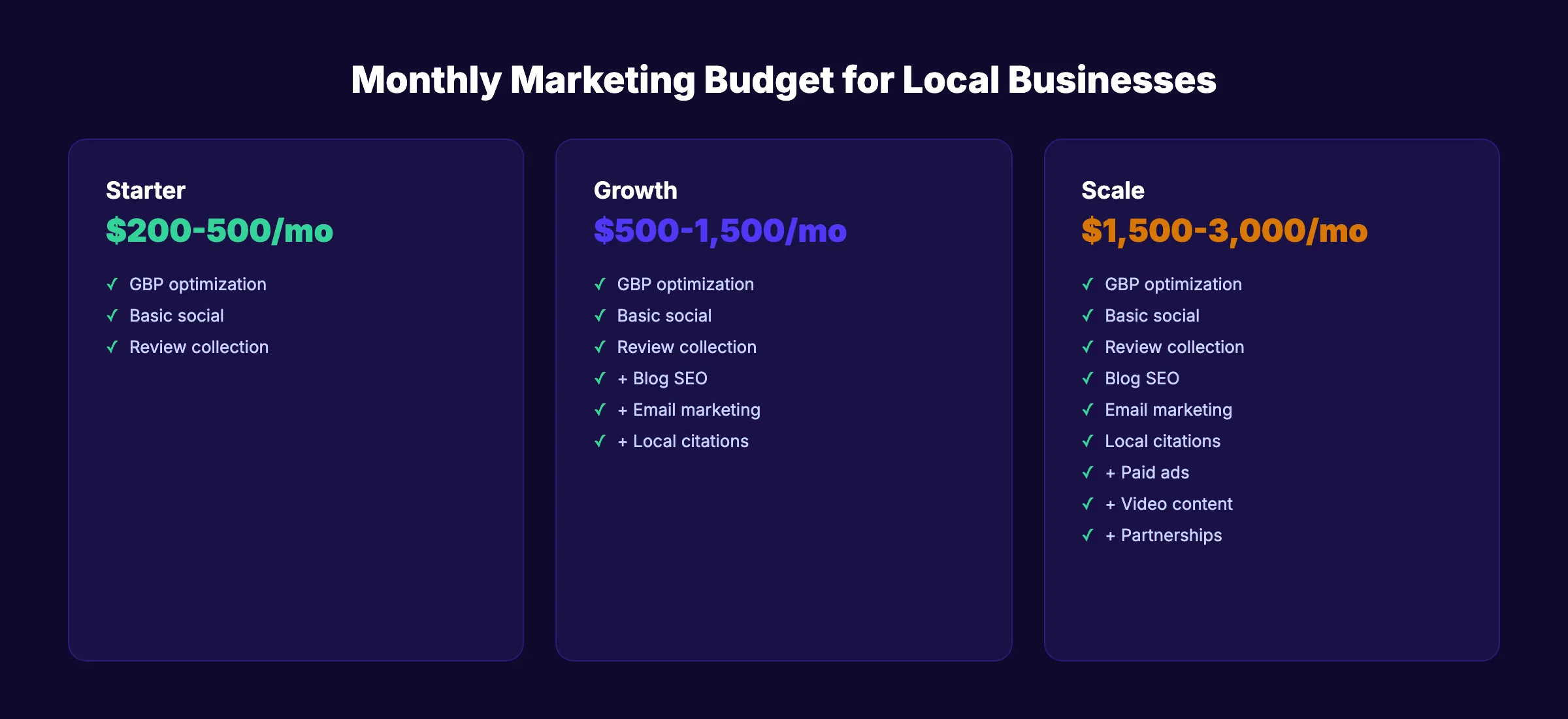
Budget Tiers
| Tier | Monthly Budget | Channels | Expected Output |
|---|---|---|---|
| Starter | $200-500/mo | GBP, Reviews, Social | Foundation built, reviews growing |
| Growth | $500-1,500/mo | + Blog SEO, Email, Citations | Traffic building, leads starting |
| Scale | $1,500-3,000/mo | + Paid Ads, Video, Partnerships | Leads flowing, market dominance |
Where to Spend First
If your budget is under $500/month, start here:
- Google Business Profile optimization. Free (your time only)
- Review collection system. Free (our review request generator helps)
- Social media posting. Free or $49/month with Stacc
- Blog SEO , $99/month with Stacc (30 articles) or DIY with AI tools
These 4 channels cover the essential local marketing foundation. Add paid ads and email once the foundation is solid.
The Stacc Stack
Stacc handles 3 of the 7 channels automatically:
| Channel | Stacc Module | Monthly Cost | Output |
|---|---|---|---|
| Blog SEO | Blog SEO | $99/mo | 30 articles |
| Social Media | Social Media | $49/mo | 30 posts across 3 platforms |
| Google Business Profile | Local SEO | $49/mo | 30 GBP posts |
| Stacc | All 3 bundled | ~$167/mo | 90 pieces of content |
The bundle covers blog content, social media, and GBP posting for approximately $167/month with the 15% multi-module discount. You handle reviews, email, and paid ads. That is the division of labor that works for most local businesses.
Rank everywhere. Do nothing. Blog SEO, Local SEO, and Social on autopilot. 90 pieces of content per month. $167. Start for $1 →
Chapter 4: The 90-Day Roadmap
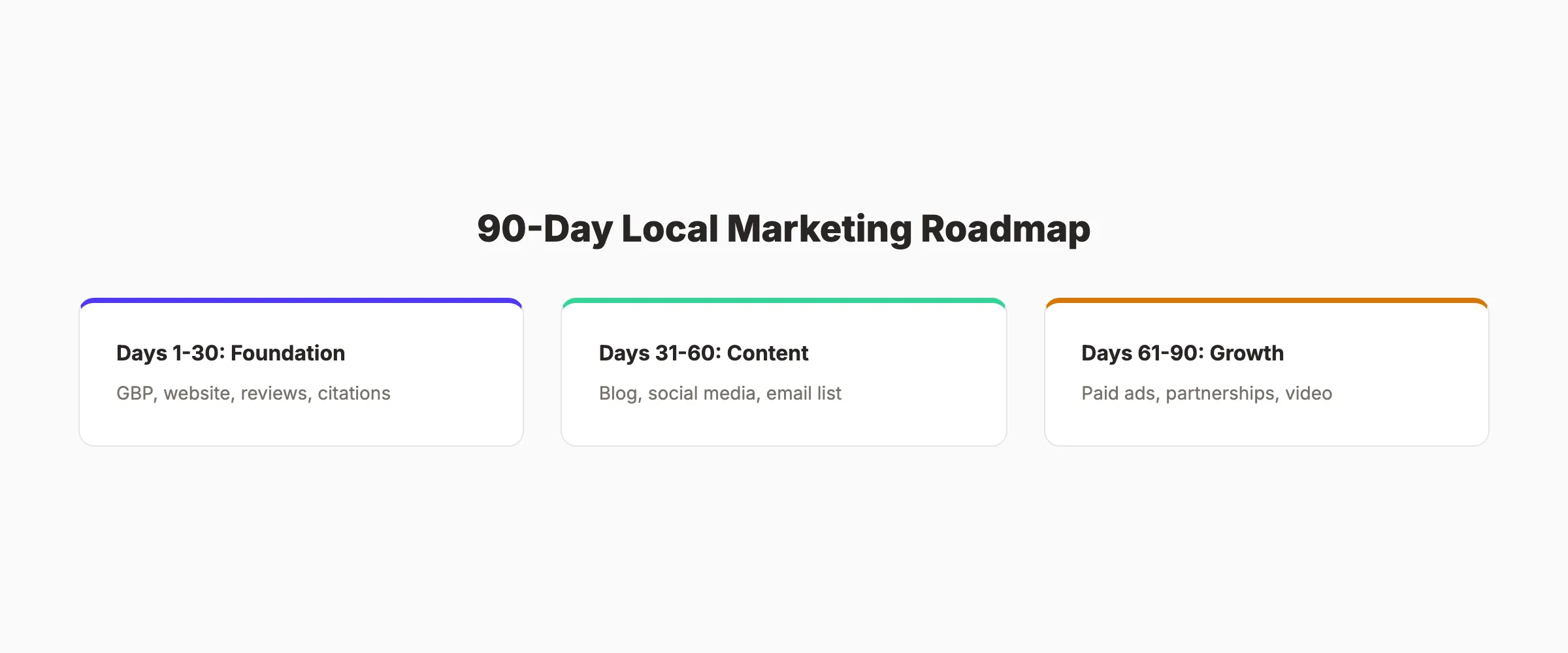
Do not try to launch all 7 channels at once. Follow this phased approach.
Days 1-30: Build the Foundation
- Claim and fully optimize your Google Business Profile
- Ensure NAP (name, address, phone) consistency across all online listings
- Set up a review collection system (how to ask for reviews)
- Build citations on 10 to 15 top local directories
- Choose your primary social media platform (Facebook or Instagram)
- Set up a basic website if you do not have one
- Install Google Analytics and Search Console
Days 31-60: Start Content
- Publish your first 4 to 8 blog posts targeting local keywords
- Begin posting 3 to 5 times per week on social media
- Send your first email newsletter to existing customers
- Collect your first 10 Google reviews
- Start sharing blog posts and reviews on social media
- Set up a content calendar for the next 30 days
Days 61-90: Accelerate Growth
- Launch your first Facebook or Google Ads campaign ($10-15/day)
- Publish 4 to 8 more blog posts (target different keyword clusters)
- Reach 20+ Google reviews with a 4.5+ star average
- Start a local partnership or sponsorship
- Create 2 to 3 short videos for Reels or TikTok
- Review analytics and double down on the channel producing the most leads
Chapter 5: How to Measure Results
Marketing without measurement is guessing. Track these metrics monthly.
Key Metrics by Channel
| Channel | Metric to Track | Tool |
|---|---|---|
| Google Business Profile | Views, calls, direction requests | GBP Insights |
| Local SEO | Keyword rankings, organic traffic | Google Search Console |
| Blog Content | Page views, time on page, conversions | Google Analytics |
| Social Media | Engagement rate, follower growth, DMs | Platform analytics |
| Reviews | Review count, average rating, response rate | GBP + review tracker |
| Open rate, click rate, unsubscribe rate | Email platform | |
| Paid Ads | Cost per lead, conversion rate, ROAS | Ad platform |
Monthly Review Checklist
- How many leads did each channel generate?
- What was the cost per lead for paid channels?
- Which blog posts drove the most traffic?
- How many new reviews did you collect?
- Is your Google Business Profile ranking improving?
- Which social posts had the highest engagement?
Cut channels that produce no leads after 90 days. Increase budget on channels that produce leads profitably. A marketing plan is a living document. Update it every quarter based on data.
Setting Realistic Expectations
Different channels produce results on different timelines. Here is what to expect:
| Channel | Time to First Results | Time to Full ROI |
|---|---|---|
| Paid Ads | 1 to 7 days | 30 to 60 days (after optimization) |
| Google Business Profile | 2 to 4 weeks | 60 to 90 days |
| Social Media | 30 to 60 days | 3 to 6 months |
| Review Collection | Immediate (per review) | 60 to 90 days (cumulative impact) |
| Blog SEO | 60 to 90 days | 6 to 12 months |
| Email Marketing | Immediate (per send) | 3 to 6 months (list growth) |
| Local Citations | 30 to 60 days | 3 to 6 months |
Paid ads produce leads immediately. SEO compounds over time. The best local marketing plans use both: paid ads for short-term leads and organic channels for long-term growth. As organic channels mature, reduce paid ad spend and let compounding traffic carry the load.
Chapter 6: Common Mistakes in Local Marketing Plans
Spreading Budget Too Thin
$200/month across 7 channels produces nothing. $200/month on 2 channels produces results. Focus beats breadth for businesses under $1 million in revenue.
Ignoring Google Business Profile
Many businesses focus on social media but neglect GBP. For local SEO, GBP drives more calls and visits than any social platform. An optimized GBP with fresh posts, photos, and reviews is the highest-ROI marketing asset for local businesses.
Not Collecting Reviews
A business with 10 reviews competes against businesses with 100+. Review velocity (new reviews per month) matters as much as total count. Build a system that asks every customer, every time.
Quitting Before Results Compound
SEO and content marketing take 3 to 6 months to show results. Most businesses quit at month 2. The Content Compound Effect means every article builds on the last. The businesses that commit for 6 months dominate the ones that quit at 2.
No Measurement System
If you do not track leads by channel, you cannot optimize. Set up Google Analytics, Search Console, and a simple spreadsheet that tracks leads per channel per month. Measurement is what separates marketing from spending.
Not Adapting to AI Search
AI search is changing how local customers find businesses. Google AI Overviews, ChatGPT, and Perplexity now answer “best [service] in [city]” queries directly. Your marketing plan should include answer engine optimization alongside traditional SEO. Structure your content to be cited by AI. Include specific data, clear answers, and schema markup. The businesses visible in both Google results and AI answers will capture the most leads in 2026 and beyond.
3,500+ blogs published. 92% average SEO score. Stacc handles blog SEO, social media, and local SEO for local businesses. Focus on your clients, not your content. Start for $1 →
FAQ
How much should a local business spend on marketing?
7 to 12% of annual revenue is the standard range. For a $500,000 revenue business, that is $2,900 to $5,000 per month. Start with $200 to $500/month focused on Google Business Profile, reviews, and content. Scale up as revenue grows and you identify which channels produce the best ROI.
What is the most effective marketing channel for local businesses?
Local SEO and Google Business Profile produce the highest ROI for most local businesses. 46% of marketers report better ROI from local SEO than any other channel. GBP drives direct calls, direction requests, and website visits from “near me” searches. Start there.
How long does it take for local marketing to produce results?
Google Business Profile optimization shows results within 2 to 4 weeks (more views, calls). Social media builds engagement within 30 to 60 days. Blog SEO and content marketing take 3 to 6 months to drive meaningful organic traffic. Paid ads generate leads immediately but stop when you stop paying.
Do I need to be on every social media platform?
No. Pick 1 to 2 platforms where your customers are most active. For most local businesses, Facebook and Instagram are the strongest options. Master 2 platforms before adding a third. Being excellent on 2 platforms outperforms being mediocre on 5.
What should a local business blog about?
Answer the questions your customers ask. “How much does [service] cost in [city]?” “When should I [maintenance task]?” “Best [product category] for [use case].” Target local keywords. Publish 4 to 8 posts per month. Each post builds topical authority and drives organic traffic.
Can Stacc handle local business marketing?
Stacc handles 3 of the 7 channels in this plan automatically. Blog SEO ($99/month for 30 articles), Social Media ($49/month for 30 posts across 3 platforms), and Local SEO ($49/month for 30 GBP posts). The full bundle costs approximately $167/month with the 15% multi-module discount. That is 90 pieces of content per month with zero time investment. Start with a $1 trial.
A local business marketing plan does not need to be complicated. It needs to be consistent. Start with Google Business Profile, reviews, and content. Add social media and email. Scale into paid ads once you know which channels convert. The businesses that follow a plan for 6 months outrank and outperform the ones that market randomly. For local businesses that want blog SEO, social media, and GBP handled automatically, Stacc starts at $99/month.

Written by
Siddharth GangalSiddharth is the founder of theStacc and Arka360, and a graduate of IIT Mandi. He spent years watching great businesses lose organic traffic to competitors who simply published more. So he built a system to fix that. He writes about SEO, content at scale, and the tactics that actually move rankings.
Automate your Google Business Profile content
30 GBP posts, local SEO articles, and review responses. Published every month automatically.
30-day trial · Cancel anytime
theStacc
Stop writing SEO content manually
30 blog articles, 30 GBP posts, and social media content. Published every month. Automatically.
Start Your $1 Trial$1 for 3 days · Cancel anytime