
How Long Does SEO Take? A Data-Backed Analysis
How long does SEO take to show results? Real data from Ahrefs and Semrush studies. Timelines by keyword difficulty and industry. Updated March 2026.
“How long does SEO take?” is the most common question every business owner asks before investing in organic search. The honest answer is not what most people want to hear.
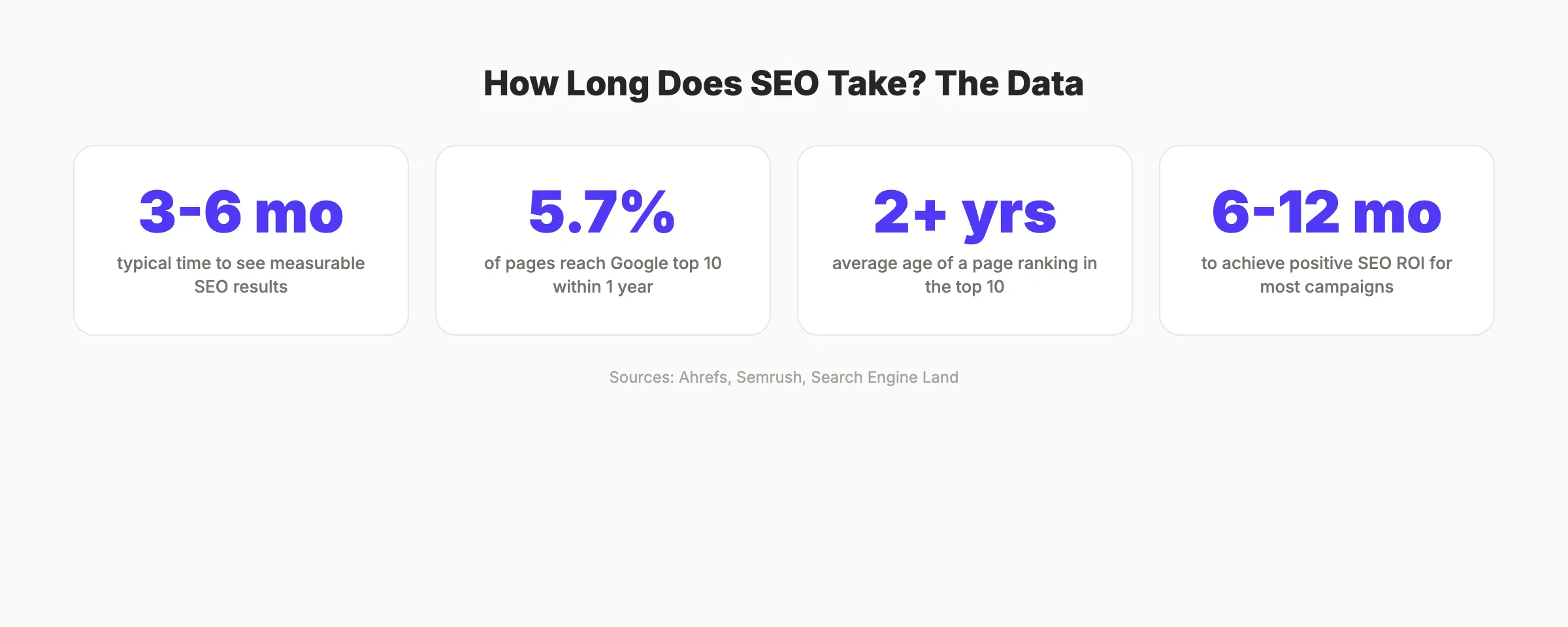
SEO takes 3 to 6 months for measurable results. Competitive industries take 6 to 12 months. An Ahrefs study of 2 million keywords found that only 5.7% of pages reach Google’s top 10 within 1 year. The average page ranking in position 1 is over 2 years old.
Those numbers sound discouraging. They should not be. They are context. Knowing the real timeline prevents you from quitting at month 3 when you are just getting started. It also helps you identify the factors that speed things up.
We have published 3,500+ blog posts across 70+ industries. We track ranking timelines across every project. This guide covers the real data behind SEO timelines, the factors that accelerate or delay results, and what to expect month by month.
Here is what you will learn:
- What the Ahrefs and Semrush studies reveal about ranking timelines
- A month-by-month breakdown of what happens during an SEO campaign
- The 6 factors that determine how fast your SEO produces results
- How keyword difficulty affects your timeline
- Why SEO compounds while paid ads do not
- How to set realistic expectations and track progress
What the Research Says: Real SEO Timeline Data
Most SEO timeline claims are opinions. Here is what the data actually shows.
The Ahrefs Study
Ahrefs analyzed 2 million random keywords and tracked how long it took pages to reach the top 10. The findings:
- The average page ranking in position 1 is 2+ years old
- The average page in the top 10 is almost 3 years old
- Only 5.7% of pages reached the top 10 within 1 year
- Of that 5.7%, most achieved their ranking between 61 and 182 days (2 to 6 months)
- 95% of pages never made it to the top 10 within a year
The takeaway is not that SEO takes 3 years. The takeaway is that most pages fail because they lack the content quality, backlinks, or authority needed to compete. The pages that do succeed typically see movement between months 2 and 6.
The Semrush Study
Semrush studied ranking stability and found:
- 41% of domains reached the top 10 within 6 months
- Only 27% remained there through the end of the 13-month study period
- Achieving rankings and maintaining them are 2 different challenges
Ranking is not a one-time event. It requires ongoing effort to maintain positions after you earn them. Content freshness, continued backlink building, and regular updates keep your rankings stable.
The Data Behind the “3 to 6 Months” Answer
When SEO professionals say “3 to 6 months,” they are citing the median experience across thousands of campaigns. But medians hide enormous variation.
A local plumber targeting “plumber in [small town]” may rank in 4 weeks. A fintech startup targeting “best personal finance app” may take 18 months. The answer always depends on your specific domain authority, keyword competition, content quality, and publishing pace.
The most useful question is not “how long does SEO take?” but “how long does SEO take for MY website, targeting MY keywords, in MY industry?” The factors section below helps you answer that precisely.
What “3 to 6 Months” Actually Means
The “3 to 6 months” figure that most SEO professionals cite refers to the first signs of measurable improvement. Not page 1 rankings for your hardest keywords. Measurable improvement means:
- Keyword positions moving from page 5 to page 2
- Organic impressions increasing in Google Search Console
- Low-difficulty keywords reaching page 1
- Organic traffic growing compared to the previous period
Full results for competitive keywords take 6 to 12 months. Peak SEO performance typically arrives in year 2 or 3 as authority compounds.
Month-by-Month SEO Timeline
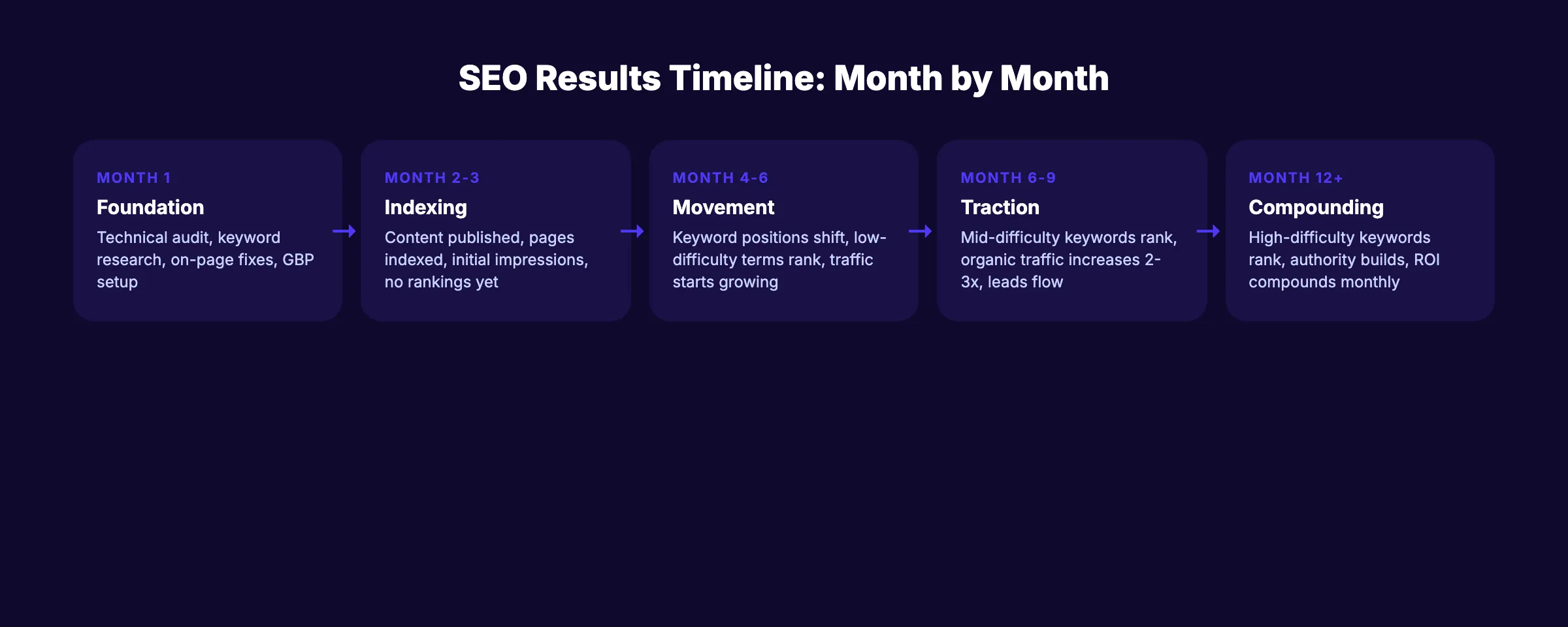
Here is what a typical SEO campaign looks like from day 1 through month 12. Every project differs. But the pattern is remarkably consistent.
Month 1: Foundation
No ranking changes. This month is about building the infrastructure.
- Complete a full SEO audit to identify technical issues
- Fix crawl errors, broken links, and page speed problems
- Conduct keyword research and map keywords to pages
- Optimize existing pages for target keywords (on-page SEO)
- Set up Google Search Console tracking
What to expect: Zero traffic changes. This is normal.
Month 2 to 3: Indexing and Initial Signals
Content gets indexed. Google starts processing your changes.
- Publish new content targeting low-difficulty keywords
- Build initial backlinks through outreach and guest posting
- Optimize internal linking structure
- Start collecting reviews and building local citations
- Monitor Search Console for impressions increases
What to expect: Impressions increase. Some low-difficulty keywords start moving. Traffic stays mostly flat.
Month 4 to 6: First Rankings and Traffic Growth
The first real results appear.
- Low-difficulty keywords reach page 1
- Medium-difficulty keywords move to page 2 or 3
- Organic traffic starts growing measurably
- Backlink profile strengthens with ongoing outreach
- Content velocity builds topical authority
What to expect: 20 to 50% traffic increase compared to month 1. Phone calls and inquiries start coming from organic search.
Stop writing. Start ranking. Stacc publishes 30 SEO articles per month. Ranking movement starts in 60 to 90 days. Start for $1 →
Month 6 to 9: Traction and ROI
SEO starts delivering measurable business outcomes.
- Medium-difficulty keywords reach page 1
- Organic traffic grows 2 to 3 times compared to the start
- Lead generation from organic search becomes consistent
- Content earns backlinks organically without outreach
- Domain authority increases noticeably
What to expect: Clear ROI. Organic traffic becomes a reliable lead source. The cost per lead from SEO drops below paid ads. This is where most businesses start reducing their ad spend and reallocating budget toward more SEO content.
For businesses in competitive industries, this phase may extend to month 12 before the full ROI picture becomes clear. The timeline stretches but the outcome remains the same. Read our SEO content writing guide for creating the content quality needed to sustain this growth.
Month 9 to 12: Authority and Compounding
The compounding effect kicks in.
- High-difficulty keywords start reaching page 1
- Organic traffic grows month over month without proportional effort increases
- Older content earns backlinks passively
- New content ranks faster due to stronger domain authority
- SEO becomes the primary traffic and lead channel
What to expect: Traffic doubles or triples compared to the start. SEO becomes cheaper per lead than any other channel.
Year 2 and Beyond: Peak Performance
This is where SEO becomes your most valuable marketing asset.
- Top rankings are established and stable
- New content ranks within weeks instead of months
- SEO generates leads and revenue on autopilot
- Maintenance replaces growth as the primary activity
- The asset you built continues producing without ongoing ad spend
At this stage, your domain authority is strong enough that new pages rank faster. A blog post published today on a DA 50 site with strong topical authority can reach page 1 for a medium-difficulty keyword in weeks rather than months. That acceleration is the compounding effect in action.
The businesses that experience this compounding are the ones that did not quit at month 4 when results were thin. They trusted the process, maintained consistency, and let authority accumulate.
6 Factors That Determine Your SEO Timeline
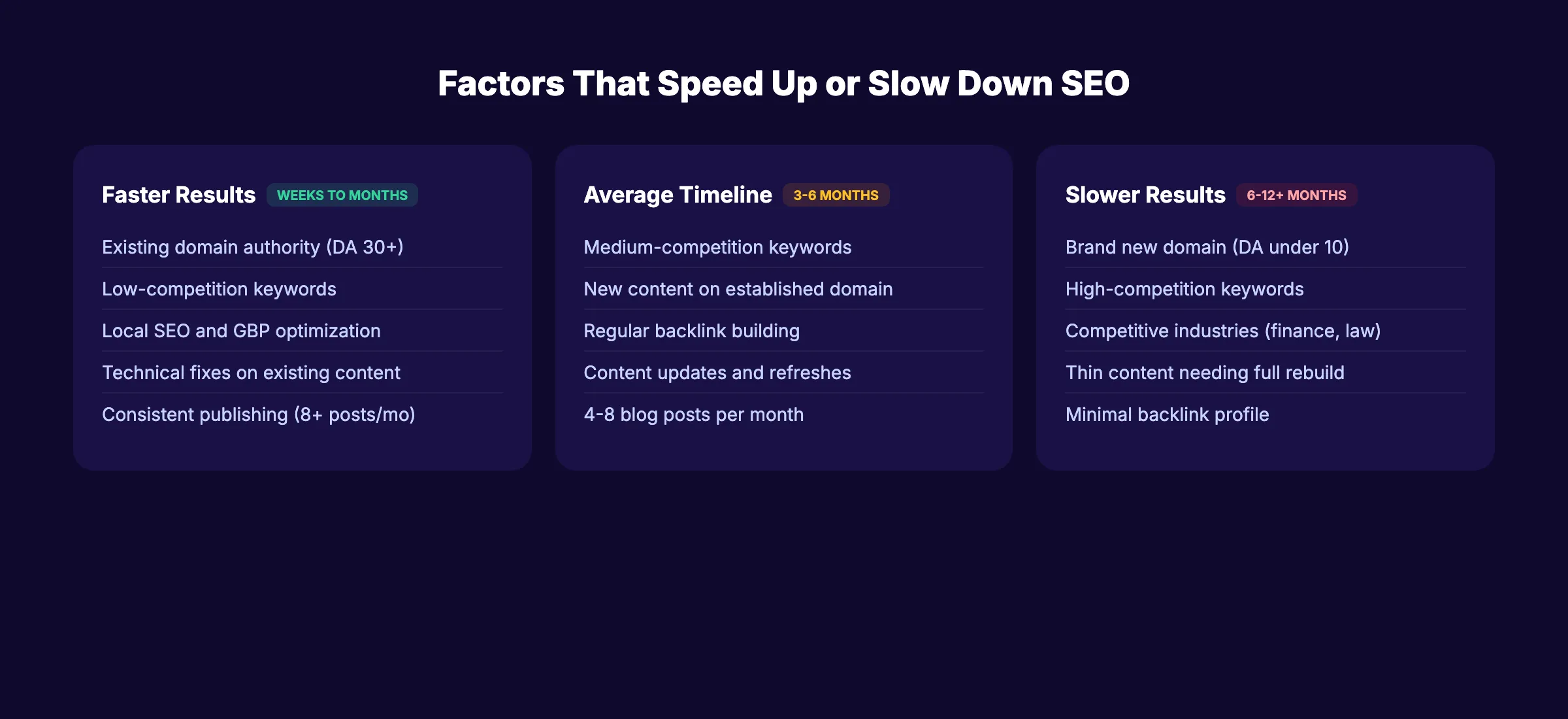
Not every site reaches results in the same timeframe. These 6 factors determine whether you see traction in 3 months or 12.
1. Domain Authority and Age
A website with DA 40 and 5 years of history ranks new content faster than a brand new domain with DA 5. Existing authority gives every new page a head start.
New domains face what some call the “sandbox” period. Google needs time to establish trust before surfacing a new site aggressively. This period typically lasts 3 to 6 months.
If your domain is new, focus on building authority through backlinks and consistent publishing. If your domain is established, you have an advantage. Use it by publishing more content, more often.
2. Keyword Difficulty
The keywords you target directly determine your timeline.
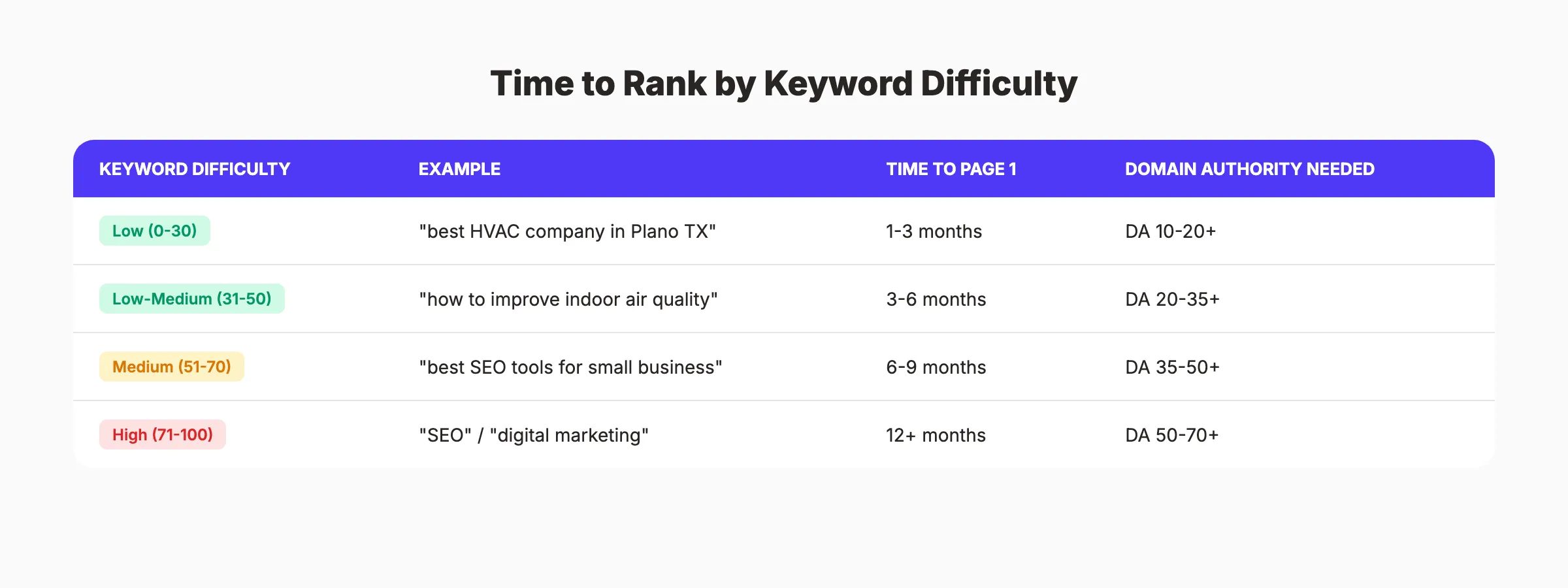
| Keyword Difficulty | Example | Time to Page 1 |
|---|---|---|
| Low (0-30) | “best HVAC company in Plano TX” | 1 to 3 months |
| Low-Medium (31-50) | “how to improve indoor air quality” | 3 to 6 months |
| Medium (51-70) | “best SEO tools for small business” | 6 to 9 months |
| High (71-100) | “SEO” or “digital marketing” | 12+ months |
Start with low-difficulty keywords. Score early wins. Build authority. Then tackle harder terms from a position of strength. Read our guide to ranking higher on Google for keyword prioritization strategies.
3. Content Quality and Depth
Thin content takes longer to rank because Google deprioritizes it. Deep, well-researched content that satisfies search intent ranks faster and holds its position longer.
A 3,000-word guide that answers every question a searcher has outranks a 500-word overview. Content with original data, expert insights, and proper E-E-A-T signals earns rankings faster than generic content.
4. Publishing Frequency
Sites that publish 4 to 8 quality posts per month rank faster than sites that publish 1 post per month. More content means more keywords targeted, more pages indexed, and faster authority building.
Consistency matters as much as volume. Publishing 8 posts per month for 12 months beats publishing 30 posts in month 1 and nothing after. Google rewards sustained activity. Read our content marketing strategy guide for planning your publishing cadence.
5. Backlink Velocity
Backlinks accelerate SEO results more than any other factor. A site earning 10 quality backlinks per month will rank faster than an identical site earning 1 per month.
The quality of links matters more than quantity. One link from a DA 60 industry publication moves your rankings more than 50 links from DA 5 blogs. Focus on earning links from relevant, high-authority sources.
6. Technical Foundation
Technical issues slow everything down. If Google cannot crawl your site efficiently, your content takes longer to index and rank.
Fix these first: site speed (under 3 seconds), mobile responsiveness, broken links, crawl errors, and proper XML sitemap configuration. A clean technical foundation removes friction from the entire SEO process. Read our Core Web Vitals guide for the technical checklist.
Your SEO team. $99 per month. 30 optimized articles published every month. Building your authority consistently. Start for $1 →
SEO vs Paid Ads: The Timeline Trade-Off
Businesses often compare SEO to Google Ads because both generate traffic from search. But the investment curves are completely different.
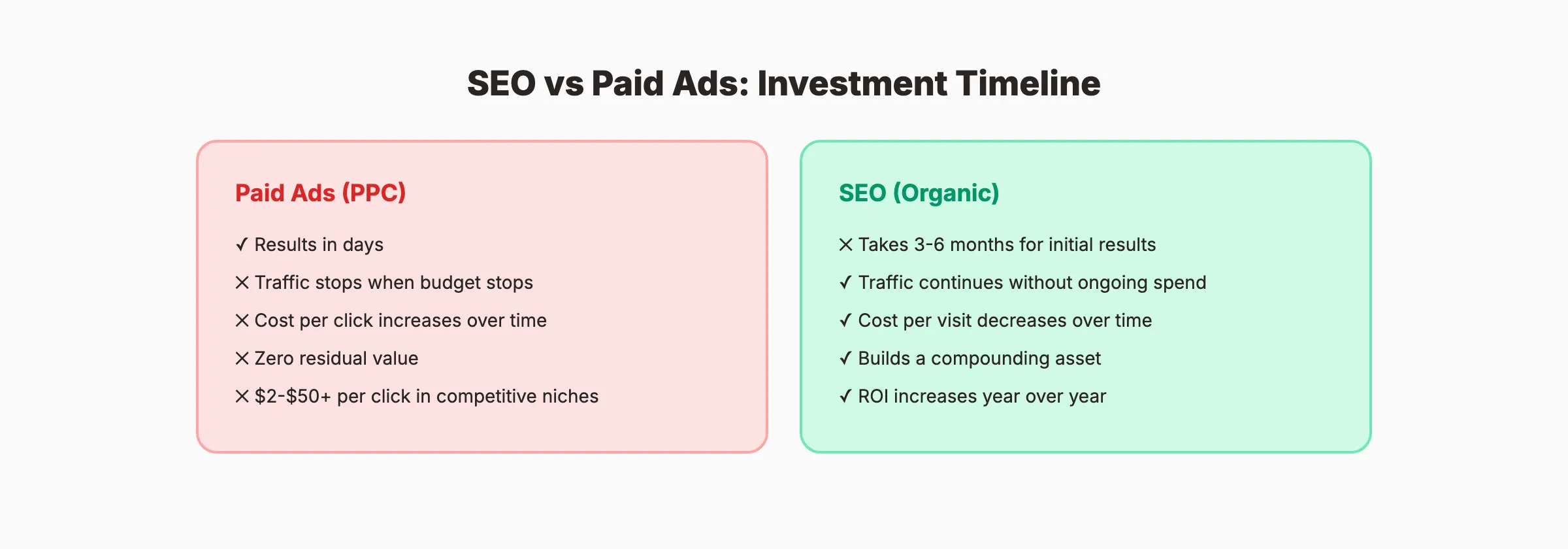
Paid ads deliver traffic immediately. You pay, you appear. But the moment you stop paying, traffic drops to zero. The cost per click typically increases over time as competition rises. Paid ads build zero long-term value.
SEO takes 3 to 6 months to produce initial results. But once you rank, traffic flows without ongoing per-click costs. The cost per visit decreases over time as your content compounds. SEO builds an asset that generates returns for years.
The best approach for most businesses is to run paid ads for immediate lead flow while investing in SEO for long-term, compounding growth. Within 6 to 12 months, SEO typically surpasses paid ads in cost efficiency. By month 18, SEO delivers leads at a fraction of the paid ad cost.
Consider a real example. A business spending $3,000 per month on Google Ads at $15 per click generates 200 visits per month. That same $3,000 invested in SEO content and link building over 12 months can build an organic traffic base of 5,000 to 10,000 monthly visits that continues growing without ongoing ad spend.
The math strongly favors SEO for any business planning to exist for more than 12 months. Paid ads are a rental. SEO is ownership.
For a deeper look at increasing organic traffic without ads, read our complete guide.
How to Speed Up Your SEO Results
You cannot trick Google into ranking you faster. But you can remove the obstacles that slow you down.
Fix technical issues immediately. Every day your site has crawl errors, broken links, or slow load times is a day Google struggles to index your content. Fix these in week 1, not month 3.
Target low-difficulty keywords first. Score early wins with long-tail, low-competition keywords while building authority for harder terms. Use keyword research tools to find terms where your current domain strength is competitive.
Publish at higher volume. If budget allows, publish 8 to 12 posts per month instead of 2 to 4. More pages indexed means more keywords targeted and faster topical authority building.
Prioritize backlink building. Allocate time every week to outreach, guest posting, and digital PR. One quality backlink per week compounds into 50 per year.
Update existing content. Refreshing old blog posts with current data, expanded sections, and better optimization often produces ranking improvements within weeks. This is faster than creating new content from scratch.
Optimize for featured snippets. Structuring your content to win featured snippets can jump you from page 2 to position 0 faster than climbing through organic rankings.
Add schema markup. Proper schema markup helps Google understand your content faster and enables rich results that boost click-through rates. Pages with rich results get 58% of clicks compared to 41% for standard listings.
Build E-E-A-T signals. Author bios, cited sources, original data, and transparent business information signal quality to Google. Sites with strong E-E-A-T signals often rank faster because Google trusts them sooner.
3,500+ blogs published. 92% average SEO score. See what Stacc can do for your site. Start for $1 →
FAQ
Can SEO show results in 1 month?
Rarely for rankings. Technical fixes and GBP optimization can produce measurable changes within weeks. But organic keyword rankings typically need 2 to 6 months of consistent effort before meaningful movement appears. If an SEO provider promises page 1 rankings in 30 days, that is a red flag.
Why does SEO take so long compared to paid ads?
Google evaluates over 200 ranking factors before positioning a page. Building the backlink profile, domain authority, content depth, and trust signals that satisfy those factors takes time. Paid ads bypass this entirely by paying for placement. SEO earns placement through accumulated quality signals. The trade-off is that SEO results persist long after you stop actively investing, while paid ad traffic stops the moment your budget runs out.
Does SEO take longer for new websites?
Yes. New domains start with zero authority, zero backlinks, and zero trust history. Google needs 3 to 6 months to establish baseline trust for a new domain before surfacing it competitively. Existing domains with established authority see faster results from new content.
How do I know if my SEO is working before results appear?
Track leading indicators in Google Search Console: impressions (how often Google shows your pages), average position (whether keywords are moving up), and indexed pages (whether Google is processing your content). These metrics improve before traffic does.
Is SEO faster for local businesses?
Yes. Local SEO and Google Business Profile optimization often produce results within 2 to 4 weeks. Local keywords have less competition than national terms. GBP optimization, review generation, and local citations can put you in the map pack faster than organic rankings for broader keywords.
What happens if I stop doing SEO after 6 months?
Your rankings will hold for a while but gradually decline. Competitors publish new content, earn new backlinks, and eventually push your pages down. SEO is not a one-time project. It requires ongoing effort to maintain positions. That said, a site with 12 months of strong SEO retains most of its traffic for 3 to 6 months even after activity stops. The compounding asset decays slowly, not instantly.
How does Stacc help speed up SEO results?
Stacc publishes 30 optimized blog posts per month, which is 7.5 times the publishing velocity of a typical business. Higher content velocity builds topical authority faster, targets more keywords simultaneously, and gives Google more pages to index and rank. Most Stacc clients see initial ranking movement within 60 to 90 days. Combined with our Local SEO module for GBP optimization, Stacc covers both the content and local signals that drive the fastest results.
SEO is a long-term investment with compounding returns. The first 3 to 6 months build the foundation. Months 6 to 12 deliver measurable results. Year 2 and beyond is when the real compounding happens.
The data is clear. 95% of pages never reach the top 10 within a year. The 5% that do share common traits: consistent publishing, quality backlinks, strong technical foundations, and patience through the early months when results are invisible. Those early months are not wasted time. They are the foundation that makes everything after month 6 possible.
The businesses that win at SEO are the ones that start early and stay consistent. Every month you delay is a month your competitors build authority you will need to overcome. Start building today. Every month of consistent effort moves you closer to the compounding phase where SEO becomes your most profitable marketing channel.
Related Tools & Resources
Free SEO Tools:
Best Lists:

Written by
Siddharth GangalSiddharth is the founder of theStacc and Arka360, and a graduate of IIT Mandi. He spent years watching great businesses lose organic traffic to competitors who simply published more. So he built a system to fix that. He writes about SEO, content at scale, and the tactics that actually move rankings.
30 SEO blog articles published every month
Keyword-optimized, scheduled, and live on your site. Automatically.
30-day trial · Cancel anytime
theStacc
Stop writing SEO content manually
30 blog articles, 30 GBP posts, and social media content. Published every month. Automatically.
Start Your $1 Trial$1 for 3 days · Cancel anytime