
What Is AEO? Answer Engine Optimization Explained
AEO (Answer Engine Optimization) gets your content into featured snippets, voice results, and AI answers. Learn what AEO is and how to optimize. Updated 2026.
60% of Google searches now end without a click. The user gets their answer directly from a featured snippet, knowledge panel, or AI Overview. They never visit a website.
AEO (Answer Engine Optimization) is the practice of optimizing your content so search engines and AI platforms deliver it as the direct answer to user queries. Where traditional SEO targets a ranking position, AEO targets position zero. The featured snippet box. The voice assistant response. The AI-generated answer.
The shift is accelerating. Gartner predicts that by 2026, 25% of traditional search volume will move to AI chatbots and virtual assistants. Google AI Overviews now appear in 30% of all searches and 74% of problem-solving queries. If your content is not structured for answer engines, you are invisible in the fastest-growing segment of search.
We publish 3,500+ articles across 70+ industries with a 92% average SEO score. We optimize every piece for both traditional rankings and answer engine visibility. This guide covers what AEO is, how it differs from SEO and GEO, and exactly how to optimize for it.
Here is what you will learn:
- What AEO means and where it originated
- How answer engines select which content to feature
- The key differences between AEO, SEO, and GEO
- 8 proven AEO optimization strategies
- How to capture featured snippets and voice search results
- How to measure AEO success
- Common mistakes that block your content from answer boxes
Chapter 1: What AEO Means
AEO stands for Answer Engine Optimization. It is the practice of structuring and optimizing content so answer engines (Google featured snippets, voice assistants, AI Overviews, and AI chatbots) select and display it as the direct answer to a user query.
The Origin of AEO
AEO emerged as Google began displaying featured snippets and knowledge panels in search results. Before featured snippets, every search result was a blue link. Users clicked through to websites to find answers. Featured snippets changed that by pulling the answer directly onto the results page.
Voice search accelerated AEO further. When a user asks Alexa, Siri, or Google Assistant a question, the device reads one answer. That answer comes from the featured snippet or the top-ranking structured result. There is no “page 2” for voice search. There is one answer or none.
AEO vs Traditional SEO
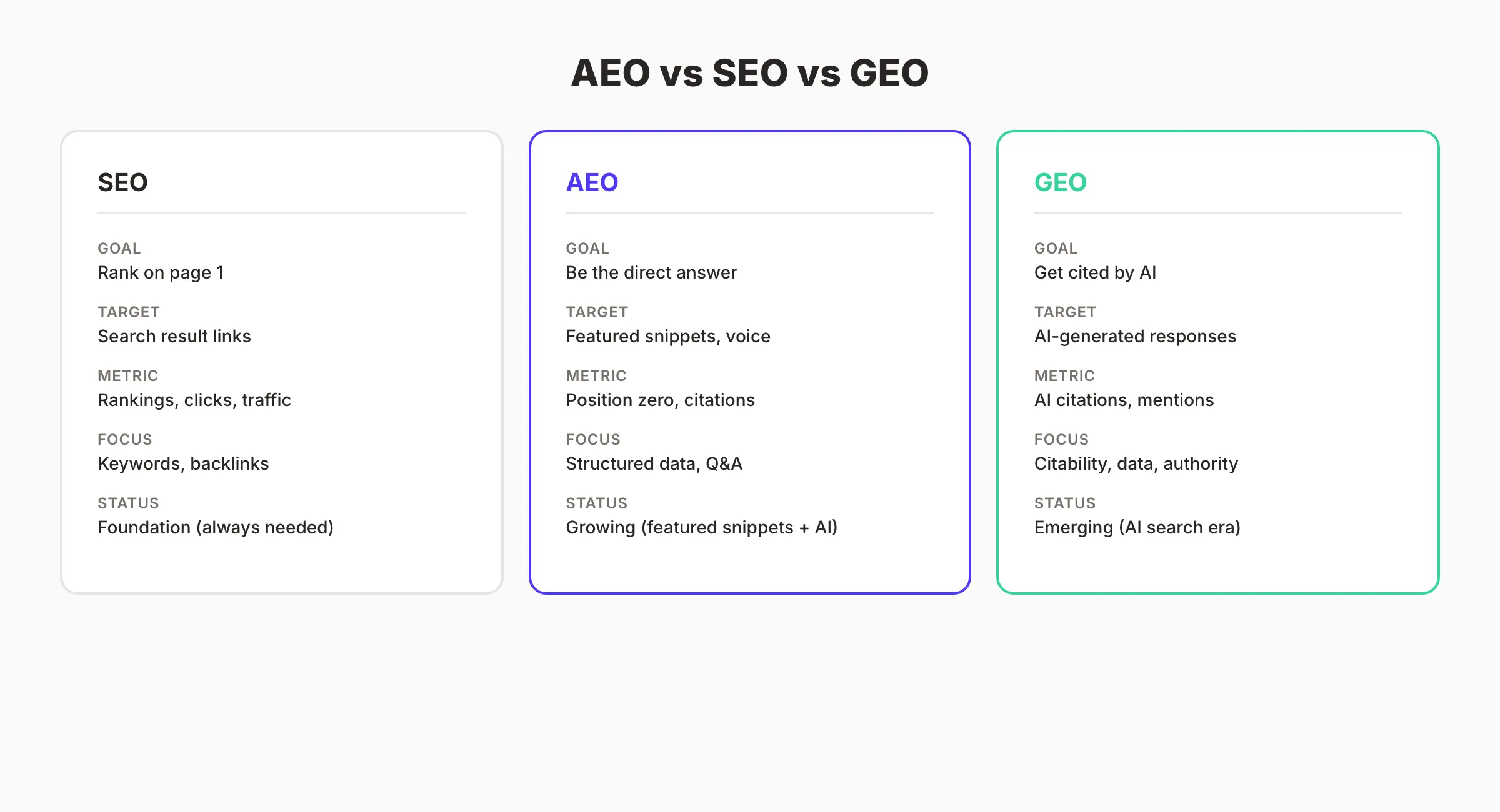
SEO optimizes for rankings. AEO optimizes for answers.
| Factor | Traditional SEO | AEO |
|---|---|---|
| Goal | Rank on page 1 | Be the direct answer (position zero) |
| Target | Search result links | Featured snippets, voice, AI answers |
| Success metric | Rankings, clicks, traffic | Position zero, citations, answer selection |
| Content focus | Keywords, backlinks, meta tags | Structured data, Q&A format, concise answers |
| Query type | Short keyword phrases | Natural language questions |
| Output | 10 blue links | Single answer box or voice response |
AEO vs GEO
AEO and GEO (Generative Engine Optimization) are closely related but target different answer formats.
AEO focuses on structured answers: featured snippets, knowledge panels, People Also Ask boxes, and voice assistant responses. These are deterministic. Google selects one answer from one source.
GEO focuses on generative answers: ChatGPT responses, Perplexity citations, Google AI Overviews. These are synthesized. The AI combines information from multiple sources into one response and cites 2 to 7 sources.
In practice, the strategies overlap significantly. Content optimized for AEO often performs well for GEO too. The Princeton GEO research found that structured, well-cited content with statistics increases visibility across both answer formats.
Most practitioners in 2026 use both terms. If your content answers questions clearly, uses structured data, and includes cited facts, you are doing both AEO and GEO.
Chapter 2: Why AEO Matters in 2026
The numbers tell the story of a search environment shifting toward answers over links.
The Zero-Click Reality
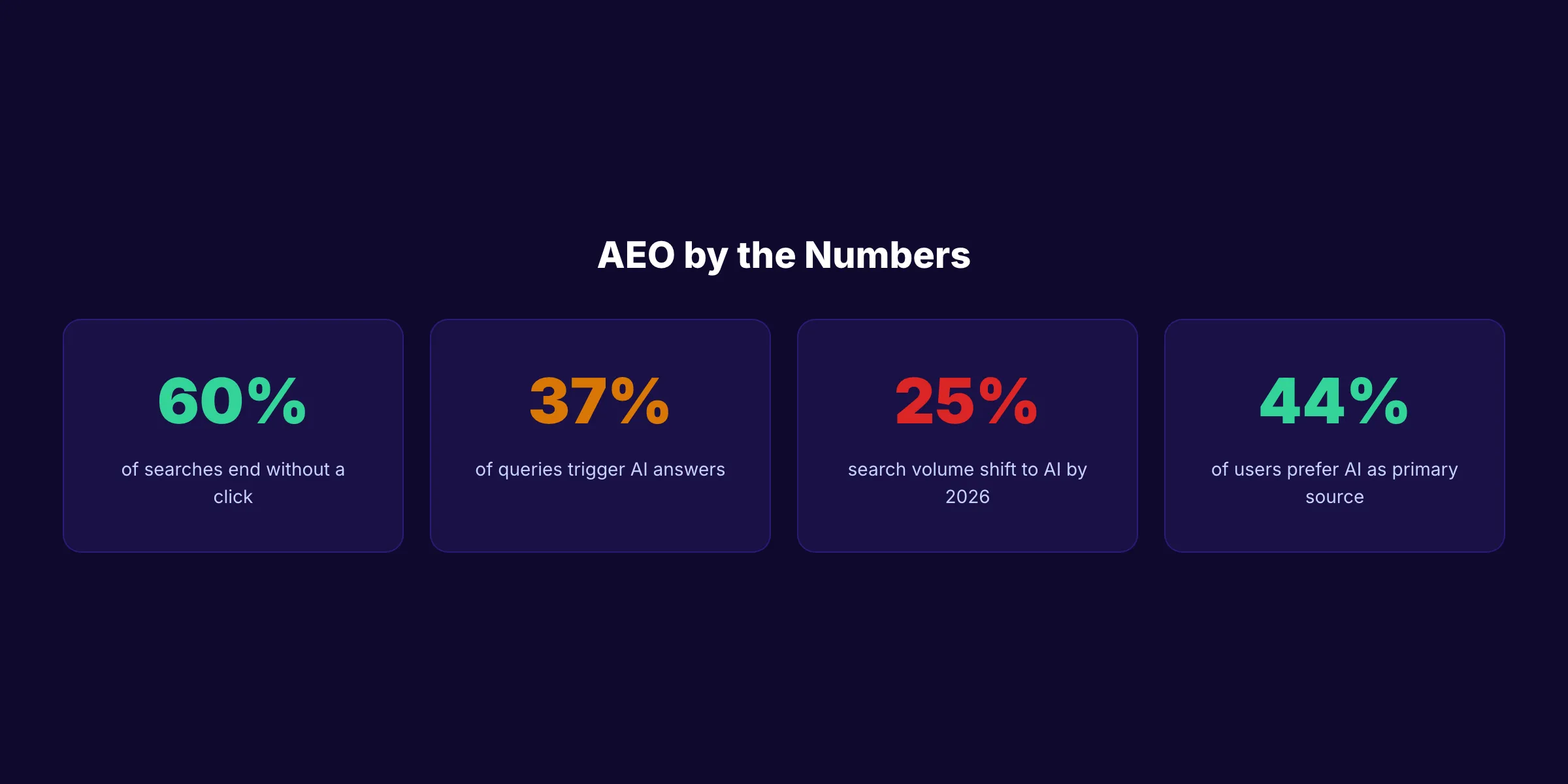
- 60% of Google searches end without a click (2025 data)
- Zero-click searches for news queries jumped from 56% to 69% in one year
- Position 1 click-through rate drops to just 2.6% when an AI Overview appears
- Zero-click search is the new default, not the exception
AI Answer Growth
- 37% of informational queries now trigger an AI-generated answer (up from 12% in January 2024)
- Google AI Overviews appear in 30% of all searches
- 74% of problem-solving queries include an AI Overview
- ChatGPT serves 800 million weekly active users
- ChatGPT accounts for 87.4% of all AI referral traffic
User Behavior Shift
- McKinsey found that 44% of AI search users now consider AI their primary source of insight
- Only 31% still rely primarily on traditional search
- Gartner predicts 25% of search volume will shift to AI chatbots by 2026
The Business Impact
Brands that optimize for AEO see measurable results. Conductor data shows that the top 10 AEO-optimized brands appear in 18% of relevant AI answers. Non-optimized brands appear in just 3%. That is a 6x visibility gap.
Featured snippets also capture a disproportionate share of clicks. Pages holding position zero earn approximately 35% of all clicks for that query. That is more than position 1 in many cases. For voice search, the stakes are even higher. Voice assistants read one answer. If your content is not that answer, you get zero visibility.
The Local SEO Connection
AEO matters especially for local businesses. When someone asks “best pizza near me” or “emergency plumber open now,” the answer engine delivers one result. That result comes from a well-optimized Google Business Profile with strong reviews, accurate hours, and structured local data. Local AEO is the difference between being the answer and being invisible.
Your SEO team. $99/month. Stacc publishes 30 articles per month optimized for both traditional search and answer engines. Every article includes structured data, Q&A formatting, and schema markup. Start for $1 →
Chapter 3: How Answer Engines Work
Understanding how answer engines select content helps you optimize for them.
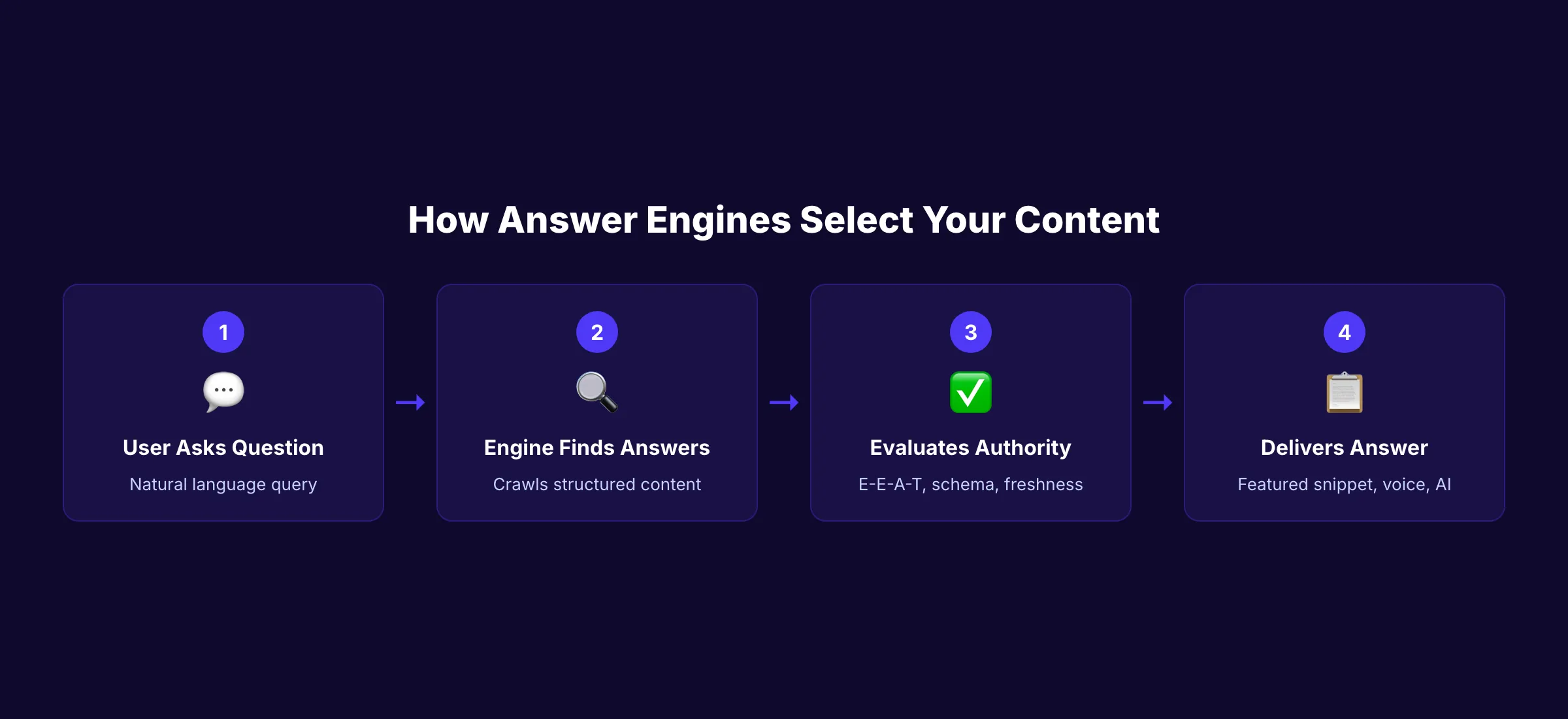
The Answer Selection Process
When a user asks a question, the answer engine follows a predictable process:
1. Parse the query. The engine identifies the question type (definition, comparison, how-to, list) and the topic.
2. Search for structured answers. The engine looks for content that directly matches the question format. FAQ schema, HowTo schema, and content with question-formatted headers get priority.
3. Evaluate authority. The engine checks E-E-A-T signals: author credentials, source citations, domain authority, and content freshness.
4. Extract the answer. For featured snippets, the engine pulls a paragraph (40 to 60 words), list, or table directly from the page. For voice search, it reads a 30-word average response.
What Answer Engines Prioritize
Based on research from Semrush and analysis of featured snippet patterns:
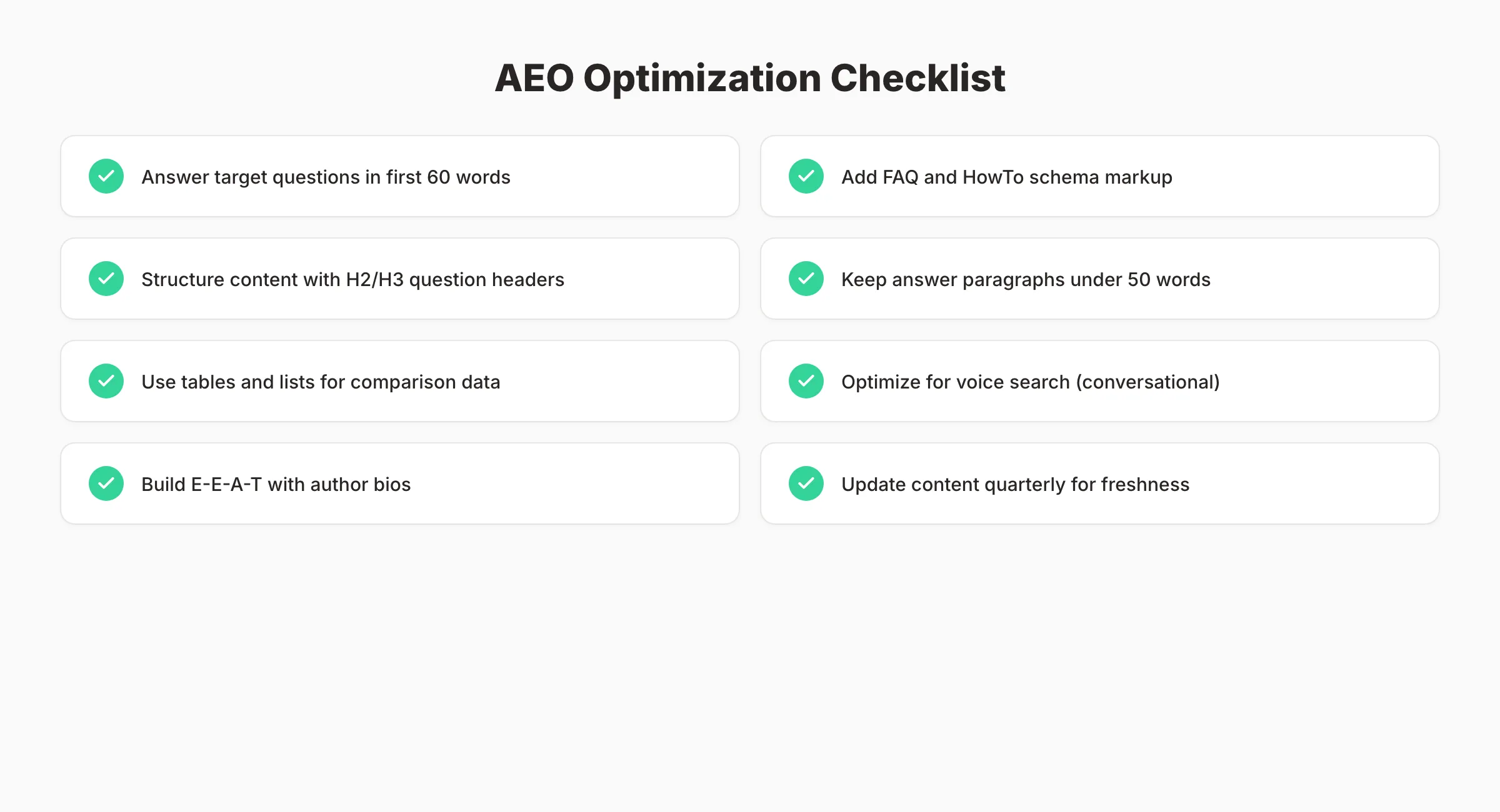
- Direct answers in the first 60 words of a section (the engine does not dig deep)
- Question-formatted H2 and H3 headers that match how users search
- Structured data markup (FAQ, HowTo, Article schema)
- Lists and tables for comparison and step-by-step queries
- Concise paragraphs under 50 words for definition queries
- Recent publication or update dates (freshness signals)
- Strong E-E-A-T signals (author bios, cited sources, credentials)
Featured Snippet Types
| Snippet Type | Format | Best For | Percentage of Snippets |
|---|---|---|---|
| Paragraph | 40-60 word answer | Definitions, explanations | 70% |
| List | Numbered or bulleted | Steps, rankings, tips | 19% |
| Table | Rows and columns | Comparisons, data, pricing | 6% |
| Video | YouTube clip | How-to, tutorials | 5% |
Paragraph snippets dominate. To capture one, answer the target question in 40 to 60 words directly below a question-formatted heading. The engine extracts that paragraph verbatim.
Chapter 4: 8 AEO Optimization Strategies
These strategies are proven to increase your content’s chances of being selected as a direct answer.
1. Answer the Question in the First 60 Words
Answer engines pull from the top of a section. If your answer is buried in paragraph 3, it will not get extracted. Place your direct answer immediately after the heading. Then expand with detail below.
Example structure:
## What is answer engine optimization?

Answer engine optimization (AEO) is the practice of... [40-60 word direct answer]

[Expanded explanation, context, examples follow]
2. Use Question-Formatted Headers
Structure your H2 and H3 tags as questions that match user search queries. “What is AEO?” “How does answer engine optimization work?” “What is the difference between AEO and SEO?”
Search engines match question headers to question queries. A header that mirrors the user’s exact question has a higher chance of triggering a featured snippet.
3. Implement Schema Markup
Schema markup tells answer engines exactly what your content contains. For AEO, the most impactful schema types are:
- FAQPage schema. For FAQ sections (Google displays these as expandable Q&A)
- HowTo schema. For step-by-step guides (Google shows steps in results)
- Article schema. For blog posts (includes author, date, headline)
- Speakable schema. For voice search (marks content suitable for audio)
Use our schema markup generator to create the correct markup for your content.
4. Write Concise Answer Paragraphs
Featured snippet paragraphs average 40 to 60 words. Voice search answers average 30 words. Write your direct answer in that range. Save the 200-word explanation for the paragraph below.
The best featured snippet content is not the longest. It is the most precise.
5. Use Tables and Lists for Comparison Queries
“AEO vs SEO” and “best [category] tools” queries trigger table and list snippets. Format your comparisons as markdown tables. Format your rankings as numbered lists. These structured formats get extracted more often than prose paragraphs.
6. Build Strong E-E-A-T Signals
Answer engines prefer content from authoritative sources. Build your E-E-A-T by:
- Adding detailed author bios with credentials
- Citing authoritative external sources
- Including original data and research
- Updating content regularly (quarterly minimum)
- Earning backlinks from reputable sites
7. Optimize for Voice Search
Voice queries are longer and more conversational than typed queries. The average voice search is 29 words. Optimize by:
- Targeting long-tail question keywords
- Writing in natural, conversational language
- Keeping answer paragraphs under 30 words for voice extraction
- Including local keywords for “near me” voice queries
- Ensuring fast page load times (voice assistants prefer fast-loading pages)
8. Target People Also Ask Boxes
People Also Ask (PAA) boxes appear in 43% of Google searches. Each PAA question is an AEO opportunity. Research PAA questions for your target keyword and answer each one with a clear, concise response on your page.
Our guide on optimizing for People Also Ask covers the full strategy.
Rank everywhere. Do nothing. Blog SEO, Local SEO, and Social on autopilot. Every Stacc article includes schema markup and answer-optimized formatting. Start for $1 →
Chapter 5: How to Measure AEO Success
Traditional SEO metrics do not fully capture AEO performance. You need additional measurements.
Featured Snippet Tracking
Monitor how many featured snippets your site holds. Tools like Semrush and Ahrefs track featured snippet ownership by keyword. A growing snippet count means your AEO strategy is working.
Position Zero Monitoring
Track keywords where your content appears in position zero (the featured snippet box) versus position 1 (the first organic link). Position zero gets approximately 35% of clicks for queries that display a snippet.
Voice Search Visibility
Test your content against voice assistants. Ask Google Assistant, Alexa, and Siri your target questions. If they read your content as the answer, your AEO is working. If they read a competitor’s content, analyze what they do differently.
AI Citation Monitoring
Track whether AI platforms (ChatGPT, Perplexity, Google AI Overviews) cite your content. This overlaps with GEO measurement. Tools like Semrush AI Visibility Index and manual testing across AI platforms reveal your citation presence.
Our guide on tracking AI search visibility covers the full measurement setup for both AEO and GEO.
Content Citability Scoring
Evaluate each page on its answer potential. Score these factors for every target page:
- Does the first paragraph directly answer the target question?
- Are headers formatted as questions?
- Does the page include FAQ or HowTo schema?
- Are answer paragraphs under 60 words?
- Does the page include tables or lists?
- Is there a named author with credentials?
- Was the page updated within the last 90 days?
Pages scoring 5 or more out of 7 are strong AEO candidates. Pages scoring below 4 need optimization before they can compete for featured snippet and AI answer positions. Prioritize your highest-traffic pages first.
Google Search Console Data
Google Search Console shows queries where your pages appear. Filter for question-format queries (starting with “what,” “how,” “why,” “when”). Track impressions and click-through rates for these queries over time.
Chapter 6: Common AEO Mistakes
Avoid these errors that prevent your content from being selected as a direct answer.
Burying the Answer
The most common mistake. The user asks “what is AEO?” and your first paragraph talks about the history of search engines for 200 words before defining AEO. Answer engines extract from the top of a section. If your answer is not in the first 60 words, you lose the snippet.
Ignoring Structured Data
Without schema markup, answer engines cannot efficiently identify your FAQ, how-to steps, or article metadata. Schema is the language answer engines use to understand your content structure. Skipping it is like writing a book without a table of contents.
Writing for Keywords Instead of Questions
AEO targets questions. Users ask “how do I optimize for featured snippets?” not “featured snippets optimization.” Your headers and content should match natural language question patterns. Use search intent analysis to identify the questions your audience asks.
Neglecting Content Freshness
Answer engines favor recent content. A page last updated in 2023 loses ground to a competitor updated in 2026. Set a quarterly content refresh schedule for your most important AEO-targeted pages.
Creating Walls of Text
Answer engines extract concise answers. A 300-word paragraph with no subheadings, no lists, and no tables is nearly impossible to extract from. Break content into scannable sections with clear formatting.
Optimizing for Only One Answer Format
Some content targets only paragraph snippets and ignores list and table opportunities. Analyze the current snippet for your target query. If Google displays a list snippet, format your content as a list. If it displays a table, create a table. Match the format the engine already prefers for that query.
Not Testing Across Platforms
Testing AEO only on Google Search misses the full picture. Test your target questions on Google Assistant, Siri, Alexa, ChatGPT, and Perplexity. Each platform extracts answers differently. A query that triggers a featured snippet on Google may pull from a different source on ChatGPT. Testing across platforms reveals gaps in your AEO coverage.
3,500+ blogs published. 92% average SEO score. Every Stacc article is built for answer engines with structured data, Q&A headers, and concise answer formatting. Start for $1 →
FAQ
What does AEO stand for?
AEO stands for Answer Engine Optimization. It is the practice of optimizing content so search engines and AI platforms select it as the direct answer to user queries. AEO targets featured snippets, voice search responses, People Also Ask boxes, and AI-generated answers.
Is AEO the same as GEO?
AEO and GEO are closely related but not identical. AEO focuses on structured answers like featured snippets and voice responses. GEO focuses on AI-generated responses from platforms like ChatGPT and Perplexity. The strategies overlap significantly. Content optimized for AEO tends to perform well for GEO too. Most practitioners use both approaches together.
Does AEO replace SEO?
No. AEO builds on top of SEO. You still need technical SEO, quality content, and backlinks. AEO adds an optimization layer that targets direct answers and AI citations. Think of it as SEO plus a structured answer strategy. Without strong SEO fundamentals, AEO cannot work.
How do I get a featured snippet?
Answer the target question in 40 to 60 words directly below a question-formatted H2 or H3 heading. Use schema markup (FAQPage or HowTo). Include lists and tables for comparison queries. Update your content regularly. And build E-E-A-T signals through author bios and cited sources.
How long does AEO take to show results?
Featured snippet gains can appear within weeks of optimization. Google re-evaluates snippet selection frequently. AI citation improvements take 1 to 3 months as AI platforms re-crawl and re-index your content. Consistent optimization over 3 to 6 months produces the strongest results.
Can Stacc help with AEO optimization?
Yes. Every article Stacc publishes includes schema markup, question-formatted headers, concise answer paragraphs, and structured data. The content is optimized for both traditional search rankings and answer engine selection. Start with a $1 trial to see articles built for the answer-first search environment.
AEO is not a future concept. It is the current reality of search. 60% of searches end without a click. 37% of informational queries trigger an AI answer. The businesses that structure their content for answer engines capture visibility that link-focused competitors miss. Start with schema markup, question headers, and concise answers. For the complete AI search strategy, pair AEO with GEO and a strong on-page SEO foundation.

Written by
Siddharth GangalSiddharth is the founder of theStacc and Arka360, and a graduate of IIT Mandi. He spent years watching great businesses lose organic traffic to competitors who simply published more. So he built a system to fix that. He writes about SEO, content at scale, and the tactics that actually move rankings.
30 SEO blog articles published every month
Keyword-optimized, scheduled, and live on your site. Automatically.
30-day trial · Cancel anytime
theStacc
Stop writing SEO content manually
30 blog articles, 30 GBP posts, and social media content. Published every month. Automatically.
Start Your $1 Trial$1 for 3 days · Cancel anytime