
Local SEO Ranking Factors: The 2026 Guide
Every local SEO ranking factor that matters in 2026. GBP signals, reviews, citations, links, and AI visibility with data from the Whitespark study.
Google uses dozens of local SEO ranking factors to decide which businesses appear in the Map Pack, local organic results, and AI Overviews. Understanding these factors is the difference between ranking in the top 3 and being invisible to 46% of all Google searches that carry local intent.
The factors shift every year. Review signals grew from 16% to 20% of local pack influence between 2023 and 2026. AI search visibility emerged as an entirely new category. “Business is open at time of search” jumped into the top 5 individual factors for the first time.
This guide breaks down every local SEO ranking factor that matters in 2026. The data comes primarily from Whitespark’s 2026 Local Search Ranking Factors study, the industry’s most cited annual research. We publish 3,500+ blog posts per month across 70+ industries, and local SEO ranking factors are the foundation of every local strategy we execute.
Here is what you will learn:
- How Google’s 3 core local ranking principles work (relevance, distance, prominence)
- The percentage weight of each ranking factor category for Map Pack, organic, and AI
- The top 10 individual factors ranked by expert-scored importance
- How review signals became the fastest-growing factor category
- What AI search visibility means for local businesses in 2026
- Actionable steps to optimize for every major factor
Chapter 1: How Google Ranks Local Results
Google confirms 3 core principles for local rankings: relevance, distance, and prominence. These are stated directly in Google’s official documentation.
Relevance
Relevance measures how well your Google Business Profile matches the search query. A user searching “emergency dentist near me” sees dentists with “Emergency Dental Services” in their GBP categories and descriptions. A general dentist without that category gets filtered out.
Relevance signals include: primary GBP category, additional categories, business description keywords, services listed, and website content that matches the query.
Distance
Distance is the physical proximity between the searcher’s location and your business address. Google measures this in real time. A searcher standing 2 blocks from your office is more likely to see you than a searcher 10 miles away.
You cannot optimize for distance directly. You can optimize for relevance and prominence to compensate when distance is not in your favor. Businesses with strong prominence signals outrank closer competitors in Google’s Map Pack regularly.
Prominence
Prominence measures how well-known and trusted your business is. Google calculates prominence from review count and rating, citation consistency, backlink authority, brand mentions, and overall web presence.
A business with 200 Google reviews at 4.7 stars, consistent citations across 50 directories, and links from local news sites has stronger prominence than a business with 10 reviews and no citations. Prominence is the only core principle you can actively build over time.
For a deeper look at local fundamentals, read our local SEO guide.
Chapter 2: Ranking Factor Categories by Weight
The Whitespark 2026 study surveys 47 local SEO experts to assign percentage weights to each factor category. The weights differ significantly between the Local Pack (Map results), Local Organic (standard search results), and AI search visibility.
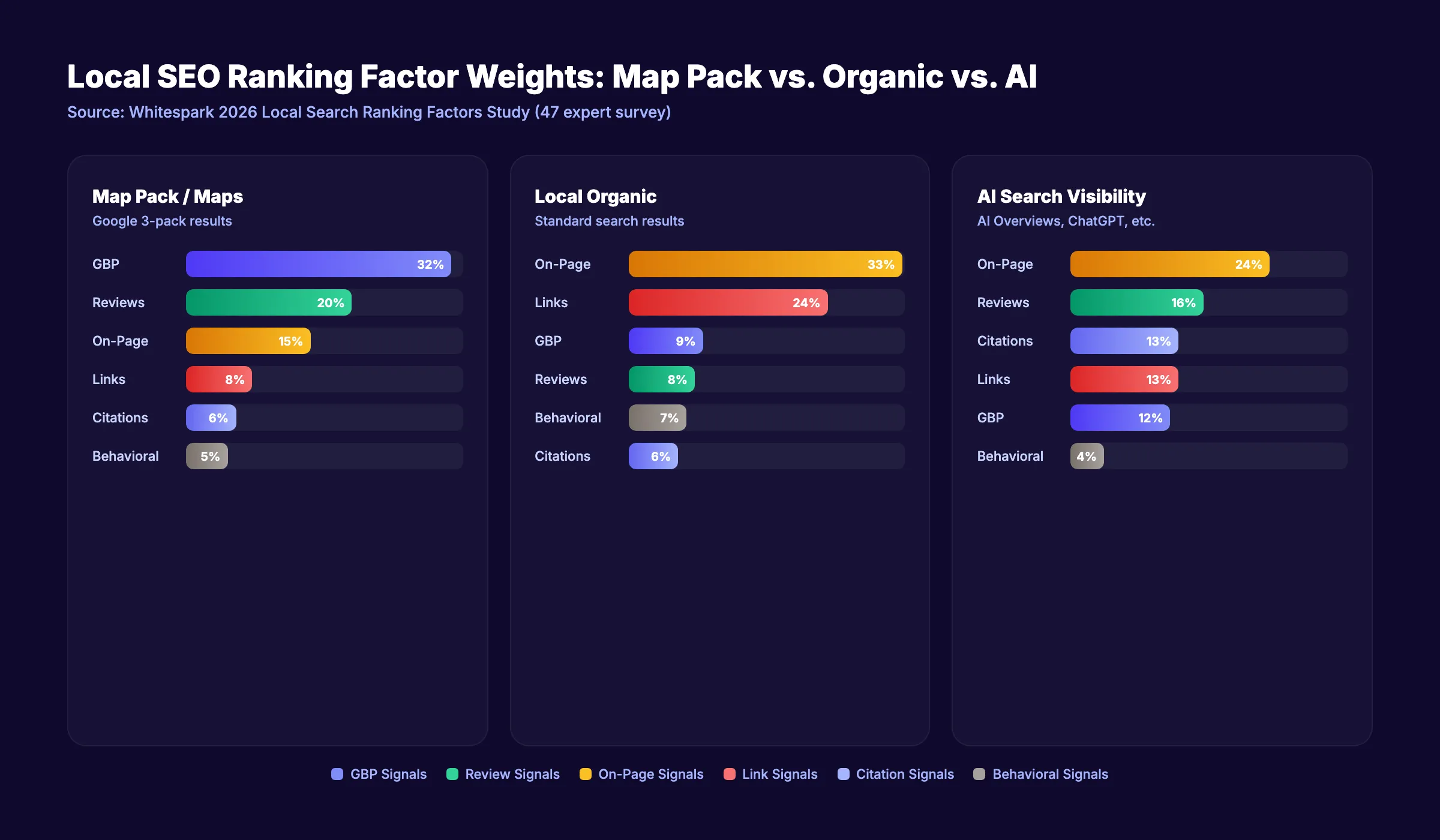
Local Pack / Maps Ranking Factors
| Category | Weight | Key Signals |
|---|---|---|
| GBP Signals | 32% | Primary category, business title, description, photos, posts |
| Review Signals | 20% | Review count, velocity, rating, diversity, response rate |
| On-Page Signals | 15% | NAP on website, local keywords in titles, schema markup |
| Link Signals | 8% | Local backlinks, domain authority, anchor text |
| Citation Signals | 6% | NAP consistency, citation volume, quality of directories |
| Behavioral Signals | 5% | Click-through rate, mobile clicks-to-call, driving directions |
| Other | 14% | Proximity, personalization, social signals |
GBP signals dominate the Map Pack. If your Google Business Profile is not optimized, no other factor compensates for it.
Local Organic Ranking Factors
| Category | Weight | Key Signals |
|---|---|---|
| On-Page Signals | 33% | Content quality, local keywords, title tags, schema |
| Link Signals | 24% | Domain authority, local links, link diversity |
| GBP Signals | 9% | Categories, description, website URL |
| Review Signals | 8% | Rating, volume, keywords in reviews |
| Behavioral Signals | 7% | Dwell time, pogo-sticking, CTR from SERP |
| Citation Signals | 6% | NAP consistency, citation volume |
| Other | 13% | Domain age, social, personalization |
Local organic rankings weight on-page content and links far more heavily than the Map Pack. This is where your website quality matters most.
AI Search Visibility Factors
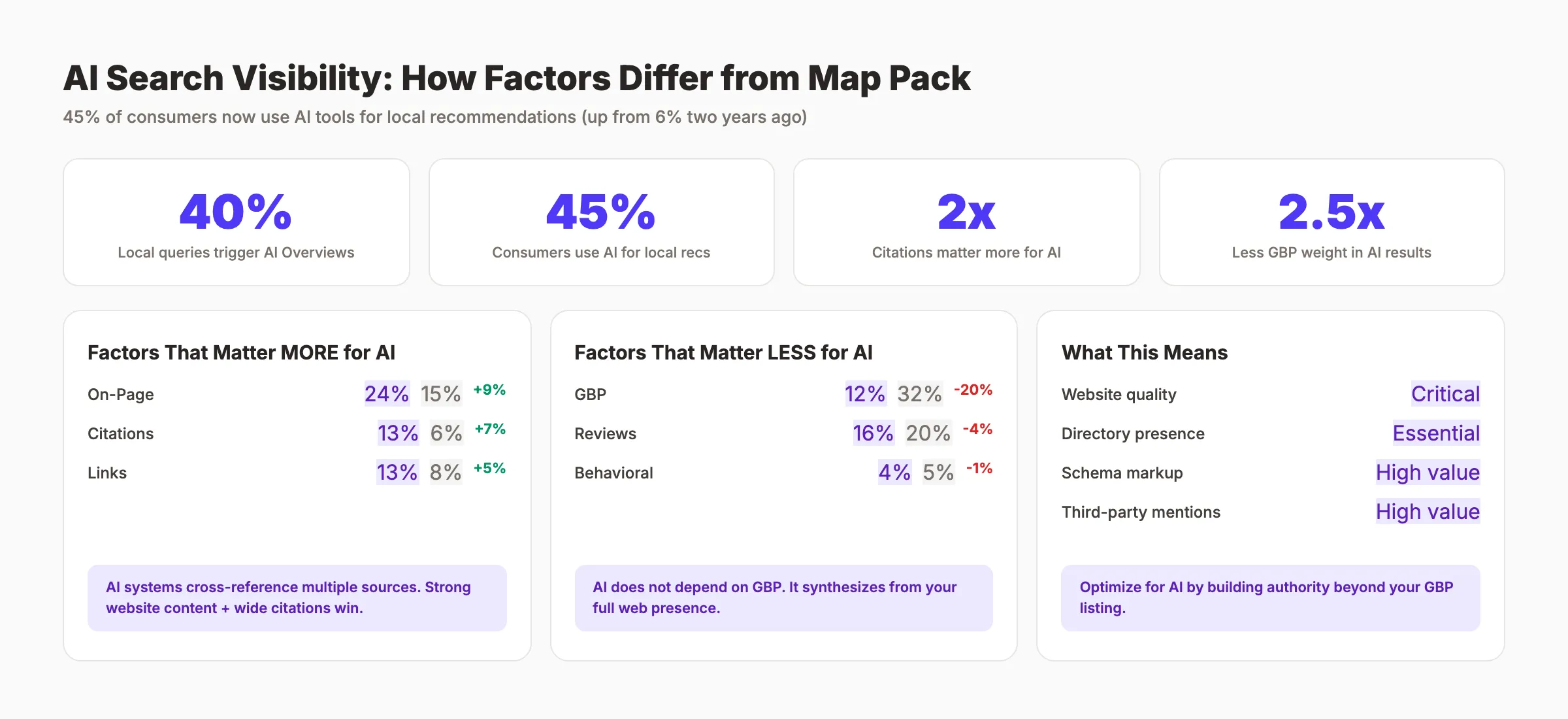
AI Overviews now appear for 40% of local business queries, according to Sterling Sky. And 45% of consumers use AI tools like ChatGPT for local recommendations.
| Category | AI Weight | Map Pack Weight | Difference |
|---|---|---|---|
| On-Page | 24% | 15% | +9% for AI |
| Reviews | 16% | 20% | -4% for AI |
| Citations | 13% | 6% | +7% for AI |
| Links | 13% | 8% | +5% for AI |
| GBP | 12% | 32% | -20% for AI |
The shift is striking. GBP matters far less for AI visibility. Citations matter 2 times more. On-page content and links carry almost double the weight. AI search rewards businesses with strong web presence beyond their GBP listing.
Chapter 3: Google Business Profile Factors
GBP signals account for 32% of Map Pack rankings. That makes your Google Business Profile the single most important asset for local search.
Top 10 Individual GBP Factors (2026)
| Rank | Factor | Score | Change from 2023 |
|---|---|---|---|
| 1 | Primary GBP category | 227 | +34 |
| 2 | Keywords in GBP business title | 223 | +42 |
| 3 | Physical address in city of search | 213 | +43 |
| 4 | Business is open at time of search | 189 | New factor |
| 5 | Address shows on GBP (vs. hidden SAB) | 176 | New factor |
| 6 | Additional GBP categories | 173 | +39 |
| 7 | Proper map pin placement | 165 | New factor |
| 8 | Completeness of GBP listing | 158 | +28 |
| 9 | GBP photos (quality and quantity) | 142 | +19 |
| 10 | GBP products/services listed | 135 | +22 |
3 factors entered the top 10 for the first time in 2026: business hours (open at search time), address visibility, and map pin accuracy. Google increasingly values real-time business availability.
How to Optimize Your GBP
- Select the most specific primary category available
- Add up to 9 relevant secondary categories
- Keep your business name accurate (no keyword stuffing)
- Update hours weekly, including holiday hours
- Add new photos every month (aim for 100+ total)
- Populate every product and service field
- Write a description that includes your primary keyword and city naturally
- Verify your map pin is placed correctly on your actual location
For a complete walkthrough, read our Google Business Profile optimization guide.
Rank everywhere. Do nothing. Stacc handles Blog SEO and Local SEO on autopilot. 30 blog posts and 30 GBP posts per month, published automatically. Start for $1 →
Chapter 4: Review Signals
Review signals grew from 16% (2023) to 20% (2026) of Local Pack ranking weight. That is the largest percentage increase of any factor category over the past 3 years. Reviews now influence rankings almost as much as on-page signals.
What Google Measures in Reviews
| Signal | What It Means | How to Influence It |
|---|---|---|
| Review count | Total number of Google reviews | Ask every customer. Automate the ask. |
| Star rating | Average rating across all reviews | Deliver great service. Address complaints fast. |
| Review velocity | New reviews per month | Consistent review requests, not seasonal bursts |
| Review recency | How recent is the latest review? | Maintain a steady flow. Reviews older than 90 days lose impact. |
| Keywords in reviews | Customers mention service terms naturally | Ask specific questions: “How was your root canal experience?” |
| Review diversity | Reviews from different platforms, not just Google | Encourage Yelp, Facebook, and industry-specific reviews |
| Response rate | Percentage of reviews with owner responses | Respond to 100% of reviews. Every one. |
Review recency jumped from ranking factor #93 (2023) to #11 (2026). That is the single largest positional jump in the entire study. Google now heavily penalizes stale review profiles.
The Numbers That Matter
Businesses with 50+ Google reviews are 266% more likely to appear in the Local Pack than those with fewer than 10. 68% of consumers only consider businesses rated 4+ stars. 88% say they would use a business that responds to all reviews.
For a system to generate reviews consistently, read our guide on getting more Google reviews.
Chapter 5: On-Page and Link Signals
On-page signals dominate local organic rankings at 33%. Links account for another 24%. Together, your website content and backlink profile drive 57% of where you appear in local organic results.
On-Page Factors for Local SEO
Title tags and meta descriptions must include your primary service keyword and city name. “Emergency Plumber in Austin TX” ranks for local searches. “Our Services” does not.
LocalBusiness schema markup tells Google exactly what your business does and where it operates. Read our schema markup guide for implementation details.
NAP on your website must match your GBP listing exactly. Include your full business name, address, and phone number on every page (footer) and in a detailed format on your contact page. Read our NAP consistency guide for formatting rules.
Dedicated service and location pages help you rank for specific “[service] + [city]” queries. A plumber with separate pages for drain cleaning, water heater repair, and pipe installation ranks for 3 times more keywords than one with a single “services” page. Read our guide on location pages for SEO for detailed setup instructions.
Link Signals for Local SEO
Local links carry more weight than generic links. A link from your city’s Chamber of Commerce matters more than a link from a random blog.
High-value local link sources:
- Chamber of Commerce membership pages
- Local business associations and networking groups
- Local news sites and community blogs
- Sponsorship pages for local events, teams, or charities
- Local university or school partnership pages
- Industry associations with geographic chapters
For a complete local link building strategy, read our guide on link building for local SEO.
Your SEO team. $99 per month. 30 optimized articles published automatically. Every article builds domain authority and strengthens your on-page local signals. Start for $1 →
Chapter 6: Citation and Behavioral Signals
Citations and behavioral signals carry smaller individual weights but still affect rankings. Ignoring them creates gaps that competitors can exploit.
Citation Signals (6% of Map Pack)
Citations are mentions of your business name, address, and phone number on other websites. Consistent NAP data across directories confirms your business identity to Google. Businesses with consistent NAP are 40% more likely to appear in the Local Pack.
Priority citation sources:
- Google Business Profile
- Bing Places
- Apple Maps
- Yelp
- BBB
- Industry-specific directories (Avvo for lawyers, Healthgrades for doctors, HomeAdvisor for contractors)
Citation cleanup matters more than citation building. Fix inconsistencies in existing listings before adding new ones.
Behavioral Signals (5% of Map Pack)
Behavioral signals measure how users interact with your listing and website after searching.
- Click-through rate: How often users click your listing in search results
- Clicks-to-call: Mobile users tapping your phone number
- Driving directions requests: Users requesting directions to your location
- Dwell time: How long users stay on your website after clicking
- Bounce rate: Users who return to search results immediately
You influence behavioral signals indirectly. Better title tags and descriptions increase CTR. Better website content increases dwell time. Faster page load reduces bounce rate. Running a local SEO audit every quarter catches behavioral signal problems before they compound.
Chapter 7: AI Search Visibility Factors
45% of consumers now use AI tools for local recommendations, up from 6% just 2 years ago, according to BrightLocal. AI Overviews appear for 40% of local business queries. AI search visibility is no longer optional.
How AI Ranks Local Businesses Differently
AI search engines (Google AI Overviews, ChatGPT, Perplexity) pull information from a wider range of sources than the traditional Map Pack algorithm.
Key differences:
- Citations matter 2 times more for AI (13% vs. 6%). AI systems cross-reference your business information across multiple sources to verify accuracy.
- GBP matters 2.5 times less for AI (12% vs. 32%). AI does not rely on GBP as heavily because it synthesizes information from your website, reviews, and third-party mentions.
- On-page content matters more for AI (24% vs. 15%). The depth and quality of your website content directly influences whether AI systems cite your business.
How to Optimize for AI Search Visibility
- Publish detailed, factual content on your website that AI can cite
- Maintain consistent NAP data across 40+ directories
- Earn mentions on authoritative third-party sites (news, industry publications)
- Use structured data (schema markup) on every location page
- Build a review profile across multiple platforms, not just Google
- Keep your website technically sound (fast, mobile-friendly, properly indexed)
For a deeper dive into AI search optimization, read our generative engine optimization guide.
Chapter 8: Negative Ranking Factors and Penalties
Certain actions actively hurt your local rankings. Avoiding these factors is as important as optimizing for positive ones.
Actions That Trigger Ranking Drops or GBP Suspension
| Action | Risk Level | Consequence |
|---|---|---|
| Keyword stuffing in GBP business name | Very High | GBP suspension, listing removal |
| Using a virtual office or fake address | Very High | Suspension, permanent ban |
| Buying fake reviews | Very High | Review removal, ranking penalty, legal risk |
| Inconsistent NAP across directories | Medium | Reduced trust, lower Map Pack positions |
| Duplicate GBP listings for one location | High | Suspension of one or both listings |
| Category spam (irrelevant categories) | Medium | Reduced relevance signals |
| Doorway pages targeting multiple cities | High | Organic ranking penalty, deindexing |
| Review gating (only asking happy customers) | Medium | Violates Google and FTC guidelines |
The Most Common Mistakes
1. Adding keywords to your business name. “Joe’s Plumbing” is your legal business name. “Joe’s Plumbing - Best Emergency Plumber Austin TX Affordable Prices” is spam. Google suspends listings for this regularly.
2. Neglecting review responses. 88% of consumers prefer businesses that respond to all reviews. Google tracks response rate as a ranking signal. Not responding signals neglect.
3. Ignoring mobile performance. 76% of “near me” searches happen on smartphones. A slow, unresponsive mobile site increases bounce rate and reduces dwell time. Both are behavioral signals that hurt rankings.
4. Inconsistent business hours. “Business is open at time of search” entered the top 5 individual ranking factors in 2026. Inaccurate hours mean Google shows competitors instead of you during your actual operating hours.
3,500+ blogs published. 92% average SEO score. Stacc drives organic traffic and local visibility for your business. Blog SEO + Local SEO, working together. Start for $1 →
FAQ
What are the top 3 local SEO ranking factors?
The top 3 individual factors for the Local Pack in 2026 are: primary GBP category (score: 227), proximity to the searcher (225), and keywords in GBP business title (223). At the category level, GBP signals (32%), review signals (20%), and on-page signals (15%) carry the most weight. The data comes from Whitespark’s 2026 Local Search Ranking Factors study.
How many Google reviews do you need to rank in the local pack?
There is no fixed number, but the data shows businesses with 50+ reviews are 266% more likely to appear in the Local Pack than those with fewer than 10. The number you actually need depends on your competition. Check the review count of the top 3 businesses in your local pack and aim to match or exceed it within 6 to 12 months.
Are citations still important for local SEO in 2026?
Citations account for 6% of Map Pack ranking weight and 13% of AI search visibility weight. They are less important than GBP, reviews, or on-page content for traditional rankings. But they are 2 times more important for AI search visibility. Focus on NAP consistency across your top 40 to 50 directories rather than building hundreds of low-quality citations.
How does AI search affect local SEO rankings?
40% of local queries now trigger AI Overviews. 45% of consumers use AI tools for local recommendations. AI search reduces the importance of GBP (12% vs. 32% for Map Pack) and increases the importance of on-page content (24% vs. 15%), citations (13% vs. 6%), and links (13% vs. 8%). Businesses with strong website content and wide citation coverage perform better in AI results.
What is the difference between local pack and local organic ranking factors?
The Local Pack (Map results) weights GBP signals at 32% and on-page at 15%. Local organic (standard results) weights on-page at 33% and links at 24%. The Map Pack rewards GBP optimization and reviews. Organic rewards website content quality and backlink authority. Winning both requires optimizing for all factor categories.
Local SEO ranking factors are not static. They shift every year as Google refines its algorithm, AI search grows, and consumer behavior evolves. The businesses that track these changes and adjust their strategy quarterly are the ones that hold their positions in the Map Pack. Start with GBP optimization, build your review profile, and publish local content consistently. The factors that matter most are the ones you can influence through steady, ongoing effort.

Written by
Siddharth GangalSiddharth is the founder of theStacc and Arka360, and a graduate of IIT Mandi. He spent years watching great businesses lose organic traffic to competitors who simply published more. So he built a system to fix that. He writes about SEO, content at scale, and the tactics that actually move rankings.
Automate your Google Business Profile content
30 GBP posts, local SEO articles, and review responses. Published every month automatically.
30-day trial · Cancel anytime
theStacc
Stop writing SEO content manually
30 blog articles, 30 GBP posts, and social media content. Published every month. Automatically.
Start Your $1 Trial$1 for 3 days · Cancel anytime