
Local Link Building (2026): Strategies, Tactics & Examples
Practical link building for local seo strategies for 2026: step-by-step tactics, real examples, and tools to improve rankings and drive organic traffic.
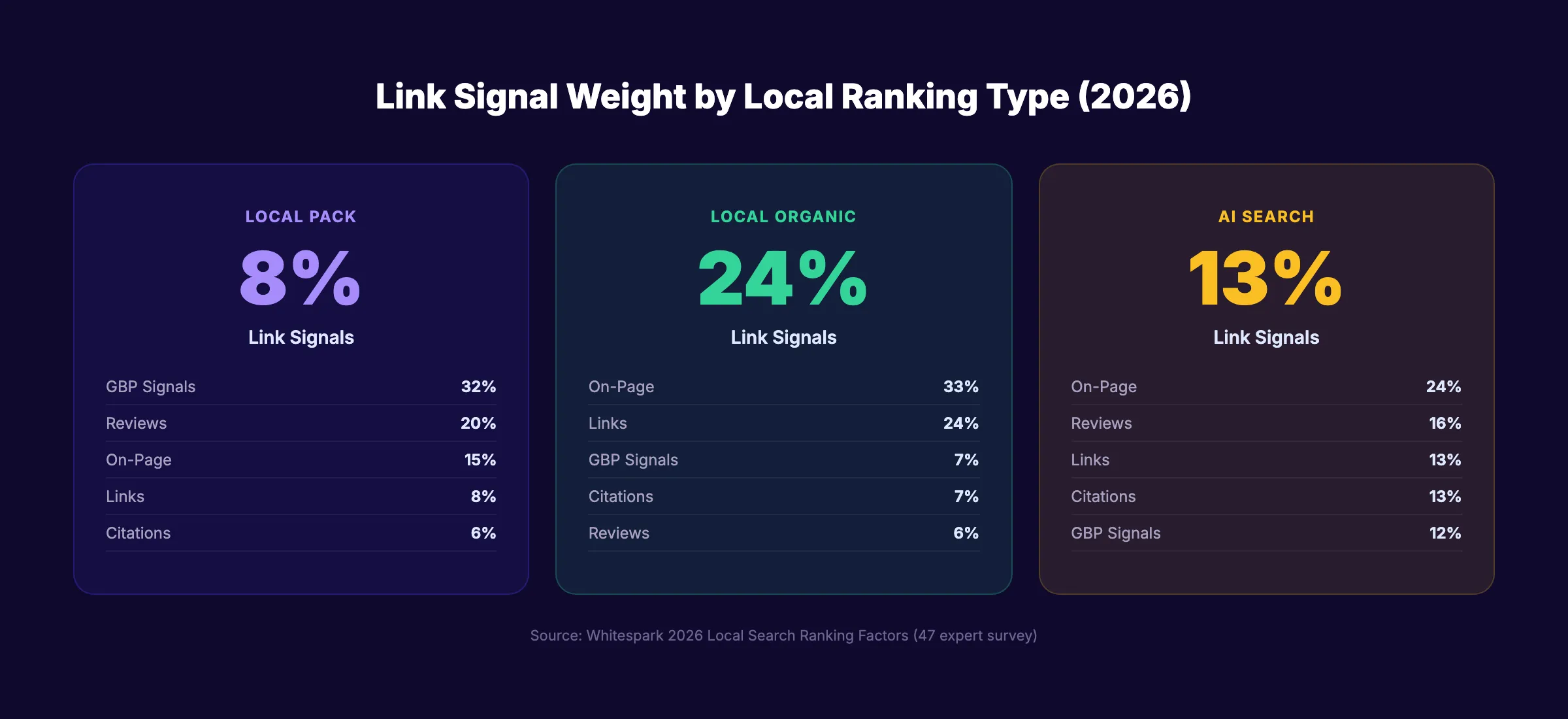
Link signals account for 24% of local organic rankings and 8% of Local Pack rankings. That comes from the 2026 Whitespark Local Search Ranking Factors study, which surveyed 47 top local SEO experts. For the first time, the study also measured AI search factors. Link signals drive 13% of AI search rankings for local businesses.
Most local businesses ignore local link building entirely. They set up a Google Business Profile, submit to a few directories, and wonder why they rank on page 3. The businesses that rank in the Local Pack and dominate organic results have something the others do not: backlinks from locally relevant, authoritative websites.
This guide covers 12 local link building strategies that work in 2026. Not theory. Actual tactics with examples, outreach templates, and a repeatable monthly workflow.
We publish 3,500+ blog posts and manage local SEO for businesses in 70+ industries. The link building tactics in this guide are the same ones we use for our clients.
Here is what you will learn:
- Why local links matter more than generic backlinks for local rankings
- 12 proven strategies to earn high-quality local backlinks
- The difference between backlinks and citations (and when each matters)
- How many local links you actually need to rank
- A monthly workflow to build local links consistently
- How to measure ROI from local link building efforts
Why Local Links Matter for Local SEO Rankings
Google uses 3 primary factors for local rankings: relevance, distance, and prominence. Prominence is partly based on links, articles, and directories from across the web. Local links are how Google determines prominence for local businesses.
Link Signals by Ranking Type
The Whitespark 2026 study breaks down how much link signals affect each type of local result:
| Ranking Type | Link Signal Weight | Top Factor |
|---|---|---|
| Local Pack (Map Pack) | 8% | GBP Signals (32%) |
| Local Organic | 24% | On-Page Signals (33%) |
| AI Search Results | 13% | On-Page Signals (24%) |
Link signals carry the most weight for local organic results. For Local Pack rankings, GBP optimization and reviews matter more. But links still play a role in all 3 result types.
Why Local Links Beat Generic Links
A backlink from your city’s Chamber of Commerce sends a stronger local ranking signal than a link from a random tech blog. Google uses the geographic relevance of linking domains to determine local authority.
5 to 10 quality local links outperform 50 generic directory links. This is a consistent finding from practitioners in the local SEO community. The relevance of the linking domain matters as much as its authority.
The Declining Weight of Links
Link signals have declined in weight over the past 3 years, especially for Local Pack. Reviews and GBP signals now carry more weight. But links remain the second most important factor for local organic results.
The shift means quality matters even more than quantity. Fewer, better links beat mass directory submissions.
Stop writing. Start ranking. Stacc publishes 30 SEO articles per month for $99. Plus Local SEO for $49/mo. Start for $1 →
Backlinks vs. Citations: Understanding the Difference
These are two different things. Confusing them is one of the most common local SEO mistakes.
What Are Local Citations?
A citation is any online mention of your business name, address, and phone number (NAP). Citations appear on directories like Yelp, Yellow Pages, and industry-specific listings. Most citations do NOT include a backlink.
Citations matter for Local Pack rankings. Consistent NAP details can improve local search rankings by up to 16%. Accurate NAP on your Google Business Profile can elevate Local Pack chances by 14%.
What Are Local Backlinks?
A backlink is a clickable link from another website to yours. Local backlinks come from websites with geographic relevance to your service area. These affect both Local Pack and local organic rankings.
When Each Matters
| Factor | Citations | Backlinks |
|---|---|---|
| Local Pack impact | 6% (citation signals) | 8% (link signals) |
| Local Organic impact | 7% (citation signals) | 24% (link signals) |
| AI Search impact | 13% (citation signals) | 13% (link signals) |
| Typical cost | Free to $50/listing | $0-500+ per link |
| Time to build | Hours (bulk submission) | Weeks (relationship-based) |
Citations are the baseline. Every local business needs consistent citations across major directories. Backlinks are the competitive edge that separates page 1 from page 3.
12 Local Link Building Strategies That Work in 2026
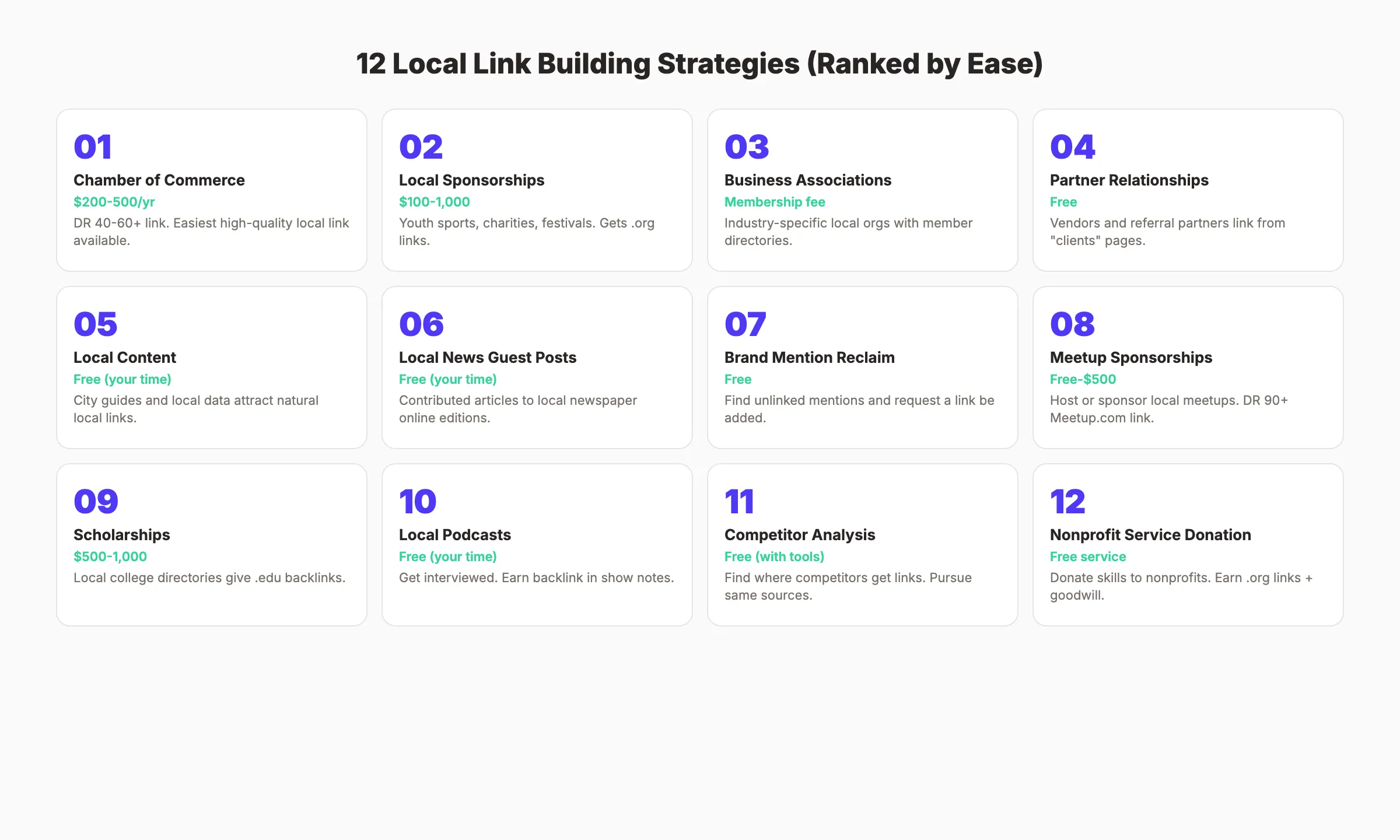
These strategies are ranked by effectiveness and accessibility. Start with the easiest ones and work your way down.
1. Join Your Local Chamber of Commerce
The single easiest high-quality local link. Chamber of Commerce websites typically have DR 40-60+. Membership costs $200-500 per year and includes a listing with a backlink on their member directory.
Every city has a Chamber. Most have an online directory with member profiles. The link is locally relevant, high authority, and requires zero outreach.
Search [your city] chamber of commerce member directory to find the page.
2. Sponsor Local Events and Organizations
Little League teams, school fundraisers, charity runs, community festivals. Local organizations list their sponsors on event pages and thank-you pages. These links come from .org domains and occasionally .edu sites.
How to find opportunities:
Search Google for:
[your city] sponsors site:.org[your city] community events sponsors[your city] charity run sponsors
Sponsorship costs range from $100 for a youth sports team to $1,000+ for major community events. The link value and brand visibility make this one of the best ROI tactics.
3. Get Listed on Local Business Association Pages
Beyond the Chamber of Commerce, most industries have local or regional associations. A plumber joins the local plumbing association. A dentist joins the state dental society. A restaurant joins the local restaurant association.
These organizations have member directories with backlinks. Some are free with membership. Others require a small fee.
4. Build Relationships With Complementary Local Businesses
A dentist and an orthodontist refer patients to each other. A real estate agent and a mortgage broker work together regularly. These existing business relationships are untapped link opportunities.
Ask partners, vendors, and suppliers to link to your site from their “partners,” “clients,” or “recommended businesses” pages. Reciprocal local links between genuinely related businesses do not trigger penalties. The relationship is real and relevant.
5. Create Locally Useful Content
Guides about your city attract natural local links. Topics that work:
- “Cost of Living in [City] 2026”
- “Best Neighborhoods in [City] for Families”
- “Complete Guide to [City] Permits for Home Renovations”
- “[City] Events Calendar 2026”
This content attracts links from local blogs, neighborhood websites, and community forums. It also targets local long-tail keywords that drive organic traffic.
Our content marketing strategy guide covers how to plan this type of content.
6. Guest Post on Local News Sites and Blogs
Local newspapers have online editions. Many accept contributed articles from local business owners. A plumber writes about winter pipe preparation for the local paper’s home section. A financial advisor writes about tax planning for the business section.
The link comes from a high-authority local domain. The content positions you as a local expert.
Outreach template:
“Hi [Editor Name], I own [Business] in [City]. I would like to contribute an article about [Topic] for your [Section]. I have [Credential]. Here is a brief outline: [3 bullet points]. Would this be a fit?”
Keep the pitch short. Editors receive dozens of requests daily.
7. Reclaim Unlinked Brand Mentions
Other websites may mention your business without linking to you. A local blog reviews your restaurant but does not include a URL. A news article quotes you but links to your social media instead of your website.
Search Google for "your business name" -site:yourdomain.com to find mentions. Then email the site owner asking them to add a link. Conversion rates on these requests are high because the mention already exists.
Your SEO team. $99 per month. 30 optimized articles, published automatically. Local SEO for $49 per month. Start for $1 →
8. Sponsor or Host Local Meetups
Meetup.com groups need sponsors and venues. Hosting a local marketing meetup, coding group, or business networking event gets you a link from Meetup.com (DR 90+) and from any coverage the event receives.
Even offering your office space as a venue for a meetup group earns a mention and link on their event page.
9. Offer Scholarships or Student Programs
Local colleges and universities maintain scholarship directories. Creating a small scholarship ($500-1,000) for local students gets you a backlink from a .edu domain. These links carry significant authority.
Contact the financial aid office of local colleges. Ask how to list your scholarship in their directory. The process is straightforward for legitimate scholarships.
10. Get Featured on Local Podcasts
Local business podcasts exist in most metro areas. Search [your city] business podcast or [your city] entrepreneur podcast on Apple Podcasts or Spotify. Getting interviewed takes 30-60 minutes and earns a backlink in the show notes.
Podcast hosts are always looking for guests. A local business owner with a good story is an easy booking. For more on this approach, read our build backlinks guide.
11. Analyze and Replicate Competitor Links
Find your top local competitors. Check their backlink profiles using Ahrefs, Semrush, or a free tool like our SEO audit tool. Identify where their links come from. Then pursue the same sources.
If your competitor has a link from the local business journal, pitch the same publication. If they sponsor a local charity, sponsor the same one. This is not copying. It is competitive intelligence.
12. Donate Services to Local Nonprofits
Offer a free service to a local nonprofit. A web designer builds a free website for a charity. An accountant does free tax prep for a community organization. The nonprofit lists you on their sponsors or partners page with a link.
This tactic builds links AND goodwill. Local nonprofits often have .org domains with strong authority. The relationship also leads to referrals and additional mentions.
How Many Local Links Do You Need?
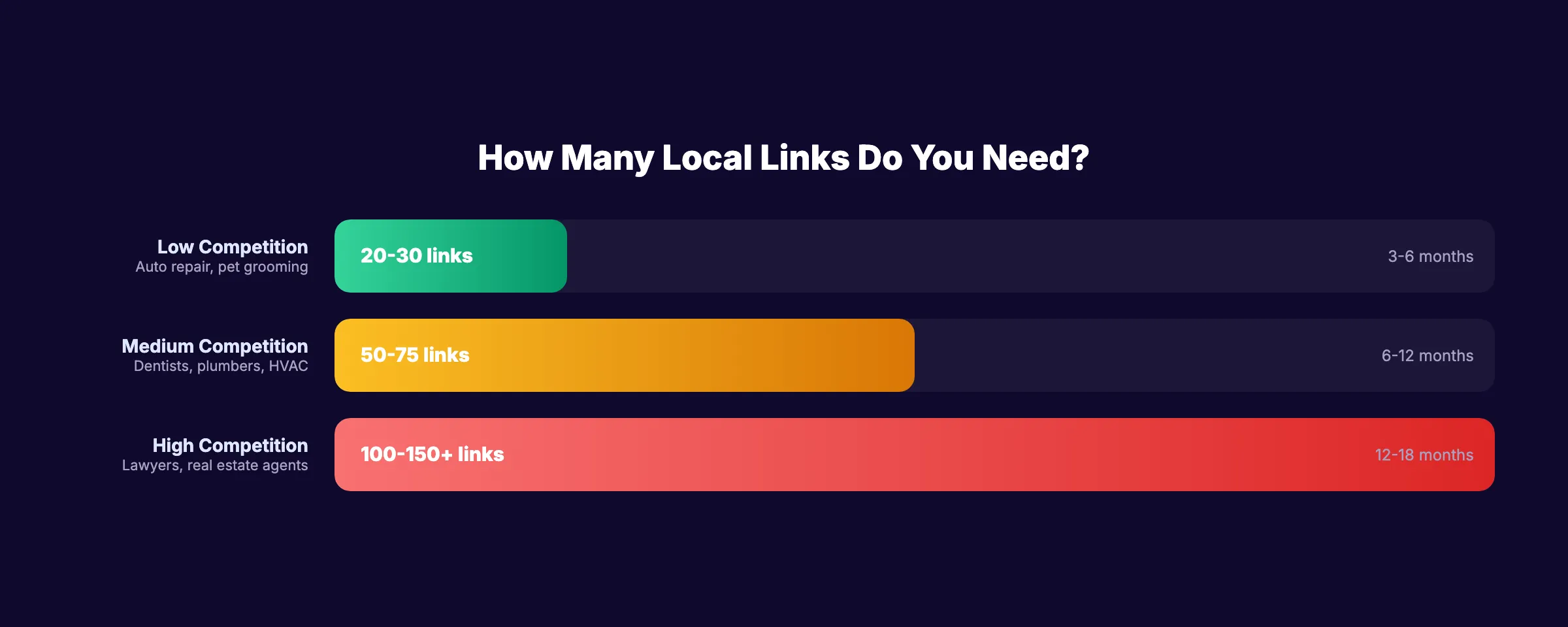
The answer depends on your competition level.
Benchmarks by Competition
| Competition Level | Example Industries | Links Needed | Timeline |
|---|---|---|---|
| Low | Auto repair, pet grooming, tutoring | 20-30 quality links | 3-6 months |
| Medium | Dentists, plumbers, HVAC, restaurants | 50-75 quality links | 6-12 months |
| High | Personal injury lawyers, real estate agents | 100-150+ quality links | 12-18 months |
These numbers come from SearchLogistics research on local ranking requirements. The average local business needs about 125 high-quality regional links to compete for Local Pack positions.
Quality Over Quantity
10 links from local news sites, Chambers of Commerce, and .edu domains outperform 100 links from random directories. Focus on:
- Domain relevance: Is the linking site in your city or region?
- Domain authority: Does the site have DR 30+?
- Link type: Is it editorial (placed in content) or mechanical (directory listing)?
- Anchor text: Does the anchor text include your service and location naturally?
Link Velocity
Build links at a natural pace. 5-10 new local links per month is sustainable for most businesses. Acquiring 50 links in a single week looks unnatural and may trigger a manual review.
3,500+ blogs published. 92% average SEO score. See what Stacc can do for your site. Start for $1 →
Monthly Local Link Building Workflow
Most businesses fail at local link building because they treat it as a one-time project. It is an ongoing process. Here is a repeatable monthly workflow.
Week 1: Prospecting
- Search for 10 new local link opportunities (events, sponsorships, guest post targets)
- Check competitor backlinks for new sources
- Search for unlinked brand mentions
- Review local news sites for content opportunities
Week 2: Outreach
- Send 10-15 outreach emails to prospects from Week 1
- Follow up on unanswered emails from the previous month
- Submit sponsorship applications
- Pitch guest post ideas to local editors
Week 3: Content Creation
- Write 1 piece of locally focused content (city guide, local data, event roundup)
- Create or update your GBP posts with local content
- Publish any accepted guest posts
Week 4: Tracking and Analysis
- Log all new links acquired in a tracking spreadsheet
- Check link quality (DR, relevance, dofollow status)
- Monitor Google Search Console for ranking changes
- Update your backlink profile in your SEO tool
- Plan next month based on what worked
Monthly Targets
| Activity | Monthly Target |
|---|---|
| Outreach emails sent | 20-30 |
| New local links acquired | 5-10 |
| Guest posts published | 1-2 |
| Sponsorships/partnerships | 1-2 |
| Brand mention reclamations | 2-3 |
| Local content pieces published | 1 |
Consistency matters more than volume. 5 quality links per month compounds to 60 per year.
Measuring Local Link Building ROI
Local link building takes time and money. You need to track whether it produces results.
Metrics to Track Monthly
| Metric | Tool | Target |
|---|---|---|
| New referring domains | Ahrefs, Semrush | 5-10/month |
| Average DR of new links | Ahrefs | 30+ |
| Local Pack position | Local Falcon, BrightLocal | Top 3 |
| Local organic rankings | Google Search Console | Page 1 |
| Organic traffic from local keywords | Google Analytics | 10%+ monthly growth |
| Phone calls and form fills | Call tracking, GA4 | Increasing trend |
Cost Per Link Analysis
| Method | Cost Per Link | Time Per Link |
|---|---|---|
| Chamber of Commerce | $200-500/year (1 link) | 1 hour |
| Local sponsorships | $100-1,000 | 2-3 hours |
| Guest posting | Free (your time) | 4-8 hours |
| Brand mention reclamation | Free | 30 minutes |
| Scholarship links | $500-1,000 (1-3 links) | 2-4 hours |
| Agency-built local links | $500+ per link | 0 (outsourced) |
Compare these costs to the industry average of $508.95 per high-quality backlink from the Editorial.link 2026 survey. Most local link building tactics cost less than the industry average.
57% of SEO experts expect results from link building within 1-3 months. For local businesses, ranking improvements typically appear within 60-90 days of consistent link building. Our guide on how long SEO takes covers expected timelines in detail.
Rank everywhere. Do nothing. Blog SEO, Local SEO, and Social on autopilot. Start for $1 →
Common Local Link Building Mistakes
These mistakes waste time and can hurt your rankings.
Buying Mass Directory Links
“500 local backlinks for $50” services on freelancer platforms deliver spam. These links come from low-quality directories that Google either ignores or penalizes. Stick with major directories (Yelp, BBB, industry-specific) and earn the rest through outreach.
Ignoring Geographic Relevance
A backlink from a random tech blog in another country does nothing for local rankings. Every link you build should have a geographic connection to your service area. Local newspapers, local organizations, local business partners.
Inconsistent NAP Across Citations
Your business name, address, and phone number must match exactly across every directory, citation, and backlink. Even small differences (“St” vs “Street,” “Suite 100” vs “#100”) confuse Google. Audit your NAP consistency regularly.
Building Links Too Fast
Acquiring 100 links in a month when you previously had 10 looks suspicious. Build at a natural pace that matches your business growth. 5-10 new links per month is safe for most local businesses.
Ignoring Anchor Text Diversity
If every backlink uses the exact same anchor text (“best plumber in Austin”), Google sees manipulation. Use a mix of:
- Brand name (“Smith Plumbing”)
- Service + location (“plumber in Austin”)
- Generic (“click here,” “learn more”)
- URL (www.smithplumbing.com)
Natural anchor text distribution builds trust with Google.
FAQ
Does local link building help Google Business Profile rankings?
Yes, but the impact is smaller than for organic results. Link signals account for 8% of Local Pack rankings vs. 24% of local organic rankings. GBP optimization and reviews have more direct impact on your Map Pack position. But links still contribute to overall prominence, which Google uses as one of 3 primary local ranking factors.
How many backlinks does a local business need to rank?
It depends on competition. Low-competition industries (auto repair, pet grooming) need 20-30 quality links. Medium-competition industries (dentists, plumbers) need 50-75. High-competition industries (personal injury lawyers) need 100-150+. Quality matters more than quantity. 10 links from local news sites outperform 100 from random directories.
What is the difference between backlinks and citations for local SEO?
Citations are mentions of your business name, address, and phone number on directories. Most do not include a clickable link. Backlinks are clickable links from other websites to yours. Both matter for local SEO, but backlinks carry significantly more weight for local organic rankings (24% vs. 7% for citation signals).
How much does local link building cost?
Costs range from free (brand mention reclamation, guest posting) to $500-1,000 (scholarships, premium sponsorships). Chamber of Commerce membership costs $200-500 per year. The industry average for a single high-quality backlink is $508.95 according to a 2026 survey of 518 SEO experts. Most local tactics cost less than this average.
Do reciprocal links between local businesses hurt SEO?
No, when the relationship is genuine and relevant. A dentist linking to an orthodontist who refers patients is natural. Google understands real business relationships. Mass reciprocal link exchanges with unrelated sites are a different story and should be avoided.
How long does it take to see results from local link building?
Most businesses see ranking improvements within 60-90 days of consistent link building. 57% of SEO experts report results within 1-3 months. The impact compounds over time. 6 months of consistent effort (5-10 links per month) produces significantly better results than a one-time burst of link building.
Related Tools & Resources
Free SEO Tools:
Best Lists:

Written by
Siddharth GangalSiddharth is the founder of theStacc and Arka360, and a graduate of IIT Mandi. He spent years watching great businesses lose organic traffic to competitors who simply published more. So he built a system to fix that. He writes about SEO, content at scale, and the tactics that actually move rankings.
Automate your Google Business Profile content
30 GBP posts, local SEO articles, and review responses. Published every month automatically.
30-day trial · Cancel anytime
theStacc
Stop writing SEO content manually
30 blog articles, 30 GBP posts, and social media content. Published every month. Automatically.
Start Your $1 Trial$1 for 3 days · Cancel anytime