
Local SEO Audit: How to Do It in 10 Steps (2026)
A step-by-step local SEO audit covering GBP, citations, reviews, on-page, and technical checks. 10 proven steps with benchmarks. Updated March 2026.
46% of all Google searches have local intent. 98% of consumers search online for local businesses before making a decision. Yet most local businesses have never audited their local SEO. They have no idea whether their Google Business Profile is optimized, their citations are consistent, or their reviews are helping or hurting their rankings.
A local SEO audit fixes that blind spot. It is a systematic review of every factor that determines whether your business appears in the Google Map Pack, local organic results, and AI Overviews. Businesses in the Google 3-pack receive 126% more traffic and 93% more actions (calls, clicks, direction requests) than those ranked below it.
This guide walks you through a complete local SEO audit in 10 steps. We publish 3,500+ blog posts per month across 70+ industries, and local SEO is the foundation that turns organic traffic into phone calls, foot traffic, and revenue.
Here is what you will learn:
- How to audit your Google Business Profile for ranking signals
- The citation consistency check that prevents ranking penalties
- How to evaluate your review profile against competitors
- On-page local SEO factors most businesses miss
- Technical checks that affect local search visibility
- How to assess your local backlink profile
- Which metrics to track after the audit
Overview
Time required: 2 to 4 hours for a single location
Difficulty: Beginner to Intermediate
What you will need: Google Business Profile access, Google Search Console access, a spreadsheet for tracking findings, and a web browser
Step 1: Audit Your Google Business Profile
Your Google Business Profile (GBP) is the single most important local ranking factor. Whitespark’s 2026 Local Search Ranking Factors study confirms that GBP signals account for the largest share of local pack ranking weight.
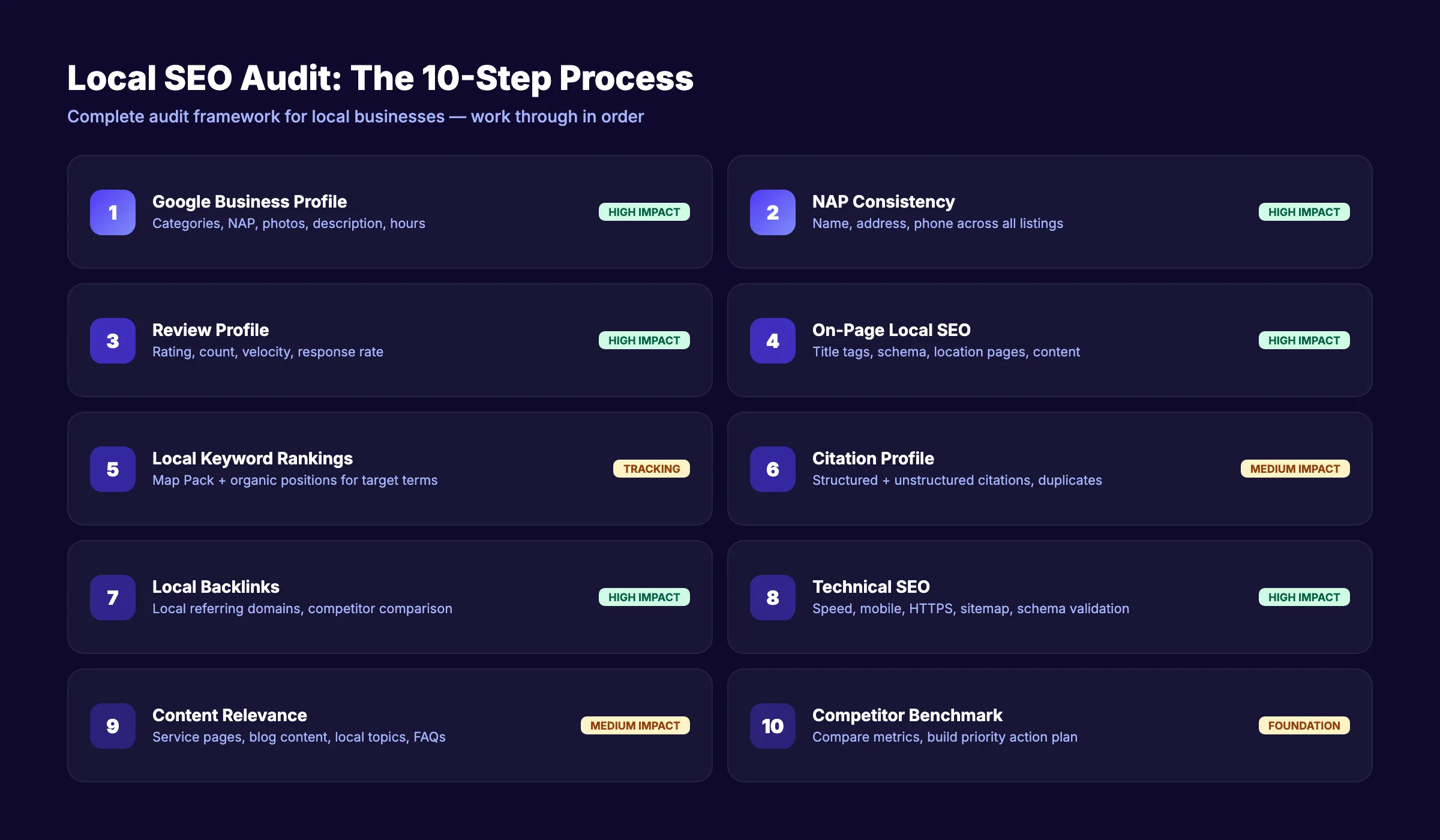
Check these GBP elements:
- Business name matches your real-world name exactly (no keyword stuffing)
- Primary category is the most specific option available
- Secondary categories cover all relevant services (use up to 9)
- Address is accurate and matches your website and citations
- Phone number is a local number, not a tracking number in the GBP listing
- Business hours are current, including holiday hours
- Website URL links to the correct page (homepage for single locations, location page for multi-location)
- Business description includes your primary keyword and city naturally
- Products and services sections are populated with descriptions and pricing
- Photos are current (add new photos monthly). Businesses with 100+ photos get 520% more calls than the average listing.
Review your GBP Insights data for the past 90 days. Note total searches, profile views, direction requests, calls, and website clicks. These numbers become your baseline for measuring improvement after the audit.
For a complete walkthrough, read our Google Business Profile optimization guide.
Why this step matters: A poorly optimized GBP means you do not appear in the Map Pack. 42% of local searchers click on Map Pack results. Missing from that section means losing nearly half of all potential local traffic.
Step 2: Check NAP Consistency Across All Listings
NAP stands for Name, Address, Phone Number. Inconsistent NAP data across the web confuses Google about your business identity. 62% of consumers avoid businesses with incorrect online information, according to BrightLocal.
How to audit NAP consistency:
- Search your business name on Google. Check the first 3 pages for any listing with outdated or incorrect information.
- Check major directories: Google, Bing Places, Apple Maps, Yelp, Facebook, Yellow Pages, BBB, and your industry-specific directories.
- Use a tool like BrightLocal, Moz Local, or Whitespark to scan for inconsistencies automatically.
Common NAP issues to fix:
- Old addresses from previous locations
- Suite or unit number variations (“Suite 200” vs. “#200” vs. “Ste 200”)
- Different phone numbers across listings (main line vs. direct line vs. tracking number)
- Business name variations (“Joe’s Plumbing” vs. “Joe’s Plumbing LLC” vs. “Joe’s Plumbing & Heating”)
- Duplicate listings on the same platform
Fix every inconsistency you find. Standardize your NAP format and use it identically everywhere. Read our guide on NAP consistency for a detailed process.
Why this step matters: Citations with inconsistent NAP data send conflicting signals to Google. Consistent citations build trust and improve local pack rankings. Inconsistent ones dilute your authority.
Step 3: Evaluate Your Review Profile
Reviews now account for 20% of local pack ranking weight, up from 16% in 2023. 68% of consumers only consider businesses with 4+ star ratings. Your review profile directly affects both rankings and conversion rates.
Audit these review metrics:
| Metric | What to Check | Benchmark |
|---|---|---|
| Star rating | Average across Google, Yelp, Facebook | 4.0+ minimum. 4.5+ is competitive. |
| Review count | Total Google reviews | Compare against top 3 local competitors |
| Review velocity | New reviews per month | 2-5 new reviews per month minimum |
| Review recency | Date of most recent review | Within the last 30 days |
| Response rate | % of reviews with owner responses | 100%. Respond to every review. |
| Sentiment | Common themes in negative reviews | Track patterns for operational fixes |
88% of consumers would choose a business that responds to both positive and negative reviews over one that does not respond. Response rate is not optional.
Competitor benchmarking: Search your primary keyword + city on Google. Note the star rating and review count for each of the 3 businesses in the Map Pack. If the top competitor has 200 reviews at 4.7 stars and you have 30 reviews at 4.3 stars, the gap is clear.
For a system to generate more reviews consistently, read our guide on getting more Google reviews.
Why this step matters: Google explicitly uses review signals for local rankings. A business with 150 reviews at 4.6 stars will consistently outrank a business with 15 reviews at 4.8 stars, assuming other factors are similar. Volume and recency matter as much as rating.
Rank everywhere. Do nothing. Stacc handles Blog SEO and Local SEO on autopilot. 30 blog posts and 30 GBP posts per month, published automatically. Start for $1 →
Step 4: Audit Local On-Page SEO
Your website needs to signal local relevance to Google on every important page. Most local businesses have weak on-page local signals.
Check these on-page elements:
- Title tags include primary keyword + city name (e.g., “Plumber in Austin TX”)
- Meta descriptions mention your service area
- H1 headings include local keywords
- Body content mentions city, neighborhood, and service area naturally
- Contact page has full NAP, embedded Google Map, and driving directions
- Each service has its own dedicated page (not one page listing all services)
- LocalBusiness schema markup is implemented on every location page
Location pages for multi-location businesses:
If you serve multiple areas, create a dedicated page for each location or service area. Each page needs unique content. A page for “Plumbing Services in Austin” should have different content than “Plumbing Services in Round Rock.” Duplicate content across location pages will hurt rankings for all of them.
For deeper on-page SEO techniques, read our dedicated guide.
Why this step matters: On-page signals tell Google what your business does and where you do it. Without these signals, Google has to guess. Guessing means lower rankings.
Step 5: Check Your Local Keyword Rankings
You cannot improve what you do not measure. Track your rankings for the keywords your customers actually use to find businesses like yours.
How to check local keyword rankings:
- Open Google Search Console and review your Performance report filtered to local queries.
- Search your primary keywords in an incognito window from your service area. Note your position in both the Map Pack and organic results.
- Use a rank tracking tool (BrightLocal, Whitespark, or Semrush) to monitor positions weekly.
Keywords to track:
- [Service] + [City] (“dentist Austin TX”)
- [Service] + “near me” (“dentist near me”)
- “best [service] in [city]” (“best dentist in Austin”)
- [Specific service] + [City] (“teeth whitening Austin”)
Track at least 10 to 20 keywords. Record your starting position for each. After implementing audit fixes, compare positions monthly to measure progress.
For a deeper understanding of the metrics that matter, read our local SEO statistics breakdown.
Why this step matters: Ranking data tells you where you stand and where to focus. A business ranking position 4 for its primary keyword needs different action than one ranking position 15. The audit findings direct your effort to the highest-impact fixes.
Step 6: Audit Your Citation Profile
Citations are mentions of your business name, address, and phone number on other websites. They come in 2 types:
Structured citations: Directory listings with formatted NAP data (Yelp, Yellow Pages, BBB, industry directories).
Unstructured citations: Mentions in blog posts, news articles, event pages, or social profiles where NAP appears in natural text.
Citation audit checklist:
- Listed on all major directories (Google, Bing, Apple Maps, Yelp, Facebook, BBB)
- Listed on top industry-specific directories for your niche
- No duplicate listings on any platform
- All listings have consistent NAP data (matches Step 2 findings)
- All listings have complete information (categories, hours, photos, descriptions)
- No listings on spammy or irrelevant directories
Use BrightLocal or Whitespark to run a citation audit. These tools scan hundreds of directories and flag inconsistencies, duplicates, and missing listings.
Priority: Fix existing listings before building new ones. A foundation of 40 to 50 accurate, complete citations on high-authority directories outperforms 200 incomplete listings on low-quality sites.
Why this step matters: Citations are a core local ranking factor. They verify your business information across the web. Accurate citations build trust with Google. Inaccurate or duplicate citations erode it.
Step 7: Analyze Your Local Backlink Profile
Backlinks from local websites carry more weight for local rankings than links from generic, non-local sources. A link from the Austin Chamber of Commerce matters more for a business in Austin than a link from a national blog.
What to check:
- Open Ahrefs, Semrush, or Moz and pull your backlink profile.
- Count total referring domains and compare against your top 3 local competitors.
- Identify links from local sources: chambers of commerce, local news sites, community organizations, local blogs, and business associations.
- Check for toxic or spammy links that could hurt your rankings.
Local link building opportunities to note during the audit:
- Chamber of commerce membership (often includes a do-follow link)
- Local business associations and networking groups
- Sponsorships of local events, sports teams, or charities
- Local news coverage for company milestones or community involvement
- Guest posts on local blogs or industry publications
For a full strategy on acquiring local links, read our guide on link building for local SEO.
Why this step matters: Link signals account for a significant share of local organic ranking weight. Local businesses that actively build relationships with community organizations, local media, and business associations earn links that competitors cannot easily replicate.
Your SEO team. $99 per month. 30 optimized blog posts published automatically. Every article builds your domain authority and improves your local search visibility. Start for $1 →
Step 8: Run a Technical SEO Check
Technical issues on your website can prevent Google from crawling and indexing your local content. Even a perfectly optimized GBP and citation profile cannot compensate for a broken website.
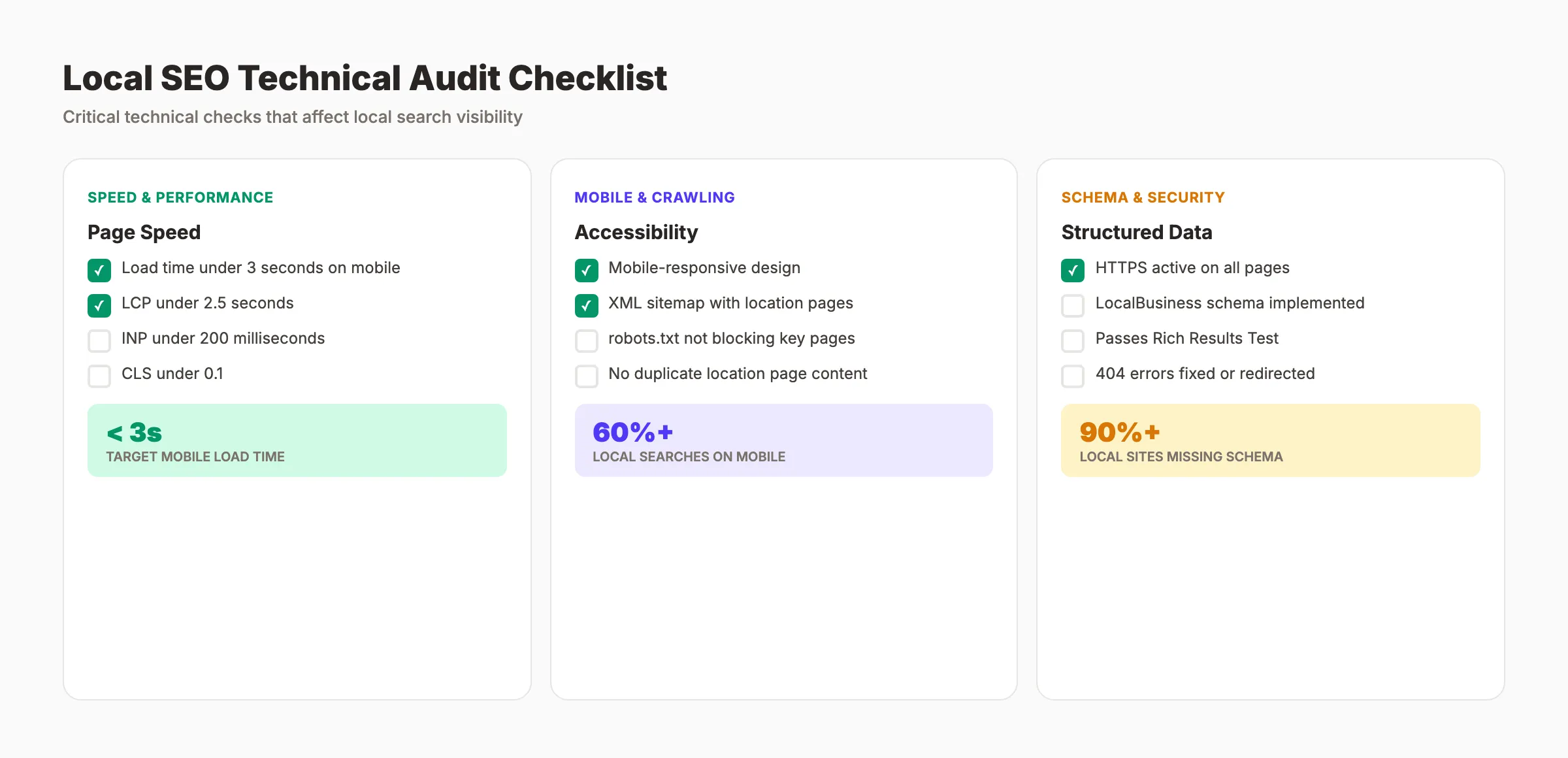
Technical checks for local SEO:
- Site loads in under 3 seconds on mobile (test at PageSpeed Insights)
- Site is mobile-responsive (test with Google’s Mobile-Friendly Test)
- HTTPS is active on all pages (no mixed content warnings)
- XML sitemap exists and includes all location pages
-
robots.txtdoes not block important pages - No duplicate content issues across location pages
- Structured data (LocalBusiness schema) passes Google Rich Results Test
- 404 errors are fixed or redirected
- Internal links connect service pages to location pages
Run a crawl using Screaming Frog, Semrush Site Audit, or our free website SEO audit tool. Fix critical errors first (broken pages, missing schema, blocked resources). Address warnings second (slow pages, missing alt text, thin content).
For a deeper technical review, follow our technical SEO checklist.
Why this step matters: Google cannot rank pages it cannot access. A single misconfigured robots.txt file can remove your entire site from local search results. Technical issues are silent killers. Most business owners never know they exist until an audit reveals them.
Step 9: Assess Your Content for Local Relevance
Content signals help Google understand your expertise and your connection to the local community. Most local businesses publish zero blog content. That is a competitive advantage for those who do.
Content audit questions:
- Does your site have blog content targeting local keywords?
- Does each service page have 500+ words of unique, helpful content?
- Do you publish content about local events, community involvement, or local industry news?
- Does your content answer the questions your customers ask before they call?
Content gaps to look for:
- No service-specific pages. A plumber with one “services” page listing everything loses to a plumber with separate pages for drain cleaning, water heater repair, and pipe installation.
- No FAQ content. Questions your customers ask on the phone should be answered on your website.
- No local content. Blog posts about local events, seasonal tips, or community partnerships build local topical authority.
- No blog at all. Businesses that publish blog content optimized for SEO rank for dozens more keywords than those with a static 5-page website.
Why this step matters: Content is how you rank for long-tail local keywords. “Emergency plumber Austin 78701” gets fewer searches than “plumber Austin” but converts at a much higher rate. Content pages capture that specific intent.
Step 10: Benchmark Against Competitors and Track Progress
The final step ties everything together. Compare your audit findings against the top 3 businesses in your local pack. Then create a tracking plan.
Competitor benchmark table:
| Metric | Your Business | Competitor 1 | Competitor 2 | Competitor 3 |
|---|---|---|---|---|
| Google reviews | ___ | ___ | ___ | ___ |
| Star rating | ___ | ___ | ___ | ___ |
| GBP categories | ___ | ___ | ___ | ___ |
| Citation count | ___ | ___ | ___ | ___ |
| Referring domains | ___ | ___ | ___ | ___ |
| Blog posts | ___ | ___ | ___ | ___ |
| Schema markup | Yes/No | Yes/No | Yes/No | Yes/No |
Create a priority action plan:
Rank your audit findings by impact and effort.
| Priority | Action | Impact | Effort |
|---|---|---|---|
| 1 | Fix GBP errors (wrong category, missing info) | High | Low |
| 2 | Fix NAP inconsistencies across top directories | High | Medium |
| 3 | Respond to all unresponded reviews | Medium | Low |
| 4 | Add LocalBusiness schema to website | High | Medium |
| 5 | Fix technical errors (speed, mobile, 404s) | High | Medium |
| 6 | Build citations on missing directories | Medium | Medium |
| 7 | Start a local content publishing plan | High | High |
| 8 | Acquire 3 to 5 local backlinks | High | High |
Track monthly: Review your Google Business Profile Insights, Search Console data, and rank tracking tool on the first Monday of each month. Compare against your baseline numbers from this audit. Run a full re-audit every quarter.
Why this step matters: An audit without a tracking plan is a report that gathers dust. The businesses that improve their local rankings are the ones that measure progress monthly, prioritize fixes by impact, and execute consistently.
3,500+ blogs published. 92% average SEO score. Stacc drives organic traffic and local visibility for your business. Blog SEO + Local SEO, working together. Start for $1 →
Results: What to Expect
After completing all 10 steps:
- Week 1 to 2: GBP fixes (categories, description, photos) reflect within days. Citation corrections take 2 to 8 weeks to propagate across directories.
- Month 1 to 3: Review velocity improvements and citation cleanup begin affecting local pack rankings. Technical fixes improve crawl efficiency.
- Month 3 to 6: Content and backlink investments start compounding. Expect measurable ranking improvements for tracked keywords.
- Month 6+: Consistent execution of the audit findings creates a widening gap between you and competitors who do not audit.
FAQ
How often should I do a local SEO audit?
Run a full audit every quarter (every 3 months). Between full audits, monitor your GBP Insights, review count, and keyword rankings monthly. Competitive changes, Google algorithm updates, and business information changes all justify regular auditing.
How much does a local SEO audit cost?
Agency audits range from $500 to $5,000 depending on complexity and number of locations. DIY audits using tools like BrightLocal ($29 per month) or Semrush ($130 per month) cost the price of the tool subscription plus 2 to 4 hours of your time. The 10-step process in this guide lets you do it yourself for free using basic tools.
What is the difference between an SEO audit and a local SEO audit?
A general SEO audit focuses on your website: technical health, content quality, backlinks, and keyword rankings. A local SEO audit includes all of that plus local-specific factors: Google Business Profile optimization, citation consistency, review management, local keyword rankings, and Map Pack visibility. Read our full SEO audit guide for the broader process.
What are the most common issues found in local SEO audits?
The 5 most common issues we see are: wrong or missing GBP categories, inconsistent NAP data across directories, no review response strategy, missing LocalBusiness schema markup, and zero local content on the website. All 5 are fixable within 30 days.
Can Stacc help with local SEO?
Yes. Stacc publishes local SEO content and GBP posts automatically every month. We handle the blog content that drives organic traffic and the GBP posts that keep your profile active. The Stacc Stack Method combines Blog SEO and Local SEO for compounding results.
A local SEO audit reveals the exact gaps between where you rank and where you should rank. Run through these 10 steps quarterly. Fix the highest-impact items first. The businesses that dominate local search are the ones that audit consistently, fix issues fast, and keep publishing local content every month.
Related Tools & Resources
Free SEO Tools:
Best Lists:

Written by
Siddharth GangalSiddharth is the founder of theStacc and Arka360, and a graduate of IIT Mandi. He spent years watching great businesses lose organic traffic to competitors who simply published more. So he built a system to fix that. He writes about SEO, content at scale, and the tactics that actually move rankings.
Automate your Google Business Profile content
30 GBP posts, local SEO articles, and review responses. Published every month automatically.
30-day trial · Cancel anytime
theStacc
Stop writing SEO content manually
30 blog articles, 30 GBP posts, and social media content. Published every month. Automatically.
Start Your $1 Trial$1 for 3 days · Cancel anytime