
Content Velocity SEO (2026): Strategies, Tactics & Examples
Practical content velocity seo strategies for 2026: step-by-step tactics, real examples, and tools to improve rankings and drive organic traffic.
The average small business publishes 2 to 4 blog posts per month. The businesses ranking on page 1 for competitive keywords publish 15 to 30. That gap is not a coincidence. It is content velocity at work.
Content velocity SEO is one of the most underused growth strategies in organic search. Most businesses obsess over individual post quality while ignoring the single metric that separates sites with 100 monthly visitors from sites with 100,000.
We have published 3,500+ articles across 70+ industries. The pattern is always the same. Faster publishing wins. Not because Google rewards volume alone. Because more content means more keywords, more internal links, more topical authority, and more chances to rank.
This guide covers everything you need to know about content velocity and how to use it.
Here is what you will learn:
- What content velocity means and why it matters for SEO
- Publishing frequency benchmarks by business size and competition level
- Why the quality vs quantity debate misses the point entirely
- 7 methods to increase content velocity without hiring a content team
- How to measure content velocity ROI with real metrics
- The 5 most common content velocity mistakes and how to avoid them
What Is Content Velocity?
Content velocity is the rate at which you publish new, optimized content. It measures how many pages you add to your site within a given timeframe. Most SEO teams measure it as articles per week or articles per month.
A site publishing 4 articles per month has a content velocity of 4. A site publishing 30 has a content velocity of 30. The math is simple. The impact is not.
Content velocity is different from content volume. Volume is the total number of pages on your site. Velocity is the speed at which that number grows. A site with 500 existing articles but zero new publications has high volume and zero velocity.
Why Velocity Matters More Than Volume
Google evaluates freshness. Sites that consistently publish new content signal active maintenance and relevance. A stale site with 1,000 old articles ranks worse than an active site with 200 articles that adds 20 per month.
According to HubSpot’s 2025 blogging benchmark report, companies that publish 16+ blog posts per month get 3.5 times more traffic than companies publishing 0 to 4 posts per month. That multiplier does not come from any single article. It comes from the compounding effect of consistent output.
Content velocity also accelerates topical authority. Google assigns authority at the topic level, not the page level. Publishing 20 articles about local SEO in 3 months builds stronger topical signals than publishing 20 articles about 20 different topics over 2 years.
Why Content Velocity Drives Rankings
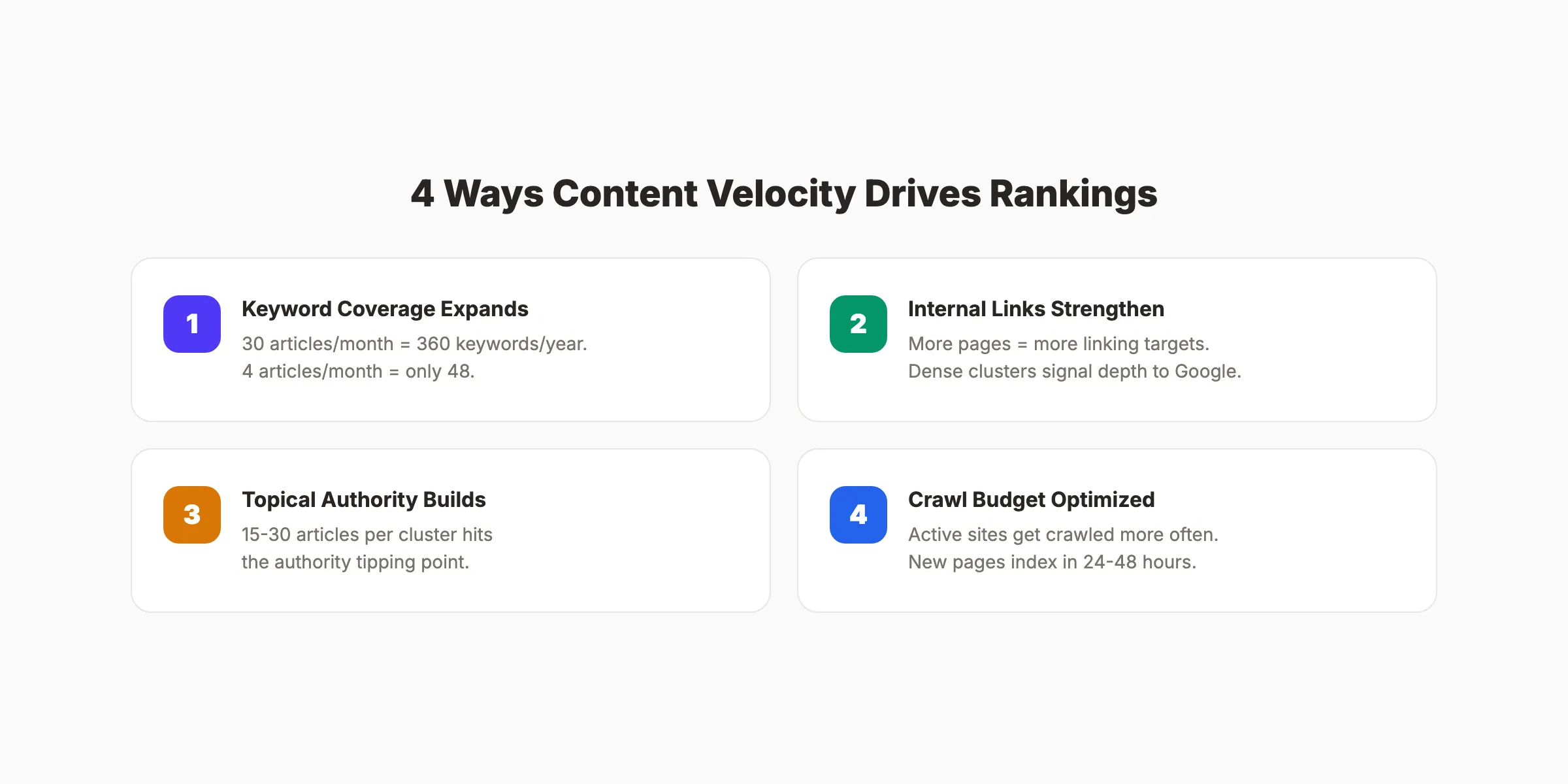
The relationship between publishing speed and rankings has 4 mechanisms. Each one compounds.
1. Keyword Coverage Expands Faster
Every article targets at least 1 primary keyword and 5 to 10 secondary keywords. Publishing 30 articles per month means targeting 30 to 300 new keywords every month.
A site publishing 4 articles per month covers 48 primary keywords per year. A site publishing 30 covers 360. After 12 months, the faster publisher has 7.5 times more keyword coverage. That gap grows every single month.
2. Internal Linking Networks Strengthen
More content creates more opportunities for internal links. Each new article links to existing articles and creates new targets for future articles to link to.
A site with 50 articles has limited internal linking options. A site with 300 articles can build dense internal link clusters around every topic. Google uses internal links to discover, crawl, and evaluate page importance. Dense clusters signal depth and authority.
3. Topical Authority Builds Exponentially
Google’s systems evaluate whether a site is a genuine authority on a topic. Publishing 3 articles about keyword research does not establish authority. Publishing 25 articles covering keyword research, search intent, long-tail strategy, competitive analysis, and keyword tools does.
The threshold for topical authority is not fixed. It depends on your niche and competitors. But across 70+ industries, we consistently see a tipping point between 15 and 30 articles per topic cluster. Sites that reach that threshold see a jump in rankings for the entire cluster. Not just one page.
4. Crawl Budget Gets Used Efficiently
Google allocates a crawl budget to every site. Sites that frequently publish new content get crawled more often. More frequent crawling means new pages get indexed faster, which means they start ranking sooner.
A site publishing once per week might wait 2 to 4 weeks for a new article to get indexed. A site publishing daily often sees indexing within 24 to 48 hours. Faster indexing means faster ranking signals. Faster ranking signals mean faster feedback loops to optimize.
Stop writing. Start ranking. Stacc publishes 30 optimized articles per month for $99. No writers. No editing. No publishing delays. Start for $1 →
Content Velocity Benchmarks by Business Size
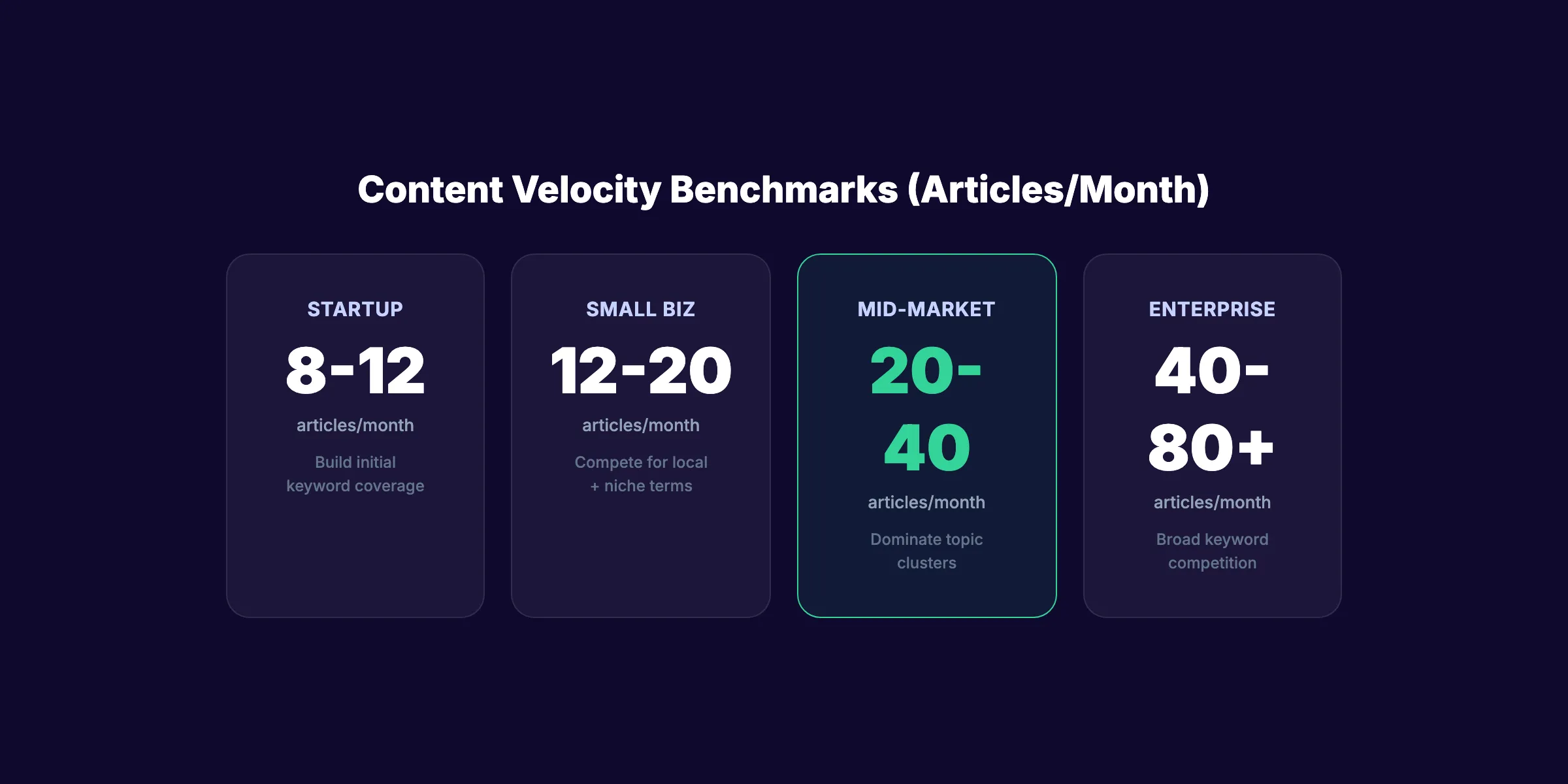
Not every business needs 30 articles per month. The right content velocity depends on your competition, your goals, and your resources.
Benchmarks by Business Size
| Business Size | Recommended Velocity | Why |
|---|---|---|
| Solo/Startup | 8-12 articles/month | Build initial keyword coverage fast |
| Small Business (10-50 emp) | 12-20 articles/month | Compete for local + niche terms |
| Mid-Market (50-200 emp) | 20-40 articles/month | Dominate topic clusters |
| Enterprise (200+ emp) | 40-80+ articles/month | Compete on broad, high-volume keywords |
Benchmarks by Competition Level
| Competition Level | Minimum Velocity | Time to Results |
|---|---|---|
| Low (local, niche) | 8 articles/month | 2-4 months |
| Medium (regional, mid-tail) | 15-20 articles/month | 4-6 months |
| High (national, broad terms) | 30+ articles/month | 6-12 months |
| Very High (SaaS, finance, health) | 50+ articles/month | 9-18 months |
These numbers come from patterns across 3,500+ published articles. They are not theoretical. Sites that hit these thresholds consistently see measurable ranking movement within the listed timeframes.
The Minimum Viable Velocity
Most SEO data points to 12 articles per month as the minimum velocity for meaningful organic growth. Below 12, the compounding effect is too slow to outpace content decay and competitor publishing.
Content decay erodes rankings on existing articles by 5 to 15% per year. If you publish only 4 articles per month, the gains from new content barely offset the losses from aging content. At 12 per month, you start pulling ahead.
Quality vs Quantity: The Debate Is Over
The SEO industry spent years arguing about quality vs quantity. The answer is both. But the debate frames the question wrong.
Quality is a baseline. Every article must clear a quality floor: proper keyword targeting, accurate information, good structure, internal links, and readable writing. Below that floor, more content does nothing.
Above that floor, velocity wins. The difference between a 92-score article and a 98-score article is marginal for rankings. The difference between publishing 5 articles and publishing 25 articles is massive.
What “Quality” Actually Means for SEO
Quality in SEO is not beautiful prose. It is functional optimization.
A quality SEO article has:
- A clear target keyword in the title, first 100 words, and at least 1 H2
- A logical content structure with H2s and H3s
- 1,500+ words for informational queries (2,500+ for guides)
- 3-5 internal links per 1,000 words
- Original insight, data, or perspective (not regurgitated competitor content)
- A meta description between 145 and 155 characters
- At least 1 image with descriptive alt text
That checklist takes 30 to 45 minutes per article when the process is systemized. It does not require a Pulitzer-winning writer. It requires a consistent workflow.
The Compound Effect of Consistent Quality
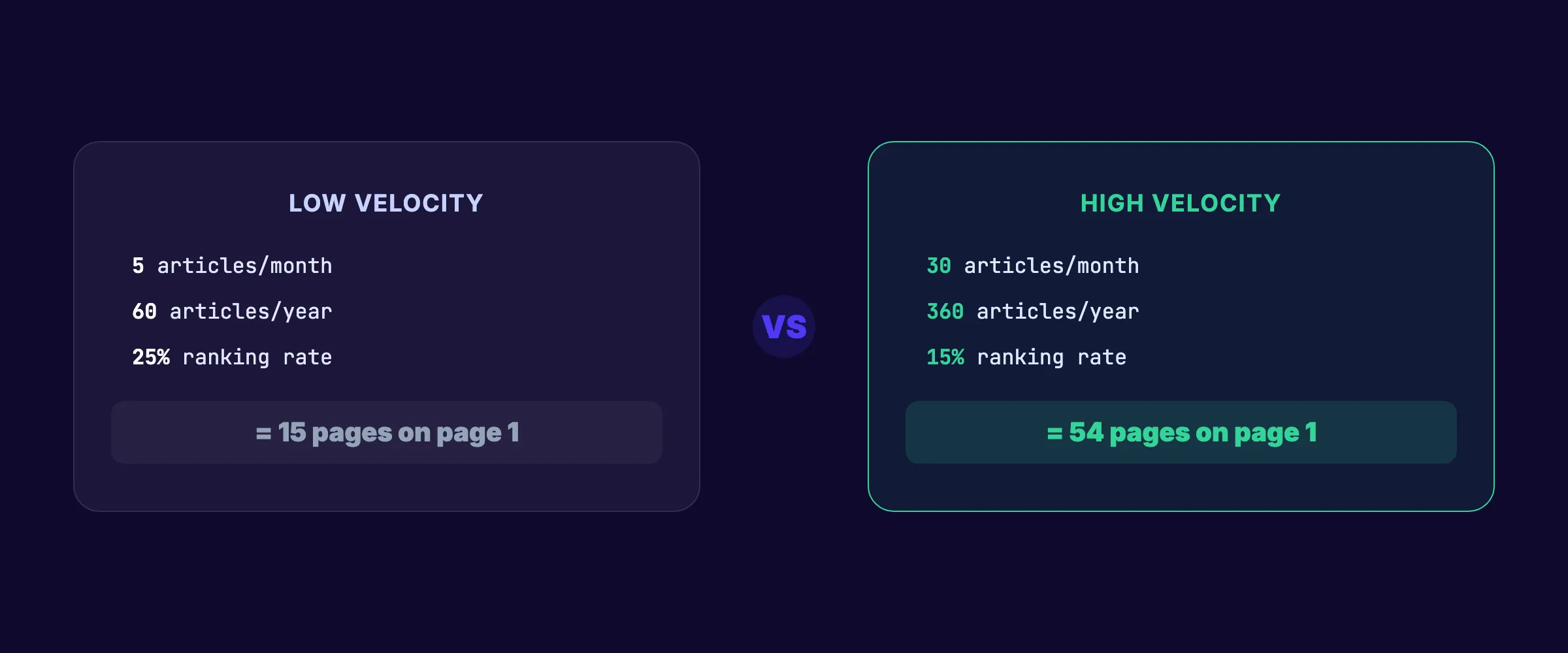
Publishing 30 articles per month at a 90% SEO score beats publishing 5 articles per month at a 98% score. Every time. The math is not close.
30 articles per month = 360 articles per year = 360 primary keywords targeted. At a 15% ranking rate (average for well-optimized content), that is 54 articles on page 1.
5 articles per month = 60 articles per year. Even at a 25% ranking rate, that is only 15 articles on page 1.
The high-velocity publisher has 3.6 times more ranking pages. More ranking pages means more traffic, more leads, and more authority signals feeding back into higher rankings across the entire site.
3,500+ blogs published. 92% average SEO score. See what Stacc can do for your site. Start for $1 →
How to Increase Content Velocity Without Sacrificing Quality
Most businesses struggle with content velocity because they rely on a manual, linear workflow: research, outline, write, edit, optimize, publish. That workflow caps out at 4 to 8 articles per month for a single writer.
Here are 7 methods to break through that ceiling.
1. Systemize Your Content Workflow
Create a repeatable process for every article. Template the research phase. Standardize outline formats. Build a style guide so every writer (human or AI) produces consistent output.
A systemized workflow cuts production time by 40 to 60%. The biggest time sink in content creation is not writing. It is decision-making. Templates eliminate decisions.
Use a content calendar to plan 30 to 90 days ahead. Batch similar tasks. Research 10 articles at once. Outline 10 at once. Write 10 at once. Batching reduces context-switching, which is the silent killer of content velocity.
2. Use AI for First Drafts
AI writing tools can produce a 2,000-word first draft in under 5 minutes. A human editor then spends 20 to 30 minutes fact-checking, adding original insight, and optimizing for SEO.
This workflow produces 3 to 5 articles per day per editor. One editor working 4 hours per day on content can produce 60 to 100 articles per month.
The key is using AI as a starting point, not a final product. Humanize the output. Add real examples. Insert data points with sources. Remove generic filler.
3. Build a Content Cluster Strategy
Instead of publishing random articles about random topics, build topical maps and publish in clusters.
A cluster approach increases velocity because:
- Research overlaps between related articles
- Internal linking is natural and planned
- Keyword cannibalization is avoided
- Writers develop expertise in the topic after 3 to 5 articles
Plan 10 to 15 articles per cluster. Publish them within a 4 to 6 week window. Then move to the next cluster. This approach builds topical authority faster than scattershot publishing.
4. Outsource or Automate Publishing
Writing is only half the bottleneck. Many teams produce articles on time but delay publishing by days or weeks due to CMS formatting, image creation, and scheduling.
Automate the publishing step. Tools that connect directly to your CMS (WordPress, Webflow, Ghost) eliminate the manual publishing bottleneck entirely.
If you cannot automate, assign a dedicated publishing coordinator. Their only job is formatting and scheduling approved content. This single role can increase effective content velocity by 30 to 50%.
5. Repurpose Existing Content
Not every article needs to be written from scratch. Repurpose blog content across formats and channels.
Turn a 3,000-word guide into:
- 5 to 8 social media posts
- 1 email newsletter
- 3 to 5 shorter blog posts covering subtopics in depth
- 1 infographic
- 1 FAQ page
Repurposing multiplies your effective content velocity by 2 to 3 times without adding writing hours.
6. Update and Republish Old Content
Updating old blog posts counts toward content velocity. Google treats a significantly updated article almost like a new publication.
Audit your existing content quarterly. Identify articles with declining traffic. Update statistics, add new sections, refresh internal links, and republish with a current date.
A site with 200 existing articles can generate 10 to 20 “new” publications per month just by updating aging content. This maintains rankings that would otherwise decay.
7. Automate the Entire Pipeline
The fastest way to increase content velocity is to remove the human bottleneck entirely for standard SEO articles.
Automated SEO content pipelines handle keyword research, content briefs, writing, optimization, and publishing without manual intervention. The output is not perfect for every article. But it clears the quality floor consistently at 10 to 30 times the speed of manual production.
For businesses that need 30+ articles per month, automation is not optional. It is the only path that scales without scaling headcount.
Content Velocity by Channel
Content velocity applies beyond blog posts. Every channel where you publish indexed content contributes to your overall SEO velocity.
Blog Content
The primary content velocity channel for most businesses. Blog articles build keyword coverage, attract backlinks, and create internal linking opportunities.
Target: 12 to 30 articles per month for most businesses.
Google Business Profile Posts
GBP posts are a local SEO velocity channel. Regular posting signals activity to Google and keeps your profile visible in local search.
Target: 4 to 8 GBP posts per month minimum. Daily posting is ideal.
The posting frequency for GBP directly correlates with local pack rankings. Businesses that post weekly outrank businesses that post monthly.
Social Media Content
Social posts do not directly affect SEO rankings. But they drive traffic, generate engagement signals, and amplify content distribution.
Publishing social media content increases the reach of your blog articles. More eyes on content means more backlinks, more shares, and more brand searches. All of which feed back into SEO.
Target: 15 to 30 social posts per month across 2 to 3 platforms.
Combined Velocity
The businesses with the strongest SEO results combine all 3 channels.
| Channel | Monthly Target | SEO Impact |
|---|---|---|
| Blog SEO | 20-30 articles | Primary: keyword coverage, authority |
| GBP Posts | 15-30 posts | Local rankings, profile visibility |
| Social Media | 20-30 posts | Traffic amplification, brand signals |
| Total Velocity | 55-90 pieces/month | Compounding across all channels |
This is what we call the Stacc Stack Method. Blog content builds organic authority. GBP posts win local search. Social amplifies both. Each channel reinforces the others.
Rank everywhere. Do nothing. Blog SEO, Local SEO, and Social on autopilot. Starting at $99 per month. Start for $1 →
Measuring Content Velocity ROI
Publishing faster is only valuable if it drives results. Here is how to measure whether your content velocity strategy is working.
Key Metrics to Track
| Metric | What It Tells You | Target |
|---|---|---|
| Articles published/month | Raw output | 12+ for growth |
| Keywords ranking (top 100) | Coverage expansion | 10-20% growth/month |
| Keywords ranking (top 10) | Competitive positions | 5-10% growth/month |
| Organic traffic | Visibility results | 15-25% growth/quarter |
| Indexed pages | Google coverage | Should match articles published |
| Average time to index | Crawl efficiency | Under 7 days |
| Organic conversions | Business impact | Should correlate with traffic growth |
The Content Velocity Formula
A simple formula to track your content velocity ROI:
Content Velocity ROI = (New Organic Revenue - Content Production Cost) / Content Production Cost
If you spend $1,000 per month producing 30 articles and those articles generate $5,000 in new organic revenue over 6 months, your ROI is 400%.
The key variable is time. Content velocity ROI improves dramatically after month 6. The first 3 months build the foundation. Months 4 through 6 show early ranking signals. Months 7 through 12 deliver compounding traffic growth.
When to Increase Velocity
Increase your content velocity when:
- Organic traffic is growing 15%+ per quarter (the system is working, scale it)
- You have covered your primary keyword clusters (expand to adjacent topics)
- Competitor analysis shows they are outpublishing you
- You have budget headroom and want to accelerate growth
When to Decrease Velocity
Decrease or pause velocity increases when:
- Article quality drops below your SEO score threshold
- You are experiencing keyword cannibalization across new articles
- Organic traffic is flat despite increasing output (quality issue, not quantity)
- Your content calendar has gaps in strategic direction
Common Content Velocity Mistakes
High content velocity without strategy creates waste. Avoid these 5 mistakes.
1. Publishing Without Keyword Targeting
Every article needs a target keyword. Publishing 30 articles per month without keyword research is just blogging. It is not SEO. Use keyword research to assign a primary keyword to every single article before writing begins.
2. Ignoring Content Quality Floors
Velocity without quality is noise. If your articles have thin content (under 800 words), no internal links, no meta descriptions, and no keyword optimization, more articles will not help. Fix the quality floor first. Then increase speed.
Check your existing content against on-page SEO fundamentals. If more than 30% of your articles fail basic checks, pause new publishing and fix what exists.
3. No Internal Linking Strategy
More content without internal links creates orphan pages. Google struggles to discover and rank pages that are not connected to your site structure.
Every new article should link to 3 to 5 existing articles. Every existing article should be audited for opportunities to link to new content. Build this into your publishing workflow. Not as an afterthought.
4. Publishing the Same Topic Repeatedly
High velocity sometimes leads to keyword cannibalization. If you publish 5 articles targeting “best SEO tools,” they compete against each other. Rankings split. None of them rank well.
Use a topical map to plan content velocity. Assign one primary keyword per article. No overlaps. Audit your existing content before writing new articles to avoid duplicating topics.
5. Neglecting Content Maintenance
New articles decay if you never update them. Content decay affects every site. Statistics become outdated. Competitors publish better versions. Links break.
Allocate 20% of your content velocity to updates. If you publish 20 new articles per month, update 4 to 5 existing articles in the same period. This prevents your content library from aging into irrelevance.
FAQ
What is a good content velocity for SEO?
A good content velocity for most small to mid-sized businesses is 12 to 20 articles per month. Businesses in competitive markets should aim for 20 to 40. The minimum velocity for measurable organic growth is 12 articles per month. Below that threshold, new content barely offsets natural content decay.
Does publishing more content really help SEO?
Yes. HubSpot data shows companies publishing 16+ blog posts per month get 3.5 times more traffic than those publishing 0 to 4. The effect compounds over time. More articles mean more keywords targeted, more internal links, and stronger topical authority signals.
How do I increase content velocity without hiring writers?
Use AI for first drafts and have one editor refine them. This workflow produces 3 to 5 articles per day per editor. You can also automate your SEO workflow end-to-end. SEO automation platforms produce 30 to 80 articles per month at a fraction of the cost of a writing team.
Is content quality or quantity more important for SEO?
Both. Quality is a floor, not a ceiling. Every article needs proper keyword targeting, good structure, and accurate information. Once you clear that floor, publishing volume becomes the differentiator. A site publishing 30 articles per month at 90% quality beats 5 articles at 98% quality.
How long does it take for content velocity to show results?
Most businesses see measurable ranking improvements in 60 to 90 days after increasing content velocity. Significant traffic growth appears at 4 to 6 months. The compounding effect accelerates in months 7 through 12, where many businesses see 2 to 5 times traffic growth compared to their baseline.
How many blog posts does it take to rank on Google?
Most sites need 15 to 30 articles per topic cluster to establish topical authority. The total number depends on competition level. Low-competition niches can rank with 30 to 50 total articles. Competitive industries need 200 to 500 articles for broad keyword coverage.
Content velocity is not about writing faster. It is about building an organic growth engine that compounds every month. Every article stacks on the last. Every internal link strengthens the network. Every keyword ranked creates authority for the next one.
The businesses winning in organic search are not writing better content than their competitors. They are writing more of it. Consistently. That is what content velocity SEO delivers.
Start with 12 articles per month. Build to 20. Then 30. If scaling content production feels impossible with your current team, 30 optimized articles cost $99 per month when publishing happens automatically.
Related Tools & Resources
Free SEO Tools:
Best Lists:

Written by
Siddharth GangalSiddharth is the founder of theStacc and Arka360, and a graduate of IIT Mandi. He spent years watching great businesses lose organic traffic to competitors who simply published more. So he built a system to fix that. He writes about SEO, content at scale, and the tactics that actually move rankings.
30 SEO blog articles published every month
Keyword-optimized, scheduled, and live on your site. Automatically.
30-day trial · Cancel anytime
theStacc
Stop writing SEO content manually
30 blog articles, 30 GBP posts, and social media content. Published every month. Automatically.
Start Your $1 Trial$1 for 3 days · Cancel anytime