
What Is Keyword Cannibalization? (And Why It Hurts)
Learn what keyword cannibalization is, why it damages your SEO rankings, how to detect it, and the fastest ways to fix it in 2026.
What Is Keyword Cannibalization?
Keyword cannibalization happens when 2 or more pages on your site target the same keyword and compete against each other in search results. Instead of 1 strong page ranking high, Google splits authority between them. Both pages rank lower than either would alone.
Think of it like sending 2 runners from the same team in the same lane. They trip each other up. Neither wins.
The term sounds dramatic, but the effect is real. Your own content eats into its own rankings. Sites with strong topical authority keep cannibalization rates below 5%. Anything above 10% signals a structural problem with your content strategy.
Why Keyword Cannibalization Hurts Your Rankings
Google wants to show the single best result for a query. When your site offers 2 competing answers, the algorithm cannot decide which to rank. It often picks neither as the top result.
The data backs this up. Backlinko found that fixing cannibalization with a 301 redirect led to a 466% increase in clicks year over year. That is not a marginal gain. That is traffic you are already earning but losing to your own pages.
Click-through rates drop fast beyond position 1. Search Engine Land reports that position 1 receives 27.6% of all clicks. Position 10 gets just 2.4%. When cannibalization pushes your best page from spot 2 to spot 5, you lose more than half your potential traffic.
The cost goes beyond clicks. Cannibalization dilutes link equity across multiple URLs. It confuses your internal linking structure. It wastes crawl budget on redundant pages. Every backlink pointing to the weaker page is a backlink not strengthening the right one.
How Keyword Cannibalization Works
Not every overlap between pages is cannibalization. This distinction matters because misidentifying the problem leads to the wrong fix.
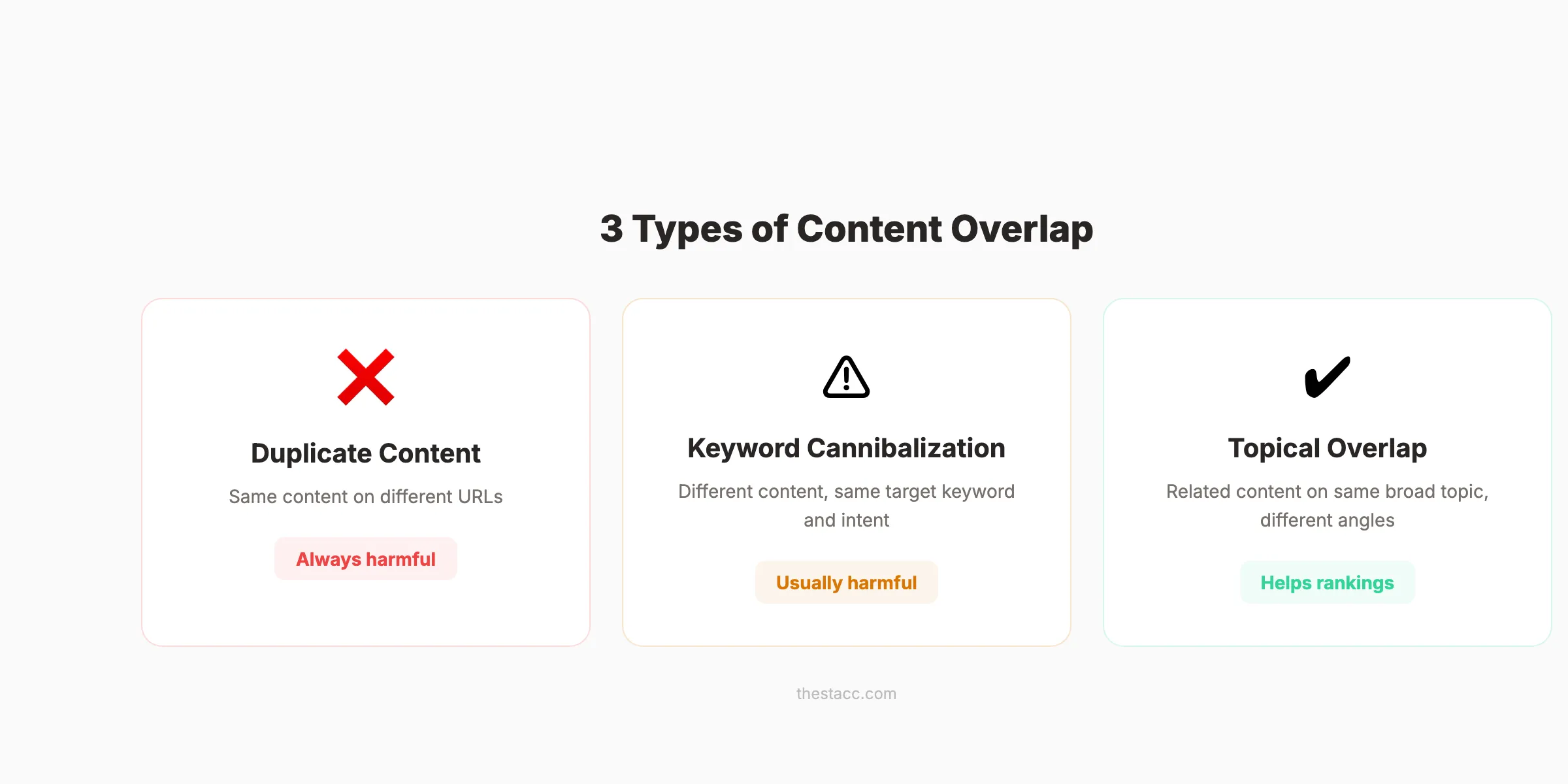
| Type | Definition | Harmful? |
|---|---|---|
| Duplicate content | Same content on different URLs | Yes. Always fix. |
| Keyword cannibalization | Different content targeting the same keyword and intent | Usually. Fix in most cases. |
| Topical authority overlap | Related content covering the same broad topic from different angles | No. This helps rankings. |
A blog post about “best running shoes” and a product category page about “best running shoes” is cannibalization. They target the same keyword with the same search intent.
A blog post about “best running shoes for flat feet” and another about “best trail running shoes” is topical overlap. Different intent. Different audience. Both strengthen your authority on running shoes.
Google’s John Mueller has stated that multiple pages ranking for the same query “does not seem problematic.” But SEO practitioners consistently observe traffic drops when pages compete for identical keywords. Both perspectives hold truth. Google evaluates pages algorithmically. Practitioners measure the real-world traffic impact.
The safest approach: build a topical map that assigns 1 primary keyword per page. Overlap in topic is fine. Overlap in target keyword is not.
Common Causes of Keyword Cannibalization
- No keyword mapping. Publishing blog posts over months without tracking which keywords each page targets. A content calendar prevents this.
- AI-scaled content without oversight. Generating dozens of articles that cover overlapping topics with no editorial review.
- Product pages competing with blog posts. An ecommerce category page and a buying guide both targeting “best standing desks.”
- Tag and category archive pages. WordPress archives ranking for your main keywords instead of your actual content.
- Location pages with similar service keywords. “Plumber in Dallas” and “Dallas plumbing services” targeting the same intent.
- No content audit process. Old posts pile up. Topics overlap. Nobody reviews what already exists. A regular content audit catches cannibalization before it compounds.
How to Detect Keyword Cannibalization
The fastest method uses Google Search Console. Open the Performance report. Filter by the query you want to check. Switch to the Pages tab. If multiple URLs appear for the same query, you have potential cannibalization.
Look for these warning signs:
- 2 or more pages ranking for the same keyword with fluctuating positions
- A page that used to rank well suddenly dropping after you publish similar content
- Clicks split across multiple URLs for 1 keyword
For a tool-based approach, Ahrefs and Semrush both offer organic keyword reports filtered by URL. Export the data. Sort by keyword. Flag any keyword assigned to more than 1 URL.
You can also run a simple site search. Type site:yourdomain.com "target keyword" into Google. Count how many of your pages appear. More than 1 result for an exact-match keyword deserves investigation.
The key word is “investigation.” Not every overlap is harmful. Check whether the pages target the same intent. If they do, you have cannibalization. If they serve different intents, you likely have healthy topical authority.
Stop losing traffic to your own pages. Stacc publishes 3,500+ SEO-optimized blog posts across 70+ industries with built-in keyword mapping. Start for $1 —>
How to Fix Keyword Cannibalization
The right fix depends on the severity. Here is a quick overview:
- Consolidate the weaker page into the stronger one. Merge the best content from both.
- 301 redirect the old URL to the winner. This is what produced the 466% click increase in the Backlinko study.
- Add a canonical tag to signal which version Google should index.
- Re-optimize one page for a different keyword. Change the on-page SEO to target a related but distinct term.
- Noindex the weaker page if it serves users but should not rank.
- Delete truly redundant content that adds no unique value.
We wrote a full breakdown of each method with step-by-step instructions. Read the companion guide: How to Fix Keyword Cannibalization in 7 Steps.
Common Mistakes
Deleting pages without redirecting. Removing a cannibalized page seems logical. But if that page has backlinks or traffic, you lose both. Always set up a 301 redirect first.
Ignoring intent differences. Two pages ranking for the same keyword is not always cannibalization. If one targets informational intent and the other targets transactional intent, Google may rank both intentionally. Check the intent before merging.
Fixing symptoms instead of systems. Merging 2 pages solves today’s problem. Building a topical map and performing keyword research before publishing prevents tomorrow’s problem. The goal is a system where cannibalization cannot happen.
Over-optimizing after consolidation. After merging pages, some teams stuff the surviving page with every keyword from both. This creates thin content problems or keyword stuffing. Keep the consolidated page focused on 1 primary keyword with natural supporting terms.
FAQ
How do I know if I have keyword cannibalization?
Check Google Search Console. Filter by query in the Performance report. If multiple URLs from your site rank for the same keyword and your positions fluctuate, you likely have cannibalization. A quick site:yourdomain.com "keyword" search also reveals overlapping pages.
Does keyword cannibalization always hurt rankings?
Not always. Google can rank multiple pages from the same site for 1 query. The problem occurs when both pages target the same intent and split your authority. If they serve different intents, the overlap may actually strengthen your site.
Can keyword cannibalization happen with new content?
Yes. Publishing a new blog post that targets the same keyword as an existing page is one of the most common causes. This is why keyword mapping and a content calendar matter. Always check what already ranks before creating new content.
What is the fastest way to fix keyword cannibalization?
A 301 redirect from the weaker page to the stronger one is the fastest fix. It consolidates link equity immediately. For a complete walkthrough of all 7 methods, read our guide on how to fix keyword cannibalization.
Your SEO team. $99 per month. Stacc publishes keyword-mapped blog content that avoids cannibalization from day 1. See plans —>
Related Tools & Resources
Free SEO Tools:
Best Lists:

Written by
Siddharth GangalSiddharth is the founder of theStacc and Arka360, and a graduate of IIT Mandi. He spent years watching great businesses lose organic traffic to competitors who simply published more. So he built a system to fix that. He writes about SEO, content at scale, and the tactics that actually move rankings.
30 SEO blog articles published every month
Keyword-optimized, scheduled, and live on your site. Automatically.
30-day trial · Cancel anytime
theStacc
Stop writing SEO content manually
30 blog articles, 30 GBP posts, and social media content. Published every month. Automatically.
Start Your $1 Trial$1 for 3 days · Cancel anytime