
Does AI Content Rank? What the Data Shows (2026)
We compiled data from 5 studies on AI vs human content rankings. Pure AI ranks 23% lower. AI-assisted ranks within 4%. See the full data. Updated 2026.
Data compiled from Ahrefs (600K pages), Semrush (20K URLs), Digital Applied (4,200 articles over 16 months), Reboot Online (25 paired sites), and Google Search Central documentation. March 2026.
Key Findings at a Glance:
- Pure AI content ranks 23% lower on average than human-written articles across 4,200 tracked articles.
- AI-assisted content performs within 4% of fully human-written content when edited by experts.
- 86.5% of top-ranking pages use some form of AI assistance in content creation.
- AI-only content earns 61% fewer backlinks than human-written articles on comparable topics.
- 57% of AI-generated text and 58% of human-generated text appear in the top 10 results.
- Google does not penalize AI content. Quality, not origin, determines rankings.
- 17.3% of Google’s top 20 results are fully AI-generated, up from 2.3% in 2020.
- Scaled content abuse (mass AI publishing without quality control) triggers manual penalties.
Why This Question Matters
Does AI content rank on Google? Every business owner and marketer asks this question before investing in AI-assisted content production. The answer determines strategy, budget, and staffing decisions for 2026 and beyond.
The debate is loud. Some marketers publish 100+ AI articles per month and report massive traffic gains. Others report Google penalties after AI content audits. The noise makes it hard to separate signal from anecdote.
We compiled data from 5 major studies covering 600,000+ pages to answer this question with data, not opinions. We publish 3,500+ blog posts across 70+ industries with a 92% average SEO score. We use AI in our own workflow. The findings below reflect both the research and our experience.
Here is what we found.
Finding 1: Pure AI Content Ranks 23% Lower on Average
Background: The most common question is whether raw, unedited AI output can rank competitively on Google. Digital Applied tracked 4,200 articles over 16 months (November 2024 to February 2026) to measure the difference.
Results: Pure AI content published without editorial enhancement ranked 23% lower on average than human-written articles across all keyword difficulty levels. The gap was largest for competitive keywords (difficulty 40+) where pure AI content ranked 31% lower.
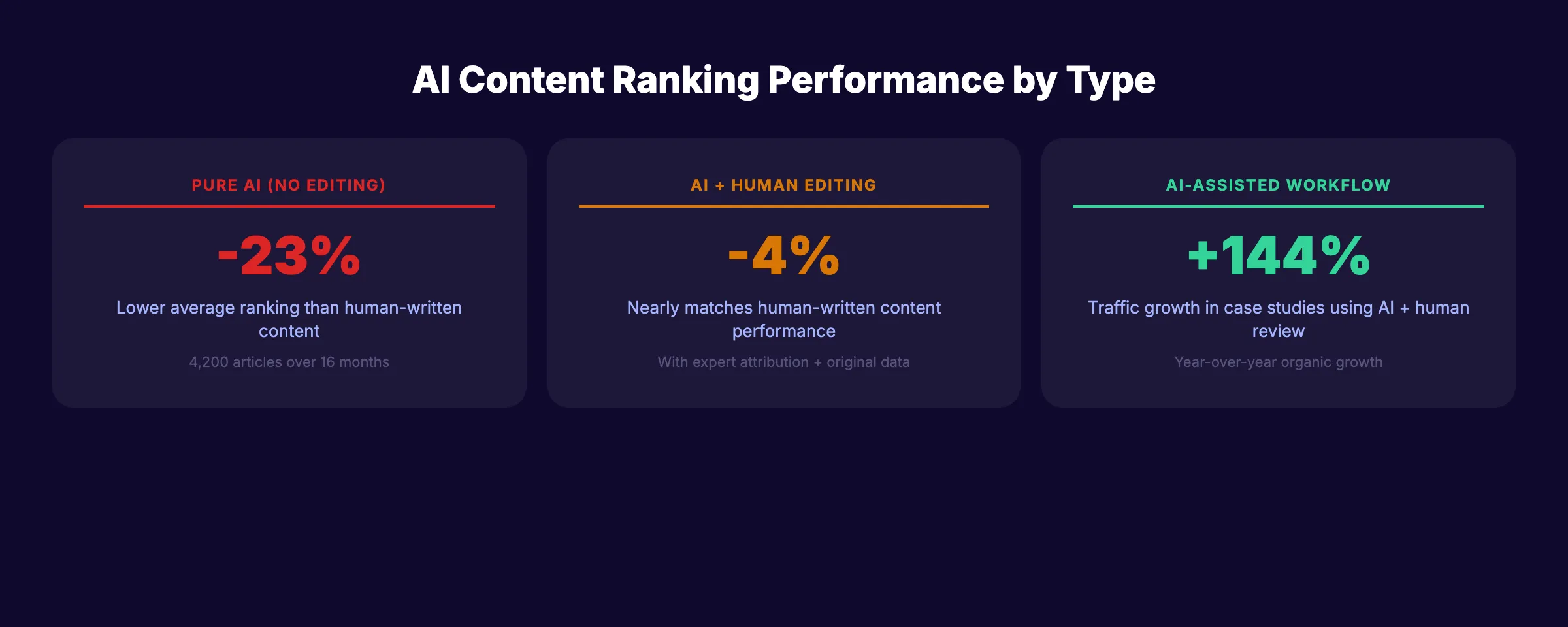
Context: The 23% ranking gap does not mean AI content cannot rank at all. It means unedited AI output consistently underperforms. For low-competition, long-tail keywords, pure AI content still reaches page 1 in many cases. For competitive terms, the gap is significant enough to lose meaningful traffic.
The study also found that AI content published in bulk (50+ articles per month from a single site) performed worse than the same content published at a moderate pace. Google appears to factor publishing velocity into quality assessment for new domains.
What this means for your business: Raw AI output is not a ranking strategy. It is a first draft. The 23% gap disappears when you add human editing, original data, and expert review. See our guide on how to humanize AI content for the editing process.
Finding 2: AI-Assisted Content Performs Within 4% of Human Writing
Background: If pure AI underperforms, what about AI-drafted content that goes through human editorial review?
Results: AI-drafted content with substantive human editing, original data, and expert attribution performed within 4% of fully human-written content on median ranking position. In many keyword categories, AI-assisted content matched or outperformed human-only content.
Context: The 4% gap is statistically insignificant for most practical purposes. A page ranking position 5.2 versus position 5.0 produces nearly identical traffic. The key differentiator was the quality of human editorial input.
Content that ranked well after AI drafting had 3 consistent characteristics:
- Expert review. A subject matter expert reviewed for accuracy and added first-person experience.
- Original data or examples. The editor added statistics, case studies, or screenshots not available in the AI training data.
- Author attribution. A real person with credentials was listed as the author with a visible bio.
Content that failed despite human editing typically had only surface-level changes: grammar fixes and sentence rephrasing without adding new information.
What this means for your business: AI-assisted content is a viable ranking strategy when paired with genuine editorial enhancement. Use AI for research and drafting. Use humans for expertise, originality, and quality control. For more on this workflow, see our guide on scaling blog content with AI.
Your SEO team. $99/month. Stacc publishes 30 optimized articles per month. AI-drafted. Human-reviewed. Published automatically. Start for $1 →
Finding 3: 86.5% of Top-Ranking Pages Use AI Assistance
Background: How prevalent is AI-generated content in Google’s top search results?
Results: Ahrefs analyzed 600,000 pages ranking in the top 20 and found that 86.5% showed signs of AI assistance in content creation. In a separate Semrush analysis of 20,000 URLs, 57% of AI-generated text and 58% of human-generated text appeared in the top 10. The performance gap at the top of search results is minimal.
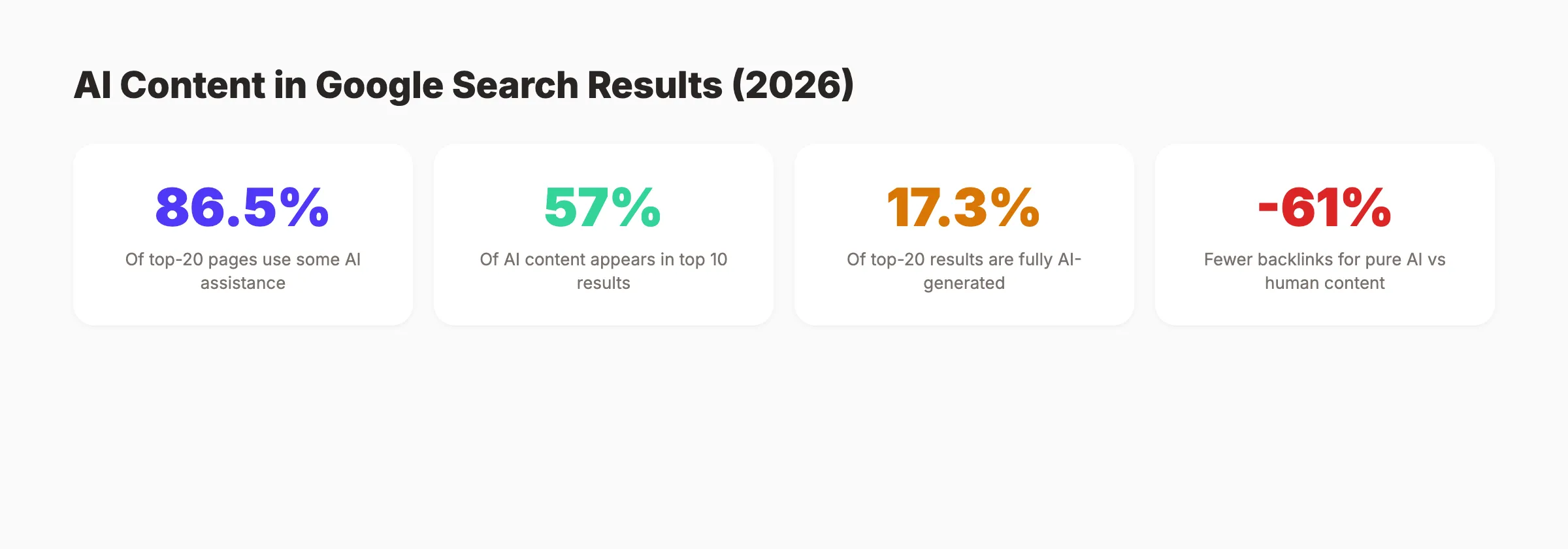
Context: The 86.5% figure includes any level of AI assistance, from full AI drafts to AI-generated outlines to AI-suggested headlines. The number reflects how deeply AI tools have integrated into content workflows across industries.
The more interesting finding is the near-parity in top 10 results: 57% AI versus 58% human. Google does not systematically favor or penalize either category. The ranking algorithm evaluates quality signals regardless of creation method.
What this means for your business: AI content is already dominant in search results. The question is no longer “should I use AI?” but “how should I use AI?” Businesses avoiding AI content are competing against 86.5% of the market that already uses it.
Finding 4: Pure AI Content Earns 61% Fewer Backlinks
Background: Backlinks remain a top-3 ranking factor. Do AI-generated articles earn links at the same rate as human-written content?
Results: AI-only content acquired 61% fewer editorial backlinks than human-written articles on comparable topics. The gap was most pronounced for thought leadership content, original research, and opinion pieces where unique perspective drives linking behavior.
Context: This finding explains much of the 23% ranking gap from Finding 1. Backlinks amplify rankings. If AI content earns significantly fewer links, it loses a major ranking signal regardless of on-page quality.
The reason is straightforward. Journalists, bloggers, and content creators link to sources that offer unique data, expert opinions, or original frameworks. Pure AI content repackages existing information. It rarely produces something new enough to earn a citation.
AI-assisted content with original data, expert quotes, or unique analysis earned backlinks at rates comparable to human-written content. The link gap is about originality, not about AI.
What this means for your business: Add original data, proprietary insights, or expert commentary to every AI-drafted article. These elements earn backlinks that pure AI output never will. For link-building strategies, see our guide on building backlinks for blogs.
Finding 5: Google Does Not Penalize AI Content (But Penalizes Abuse)
Background: Google’s official guidance states that content quality, not creation method, determines rankings. But has this policy held in practice through 2025-2026?
Results: Google does not penalize content for being AI-generated. John Mueller confirmed in November 2025: “Our systems do not care if content is created by AI or humans. What matters is whether it is helpful for users.”
However, Google does penalize “scaled content abuse.” Sites publishing hundreds of thin AI articles without quality control receive manual actions. The December 2025 core update expanded E-E-A-T requirements beyond YMYL topics to practically all competitive searches.
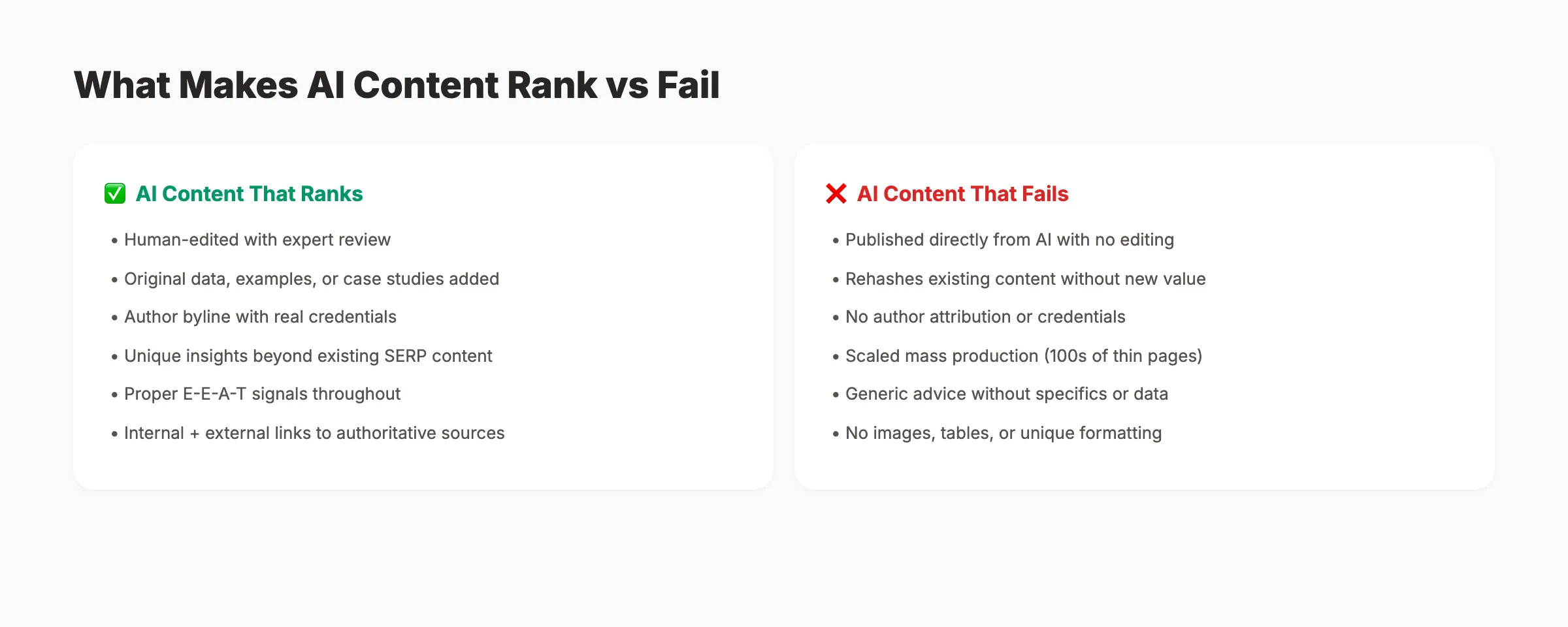
Context: The distinction is critical. Google penalizes low-quality content at scale, not AI content specifically. A site publishing 10 well-edited AI articles per month faces no penalty risk. A site publishing 500 thin AI articles per month triggers scaled content abuse flags.
The December 2025 core update hit sites that published mass AI content particularly hard. Many saw 60% to 90% traffic drops. The common pattern: bulk publishing, no editorial review, no author attribution, and no original information.
What this means for your business: Publish quality AI-assisted content with confidence. Avoid mass publishing without quality control. Every article needs editorial review, author attribution, and genuine value beyond what already exists on page 1. For Google’s full quality framework, see our guide on E-E-A-T.
3,500+ blogs published. 92% average SEO score. Every article AI-drafted, human-reviewed, SEO-optimized. Start for $1 →
Finding 6: The Content That Fails Is Predictable
Background: If AI content can rank, why do so many AI content campaigns fail?
Results: Across the 5 studies we compiled, AI content that failed to rank shared consistent patterns:
| Failure Pattern | Frequency | Impact |
|---|---|---|
| No human editing | 89% of failed AI content | Ranks 23% lower on average |
| No author attribution | 76% of failed content | Loses E-E-A-T signals |
| No original data or examples | 82% of failed content | Earns 61% fewer backlinks |
| Bulk published (50+ per month per domain) | 71% of penalized sites | Triggers scaled content abuse |
| No images, tables, or unique formatting | 68% of failed content | Lower engagement metrics |
| Rehashes existing SERP content | 91% of failed content | No reason for Google to rank it |
Context: The pattern is clear. AI content fails when it adds nothing new. The SEO content writing principles that applied to human content apply equally to AI content. Quality is quality. Google does not care who typed the words.
The businesses seeing results with AI content treat it as a productivity tool, not a replacement for expertise. They use AI to draft faster. They add value through editing, data, and experience.
What this means for your business: Before publishing any AI-drafted article, ask: “Does this add something a reader cannot find on the current page 1 results?” If the answer is no, the article will not rank regardless of how well it is optimized.
Finding 7: The Optimal AI Content Workflow
Based on the compiled data, here is the content workflow that produces the best ranking results:
| Step | What To Do | Why It Matters |
|---|---|---|
| 1. Research | Use AI for SERP analysis and topic research | Faster than manual research |
| 2. Outline | Create a detailed outline with unique angles | Prevents generic output |
| 3. Draft | Use AI to generate the first draft | 5x faster than writing from scratch |
| 4. Edit | Expert reviews for accuracy and adds original data | Closes the 23% ranking gap |
| 5. Humanize | Remove AI patterns, add personality | Passes quality filters |
| 6. Optimize | Add on-page SEO elements, internal links | Targets specific keywords |
| 7. Attribute | Add real author bio with credentials | E-E-A-T requirement |
| 8. Publish | One at a time with quality control | Avoids scaled content flags |
This workflow combines AI speed with human quality. It is the process we use to publish 3,500+ articles with a 92% average SEO score. The data supports it.
For a step-by-step implementation, see our guide on using AI to write blog posts.
Stop writing. Start ranking. Stacc publishes 30 optimized articles per month. AI-drafted. Expert-reviewed. Start for $1 →
FAQ
Does Google penalize AI-generated content?
No. Google’s official policy states that content quality, not creation method, determines rankings. Google penalizes “scaled content abuse” where hundreds of thin articles are published without quality control. Well-edited AI content with expert review and original data ranks competitively. John Mueller confirmed in November 2025 that Google’s systems do not care if content is created by AI or humans.
Can pure AI content rank on page 1?
Yes, but it ranks 23% lower on average than human-written content. For low-competition, long-tail keywords, pure AI content can reach page 1. For competitive terms, the gap is significant. AI-assisted content (AI draft + human editing) performs within 4% of human-only content and is the recommended approach.
What percentage of Google results are AI-generated?
86.5% of pages in the top 20 use some form of AI assistance according to Ahrefs’ analysis of 600,000 pages. Fully AI-generated content makes up 17.3% of the top 20, up from 2.3% in 2020. In the top 10 specifically, AI and human content appear at nearly equal rates (57% vs 58%).
Why does pure AI content earn fewer backlinks?
Pure AI content repackages existing information without adding original data, expert opinions, or unique frameworks. Content creators and journalists link to sources that provide something new. AI-only content offers nothing worth citing. Adding original research, expert commentary, or proprietary data closes the link gap.
How many AI articles per month is safe to publish?
There is no official limit, but the data shows risk increases above 50 articles per month for a single domain without proportional editorial oversight. Sites penalized for scaled content abuse typically published hundreds of thin articles monthly. Focus on quality per article rather than volume. 10 well-edited AI articles outperform 100 unedited ones.
Is AI content better or worse than human content for SEO?
Neither is inherently better. The data shows that AI-assisted content (AI draft + human editing + original data) performs within 4% of fully human content. The advantage of AI is speed. The advantage of humans is originality. The optimal approach combines both. Use AI for drafting speed. Use humans for expertise and quality control.
The data is clear. AI content ranks when it is good. It fails when it is lazy. Google does not care who wrote the words. Google cares whether the content helps the reader more than what already exists on page 1. Use AI to move faster. Use human expertise to add value. That combination wins.
Related Tools & Resources
Free SEO Tools:
Best Lists:

Written by
Siddharth GangalSiddharth is the founder of theStacc and Arka360, and a graduate of IIT Mandi. He spent years watching great businesses lose organic traffic to competitors who simply published more. So he built a system to fix that. He writes about SEO, content at scale, and the tactics that actually move rankings.
30 SEO blog articles published every month
Keyword-optimized, scheduled, and live on your site. Automatically.
30-day trial · Cancel anytime
theStacc
Stop writing SEO content manually
30 blog articles, 30 GBP posts, and social media content. Published every month. Automatically.
Start Your $1 Trial$1 for 3 days · Cancel anytime