Increase organic traffic with 12 proven strategies. Covers keyword research, content clusters, technical SEO, and link building. Updated March 2026.
Organic search drives 53% of all website traffic. It is the largest single traffic channel for most businesses. Yet 96.55% of all web pages get zero organic traffic from Google. The gap between sites that grow organically and sites that stagnate comes down to 12 specific strategies.
Most businesses try to increase organic traffic by publishing more content. Volume alone does not work. Companies publishing 30 random blog posts per month can still see zero growth if those posts target the wrong keywords, miss search intent, or lack internal links.
The strategies that actually move organic traffic numbers are systematic. They compound over time. And they work regardless of industry, business size, or starting point.
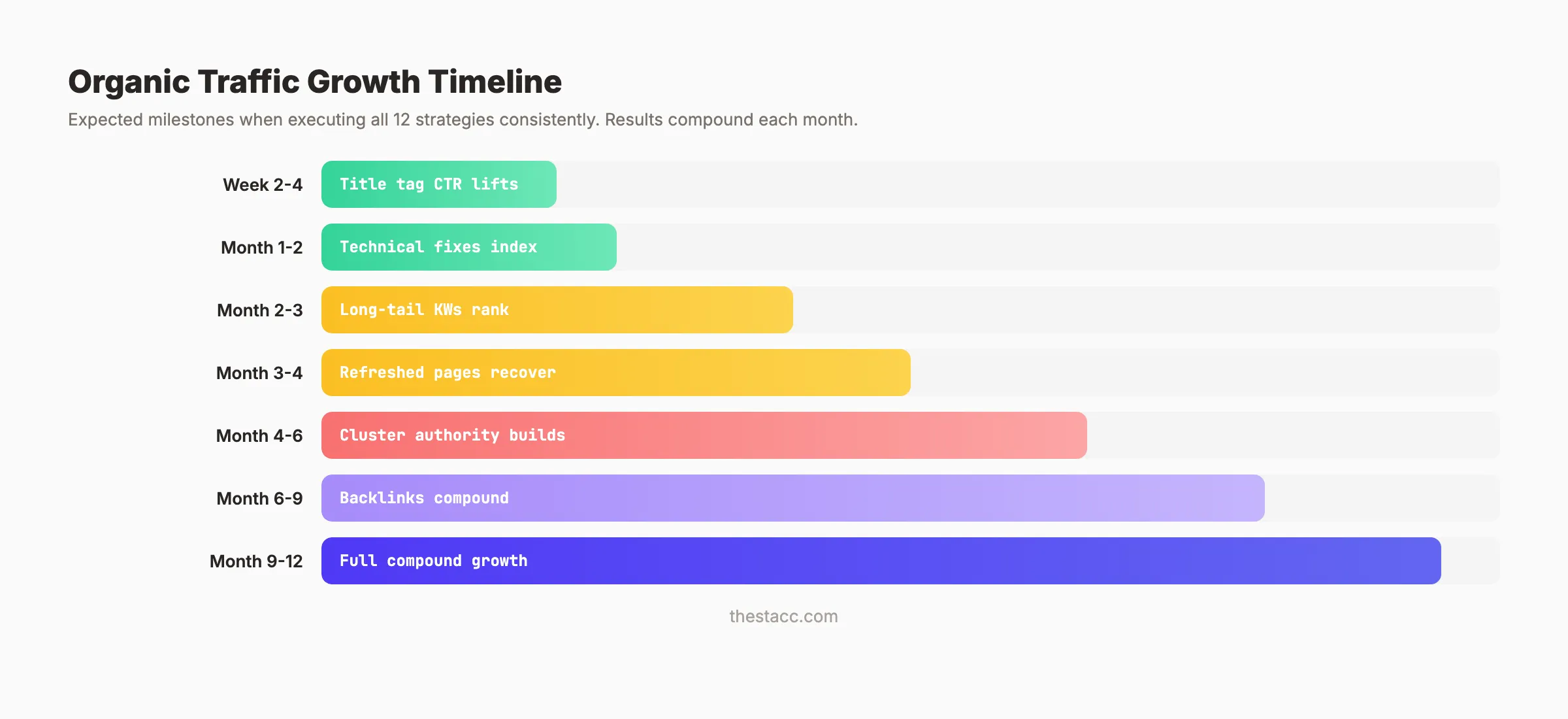
We have published 3,500+ blog posts across 70+ industries. The 12 strategies in this guide are the ones that consistently produce measurable traffic growth within 3 to 6 months.
Here is what you will learn:
- The 12 strategies that drive organic traffic growth in 2026
- Which strategies deliver results fastest and which compound over time
- How to prioritize efforts based on your site's current performance
- Common mistakes that prevent traffic growth despite strong content
- How to measure and track organic traffic improvements
Why Organic Traffic Matters More Than Ever
Organic traffic is free after the content is published. Paid ads stop the moment the budget runs out. Social media reach declines every year as platforms throttle organic distribution. Email requires a list you already built.
Organic search is the only channel that compounds. A blog post published today can generate traffic for years. Each new page builds authority that lifts every other page on your site.
The Numbers Behind Organic Traffic
- Organic search generates 53% of all website traffic across industries.
- The number 1 result on Google gets 39.8% of all clicks. Position 5 gets about 5%.
- Companies publishing 16+ blog posts per month get 3.5 times more traffic than those publishing 0 to 4.
- Organic search generates 44.6% of all B2B revenue.
The 2026 Challenge
Organic traffic faces headwinds. Zero-click searches now account for 60% of queries. AI Overviews appear on 30% of searches and reduce click-through rates by up to 58% when they do. AI referral traffic is growing 165 times faster than organic, but still accounts for just 1.08% of total web traffic.
The businesses growing organic traffic in 2026 are not ignoring these trends. They are adapting. The strategies below account for AI search, zero-click behavior, and the shift toward topical authority.
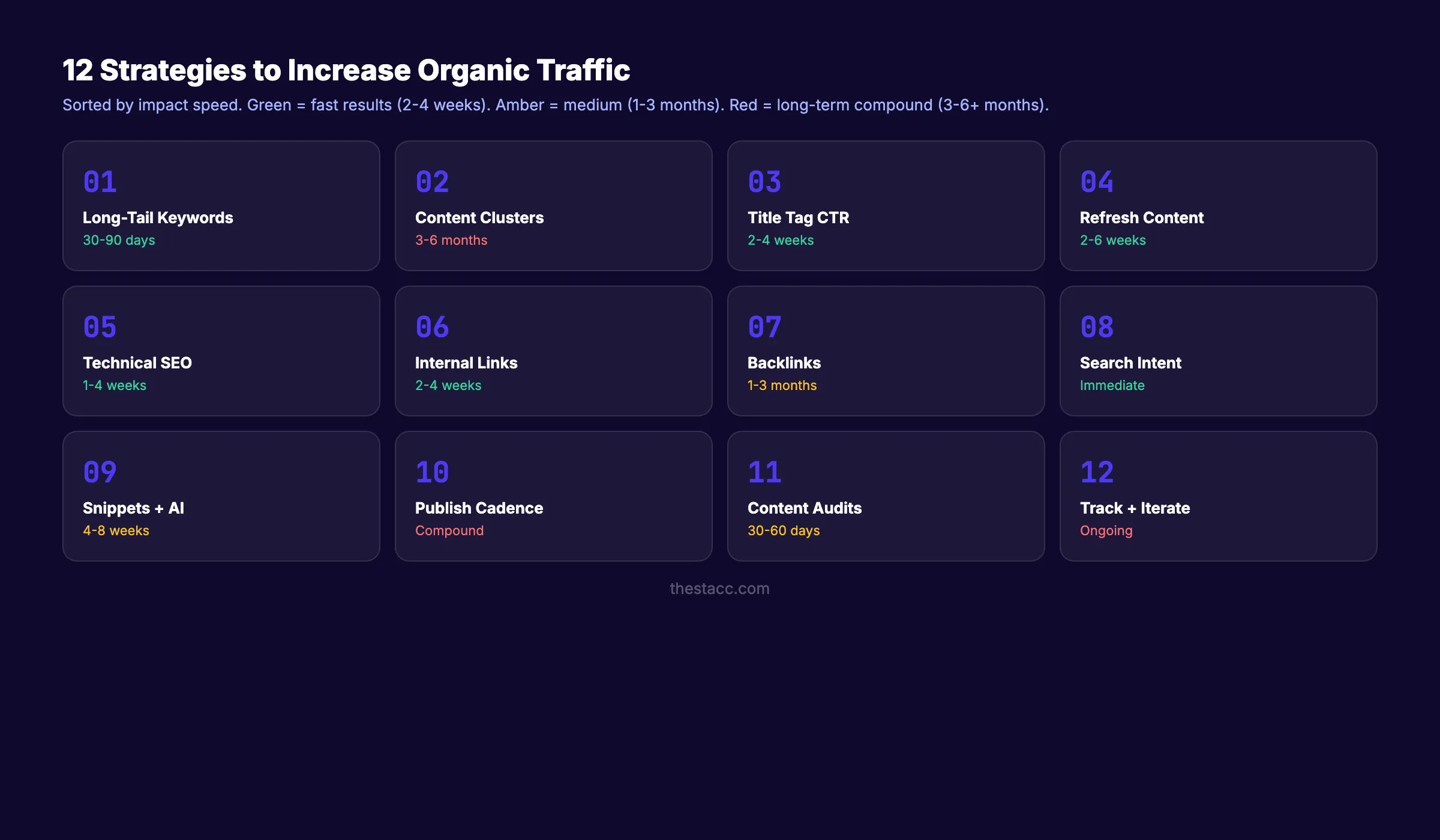
Strategy 1: Target Long-Tail Keywords with Low Competition
The fastest path to organic traffic growth is targeting keywords your site can actually rank for. That means long-tail keywords with moderate search volume and low difficulty.
Long-tail keywords (3+ words) account for 70% of all search traffic. They convert at 36% on average. Short, generic keywords like "marketing" or "SEO" are dominated by sites with massive authority. Long-tail variations like "how to do keyword research for blog posts" are accessible to newer sites.
How to find low-competition long-tail keywords:
- Enter your core topic into Ahrefs, Semrush, or Ubersuggest.
- Filter by keyword difficulty under 30 and volume between 100 and 5,000.
- Check Google autocomplete for natural phrase variations.
- Look at People Also Ask boxes for question-based keywords.
Read our full guide on keyword research for blog posts for the complete 7-step process.
Example of long-tail keyword targeting:
| Broad Keyword (Hard) | Long-Tail Variation (Accessible) | Monthly Volume | KD |
|---|---|---|---|
| SEO | how to do SEO for a new website | 2,400 | 18 |
| content marketing | content marketing strategy for small business | 1,200 | 22 |
| backlinks | how to build backlinks for a new blog | 900 | 15 |
| local SEO | local SEO checklist for small business | 1,600 | 20 |
Start with 10 to 15 long-tail keywords. Write one post per keyword. Track rankings weekly in Google Search Console. The first page-1 ranking usually arrives within 60 days for keywords under KD 20.
Impact timeline: 30 to 90 days for low-KD keywords to reach page 1.
Strategy 2: Build Content Clusters Around Pillar Pages
Isolated blog posts on random topics do not build authority. Content clusters do.
A content cluster is a group of 8 to 15 related blog posts organized around a central pillar page. The pillar covers the broad topic. Cluster pages cover subtopics in depth. Internal links connect everything.
Sites with topic clusters drive 30 to 43% more organic traffic than sites with unconnected content.
How to build a cluster:
- Choose a broad topic your business is an authority on.
- Map 8 to 15 subtopics, each targeting a unique keyword.
- Write the pillar page (3,000 to 5,000 words covering every subtopic at a high level).
- Write cluster pages (1,500 to 3,500 words each on specific subtopics).
- Link every cluster page to the pillar. Link the pillar to every cluster page.
Read our guide on building topical authority for the complete cluster strategy.
Impact timeline: 3 to 6 months for the cluster compounding effect to become visible.
Stop publishing random blog posts. theStacc plans content clusters, writes 30 optimized articles per month, and handles all internal linking automatically.
Strategy 3: Optimize Title Tags and Meta Descriptions for CTR
Ranking on page 1 means nothing if nobody clicks. Title tags and meta descriptions are the first (and often only) thing searchers see. Optimizing them for click-through rate can increase traffic without changing your ranking position.
Pages in positions 3 to 10 with optimized titles outperform pages in positions 1 to 2 with generic titles.
Title tag optimization:
- Front-load the primary keyword (first 3 to 5 words).
- Keep under 60 characters to avoid truncation.
- Include a power word (proven, complete, essential) or number.
- Make the title clearly different from competing results.
Meta description optimization:
- 145 to 155 characters.
- Include the primary keyword naturally.
- State a clear benefit or outcome.
- Add a freshness signal (year, "updated").
Read our guide on writing blog headlines that get clicks for 15 proven title formulas.
Impact timeline: 2 to 4 weeks. Title and meta changes reflect in search results quickly.
Strategy 4: Update and Refresh Existing Content
New content is not always the answer. Refreshing existing content that has started to decline in rankings is faster and more effective than writing new posts from scratch.
A 30-minute content refresh can recover lost rankings that took 6 months to build. Google rewards freshness. Updated content with new data and expanded sections often outperforms the original version.
What to refresh:
- Posts that dropped from page 1 to page 2 (check Google Search Console).
- Posts with declining traffic over the past 3 to 6 months.
- Posts with outdated statistics, recommendations, or dates.
- Posts that competitors now cover in more depth.
How to refresh:
- Add new statistics and data from the current year.
- Expand thin sections that competitors have surpassed.
- Remove outdated information.
- Add new internal links to recently published content.
- Update the title tag and meta description.
- Republish with the current date.
Read our full guide on updating old blog posts for the step-by-step refresh process.
Impact timeline: 2 to 6 weeks for re-indexing and ranking recovery.
Strategy 5: Fix Technical SEO Issues
Technical SEO creates the foundation. If Google cannot crawl and index your pages, no amount of content will generate traffic.
Priority technical fixes:
| Issue | Impact | How to Find It |
|---|---|---|
| Crawl errors (4xx, 5xx) | Pages not indexed | Google Search Console > Pages |
| Slow page speed | Higher bounce rate, lower rankings | PageSpeed Insights |
| Mobile usability issues | Reduced mobile rankings | GSC > Mobile Usability |
Missing or broken sitemap.xml | Slow indexing of new content | Manual check at /sitemap.xml |
| Duplicate content | Keyword cannibalization | Screaming Frog or site audit tool |
| Broken internal links | Lost link equity | SEO Audit tool |
Core Web Vitals (LCP, INP, CLS) are confirmed ranking factors. Sites that pass all 3 thresholds rank higher than sites that fail them.
Read our guide on improving Core Web Vitals for the full technical optimization process.
Impact timeline: 1 to 4 weeks after fixing issues. Google re-crawls and re-evaluates quickly.
Your SEO team. $99 per month. 30 optimized articles published automatically with keyword research, internal linking, and on-page SEO built in.
Strategy 6: Build Strategic Internal Links
Internal links distribute page authority across your site. They help Google discover new pages. They keep readers engaged longer. Sites with strong internal linking rank faster for new content.
Internal linking rules:
- 3 to 5 internal links per 1,000 words.
- Use descriptive anchor text (not "click here").
- Link to topically related pages.
- Distribute links across sections. Do not cluster in one paragraph.
- Update old posts to link to new content (most teams skip this step).
Read our guide on internal linking for blog posts for the full strategy.
Impact timeline: 2 to 4 weeks. Internal link changes propagate as Google re-crawls linked pages.
Strategy 7: Earn Backlinks Through Link-Worthy Content
Backlinks remain one of the top 3 ranking factors. The number 1 result on Google has 3.8 times more backlinks than results in positions 2 through 10.
Not all content earns links. The content types that attract the most backlinks are:
- Data studies and original research. Sites link to your data as a source.
- Ultimate guides and definitive resources. Other writers reference your guide.
- Free tools and calculators. Utility content earns links naturally.
- Infographics and visual data. Easy to embed and credit.
Practical link building actions:
- Publish original data or research in your niche.
- Create a free tool related to your industry. See our free SEO tools for examples.
- Write guest posts on industry blogs with a link back to your pillar content.
- Fix broken links on other sites by offering your content as a replacement.
Read our guide on building backlinks for your blog for 10+ link building tactics.
Impact timeline: 1 to 3 months. Backlinks take time to accrue authority.
Strategy 8: Match Content Format to Search Intent
Google ranks pages that match search intent. Write the wrong format for the intent and your page will not rank, regardless of word count or backlinks.
The 4 types of search intent:
| Intent | Signal | Best Format |
|---|---|---|
| Informational | "what is," "how to," "guide" | Blog post, guide, tutorial |
| Commercial | "best," "review," "vs" | Listicle, comparison, review |
| Transactional | "buy," "pricing," "sign up" | Product page, pricing page |
| Navigational | Brand name, "login" | Homepage, specific page |
How to verify intent: Search the keyword. Look at the top 3 results. Match their format.
The most common intent mismatch: writing a 5,000-word guide for a keyword where Google ranks 500-word definitions. Or writing a product page for a keyword where Google ranks blog posts.
Common intent mismatches and fixes:
| Keyword | Wrong Format | Right Format | Fix |
|---|---|---|---|
| "best CRM software" | Product page | Listicle with rankings | Rewrite as a comparison list |
| "what is SEO" | 3,000-word guide | 800-word definition | Shorten to a focused definition post |
| "CRM pricing" | Blog post | Pricing table | Create a pricing comparison page |
| "how to write a proposal" | Infographic | Step-by-step guide | Rewrite as a tutorial with steps |
Always verify intent before writing. 5 minutes of SERP analysis prevents months of wasted effort on content that never ranks.
Impact timeline: Immediate improvement in rankings after correcting format mismatches.
Strategy 9: Optimize for Featured Snippets and AI Overviews
Featured snippets appear above position 1. AI Overviews appear at the top of 30% of queries. Winning these positions drives traffic even as zero-click searches grow.
How to win featured snippets:
- Answer the query directly in 40 to 60 words at the top of the relevant section.
- Use the exact question as an H2 or H3 heading.
- Format answers as paragraphs (for definition queries), lists (for step queries), or tables (for comparison queries).
How to get cited in AI Overviews:
- Structure content with clear headers and short paragraphs.
- Include specific data points with sources.
- Demonstrate E-E-A-T signals (author credentials, firsthand experience, citations).
- Build topical authority through content clusters.
Read our guide on optimizing for Google AI Overviews and getting cited in AI search for the full optimization process.
Impact timeline: 4 to 8 weeks for snippet acquisition after optimization.
3,500+ blogs published. Every article is SEO-scored before publish. theStacc handles content strategy, keyword research, writing, and publishing. You get the traffic.
Strategy 10: Publish Consistently (Frequency Matters)
Publishing frequency correlates directly with organic traffic growth. Companies publishing 16+ posts per month see 3.5 times more traffic than those publishing 0 to 4. The correlation holds across industries and business sizes.
Consistency matters more than volume. 4 posts per week, every week, outperforms 30 posts in January and nothing for the next 3 months.
Recommended publishing cadence by business size:
| Business Size | Monthly Posts | Expected Timeline to Growth |
|---|---|---|
| Solo / startup | 4 to 8 | 6 to 12 months |
| Small team | 8 to 16 | 3 to 6 months |
| Growth-stage | 16 to 30 | 2 to 4 months |
| Enterprise | 30+ | 1 to 3 months |
Build a content calendar to maintain cadence. Plan topics 4 to 8 weeks ahead so you never scramble for ideas.
Impact timeline: Traffic compounds with each month of consistent publishing.
Strategy 11: Run Quarterly Content Audits
A content audit identifies underperforming pages that drag down your site's average quality. It also surfaces opportunities to consolidate, redirect, or update content for maximum impact.
What to audit every 90 days:
- Pages with zero organic traffic (consider consolidating or removing).
- Pages ranking on page 2 (push to page 1 with updates and internal links).
- Pages with high impressions but low CTR (improve titles and descriptions).
- Duplicate or near-duplicate content (consolidate into one strong page).
- Pages with outdated information (refresh with current data).
Read our guide on how to do a content audit for the full process.
Impact timeline: 30 to 60 days after implementing audit recommendations.
Strategy 12: Track, Measure, and Iterate
Organic traffic growth requires measurement. Without data, you cannot identify what works, what fails, or where to invest next.
Tools to track organic traffic:
| Tool | What It Shows | Cost |
|---|---|---|
| Google Search Console | Rankings, impressions, CTR, indexing | Free |
| Google Analytics 4 | Traffic, engagement, conversions | Free |
| Ahrefs / Semrush | Keyword tracking, competitor analysis, backlinks | $99-139/mo |
| SEO Audit tool | Technical issues, on-page score | Free |
Key metrics to track monthly:
- Organic sessions: Total visits from organic search.
- Keyword rankings: Number of page-1 rankings. Target: growing each month.
- Organic CTR: Average click-through rate from search results.
- Pages indexed: Total pages Google has in its index.
- Backlink growth: New referring domains each month.
Read our Google Search Console guide for setting up and reading your organic performance data.
Impact timeline: Ongoing. Measurement enables all other strategies.
What practitioners are saying on X
AI search advice ages quickly. Here is high-signal public discussion from SEO and growth operators — context for your roadmap, not a substitute for primary data.
- @hridoyreh (Mar 2026): Widely shared SEO skill tree: foundations, research, technical, on-page, content, links, AI SEO/GEO, analytics, UX, brand, programmatic — useful map for stats and how-to posts. See the post on X.
- @jakezward (Feb 2026): 2026 SEO predictions emphasize AI Overview share-of-SERP, schema for LLM token efficiency, brand mentions in AI answers as a KPI, proprietary data as a moat, and content refresh beating net-new AI slop. See the post on X.
Grok, AI Overviews, and multi-engine visibility
For “increase organic traffic”, multi-engine visibility still starts with clear definitions, sourced numbers, and extractable section answers. Grok additionally factors live X discussion — keep public claims consistent with this page.
- Google AI Overviews: Use passage-ready answers, tables, and FAQ schema where relevant.
- ChatGPT / Perplexity: Cite named sources next to key claims.
- Grok: Maintain accurate entity facts on-site and in high-signal X posts.
Publish content built for Google and AI citations. theStacc’s Content SEO module ships SEO-scored articles structured for rankings and generative engines — including clearer entity pages models like Grok can quote.
FAQ
Low-competition keywords can rank within 30 to 60 days. Medium-competition keywords take 3 to 6 months. Building significant organic traffic (10,000+ monthly visits) from a new site typically takes 6 to 12 months of consistent publishing. The compounding effect means growth accelerates over time.
Companies publishing 16+ posts per month see 3.5 times more traffic than those publishing 0 to 4. Start with 4 posts per month minimum. Each post should target a specific keyword and be part of a content cluster. Volume without strategy does not produce results.
Common causes include Google algorithm updates, technical SEO issues (crawl errors, slow speed), content decay (outdated information), lost backlinks, increased competition, and the rise of zero-click searches. Check Google Search Console for specific page-level drops and correlate with update timelines.
Social media does not directly affect Google rankings. Social shares do not count as backlinks. But social media drives referral traffic, increases brand awareness, and can lead to natural backlinks when people discover and reference your content. Repurposing blog content for social media amplifies your reach without creating new content.
10 to 20% month-over-month growth is strong for sites in the first 12 months. Established sites targeting 5 to 10% monthly growth are on track. Any consistent growth is better than stagnation. Measure growth against your own baseline, not competitors.
Yes. theStacc publishes 30 SEO-optimized blog posts per month with keyword research, content clusters, internal linking, and on-page optimization. Every article targets a specific keyword and follows the strategies outlined in this guide. Traffic typically starts growing within 60 to 90 days of consistent publishing.
Organic traffic does not grow by accident. It grows through systematic execution of these 12 strategies, applied consistently over months. Start with the strategies that match your current gaps. Fix technical issues first. Then build content clusters. Then optimize for clicks and AI visibility. The compound effect does the rest.
Sources & references
- [1] Princeton / Georgia Tech et al. — GEO research (arXiv:2311.09735)
- [2] @hridoyreh on X — Widely shared SEO skill tree: foundations, research, technical, on-page, content, links, AI SEO/GEO, analytics, UX, bran
- [3] @jakezward on X — 2026 SEO predictions emphasize AI Overview share-of-SERP, schema for LLM token efficiency, brand mentions in AI answers
- [4] Referenced source — backlinko.com

Plan topics, review article drafts, and publish to a connected CMS.
Weekly local SEO teardowns
One practical email a week. Map Pack, GBP, AI Overviews — no fluff. Unsubscribe anytime.
Explore this topic: Organic Traffic.