
Music School SEO: Get More Students From Google
Music school SEO guide covering local rankings, GBP optimization, instrument-specific keywords, and content strategy. Enroll more students from Google. Updated 2026.
Siddharth Gangal • 2026-04-02 • Local SEO
In This Article
A parent searches “piano lessons near me” on a Tuesday evening. Google shows 3 music schools in the local map pack. The school with 120 reviews and a 4.9 rating gets the inquiry. The school on page 2 never enters the conversation.
Music school SEO determines which studio fills its roster and which one struggles with empty lesson slots. The U.S. private music instruction industry generates $724.8 million annually, and 82% of parents say they want their child to learn an instrument. The demand is there. The question is whether your school shows up when parents search.
The problem is familiar. Most music schools rely on word of mouth and recital flyers. Those channels produce students, but they do not scale. A single Google ranking for “guitar lessons [your city]” can generate 15 to 30 inquiries per month. That is a full class from one keyword.
We publish 3,500+ blog posts across 70+ industries. Music schools, tutoring centers, and education businesses are a growing vertical. This guide covers every SEO tactic a music school or private lesson studio needs to rank on Google.
Here is what you will learn:
- Why Google is the #1 source of new music students in 2026
- The exact keywords parents search when looking for music lessons
- How to optimize your Google Business Profile for the local map pack
- Content ideas that attract parents and adult learners
- Review generation tactics specific to music education
- Location page strategy for multi-branch schools
- Technical SEO basics for music school websites
- What music school SEO costs and what to expect
Why Google Is the #1 Source of New Music Students
Word of mouth still works for music schools. But it has a ceiling. A parent can only refer your school to friends who happen to mention they want music lessons. Google captures every parent actively searching for lessons right now.
How Parents Find Music Lessons
The search journey for a music school parent looks like this:
- Trigger: Child expresses interest in an instrument. Or a parent decides it is time.
- Search: “piano lessons near me” or “music school [city]”
- Compare: Read reviews. Check websites. Look at lesson offerings and pricing.
- Decide: Call or fill out a form at the school with the best online presence.
- Enroll: Start lessons. Tell other parents if the experience is good.
Every step after the trigger runs through Google. A music school with no Google presence loses at step 2.
The Cost of Relying on Referrals Alone
Referrals produce high-quality students. But they are unpredictable. You cannot control when a current family mentions your school to a friend. You cannot increase referral volume during slow enrollment months.
Google search is predictable. 78% of mobile local searches lead to an offline visit or call within 24 hours. Parents search for music lessons year-round, with spikes in August (back to school), January (New Year resolutions), and September (fall semester). A music school ranking for the right keywords captures this demand consistently.
Why Most Music Schools Are Invisible on Google
They have a 3-page website. A homepage, a “lessons” page, and a contact page. Google needs content to understand what your school offers, where you are located, and why parents should choose you. 3 pages do not compete with a school that has 40.
They list instruments but do not create pages for them. A parent searching “violin lessons [city]” does not land on a page that says “We offer piano, guitar, violin, drums, and voice.” They land on a page dedicated to violin lessons. Most music schools do not have instrument-specific pages.
They ignore Google Business Profile. A GBP listing with 8 reviews from 2023 and no photos tells Google the school is stagnant. Active profiles rank higher in the local map pack.
Your SEO team. $99 per month. 30 optimized articles published automatically for your music school. Start for $1 →
Music School Keyword Strategy
Keyword research for music schools splits into 3 categories: instrument-based, student-type, and location-based. Each captures a different searcher.
Instrument-Based Keywords (Highest Volume)
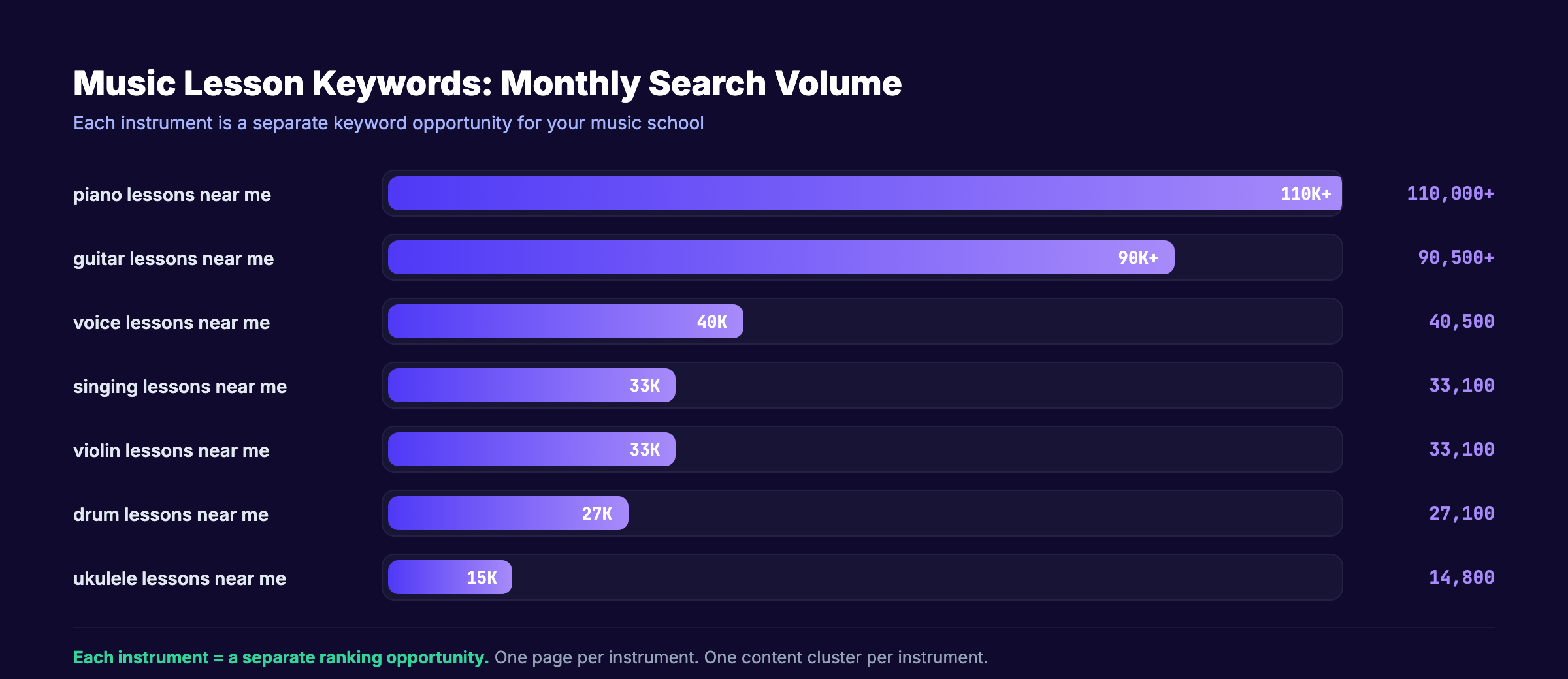
Every instrument you teach is a keyword category. Parents search by instrument, not by “music school.”
| Keyword | Monthly Volume (National) | Intent |
|---|---|---|
| piano lessons near me | 110,000+ | Ready to enroll |
| guitar lessons near me | 90,500+ | Ready to enroll |
| violin lessons near me | 33,100 | Ready to enroll |
| drum lessons near me | 27,100 | Ready to enroll |
| voice lessons near me | 40,500 | Ready to enroll |
| singing lessons near me | 33,100 | Ready to enroll |
| ukulele lessons near me | 14,800 | Ready to enroll |
Each instrument deserves its own dedicated page. A page targeting “piano lessons [city]” outranks a generic “music lessons” page for piano-related searches every time.
Student-Type Keywords
Different students search differently. Segment your content by audience.
| Keyword Pattern | Example | Target Audience |
|---|---|---|
| [instrument] lessons for kids | piano lessons for kids [city] | Parents of children 5-12 |
| [instrument] lessons for beginners | guitar lessons for beginners | Adult beginners |
| [instrument] lessons for adults | violin lessons for adults | Adult learners |
| [instrument] lessons for toddlers | music classes for toddlers | Parents of children 2-4 |
| [instrument] lessons for teens | drum lessons for teens | Parents of teenagers |
| online [instrument] lessons | online piano lessons | Remote learners |
Age-specific and skill-level content shows parents you understand their child’s needs. A parent searching “piano lessons for 5 year olds” wants to see a page about your early childhood music program, not a generic lesson page.
Location-Based Keywords
These capture parents searching in your specific area.
City-level: “music school [city],” “piano lessons [city],” “guitar teacher [city]”
Neighborhood-level: “music lessons [neighborhood],” “piano teacher near [landmark]”
Comparative: “best music school [city],” “top rated piano lessons [city]”
Build a content cluster for each instrument. One pillar page per instrument. Supporting blog posts about learning that instrument. Internal links connecting everything.
Google Business Profile Optimization for Music Schools
Your Google Business Profile controls whether you appear in the local map pack. For music schools, the map pack is where most parents start their search.
Complete Every Field
- Business name (exact legal name)
- Primary category: Music School
- Secondary categories: Music Instructor, Music Lesson, Performing Arts School, Piano Instructor
- Address (physical location)
- Business hours (include lesson hours, not just office hours)
- Phone number (local number preferred)
- Website URL
- Business description (750 characters, mention instruments, age groups, and location)
- Services list: each instrument as a separate service with pricing
- Attributes: Wheelchair accessible, free trial lesson, online lessons available
Photos That Attract Parents
Parents want to see where their child will learn. Listings with photos receive 42% more direction requests and 35% more website clicks.
Upload these photo types:
- Lesson rooms (clean, well-lit, instruments visible)
- Students at recitals (with parent permission)
- Teachers working with students one-on-one
- Group classes in action
- Building exterior (helps parents find you)
- Instruments and equipment
- Recital hall or performance space
Upload at least 10 photos. Add new photos after every recital and event. Google prioritizes profiles with recent activity.
Weekly GBP Posts
Post to your GBP weekly.
Post ideas for music schools:
- Upcoming recital announcements
- Student achievement spotlights (with permission)
- New instructor introductions
- Instrument tips (“3 ways to help your child practice piano”)
- Enrollment openings for specific instruments
- Seasonal promotions (back-to-school, summer camp)
Content Ideas That Attract Parents and Students
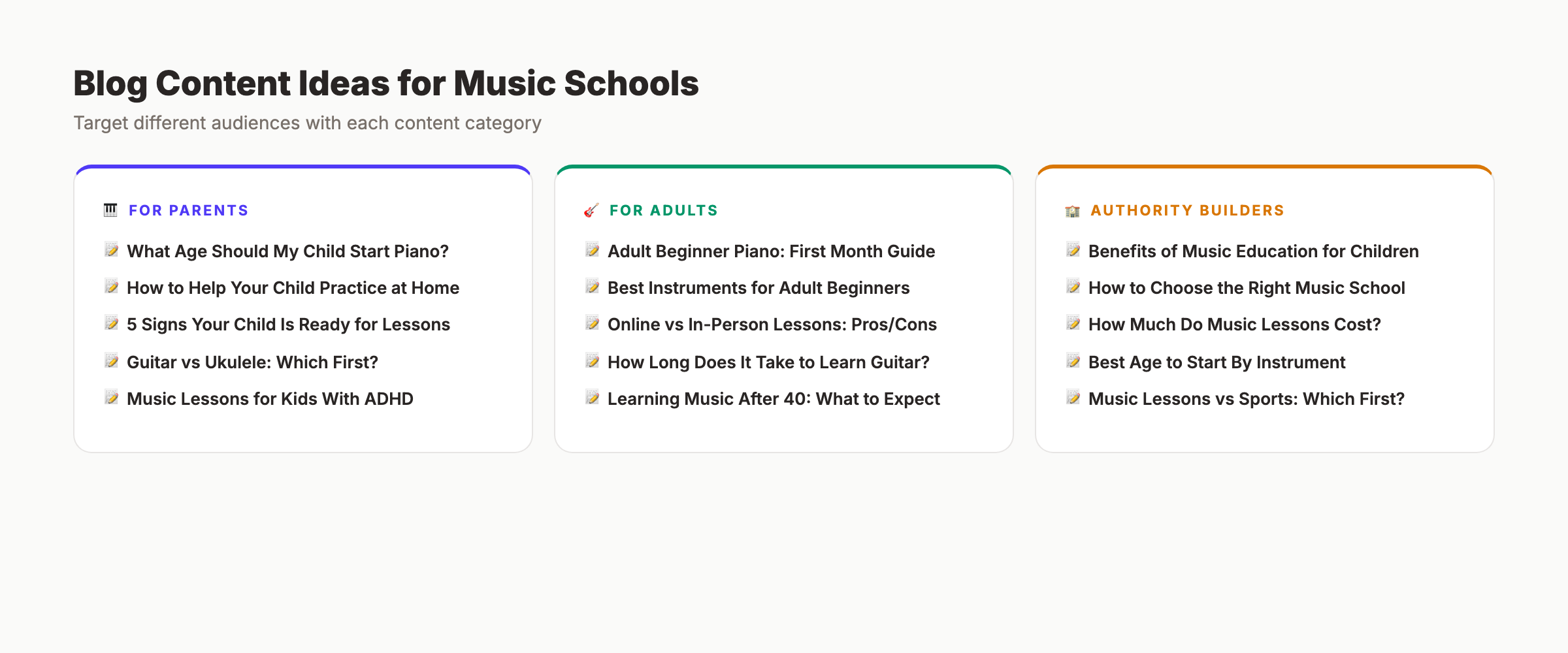
Blog content for a music school does 2 things: it builds topical authority with Google and it gives parents a reason to trust your school before they ever walk through the door.
Blog Post Ideas by Instrument
| Blog Post Title | Target Keyword | Why It Works |
|---|---|---|
| ”What Age Should My Child Start Piano Lessons?“ | when to start piano | Top parent question |
| ”Guitar vs Ukulele: Which Should Your Child Learn First?“ | guitar vs ukulele for kids | Comparison content |
| ”How to Help Your Child Practice Violin at Home” | violin practice tips | Ongoing parent concern |
| ”5 Signs Your Child Is Ready for Drum Lessons” | drum lessons for kids | Decision-stage content |
| ”Adult Beginner Piano: What to Expect in Your First Month” | adult piano lessons | Attracts adult learners |
| ”How Much Do Music Lessons Cost? (Complete Guide)“ | music lessons cost | Price-shopping parents |
Blog Post Ideas for Authority Building
| Blog Post Title | Target Keyword | Why It Works |
|---|---|---|
| ”Benefits of Music Education for Children” | benefits of music education | High volume, builds trust |
| ”How to Choose the Right Music School” | how to choose music school | Decision-stage parents |
| ”Online vs In-Person Music Lessons: Pros and Cons” | online vs in person music lessons | Captures remote searchers |
| ”Best Age to Start Music Lessons (By Instrument)“ | best age to start music | Evergreen, high volume |
| ”How Long Does It Take to Learn Piano?“ | how long to learn piano | Common parent question |
| ”Music Lessons for Kids With ADHD: What Parents Should Know” | music lessons ADHD kids | Niche, underserved audience |
Publishing Cadence
Publish consistently. 2 to 4 posts per month is a solid minimum for a music school. 20 to 30 posts per month with automated publishing accelerates results dramatically. Each post targets a different keyword and adds a new page for Google to index.
Rank everywhere. Do nothing. Blog SEO, Local SEO, and Social on autopilot for music schools. Start for $1 →
Review Strategy for Music Schools
Reviews are the #1 trust signal for parents choosing a music school. Parents are entrusting their child to your instructors. They read reviews more carefully than for almost any other local service.
What Parents Look for in Reviews
Parents scanning music school reviews look for specific signals:
- Teacher quality. Mentions of patient, encouraging, skilled instructors.
- Child experience. Did the child enjoy lessons? Did they make progress?
- Communication. Does the school communicate well with parents?
- Facilities. Is the school clean, safe, and well-equipped?
- Value. Do parents feel the cost is justified?
A review saying “My 7-year-old went from hating practice to begging for extra lessons” is worth more than 10 generic 5-star reviews.
How to Generate More Reviews
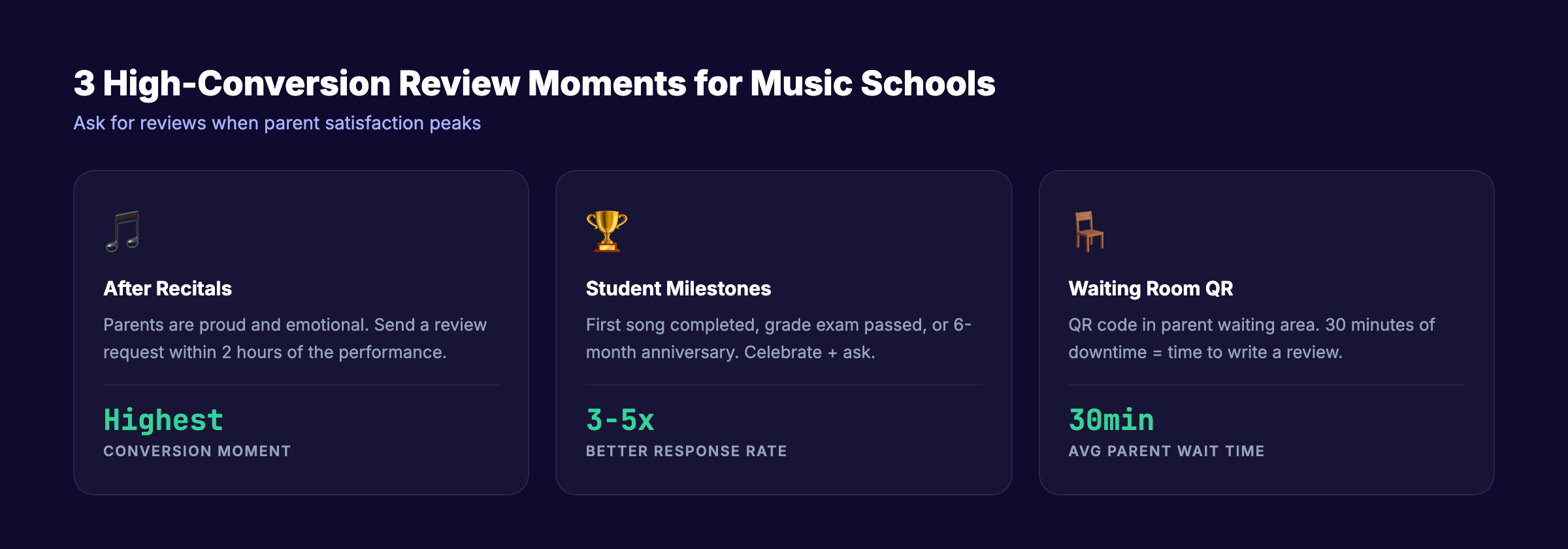
The recital moment. After a recital, parents are proud and emotional. Send a text or email within 2 hours: “We loved watching [Child’s Name] perform tonight! Would you share your experience on Google? [link].” This is the highest-conversion review moment.
The milestone text. When a student completes their first song, passes a grade exam, or hits a 6-month anniversary, text the parent: “We are so proud of [Child’s Name]‘s progress. If you have been happy with lessons, a Google review would mean a lot. [link].”
The waiting room QR code. Place a framed QR code in the parent waiting area. Parents sitting for 30 minutes during their child’s lesson have time to write a review. Use our Review QR Code Generator.
Respond to every review. 89% of consumers are more likely to choose a business that responds to reviews. Use our Review Response Generator for templates. Only 5% of businesses respond. This puts your school ahead of 95% of competitors.
3,500+ blogs published. 92% average SEO score. See what Stacc can do for your music school. Start for $1 →
Location Pages for Multi-Branch Music Schools
Music schools with 2 or more locations need a page for each branch. Each location page targets “[instrument] lessons [city/neighborhood]” and ranks independently.
What Each Location Page Needs
Unique content per location. Do not copy the same text and swap the city name. Mention the neighborhood, nearby landmarks, parking details, and which instructors teach at that location.
Instrument and schedule details. List every instrument taught at that specific location with available days and times.
Location-specific reviews. Embed or quote reviews from families at that branch.
Embedded Google Map. Help parents visualize the drive from their home.
Schema markup. Add LocalBusiness schema with address, coordinates, hours, and services for each location.
URL Structure
/locations/[city-or-neighborhood]/
/piano-lessons-[city]/
/guitar-lessons-[city]/
Start with one page per location. Then create instrument-specific pages for each location as content scales.
Technical SEO for Music School Websites
Music school websites do not need complex technical SEO. They need the basics done correctly.
Internal Linking Strategy
Every page on your music school website should link to at least 2 to 3 other relevant pages. Create clear pathways between content.
- Instrument pages link to related blog posts (“Piano Lessons” links to “What Age Should My Child Start Piano?”)
- Blog posts link back to relevant instrument pages
- Location pages link to instrument pages available at that branch
- The homepage links to all instrument pages and top blog posts
Strong internal linking distributes ranking authority across your site. It also helps parents explore lesson options they had not considered.
Mobile-First Design
Parents search for music lessons on their phones during commutes, at kid activities, and during lunch breaks. Over 60% of local searches happen on mobile. Your site must load in under 3 seconds. Check Core Web Vitals in Google Search Console.
Schema Markup
Add structured data to every key page.
- MusicSchool or LocalBusiness schema on the homepage
- Course schema on each instrument page (piano lessons, guitar lessons, etc.)
- FAQ schema on pages with frequently asked questions
- Event schema on recital and concert announcement pages
Schema markup enables rich results. Your listing can show ratings, lesson types, and pricing directly in search results.
Page Structure Best Practices
| Page Type | URL Pattern | Example |
|---|---|---|
| Homepage | / | musicschoolpro.com |
| Instrument page | /[instrument]-lessons/ | /piano-lessons/ |
| Location page | /locations/[area]/ | /locations/downtown/ |
| Blog post | /blog/[topic]/ | /blog/best-age-start-piano/ |
| About/teachers | /teachers/ | /teachers/ |
| Pricing | /pricing/ | /pricing/ |
What Music School SEO Costs and What to Expect
Typical Music School SEO Costs
| Option | Monthly Cost | What You Get |
|---|---|---|
| DIY (your time) | $0 + 10-15 hours/month | Slow, inconsistent |
| Freelance SEO | $500-1,200/month | Basic optimization |
| Local SEO agency | $1,000-3,000/month | Full service, slow |
| Stacc Blog SEO | $99/month | 30 articles/month, published automatically |
| Stacc Blog + Local SEO | $133/month | 30 articles + 30 GBP posts/month |
Expected Timeline
Month 1-2: GBP optimized. Instrument pages created. First blog content published. No significant ranking changes yet.
Month 3-4: Blog posts begin indexing. Long-tail keywords (“violin lessons for kids [city]”) rank on pages 2 and 3. GBP activity improves listing visibility.
Month 5-6: First page rankings for low-competition instrument + city keywords. Inquiry volume increases 15 to 25%.
Month 7-12: Multiple instrument pages rank on page 1. Seasonal content drives enrollment spikes in August and January. Organic search becomes the #1 student acquisition channel.
ROI for a Music School
Average monthly tuition per student: $200 to $400. Average student lifetime: 12 to 24 months.
A music school spending $133 per month on SEO that enrolls 3 new students from organic search generates $600 to $1,200 in monthly recurring revenue. Over 12 months, those 3 students represent $7,200 to $14,400 in lifetime revenue. From a $133 monthly investment.
One organic search enrollment pays for the entire year of SEO.
FAQ
How long does music school SEO take to show results?
Most music schools see initial ranking improvements within 60 to 90 days. Meaningful enrollment increases from organic search typically appear by month 5 to 6. Schools that publish content consistently and maintain an active GBP reach these milestones faster.
What keywords should a music school target first?
Start with “[instrument] lessons [your city]” for your most popular instrument. Piano and guitar generate the highest search volume. Then expand to other instruments and student-type modifiers like “for kids” or “for adults.” Build topical authority with educational content about learning music.
Is Google Business Profile more important than a website?
Both matter, but start with GBP. Your Google Business Profile determines whether you appear in the local map pack. A fully optimized GBP with regular posts, fresh photos, and strong reviews outranks a competitor with a better website but a neglected profile.
How many reviews does a music school need?
Businesses with 40+ reviews rank significantly higher in local results. Focus on generating 3 to 5 new reviews per month. Target review requests around high-emotion moments like recitals, student milestones, and enrollment anniversaries.
Can a small music school compete with large chains like School of Rock?
Yes. Independent music schools have advantages chains cannot match. You can create hyper-local content about your specific community. You can highlight individual instructors by name. You can respond personally to every review. Local businesses that invest consistently in SEO regularly outrank national chains in local map pack results.
The music school ranking #1 for “piano lessons [your city]” fills its roster first. That position comes from consistent content, an active Google Business Profile, and a steady flow of parent reviews. Start building that presence now and the enrollments follow.
Skip the agency. Keep the results. Stacc starts at $99 per month with a $1 trial. Start for $1 →
Written and published by Stacc. We publish 3,500+ articles per month across 70+ industries. All data verified against public sources as of March 2026.
