
How to Write Social Media Posts That Get Engagement
Learn how to write social media posts that get engagement with 7 steps, hook formulas, and caption examples. Carousels drive 1.92% engagement. Updated 2026.
Siddharth Gangal • 2026-03-28 • Content Strategy
In This Article
The average social media engagement rate on Instagram is 0.48%. On Facebook, it is 0.15%. That means for every 1,000 followers, fewer than 5 people interact with your post.
Most businesses write social media posts the same way: a generic caption, a stock photo, and “link in bio.” That formula produces generic results. Learning how to write social media posts that get engagement requires a different approach. It starts with a hook, delivers value in the middle, and ends with a clear call to action.
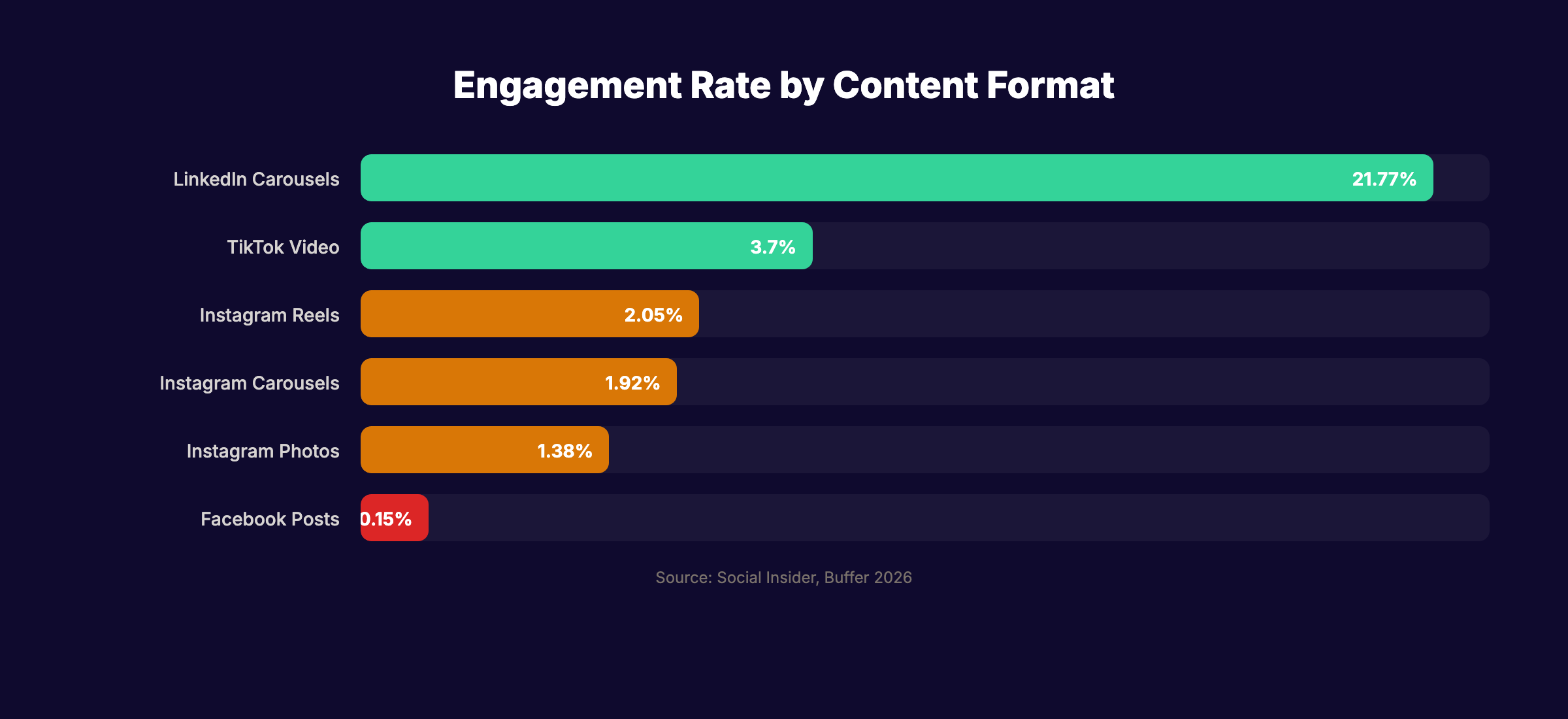
According to Buffer’s 2026 engagement study analyzing 52 million posts, carousel posts on Instagram drive 1.92% engagement. LinkedIn PDF carousels hit 21.77%. TikTok leads all platforms at 3.70%. The format and the writing both matter.
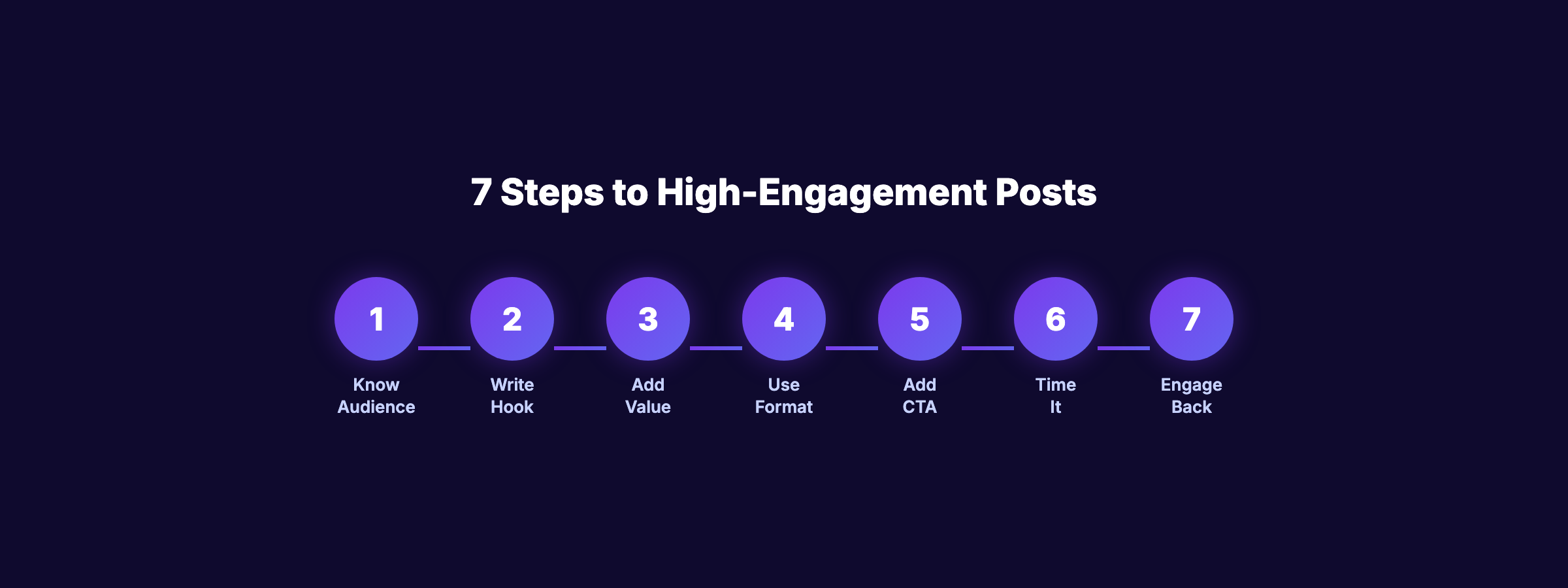
We publish 3,500+ articles across 70+ industries. We write social captions, blog posts, and ad copy daily. This guide breaks down the 7 steps we use to write posts that stop the scroll and drive comments, saves, and shares.
Here is what you will learn:
- The 4-part anatomy of a high-engagement post
- 10 proven hook formulas you can copy today
- Which content formats drive the highest engagement by platform
- How to write captions that drive comments and saves
- The posting formula that works across every platform
- How to measure and improve engagement over time
Time required: 15 to 30 minutes per post (once you learn the formula) Difficulty: Beginner What you will need: A social media account and ideas from our 217 content ideas list
Step 1: Understand What Drives Engagement
Engagement is not random. Specific formats and writing patterns consistently outperform others.
Engagement Rates by Format (2026 Data)
| Format | Platform | Avg Engagement Rate |
|---|---|---|
| PDF Carousels | 21.77% | |
| Short-Form Video | TikTok | 3.70% |
| Reels | 2.05% | |
| Carousels | 1.92% | |
| Photo Posts | 1.38% | |
| Text Posts | X (Twitter) | Best on X |
| All Posts | 0.15% |
Two patterns emerge. First, interactive and swipeable formats (carousels, Reels) outperform static images on visual platforms. Second, the platform with the highest engagement is the one where your format matches the algorithm’s preference. LinkedIn rewards carousels. TikTok rewards video. X rewards text.
What the Algorithm Wants
Every social media algorithm optimizes for time on platform. Posts that generate comments, saves, shares, and extended view time get shown to more people. A post that receives 10 comments in the first hour reaches 5 to 10 times more people than a post with zero comments.
Why this step matters: If you post the wrong format for the platform, no amount of great writing saves it. Match format to platform first. Then optimize the writing.
Step 2: Master the 4-Part Post Structure
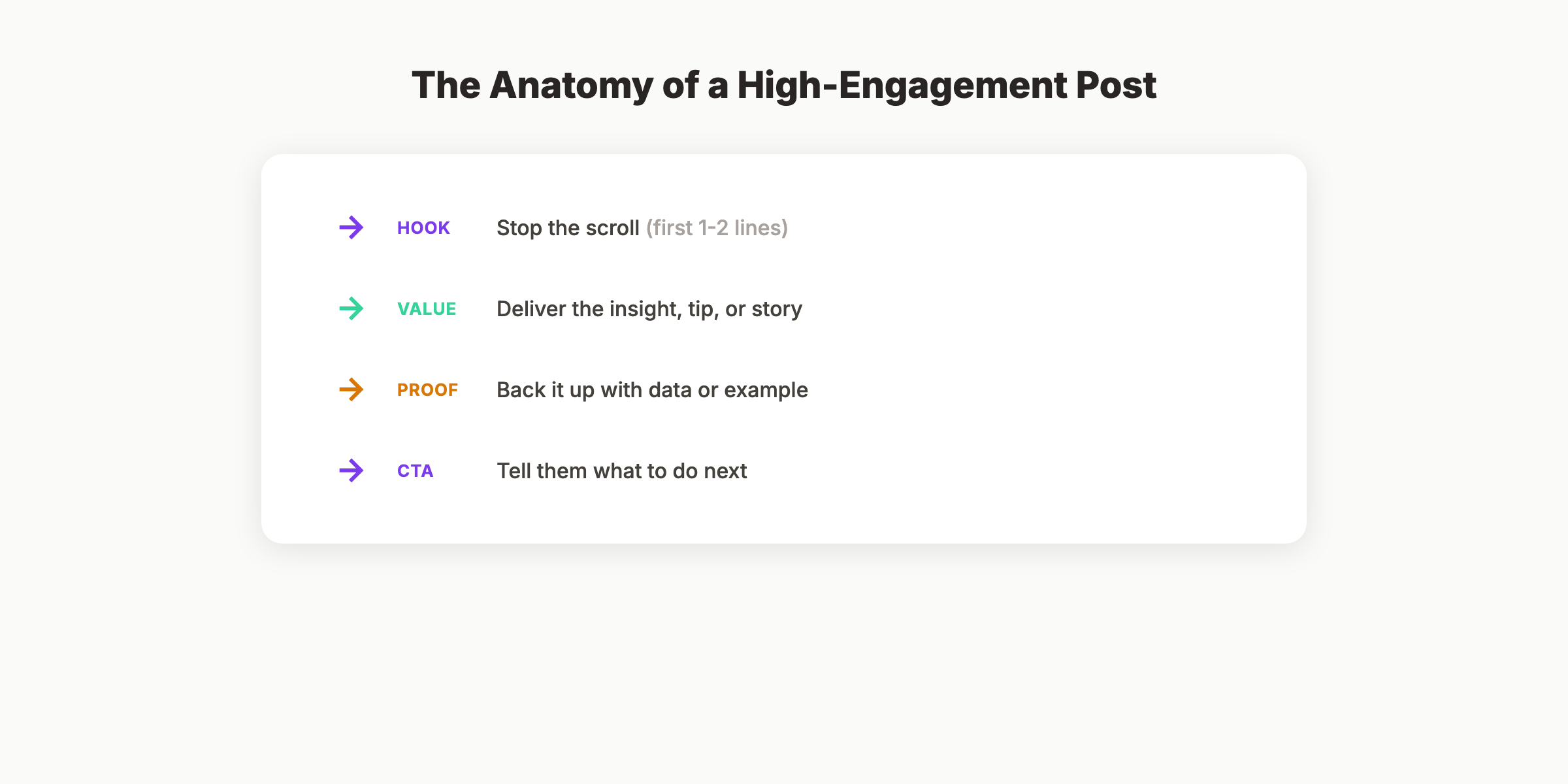
Every high-engagement post follows the same structure. Hook. Value. Proof. CTA.
Part 1: The Hook (First 1 to 2 Lines)
The hook stops the scroll. Instagram cuts captions after 125 characters. LinkedIn shows 3 lines before “see more.” Your first line determines whether anyone reads the rest.
Effective hooks use one of these triggers:
- Curiosity: “The mistake 90% of marketers make with hashtags.”
- Controversy: “Unpopular opinion: posting daily hurts your engagement.”
- Specificity: “I analyzed 500 Instagram posts. Here is what worked.”
- Direct address: “If you run a local business, read this.”
Part 2: The Value (Body Content)
After the hook, deliver what you promised. A tip. A framework. A story. A data point. The value section is where you earn the save and the share. Keep paragraphs short. Use line breaks. Make it easy to skim on a phone screen.
Part 3: The Proof (Evidence)
Back your claims with numbers, screenshots, or examples. “Posts with questions get 2x more comments” is stronger than “questions work.” A screenshot of your analytics showing a spike is stronger than “our engagement improved.”
Part 4: The CTA (Call to Action)
Tell people what to do. “Save this for later.” “Tag a friend who needs this.” “Drop a fire emoji if you agree.” “Which one do you prefer? Comment below.” Posts without a CTA get fewer comments because you never asked for them.
Copywriting Formulas That Work for Social Media
Three copywriting formulas translate well from long-form to social media captions:
PAS (Problem, Agitation, Solution): Name the problem. Amplify the pain. Present the answer. “Posting every day but getting zero comments? (Problem) That means the algorithm buries your content and new followers never find you. (Agitation) Here is a 3-step caption formula that fixes it. (Solution)”
BAB (Before, After, Bridge): Show the current state. Show the desired state. Bridge them. “Before: 12 likes per post. After: 200+ saves per post. Bridge: I changed one thing about my captions.”
AIDA (Attention, Interest, Desire, Action): Grab attention with a bold claim. Build interest with data. Create desire with a benefit. Drive action with a CTA.
Pick one formula per post. Do not mix them. Clarity beats cleverness.
Why this step matters: The 4-part structure works because it mirrors how people process content. Attention (hook), value (body), trust (proof), action (CTA). Skip any part and engagement drops.
Your SEO team. $99/month. Stacc publishes 30 articles and 30 social posts per month. Every post follows engagement-optimized formulas. Start for $1 →
Step 3: Write Hooks That Stop the Scroll
Posts with strong hooks are 50% more likely to increase engagement. The hook is the single highest-impact element of any social media post.
10 Proven Hook Formulas
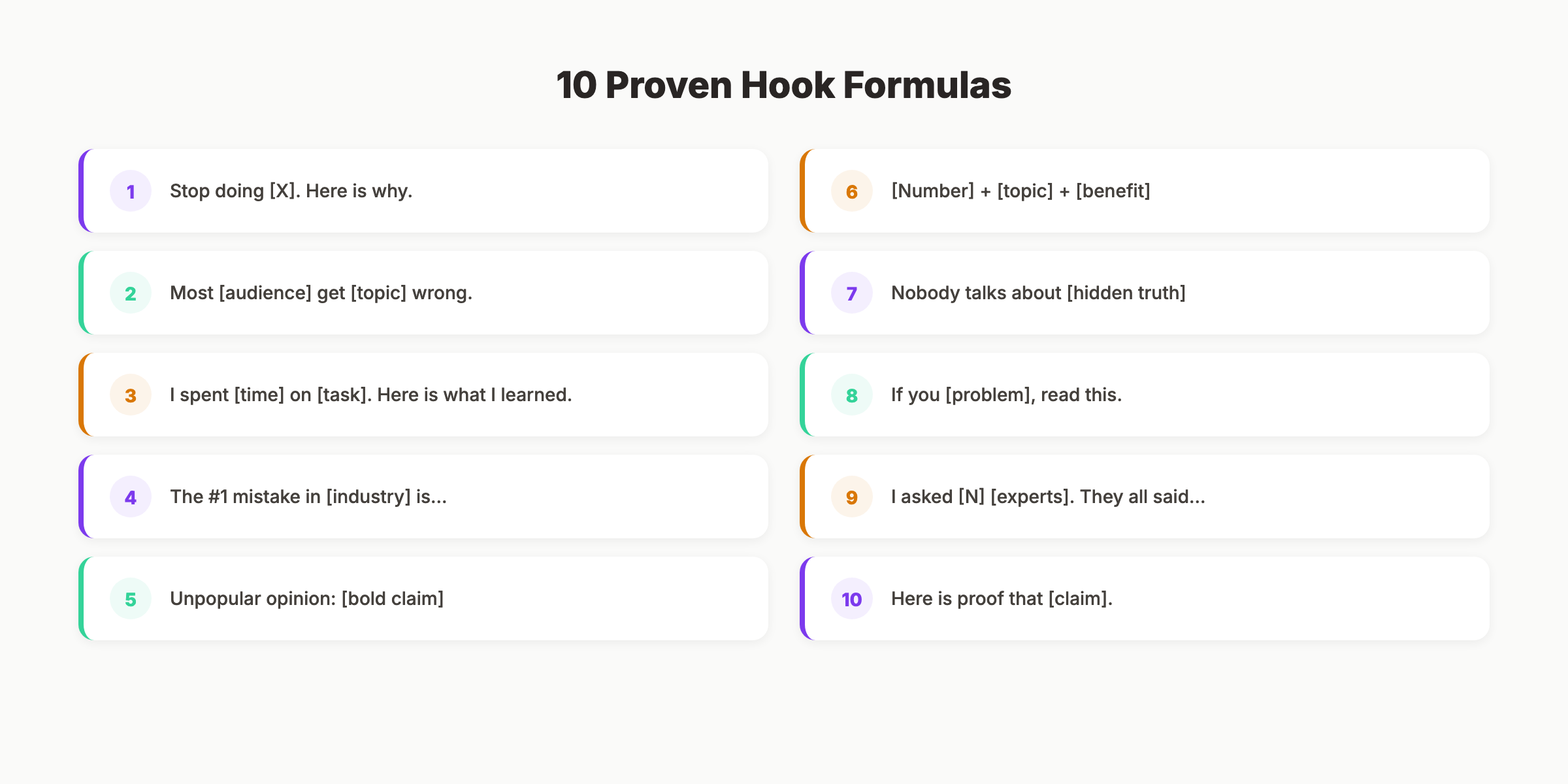
- “Stop doing [X]. Here is why.” — Challenges a common practice. Creates curiosity.
- “Most [audience] get [topic] wrong.” — Positions you as the expert who knows better.
- “I spent [time] on [task]. Here is what I learned.” — Personal experience builds trust.
- “The number 1 mistake in [industry] is…” — Identifies a specific pain point.
- “Unpopular opinion: [bold claim].” — Sparks debate. Drives comments.
- “[Number] [topic] [benefit].” — Quantified lists attract clicks. “7 tools that saved me 10 hours per week.”
- “Nobody talks about [hidden truth].” — Insider knowledge creates intrigue.
- “If you [problem], read this.” — Qualifies the reader. Makes it personal.
- “I asked [N] experts. They all said…” — Borrowed authority from multiple sources.
- “Here is proof that [claim].” — Evidence-based hooks build immediate credibility.
How to Choose the Right Hook
Match the hook to the content type:
| Content Type | Best Hook Style |
|---|---|
| Educational tip | ”Most people get [X] wrong” or “Stop doing [X]“ |
| Personal story | ”I spent [time] on [task]” or “Nobody talks about” |
| Data or research | ”Here is proof” or “I analyzed [N] posts” |
| Opinion piece | ”Unpopular opinion” or “The number 1 mistake” |
| List or framework | ”[Number] [topic] [benefit]” |
Why this step matters: The hook determines whether 5 people or 500 people read your post. Invest 50% of your writing time on the first 2 lines.
Step 4: Choose the Right Format for Each Platform
The same message performs differently depending on the format. A tip that works as an Instagram carousel fails as a Facebook text post. Match the format to the platform.
Format-Platform Matrix
| Platform | Best Performing Format | Why |
|---|---|---|
| Carousels (1.92%) and Reels (2.05%) | Swipeable and watchable content gets algorithmic reach | |
| PDF carousels (21.77%) and text posts | Professional audience saves and shares documents | |
| TikTok | Short video under 60 seconds (3.70%) | Algorithm rewards watch time and completion rate |
| Video and link posts | Video auto-plays in feed. Links drive traffic. | |
| X (Twitter) | Text-only posts and threads | Short, opinionated text outperforms media on X |
Content Recycling by Format
One idea becomes 5 posts across 5 platforms:
- Instagram Carousel: 7 slides breaking down a tip
- LinkedIn Text Post: The same tip as a story with data
- TikTok Video: 30-second talking-head version
- Facebook Post: The tip + a question for comments
- X Thread: 5-tweet breakdown of the same concept
Repurposing content across platforms multiplies your reach without multiplying your effort. Write once. Adapt the format. Publish everywhere.
Why this step matters: A great caption in the wrong format is invisible. Carousels dominate Instagram. Video dominates TikTok. Text dominates X. Respect the platform.
Rank everywhere. Do nothing. Blog SEO, Local SEO, and Social on autopilot. Stacc publishes 30 social posts per month across 3 platforms. Start for $1 →
Step 5: Write Captions That Drive Comments and Saves
Comments and saves are the 2 highest-value engagement actions. Comments signal conversation (algorithms reward this). Saves signal lasting value (algorithms reward this too).
How to Drive Comments
Ask a direct question at the end of your post. “Which one do you prefer?” “What would you add to this list?” “Agree or disagree?” The simpler the question, the more comments you get. Yes/no questions outperform open-ended ones for comment volume.
Share a controversial take. “I think email marketing is dead for small businesses.” People who disagree will comment. People who agree will comment. Controversy is the fastest comment driver.
How to Drive Saves
Create reference content. Tips lists, checklists, templates, and formulas get saved because people want to come back to them later. A post titled “7 caption formulas to save” gets saved more than “my thoughts on captions.”
Include actionable frameworks. The PAS formula (Problem, Agitation, Solution), the BAB formula (Before, After, Bridge), and numbered step-by-step processes all drive saves because they are reusable.
Caption Length by Platform
| Platform | Ideal Caption Length | Notes |
|---|---|---|
| 150 to 300 words | Long captions work for education. Short for visual-first. | |
| 100 to 200 words | Hook in first line. Break into short paragraphs. | |
| 40 to 80 words | Shorter posts get more engagement on Facebook. | |
| TikTok | 10 to 30 words | The video is the content. Caption supports it. |
| X | Under 280 characters | Tight, punchy, opinionated. |
Why this step matters: Comments and saves are the 2 engagement signals that matter most to algorithms. A post with 20 comments reaches 5x more people than a post with 20 likes.
Step 6: Post at the Right Time
The best writing in the wrong time slot reaches nobody. Posting when your audience is active increases initial engagement. Initial engagement determines how far the algorithm pushes your post.
Best Posting Times by Platform (2026)
| Platform | Best Days | Best Times |
|---|---|---|
| Tuesday to Friday | 11 AM to 1 PM, 7 to 9 PM | |
| Tuesday to Thursday | 8 to 10 AM | |
| TikTok | Tuesday to Thursday | 7 to 9 AM, 12 to 3 PM, 7 to 11 PM |
| Wednesday to Friday | 9 to 11 AM, 1 to 3 PM | |
| X | Monday to Wednesday | 8 to 10 AM, 12 to 1 PM |
These are averages. Your specific audience may differ. Check your platform analytics for when your followers are most active. Scheduling tools like Buffer and Metricool show your best posting times based on your audience data.
Why this step matters: A post published at 3 AM gets buried before your audience wakes up. Timing does not make bad content good. But good timing makes good content reach more people.
Step 7: Engage Back Within the First Hour
Posting is half the job. Engaging with responses is the other half.
The First-Hour Rule
The first 60 minutes after publishing determine how far your post reaches. Reply to every comment within that window. Each reply counts as an additional engagement signal. A post with 10 comments and 10 replies (20 total engagements) outperforms a post with 10 comments and zero replies.
How to Respond
- Questions: Answer the question directly. Then ask a follow-up.
- Compliments: Thank them. Then reference something specific.
- Disagreements: Acknowledge their point. Share your perspective without being defensive.
- Tags: Thank the person who tagged a friend. Welcome the new person.
Turn Comments Into Content
When a follower asks a good question in the comments, make that question your next post. “Someone asked me [question]. Here is my answer.” Comment-driven content performs well because the audience sees that you listen and respond.
Build an Engagement Habit
Set a 15-minute timer twice per day. Once after posting (for the critical first hour) and once in the evening. During each session, reply to every comment on your posts, comment on 5 to 10 posts from accounts in your niche, and respond to any DMs. This 30-minute daily habit produces more engagement growth than spending 2 hours creating a single perfect post. Engagement is a two-way conversation. The accounts that give engagement receive it.
Why this step matters: Social media is social. Posting without engaging is broadcasting. Broadcasting gets ignored. Conversation gets amplified.
3,500+ blogs published. 92% average SEO score. Stacc handles blog content and social media on autopilot. Every post is built for engagement. Start for $1 →
Results: What to Expect
After implementing this 7-step system:
- Week 1-2: Your posts follow the Hook-Value-Proof-CTA structure. Initial engagement improvements appear.
- Month 1: Comments and saves increase as your audience recognizes the pattern of valuable content.
- Month 2-3: The algorithm rewards your consistent engagement. Reach grows. New followers arrive.
- Month 6: Engagement compounds. Your best-performing content formats and hooks become clear from data.
The difference between a low-engagement account and a high-engagement one is rarely the quality of the business. It is the quality of the writing. Follow the formula. Test the hooks. Engage with every response. The engagement follows.
Common Mistakes That Kill Engagement
No hook in the first line. Starting with “We are excited to announce” loses the reader before the second line. Lead with value or curiosity. Save the announcement for line 3.
No call to action. A post without a CTA is a monologue. Tell people what to do. Ask a question. Request a save. Prompt a tag. Without direction, most followers scroll past.
Posting and disappearing. Publishing a post and ignoring comments for 24 hours tells the algorithm your content does not generate conversation. Engage within 60 minutes of posting.
Same format every time. Alternating between carousels, Reels, single images, and text posts keeps your feed dynamic. Audiences tire of repetition. Mix 3 to 4 formats per week.
Writing for yourself instead of your audience. The post that excites you may bore your followers. Check your analytics. Your top 5 performing posts reveal what your audience actually wants. Give them more of that.
FAQ
What is a good engagement rate on social media?
Engagement rates vary by platform. On Instagram, 1 to 3% is considered good for business accounts. On LinkedIn, 2 to 5% is strong. On TikTok, 3 to 7% is typical. Facebook averages 0.15% across all business pages. Compare your rate against your own historical data and industry benchmarks, not arbitrary standards.
How do I get more comments on social media posts?
Ask a direct question at the end of every post. Share a controversial opinion that invites debate. Use fill-in-the-blank prompts. Respond to every comment within 1 hour to double your engagement count. The simplest hack: end every post with a yes/no question. Binary choices drive more comments than open-ended prompts.
What type of social media post gets the most engagement?
Carousel posts on Instagram (1.92% engagement) and LinkedIn PDF carousels (21.77%) consistently outperform other formats. Short-form video leads on TikTok (3.70%) and Instagram Reels (2.05%). Interactive content (polls, questions, quizzes) drives the highest comment rates across all platforms.
How long should a social media caption be?
It depends on the platform. Instagram captions perform best at 150 to 300 words for educational content. LinkedIn works well at 100 to 200 words. Facebook performs best under 80 words. TikTok captions should stay under 30 words since the video carries the message. Match your caption length to the platform and the content type.
How often should I post on social media for engagement?
3 to 5 posts per week on your primary platform. Daily Stories on Instagram. Consistency outperforms volume. 3 quality posts per week for 12 months produces better engagement than 10 posts per week for 2 months. Use a content calendar and scheduling tool to maintain your cadence.
Can Stacc write social media posts for my business?
Yes. Stacc’s Social Media module publishes 30 posts per month across Instagram, LinkedIn, X, and Facebook for $49/month. Every post follows engagement-optimized writing formulas. For businesses that also need blog SEO, the Blog SEO module ($99/month) publishes 30 articles per month. Start with a $1 trial.
Writing social media posts that get engagement is a skill, not a talent. Follow the Hook-Value-Proof-CTA structure. Match your format to the platform. Post at the right time. Engage with every response. The formula works on every platform for every industry. Start with Step 2 today and apply the 4-part structure to your next post. For businesses that want social media handled on autopilot, Stacc starts at $49/month.
Written and published by Stacc. We publish 3,500+ articles per month across 70+ industries. All data verified against public sources as of March 2026.
