Social Media for Car Dealerships: The Complete Guide
Social media for car dealerships explained by platform. Covers Facebook, Instagram, TikTok, YouTube, content ideas, ad strategy, and ROI tracking.
Siddharth Gangal • 2026-03-29 • SEO Tips
In This Article
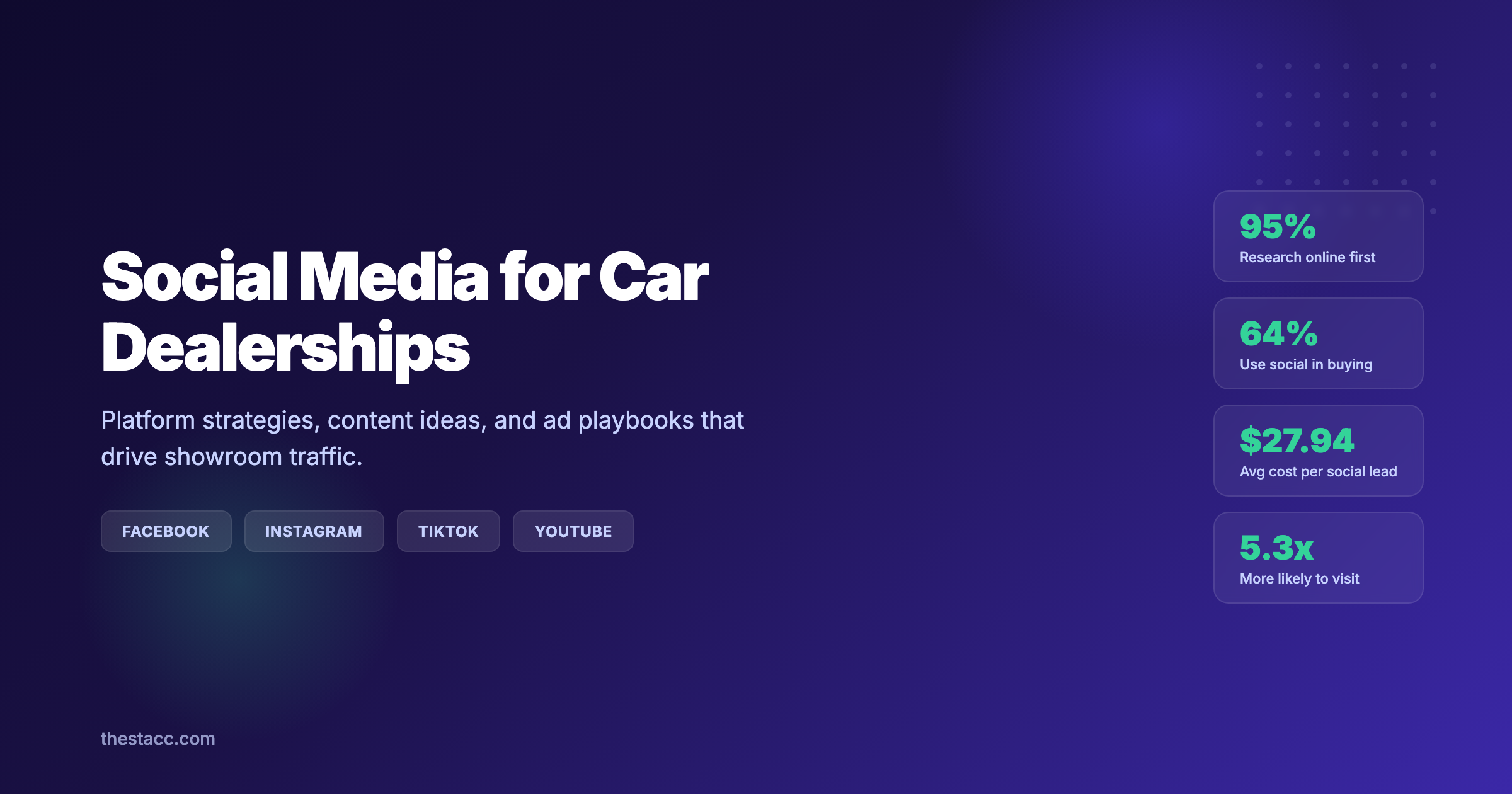
95% of car shoppers research online before visiting a dealership. 64% of those shoppers use social media during the buying process. And 44% of Americans say social media is the most influential channel for discovering a new vehicle, according to Demand Local.
Social media for car dealerships is no longer optional. It is the first step in the buying journey for most customers. Yet most dealerships post inventory photos to Facebook twice a month and wonder why it does not generate leads.
The problem is not the channel. It is the strategy. Dealerships that treat social media as a billboard miss the opportunity entirely. The ones generating real floor traffic use social media to build trust, showcase personality, and convert engagement into test drive bookings.
This guide covers exactly what works for auto dealers on each platform. We publish 3,500+ articles across 70+ industries, including automotive and local service businesses.
Here is what you will learn:
- Which social media platforms actually drive car sales (with data)
- A content framework with 7 post types that generate engagement
- Platform-specific strategies for Facebook, Instagram, TikTok, and YouTube
- How to run Facebook and Instagram ads beyond the boosted post
- The weekly posting calendar dealerships should follow
- How to connect social media activity to actual vehicle sales
Why Social Media Drives Car Sales in 2026
The car buying journey starts on a screen, not a lot.
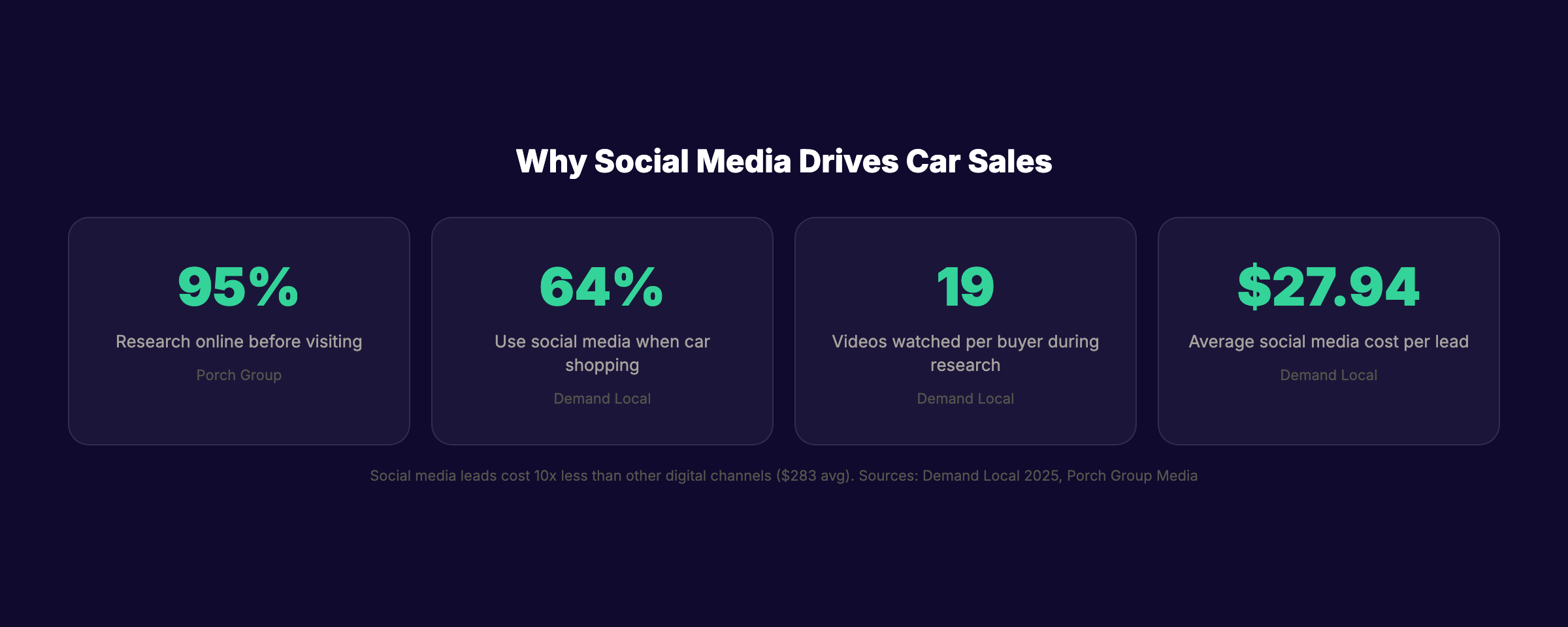
Buyers watch an average of 19 videos during the car research process, according to Demand Local. 84% plan to watch auto videos during their next buying cycle. YouTube reaches 92% of people planning to buy a car within 6 months.
The numbers for younger buyers are even stronger. 74% of Gen Z shoppers use social media during the car buying process. 37% of TikTok users are actively car shopping. The dealership that shows up on their feed wins the first impression.
Social media leads cost dealerships an average of $27.94 per lead. Other digital channels average $283 per lead. The cost gap is massive, and the conversion quality is strong. Car shoppers are 5.3x more likely to visit a dealership when they find positive social content and reviews.
Only 16% of dealerships have a formal user-generated content strategy. Only 28% run structured paid campaigns beyond boosted posts. The opportunity for dealers who execute well is wide open.
The 5 Platforms That Actually Move Cars
Not every platform deserves your time. These 5 drive real results for dealerships.
Facebook: The Lead Generation Engine
70% of Americans use Facebook. 66% visit local business pages at least once per week. Facebook remains the primary platform for dealership lead generation.
What works on Facebook for dealers:
- Automotive Inventory Ads (AIAs): Pull from your live inventory feed. Show specific vehicles to in-market shoppers. AIAs deliver 66% lower cost-per-click and 5x higher click-through rate vs. industry averages.
- Customer delivery photos: “New car day” posts generate the highest organic engagement. Tag the customer (with permission) to reach their network.
- Local event posts: Sponsor a little league team. Host a food truck night. Post about it. Local content builds community trust.
- Facebook Marketplace listings: Buyers browse Marketplace for vehicles. List inventory there for direct DMs and phone calls.
- Facebook Live: New model reveals and inventory walkthroughs perform well as live events.
Posting cadence: 3 to 4 times per week.
Instagram: The Visual Showroom
Instagram engagement for local dealerships averages 4.8%. The all-industry median is 0.046%. That is a 104x advantage. Dealerships that post quality visual content win on Instagram.
What works on Instagram for dealers:
- Reels (under 30 seconds): Quick vehicle walkarounds, feature highlights, staff introductions. Reels get the highest organic reach.
- Stories (daily): Polls (“AWD or FWD?”), behind-the-scenes service bay content, “just arrived” inventory teasers.
- Carousel posts: Side-by-side trim comparisons, “3 reasons to choose this model,” before/after detail photos.
- Customer UGC reposts: When buyers post their new car, repost it. User-generated content drives 4.5x higher engagement than branded posts.
Posting cadence: 4 to 5 times per week (2 Reels, daily Stories, 1 to 2 static or carousel posts).
TikTok: The Gen Z Dealership
37% of TikTok users are actively car shopping. NADA recognizes TikTok as a legitimate sales channel. Dealers using TikTok report increased walk-in traffic from younger buyers.
What works on TikTok for dealers:
- 15 to 30 second videos: Feature reveals (“3 things you did not know about the 2026 Camry”), day-in-the-life of a sales rep, humorous takes on car buying myths.
- Trending audio: Overlay popular sounds on inventory walkthroughs. Trending audio significantly boosts reach.
- Local hashtags: #[CityName]Cars, #[BrandName]TikTok, #CarTok.
- Authentic personality: TikTok rewards realness. The salesperson who shows their actual personality outperforms polished corporate content.
Short-form videos under 60 seconds earn a 50% engagement rate on TikTok. No other platform comes close.
Posting cadence: 4 to 5 times per week.
Stop posting. Start ranking. Stacc handles Blog SEO, Local SEO, and Social Media on autopilot. Social Media posting starts at $49/mo across 3 platforms. Start for $1 →
YouTube: The Research Hub
YouTube is where serious buyers go. 41% of automotive buyers use YouTube when researching a purchase. YouTube reaches 92% of in-market shoppers within 6 months of purchase.
What works on YouTube for dealers:
- Full vehicle walkthroughs (10 to 15 minutes): Cover every feature, trim level, and selling point. Title format: “2026 [Model] Full Walkthrough — [Dealership City].”
- Financing explainer videos: “How car financing works in 5 minutes” builds trust and captures search traffic.
- Service how-tos: “How to check your tire pressure” or “When to change your oil.” Service content keeps your channel relevant between purchase cycles.
- YouTube Shorts: 60-second inventory teasers that link to full walkaround videos.
Optimize titles with the vehicle model, year, and city name. Add chapter markers. Pin a comment with an inventory link or scheduling URL.
Posting cadence: 1 to 2 times per week (mix long-form and Shorts).
Google Business Profile: The Local Discovery Engine
GBP is not technically a social platform. But it functions like one. Weekly posts, photo uploads, review responses, and Q&A all drive local visibility.
Post GBP updates weekly. Upload 5 to 10 new vehicle photos per month. Respond to every Google review within 24 hours. This activity directly feeds into local SEO rankings and Google Maps visibility.
Ask every buyer to leave a Google review within 48 hours of purchase. Positive reviews mentioning specific vehicles, staff members, or the buying experience carry weight for both local SEO and social proof. A dealership with 500 reviews and 10 new ones per month outranks a competitor with 200 stale reviews.
The 7 Content Pillars for Dealership Social Media
Most dealerships post the same thing: a stock photo of a vehicle with a price. That approach does not build an audience. Use these 7 content types instead.
| Content Pillar | Example | Platform |
|---|---|---|
| New inventory arrivals | ”Just landed: 2026 RAV4 Hybrid. First look.” | Instagram Reels, TikTok, Facebook |
| Customer delivery moments | ”Congratulations to the Johnsons on their new Tahoe!” | Facebook, Instagram Stories |
| Behind the scenes | Service bay time-lapses, detailing transformations | TikTok, Instagram Reels |
| Staff spotlights | ”Meet Sarah, our finance manager. Ask her anything.” | Instagram, Facebook, LinkedIn |
| Educational content | ”How to check your trade-in value in 60 seconds” | YouTube, TikTok |
| Community involvement | Local event sponsorships, charity drives, school partnerships | Facebook, GBP |
| Promotions and events | End-of-month specials, model year clearance, holiday sales | All platforms |
Rotate through all 7 pillars each week. A feed that mixes inventory, people, education, and community builds trust faster than a feed of vehicle listings alone.
The Content Nobody Else Is Posting
Employee-shared content drives 8x higher engagement than brand-channel content. Encourage your sales team to post their own vehicle walkarounds, customer delivery moments, and car tips on their personal accounts.
72% of dealership employees are missing social selling opportunities. An employee advocacy program turns every salesperson into a micro-influencer for your dealership.
Weekly Posting Calendar for Car Dealerships
A consistent schedule prevents the feast-or-famine posting pattern that kills reach.
| Day | TikTok | YouTube | ||
|---|---|---|---|---|
| Monday | New inventory post | Reel: vehicle feature | Quick tip video | — |
| Tuesday | Community/local event | Story: poll or quiz | — | — |
| Wednesday | — | Carousel: trim comparison | Day-in-the-life | YouTube Short |
| Thursday | Customer delivery photo | Story: behind the scenes | Trending audio walkthrough | — |
| Friday | Weekend promo/event | Reel: staff spotlight | Humor/myth-busting | Full walkaround video |
| Saturday | Facebook Live: lot tour | Story: weekend energy | — | — |
Adjust based on your team capacity. Posting 3 to 4 times per week on each platform is more effective than posting 7 times one week and disappearing the next.
Your SEO team. $99 per month. 30 optimized blog posts published automatically. Add Social Media for $49/mo. Blog + Social content on autopilot. Start for $1 →
Facebook and Instagram Ads for Dealerships
Boosted posts waste money. Structured ad campaigns generate leads.
Automotive Inventory Ads (AIAs)
AIAs pull directly from your dealership’s inventory feed. They show specific vehicles to shoppers based on their browsing behavior. When a shopper views SUVs on your website, your AIA shows them SUVs in their Facebook and Instagram feed.
Setup requires:
- A product catalog connected to your inventory management system
- Meta Pixel installed on your website
- Campaign objective set to “Catalog Sales” or “Lead Generation”
AIAs deliver the highest ROI of any dealership ad format. 66% lower CPC and 5x higher CTR than standard campaigns.
Retargeting Campaigns
Install the Meta Pixel on every page of your dealership website. Run retargeting ads to people who viewed specific vehicle pages but did not submit a lead form.
Retargeting creative should be specific: “Still looking at the 2026 Accord? Schedule a test drive.” Generic brand awareness ads do not convert at this stage.
Lookalike Audiences
Upload your CRM customer list to Meta. Create a lookalike audience. Meta finds people who match the demographics and behavior of your existing buyers. Lookalike campaigns consistently outperform interest-based targeting for dealerships.
Life Event Targeting
Target people who recently experienced a life event that triggers a car purchase:
- New job
- Recently moved
- New baby
- Recently engaged
Life event targeting reaches buyers at the moment their need changes. This is one of the most underused targeting options for dealerships.
Budget Allocation for Dealership Social Ads
Most dealerships spend between $2,000 and $10,000 per month on social advertising. Here is a starting framework for a $3,000 monthly budget:
| Campaign Type | Budget Allocation | Objective |
|---|---|---|
| Automotive Inventory Ads | 50% ($1,500) | Catalog sales / lead generation |
| Retargeting | 25% ($750) | Convert website visitors |
| Lookalike campaigns | 15% ($450) | Reach new qualified buyers |
| Brand awareness (video) | 10% ($300) | Build top-of-funnel reach |
Start with AIAs and retargeting. These two campaign types generate the highest ROI for dealers. Add lookalike and awareness campaigns once the core is performing.
65% of dealers planned to increase social ad spending in 2025. The dealers who invest in structured campaigns rather than random boosts outperform their market consistently.
How to Measure Social Media ROI for Your Dealership
The biggest objection from dealer principals: “Show me that social media sells cars.” Here is how to connect the dots.
The Metrics That Matter
| Metric | What It Measures | Tool |
|---|---|---|
| Engagement rate | Audience interest and content quality | Native platform analytics |
| Link clicks | Traffic driven to website or VDP pages | Meta Business Suite, Google Analytics |
| Lead form submissions | Direct inquiries from social ads | CRM + Meta Lead Ads |
| Phone calls from social | Calls triggered by social profiles or ads | Call tracking software |
| Cost per lead | Efficiency of paid campaigns | Meta Ads Manager |
| Showroom attribution | Walk-ins who mention social media | Sales team tracking |
Connecting Social to Sales
-
Track UTM parameters on every link you post. Tag links with
utm_source=facebookorutm_source=instagramso Google Analytics shows exactly which platform drove each website visit. -
Use lead form ads on Facebook and Instagram. Leads go directly into your CRM with the source tagged. Your sales team follows up knowing the lead came from social.
-
Ask “How did you hear about us?” on every lead form and at the point of sale. Simple but most dealerships skip it.
-
Track phone calls from your social profiles using a dedicated tracking number. This separates social-generated calls from other sources.
The average social media lead costs $27.94. If your average gross profit per vehicle is $3,000, you need roughly 1 sold unit per 100 social leads to achieve positive ROI. Most dealerships exceed that ratio easily.
5 Social Media Mistakes Dealerships Keep Making
Posting Only Inventory
A feed full of vehicle listings with pricing is a catalog, not a social media presence. Mix in team content, community posts, educational videos, and customer stories. The 7-pillar framework above solves this.
Ignoring DMs and Comments
23.5% of dealer leads miss the 24-hour follow-up window. Social media DMs often go unanswered for days. A buyer who sends a DM at 8pm expects a response by the next morning. Assign someone to monitor inbound messages daily.
No Video Content
90% of marketers confirm positive ROI from video. 85% planned to increase video spending in 2025. Yet many dealerships still post only static photos. Start with one 30-second Reel per week. You do not need a production crew. A smartphone and natural lighting are enough.
Random Boosting Instead of Structured Campaigns
Boosting a post puts money behind content that was designed for organic reach. It does not target the right audience, optimize for conversions, or use your inventory feed. Run structured campaigns through Meta Ads Manager with clear objectives.
Deleting Negative Comments
Deleting complaints destroys trust. Respond publicly, acknowledge the issue, and move the conversation to a private channel. A professional response to a negative comment builds more credibility than 10 positive reviews.
No Seasonal Content Strategy
Model year changeovers, end-of-month pushes, holiday sales events, and tax refund season all create natural content opportunities. Plan promotional content 2 to 4 weeks ahead of each event. A content calendar prevents missed opportunities and ensures your social presence aligns with your sales floor priorities.
End-of-year clearance events, Memorial Day sales, and Black Friday promotions all deserve dedicated social campaigns with countdowns, inventory highlights, and financing offers. The dealerships that plan ahead capture demand. The ones that scramble last-minute lose to competitors who posted first.
Rank everywhere. Do nothing. Blog SEO, Local SEO, and Social on autopilot. Stacc starts at $49/mo for Social Media across 3 platforms. Start for $1 →
FAQ
Which social media platform is best for car dealerships?
Facebook generates the most leads through Automotive Inventory Ads. Instagram delivers the highest organic engagement at 4.8%. TikTok reaches the most Gen Z buyers (37% are actively car shopping). YouTube captures serious researchers. The best strategy uses all 4 platforms with content tailored to each.
How often should a car dealership post on social media?
Post 3 to 5 times per week on Facebook and Instagram. Post 4 to 5 times per week on TikTok. Post 1 to 2 times per week on YouTube. Consistency matters more than volume. Posting 3 times per week every week beats posting 10 times one week and disappearing the next.
Does social media actually help sell cars?
Yes. 64% of automotive shoppers conduct social media research before purchasing. Buyers exposed to positive social content are 5.3x more likely to visit the dealership. Social media leads cost $27.94 on average compared to $283 from other digital channels.
What type of content works best for car dealership social media?
Short-form video outperforms every other format. Videos under 60 seconds earn a 50% engagement rate on TikTok. Customer delivery photos generate the highest organic engagement on Facebook. Vehicle walkaround Reels and employee spotlights perform well on Instagram. Mix 7 content types for the best results.
Should car dealerships use TikTok?
Yes. 37% of TikTok users are actively car shopping. NADA recognizes TikTok as a legitimate sales channel. Dealers report increased walk-in traffic from younger buyers. Start with 3 to 4 short videos per week featuring real staff, real vehicles, and authentic personality.
How do car dealerships measure social media ROI?
Track UTM parameters on all links, use lead form ads that feed directly into your CRM, assign a tracking phone number to social profiles, and ask “how did you hear about us” on every lead form. Connect engagement metrics to website traffic, lead submissions, and closed sales.
Social media for car dealerships works when you stop treating it as a billboard and start treating it as a conversation with future buyers. Every video, every customer photo, and every community post builds the trust that turns a scroll into a showroom visit. Start with one platform, post consistently, and measure what converts.
Written and published by Stacc. We publish 3,500+ articles per month across 70+ industries. All data verified against public sources as of March 2026.