
Social Media for Roofers: Get More Jobs from Every Post
Social media for roofers explained by platform. Covers Facebook ads, before/after content, storm response, Nextdoor strategy, and lead tracking.
Siddharth Gangal • 2026-03-29 • SEO Tips
In This Article
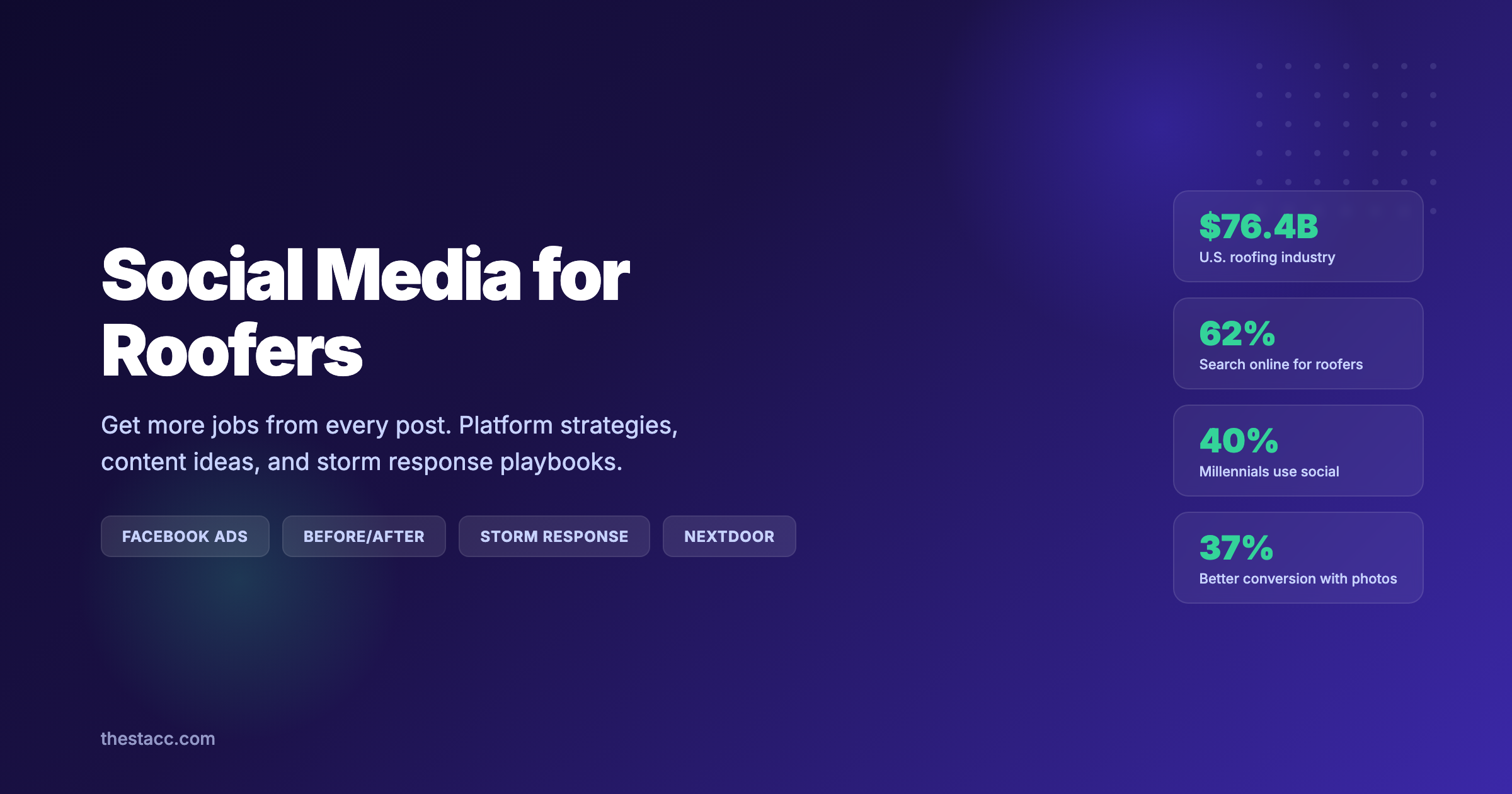
The U.S. roofing industry generates $76.4 billion in annual revenue across 101,679 contractors. 62% of homeowners search the internet to find a roofer. 25% use social media directly. For Millennials, that number jumps to 40%, according to Roofing Contractor’s 2025 Homeowner Survey.
Social media for roofers is not about posting a job photo every few weeks. It is about showing up consistently in the feeds of homeowners who will need a roof in the next 1 to 5 years. The average homeowner replaces a roof every 15 to 20 years. When that moment arrives, the roofer they have seen on Facebook, Instagram, or Nextdoor for months gets the call.
Yet 40% of roofing companies still do not use social media. The ones that do often post sporadically with no strategy, no targeting, and no way to measure results.
This guide covers what actually works for roofing companies on social media. We publish 3,500+ articles across 70+ industries, including home services and contractors.
Here is what you will learn:
- Which platforms drive real roofing leads (and which waste time)
- The 7 content types that generate the most engagement for roofers
- How to run Facebook ads that target homeowners in your service area
- The storm response playbook that fills your calendar after severe weather
- A weekly posting schedule built for a small roofing team
- How to track which social posts turn into actual jobs
The 5 Platforms That Work for Roofing Companies
Not every platform deserves your time. Focus on these 5.
Facebook: The Lead Generation Engine
Facebook is the primary platform for residential roofing. 70% of Americans use it. Local targeting lets you reach homeowners within a 15 to 25 mile radius of your service area.
What works on Facebook for roofers:
- Before/after project carousels with neighborhood, material type, and timeline
- Facebook ads targeting homeowners by zip code, age (30-65+), and interests (home improvement, HGTV, DIY)
- Customer review screenshots paired with project photos
- Weather-triggered posts after local storms (“Free inspections available in [neighborhood]”)
- Facebook Live from a job site showing a replacement in progress
- Community group participation answering roofing questions without self-promotion
Ad budget starting point: $500 to $1,500 per month for testing. Facebook ads for roofers target homeowners specifically and deliver measurable leads when combined with retargeting.
Instagram: The Visual Portfolio
Instagram engagement for local contractors outperforms most industries. Reels drive the highest organic reach.
What works on Instagram for roofers:
- Project timelapse Reels (30 to 60 seconds, sunrise to finished roof)
- Drone flyover clips showing completed roofs with neighborhood context
- Before/after swipe carousels with city, material, and customer quote
- Stories for daily job site updates (builds familiarity with your crew)
- Crew spotlights showing the people behind the work
Tag specific neighborhoods and cities in every post. Use local hashtags: #[City]Roofer, #[City]Roofing, #StormDamage[State].
TikTok: The Untapped Opportunity
Most roofers are not on TikTok. That is exactly why you should be. Early movers in roofing TikTok get disproportionate reach with zero competition.
What works on TikTok for roofers:
- “What hail damage actually looks like” educational clips (15 to 30 seconds)
- “We replaced this roof in 8 hours” timelapse content
- Trending audio overlays on project walkthroughs
- Myth-busting: “Can you put new shingles over old ones?” (the answer surprises people)
- Crew humor and day-in-the-life content
TikTok content does not need to be polished. Authenticity outperforms production quality. A crew member holding a phone on a roof outperforms a scripted ad.
YouTube: The Authority Builder
YouTube videos rank directly in Google search results for queries like “what does hail damage look like” and “how long does a roof last.” Most roofing companies have zero YouTube presence.
What works on YouTube for roofers:
- Full project walkthroughs (8 to 15 minutes showing the entire replacement process)
- Material comparison videos (asphalt vs metal vs slate with pros, cons, and pricing)
- Insurance claim explainers (step-by-step from adjuster visit to final payment)
- Customer testimonial videos (3 to 5 minutes with the homeowner on their new roof)
- Drone project flyovers as a recurring series
Optimize video titles with the service and city: “Complete Roof Replacement in Austin TX — Asphalt to Metal Upgrade.”
Nextdoor: The Trust Platform
Nextdoor is the most underused platform for residential roofers. Neighbor recommendations on Nextdoor carry more weight than Google reviews for many homeowners.
What works on Nextdoor for roofers:
- Claim your Business Page and complete every field
- Post seasonal maintenance tips quarterly (not promotional content)
- Ask happy customers to recommend you on Nextdoor (in addition to Google)
- After local storms, post in neighborhood feeds offering free inspections
- Partner with realtors and property managers who can refer you in threads
Stop posting randomly. Start ranking. Stacc handles Blog SEO, Local SEO, and Social Media posting on autopilot. Social starts at $49/mo across 3 platforms. Start for $1 →
The 7 Content Types That Generate Roofing Leads
Most roofers post the same thing: a low-quality phone photo of a finished roof with no context. That approach does not build an audience. Use these 7 content types instead.
1. Before/After Projects
The single highest-performing content type for roofers. Show the transformation.
Format: Swipe carousel with 4 to 6 images. Include the city, roof type, material used, project timeline, and a brief customer quote. Tag the neighborhood.
2. Storm Damage Education
Homeowners do not know what hail damage, wind damage, or storm damage looks like on a roof. Teach them.
Topics:
- “How to spot hail damage on your roof (3 signs)”
- “What granule loss looks like and why it matters”
- “When to call a roofer after a storm vs when to wait”
Educational storm content builds trust before the homeowner needs you. When the next storm hits, they remember the roofer who taught them what to look for.
3. Cost Transparency
45% of your competitors refuse to discuss pricing publicly. Be the one who does.
Post examples:
- “What a 2,000 sq ft asphalt replacement actually costs in [City]”
- “Metal roof vs asphalt shingle: the real cost difference”
- “5 things that affect your roof replacement price”
Cost content drives massive engagement because every homeowner researching a roof wants pricing information.
4. Insurance Claim Walkthroughs
The insurance claim process confuses most homeowners. A roofer who explains it clearly wins their trust and their business.
Series idea: 5-part carousel or video series: “How Your Roof Insurance Claim Works Step by Step.” Cover filing the claim, the adjuster visit, getting estimates, choosing a contractor, and final payment.
5. Crew and Team Content
Employee-shared content drives 8x higher engagement than brand-channel content. Put your crew on camera.
Ideas:
- Meet-the-crew spotlights (name, role, years of experience)
- Safety gear walkthrough (“Here is everything our crew wears on every job”)
- Celebrating milestones (“Roof number 500 of the year”)
- Charity projects and community involvement
6. Seasonal Maintenance Tips
Seasonal content keeps your brand visible between the 15 to 20 year replacement cycle.
| Season | Content Topic |
|---|---|
| Spring | ”Your roof survived winter. Here are 5 things to check now.” |
| Summer | ”What happens to your attic without proper ventilation in July” |
| Fall | ”5 things to do to your roof before the first freeze” |
| Winter | ”How ice dams form and how to prevent them” |
Publish seasonal content 4 to 6 weeks before each season shift.
7. Social Proof and Reviews
35% of homeowners say online reviews are their top factor in choosing a roofer, per RoofLink research. 67% say reviews are “very” or “extremely” important when selecting a contractor.
Formats:
- Screenshot a Google review and pair it with the project photo
- Film a 60-second customer testimonial on the finished roof
- Post “This homeowner just got a 50-year manufacturer warranty” with the certificate
- Weekly “Review of the Week” post highlighting a specific customer story
75% of roofing contractors already feature customer testimonials on their website and social channels. The roofers who do not are at a measurable disadvantage.
The Storm Response Playbook
Severe weather creates the highest-urgency lead opportunity in roofing. A strong storm response strategy separates the roofers who fill their calendar from the ones who scramble.
Before the storm:
- Publish a pre-storm checklist post: “A storm is forecast for [area] tonight. Here is what to document on your roof before it hits.”
- Set up a Facebook ad campaign ready to launch immediately after the weather event
During the storm:
- Post a Stories update showing your team preparing for the response
After the storm (within 24 hours):
- Launch weather-triggered Facebook ads: “Hail damage in [neighborhood]? Free inspections this week.”
- Post to Nextdoor neighborhood feeds offering free inspections
- Share a carousel showing what storm damage looks like on a roof
- Update your Google Business Profile with a post about storm response availability
48 to 72 hours after:
- Post before/after content from the first inspections
- Share drone footage of affected neighborhoods (without showing identifying details of specific homes)
- Publish educational content: “How to file a roof insurance claim after [Storm Name]”
The roofers who respond fastest win the most jobs. Insurance claim-related content is the highest-value educational content a roofer can produce. Most competitors avoid it because the process is complex. That complexity is exactly why homeowners need a guide.
Eco-Roofing Content for the Growing Market
45% of homeowners would pay 10 to 15% more for environmentally responsible roofing, according to RoofLink. Yet almost no roofers create social content around sustainability.
Topics that tap this audience:
- “Cool roof” coatings that reduce energy bills
- Solar-ready roof installation
- Metal roofing as the 40 to 70 year eco-friendly option
- Recycled shingle programs
- Energy efficiency comparisons between roofing materials
This content reaches a premium audience willing to pay more for quality work.
Facebook Ads for Roofing Companies
Organic posts build brand awareness. Paid ads generate leads.
Ad Targeting for Roofers
| Targeting Option | Setting |
|---|---|
| Location | 15 to 25 mile radius around your office or service area |
| Age | 30 to 65+ (homeowner demographic) |
| Interests | Home improvement, HGTV, DIY, homeownership |
| Income | Target household income brackets above $60K |
| Custom audience | Upload CRM customer list for lookalike targeting |
| Retargeting | Website visitors who viewed your services page |
Weather-Triggered Campaigns
Set up ad campaigns that launch immediately after severe weather events in your area. “Hail damage in [Neighborhood]? Free inspections this week.” These campaigns convert at the highest rate because the need is urgent and immediate.
Conversion rates are 8x higher when leads are contacted within the first 5 minutes, according to Roofing Webmasters. Pair a weather-triggered ad with a fast response process.
Budget Allocation
| Campaign Type | Budget Share | Objective |
|---|---|---|
| Storm response ads | 40% | Immediate lead generation |
| Before/after project showcase | 25% | Brand awareness + trust |
| Retargeting website visitors | 20% | Convert warm leads |
| Lookalike audience | 15% | Reach new homeowners |
Start at $500 to $1,500 per month. Scale the budget for storm response campaigns when severe weather is forecasted.
Your SEO team. $99 per month. 30 optimized blog posts published automatically. Add Social Media for $49/mo. Blog + Social on autopilot. Start for $1 →
Weekly Posting Schedule for Roofers
Consistency beats volume. Posting 3 to 4 times per week on each platform outperforms posting 10 times in one week and disappearing for a month.
| Day | TikTok | ||
|---|---|---|---|
| Monday | Before/after project | Reel: project timelapse | Quick tip (30 sec) |
| Tuesday | — | Story: job site update | — |
| Wednesday | Educational post (storm damage, maintenance) | Carousel: material comparison | Myth-busting clip |
| Thursday | Customer review + photo | Story: crew spotlight | — |
| Friday | Community/seasonal post | Reel: drone flyover | Day-in-the-life |
Post to Nextdoor quarterly with seasonal maintenance tips. Post to YouTube 1 to 2 times per month with longer project walkthroughs.
How to Track Social Media ROI for Roofing
The biggest objection from roofing company owners: “I post but I do not know if it brings jobs.”
Tracking Setup
- Add UTM parameters to every link you share on social
- Install Meta Pixel on your website for Facebook/Instagram ad tracking
- Use a dedicated phone number for social media profiles (call tracking)
- Add “How did you hear about us?” to every lead form and estimate request
- Track leads in your CRM with the source tagged
Metrics That Matter
| Metric | What It Tells You |
|---|---|
| Link clicks from social | How many people visited your website from social posts |
| Lead form submissions | Direct inquiries from social ads or profile links |
| Phone calls from social profiles | Calls generated by your social presence |
| Cost per lead (paid ads) | Efficiency of your ad spend |
| Jobs booked from social leads | Revenue generated from social media |
Roofing websites that display actual project photos convert 37% better than those using stock photos. The content you post on social media becomes the visual proof that drives website conversions.
Connecting Social to Sales
Most roofing companies cannot connect a social media post to a signed contract. Here is how to close that gap.
Step 1: Every link shared on social media gets a UTM parameter. Tag links with utm_source=facebook or utm_source=instagram so Google Analytics shows the exact source.
Step 2: Use Facebook Lead Ads for direct form submissions. Leads go into your CRM with “Facebook” tagged as the source. Your sales team follows up knowing exactly where the lead originated.
Step 3: Assign a unique tracking phone number to each social media profile. A separate number on Facebook vs Instagram vs your website shows which channel generates calls.
Step 4: Ask every caller and form submitter “How did you hear about us?” This simple question is the most reliable attribution method for small roofing companies.
Step 5: Track the full pipeline. Lead source → estimate scheduled → estimate given → job booked → job completed → revenue. Calculate cost per booked job from each social channel.
The average roofing job generates $21,050 to $30,680 in revenue. If social media produces 2 jobs per month at a $500 ad spend, the ROI is 40x or higher. The math works. The tracking proves it.
The 5 Mistakes Roofers Keep Making on Social Media
Only posting finished jobs. A feed of completed roofs without context, education, or personality is a catalog. Mix in crew content, tips, and community posts.
Posting only during busy season. Social media compounds over time. Posting only in spring and summer means you restart from zero visibility every year. Post year-round to maintain audience and algorithm momentum.
No call to action. Every post should include a next step. “DM us for a free inspection.” “Call [number] for a same-day estimate.” “Link in bio to schedule.” Without a CTA, engagement does not convert.
Ignoring negative comments. Deleting or ignoring complaints destroys trust publicly. Respond professionally, acknowledge the concern, and move the conversation offline. Onlookers judge your response more than the complaint itself.
No paid amplification. Organic reach on Facebook averages 2 to 5% of your followers. Relying only on organic posts means 95% of your audience never sees your content. Even $300 per month in targeted ads dramatically increases visibility.
Rank everywhere. Do nothing. Blog SEO, Local SEO, and Social on autopilot. Stacc starts at $49/mo for Social Media across 3 platforms. Start for $1 →
FAQ
What is the best social media platform for roofers?
Facebook generates the most leads through targeted ads and local community engagement. Instagram works best for visual portfolio building and younger homeowners. Nextdoor carries the highest trust for residential contractors. TikTok offers the biggest untapped opportunity with near-zero competition from other roofers.
How often should a roofing company post on social media?
Post 3 to 4 times per week on Facebook and Instagram. Post 2 to 3 times per week on TikTok if you have video content. Post quarterly on Nextdoor with seasonal tips. Consistency matters more than volume. Posting regularly every week outperforms sporadic bursts.
Does social media actually work for getting roofing jobs?
Yes. 25% of homeowners use social media to find contractors. For Millennials, that number is 40%. Companies with strong social presence and online reviews convert significantly more website visitors into calls. The key is combining organic content with targeted paid ads.
What should roofers post on social media?
Focus on 7 content types: before/after projects, storm damage education, cost transparency, insurance claim walkthroughs, crew spotlights, seasonal maintenance tips, and customer testimonials. Mix educational content with project showcases. Avoid posting only promotional offers.
How much should a roofing company spend on Facebook ads?
Start at $500 to $1,500 per month for testing. Allocate 40% to storm response campaigns, 25% to project showcases, 20% to retargeting, and 15% to lookalike audiences. Scale storm response budgets when severe weather is forecasted in your area.
Should roofers use Nextdoor?
Yes. Nextdoor is the most trusted platform for residential contractor recommendations. Neighbor endorsements carry more weight than ads. Claim your Business Page, post seasonal tips, and ask customers to recommend you there. Post free inspection offers in neighborhood feeds after storms.
Social media for roofers works when you treat it as a trust-building system, not a billboard. Every project photo, every storm tip, and every crew spotlight builds the credibility that turns a homeowner into a customer 6 months or 6 years from now. Start with one platform, post consistently, and track what converts.
Written and published by Stacc. We publish 3,500+ articles per month across 70+ industries. All data verified against public sources as of March 2026.
