
Blog Post Length Statistics: 42 Data Points (2026)
42 blog post length statistics from Orbit Media, Backlinko, Semrush, and HubSpot. See what the data says about ideal word count. Updated March 2026.
Siddharth Gangal • 2026-03-28 • Content Strategy
In This Article
Last updated: March 2026
The average blog post is 1,333 words long. But the posts that generate the most traffic, backlinks, and leads are 2,000-3,000 words. Only 9% of bloggers publish posts that long. (Source: Orbit Media, 2025)
Everyone asks how long a blog post should be. The answer depends on what you want the post to do. Blog post length statistics show a clear pattern: longer content ranks higher, earns more backlinks, and drives more traffic. But 75% of readers prefer posts under 1,000 words.
That tension defines the content strategy decision every business faces. We publish 3,500+ articles across 70+ industries and track performance across every word count tier. Here are 42 data-backed blog post length statistics organized by category.
Average Blog Post Length
1. The average blog post is 1,333 words long. Source: Orbit Media Annual Blogger Survey, 2025 (n=808 content marketers)
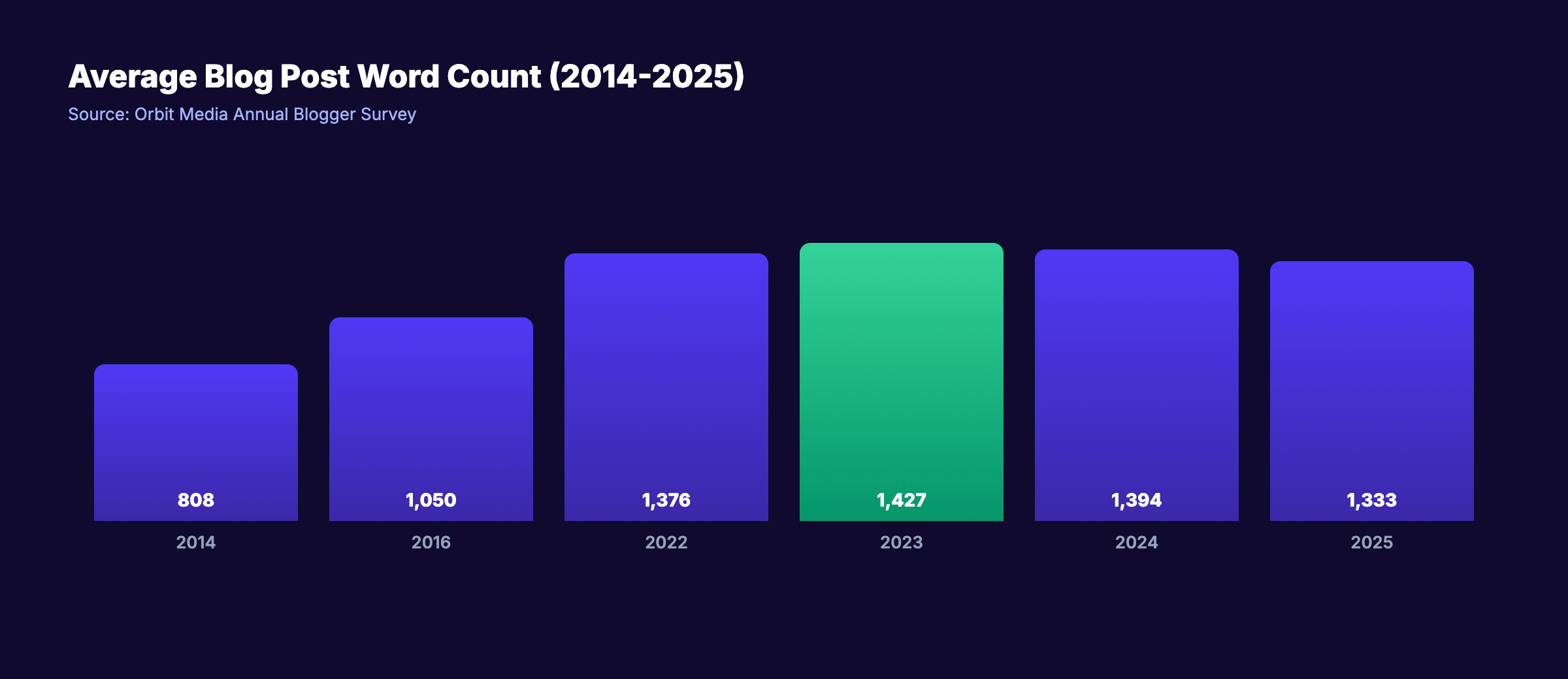
2. Blog post length grew 77% from 2014 to 2023. The average post went from 808 words in 2014 to 1,427 words in 2023. Length peaked in 2023 and has declined slightly since. Source: Orbit Media
3. Average blog post length by year:
| Year | Average Words |
|---|---|
| 2014 | 808 |
| 2016 | 1,050 |
| 2022 | 1,376 |
| 2023 | 1,427 (peak) |
| 2024 | 1,394 |
| 2025 | 1,333 |
Source: Orbit Media
4. Top-performing blog posts average 1,152 words. Low-performing posts average 668 words. That is a 72% word count gap between the best and worst performers. Source: Semrush Blogging Statistics
5. 32% of bloggers write 1,000-1,500 words. 31% write 500-1,000 words. Only 14% write over 2,000 words. Only 3% regularly publish over 3,000 words. Source: Digital Information World
Blog Post Length and SEO Rankings
6. The average Google first-page result is 1,447 words. Based on an analysis of 11.8 million Google search results. The study found a correlation between length and rankings but not a direct causal link. Source: Backlinko + Ahrefs
7. Pages exceeding 2,200 words rank in position #1 2.7 times more often. Long-form content appears in the top 3 Google results 51% more often than short-form content. Source: Amra & Elma Research
8. Long-form content achieves an average SERP position of 10.33. Short-form averages 38.63. Long-form content generates 2 times more URL clicks (31 vs. 15 clicks on average). Source: Amra & Elma
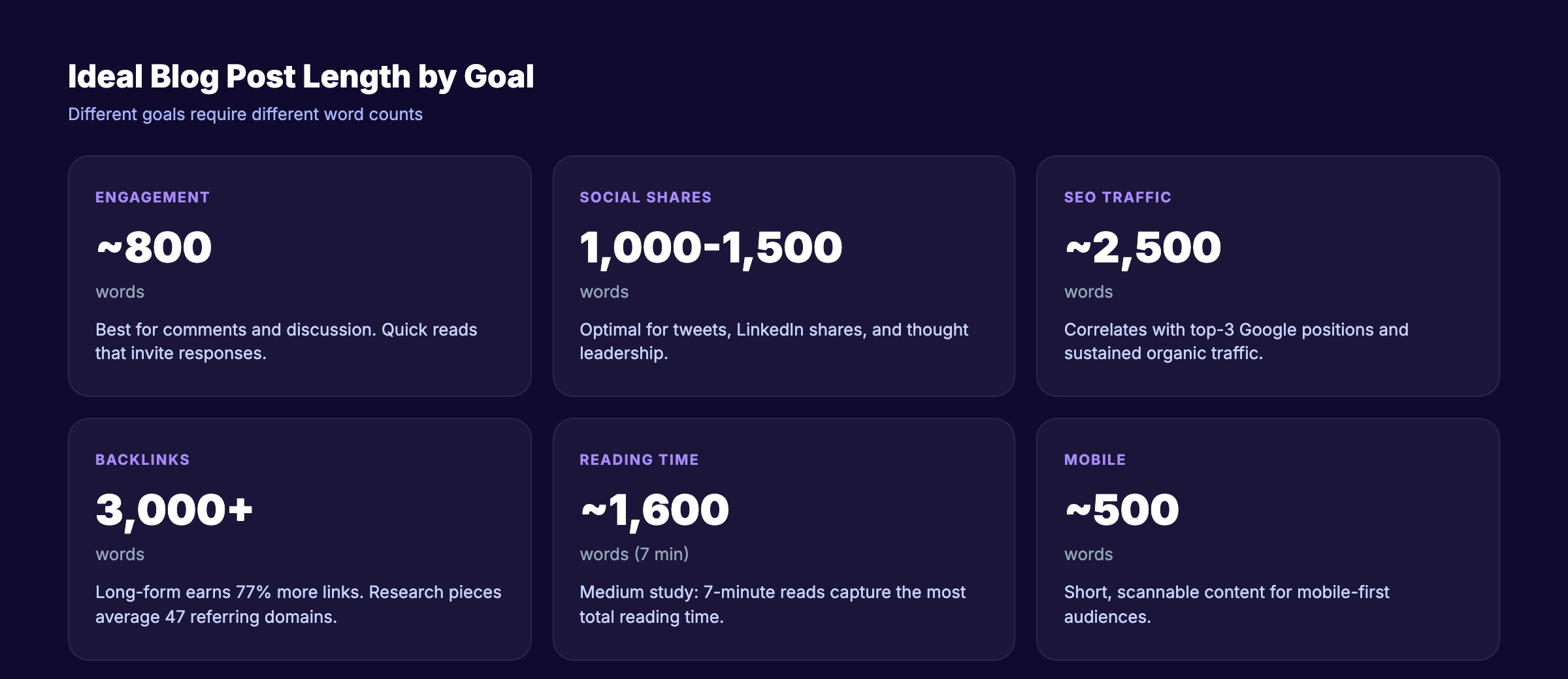
9. Posts with 3,000+ words get 138% more page views than posts under 500 words. Posts over 3,000 words also receive 21% more traffic, 24% more shares, and 75% more backlinks than average-length posts (901-1,200 words). Source: Semrush State of Content Marketing
10. Word count is not a confirmed Google ranking factor. Google has stated this explicitly. The correlation between length and rankings exists because longer content tends to cover topics more thoroughly, not because Google counts words. Source: Rankability
Stop writing. Start ranking. theStacc publishes 30 optimized articles per month for $99. Every piece is written to the word count that matches its topic and search intent. Start for $1 →
Blog Post Length and Backlinks
11. Long-form content gets 77.2% more backlinks than short articles. The Backlinko + BuzzSumo study of 912 million blog posts found that content over 3,000 words earns 77% more referring domain links than content under 1,000 words.
12. Content over 1,000 words attracts backlinks from 2 times as many referring domains as 400-word content. Source: Ahrefs
13. Original research pieces over 3,000 words earn an average of 47 referring domains. Content under 800 words earns 9. Source: Amra & Elma
14. 94% of all blog posts have zero external links pointing to them. Most content earns no backlinks regardless of length. The 6% that do earn links tend to be longer, more original, and data-driven. Source: Backlinko + BuzzSumo
15. Posts around 3,000 words generate the most backlinks (3,193 referring domains on average). Based on an analysis of 8,493 websites. Source: Neil Patel (LinkedIn, 2025)
Blog Post Length and Social Shares
16. Long-form content gets 56% more social shares than short content under 1,000 words. Source: Backlinko + BuzzSumo 912M post study
17. Posts longer than 1,500 words receive 68% more tweets and 22.6% more Facebook likes. Source: Neil Patel
18. 1.3% of articles generate 75% of all social shares. The vast majority of content gets minimal social distribution regardless of length. Source: Backlinko + BuzzSumo
19. Posts of 1,000-1,500 words perform best for social shares and thought leadership. Shorter than what ranks well for SEO, but optimal for social engagement. Source: Neil Patel (8,493 websites study)
20. LinkedIn long-form posts receive 47% more shares than short-form updates. Posts exceeding 1,200 words generate 3.2 times more profile visits. Source: Amra & Elma
Ideal Blog Post Length by Goal
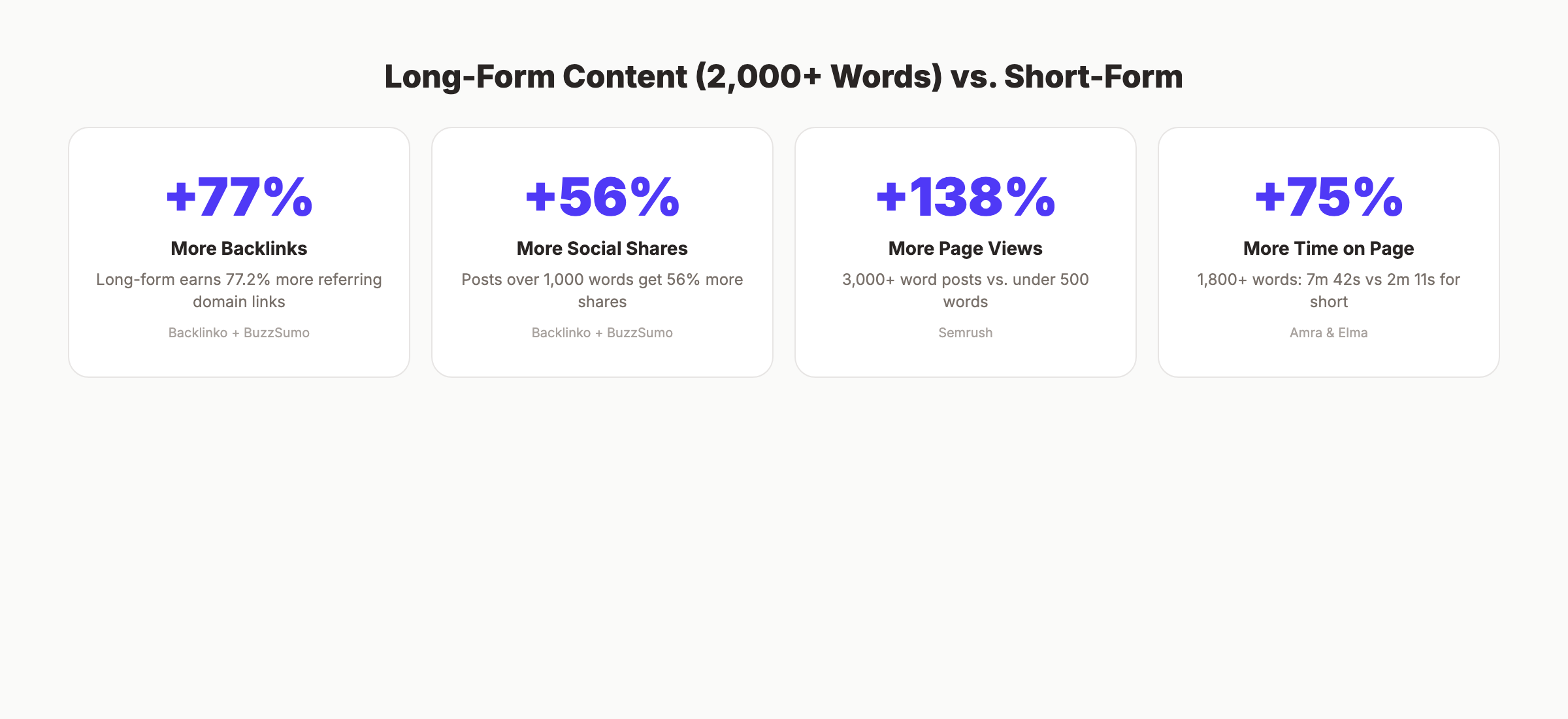
21. The ideal word count depends on what you want the post to achieve:
| Goal | Ideal Word Count | Source |
|---|---|---|
| Comments and engagement | ~800 words | Neil Patel |
| Social shares and thought leadership | 1,000-1,500 words | Neil Patel |
| SEO traffic | ~2,481 words | Neil Patel |
| Backlink acquisition | ~3,000-3,193 words | Neil Patel |
| Maximum reading time | ~1,600 words (7-minute read) | Medium Data Lab |
| Mobile optimization | ~500 words | Semrush |
22. HubSpot recommends 2,100-2,400 words for SEO. Their top-performing blog posts cluster around this range. Average lead generation articles hit ~2,500 words. Source: HubSpot internal blog research
23. Semrush recommends 1,500-2,500 words as the general ideal range. No single best word count exists. The right length depends on search intent, topic complexity, and competition. Source: Semrush
24. WordStream’s best-performing posts average 2,700-3,000 words. Source: WordStream
25. Yoast sets the minimum at 300 words for regular posts and 900 words for cornerstone content. These are floors, not targets. Source: Yoast
Blog Post Length by Content Type
26. Recommended word count by format:
| Content Type | Recommended Length |
|---|---|
| Press releases | 400-700 words |
| News articles | 600-1,000 words |
| B2B case studies | 500-1,500 words |
| Demo and tutorial articles | 500-1,000 words |
| Informational blog posts | 1,000-1,500 words |
| How-to guides | 1,500-2,500 words |
| Listicles (optimal for SEO) | 2,300-2,500 words |
| Pillar pages and ultimate guides | 3,000+ words |
| White papers and research studies | 4,000+ words |
27. B2B posts are 12% longer than other blog categories on average. SaaS blogs typically aim for 2,500+ words to accommodate screenshots, examples, and step-by-step instructions. Source: Databox
28. Competitive industries average 2,847 words per post and receive 58% more organic traffic. Higher competition pushes content length upward as businesses compete on depth. Source: Amra & Elma
For a deeper dive into how many blog posts you need to rank, see our analysis of publishing frequency and topical authority.
Your SEO team. $99/month. 30 optimized articles published automatically. Every piece written to the exact length its topic demands. Start for $1 →
Reading Time and Engagement Statistics
29. The average reader spends 96 seconds on a blog post. Some studies report as low as 52 seconds. Either way, most visitors do not read the full article. Source: MasterBlogging
30. The optimal blog post length for total reading time is ~1,600 words (a 7-minute read). Based on analysis of millions of Medium posts. 74% of posts were under 3 minutes long. Source: Medium Data Lab
31. Long-form articles (1,800+ words) achieve 7 minutes 42 seconds average time-on-page. Short-form articles (under 600 words) average 2 minutes 11 seconds. Long-form gets 75% more time-on-page. Source: Amra & Elma
32. 75% of readers prefer posts under 1,000 words. The tension: readers prefer short content, but search engines reward long content. The strategy that works: write long, structure for scanning. Source: Digital Information World
33. Blog and news site bounce rates average 70-80%. Most visitors leave after reading one page regardless of content length. Source: Industry benchmarks
Writing Time Statistics
34. The average blog post takes 3 hours 30 minutes to write in 2025. Down from a peak of 4 hours 10 minutes in 2022. AI adoption is the primary driver of the decline. Source: Orbit Media, 2025
35. Writing time grew 119% from 2014 to 2022. Posts that took 2 hours 24 minutes in 2014 took 4 hours 10 minutes by 2022. Since then, AI tools have reversed the trend. Source: Orbit Media
36. Posts taking more than 6 hours to write produce stronger results. There is a direct correlation between time invested and reported performance. Quick posts underperform. Source: Digital Information World
37. 80% of bloggers now use AI tools. Primary uses: draft writing (25%), visual creation (24%), and editing suggestions (21%). AI is the main reason average writing time is declining. Source: Digital Information World
38. Only 2% of bloggers publish daily. 39% publish at least weekly. The trend: fewer posts, longer content, higher quality per piece. Source: Orbit Media, 2025
Long-Form vs. Short-Form: The Full Comparison
39. Long-form content advantages by metric:
| Metric | Long-Form Advantage | Source |
|---|---|---|
| Backlinks | +77.2% more | Backlinko/BuzzSumo |
| Social shares | +56% more | Backlinko/BuzzSumo |
| Page views (3,000+ vs. <500 words) | +138% more | Semrush |
| SERP position (avg) | 10.33 vs. 38.63 | Amra & Elma |
| Time on page | +75% more | Amra & Elma |
| URL clicks | 2x more | Amra & Elma |
| Lead generation | 9x more leads | Sweor |
| Consumer trust | 57% more likely to trust | Amra & Elma |
40. 39% of marketers publishing 2,000+ word posts report strong results. The overall benchmark across all post lengths is only 21%. Source: Orbit Media / MarketingProfs
41. Only 9% of bloggers publish posts over 2,000 words. The gap between what works and what most people do is enormous. 91% of bloggers leave the highest-performing word count tier untouched. Source: Orbit Media, 2025
42. Posts with video get 70% more traffic than posts without video. Content length is not the only variable. Format diversity (images, video, infographics) also drives traffic. Source: Semrush
Key Takeaways
- Average post length: 1,333 words but the best-performing posts are 2,000-3,000 words.
- First-page Google results average 1,447 words. Ranking in position #1 correlates with 2,200+ words.
- Long-form content earns 77% more backlinks and 56% more social shares than short content.
- 94% of blog posts earn zero backlinks. Length alone does not guarantee links. Quality and originality matter more.
- 75% of readers prefer posts under 1,000 words but search engines reward 2,000+ word posts. Write long, structure for scanning.
- Only 9% of bloggers write 2,000+ words. The opportunity is in the gap between what most people write and what actually performs.
- AI reduced average writing time from 4+ hours to 3.5 hours. 80% of bloggers now use AI.
Methodology
Sources: Orbit Media Studios (2025 Annual Blogger Survey, n=808), Backlinko + BuzzSumo (912 million blog posts), Backlinko + Ahrefs (11.8 million Google results), Semrush (State of Content Marketing), HubSpot, Neil Patel (8,493 websites), Medium Data Lab, Yoast, WordStream, Amra & Elma, Databox.
Last updated: March 2026
Note: We update this page annually. All statistics include their original source and year. Where studies conflict, we cite both numbers.
Rank everywhere. Do nothing. Blog SEO, Local SEO, and Social Media on autopilot. theStacc starts at $99/mo with a $1 trial. Start for $1 →
FAQ
What is the ideal blog post length for SEO?
Data from multiple studies points to 1,500-2,500 words as the general sweet spot. HubSpot recommends 2,100-2,400 words. Backlinko found that the average first-page result is 1,447 words. The right length depends on your topic, competition, and search intent. Match the depth of top-ranking competitors.
How long should a blog post be in 2026?
The average blog post is 1,333 words (Orbit Media, 2025). Posts of 2,000+ words report 39% stronger results versus the 21% benchmark across all lengths. For content marketing, aim for 1,500-2,500 words on standard topics and 3,000+ words for pillar content and competitive keywords.
Does word count affect Google rankings?
Word count is not a confirmed Google ranking factor. However, longer content correlates with higher rankings because it tends to cover topics more thoroughly, earn more backlinks, and satisfy search intent more completely. Focus on covering the topic fully rather than hitting a specific word count target.
Is short-form or long-form content better?
Long-form content (2,000+ words) outperforms short-form on every measured SEO metric: 77% more backlinks, 56% more social shares, 138% more page views, and 2x more URL clicks. Short-form content (under 1,000 words) gets more comments and is preferred by 75% of readers. The right choice depends on your goal.
How long does it take to write a blog post?
The average blog post takes 3 hours 30 minutes to write in 2025, down from 4 hours 10 minutes in 2022. AI tools have reduced writing time. Posts that take 6+ hours to produce report stronger results. For businesses that want SEO content without the writing time, theStacc publishes 30 optimized articles per month for $99.
The Bottom Line
The data is clear: longer posts perform better for SEO, backlinks, and traffic. Most bloggers write under 1,500 words. The businesses that invest in 2,000-3,000 word content consistently outperform those that do not.
Length alone is not the strategy. Depth, structure, and originality drive results. The word count follows the coverage, not the other way around.
Start for $1 → 30 articles published monthly at the right length
Written and published by Stacc. We publish 3,500+ articles per month across 70+ industries. All data verified against public sources as of March 2026.
