
What Is AI Personalization? Complete Guide
AI personalization adapts website content to each visitor using machine learning. Learn how it works, SEO risks, and when to use it. Updated April 2026.
Siddharth Gangal • 2026-04-02 • Content Strategy
In This Article
Every visitor to your website has different needs. AI personalization makes your website respond to those differences automatically. Instead of showing the same page to everyone, the site adapts headlines, product recommendations, CTAs, and content blocks based on who is viewing.
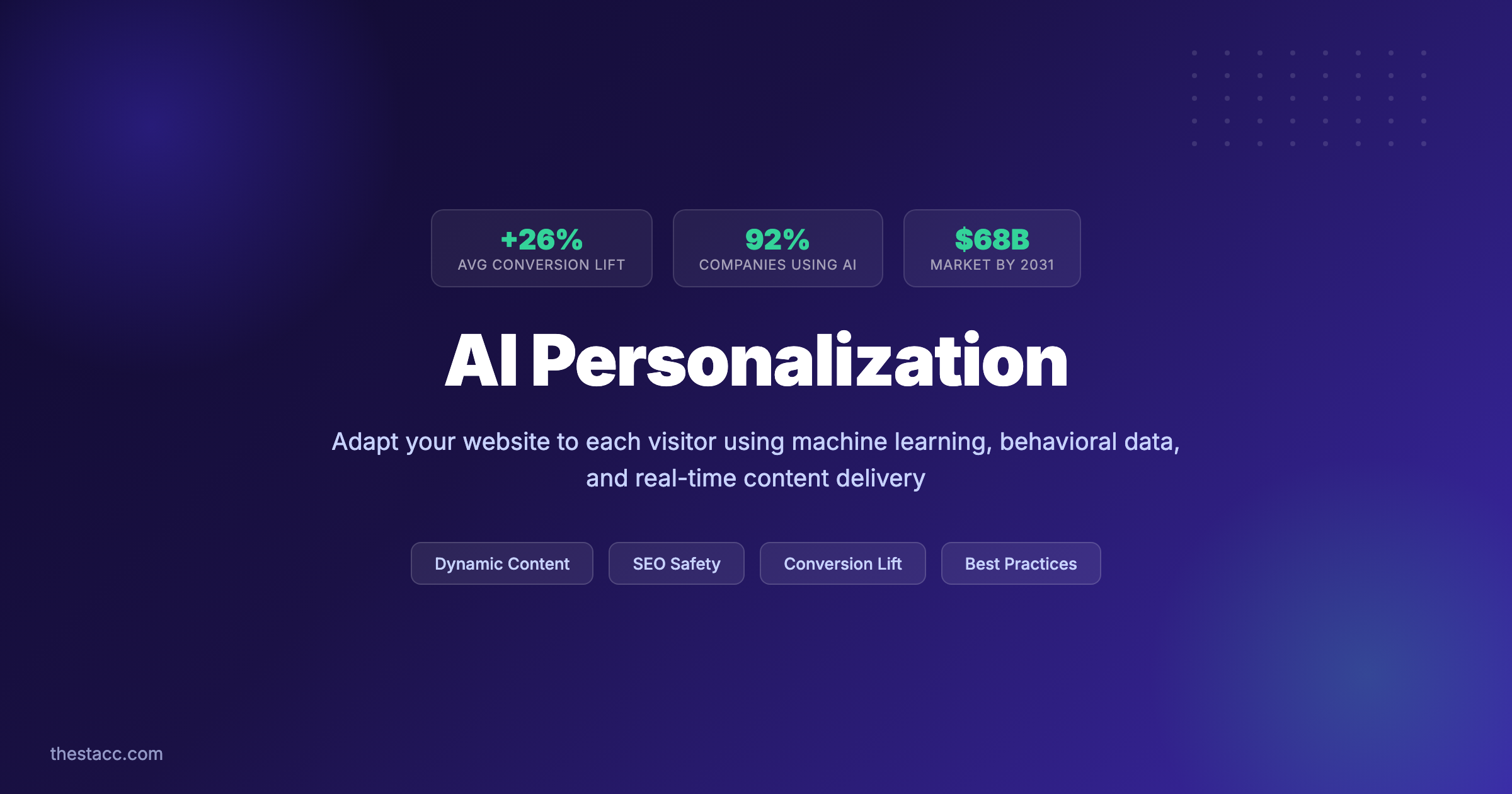
The numbers back the approach. Companies using AI personalization see an average 26% increase in conversion rates. 92% of companies now use AI-driven personalization to drive growth. The global hyper-personalization market hit $21.2 billion in 2024 and projects to reach $68 billion by 2031.
But personalization introduces SEO risks if done wrong. This guide covers what AI personalization is, how it works, when it helps, and how to avoid the pitfalls.
What Is AI Personalization?
AI personalization is the practice of using machine learning and real-time data to automatically adapt website content, product recommendations, and user experiences for each individual visitor.
A visitor from New York sees different hero images than a visitor from London. A returning customer sees products related to their last purchase. A first-time visitor sees an introductory offer. The content changes. The URL does not.
Traditional personalization required manual rules: “if location = Texas, show Texas banner.” AI personalization goes further. Machine learning algorithms analyze behavior patterns across thousands of visitors and predict what each person is most likely to engage with. The system learns and improves with every interaction.
The key components of AI personalization include:
- Behavioral data: Pages viewed, time on site, scroll depth, click patterns
- Contextual data: Location, device type, time of day, referral source
- Historical data: Past purchases, previous visits, email engagement
- Predictive modeling: AI predicts what each visitor is most likely to want next
Key point: AI personalization adapts the experience in real time. The visitor sees a version of your page tailored to their behavior and context. No two visitors see exactly the same thing.
Why AI Personalization Matters
Generic websites treat every visitor the same. Personalized websites treat every visitor as an individual. The difference shows up directly in revenue.
Conversion rate impact. AI personalization boosts conversions by an average of 26%. Dynamic Yield benchmarks show 89% more purchases from behavior-focused personalization. Mobile conversion rates improve by 40% with personalized experiences.
Revenue growth. Personalization leaders grow approximately 10 percentage points faster annually than competitors who do not personalize. Revenue improvements range from 10-40% depending on implementation depth.
Customer lifetime value. Personalized experiences increase customer lifetime value by 33%. Returning visitors who see relevant content based on their history spend more and return more frequently.
The Amazon effect. Amazon generates over 35% of its total revenue from personalized product recommendations. Netflix uses personalization to reduce churn and increase engagement. These are not niche tactics. They are the standard for modern digital businesses.
The bottom line: Websites that show the same content to every visitor are leaving measurable revenue on the table. The data is clear. Personalization works.
Your SEO team. $99 per month. 30 optimized articles, published automatically. Content built for your audience. Start for $1 →
How AI Personalization Works
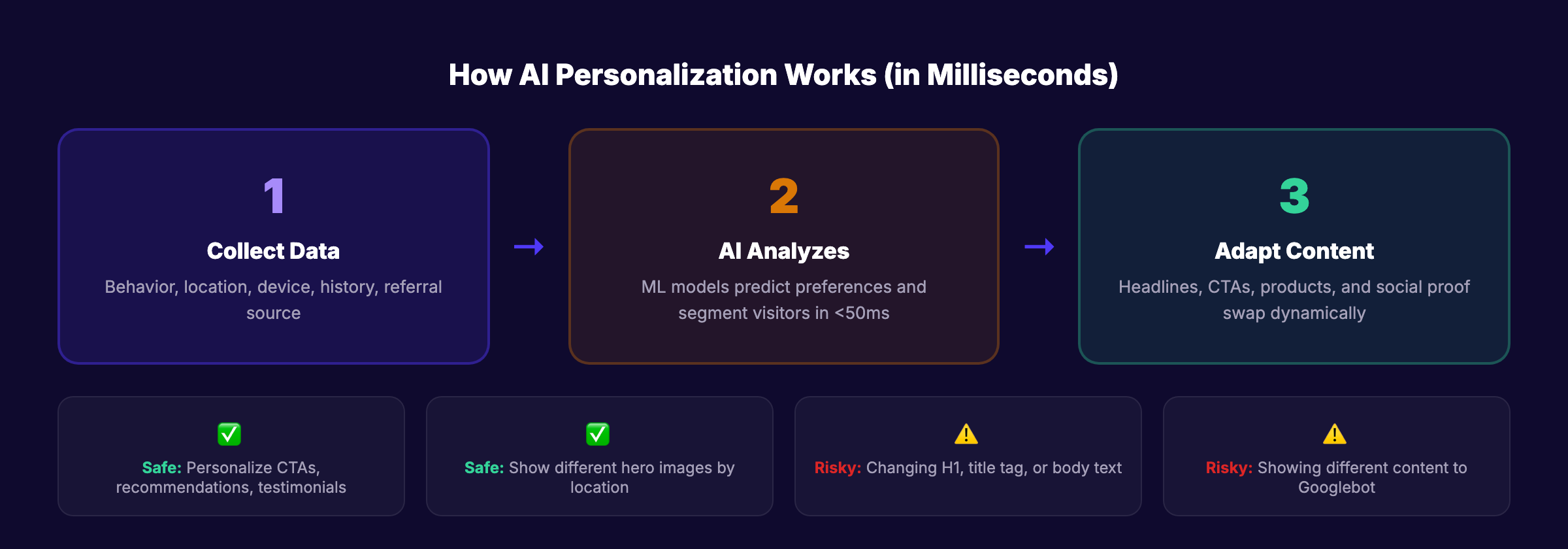
The process follows 3 stages that happen in milliseconds.
Stage 1: Data Collection
The personalization system collects signals about each visitor. These include:
| Signal Type | Examples | How Collected |
|---|---|---|
| Behavioral | Pages viewed, products clicked, cart contents | On-site tracking (cookies, sessions) |
| Contextual | Location, device, browser, time of day | HTTP headers, IP geolocation |
| Historical | Past purchases, previous sessions, email clicks | CRM, customer database, CDP |
| Referral | Came from Google, email, social media, paid ad | UTM parameters, referrer headers |
Stage 2: Real-Time Analysis
Machine learning models process the collected data and classify the visitor into segments or generate individual predictions. The AI determines:
- What content is most relevant to this visitor
- What products they are most likely to buy
- What CTA is most likely to convert them
- What messaging tone matches their stage in the buyer journey
Modern systems do this in under 50 milliseconds. The visitor never notices a delay.
Stage 3: Dynamic Content Delivery
Based on the AI’s predictions, the website dynamically swaps content elements. Common personalization targets include:
- Hero banners and headlines (different value propositions for different segments)
- Product recommendations (based on browsing and purchase history)
- CTA buttons (different offers for new vs returning visitors)
- Navigation menus (highlighting relevant categories)
- Social proof (showing testimonials from the same industry as the visitor)
- Pricing displays (annual vs monthly based on predicted preference)
The page URL stays the same. Only the content within specific zones changes.
AI Personalization and SEO: The Critical Rules
Personalization and SEO can conflict if implemented incorrectly. The core risk is cloaking: showing different content to search engines than to human visitors. Google treats cloaking as a policy violation that can result in deindexing.
The Golden Rule
Googlebot must see the same base content that an anonymous, first-time visitor sees. Personalization applies on top of the base content for known or returning visitors. Never personalize the version of a page that search engine crawlers receive.
What Is Safe
- Personalizing product recommendations in a sidebar or “recommended for you” section
- Showing different hero images based on location (as long as the base version is what crawlers see)
- Displaying “welcome back” messages for logged-in users
- Adapting CTA copy based on referral source
- Showing industry-specific testimonials
What Is Risky
- Changing the H1, title tag, or main body content based on user data
- Hiding content sections from certain visitor segments
- Redirecting visitors to different URLs based on behavior (without proper hreflang for language/geo redirects)
- Serving thin or different content to Googlebot vs users
SEO Best Practices for Personalization
- Ensure crawlers see the default, unpersonalized version of every page
- Keep title tags, meta descriptions, and H1 headings static (not personalized)
- Do not change the canonical URL based on personalization
- Test your pages with Google’s URL Inspection tool to verify what Googlebot sees
- Use JavaScript-based personalization that loads after the initial HTML (so crawlers get the base content)
- Never block personalization scripts from crawlers (this creates a discrepancy)
For sites using edge SEO or headless WordPress, personalization can be implemented at the CDN or frontend layer. The same rules apply: Googlebot must see the default content.
Best Practices for AI Personalization
Start with high-impact, low-risk elements. Product recommendations, CTA variations, and social proof are the safest and most effective personalization targets. These elements do not affect your SEO-critical content (title, H1, body text).
Use a Customer Data Platform (CDP). Unify data from your website, email, CRM, and ad platforms into one profile per visitor. Fragmented data produces poor predictions. Unified data produces relevant personalization.
Measure incrementally. Run A/B tests comparing personalized vs non-personalized experiences. Track conversion rate lift, revenue per visitor, and bounce rate changes. Do not assume personalization works. Prove it with data.
Respect privacy regulations. GDPR, CCPA, and similar laws require consent for behavioral tracking. Cookie consent banners must offer a genuine opt-out. Personalization systems must function gracefully when a visitor declines tracking. Serve the default content.
Keep page speed fast. Personalization requires JavaScript execution and API calls. Poorly implemented personalization adds latency. Monitor Core Web Vitals after implementing any personalization system. Aim for under 50ms added load time.
Common Mistakes to Avoid
-
Personalizing SEO-critical elements. Changing title tags, H1 headings, or main body content per visitor creates cloaking risk and confuses search engines. Keep these elements static. Personalize supplementary content (recommendations, CTAs, testimonials) instead.
-
Over-personalizing too early. First-time visitors have almost no data. Aggressive personalization based on a single page view feels random, not relevant. Start personalizing after you have 2-3 behavioral signals. Until then, serve a strong default experience.
-
Ignoring the fallback experience. If personalization fails (API timeout, JavaScript error, cookie rejection), visitors see the default page. Many teams optimize the personalized version and neglect the default. The default is what most visitors and all search engine crawlers see. Make it excellent.
AI Personalization and Stacc
Stacc publishes 30 SEO-optimized articles per month to your website. Each article targets specific search intents across your audience segments. While Stacc does not implement on-site personalization, the content we publish creates the foundation that personalization systems draw from. More indexed pages targeting more topics means more content available for personalization engines to serve to the right visitors.
3,500+ blogs published. 92% average SEO score. See what Stacc can do for your site. Start for $1 →
Learn More
Related topics:
- How to Increase Organic Traffic
- Search Intent Guide
- How to Improve Core Web Vitals
- Edge SEO Guide
- Measure Content Marketing ROI
FAQ
Does AI personalization hurt SEO?
Not if implemented correctly. The rule is simple: search engine crawlers must see the same content that an anonymous first-time visitor sees. Personalization should only change supplementary elements (recommendations, CTAs, testimonials) for known or returning visitors. Never personalize title tags, H1 headings, or core body content that crawlers index.
What is the difference between AI personalization and A/B testing?
A/B testing shows 2 fixed versions of a page to random visitors and measures which performs better. AI personalization predicts which version each specific visitor prefers based on their data and serves it automatically. A/B testing is a measurement tool. AI personalization is a delivery system. Use A/B tests to validate that your personalization actually improves results.
How much does AI personalization improve conversion rates?
The average conversion rate lift is 26%. Results vary by industry, implementation quality, and traffic volume. E-commerce sites with high traffic and rich behavioral data typically see the largest gains (up to 40% on mobile). Smaller sites with less data may see more modest improvements until they build sufficient visitor profiles.
What tools are used for AI personalization?
Leading platforms include Dynamic Yield (acquired by Mastercard), Optimizely, Adobe Target, Mutiny (for B2B), and VWO. For smaller businesses, tools like RightMessage, Hyperise, and If-So offer simpler implementations. The right tool depends on your traffic volume, data infrastructure, and budget.
AI personalization turns a static website into a responsive experience that adapts to every visitor. The conversion data is clear. The technology is mature. The only risk is poor implementation that conflicts with SEO. Follow the rules in this guide, and personalization becomes a revenue multiplier rather than a ranking risk.
Written and published by Stacc. We publish 3,500+ articles per month across 70+ industries. All data verified against public sources as of March 2026.
