What Is Edge SEO? The Complete Guide
Edge SEO implements technical SEO changes at the CDN level without touching your codebase. Learn how it works, use cases, and when to use it. Updated April 2026.
Siddharth Gangal • 2026-04-02 • SEO Tips
In This Article
Most technical SEO changes require a developer, a sprint cycle, and weeks of waiting. Edge SEO removes that bottleneck entirely. It lets you implement redirects, inject schema markup, modify meta tags, and fix crawl issues at the CDN level. No code deployments. No developer sprints. Changes go live in minutes.
Edge SEO uses serverless functions (Cloudflare Workers, Akamai EdgeWorkers, Fastly Compute) to modify HTML responses between your server and the user. The changes happen at the “edge” of the network, after your CMS generates the page but before the browser or search engine receives it.
For SEO teams stuck in development queues, edge SEO is how critical fixes get done today instead of next quarter.
What Is Edge SEO?
Edge SEO is the practice of implementing technical SEO changes at the CDN (Content Delivery Network) level using serverless edge functions. Instead of modifying your website’s source code or CMS, you write small functions that intercept and modify HTTP responses as they pass through the CDN.
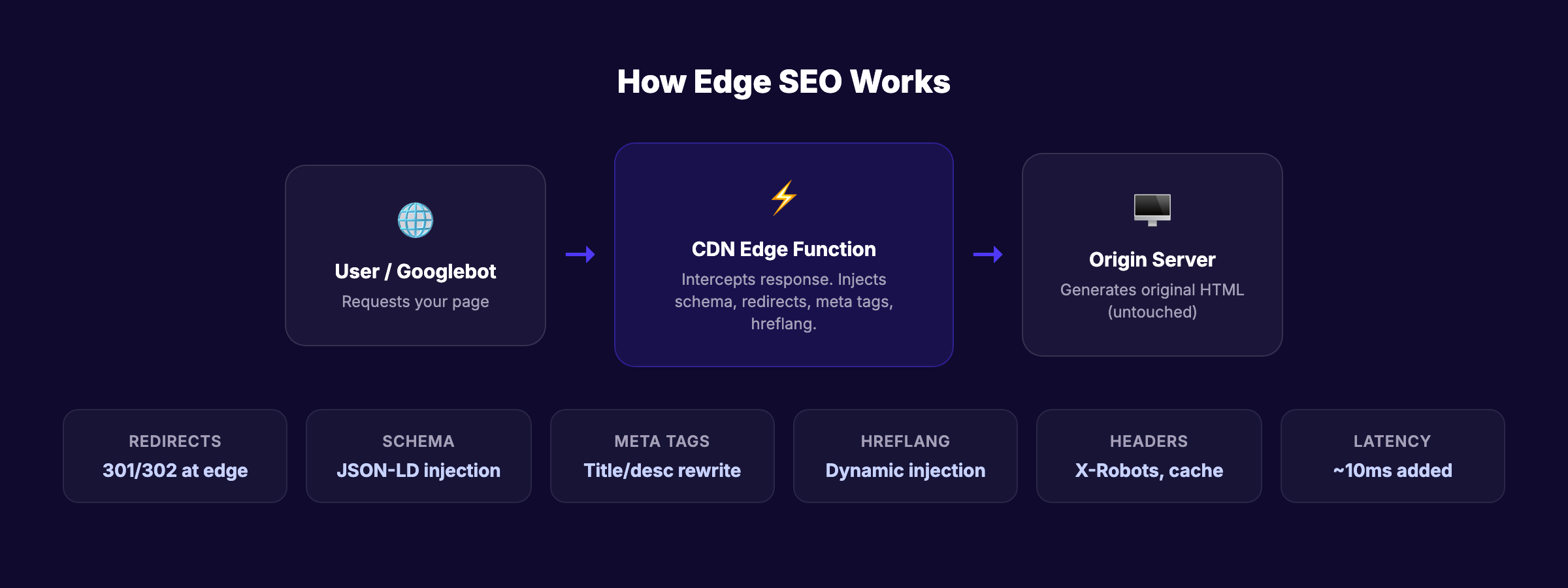
Think of the CDN as a middleman between your server and the user. Edge SEO puts that middleman to work. When Googlebot or a user requests a page, the CDN fetches it from your server, runs your edge function to make modifications, and serves the modified version. Your origin code stays untouched.
The term was popularized by Dan Taylor and the technical SEO community around 2019-2020. By 2026, it is a standard tool in enterprise SEO operations, especially for teams working on platforms with limited technical access like Shopify, Salesforce Commerce Cloud, or legacy CMSes.
Key point: Edge SEO modifies what search engines and users see without changing your actual website code. Changes are made at the network layer, not the application layer.
Why Edge SEO Matters
The biggest barrier to technical SEO is implementation speed. SEO teams identify issues in days. Fixing those issues through traditional development cycles takes weeks or months. Edge SEO collapses that timeline.
Speed of implementation. Edge SEO changes deploy in under an hour. A redirect that would take 3 weeks through a dev sprint goes live in 15 minutes through a Cloudflare Worker. For time-sensitive issues like broken redirects after a migration, that speed is the difference between losing rankings and preserving them.
No developer dependency. SEO teams with basic JavaScript knowledge can deploy edge functions independently. The changes are isolated from the main codebase, so there is no risk of breaking other site functionality. The SEO team stops competing with product teams for development resources.
Platform agnostic. Edge SEO works regardless of your CMS. Shopify, WordPress, custom builds, legacy enterprise platforms. The edge function sits between the platform and the user. It does not care what generates the HTML.
Minimal performance cost. Edge functions add approximately 10 milliseconds of latency. That is imperceptible to users and search engines. In many cases, edge optimizations (compression, header management) actually improve Core Web Vitals.
The bottom line: Edge SEO gives SEO teams the ability to ship technical changes at the speed SEO demands, not the speed development queues allow.
Your SEO team. $99 per month. 30 optimized articles, published automatically. We handle the content. You handle the technical performance. Start for $1 →
How Edge SEO Works
The process follows 3 steps:
1. Request interception. A user or search engine bot requests a page from your website. The CDN intercepts that request before it reaches your origin server (or after the origin responds, depending on the implementation).
2. Edge function execution. A serverless function runs at the CDN edge node closest to the requester. The function reads the HTML response and applies modifications. Add a redirect header. Inject schema markup. Rewrite a meta title. Remove a noindex tag.
3. Modified response delivery. The CDN serves the modified HTML to the user or bot. The origin server never changes. The CMS is not involved.
Supported CDN Platforms
| Platform | Edge Function Name | Best For |
|---|---|---|
| Cloudflare | Workers | Most popular for edge SEO. Free tier available |
| Akamai | EdgeWorkers | Enterprise sites already on Akamai CDN |
| Fastly | Compute | High-performance, real-time edge compute |
| AWS | Lambda@Edge / CloudFront Functions | AWS-hosted infrastructure |
| Vercel | Edge Functions | Next.js and Vercel-hosted sites |
Cloudflare Workers is the most widely used platform for edge SEO due to its free tier, documentation, and active SEO community.
Edge SEO Use Cases
Redirect Management
Implement 301 redirects at the edge without touching your server configuration or CMS. Especially useful during site migrations where you need to manage thousands of URL redirects. Read our 301 redirects guide for redirect strategy.
Edge-based redirects can also use context-aware logic. Redirect by geography, device type, or time. Traditional server redirects cannot match this flexibility.
Schema Markup Injection
Inject JSON-LD structured data into pages that lack it. Product schema, FAQ schema, BreadcrumbList schema, and Organization schema can be dynamically generated and injected at the edge without modifying templates.
This is critical for platforms like Shopify where template access is limited. The edge function reads the page content and injects the appropriate schema before the response reaches Googlebot.
Meta Tag Modification
Rewrite meta titles, meta descriptions, canonical tags, and robots directives on the fly. Test different meta titles to measure CTR impact. Fix noindex tags that are accidentally blocking pages. Add canonical tags to pages with duplicate content.
Hreflang Tag Implementation
For multilingual sites, edge functions dynamically generate and inject hreflang tags based on available translations and regional content. This eliminates manual updates across hundreds or thousands of pages. The edge function reads the URL, determines the language variant, and injects the correct hreflang annotations.
HTTP Header Management
Set or modify X-Robots-Tag headers, cache headers, security headers, and custom response headers. Useful for controlling crawl behavior on pages where you cannot modify the HTML directly.
A/B Testing for SEO
Run split tests on meta titles, heading structures, or content variations at the edge. Serve different versions to different segments of traffic and measure the ranking impact. Tools like SearchPilot specialize in this approach.
JavaScript Pre-Rendering
For single-page applications (SPAs) built with React, Angular, or Vue, edge functions can serve pre-rendered HTML to search engine bots while serving the JavaScript version to users. This solves the crawling problem for JavaScript-heavy sites without server-side rendering (SSR).
Best Practices for Edge SEO
Start with low-risk changes. Begin with redirect management and meta tag fixes. These are the safest and most impactful edge SEO use cases. Build confidence before attempting complex schema injection or content modifications.
Version control your edge functions. Treat edge functions like any other code. Use Git. Document changes. Include rollback procedures. A misconfigured edge function can affect every page on your site.
Monitor for errors. Set up logging and alerting for your edge functions. A function that throws an error may serve broken HTML or fall back to the unmodified response. Monitor response codes and function execution metrics.
Test with Googlebot specifically. Edge functions can serve different content to different user agents. Verify that the modified HTML Googlebot receives is correct by using the URL Inspection tool in Google Search Console.
Keep functions lightweight. Edge functions run on every request. Heavy computation adds latency. Keep functions focused on a single task. If you need complex logic, split it across multiple functions.
Common Mistakes to Avoid
-
Cloaking. Serving different content to Googlebot than to users is a Google Search policy violation. Edge functions must serve the same content to all visitors and bots. The only exception is pre-rendering JavaScript content for bots.
-
Overriding critical headers. Removing security headers (CSP, HSTS) or cache headers to “fix” an SEO issue can create security vulnerabilities. Always audit which headers your edge function modifies.
-
No fallback strategy. If the edge function fails, the CDN should serve the original unmodified response. Never configure edge functions where a failure serves an error page or blank content.
Edge SEO and Stacc
Stacc publishes content that is already optimized for search engines. Clean HTML structure, proper heading hierarchy, schema markup, and fast-loading pages. For teams that need edge SEO for technical fixes on top of strong content, the combination of automated content production and edge-level technical optimization covers both sides of the SEO audit checklist.
3,500+ blogs published. 92% average SEO score. See what Stacc can do for your site. Start for $1 →
Learn More
Related topics:
- 301 Redirects Guide
- Schema Markup SEO Guide
- How to Optimize robots.txt
- How to Improve Core Web Vitals
- On-Page SEO Guide
FAQ
What is edge SEO in simple terms?
Edge SEO is making technical SEO changes (redirects, meta tags, schema markup) at the CDN level instead of in your website’s code. A small serverless function modifies the HTML response before it reaches the user or search engine. Your origin code stays untouched. Changes go live in minutes, not weeks.
Do I need a developer to implement edge SEO?
Basic edge SEO (redirects, header modifications) requires minimal JavaScript knowledge. More advanced use cases (schema injection, pre-rendering) require moderate programming skills. Most SEO professionals with technical experience can handle standard edge SEO tasks. Complex implementations may need a developer for the initial setup.
Which CDN is best for edge SEO?
Cloudflare Workers is the most popular choice due to its free tier, extensive documentation, and active SEO community. Akamai EdgeWorkers is preferred for enterprise sites already on Akamai. The best platform depends on your existing infrastructure. If your site already uses a specific CDN, start with that platform’s edge function capability.
Is edge SEO safe? Can it hurt rankings?
Edge SEO is safe when implemented correctly. The main risk is cloaking (showing different content to Googlebot than to users), which violates Google’s policies. Always serve the same content to bots and users. Test changes with Google’s URL Inspection tool. Maintain fallback behavior so a function error serves the original unmodified page.
Edge SEO turns the CDN from a performance layer into an SEO execution layer. For teams that need technical changes faster than development cycles allow, it is the most practical approach available in 2026.
Written and published by Stacc. We publish 3,500+ articles per month across 70+ industries. All data verified against public sources as of March 2026.