
Email Marketing for Gyms: The Complete Guide (2026)
Everything you need to run email marketing for your gym. List building, automation, campaigns, and benchmarks in one 8-chapter guide. Updated 2026.
Siddharth Gangal • 2026-03-30 • Content Strategy
In This Article
Most gyms lose 30 to 50% of their members every year. That is not a marketing problem. That is a communication problem. Email marketing for gyms fixes it by keeping members engaged between visits, bringing lapsed members back, and turning prospects into paying customers.
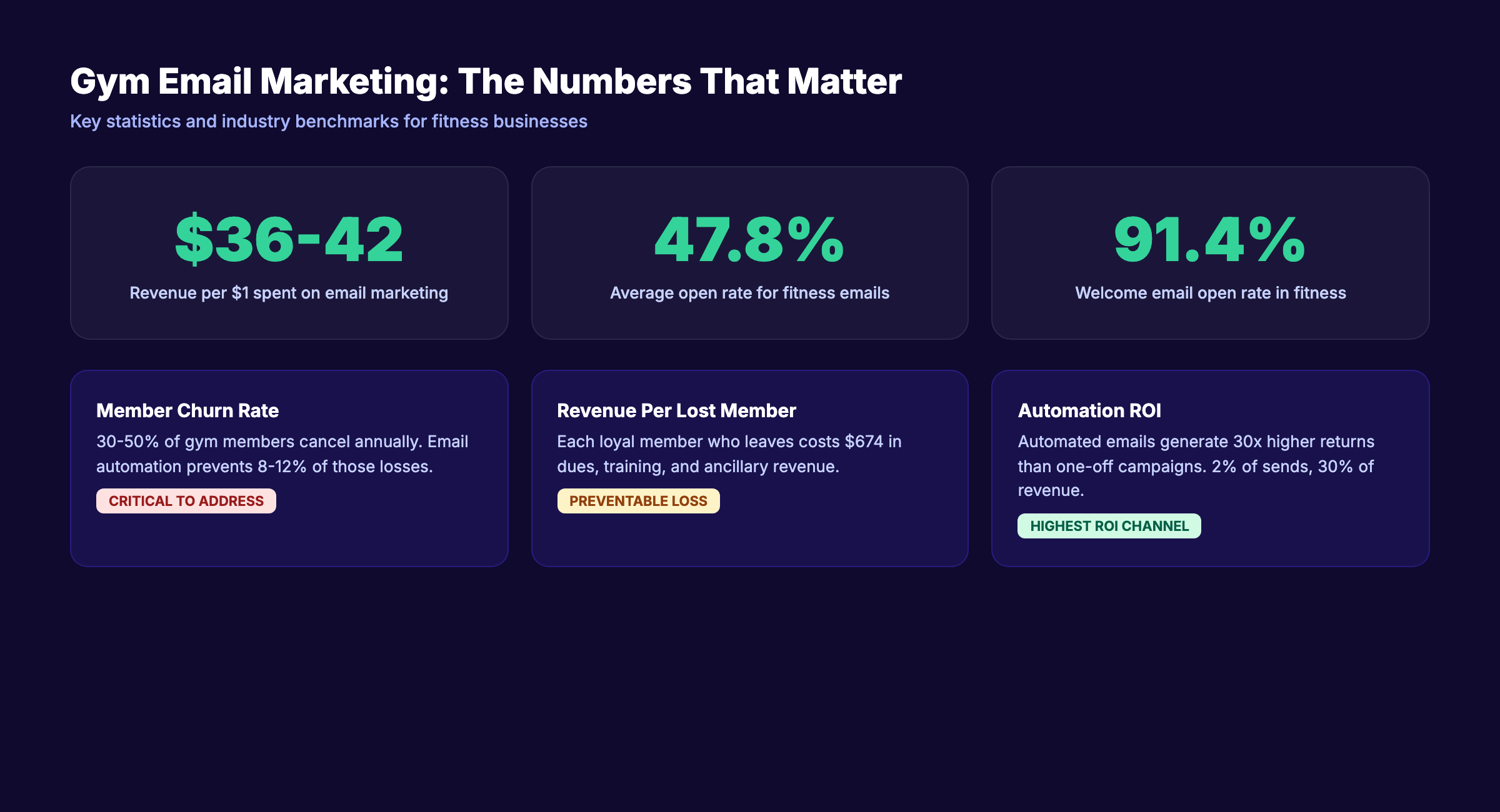
The numbers back this up. Email generates $36 to $42 in revenue for every $1 spent, according to Litmus. The fitness industry sees a 47.81% average open rate, well above the cross-industry average of 35 to 40%. Yet most gym owners send fewer than 3 emails per month and have no automation in place.
That gap between opportunity and execution costs real revenue. Every lost loyal member leaves a $674 revenue hole when you factor in monthly dues, personal training sessions, and retail purchases. Multiply that by 100 members per year and you are looking at $67,400 in preventable losses.
This guide covers every part of email marketing that matters for gyms in 2026. We publish 3,500+ blog posts per month across 70+ industries, including fitness businesses. This is everything we know about gym email strategy, distilled into 8 chapters.
Here is what you will learn:
- How to build a gym email list from zero (6 proven methods)
- The member lifecycle framework that maps emails to every stage
- 7 email campaigns every gym needs running right now
- Subject line formulas that beat the 47.81% industry open rate
- How to automate sequences that reduce churn and recover lapsed members
- Which metrics to track and what good benchmarks look like
- The 5 most common gym email mistakes and how to avoid them
Chapter 1: Why Email Marketing Works for Gyms
Gyms operate on recurring revenue. A member who stays 12 months is worth 6 to 10 times more than the cost to acquire them. Email is the highest-ROI channel for keeping those members engaged and renewing.
The ROI Advantage
Email marketing returns $36 to $42 for every dollar spent. No other marketing channel matches this. Social media organic reach averages 2 to 5%. Paid ads stop working the moment you stop paying. Email builds an owned audience that you control.
For a gym spending $50 per month on an email platform, that translates to $1,800 to $2,100 in potential monthly revenue from email alone. The math improves further with automation. Automated emails generate 30 times higher returns than one-off campaigns, according to Omnisend.
Why Gyms Are Perfectly Positioned
Fitness has the highest email open rates of any industry. MailerLite reports a 47.81% open rate and 1.45% click rate for health and fitness. Welcome emails in the fitness space hit a 91.43% open rate.
Gym members also have recurring touchpoints that create natural email triggers. Check-ins, class bookings, personal training sessions, membership renewals, and milestone achievements all generate behavioral data. That data fuels targeted emails that feel personal, not promotional.
The Cost of Not Emailing
50% of new gym members quit within the first 6 months. That is the industry standard. Most of those members never receive a single email after their welcome message. They drift away silently.
A gym with 500 members losing 40% annually replaces 200 members per year. At an average acquisition cost of $100 to $150 per member, that is $20,000 to $30,000 spent just to stay flat. Email reduces that churn by keeping members connected between visits.
Chapter 2: Build Your Gym Email List
An email list is only valuable if the people on it actually want to hear from you. Purchased lists destroy deliverability and violate CAN-SPAM regulations. Build your list with these 6 methods instead.
At Sign-Up
Every new member who walks through the door should enter your email system automatically. Connect your gym management software (Mindbody, Zen Planner, Gymdesk, or PushPress) to your email platform. This is not optional.
Collect first name, email address, and membership type at minimum. If your software supports it, also capture fitness goals and preferred class types. These fields power segmentation later.
Website Lead Magnets
Offer something valuable in exchange for an email address on your gym website. Effective lead magnets for gyms include:
- Free 7-day pass (highest conversion, works for every gym)
- Workout plan PDF (targets people researching fitness online)
- Nutrition guide (attracts health-conscious prospects)
- Body composition assessment (drives in-person visits)
Place the lead magnet form above the fold on your homepage and on every landing page. Read our guide on building an online presence for local businesses for more website conversion strategies.
In-Gym Collection Points
Put a tablet at your front desk with a simple email sign-up form. Offer a free smoothie, guest pass, or merchandise item for completing it. Train your front desk staff to mention it during every interaction.
QR codes on posters, locker room signage, and equipment tags also work. Link each QR code to a mobile-optimized landing page with a single form field.
Social Media Cross-Promotion
Use your gym’s social media presence to drive email sign-ups. Post the lead magnet link in your Instagram bio, Facebook page CTA button, and TikTok profile link. Run a monthly contest where entry requires an email address.
Referral Incentives
Existing members are your best acquisition channel. Offer a referral reward (free month, guest passes, branded merchandise) when a member refers someone who signs up for your email list. The referred contact enters your prospect nurture sequence automatically.
Events and Challenges
Host a free community workout, nutrition seminar, or 30-day fitness challenge. Registration requires an email address. These events attract warm prospects who already want what your gym offers.
Stop writing. Start ranking. Stacc publishes 30 SEO-optimized blog posts per month for your gym. Every article drives organic traffic to your website and email sign-up forms. Start for $1 →
Chapter 3: Segment Your Members by Lifecycle Stage
Sending the same email to every contact on your list is the fastest way to increase unsubscribes. The fitness industry already has the highest unsubscribe rate of any sector at 0.40%. Segmentation fixes that.
The Gym Member Lifecycle
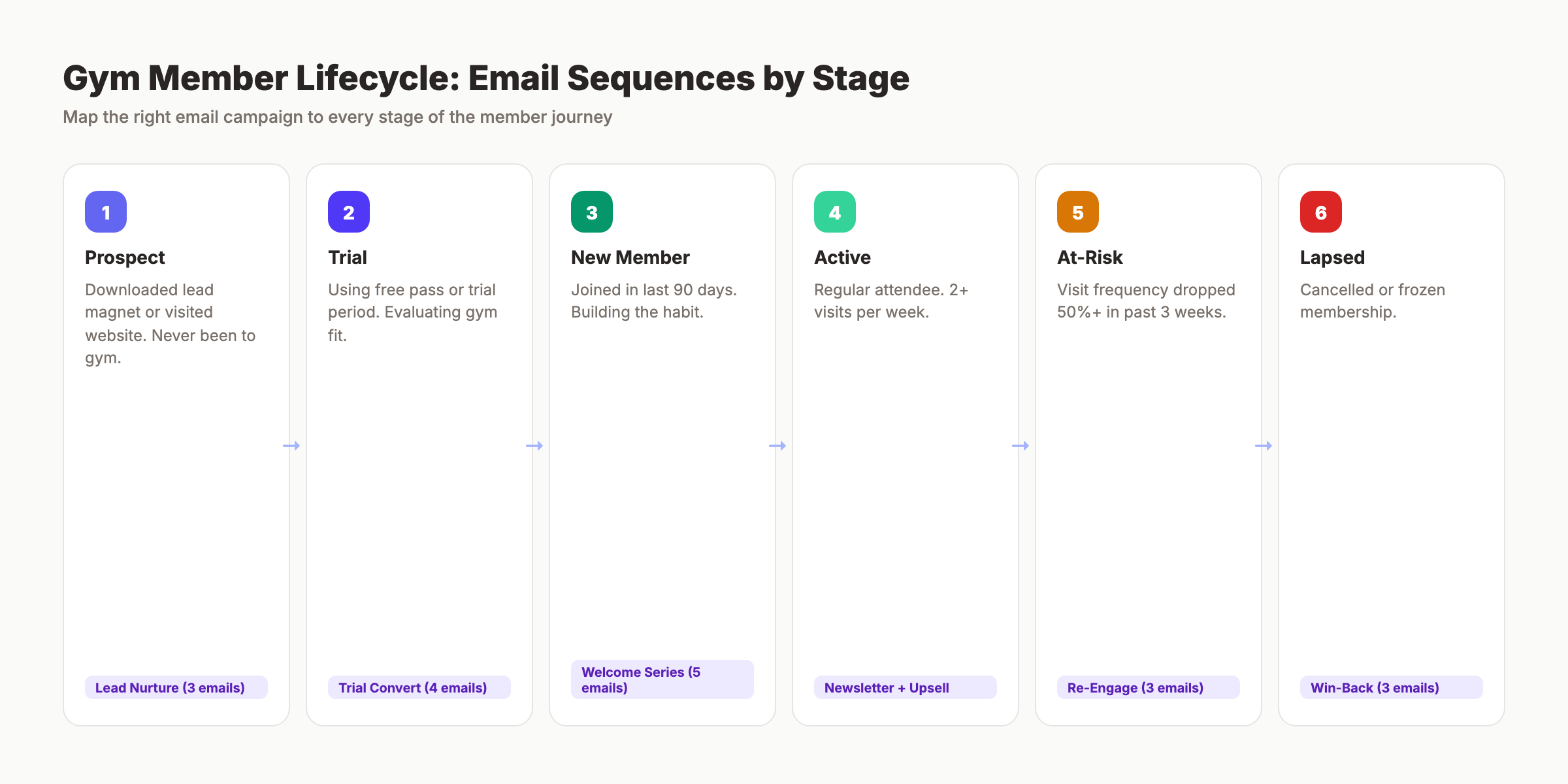
Every gym contact moves through 6 stages. Each stage requires different messaging.
| Stage | Who They Are | Email Goal |
|---|---|---|
| Prospect | Signed up for lead magnet, never visited | Convert to trial or first visit |
| Trial | Attending free trial or day pass | Convert to paid membership |
| New Member | Joined in the last 90 days | Onboard and build the habit |
| Active Member | Regular attendee (2+ visits/week) | Retain and upsell |
| At-Risk | Declining attendance (fewer than 1 visit/week for 3+ weeks) | Re-engage before cancellation |
| Lapsed | Cancelled or frozen membership | Win back within 90 days |
How to Segment in Practice
Most email platforms (Mailchimp, ActiveCampaign, MailerLite) support tag-based or list-based segmentation. Connect your gym management software via Zapier or native integration.
Segment by:
- Membership type: Group fitness, personal training, family, student, premium
- Attendance frequency: Daily, 3x/week, 1x/week, inactive
- Join date: First 30 days, 30-90 days, 90+ days
- Interests: Yoga, weightlifting, cardio, nutrition, group classes
- Engagement: Opens emails regularly, rarely opens, never opens
The most powerful segment is “at-risk.” Members who drop from 3 visits per week to 1 or fewer are 5 times more likely to cancel within 60 days. An automated re-engagement email sent at this trigger point alone can save 10 to 15% of at-risk members.
Chapter 4: 7 Email Campaigns Every Gym Needs
These 7 campaigns cover the full member lifecycle. Set them up once and let automation handle the rest.
1. Welcome Sequence (3 to 5 emails over 14 days)
Triggered immediately after sign-up. This is your highest-engagement window. Welcome emails achieve a 91.43% open rate in fitness.
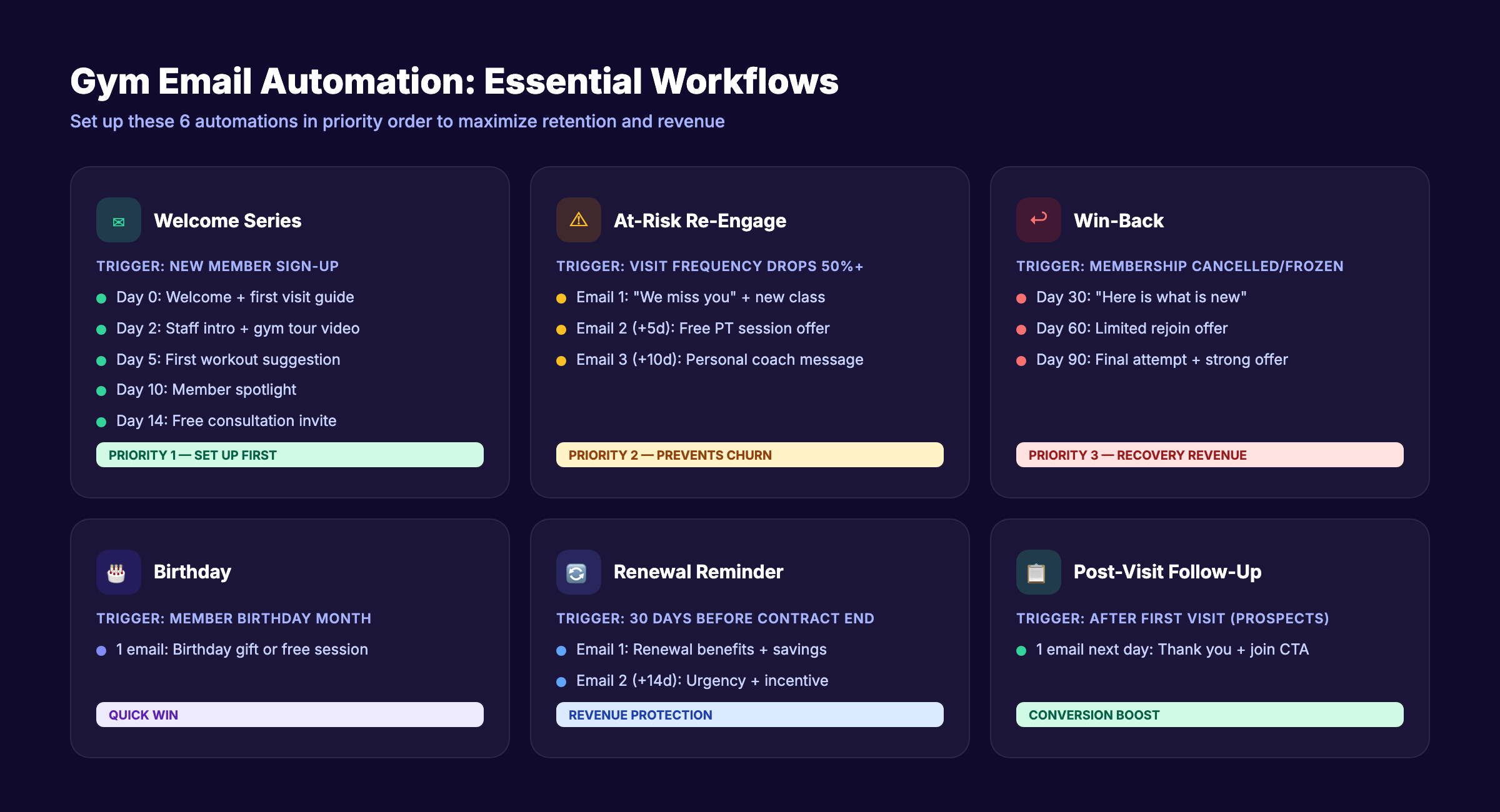
Email 1 (Day 0): Welcome + what to expect on your first visit (parking, what to bring, class schedule link) Email 2 (Day 2): Staff introduction + gym tour video Email 3 (Day 5): First workout suggestion based on their stated goal Email 4 (Day 10): Member spotlight or testimonial Email 5 (Day 14): Invitation to book a free consultation or class
2. Class and Event Promotion
Send weekly or bi-weekly emails highlighting upcoming classes, workshops, or special events. Include the schedule, instructor name, difficulty level, and a direct booking link.
Personalize by interest segment. A member tagged “yoga” should receive yoga class updates, not a CrossFit WOD preview.
3. Member Milestone Celebrations
Celebrate achievements automatically. Trigger emails for:
- 30-day membership anniversary
- 100th check-in
- Personal record achievements (if your software tracks them)
- Birthday month (offer a free session or discount)
These emails cost nothing to send and generate strong positive sentiment. Members who feel recognized are 3 times more likely to refer friends.
4. At-Risk Re-Engagement
Trigger when a member’s visit frequency drops below their average. The sequence should be warm and non-judgmental.
Email 1: “We miss you at [Gym Name].” Share a new class or program they have not tried. Email 2 (5 days later): Offer a free personal training session or group class pass. Email 3 (10 days later): Direct message from a coach or manager. Personal touch matters here.
5. Win-Back Campaign
For members who cancelled or let their membership lapse. Send at 30, 60, and 90 days post-cancellation.
Email 1 (Day 30): “Here is what is new since you left.” Highlight new equipment, classes, or renovations. Email 2 (Day 60): Limited-time rejoin offer (waived enrollment fee, discounted first month). Email 3 (Day 90): Final attempt. Stronger offer or emotional appeal (community, health goals).
Win-back campaigns recover 5 to 15% of lapsed members when executed well. At $674 average lifetime value per member, even a 5% recovery rate generates significant revenue.
6. Monthly Newsletter
One email per month with a mix of value and promotion. A good ratio is 80% useful content, 20% promotional.
Include:
- 1 member success story or transformation
- 2 to 3 fitness tips or nutrition advice
- 1 upcoming event or new class announcement
- 1 promotional offer (refer a friend, upgrade, retail)
Keep newsletters under 500 words. Link to your blog for longer content. If your gym publishes blog content for SEO, the newsletter becomes a distribution channel for that content.
7. Seasonal Campaigns
Gyms have predictable demand cycles. Build email campaigns around them.
| Season | Campaign Focus |
|---|---|
| January | New Year resolution offers, 30-day challenges |
| March/April | Spring body prep, outdoor training |
| June | Summer membership specials, outdoor boot camps |
| September | Back-to-routine after summer, student deals |
| November | Holiday gift cards, Black Friday membership deals |
The January surge is the single biggest acquisition opportunity for gyms. Start your email campaign in late December. Send a 3-email sequence: teaser (Dec 26), offer launch (Jan 1), urgency close (Jan 7).
Your SEO team. $99 per month. 30 optimized blog posts that drive organic traffic to your gym website. Every article builds your email list and local authority. Start for $1 →
Chapter 5: Write Subject Lines That Get Opened
Your subject line determines whether your email gets read or deleted. The fitness industry starts with a 47.81% open rate advantage. A strong subject line pushes that above 55%.
Subject Line Formulas That Work for Gyms
| Formula | Example | Why It Works |
|---|---|---|
| Number + Benefit | ”5 stretches that fix lower back pain” | Specific and useful |
| Question | ”Ready to hit a new PR this week?” | Creates curiosity |
| Urgency + Offer | ”Last day: $0 enrollment fee” | Drives immediate action |
| Personalization | ”[Name], your 100th check-in is tomorrow” | Feels personal |
| Curiosity Gap | ”The one exercise most people skip (and regret)“ | Demands the open |
| Social Proof | ”Sarah lost 22 lbs in 90 days. Here is how.” | Builds credibility |
Subject Line Rules
- Keep subject lines under 50 characters for mobile display
- Avoid spam triggers: “FREE,” “ACT NOW,” all caps, excessive exclamation marks
- Use the member’s first name when possible (adds 2 to 3% open rate lift)
- A/B test 2 subject lines per campaign. Send the winner to the remaining 80% of the list.
- Never use misleading subject lines. Trust is everything for a recurring membership business.
Preview text (the snippet shown after the subject line in inbox view) matters almost as much. Use it to extend the subject line’s promise, not repeat it.
Chapter 6: Automate Your Email Sequences
Manual email campaigns are unsustainable for gym owners who already manage operations, staff, and facility maintenance. Automation handles the repetitive work and sends the right message at the right time.
Essential Automations for Gyms
| Automation | Trigger | Sequence Length |
|---|---|---|
| Welcome series | New member sign-up | 5 emails over 14 days |
| At-risk alert | Visit frequency drops 50%+ | 3 emails over 10 days |
| Win-back | Membership cancelled or frozen | 3 emails over 90 days |
| Birthday | Member birthday month | 1 email with offer |
| Renewal reminder | 30 days before contract end | 2 emails over 14 days |
| Class reminder | 24 hours before booked class | 1 email |
| Post-visit follow-up | After first visit (prospects) | 1 email next day |
Choosing an Email Platform
Most gym owners do not need an enterprise email platform. These 4 cover the essentials.
| Platform | Starting Price | Best For |
|---|---|---|
| Mailchimp | Free (up to 500 contacts) | Gyms just starting with email |
| MailerLite | $9/month | Small gyms wanting automation |
| ActiveCampaign | $29/month | Gyms needing advanced segmentation |
| Constant Contact | $12/month | Gyms wanting built-in event management |
Choose a platform that integrates with your gym management software. A direct integration between Mindbody (or Zen Planner, Gymdesk, PushPress) and your email platform eliminates manual data entry. Zapier bridges the gap when native integrations do not exist.
For gym owners looking for email marketing tools designed for local businesses, we compare the top options in a dedicated guide.
Set Up in This Order
- Welcome sequence first. This has the highest open rates and sets the tone for the entire member relationship.
- At-risk re-engagement second. This directly prevents revenue loss.
- Win-back campaign third. Recovery revenue from lapsed members.
- Monthly newsletter fourth. Ongoing engagement for active members.
- Seasonal campaigns last. These are calendar-driven and can wait until each season approaches.
Chapter 7: Measure Results and Optimize
Sending emails without tracking results is like running a gym without counting memberships. You need data to improve.
Key Metrics for Gym Email Marketing
| Metric | Industry Benchmark | What It Tells You |
|---|---|---|
| Open Rate | 47.81% (health/fitness) | Subject line effectiveness |
| Click Rate | 1.45% (health/fitness) | Content relevance and CTA strength |
| Unsubscribe Rate | 0.40% (health/fitness) | Email frequency or content mismatch |
| Conversion Rate | Varies by campaign | Revenue impact of each email |
| List Growth Rate | 2-5% per month | Health of your acquisition funnel |
| Revenue Per Email | Varies | Direct ROI measurement |
How to Improve Each Metric
Low open rates (below 40%): Test new subject lines. Send at different times. Clean your list by removing contacts who have not opened in 90+ days. A smaller, engaged list outperforms a large, inactive one.
Low click rates (below 1%): Simplify your email design. Use one clear CTA per email, not 5 competing links. Make the CTA button large and above the fold on mobile.
High unsubscribe rates (above 0.5%): You are emailing too often or sending irrelevant content. Reduce frequency or improve segmentation. Give subscribers a preference center where they choose how often they want to hear from you.
Track revenue attribution. Use UTM parameters on every link in your emails. Tag each campaign in Google Analytics. Connect the dots between email clicks and membership sign-ups, class bookings, or retail purchases.
Run a monthly review. Block 30 minutes on the first Monday of each month. Review your top 3 performing emails and your bottom 3. Identify what worked, what failed, and adjust your next month’s plan.
For a broader look at tracking marketing performance, read our guide on measuring content marketing ROI.
Chapter 8: 5 Common Gym Email Marketing Mistakes
Most gym email programs fail not because of bad strategy but because of avoidable execution errors. Fix these 5 first.
Mistake 1: Sending Without Segmentation
Blasting the same email to every contact signals that you do not know your members. A prospect who has never visited does not care about your advanced powerlifting workshop. An active member does not need a “we miss you” re-engagement email.
Segment by lifecycle stage at minimum. Even basic segmentation (prospect vs. member vs. lapsed) improves open rates by 14 to 20%.
Mistake 2: No Welcome Sequence
The first 14 days after joining are the highest-risk window for churn. A member who receives no communication after sign-up feels like a transaction, not a community member. Set up a 3 to 5 email welcome sequence before you do anything else.
Mistake 3: Selling in Every Email
If every email is a promotional offer, members tune out. The 80/20 rule works: 80% valuable content (tips, stories, education), 20% promotional (offers, upgrades, referral asks). Members who trust your emails open them. Members who expect a sales pitch delete them.
Mistake 4: Ignoring Mobile
78% of email opens happen on mobile devices. If your emails require horizontal scrolling, have tiny fonts, or use images that do not load, you lose most of your audience. Use a single-column layout, 16px minimum font size, and buttons instead of text links.
Mistake 5: Never Cleaning the List
An email list degrades 25 to 30% per year from abandoned addresses, changed emails, and spam traps. Sending to dead addresses hurts your sender reputation, which reduces deliverability for every email you send. Remove contacts who have not opened an email in 6 months. Re-engagement campaigns go out before removal, not after.
3,500+ blogs published. 92% average SEO score. Stacc drives organic traffic to your gym website. More traffic means more email sign-ups, more members, and more revenue. Start for $1 →
FAQ
How often should a gym send marketing emails?
Most successful gyms send 5 to 7 emails per month. That breaks down to 1 newsletter, 1 to 2 promotional emails, and 2 to 3 automated lifecycle emails per member. Avoid daily emails. The fitness industry has the highest unsubscribe rate across all sectors, and over-emailing is the primary cause.
What is a good email open rate for gyms?
The industry benchmark is 47.81% for health and fitness businesses, according to MailerLite’s 2025 benchmarks. Welcome emails perform even higher at 91.43%. If your open rate falls below 35%, your subject lines need work or your list needs cleaning.
Does email marketing work for small gyms and personal trainers?
Yes. Email marketing scales down just as well as it scales up. A personal trainer with 50 contacts and a proper welcome sequence, monthly newsletter, and birthday automation will retain more clients than one relying on social media alone. The tools cost $0 to $9 per month at that list size.
What is the best email marketing platform for a gym?
For gyms under 500 contacts, Mailchimp’s free plan covers the basics. For gyms needing automation and segmentation, MailerLite ($9 per month) or ActiveCampaign ($29 per month) are the best options. The deciding factor is integration with your gym management software. Choose the platform that connects directly to Mindbody, Zen Planner, or whichever system you use.
How can email marketing reduce gym member churn?
Email reduces churn by maintaining a connection between visits. At-risk re-engagement emails, triggered when visit frequency drops, recover 10 to 15% of members who would otherwise cancel. Win-back campaigns recover an additional 5 to 15% of lapsed members. Combined, a basic email automation program can reduce annual churn by 8 to 12 percentage points.
Email marketing for gyms is not about blasting promotional offers. It is about building a communication system that matches the right message to the right member at the right time. Start with a welcome sequence, add at-risk automation, and review your metrics monthly. The gyms that retain 70%+ of their members all year are the ones that treat email as a retention system, not a megaphone.
Written and published by Stacc. We publish 3,500+ articles per month across 70+ industries. All data verified against public sources as of March 2026.
