What Is the GBP Engagement Metric? Guide
GBP engagement metrics like clicks, calls, and direction requests now drive local rankings. Learn what they are and how to improve them. Updated April 2026.
Siddharth Gangal • 2026-04-02 • Local SEO
In This Article
Google Business Profile is no longer a static listing. It is a live engagement surface. And the metrics that measure how users interact with your profile now directly influence where you rank in the local pack.
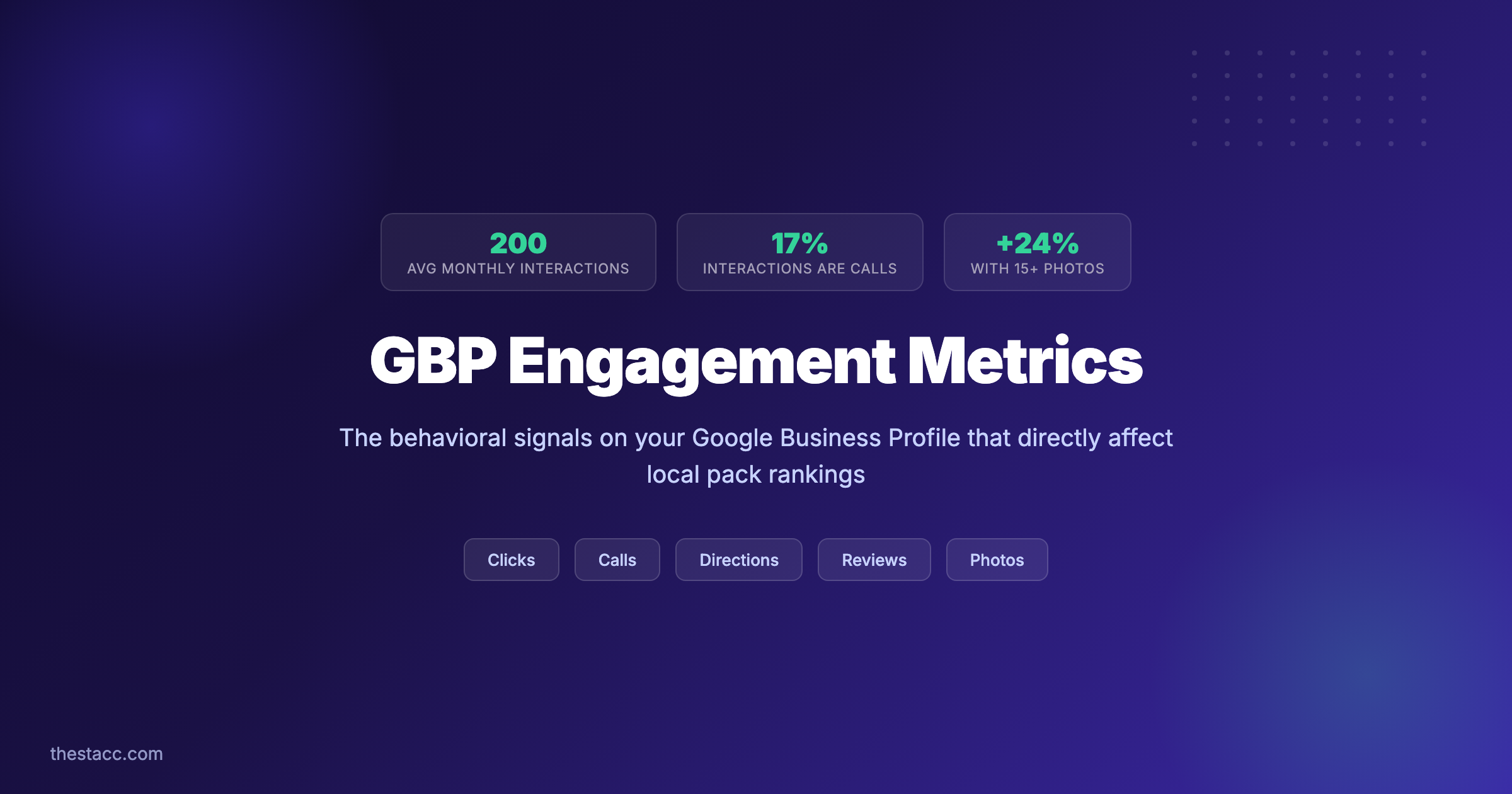
The GBP engagement metric refers to the set of behavioral signals Google tracks on your Business Profile: clicks to your website, phone calls, direction requests, photo views, booking actions, and post interactions. In 2026, these engagement signals have quietly become some of the strongest local ranking factors.
A verified Google Business Profile generates an average of 200 clicks or interactions per month. Businesses with higher engagement rates rank higher. The relationship is measurable and actionable.
What Is the GBP Engagement Metric?
The GBP engagement metric is a collective term for all user interactions that happen on your Google Business Profile. Google tracks these interactions and uses them as behavioral signals to assess whether your business is relevant, trustworthy, and actively serving customers.
The core engagement metrics Google measures include:
| Metric | What It Tracks | Why It Matters |
|---|---|---|
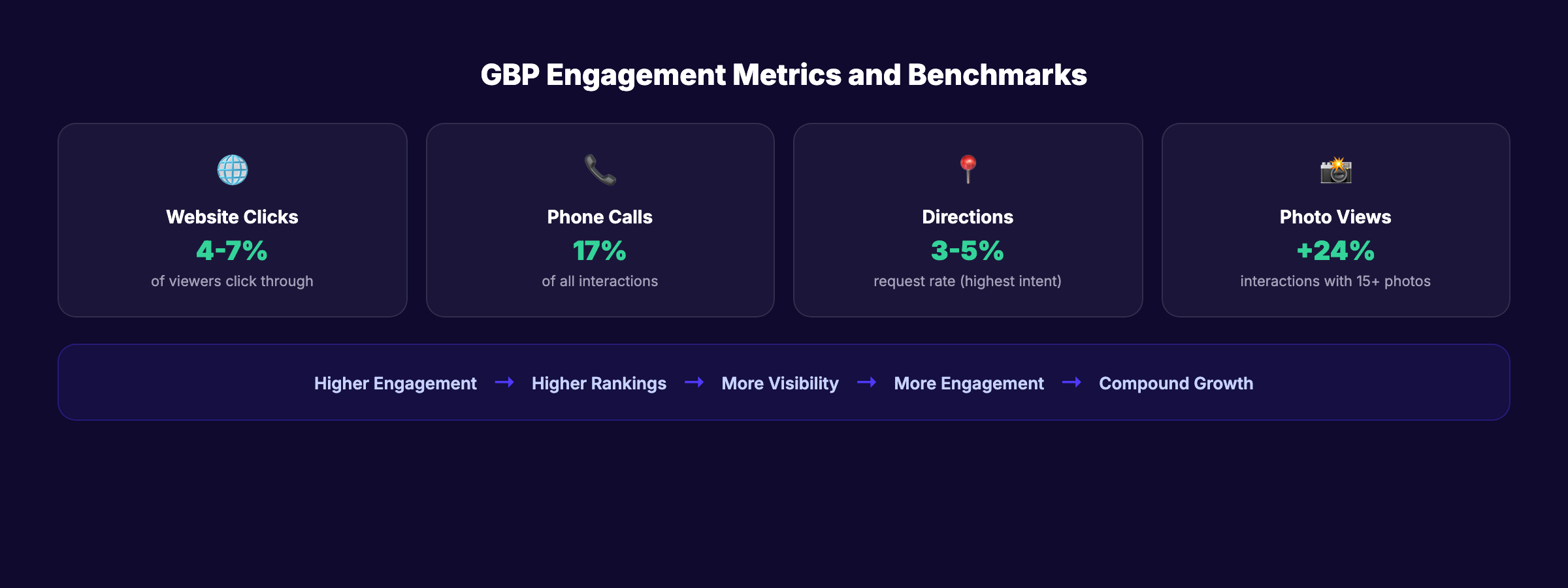
| Website clicks | Users clicking your website link | High-intent signal. 4-7% of viewers click through |
| Phone calls | Users clicking your call button | 17% of all GBP interactions are phone calls |
| Direction requests | Users clicking “Get directions” | Strongest purchase intent signal. User is planning a visit |
| Booking clicks | Users clicking a booking link | Direct conversion action |
| Photo views | Users viewing your photos | Profiles with 15+ photos see 24% higher interaction rates |
| Post interactions | Users engaging with your GBP posts | Signals an active, relevant business |
| Message conversations | Users starting a chat | Direct engagement with the business |
Google aggregates these signals into a behavioral profile of your listing. High engagement tells Google: “Users find this business useful. Show it to more people.” Low engagement tells Google: “Users ignore this listing. Rank it lower.”
Key point: GBP engagement is not just a vanity metric. It is a local ranking factor that directly affects your position in the local pack and Google Maps.
Why GBP Engagement Metrics Matter
They Are Rising in Ranking Importance
The Whitespark Local Search Ranking Factors study tracks what drives local rankings each year. In 2026, behavioral and engagement signals (clicks, calls, direction requests, review cadence) are climbing fast in importance. Post activity, photo freshness, and review velocity now separate position 1 from position 5.
They Feed AI Search Results
Google AI Overviews trigger on 40% of local queries. The AI pulls from the same engagement signals: review recency, photo freshness, post activity, and service completeness. Businesses with active, engaging profiles appear in both the local pack and AI-generated answers.
They Reflect Real Customer Behavior
59% of GBP interactions come from mobile users ready to call, visit, or get directions. 88% of consumers who search locally on mobile visit or call within 24 hours. GBP engagement metrics measure the exact moment potential customers decide to act.
The bottom line: Businesses that actively generate engagement on their GBP listings outrank those with static, neglected profiles. The data is clear.
Rank everywhere. Do nothing. Blog SEO, Local SEO, and Social on autopilot. 30 GBP posts per month. Start for $1 →
How GBP Engagement Metrics Affect Rankings
Google uses engagement metrics as behavioral validation signals. The logic is straightforward.
The Engagement Ranking Loop
- A user searches “dentist near me”
- Google shows 3 businesses in the local pack
- The user clicks on Business A’s listing, views photos, and calls
- Google records those engagement signals for Business A
- Over time, Business A consistently generates more clicks, calls, and interactions than Business B and C
- Google ranks Business A higher because user behavior confirms it is the most useful result
The loop is self-reinforcing. Higher engagement leads to higher rankings. Higher rankings lead to more visibility. More visibility leads to more engagement. Businesses that enter the loop early compound their advantage.
What Google Specifically Tracks
Beyond the basic click/call/direction metrics, Google also evaluates:
- Review velocity: How frequently you receive new reviews. A business getting 5 reviews per month outranks one getting 5 reviews per year
- Review response rate: Businesses that respond to reviews demonstrate active management. Google weights response rate as a ranking signal
- Photo freshness: Profiles with recently uploaded photos engage users more. Monthly photo uploads correlate with 24% higher interactions
- Post frequency: Regular GBP posts signal an active business. Inactive profiles lose ranking momentum
- Business hours accuracy: Being listed as “open” when users search is now a top 5 local pack ranking factor
Best Practices for Improving GBP Engagement
Publish GBP posts weekly. Each post creates a new engagement opportunity. Share offers, updates, events, and tips. Posts remain visible for 6 months. Consistent posting signals an active business and gives users reasons to interact. Read our guide on optimizing Google Business Profile for the full strategy.
Upload new photos at least twice per month. Profiles with 15+ photos and regular uploads see measurably higher engagement. Show your team, your work, your location, and your products. Real photos outperform stock images.
Respond to every review within 24 hours. Response rate is a ranking signal. Speed of response affects customer perception. Use a professional, helpful tone for both positive and negative reviews. Our review response generator can help.
Keep business information accurate. Incorrect hours, closed locations, or wrong phone numbers create negative engagement signals. Users who call a wrong number or visit during “open” hours and find a closed business generate bounce signals that hurt rankings.
Add all relevant services and products. Complete service listings with descriptions and pricing give users more reasons to engage. Incomplete profiles generate fewer clicks. Fill every available field in your GBP dashboard.
Enable messaging and booking. Every additional interaction channel increases total engagement. If your business can handle messages and bookings, enable them. More interaction options mean more engagement signals.
Common Mistakes to Avoid
-
Neglecting the profile after setup. A GBP listing created and never updated sends the opposite of an engagement signal. Google sees zero activity and ranks accordingly. GBP optimization is ongoing, not a one-time task.
-
Ignoring negative reviews. Unresponded negative reviews hurt both engagement metrics and customer trust. Responding to negative reviews is more important than responding to positive ones. It shows active management and gives Google a response signal.
-
Using stock photos instead of real ones. Stock photos do not differentiate your business. Users scroll past generic images. Real photos of your location, team, and work generate more photo views and longer dwell time on your listing.
GBP Engagement and Stacc
Stacc publishes 30 GBP posts per month for local businesses. Each post creates a new engagement touchpoint. Consistent posting drives clicks, calls, and direction requests. Over time, the engagement signals compound into higher local pack rankings. Combined with blog SEO (30 articles per month), the Stacc Stack Method builds visibility across both organic search and local results.
3,500+ blogs published. 92% average SEO score. See what Stacc can do for your site. Start for $1 →
Learn More
Related topics:
- Optimize Google Business Profile
- How to Get More Google Reviews
- Local SEO Guide
- Local SEO Statistics
- Predictive Local SEO
FAQ
Is GBP engagement a confirmed Google ranking factor?
Google does not publicly confirm individual ranking factors. But the Whitespark Local Search Ranking Factors study and multiple industry analyses confirm that behavioral engagement signals (clicks, calls, direction requests) correlate strongly with local pack rankings. Google’s own documentation describes these as “interaction” metrics that reflect business relevance.
What is a good GBP engagement rate?
Industry benchmarks vary. Website click-through rates average 4-7% of profile viewers. Direction request rates average 3-5%. Phone calls account for 17% of all interactions. B2B service companies often see higher website click rates of 10-12%. Restaurants and retail businesses see higher direction request rates of 7-10%.
How often should I post on Google Business Profile?
At minimum, once per week. Businesses posting weekly or more see higher engagement rates and stronger local rankings than those posting monthly or less. Each post stays visible for 6 months. Consistent posting builds cumulative engagement signals that compound over time.
Do GBP engagement metrics affect AI search results?
Yes. Google AI Overviews pull from the same signals that feed local pack rankings. Review recency, photo freshness, post activity, and service completeness all influence whether your business appears in AI-generated local answers. Active profiles are more likely to be cited in both local pack results and AI Overviews.
GBP engagement metrics are the behavioral signals that separate local businesses that rank from those that do not. Active profiles with fresh content, regular reviews, and consistent user interactions build the ranking momentum that static listings cannot match. Start publishing, start engaging, and let the loop compound.
Written and published by Stacc. We publish 3,500+ articles per month across 70+ industries. All data verified against public sources as of March 2026.