
What Is Predictive Local SEO? Complete Guide
Predictive local SEO uses AI to forecast local search demand before it peaks. Learn how it works, key tactics, and why it matters. Updated April 2026.
Most local SEO is reactive. A business optimizes for keywords that already have demand. Predictive local SEO flips that approach. It uses AI and historical data to forecast which local searches will surge before they peak, then builds content and optimizations to capture that demand first.
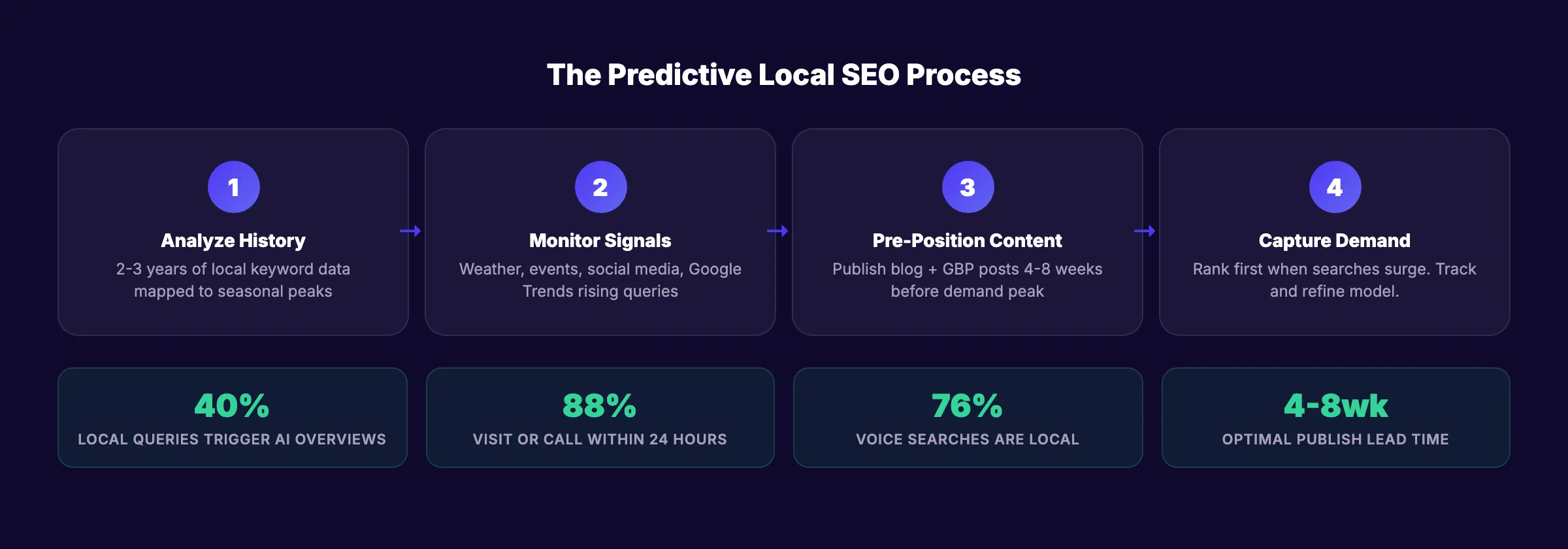
The opportunity is significant. 40% of local business queries now trigger Google AI Overviews. 88% of consumers who run a local search on their phone visit or call a business within 24 hours. And 76% of voice searches involve “near me” or local queries.
The businesses that predict local demand patterns 4-8 weeks ahead rank before competitors even start optimizing. This guide covers how predictive local SEO works and how to apply it.
What Is Predictive Local SEO?
Predictive local SEO is the practice of using machine learning, historical search data, and trend analysis to forecast local search demand before it peaks. Instead of reacting to current keyword volumes, predictive local SEO anticipates future demand and positions content, Google Business Profile updates, and local pages to capture traffic at the moment demand arrives.
Traditional local SEO asks: “What are people searching for right now?”
Predictive local SEO asks: “What will people in this area search for in 4-8 weeks?”
The approach combines 3 data sources:
- Historical search patterns: Year-over-year search volume data for local keywords reveals seasonal cycles. “AC repair near me” surges every June. “Snow removal service” spikes every November. These patterns repeat predictably.
- Real-time trend signals: Social media conversations, weather forecasts, local events, and news all indicate upcoming demand shifts before search volumes change.
- AI pattern recognition: Machine learning models analyze thousands of data points to identify emerging trends that manual analysis would miss.
Key point: Predictive local SEO gives businesses a head start on seasonal and event-driven demand, which is the majority of local search volume.
Why Predictive Local SEO Matters
Local search is time-sensitive. A business that ranks for “emergency plumber near me” on the day a cold snap hits captures every call. A business that starts optimizing after the cold snap misses the window.
Seasonal demand drives local revenue. HVAC, landscaping, pest control, tax preparation, wedding services, home renovation. Every local service industry has seasonal peaks. Predictive local SEO ensures your content and GBP posts are live and indexed before each peak begins.
AI Overviews change local search. Over 40% of local queries now trigger AI Overviews. AI Overviews pull from recently published, relevant content. A GBP post or blog article published 2 weeks before a seasonal surge is more likely to appear in AI Overviews than content published months ago.
Mobile behavior demands speed. 84% of local searches happen on mobile. 88% of those searchers visit or call within a day. The window between search and action is hours, not days. Predictive optimization ensures you are visible during that window.
First-mover advantage compounds. Content published before demand peaks gets indexed first. It earns early clicks and engagement signals. By the time competitors publish their seasonal content, your pages already have ranking momentum.
The bottom line: Reactive local SEO competes at peak demand when every competitor is active. Predictive local SEO captures demand early when competition is low.
Rank everywhere. Do nothing. Blog SEO, Local SEO, and Social on autopilot. 30 articles and 30 GBP posts per month. Start for $1 →
How Predictive Local SEO Works
Step 1: Analyze Historical Local Search Data
Export 2-3 years of keyword research data for your local market. Google Trends, Google Ads Keyword Planner, and Search Console all provide historical volume data. Map every keyword to its seasonal peak month.
| Service Category | Peak Search Months | Content Publish Window |
|---|---|---|
| HVAC / AC repair | June-August | Publish by mid-May |
| Plumbing (frozen pipes) | December-February | Publish by mid-November |
| Tax preparation | January-April | Publish by December |
| Landscaping | March-May | Publish by February |
| Pest control | April-June | Publish by March |
| Holiday retail | October-December | Publish by September |
Build a 12-month content calendar that maps seasonal content to publish dates 4-8 weeks before each peak.
Step 2: Monitor Real-Time Trend Signals
Seasonal patterns are predictable. Unexpected demand spikes are not. Monitor these signals for emerging local search demand:
- Weather forecasts. Extended forecasts trigger service demand. A predicted heat wave drives AC searches. A hurricane warning drives generator and emergency supply searches.
- Local events and news. New business openings, road construction, school schedules, festivals, and sports events all shift local search patterns.
- Social media conversations. Reddit, Nextdoor, and local Facebook groups reveal emerging pain points before they become search queries. A neighborhood thread about rising crime drives “home security near me” searches within days.
- Google Trends rising queries. The “rising” filter in Google Trends shows queries gaining momentum in your geographic area. Check weekly.
Step 3: Create Pre-Positioned Content
For each predicted demand surge, publish content 4-8 weeks before the expected peak.
Blog content. Write local-focused articles targeting seasonal long-tail keywords. “How to prepare your AC for summer in [City]” published in April captures May and June traffic. Read our local SEO guide for the full content strategy.
GBP posts. Publish Google Business Profile posts that match upcoming seasonal demand. GBP posts are active for 6 months. A post about winterization services published in October captures searches through March.
Service pages. Update or create service pages for seasonal offerings before demand peaks. Add location-specific content and LocalBusiness schema markup.
Step 4: Track and Refine Predictions
After each seasonal cycle, compare your predictions against actual search data. Which keywords surged as expected? Which surprised you? Update your prediction model for the next year.
Track these metrics per seasonal campaign:
- Search Console impressions and clicks during the predicted peak period
- Local pack ranking changes during the prediction window
- GBP post views and engagement during seasonal periods
- Calls and direction requests tied to seasonal content
Best Practices for Predictive Local SEO
Build a 12-month prediction calendar. Map every seasonal keyword in your industry to a publish date 4-8 weeks before peak demand. Review and update this calendar quarterly. The more years of historical data you have, the more accurate your predictions become.
Combine blog SEO with GBP posting. Blog articles rank in organic results. GBP posts appear in local pack and Google Maps results. Publishing both for the same seasonal keyword covers both surfaces. Stacc automates both through Blog SEO and Local SEO modules.
Use Google Business Profile attributes strategically. Update seasonal service offerings, hours, and business descriptions before each peak. GBP attributes feed into AI Overviews and local pack rankings.
Target “near me” and “[service] in [city]” keywords. 76% of voice searches are local. Optimize for conversational, location-specific queries. Predictive content should include specific city and neighborhood names.
Encourage seasonal reviews. Request reviews during and immediately after peak seasons when customer satisfaction is highest. Fresh reviews during seasonal peaks boost local pack visibility exactly when demand is highest.
Common Mistakes to Avoid
-
Publishing seasonal content too late. Google takes 2-4 weeks to index and rank new content. Publishing a summer AC guide in June means missing June traffic entirely. Publish 4-8 weeks before the expected peak. Earlier is better.
-
Ignoring non-seasonal prediction signals. Seasonal patterns are the foundation. But local events, weather anomalies, and economic shifts also create search demand. A new competitor opening nearby drives “best [service] in [city]” searches. Monitor these signals weekly.
-
Relying on national search data for local predictions. “HVAC repair” peaks in June nationally. But in Phoenix it peaks in May. In Minneapolis it peaks in July. Use location-specific Google Trends data, not national averages.
Predictive Local SEO and Stacc
Stacc publishes 30 blog articles and 30 GBP posts per month. For local businesses, that publishing cadence creates a natural prediction advantage. Monthly content covers seasonal keywords before each peak arrives. Fresh GBP posts keep your profile active during high-demand periods. The compounding effect of consistent local publishing means your local presence strengthens with every seasonal cycle.
3,500+ blogs published. 92% average SEO score. See what Stacc can do for your site. Start for $1 →
Learn More
Related topics:
- Local SEO Guide
- Optimize Google Business Profile
- Local SEO Statistics
- Create a Content Calendar for SEO
- AI Search Is Changing SEO
FAQ
What is the difference between predictive SEO and regular local SEO?
Regular local SEO optimizes for keywords that currently have demand. Predictive local SEO forecasts which keywords will have demand in the future and optimizes before the peak arrives. The core tactics (content creation, GBP optimization, schema markup) are the same. The timing is different. Predictive local SEO publishes 4-8 weeks ahead of expected demand.
What tools do I need for predictive local SEO?
Google Trends (with location filter), Google Search Console historical data, and Google Ads Keyword Planner provide the foundation. For advanced prediction, tools like Semrush Trends, Exploding Topics, and AI forecasting platforms like Prophet or custom models analyze patterns across multiple data sources. Most small businesses can start with Google Trends alone.
How far ahead should I publish seasonal local content?
4-8 weeks before the expected demand peak. Google needs 2-4 weeks to crawl, index, and rank new content. Publishing earlier gives your pages time to build ranking signals before competitors enter the market. For major seasonal peaks (tax season, summer services), 8 weeks ahead is ideal.
Does predictive local SEO work for small businesses?
Yes. Small local businesses benefit the most because the prediction window matters more in local search. A single plumber who publishes frozen pipe content in November captures December searches that bigger competitors miss. The approach scales with available data but works at any business size.
Predictive local SEO is how forward-thinking local businesses stop competing during peak demand and start owning it before competitors arrive. The data is available. The patterns repeat every year. The businesses that act on predictions first rank first.

Written by
Siddharth GangalSiddharth is the founder of theStacc and Arka360, and a graduate of IIT Mandi. He spent years watching great businesses lose organic traffic to competitors who simply published more. So he built a system to fix that. He writes about SEO, content at scale, and the tactics that actually move rankings.
Automate your Google Business Profile content
30 GBP posts, local SEO articles, and review responses. Published every month automatically.
30-day trial · Cancel anytime
theStacc
Stop writing SEO content manually
30 blog articles, 30 GBP posts, and social media content. Published every month. Automatically.
Start Your $1 Trial$1 for 3 days · Cancel anytime