Explain SEO to a client by translating it into business outcomes rather than rankings. Cover what SEO is, how long it takes, what you will do each month, what they must supply, and how you will report. Set the timeline early: meaningful movement usually takes three to six months.
Most clients have one question before they sign: "Will this actually work?"
That is not a technical question. It is a trust question.
When clients do not understand SEO, they second-guess every invoice. They churn after 60 days. They hire someone cheaper and restart the same cycle. Poor client communication costs agencies more business than poor SEO execution ever will.
We have published 3,500+ blog articles across 70+ industries. In that time, we have seen exactly where client relationships break down. Almost always in the explanation, not the results.
Here is what you will learn:
- How to gauge a client's knowledge level before your first explanation
- The exact definition of SEO that resonates with non-technical clients
- 4 analogies that make SEO click for any business owner
- The 3-pillar framework that simplifies your entire pitch
- How to set expectations that keep clients from churning at month 3
- How to translate SEO metrics into business outcomes clients actually care about
- How to handle the 5 most common objections before they come up
Time required: 20–30 minutes per client onboarding conversation Difficulty: Beginner What you will need: A client context brief, basic SEO knowledge, and a reporting tool
Step 1: Gauge Your Client's Starting Point
Before you explain anything, ask one question: "What does your current website do for your business?"
The answer tells you everything.
If they say "not much" or "I am not sure," you are starting from scratch. If they say "it drives about 30% of our leads," you are talking to someone who understands digital channels.
The explanation you give a plumber who has never heard of Google Search Console is different from the one you give a B2B SaaS founder who already tracks organic traffic. Do not assume knowledge. Do not assume ignorance. Ask, then calibrate.
Questions that reveal their level:
- "Have you done any SEO before?"
- "Do you know what keywords your customers search before finding you?"
- "Are you currently tracking where your website visitors come from?"
Why this step matters: If you pitch technical solutions to a non-technical client, you lose them in the first 3 minutes. The gap between client knowledge and your explanation is where trust breaks down. Not in month 6 when results are slow.
Pro tip: Add these 3 questions to a short intake form before every discovery call. You will walk into each meeting knowing exactly which gear to start in.
Step 2: Define SEO in Business Terms, Not Technical Ones
Most SEO explanations start with how search engines work. That is the wrong starting point.
Clients do not care about crawl budgets or index freshness. They care about one thing: "How does this get me more customers?"
Start there.
The 10-second definition:
"SEO is the process of making your website appear higher on Google when someone searches for what you sell. The higher you appear, the more people visit. More visitors means more leads."
That is it. Do not expand unless they ask.
For clients who want more detail, explain the business logic behind it:
- 75% of Google users never scroll past the first page of results
- Organic search drives more traffic than paid ads, email, and social combined
- Unlike paid ads, SEO traffic compounds. The work done today pays dividends for years
The key framing shift: SEO is not a marketing expense. It is an asset. Every article, every optimized page, and every earned link builds value that accumulates over time.
For clients who are completely new to digital marketing, the SEO guide for small businesses covers the full foundation in plain language.
Why this step matters: Clients who understand the business case for SEO stay longer. Clients who only know they "need SEO" leave the moment results are not immediate.
Step 3: Use Analogies That Make SEO Click
Analogies are the fastest path to client understanding. They bypass jargon and connect new concepts to things clients already know.
These are the 4 analogies that work in almost every client conversation.
The Yellow Pages Analogy (best for local businesses and older clients)
"Google is the new Yellow Pages. But instead of paying to be listed, you earn your position by being the most relevant answer. SEO is how you earn that position."
The Real Estate Analogy (best for business-minded clients)
"A page 1 ranking is like commercial real estate. The higher the foot traffic, the more valuable the location. SEO builds your presence on the busiest street in your industry."
The Résumé Analogy (best for B2B and professional service clients)
"Every piece of content we publish is like adding a credential to your website's résumé. Over time, Google recognizes your site as the most qualified answer in your field."
The Word-of-Mouth Analogy (best for service business owners)
"When a satisfied customer refers you, they tell one person. When a top-ranked Google listing refers you, it tells thousands of people every month. Automatically."
Pick one analogy per client. Use the one that fits their world. A restaurant owner connects with "location and foot traffic." A law firm partner connects with "credentials and reputation."
Why this step matters: Clients who cannot visualize SEO cannot justify it internally. When they present your services to a business partner or CFO, they need a simple story. Give them one.
Your clients need SEO explained. Your competitors need it done. theStacc writes, optimizes, and publishes SEO articles automatically. So your clients rank while you focus on selling.
Step 4: Break Down the 3 Pillars of SEO Without the Jargon
Once the analogy clicks, clients want to understand what SEO actually involves. Give them a simple 3-part framework.
Do not say "on-page, off-page, and technical SEO." Those labels mean nothing to non-SEO clients.
Instead, use this framework:
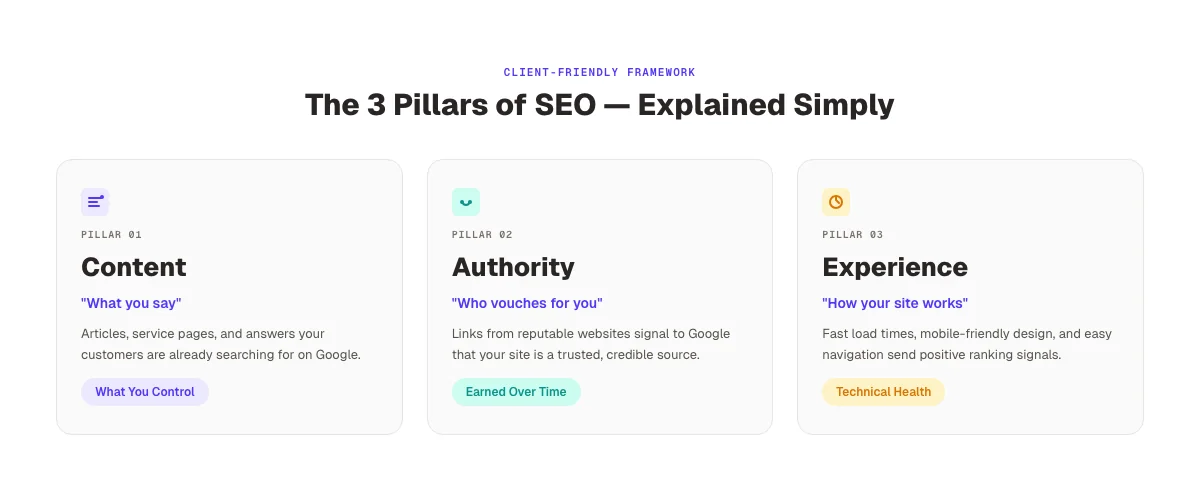
Pillar 1: Content. What You Say
Your website needs to answer the exact questions your customers are already searching. Every article, every service page, and every FAQ is a potential match for a real search query. Google reads your content and decides whether you are the right answer.
Pillar 2: Authority. Who Vouches for You
When other reputable websites link to yours, Google interprets that as a vote of confidence. The more quality links you earn, the more Google trusts you as a credible source. Think of it as professional endorsements from other established businesses.
Pillar 3: Experience. How Your Site Works
A slow website, a confusing layout, or a site that does not work on mobile sends negative signals to Google. User experience directly affects rankings. If visitors leave your site within seconds, Google notices.
Present this during client onboarding as a simple table:
| Pillar | Plain Language | What It Means for You |
|---|---|---|
| Content | What you say | Articles, pages, and answers your customers search for |
| Authority | Who trusts you | Links from reputable websites in your industry |
| Experience | How your site works | Fast load time, mobile-friendly, easy to move through |
This framework works for every industry. A dentist, a software company, and a real estate agency all benefit from the same 3 pillars. In the same order of priority.
For a complete breakdown of when SEO makes more sense than paid advertising, our SEO vs. PPC guide covers exactly when to use each channel.
Why this step matters: Clients who understand what SEO involves become better partners. They prioritize website improvements. They approve content faster. They stop asking "why does this cost money?"
Step 5: Set Timeline Expectations on Day 1
SEO takes time. That is not a flaw. It is a feature. But if you wait for a client to ask "why are we not ranking yet?" before you address it, you have already lost credibility.
Set the timeline expectation on day 1, in writing.
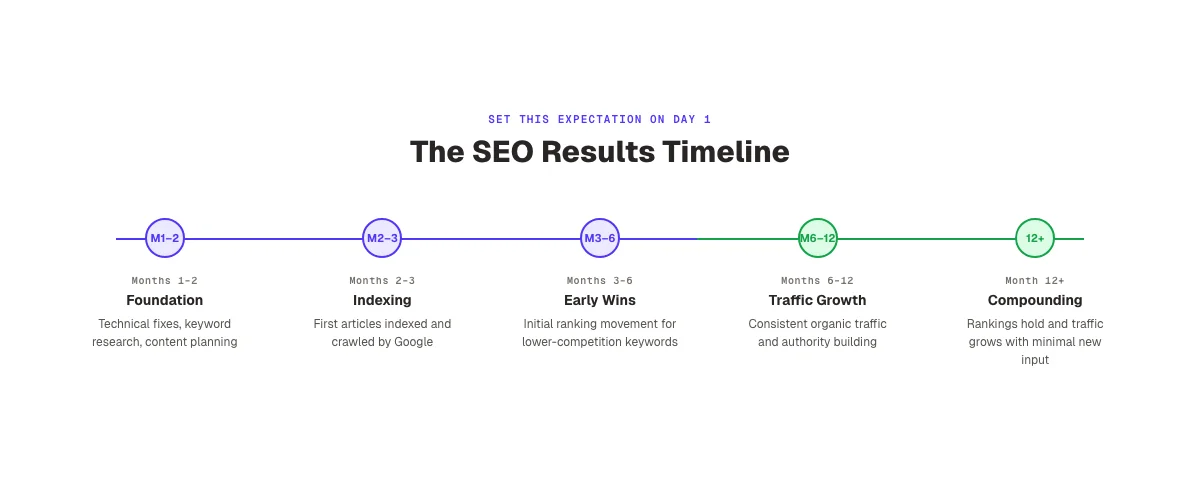
The honest timeline:
- Months 1–2: Technical fixes, content foundation, keyword research
- Months 2–3: First pieces of content indexed and crawled by Google
- Months 3–6: Initial ranking improvements for lower-competition keywords
- Months 6–12: Consistent traffic growth and authority building
- Month 12+: Compounding returns. Rankings hold and traffic grows with minimal new input
Be specific about what "results" means at each stage. A new organic visitor in month 2 is a result. A keyword moving from page 3 to page 1 in month 5 is a result. Traffic growth sustained in month 12 is a result.
Use this framing: "SEO is not a faucet you turn on. It is a well you dig. Once dug, it runs constantly."
For supporting data on typical return timelines, the SEO ROI statistics guide covers what results look like across different industries and budgets.
Why this step matters: Most SEO client relationships fail not because of bad results. But because of misaligned expectations. A client who expects results in 30 days will churn regardless of how good your work is. Set the right frame early and you protect the relationship before it is ever at risk.
Step 6: Translate Metrics Into Business Outcomes
Most SEO reports fail clients. Not because the data is wrong. Because the data is irrelevant.
Clients do not care about domain authority scores. They do not care about impressions or crawl errors. They care about one thing: "Is this growing my business?"
Every metric you report needs to connect to a business outcome.
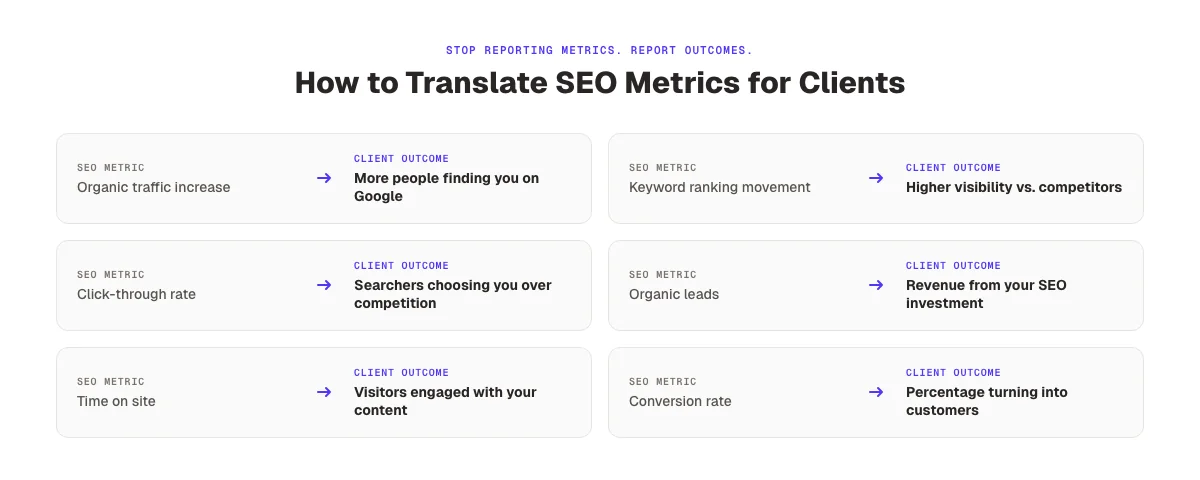
Metric translation guide:
| SEO Metric | Business Translation |
|---|---|
| Organic traffic increase | More people finding your business through Google |
| Keyword ranking improvement | Higher position means more visibility vs. competitors |
| Click-through rate | How many searchers choose you over the competition |
| Organic leads | Revenue-generating visitors from your SEO investment |
| Time on site | How engaged visitors are with your content |
| Conversion rate | Percentage of visitors who become actual customers |
Instead of saying: "Your domain rating increased from 28 to 34." Say: "Google now sees your site as 22% more authoritative, which means your pages compete for harder keywords."
Instead of saying: "You got 1,200 organic sessions this month." Say: "1,200 people found your business on Google this month without you paying for a single click."
Our SEO KPIs guide covers exactly which metrics belong in client-facing dashboards. And which to drop entirely from your reporting.
For agencies managing multiple clients, the SEO reporting guide has templates that translate metrics automatically into business language that clients engage with.
Use the free SEO ROI Calculator to show clients the estimated business value of their current organic traffic in dollars.
Why this step matters: Research shows that 67% of professional SEO reports receive no meaningful engagement from clients. Reports full of metrics clients do not understand get ignored. Reports that speak to business goals get read, shared internally, and used to justify continued investment.
Stop creating reports clients ignore. theStacc publishes the content that generates results worth reporting, month after month.
Step 7: Handle Common Objections Before They Arise
The best time to address an objection is before it is raised. Walk through these 5 objections proactively. In proposals, onboarding calls, and monthly check-ins.
Objection 1: "Why is SEO so expensive?"
Frame it relative to the alternative: "A freelance writer charges $150–$250 per article. Our blog SEO module publishes to your site for $99 a month total. One month of our service costs less than a single freelance article."
Compare to paid advertising: "Every dollar you spend on Google Ads disappears when you stop paying. Every SEO article we publish keeps working for years. Without ongoing spend."
For a full cost comparison, the SEO cost guide breaks down what SEO investment looks like at different service levels.
Objection 2: "How long until I see results?"
You addressed this in Step 5. Revisit the timeline document you provided on day 1. Then add: "The businesses that grow fastest from SEO are the ones who start earliest. Every month you wait is a month the competition is building authority you then have to catch up to."
Objection 3: "I tried SEO before and it did not work."
Ask: "What did that look like?" Most clients who had bad experiences worked with agencies that overpromised or underdelivered. Validate the frustration. Then distinguish your approach: "We focus on volume and consistency. 30 published articles per month creates far more ranking opportunities than 2–3 one-off pieces ever could."
Objection 4: "Can I just do this myself?"
Yes. But at what cost? "You absolutely could write 30 SEO-optimized articles per month. If your time is worth $50/hour and each article takes 3–4 hours to research, write, and optimize, you are spending 90–120 hours and $4,500–$6,000 worth of time each month. Our service handles all of that for $99."
Objection 5: "Why not just run paid ads instead?"
This is not an either/or question. But clients often frame it that way. SEO and paid advertising serve different purposes. Ads drive immediate traffic. SEO builds long-term visibility that compounds without ongoing spend. The companies growing fastest online do both. But if budget forces a choice: "SEO compounds. Ads stop the second your budget does."
Why this step matters: Every unaddressed objection becomes a reason a client finds to cancel. Walking through these 5 objections proactively closes the loop before doubt sets in. And long before the 90-day mark where most churn decisions happen.
Results: What to Expect After Following These Steps
After completing this 7-step process with every new client, you should expect:
- Faster onboarding: Clients who understand the process ask fewer questions and approve content faster
- Longer retention: Expectation alignment in month 1 dramatically reduces churn at month 3 and month 6
- More referrals: Clients who understand SEO are more likely to recommend you to other business owners
- Higher lifetime value: Clients who trust the process invest more over time. Expanding scope, adding modules, or upgrading their plan
Realistic timeline for the explanation process itself:
- Day 1: Client has a clear mental model of what SEO is and what it is not
- Week 2: Client reviews monthly metrics without confusion or anxiety
- Month 3: Client references the onboarding timeline benchmark instead of asking "why are we not ranking yet?"
Troubleshooting
Problem: Client still asks "when will I see results?" at every monthly check-in.
Solution: Lock the timeline expectation in writing after the first call. Send a one-page onboarding summary with the 3-, 6-, and 12-month benchmarks clearly written out. When they ask, reference the document. Not a verbal re-explanation.
Problem: Client stops responding to monthly reports.
Solution: Switch from emailing PDF reports to recording a 2-minute Loom video walking through the month's key results in plain language. Open with 1 metric that ties directly to revenue or leads. Clients who ignore PDF attachments consistently watch short videos.
Problem: Client wants to cancel after 2 months of service.
Solution: Pull the onboarding document. Compare actual results to the month 2 benchmark you set on day 1. In most cases, results are on track. The client simply forgot what month 2 was supposed to look like. Showing the benchmark document resolves most cancellation conversations.
What practitioners are saying on X
AI search advice ages quickly. Here is high-signal public discussion from SEO and growth operators — context for your roadmap, not a substitute for primary data.
- @hridoyreh (Mar 2026): Widely shared SEO skill tree: foundations, research, technical, on-page, content, links, AI SEO/GEO, analytics, UX, brand, programmatic — useful map for stats and how-to posts. See the post on X.
- @jakezward (Feb 2026): 2026 SEO predictions emphasize AI Overview share-of-SERP, schema for LLM token efficiency, brand mentions in AI answers as a KPI, proprietary data as a moat, and content refresh beating net-new AI slop. See the post on X.
Grok, AI Overviews, and multi-engine visibility
For “how to explain seo to clients”, multi-engine visibility still starts with clear definitions, sourced numbers, and extractable section answers. Grok additionally factors live X discussion — keep public claims consistent with this page.
- Google AI Overviews: Use passage-ready answers, tables, and FAQ schema where relevant.
- ChatGPT / Perplexity: Cite named sources next to key claims.
- Grok: Maintain accurate entity facts on-site and in high-signal X posts.
Publish content built for Google and AI citations. theStacc’s Content SEO module ships SEO-scored articles structured for rankings and generative engines — including clearer entity pages models like Grok can quote.
FAQ
Start with the business outcome, not the process: "SEO gets your website to show up when potential customers search for what you sell." Avoid technical terms in the first explanation. Once they understand why it matters, introduce the 3 pillars. Content, authority, and experience. Using the plain-language framework from Step 4.
The word-of-mouth analogy works well for service business owners: "When a top-ranked Google listing refers you, it tells thousands of people every month. Automatically." The real estate analogy works for business-minded clients who already understand the value of location and foot traffic.
Initial ranking movement typically appears in months 3–6. Meaningful traffic growth builds from month 6–12. Full compounding returns appear in year 2 and beyond. The exact timeline depends on industry competition, domain age, and content publishing volume.
Frame it as an investment, not a delay: "SEO is not a faucet you turn on. It is a well you dig. Once dug, it runs constantly. Every week we publish and optimize adds permanent value to your site." Pair this framing with a written timeline so clients have something concrete to track against month by month.
Report metrics that connect directly to business outcomes. Organic sessions, keyword ranking movement, and lead conversions from organic are the most relevant for most clients. Drop vanity metrics like domain authority and raw impressions from client-facing dashboards unless specifically requested. The SEO KPIs guide covers the full breakdown of what to include and what to leave out.
Compare to the alternative: freelance articles at $150–$250 each, or agency retainers at $1,000–$5,000 per month. Then anchor to long-term value: "Every article we publish keeps working for years. Paid ads stop the moment your budget does."
Now you know how to explain SEO to clients without losing them in jargon. The 7 steps move from knowledge assessment to analogy to expectation-setting to objection handling. In that order, for a reason.
The clients who stay the longest are not the ones who needed the least explanation. They are the ones who got the clearest explanation on day 1.
Start with Step 1 in your next discovery call.
SEO articles published automatically. Starting at $99/month. We do the work that needs explaining.
Related Tools & Resources
Free SEO Tools:
Best Lists:
Sources & references
- [1] Princeton / Georgia Tech et al. — GEO research (arXiv:2311.09735)
- [2] @hridoyreh on X — Widely shared SEO skill tree: foundations, research, technical, on-page, content, links, AI SEO/GEO, analytics, UX, bran
- [3] @jakezward on X — 2026 SEO predictions emphasize AI Overview share-of-SERP, schema for LLM token efficiency, brand mentions in AI answers

Plan topics, review article drafts, and publish to a connected CMS.
Weekly local SEO teardowns
One practical email a week. Map Pack, GBP, AI Overviews. No fluff. Unsubscribe anytime.