
Interior Design SEO: The Complete Guide (2026)
Everything you need to know about interior design SEO in one 8-chapter guide. Covers keywords, portfolio optimization, local SEO, and content strategy.
Siddharth Gangal • 2026-04-02 • Local SEO
In This Article
Most interior designers rely on Instagram and word-of-mouth to find clients. Both channels stall the moment you stop posting or your referral network dries up.
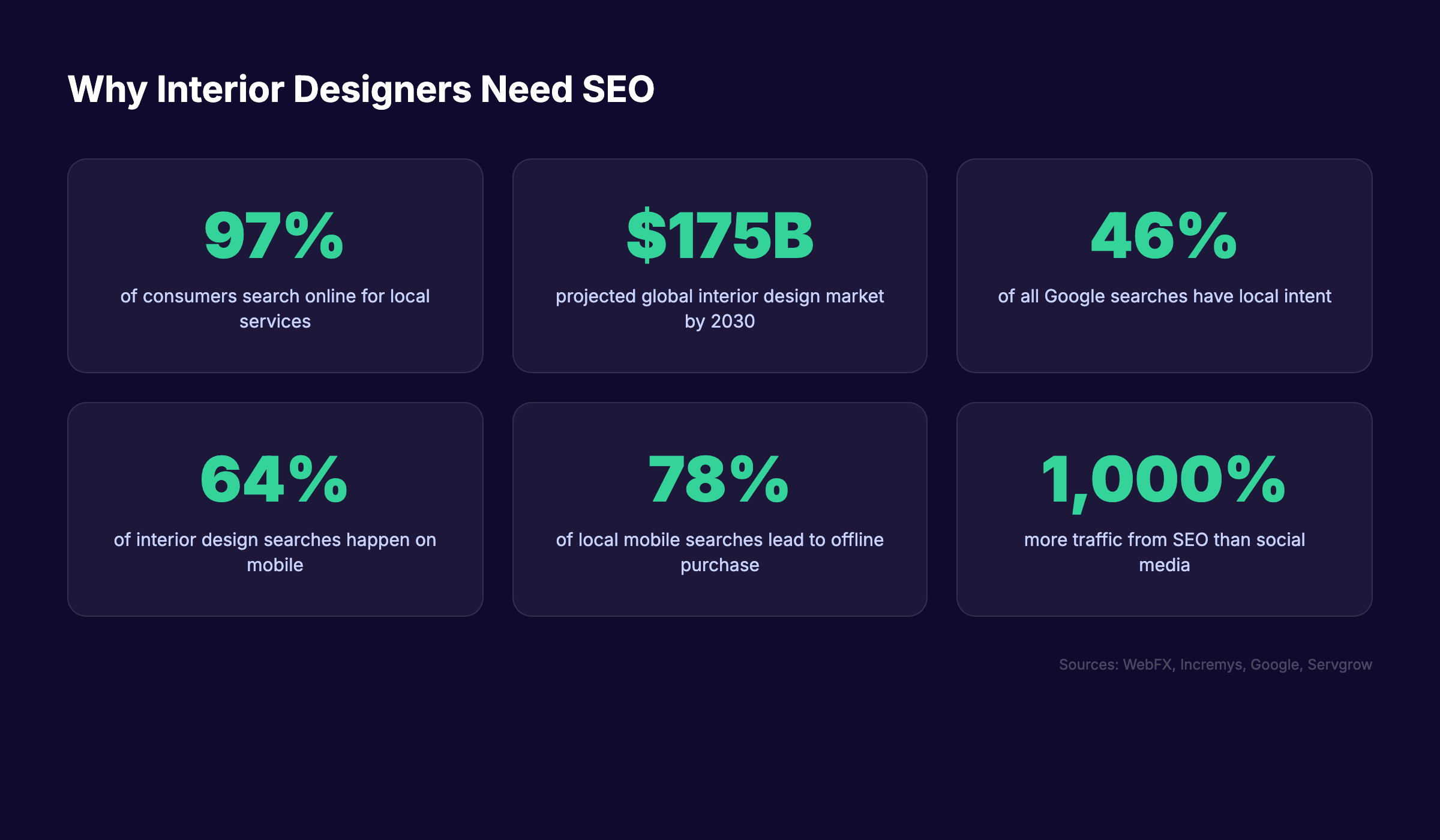
That gap costs real money. Interior design studios that do not rank on Google lose out on the 97% of consumers who search online before hiring a local service. The global interior design market is projected to reach $175 billion by 2030. Your share depends on whether clients can find you.
This interior design SEO guide fixes that. It covers keyword research, portfolio optimization, local SEO, content strategy, and the technical details that keep design websites from ranking.
We publish 3,500+ blog posts across 70+ industries. Interior design is one of the most visual, location-dependent fields we work in. This guide covers everything we know about helping designers rank.
Here is what you will learn:
- How to find the exact keywords your ideal clients search for
- How to turn your portfolio into an SEO asset (not just a gallery)
- How to dominate local search results and Google Maps
- The content strategy that brings in organic leads every month
- Technical SEO fixes specific to image-heavy design websites
- How to build authority through backlinks and design directories
Chapter 1: Why Interior Designers Need SEO
Search engine optimization is not optional for interior designers in 2026. It is the difference between waiting for referrals and generating a steady pipeline of qualified leads from Google.
The Numbers Tell the Story
46% of all Google searches carry local intent. When a homeowner searches “interior designer near me,” Google serves results from studios with strong SEO. Studios without it do not appear.
64% of interior design searches happen on mobile devices. That means potential clients search while standing in the kitchen they want to renovate. They pick a designer from the first page of results.
SEO generates 1,000% more traffic than social media for most businesses. Instagram might showcase your work, but Google delivers clients who are ready to hire.
Why Referrals Alone Fall Short
Referrals are unpredictable. You cannot scale a business on a channel you do not control.
SEO compounds over time. Every blog post, every optimized portfolio page, and every Google review builds on the last. A single well-optimized service page can generate leads for years.
The designers who invest in SEO now will own the search results in their market. The ones who wait will pay more to catch up later.
What Makes Interior Design SEO Different
Interior design is visual-first. Your website is full of high-resolution images that slow down load times. Your portfolio is your best sales tool, but search engines cannot see images the way humans do.
That creates a unique challenge. You need to make beautiful content machine-readable. This guide shows you how.
Chapter 2: Keyword Research for Interior Designers
Every SEO strategy starts with keywords. For interior designers, the right keywords connect you with clients who are actively searching for your services.
Skip this step and you will write content nobody finds. Get it right and you attract homeowners, developers, and business owners who are ready to hire.
Three Keyword Categories That Matter
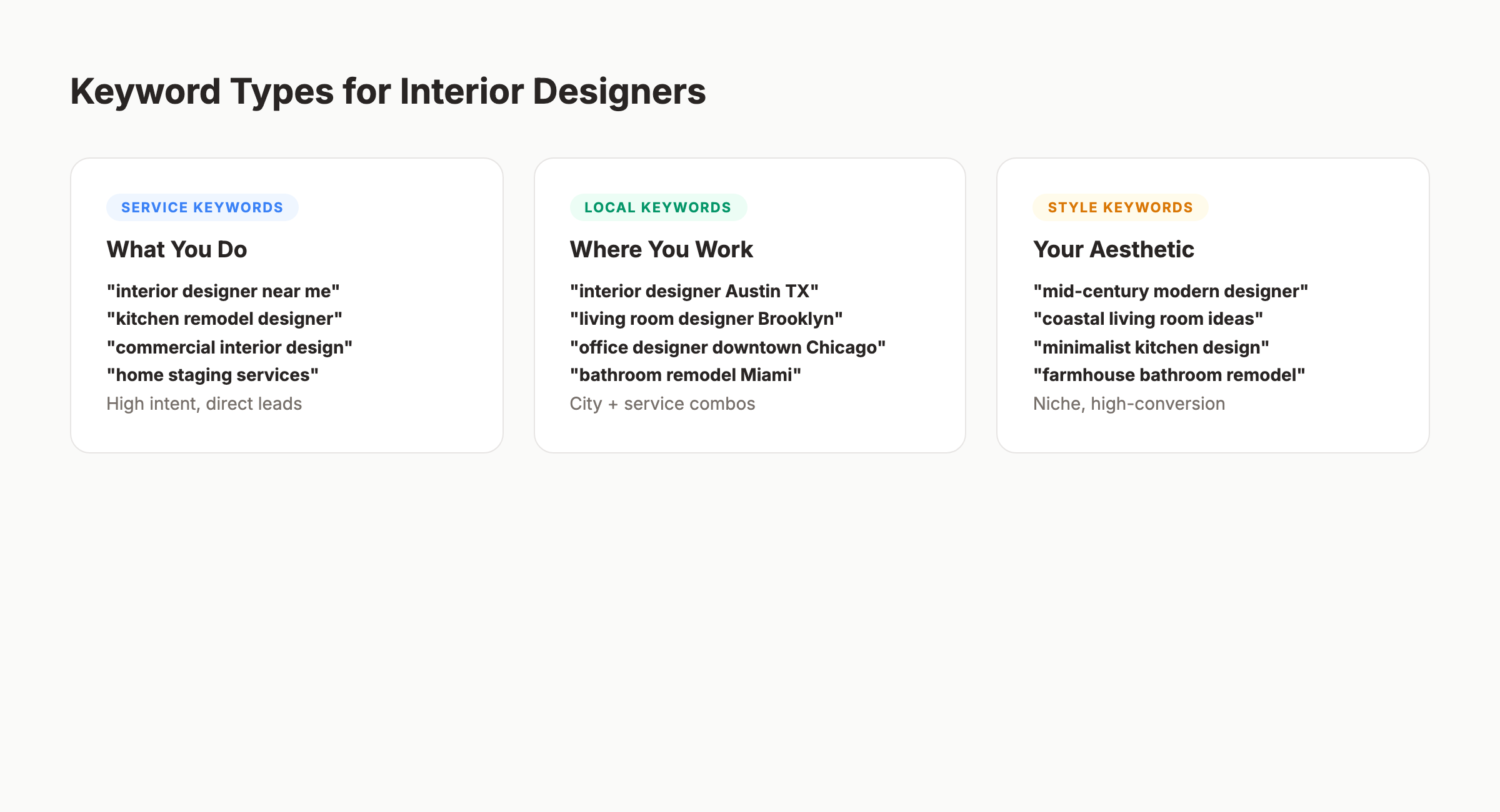
Service keywords describe what you do. Examples include “interior designer,” “kitchen remodel designer,” “commercial interior design,” and “home staging services.” These carry the highest purchase intent.
Local keywords combine your service with a location. “Interior designer Austin TX,” “living room designer Brooklyn,” and “bathroom remodel Miami” are examples. These are the keywords that drive local leads.
Style keywords target specific aesthetics. “Mid-century modern designer,” “coastal living room ideas,” and “minimalist kitchen design” attract clients who already know what they want. These convert at higher rates because the intent is so specific.
How to Find Your Keywords
Start with free tools. Google Autocomplete shows you what people actually type. Enter “interior designer” and note every suggestion. Do the same for “kitchen design,” “bathroom remodel,” and “home staging.”
Google’s “People Also Ask” section reveals questions your clients have. These questions become blog topics and FAQ content.
Use keyword research tools to check search volume. Focus on keywords with 100 to 1,000 monthly searches. High-volume keywords like “interior design” (90,000+ searches) are too competitive for most studios.
Long-Tail Keywords Win for Designers
“Interior designer” is nearly impossible to rank for. “Farmhouse kitchen designer in Portland Oregon” is achievable.
Long-tail keywords have 3 or more words. They attract fewer searches but much higher conversion rates. A client searching “mid-century modern living room designer Denver” knows exactly what they want.
Build a list of 30 to 50 long-tail keywords. Group them by service type, location, and style. This becomes your content calendar.
Competitor Keyword Research
Search your top keywords and study the studios that rank on page 1. Note their page titles, headings, and content topics. Tools like Google Search Console (free) show you which queries already bring traffic to your site.
Look for gaps. If no competitor has a detailed page about “commercial office design” in your city, that is your opportunity.
Your competitors are already ranking for your keywords. Stacc publishes 30 SEO-optimized articles per month to help you catch up and pass them. Start for $1 →
Chapter 3: On-Page SEO for Interior Design Websites
On-page SEO is the foundation. Every page on your website needs to be optimized for both search engines and the humans who visit it.
Most interior design websites prioritize aesthetics over search visibility. Beautiful homepage, zero text, no rankings. You can have both.
Title Tags and Meta Descriptions
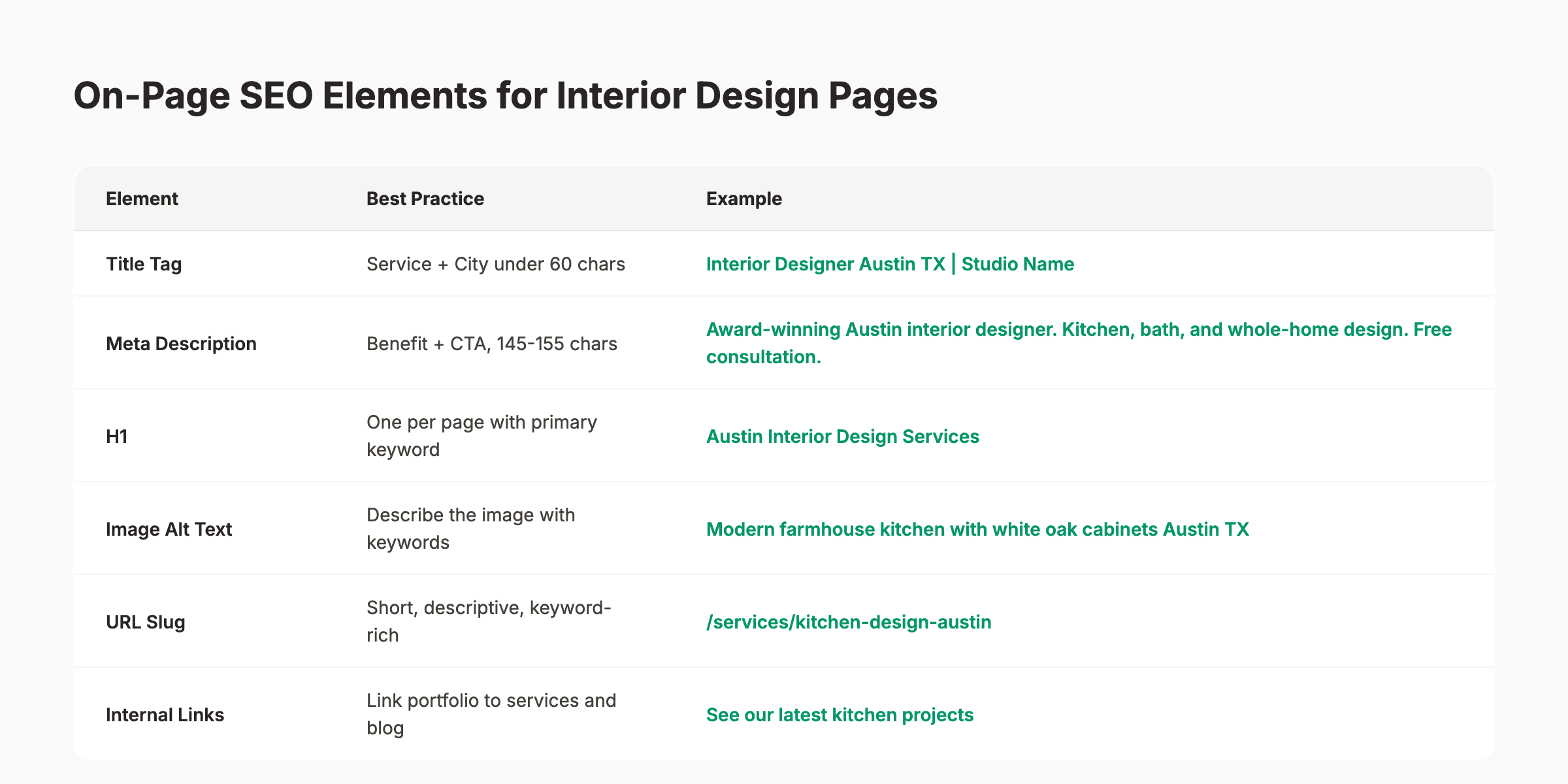
Your title tag is the first thing Google shows in search results. Keep it under 60 characters. Include your primary keyword and city.
| Page Type | Title Tag Formula | Example |
|---|---|---|
| Homepage | Studio Name + Service + City | ”Park Studio - Interior Designer Austin TX” |
| Service Page | Service + City + Studio | ”Kitchen Design Austin TX - Park Studio” |
| Portfolio | Project Style + Room + City | ”Modern Farmhouse Kitchen - Austin Interior Design” |
| Blog Post | Topic + Benefit | ”Small Bathroom Design Ideas That Save Space” |
Your meta description should be 145 to 155 characters. Include your keyword, a benefit, and a call to action. “Award-winning Austin interior designer. Kitchen, bath, and whole-home design. Book a free consultation.”
Heading Structure
Use one H1 per page with your primary keyword. Break content into H2 and H3 subheadings. Each heading should describe the content below it.
Bad heading: “Our Work.” Good heading: “Residential Kitchen Design Projects in Austin.”
Headings give Google a map of your page. They also help visitors scan and find what they need.
Homepage Optimization
Most designer homepages have stunning photos and almost no text. Google cannot rank a page it cannot read.
Add 300 to 500 words of content to your homepage. Describe your services, your design philosophy, and the areas you serve. Weave in your primary keywords naturally.
Keep the visual appeal. Place text between image galleries. Use your on-page SEO guide as a reference for every page you optimize.
Service Pages
Create a dedicated page for each service you offer. “Kitchen Design,” “Bathroom Remodel,” “Commercial Interior Design,” and “Home Staging” should each have their own page.
Each service page needs:
- A keyword-optimized title tag
- 500+ words describing the service
- 3 to 5 portfolio images with alt text
- Client testimonials
- A clear call to action
- Links to related portfolio projects
Service pages are where high-intent visitors land. Treat them as sales pages that also rank in search.
Chapter 4: Image SEO and Portfolio Optimization
Your portfolio is your strongest asset and your biggest SEO challenge. Search engines cannot interpret images without help. Every photo needs context.
Done right, portfolio optimization turns Google Images into a lead generation channel. Interior design is one of the few industries where image search drives real business.
File Naming Conventions
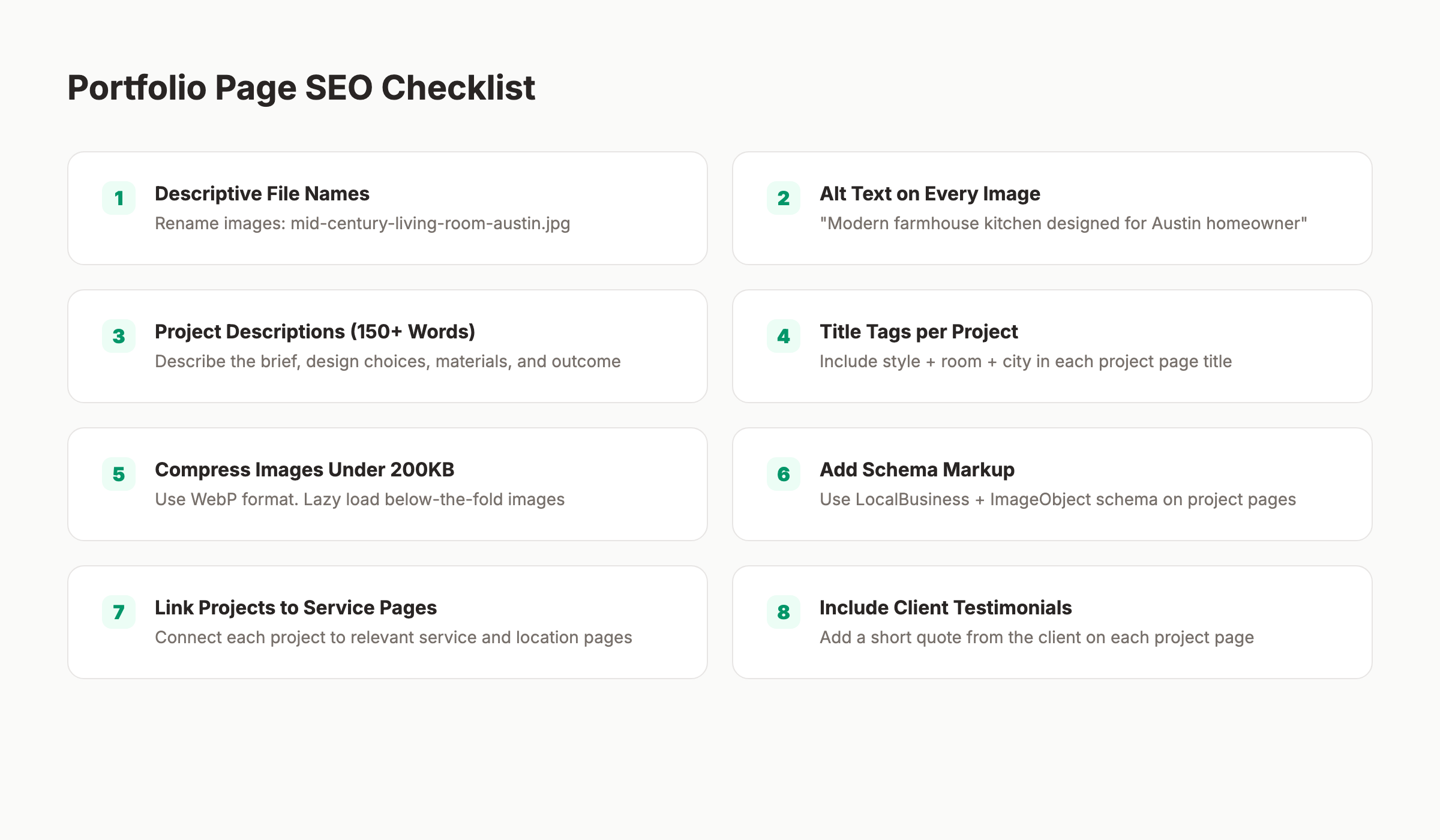
Stop uploading files named “IMG_4382.jpg.” Search engines read file names.
Rename every image before uploading. Use lowercase, hyphen-separated descriptions with keywords.
| Bad File Name | Good File Name |
|---|---|
| IMG_4382.jpg | mid-century-living-room-austin-tx.jpg |
| photo-final-v2.png | modern-farmhouse-kitchen-white-oak.jpg |
| screenshot-2026.jpg | coastal-bathroom-remodel-miami.jpg |
This takes 10 seconds per image and makes a real difference in Google Image rankings.
Alt Text Strategy
Alt text describes an image to search engines and screen readers. Write it like you are explaining the photo to someone who cannot see it.
Bad alt text: “Kitchen.” Good alt text: “Modern farmhouse kitchen with white oak cabinets and quartz countertops designed for Austin homeowner.”
Include your style, the room type, key materials, and your city. Do not stuff keywords. Write naturally. Check our blog image optimization guide for detailed examples.
Image Compression and Format
Interior design photos are large. Uncompressed portfolio images can push page load times past 10 seconds. Google penalizes slow sites.
Convert images to WebP format. This cuts file size by 25% to 35% without visible quality loss. Aim for under 200KB per image.
Use lazy loading for images below the fold. The browser loads them only when the visitor scrolls down. This keeps your initial page load fast.
Tools like ShortPixel, TinyPNG, or Squoosh handle compression automatically.
Project Page Architecture
Do not dump all your photos on a single portfolio page. Create individual project pages.
Each project page should include:
- 5 to 10 optimized images
- A 150+ word project description
- The design brief and client goals
- Materials and brands used
- A client testimonial
- Links to your related service page
This structure gives Google more pages to index. It also keeps visitors engaged longer, which improves your rankings.
Group projects by room type, style, or location. Create category pages like “/portfolio/kitchens” and “/portfolio/modern” that link to individual projects.
Google Images as a Lead Channel
22% of Google searches return image results. For visual industries like interior design, that percentage is higher.
When someone searches “modern kitchen design ideas,” Google shows an image grid. If your portfolio photos appear there, you get free traffic from people already interested in your style.
Optimize for Google Images by using descriptive file names, detailed alt text, and surrounding your images with relevant text content. Add captions where possible.
Your portfolio should work as hard as you do. Stacc handles your blog content so you can focus on design work that fills your portfolio. Start for $1 →
Chapter 5: Local SEO for Interior Designers
Interior design is a local business. Your clients live within driving distance of your studio. Local SEO puts you in front of those clients at the exact moment they search.
46% of Google searches have local intent. When someone types “interior designer near me,” Google shows a Map Pack with 3 local results. You need to be in that pack.
Google Business Profile Optimization
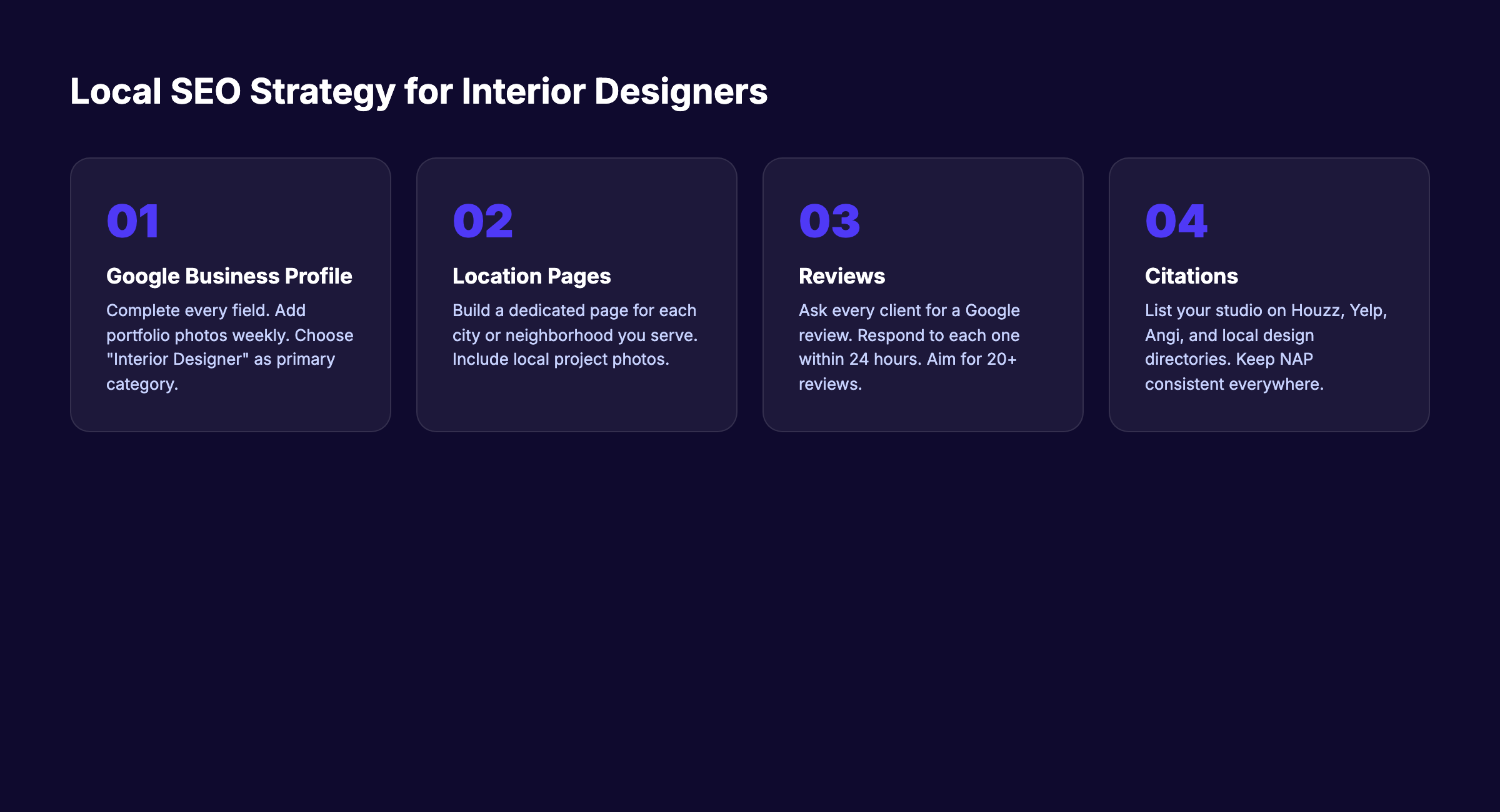
Your Google Business Profile is the single most important local SEO asset. It determines whether you appear in the Map Pack.
Set your primary category to “Interior Designer.” Add secondary categories like “Kitchen Remodeler,” “Home Staging Service,” or “Interior Decorator” if they apply.
Complete every field. Add your service area, business hours, website URL, and phone number. Write a 750-character description that includes your primary keywords and the cities you serve.
Upload new portfolio photos every week. Google rewards active profiles with better visibility. Add photos of completed projects, your studio, and your team.
Location Pages
If you serve multiple cities, create a dedicated page for each one. “/services/interior-designer-austin” and “/services/interior-designer-round-rock” should be separate pages.
Each location page needs:
- A unique title tag with the city name
- 400+ words of unique content about that market
- Portfolio photos from projects in that area
- Driving directions or a map embed
- Local testimonials from clients in that city
Do not copy-paste the same content across location pages. Google filters duplicate content. Write unique descriptions of your work in each area. Reference local landmarks, neighborhoods, and design trends specific to that market.
Read our full local SEO guide for the complete strategy.
Review Management
Reviews are a top ranking factor for local search. Studios with 20+ Google reviews and a 4.5+ star rating dominate the Map Pack.
Ask every client for a Google review after project completion. Send a direct link to your Google review page. Make it easy.
Respond to every review within 24 hours. Thank positive reviewers by name. Address negative reviews professionally. Google tracks response rate and speed.
Include project details in your response. “Thank you for trusting us with your mid-century kitchen remodel in East Austin” adds keywords to your review section naturally.
Citations and Design Directories
List your studio on every relevant directory. Consistency matters. Your business name, address, and phone number (NAP) must be identical everywhere.
Priority directories for interior designers:
- Houzz (critical for designers)
- Yelp
- Angi (formerly Angie’s List)
- Better Business Bureau
- Local chamber of commerce
- Design-specific directories (ASID, IIDA)
Houzz deserves special attention. It functions as both a directory and a portfolio platform. Optimize your Houzz profile with keywords, add your best project photos, and collect Houzz reviews. Many designers get leads directly from Houzz.
Use our local SEO checklist to verify you have not missed any steps.
Chapter 6: Content Strategy for Interior Design Blogs
Blogging is not optional for designers who want to rank. Your portfolio brings in image search traffic. Your blog brings in everything else.
A consistent blog builds topical authority. Google sees your site as an expert resource on interior design in your market. That authority lifts the rankings of every page on your site.
Content Topics That Drive Traffic
Not every blog topic is equal. Focus on the ones that attract potential clients, not other designers.
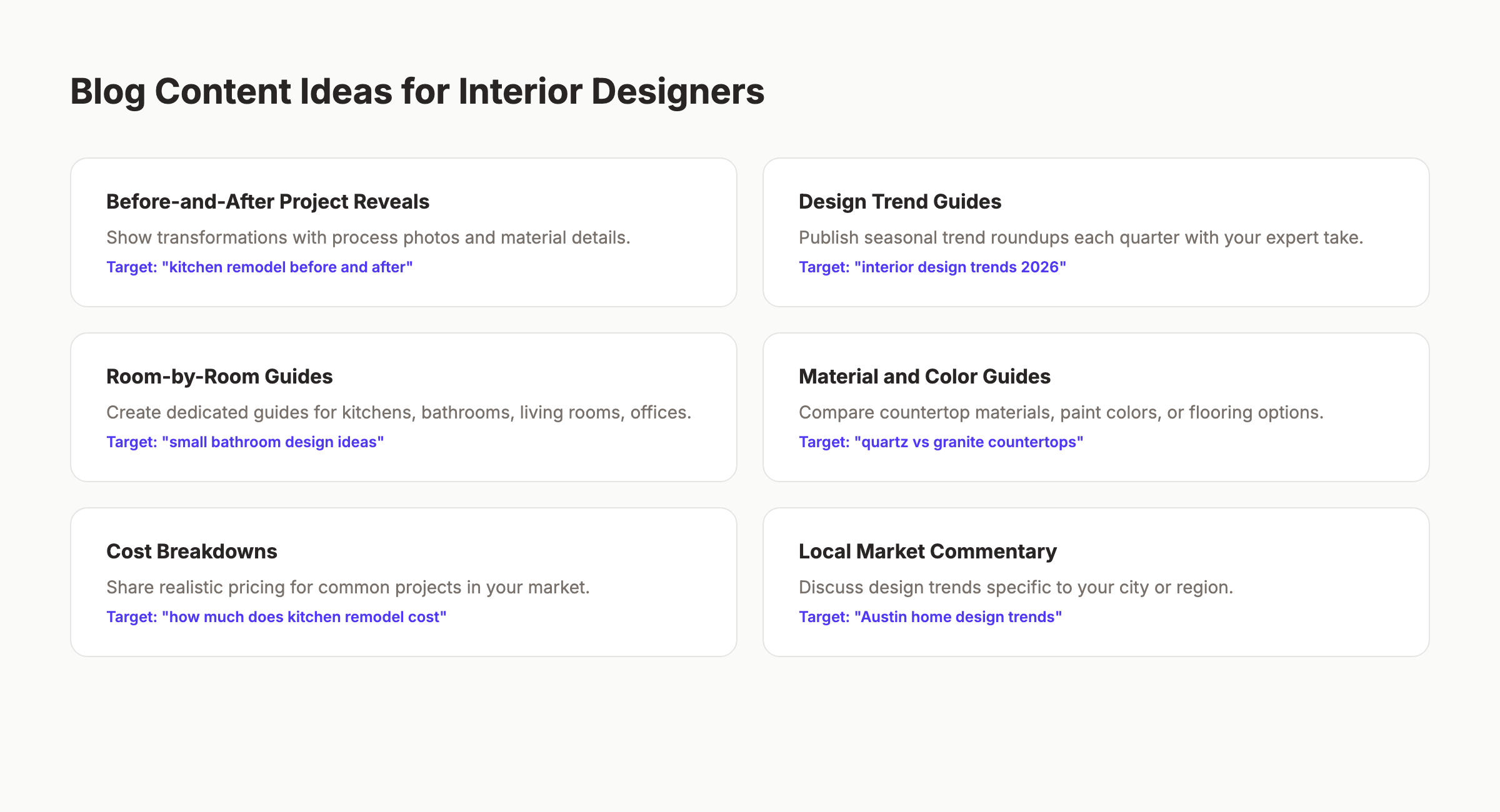
Before-and-after project reveals. These are gold. Show the transformation with process photos. Describe the brief, your design decisions, and the materials you chose. Target keywords like “kitchen remodel before and after.”
Room-by-room design guides. “Small bathroom design ideas,” “home office layout tips,” and “open concept living room ideas” attract homeowners in the research phase. These visitors become clients.
Cost breakdown posts. “How much does a kitchen remodel cost in Austin” is a high-intent keyword. People searching for pricing are close to hiring. Be transparent about numbers.
Trend roundups. Publish quarterly trend posts. “Interior design trends 2026” gets seasonal search volume spikes.
Material comparison guides. “Quartz vs granite countertops” and “hardwood vs vinyl flooring” attract homeowners making purchase decisions. Link to your relevant service pages.
Publishing Frequency
Consistency beats volume. One quality post per week outperforms 10 rushed posts per month.
The content compound effect rewards studios that publish regularly over time. After 6 months of weekly publishing, your organic traffic builds momentum. After 12 months, it becomes a reliable lead channel.
Each post should be 1,500 to 2,500 words. Include 3 to 5 images. Link to your service pages and portfolio. Every blog post is a doorway to your website.
Writing for SEO Without Sounding Robotic
Write the way you explain things to clients. Use the words they use, not industry jargon.
Your clients say “kitchen remodel.” They do not say “culinary space transformation.” Match their language in your content.
Place your target keyword in the title, the first 100 words, at least one H2, and the meta description. Use related terms throughout. Google understands synonyms and context.
Read our SEO content writing guide for the complete approach.
Publishing 30 SEO articles per month sounds impossible for a design studio. That is exactly what Stacc does for you. We write, optimize, and publish while you focus on clients. Start for $1 →
Chapter 7: Technical SEO for Design Websites
Interior design websites are heavy. High-resolution images, JavaScript galleries, and animated transitions create a beautiful experience. They also create performance problems that kill your rankings.
Technical SEO ensures Google can crawl, index, and rank your site. Skip this chapter and your content and local SEO work will underperform.
Page Speed Optimization
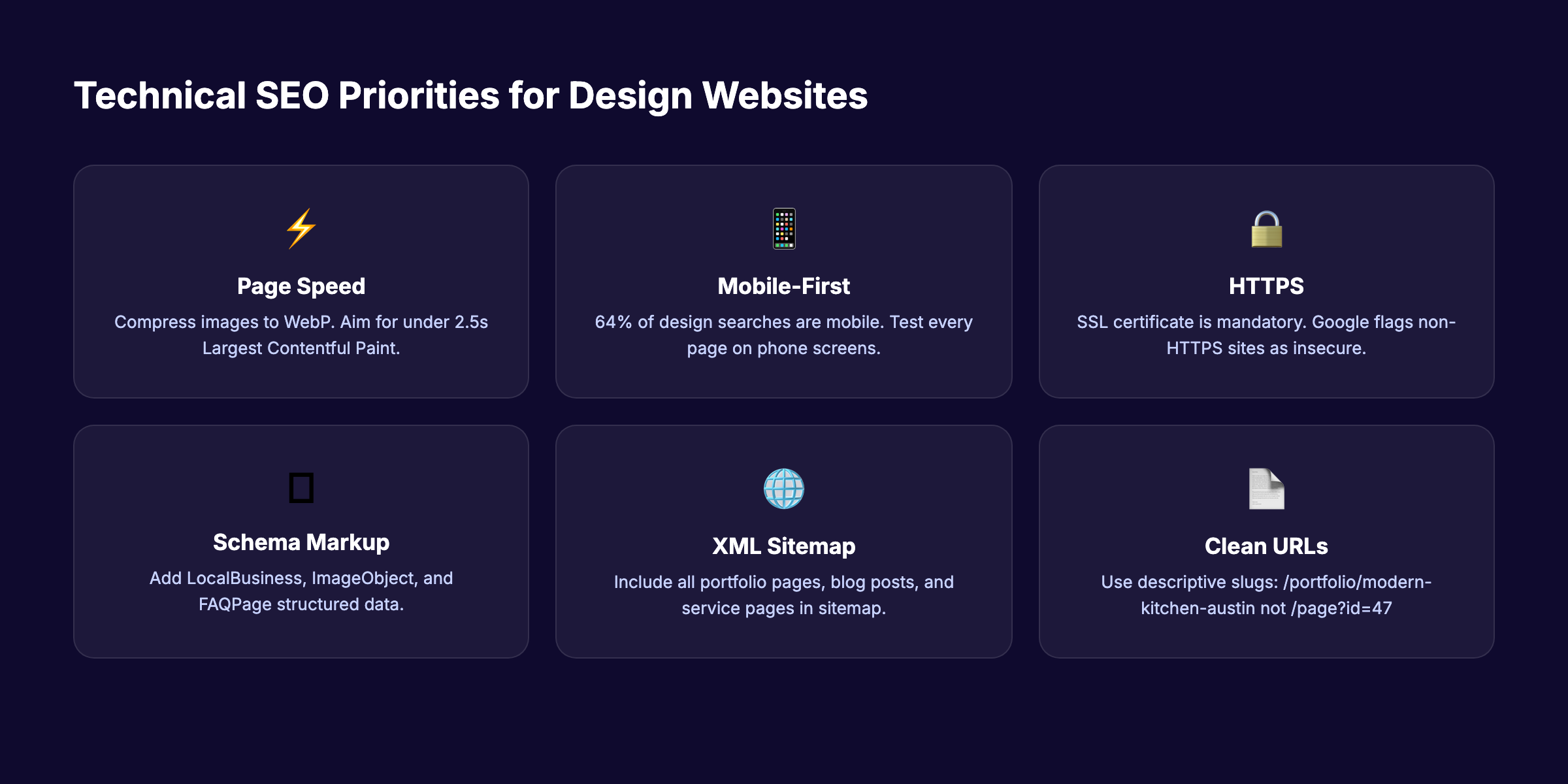
Google measures page speed through Core Web Vitals. The most important metric is Largest Contentful Paint (LCP). Aim for under 2.5 seconds.
Interior design sites fail this test constantly. A single uncompressed hero image can push LCP past 5 seconds.
Fix it with these steps:
- Convert all images to WebP format
- Enable lazy loading on below-fold images
- Use a content delivery network (CDN)
- Minimize JavaScript and CSS files
- Enable browser caching
Test your site with Google PageSpeed Insights. Fix every issue it flags. Read our page speed optimization guide for a detailed walkthrough.
Mobile Optimization
64% of interior design searches happen on mobile. Google uses mobile-first indexing. That means Google ranks your site based on its mobile version, not desktop.
Test your site on a phone. Check that:
- Text is readable without zooming
- Buttons are large enough to tap
- Images scale correctly
- Navigation works smoothly
- Contact forms are easy to complete
Portfolio galleries need special attention on mobile. Lightbox galleries that work on desktop often break on small screens. Test every gallery on at least 3 different phone sizes.
Schema Markup
Schema markup tells Google exactly what your page contains. For interior designers, 3 schema types matter most.
LocalBusiness schema — Tells Google your business name, address, phone, hours, and service area. Required for Map Pack visibility.
ImageObject schema — Adds context to your portfolio images. Include the creator, description, and date created.
FAQPage schema — Marks up your FAQ sections. Questions can appear directly in search results as rich snippets, taking up more space and attracting more clicks.
Add schema through your website platform or a plugin. Test it with Google’s Rich Results Test tool.
Site Architecture
A clear site structure helps Google understand your content. Follow this hierarchy:
Homepage → Service Pages → Portfolio → Individual Projects → Blog
Link downward and sideways. Every service page should link to related portfolio projects. Every blog post should link to a relevant service page. Every project page should link back to its service category.
Use a flat architecture. No page should be more than 3 clicks from your homepage. Check our technical SEO checklist for the full audit.
Chapter 8: Off-Page SEO and Link Building
Off-page SEO builds your domain authority. The more high-quality websites that link to yours, the higher Google ranks your pages.
Interior designers have a natural advantage here. Your visual work gets featured in design blogs, local media, and industry publications. You just need to ask for the link.
Backlink Strategies for Designers
Design publications. Submit your best projects to design blogs and magazines. Apartment Therapy, Dwell, House Beautiful, and regional design publications accept submissions. Every feature includes a backlink.
Local media. Reach out to local newspapers, lifestyle magazines, and neighborhood blogs. Offer expert commentary on design trends. “Interior designer explains 2026 kitchen trends” is a story every local outlet wants.
HARO and source requests. Platforms like Connectively (formerly HARO) connect you with journalists writing about home design. Respond to queries. Each placement earns a high-authority backlink.
Guest posts. Write guest articles for real estate blogs, home improvement sites, and local business publications. Include a link back to your site in your author bio.
Read our link building for local SEO guide for more strategies.
Platform SEO Beyond Google
Interior designers compete on multiple platforms. Each one sends signals back to Google.
Houzz. Complete your profile. Add keywords to your project descriptions. Collect Houzz reviews. Create Ideabooks that link to your website. Houzz profiles rank highly in Google for designer searches.
Pinterest. Pin every portfolio image with keyword-rich descriptions. Create boards organized by room type and style. Pinterest images appear in Google Image results. Use Rich Pins that pull metadata from your website.
Instagram. While not a direct SEO factor, an active Instagram presence builds brand signals that Google notices. Link your Instagram to your website. Use location tags on every post.
Building Authority Over Time
Link building is a long-term investment. Do not expect overnight results.
Aim for 2 to 4 quality backlinks per month. Quality means links from sites with real traffic and editorial standards. One link from a reputable design publication is worth more than 50 links from directories nobody visits.
Track your domain authority monthly. Tools like Ahrefs and Moz show your progress. Most interior design studios can reach a domain authority of 20 to 30 within 12 months of consistent effort.
SEO compounds. Every article, every link, every review stacks on the last. Stacc keeps your content engine running so the compound effect never stalls. Start for $1 →
Frequently Asked Questions
How long does SEO take for interior designers?
Expect initial movement in 60 to 90 days. Meaningful traffic growth takes 6 to 12 months. Local SEO results often appear faster because competition is lower in most markets. The studios that commit to consistent publishing and optimization for 12+ months see the strongest results.
Do interior designers really need a blog?
Yes. Your portfolio attracts image search traffic, but your blog captures informational queries like “small bathroom design ideas” and “how much does kitchen remodel cost.” These queries represent homeowners in the research phase. A blog turns them into leads. Studios that publish weekly see 3 to 5 times more organic traffic than those that do not blog.
What is the most important SEO factor for interior designers?
Local SEO and image optimization carry the most weight. Your Google Business Profile determines Map Pack visibility. Your portfolio image optimization determines Google Image rankings. Together, they cover the 2 search channels that matter most for visual, location-based businesses.
How much does interior design SEO cost?
DIY SEO costs your time plus $0 to $100 per month for tools. Hiring an agency costs $1,000 to $5,000 per month. Stacc handles blog content for $99 per month (30 articles). The right approach depends on your budget and how quickly you need results.
Should interior designers be on Houzz for SEO?
Absolutely. Houzz profiles rank highly in Google for interior design searches. A complete, optimized Houzz profile with reviews and project photos acts as both a directory listing and a portfolio. It sends authority signals to Google and generates direct leads from the Houzz platform.
Can I do interior design SEO myself?
Yes. This guide covers everything you need. Start with Google Business Profile optimization, image SEO on your portfolio, and local keyword research. Add one blog post per week. The technical pieces (schema, page speed, site structure) take more effort but are achievable with our technical SEO checklist. If you want the content handled for you, that is exactly what Stacc does.
Your Next Steps
Interior design SEO is not a one-time project. It is an ongoing system that builds authority, attracts clients, and compounds over time.
Start with the highest-impact items: claim and optimize your Google Business Profile, add alt text to every portfolio image, and publish your first keyword-targeted blog post this week. The designers who start today will own their local search results 12 months from now.
Your SEO team. $99 per month. Stacc publishes 30 SEO-optimized articles every month so you can focus on designing spaces, not writing blog posts. Start for $1 →
Written and published by Stacc. We publish 3,500+ articles per month across 70+ industries. All data verified against public sources as of March 2026.
